Mule ESB
(Complete Integration & Middleware Solution)
Presenter:
Feroz
Software Engineer
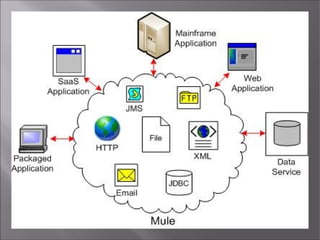
 Mule ESB is a lightweight Java-based messaging
framework that allows you to quickly and
 easily connect your applications and enable
them to exchange data.
 Mule ESB uses a service-oriented architecture
(SOA), enabling easy integration of your
existing systems.

Regardless of the different technologies the
applications use, including JMS, Web Services,
JDBC, HTTP, and more, Mule ESB seamlessly
handles interactions among them all.

The Mule framework is highly scalable,
allowing you to start small and connect more
applications over time.

Mule ESB manages all the interactions between
applications and components transparently,
regardless of whether they exist in the same
virtual machine or over the Internet, and
regardless of the underlying transport protocol
used.
 There are currently several commercial ESB
implementations on the market. However,
many of these provide limited functionality or
are built on top of an existing application server
or messaging server, locking you into that
specific vendor.
 Mule ESB is vendor-neutral, so different
vendor implementations can plug in to it. You
are never locked in to a specific vendor when
you use Mule ESB.
 Mule ESB components can be any type you
want. You can easily integrate anything from a
“plain old Java object” (POJO) to a component
from another framework.
 Mule ESB and the ESB model enable significant
component reuse. Unlike other frameworks,
Mule ESB allows you to use your existing
components without any changes.

Components do not require any Mule ESB-
specific code to run in Mule ESB, and there is no
programmatic API required. The business logic
is kept completely separate from the messaging
logic.

Messages can be in any format from SOAP to
binary image files. Mule ESB does not force any
design constraints on the architect, such as XML
messaging or WSDL service contracts.

You can deploy Mule ESB in a variety of
topologies, not just ESB. Because it is
lightweight and embeddable, Mule ESB can
dramatically decrease time to market and
increases productivity for projects to provide
secure, scalable applications that are adaptive to
change and can scale up or down as needed

MuleSoft also provides administration tools that
allow you to manage your deployments (Mule
Management Console) and control your
infrastructure (Mule Galaxy).
 Thank You

MuleEsb

  • 1.
    Mule ESB (Complete Integration& Middleware Solution) Presenter: Feroz Software Engineer
  • 2.
     Mule ESBis a lightweight Java-based messaging framework that allows you to quickly and  easily connect your applications and enable them to exchange data.  Mule ESB uses a service-oriented architecture (SOA), enabling easy integration of your existing systems.
  • 3.
     Regardless of thedifferent technologies the applications use, including JMS, Web Services, JDBC, HTTP, and more, Mule ESB seamlessly handles interactions among them all.
  • 5.
     The Mule frameworkis highly scalable, allowing you to start small and connect more applications over time.  Mule ESB manages all the interactions between applications and components transparently, regardless of whether they exist in the same virtual machine or over the Internet, and regardless of the underlying transport protocol used.
  • 6.
     There arecurrently several commercial ESB implementations on the market. However, many of these provide limited functionality or are built on top of an existing application server or messaging server, locking you into that specific vendor.  Mule ESB is vendor-neutral, so different vendor implementations can plug in to it. You are never locked in to a specific vendor when you use Mule ESB.
  • 7.
     Mule ESBcomponents can be any type you want. You can easily integrate anything from a “plain old Java object” (POJO) to a component from another framework.  Mule ESB and the ESB model enable significant component reuse. Unlike other frameworks, Mule ESB allows you to use your existing components without any changes.
  • 8.
     Components do notrequire any Mule ESB- specific code to run in Mule ESB, and there is no programmatic API required. The business logic is kept completely separate from the messaging logic.  Messages can be in any format from SOAP to binary image files. Mule ESB does not force any design constraints on the architect, such as XML messaging or WSDL service contracts.
  • 9.
     You can deployMule ESB in a variety of topologies, not just ESB. Because it is lightweight and embeddable, Mule ESB can dramatically decrease time to market and increases productivity for projects to provide secure, scalable applications that are adaptive to change and can scale up or down as needed  MuleSoft also provides administration tools that allow you to manage your deployments (Mule Management Console) and control your infrastructure (Mule Galaxy).
  • 10.