Muhammad Usman
BAGF14E256
Presented to : Dr. Sher Muhammad Shahzad
Microbial transformation of phosphorus within soil
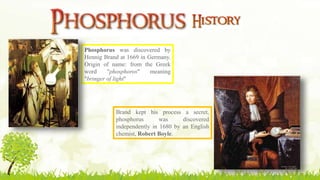
Phosphorus was discovered by
Hennig Brand at 1669 in Germany.
Origin of name: from the Greek
word "phosphoros" meaning
"bringer of light"
Brand kept his process a secret,
phosphorus was discovered
independently in 1680 by an English
chemist, Robert Boyle.
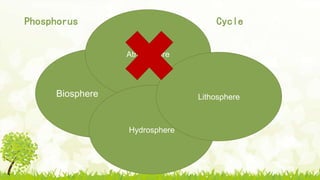
BIOGEOCHEMICAL CYCLES
The complete pathway that a chemical element takes
through the biosphere, hydrosphere, atmosphere and
lithosphere.
Phosphorus Cycle
Biosphere
Atmosphere
Hydrosphere
Lithosphere
Introduction
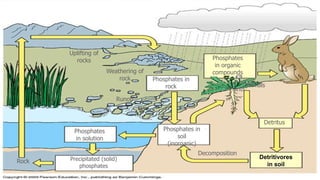
 The phosphorus cycle is the movement of phosphorus from the environment to organisms
and then back to the environment.
 The phosphorus cycle may also be referred to as the mineral cycle or sedimentary cycle.
 Unlike the other cycles, phosphorus cannot be found in air in the gaseous state.
 The phosphorus cycle is the SLOWEST cycle.
 The atmosphere does not play a significant role in the movement of phosphorus, because
phosphorus and phosphorus-based compounds are usually solids at the typical ranges of
temperature and pressure found on Earth. The production of phosphine gas occurs in only
specialized, local conditions.
 On the land, phosphorus (chemical symbol, P) gradually becomes less available to plants
over thousands of years, because it is slowly lost in runoff.
Uplifting of
rocks
Weathering of
rock
Runoff
Phosphates in
rock
Phosphates in
soil
(inorganic)
Phosphates
in solution
Precipitated (solid)
phosphates
Rock
Decomposition
Phosphates
in organic
compounds
Plants
Animals
Detritus
Detritivores
in soil
Microbiological importance of phosphorous
Phosphorus is a macronutrient necessary to all living cells. It is an important component of
adenosine triphosphate (ATP), nucleic acids (DNA and RNA), and phospholipids in cell
membranes.
It may be stored in intracellular volutin granules as polyphosphates in both prokaryotes
and eukaryotes.
It is a limiting nutrient for algal growth in lakes. The average concentration of total
phosphorus (inorganic and organic forms) in wastewater is in the range 10–20 mg/L.
The major transformations of phosphorus within soil described below :
 Mineralization
 Assimilation.
 Microbial Solubilization of Insoluble Forms of Phosphorus.
 Precipitation of Phosphorus Compounds.
Mineralization :
Phosphatase enzymes are present in all organisms but only bacteria, fungi, and some
algae are able to secrete them outside of their cells. As exoenzymes, they participate in
the dissolution and mineralization of organic phosphate compounds in the environment
(Jones 2002).
Organic phosphorus compounds (e.g., phytin, inositol phosphates, nucleic acids,
phospholipids) are mineralized to orthophosphate by a wide range of microorganisms that
include bacteria (e.g., B. subtilis, Arthrobacter), actinomycetes (e.g., Streptomyces), and
fungi (e.g., Aspergillus, Penicillium).
 Phosphatases are the enzymes responsible for degradation of phosphorus compounds.
Transformations of phosphorus within Soil
Microbial Solubilization of Insoluble Forms of Phosphorus and Assimilation :
Some heterotrophic micro-organisms are also capable of solubilizing phosphates combined
with calcium or magnesium (Atlas & Bartha 1998). These soluble forms can now be readily
taken up by plants, algae, cyanobacteria, and autotrophic bacteria and assimilated into
organic cellular components (DNA, RNA, ATP, etc.).
The mechanisms of solubilization are metabolic processes involving :
 enzymes,
 production of organic and inorganic acids by microorganisms (e.g., succinic acid, oxalic
acid, nitric acid, and sulfuric acid),
 production of CO2 , which lowers pH,
 production of H2S,which may react with iron phosphate and liberate orthophosphate, and
 the production of chelators, which can complex Ca, Fe, or Al
Transformations of phosphorus within Soil
Precipitation of Phosphorus Compounds:
The solubility of orthophosphate is controlled by the pH of the aquatic environment and by
the presence of Ca2+,Mg2+, Fe3+ and Al3+.
 When precipitation occurs, there is formation of insoluble compounds such as hydroxyapatite
(Cal0(PO4)6(OH)2 , vivianite Fe3(PO4)2 . 8H2O or variscite AlPO4 . 2H2O .
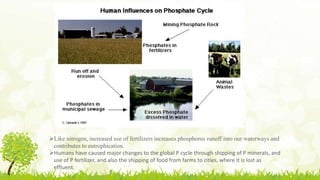
Like nitrogen, increased use of fertilizers increases phosphorus runoff into our waterways and
contributes to eutrophication.
Humans have caused major changes to the global P cycle through shipping of P minerals, and
use of P fertilizer, and also the shipping of food from farms to cities, where it is lost as
effluent.
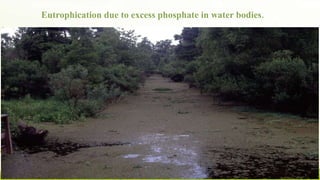
Eutrophication due to excess phosphate in water bodies.
References:
Dr. A. Adkins, Department of Biology, University of
Winnipeg
D. Leduc, Projects Student, Department of Biology, U. of
Winnipeg
NAHT K S

Muhammad usman

  • 1.
    Muhammad Usman BAGF14E256 Presented to: Dr. Sher Muhammad Shahzad Microbial transformation of phosphorus within soil
  • 2.
    Phosphorus was discoveredby Hennig Brand at 1669 in Germany. Origin of name: from the Greek word "phosphoros" meaning "bringer of light" Brand kept his process a secret, phosphorus was discovered independently in 1680 by an English chemist, Robert Boyle.
  • 3.
    BIOGEOCHEMICAL CYCLES The completepathway that a chemical element takes through the biosphere, hydrosphere, atmosphere and lithosphere.
  • 4.
  • 5.
    Introduction  The phosphoruscycle is the movement of phosphorus from the environment to organisms and then back to the environment.  The phosphorus cycle may also be referred to as the mineral cycle or sedimentary cycle.  Unlike the other cycles, phosphorus cannot be found in air in the gaseous state.  The phosphorus cycle is the SLOWEST cycle.  The atmosphere does not play a significant role in the movement of phosphorus, because phosphorus and phosphorus-based compounds are usually solids at the typical ranges of temperature and pressure found on Earth. The production of phosphine gas occurs in only specialized, local conditions.  On the land, phosphorus (chemical symbol, P) gradually becomes less available to plants over thousands of years, because it is slowly lost in runoff.
  • 6.
    Uplifting of rocks Weathering of rock Runoff Phosphatesin rock Phosphates in soil (inorganic) Phosphates in solution Precipitated (solid) phosphates Rock Decomposition Phosphates in organic compounds Plants Animals Detritus Detritivores in soil
  • 7.
    Microbiological importance ofphosphorous Phosphorus is a macronutrient necessary to all living cells. It is an important component of adenosine triphosphate (ATP), nucleic acids (DNA and RNA), and phospholipids in cell membranes. It may be stored in intracellular volutin granules as polyphosphates in both prokaryotes and eukaryotes. It is a limiting nutrient for algal growth in lakes. The average concentration of total phosphorus (inorganic and organic forms) in wastewater is in the range 10–20 mg/L. The major transformations of phosphorus within soil described below :  Mineralization  Assimilation.  Microbial Solubilization of Insoluble Forms of Phosphorus.  Precipitation of Phosphorus Compounds.
  • 8.
    Mineralization : Phosphatase enzymesare present in all organisms but only bacteria, fungi, and some algae are able to secrete them outside of their cells. As exoenzymes, they participate in the dissolution and mineralization of organic phosphate compounds in the environment (Jones 2002). Organic phosphorus compounds (e.g., phytin, inositol phosphates, nucleic acids, phospholipids) are mineralized to orthophosphate by a wide range of microorganisms that include bacteria (e.g., B. subtilis, Arthrobacter), actinomycetes (e.g., Streptomyces), and fungi (e.g., Aspergillus, Penicillium).  Phosphatases are the enzymes responsible for degradation of phosphorus compounds. Transformations of phosphorus within Soil
  • 9.
    Transformations of phosphoruswithin Soil Microbial Solubilization of Insoluble Forms of Phosphorus and Assimilation : Some heterotrophic micro-organisms are also capable of solubilizing phosphates combined with calcium or magnesium (Atlas & Bartha 1998). These soluble forms can now be readily taken up by plants, algae, cyanobacteria, and autotrophic bacteria and assimilated into organic cellular components (DNA, RNA, ATP, etc.). The mechanisms of solubilization are metabolic processes involving :  enzymes,  production of organic and inorganic acids by microorganisms (e.g., succinic acid, oxalic acid, nitric acid, and sulfuric acid),  production of CO2 , which lowers pH,  production of H2S,which may react with iron phosphate and liberate orthophosphate, and  the production of chelators, which can complex Ca, Fe, or Al
  • 10.
    Transformations of phosphoruswithin Soil Precipitation of Phosphorus Compounds: The solubility of orthophosphate is controlled by the pH of the aquatic environment and by the presence of Ca2+,Mg2+, Fe3+ and Al3+.  When precipitation occurs, there is formation of insoluble compounds such as hydroxyapatite (Cal0(PO4)6(OH)2 , vivianite Fe3(PO4)2 . 8H2O or variscite AlPO4 . 2H2O .
  • 11.
    Like nitrogen, increaseduse of fertilizers increases phosphorus runoff into our waterways and contributes to eutrophication. Humans have caused major changes to the global P cycle through shipping of P minerals, and use of P fertilizer, and also the shipping of food from farms to cities, where it is lost as effluent.
  • 12.
    Eutrophication due toexcess phosphate in water bodies.
  • 13.
    References: Dr. A. Adkins,Department of Biology, University of Winnipeg D. Leduc, Projects Student, Department of Biology, U. of Winnipeg
  • 14.