Presented by
Sherin K Rahman
M.Tech (1st yr.)
CPEE
Introduction
 The phosphorus cycle is the movement of phosphorus from the environment to

organisms and then back to the environment.
 The phosphorus cycle may also be referred to as the mineral cycle or sedimentary

cycle.
 Unlike the other cycles, phosphorus cannot be found in air in the gaseous state.
 The phosphorus cycle is the SLOWEST cycle.
 The atmosphere does not play a significant role in the movement of phosphorus,

because phosphorus and phosphorus-based compounds are usually solids at the

typical ranges of temperature and pressure found on Earth.
 On the land, phosphorus (chemical symbol, P) gradually becomes less available to

plants over thousands of years, because it is slowly lost in runoff.
 Low concentration of P in soils reduces plant growth, and slows soil microbial

growth.
 Soil microorganisms act as both sinks and sources of available P in the

biogeochemical cycle.
 Locally, transformations of P are chemical, biological and microbiological: the

major long-term transfers in the global cycle, however, are driven
by tectonic movements in geologic time.
 Humans have caused major changes to the global P cycle through shipping of P

minerals, and use of P fertilizer, and also the shipping of food from farms to cities,
where it is lost as effluent.
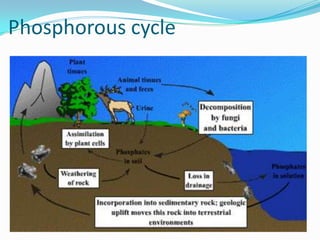
Phosphorous cycle
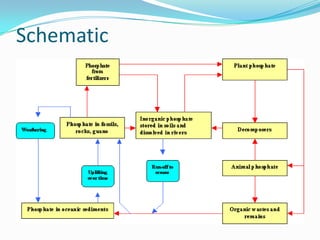
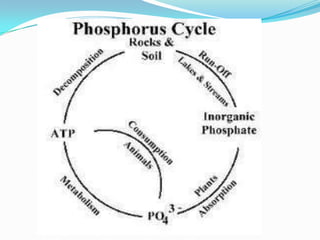
 Phosphate salts that are released from rocks through weathering

usually dissolve in soil water and will be absorbed by plants.
 Animals absorb phosphates by eating plants or plant-eating animals.
 When animals and plants die, phosphates will return to the soils or

oceans again during decomposition.
 After that, phosphorus will end up in sediments or rock formations

again, remaining there for millions of years. Eventually, phosphorus is
released again through weathering and the cycle starts over.
Schematic
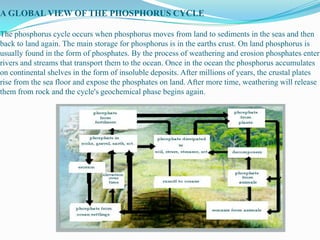
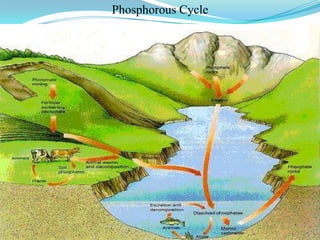
A GLOBAL VIEW OF THE PHOSPHORUS CYCLE
The phosphorus cycle occurs when phosphorus moves from land to sediments in the seas and then
back to land again. The main storage for phosphorus is in the earths crust. On land phosphorus is
usually found in the form of phosphates. By the process of weathering and erosion phosphates enter
rivers and streams that transport them to the ocean. Once in the ocean the phosphorus accumulates
on continental shelves in the form of insoluble deposits. After millions of years, the crustal plates
rise from the sea floor and expose the phosphates on land. After more time, weathering will release
them from rock and the cycle's geochemical phase begins again.
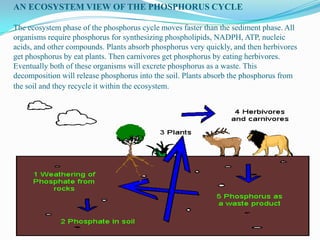
AN ECOSYSTEM VIEW OF THE PHOSPHORUS CYCLE
The ecosystem phase of the phosphorus cycle moves faster than the sediment phase. All
organisms require phosphorus for synthesizing phospholipids, NADPH, ATP, nucleic
acids, and other compounds. Plants absorb phosphorus very quickly, and then herbivores
get phosphorus by eat plants. Then carnivores get phosphorus by eating herbivores.
Eventually both of these organisms will excrete phosphorus as a waste. This
decomposition will release phosphorus into the soil. Plants absorb the phosphorus from
the soil and they recycle it within the ecosystem.
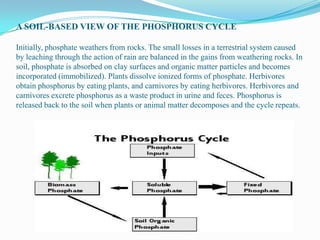
A SOIL-BASED VIEW OF THE PHOSPHORUS CYCLE
Initially, phosphate weathers from rocks. The small losses in a terrestrial system caused
by leaching through the action of rain are balanced in the gains from weathering rocks. In
soil, phosphate is absorbed on clay surfaces and organic matter particles and becomes
incorporated (immobilized). Plants dissolve ionized forms of phosphate. Herbivores
obtain phosphorus by eating plants, and carnivores by eating herbivores. Herbivores and
carnivores excrete phosphorus as a waste product in urine and feces. Phosphorus is
released back to the soil when plants or animal matter decomposes and the cycle repeats.
Phosphorous Cycle
Form of existence in nature
 Unlike the other cycles, there is no volatile phosphorus-containing product to

return phosphorus to the atmosphere in the way carbon dioxide, nitrogen gas, and

sulfur dioxide are returned.
 Therefore, phosphorus tends to accumulate in the seas. It can be retrieved by

mining the above-ground sediments of ancient seas, mostly as deposits of calcium
phosphate.
 Seabirds also mine phosphorus from the sea by eating phosphorus-containing fish

and depositing it as guano (bird droppings).
 Certain small islands inhabited by such birds have long been mined for these

deposits as a source of phosphorus for fertilizers.
Microbiological importance of
phosphorous
 Phosphorus is a macronutrient necessary to all living cells. It is an important










component of adenosine triphosphate (ATP), nucleic acids (DNA and RNA), and
phospholipids in cell membranes.
It may be stored in intracellular volutin granules as polyphosphates in both
prokaryotes and eukaryotes.
It is a limiting nutrient for algal growth in lakes. The average concentration of total
phosphorus (inorganic and organic forms) in wastewater is in the range 10–20 mg/L.
The major transformations of phosphorus in aquatic environments are described
below :
Mineralization
Assimilation.
Precipitation of Phosphorus Compounds.
Microbial Solubilization of Insoluble Forms of Phosphorus.
Mineralization :
 Organic phosphorus compounds (e.g., phytin, inositol phosphates, nucleic acids,
phospholipids) are mineralized to orthophosphate by a wide range of microorganisms
that include bacteria (e.g., B. subtilis, Arthrobacter), actinomycetes (e.g.,
Streptomyces), and fungi (e.g., Aspergillus, Penicillium).
 Phosphatases are the enzymes responsible for degradation of phosphorus
compounds.
Assimilation :
 Microorganisms assimilate phosphorus, which enters in the composition of several
macromolecules in the cell.
 Some microorganisms have the ability to store phosphorus as polyphosphates in
special granules
Precipitation of Phosphorus Compounds:
 The solubility of orthophosphate is controlled by the pH of the aquatic environment
and by the presence of Ca2+,Mg2+, Fe3+ and Al3+.
 When precipitation occurs, there is formation of insoluble compounds such as
hydroxyapatite (Cal0(PO4)6(OH)2 , vivianite Fe3(PO4)2 . 8H2O or variscite AlPO4
. 2H2O .
Microbial Solubilization of Insoluble Forms of Phosphorus:
 Through their metabolic activity, microorganisms help in the solubilization of P

compounds.
 The mechanisms of solubilization are metabolic processes involving :

 enzymes,
 production of organic and inorganic acids by microorganisms (e.g., succinic acid,

oxalic acid, nitric acid, and sulfuric acid),
 production of CO2 , which lowers pH,
 production of H2S,which may react with iron phosphate and liberate orthophosphate,

and
 the production of chelators, which can complex Ca, Fe, or Al.
Phosphatic minerals
 The availability of phosphorus in an ecosystem is restricted by the rate of release of
this element during weathering.
 The release of phosphorus from apatite dissolution is a key control on ecosystem
productivity.
 The primary mineral with significant phosphorus content, apatite [Ca5(PO4)3OH]










undergoes carbonation.
Little of this released phosphorus is taken by biota (organic form) whereas, large
proportion reacts with other soil minerals leading to precipitation in unavailable
forms.
Available phosphorus is found in a biogeochemical cycle in the upper soil profile,
while phosphorus found at lower depths is primarily involved in geochemical
reactions with secondary minerals.
Plant growth depends on the rapid root uptake of phosphorus released from dead
organic matter in the biochemical cycle. Phosphorus is limited in supply for plant
growth.
Phosphates move quickly through plants and animals; however, the processes that
move them through the soil or ocean are very slow, making the phosphorus cycle
overall one of the slowest biogeochemical cycles.
Low-molecular-weight (LMW) organic acids are found in soils. They originate from
the activities of various microorganisms in soils or may be exuded from the roots of
living plants.
 Several of those organic acids are capable of forming stable organo-metal complexes with

various metal ions found in soil solutions.
 These processes may lead to the release of inorganic phosphorus associated with aluminium,

iron, and calcium in soil minerals.
 The production and release of oxalic acid by mycorrhizal fungi explain their importance in

maintaining and supplying phosphorus to plant.
 The availability of organic phosphorus to support microbial, plant and animal growth depends

on the rate of their degradation to generate free phosphate.
 There are various enzymes such as Phosphatases, nucleases, and phytase involved for the

degradation.
 Some of the abiotic pathways in the environment studied are hydrolytic reactions and

photolytic reactions.
 Enzymatic hydrolysis of organic phosphorus is an essential step in the biogeochemical

phosphorus cycle, including the phosphorus nutrition of plants and microorganisms and the
transfer of organic phosphorus from soil to bodies of water.
Human Impacts on the Phosphorus Cycle
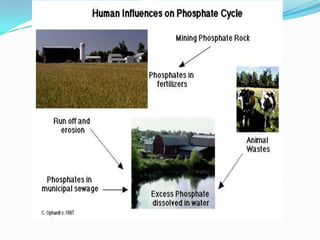
 Like nitrogen, increased use of fertilizers increases phosphorus runoff into our waterways

and contributes to eutrophication.
 Humans have greatly influenced the P cycle by mining P, converting it to fertilizer, and

by shipping fertilizer and products around the globe.
 Transporting P in food from farms to cities has made a major change in the global P

cycle.
 Waters are enriched in P from farms run off, and from effluent that is inadequately treated

before it is discharged to waters.
 Natural eutrophication is a process by which lakes gradually age and become more

productive and may take thousands of years to progress.
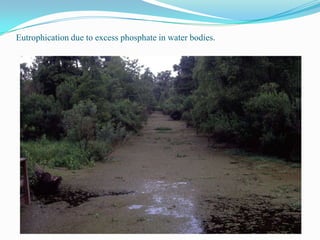
 Cultural or anthropogenic eutrophication, however, is water pollution caused by

excessive plant nutrients, which results in excessive growth in algae population.
 Surface and subsurface runoff and erosion from high-P soils may be major contributing

factors to fresh water eutrophication.
 The processes controlling soil P release to surface runoff and to subsurface flow are a

complex interaction between the type of P input, soil type and management, and transport
processes depending on hydrological conditions.
 In poorly drained soils or in areas where snowmelt can cause periodical waterlogging, Fe-

reducing conditions can be attained in 7–10 days. This causes a sharp increase in P
concentration in solution and P can be leached.
 In addition, reduction of the soil causes a shift in phosphorus from resilient to more labile

forms. This could eventually increase the potential for P loss.
 This is of particular concern for the environmentally sound management of such areas,

where disposal of agricultural wastes has already become a problem.
 It is suggested that the water regime of soils that are to be used for organic wastes disposal

is taken into account in the preparation of waste management regulations.
Eutrophication due to excess phosphate in water bodies.
Phosphorous cycle
Phosphorous cycle

Phosphorous cycle

  • 1.
    Presented by Sherin KRahman M.Tech (1st yr.) CPEE
  • 2.
    Introduction  The phosphoruscycle is the movement of phosphorus from the environment to organisms and then back to the environment.  The phosphorus cycle may also be referred to as the mineral cycle or sedimentary cycle.  Unlike the other cycles, phosphorus cannot be found in air in the gaseous state.  The phosphorus cycle is the SLOWEST cycle.  The atmosphere does not play a significant role in the movement of phosphorus, because phosphorus and phosphorus-based compounds are usually solids at the typical ranges of temperature and pressure found on Earth.  On the land, phosphorus (chemical symbol, P) gradually becomes less available to plants over thousands of years, because it is slowly lost in runoff.
  • 3.
     Low concentrationof P in soils reduces plant growth, and slows soil microbial growth.  Soil microorganisms act as both sinks and sources of available P in the biogeochemical cycle.  Locally, transformations of P are chemical, biological and microbiological: the major long-term transfers in the global cycle, however, are driven by tectonic movements in geologic time.  Humans have caused major changes to the global P cycle through shipping of P minerals, and use of P fertilizer, and also the shipping of food from farms to cities, where it is lost as effluent.
  • 4.
  • 5.
     Phosphate saltsthat are released from rocks through weathering usually dissolve in soil water and will be absorbed by plants.  Animals absorb phosphates by eating plants or plant-eating animals.  When animals and plants die, phosphates will return to the soils or oceans again during decomposition.  After that, phosphorus will end up in sediments or rock formations again, remaining there for millions of years. Eventually, phosphorus is released again through weathering and the cycle starts over.
  • 6.
  • 8.
    A GLOBAL VIEWOF THE PHOSPHORUS CYCLE The phosphorus cycle occurs when phosphorus moves from land to sediments in the seas and then back to land again. The main storage for phosphorus is in the earths crust. On land phosphorus is usually found in the form of phosphates. By the process of weathering and erosion phosphates enter rivers and streams that transport them to the ocean. Once in the ocean the phosphorus accumulates on continental shelves in the form of insoluble deposits. After millions of years, the crustal plates rise from the sea floor and expose the phosphates on land. After more time, weathering will release them from rock and the cycle's geochemical phase begins again.
  • 9.
    AN ECOSYSTEM VIEWOF THE PHOSPHORUS CYCLE The ecosystem phase of the phosphorus cycle moves faster than the sediment phase. All organisms require phosphorus for synthesizing phospholipids, NADPH, ATP, nucleic acids, and other compounds. Plants absorb phosphorus very quickly, and then herbivores get phosphorus by eat plants. Then carnivores get phosphorus by eating herbivores. Eventually both of these organisms will excrete phosphorus as a waste. This decomposition will release phosphorus into the soil. Plants absorb the phosphorus from the soil and they recycle it within the ecosystem.
  • 10.
    A SOIL-BASED VIEWOF THE PHOSPHORUS CYCLE Initially, phosphate weathers from rocks. The small losses in a terrestrial system caused by leaching through the action of rain are balanced in the gains from weathering rocks. In soil, phosphate is absorbed on clay surfaces and organic matter particles and becomes incorporated (immobilized). Plants dissolve ionized forms of phosphate. Herbivores obtain phosphorus by eating plants, and carnivores by eating herbivores. Herbivores and carnivores excrete phosphorus as a waste product in urine and feces. Phosphorus is released back to the soil when plants or animal matter decomposes and the cycle repeats.
  • 11.
  • 12.
    Form of existencein nature  Unlike the other cycles, there is no volatile phosphorus-containing product to return phosphorus to the atmosphere in the way carbon dioxide, nitrogen gas, and sulfur dioxide are returned.  Therefore, phosphorus tends to accumulate in the seas. It can be retrieved by mining the above-ground sediments of ancient seas, mostly as deposits of calcium phosphate.  Seabirds also mine phosphorus from the sea by eating phosphorus-containing fish and depositing it as guano (bird droppings).  Certain small islands inhabited by such birds have long been mined for these deposits as a source of phosphorus for fertilizers.
  • 13.
    Microbiological importance of phosphorous Phosphorus is a macronutrient necessary to all living cells. It is an important        component of adenosine triphosphate (ATP), nucleic acids (DNA and RNA), and phospholipids in cell membranes. It may be stored in intracellular volutin granules as polyphosphates in both prokaryotes and eukaryotes. It is a limiting nutrient for algal growth in lakes. The average concentration of total phosphorus (inorganic and organic forms) in wastewater is in the range 10–20 mg/L. The major transformations of phosphorus in aquatic environments are described below : Mineralization Assimilation. Precipitation of Phosphorus Compounds. Microbial Solubilization of Insoluble Forms of Phosphorus.
  • 14.
    Mineralization :  Organicphosphorus compounds (e.g., phytin, inositol phosphates, nucleic acids, phospholipids) are mineralized to orthophosphate by a wide range of microorganisms that include bacteria (e.g., B. subtilis, Arthrobacter), actinomycetes (e.g., Streptomyces), and fungi (e.g., Aspergillus, Penicillium).  Phosphatases are the enzymes responsible for degradation of phosphorus compounds. Assimilation :  Microorganisms assimilate phosphorus, which enters in the composition of several macromolecules in the cell.  Some microorganisms have the ability to store phosphorus as polyphosphates in special granules Precipitation of Phosphorus Compounds:  The solubility of orthophosphate is controlled by the pH of the aquatic environment and by the presence of Ca2+,Mg2+, Fe3+ and Al3+.  When precipitation occurs, there is formation of insoluble compounds such as hydroxyapatite (Cal0(PO4)6(OH)2 , vivianite Fe3(PO4)2 . 8H2O or variscite AlPO4 . 2H2O .
  • 15.
    Microbial Solubilization ofInsoluble Forms of Phosphorus:  Through their metabolic activity, microorganisms help in the solubilization of P compounds.  The mechanisms of solubilization are metabolic processes involving :  enzymes,  production of organic and inorganic acids by microorganisms (e.g., succinic acid, oxalic acid, nitric acid, and sulfuric acid),  production of CO2 , which lowers pH,  production of H2S,which may react with iron phosphate and liberate orthophosphate, and  the production of chelators, which can complex Ca, Fe, or Al.
  • 16.
    Phosphatic minerals  Theavailability of phosphorus in an ecosystem is restricted by the rate of release of this element during weathering.  The release of phosphorus from apatite dissolution is a key control on ecosystem productivity.  The primary mineral with significant phosphorus content, apatite [Ca5(PO4)3OH]      undergoes carbonation. Little of this released phosphorus is taken by biota (organic form) whereas, large proportion reacts with other soil minerals leading to precipitation in unavailable forms. Available phosphorus is found in a biogeochemical cycle in the upper soil profile, while phosphorus found at lower depths is primarily involved in geochemical reactions with secondary minerals. Plant growth depends on the rapid root uptake of phosphorus released from dead organic matter in the biochemical cycle. Phosphorus is limited in supply for plant growth. Phosphates move quickly through plants and animals; however, the processes that move them through the soil or ocean are very slow, making the phosphorus cycle overall one of the slowest biogeochemical cycles. Low-molecular-weight (LMW) organic acids are found in soils. They originate from the activities of various microorganisms in soils or may be exuded from the roots of living plants.
  • 17.
     Several ofthose organic acids are capable of forming stable organo-metal complexes with various metal ions found in soil solutions.  These processes may lead to the release of inorganic phosphorus associated with aluminium, iron, and calcium in soil minerals.  The production and release of oxalic acid by mycorrhizal fungi explain their importance in maintaining and supplying phosphorus to plant.  The availability of organic phosphorus to support microbial, plant and animal growth depends on the rate of their degradation to generate free phosphate.  There are various enzymes such as Phosphatases, nucleases, and phytase involved for the degradation.  Some of the abiotic pathways in the environment studied are hydrolytic reactions and photolytic reactions.  Enzymatic hydrolysis of organic phosphorus is an essential step in the biogeochemical phosphorus cycle, including the phosphorus nutrition of plants and microorganisms and the transfer of organic phosphorus from soil to bodies of water.
  • 18.
    Human Impacts onthe Phosphorus Cycle  Like nitrogen, increased use of fertilizers increases phosphorus runoff into our waterways and contributes to eutrophication.  Humans have greatly influenced the P cycle by mining P, converting it to fertilizer, and by shipping fertilizer and products around the globe.  Transporting P in food from farms to cities has made a major change in the global P cycle.  Waters are enriched in P from farms run off, and from effluent that is inadequately treated before it is discharged to waters.  Natural eutrophication is a process by which lakes gradually age and become more productive and may take thousands of years to progress.  Cultural or anthropogenic eutrophication, however, is water pollution caused by excessive plant nutrients, which results in excessive growth in algae population.
  • 19.
     Surface andsubsurface runoff and erosion from high-P soils may be major contributing factors to fresh water eutrophication.  The processes controlling soil P release to surface runoff and to subsurface flow are a complex interaction between the type of P input, soil type and management, and transport processes depending on hydrological conditions.  In poorly drained soils or in areas where snowmelt can cause periodical waterlogging, Fe- reducing conditions can be attained in 7–10 days. This causes a sharp increase in P concentration in solution and P can be leached.  In addition, reduction of the soil causes a shift in phosphorus from resilient to more labile forms. This could eventually increase the potential for P loss.  This is of particular concern for the environmentally sound management of such areas, where disposal of agricultural wastes has already become a problem.  It is suggested that the water regime of soils that are to be used for organic wastes disposal is taken into account in the preparation of waste management regulations.
  • 21.
    Eutrophication due toexcess phosphate in water bodies.