Presentation by : Parnavi S. Kadam
Topic : Effect of Environmental Factors &
Nutrition on Plant Disease
Development.
(1)
What is Plant Pathology?
The science of plant diseases is called Plant Pathology
or Phytopathology.
“It is defined as the study of organisms &
environmental conditions that cause diseases in
plants,the mechanism by which this occurs,the
interactions between these causal agents & the
plants & the methods of managing or controlling
plant diseases”
It also draws on knowledge from other scientific fields
such as mycology,microbiology,virology,
biochemistry,bioinformatics,etc…
(2)
Environmental factors that affect
Development of Plant Diseases
Environment can determine whether disease will
occur or not.
• Temperature
• Moisture
• Wind
• Light
• Soil pH
Environmental Factors Influences
1) Growth & susceptibility of host
2) Multiplication & activity of pathogen
3) Interaction between the host & pathogen (3)
Effect of Temperature
• Optimums for plant & pathogen
• If T⁰ is near optimum for host & not optimum for pathogen
= slower is the disease cycle.
• Stem Rust of wheat infection cycle:
5⁰C = 22 days
10⁰C = 15 days
23⁰C = 5/6 days
• If plant & pathogen have equal minimum, optimum &
maximum temperatures,pathogen gets upper hand.
• Temperature also affects the incubation period/latent
period,generation time,infectious period. (4)
• Effect on viruses is unpredictable
• T⁰ + Light intensity may determine seasonal appearance of
symptoms
• Viruses producing Leaf-Roll symptoms are severe in
summer
• Viruses causing Mosaic or Ringspot symptoms are more
pronounced in spring
Leaf-Roll symtoms Ringspot symptoms (5)
Effect of Moisture
Soil inhabiting fungii Root rot due to wet drought
(cool & wet) conditions
How moisture favours Pathogen?
• Spore germination & germ tube penetration
• Activation of bacteria
• Increased succulence of plants
• Soil pathogens often more virulent when soil near saturation
point
How moisture favours Plant?
• Adequate water helps ensure healthier plant
• Turgidity results in cell elongation
(7)
• Plant diseases more common & severe in humid to wet
areas of world
• Number rainfalls/season determines number of infection
cycles/season for many fungal diseases
(8)
Effect of Wind
• Most disease epidemics are caused by pathogens which are
spread directly by the wind or indirectly by insect vectors
that can be carried along long distances by the wind.
• Causes of wounds
–Direct wind damage
–Wind-blown sand
–Plants rubbing
• Dries plant surface
• Wind + Rain devastating combination
• Releases spores & bacteria from infected tissue
(9)
Effect of Light
• Sunlight is very important to plant health.
• Plants that do not receive required amount of light to meet
their cultural requirements become stressed.
• This may make them more susceptible to infection.
• Low light usually favours susceptibility to viral infections.
• Right plant in right place.
(10)
Effect of Soil pH
• Usually affects pathogens more than plants
• –Plasmodiophora brassicae (Clubroot) Optimum at pH 5.7,
Inhibited at pH 7.8
• –Streptomyces scabies (Potato Scab) Optimum pH 5.2 to
8.0, Inhibited below 5.2
• pH-Causes nutrient imbalance in plants &weakens them
Clubroot Potato Scab (11)
Effect of Nutrition on Development of
Plant Diseases
• Nutritional status affects plant’s rate of growth & ability to
defend against pathogens
(12)
Nitrogen
• Plants fertilized heavily with N are attacked more severely
by some pathogens-eg:Puccinia (Rust) on wheat
• Excess N causes prolonged vegetative period
• N deficiency causes weaker, slower growth, faster aging
• Greater susceptibility to pathogens that attack weak, slow-
growing plants
• Eg:Fusarium (Wilt) on Tomato
Alternaria solani (Early Blight) in Solanaceae
( (13)
Phosphorus
• When P Increases, it either Improves nutrient balance in
plant or accelerates maturity of crop.
• Allows it to escape infection making it resistant towards the
invading pathogen.
• Improves tolerance to disease that can reduce crop yield &
quality.
• The protection that P provides is often related to the role it
plays in plant development.For eg; P is important in early
root development & plays a key role in proper seed
development.
Reduced growth in
P-deficient plant (right) (14)
Potassium
• Reduces severity of numerous diseases,eg: Stalk Rot of
Corn
• Excess K increases severity of some diseases, eg: Rice Blast
• Promotes wound healing
• Increases resistance to frost injury
Stalk Rot of Corn Rice Blast (15)
Calcium
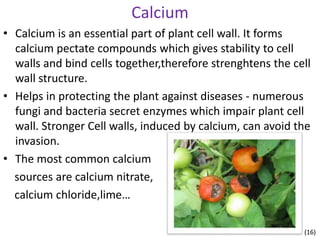
• Calcium is an essential part of plant cell wall. It forms
calcium pectate compounds which gives stability to cell
walls and bind cells together,therefore strenghtens the cell
wall structure.
• Helps in protecting the plant against diseases - numerous
fungi and bacteria secret enzymes which impair plant cell
wall. Stronger Cell walls, induced by calcium, can avoid the
invasion.
• The most common calcium
sources are calcium nitrate,
calcium chloride,lime…
(16)
New Aspect
• A recently recognized aspect of environment that
can influence disease in plants is AIR POLLUTION.
• High concentration of pollutants can affect disease
development.
• In extreme cases they may damage the plants
directly by causing acid rain.
(17)
THANK YOU

Effect of environment and nutrition on plant disease development

  • 1.
    Presentation by :Parnavi S. Kadam Topic : Effect of Environmental Factors & Nutrition on Plant Disease Development. (1)
  • 2.
    What is PlantPathology? The science of plant diseases is called Plant Pathology or Phytopathology. “It is defined as the study of organisms & environmental conditions that cause diseases in plants,the mechanism by which this occurs,the interactions between these causal agents & the plants & the methods of managing or controlling plant diseases” It also draws on knowledge from other scientific fields such as mycology,microbiology,virology, biochemistry,bioinformatics,etc… (2)
  • 3.
    Environmental factors thataffect Development of Plant Diseases Environment can determine whether disease will occur or not. • Temperature • Moisture • Wind • Light • Soil pH Environmental Factors Influences 1) Growth & susceptibility of host 2) Multiplication & activity of pathogen 3) Interaction between the host & pathogen (3)
  • 4.
    Effect of Temperature •Optimums for plant & pathogen • If T⁰ is near optimum for host & not optimum for pathogen = slower is the disease cycle. • Stem Rust of wheat infection cycle: 5⁰C = 22 days 10⁰C = 15 days 23⁰C = 5/6 days • If plant & pathogen have equal minimum, optimum & maximum temperatures,pathogen gets upper hand. • Temperature also affects the incubation period/latent period,generation time,infectious period. (4)
  • 5.
    • Effect onviruses is unpredictable • T⁰ + Light intensity may determine seasonal appearance of symptoms • Viruses producing Leaf-Roll symptoms are severe in summer • Viruses causing Mosaic or Ringspot symptoms are more pronounced in spring Leaf-Roll symtoms Ringspot symptoms (5)
  • 6.
    Effect of Moisture Soilinhabiting fungii Root rot due to wet drought (cool & wet) conditions
  • 7.
    How moisture favoursPathogen? • Spore germination & germ tube penetration • Activation of bacteria • Increased succulence of plants • Soil pathogens often more virulent when soil near saturation point How moisture favours Plant? • Adequate water helps ensure healthier plant • Turgidity results in cell elongation (7)
  • 8.
    • Plant diseasesmore common & severe in humid to wet areas of world • Number rainfalls/season determines number of infection cycles/season for many fungal diseases (8)
  • 9.
    Effect of Wind •Most disease epidemics are caused by pathogens which are spread directly by the wind or indirectly by insect vectors that can be carried along long distances by the wind. • Causes of wounds –Direct wind damage –Wind-blown sand –Plants rubbing • Dries plant surface • Wind + Rain devastating combination • Releases spores & bacteria from infected tissue (9)
  • 10.
    Effect of Light •Sunlight is very important to plant health. • Plants that do not receive required amount of light to meet their cultural requirements become stressed. • This may make them more susceptible to infection. • Low light usually favours susceptibility to viral infections. • Right plant in right place. (10)
  • 11.
    Effect of SoilpH • Usually affects pathogens more than plants • –Plasmodiophora brassicae (Clubroot) Optimum at pH 5.7, Inhibited at pH 7.8 • –Streptomyces scabies (Potato Scab) Optimum pH 5.2 to 8.0, Inhibited below 5.2 • pH-Causes nutrient imbalance in plants &weakens them Clubroot Potato Scab (11)
  • 12.
    Effect of Nutritionon Development of Plant Diseases • Nutritional status affects plant’s rate of growth & ability to defend against pathogens (12)
  • 13.
    Nitrogen • Plants fertilizedheavily with N are attacked more severely by some pathogens-eg:Puccinia (Rust) on wheat • Excess N causes prolonged vegetative period • N deficiency causes weaker, slower growth, faster aging • Greater susceptibility to pathogens that attack weak, slow- growing plants • Eg:Fusarium (Wilt) on Tomato Alternaria solani (Early Blight) in Solanaceae ( (13)
  • 14.
    Phosphorus • When PIncreases, it either Improves nutrient balance in plant or accelerates maturity of crop. • Allows it to escape infection making it resistant towards the invading pathogen. • Improves tolerance to disease that can reduce crop yield & quality. • The protection that P provides is often related to the role it plays in plant development.For eg; P is important in early root development & plays a key role in proper seed development. Reduced growth in P-deficient plant (right) (14)
  • 15.
    Potassium • Reduces severityof numerous diseases,eg: Stalk Rot of Corn • Excess K increases severity of some diseases, eg: Rice Blast • Promotes wound healing • Increases resistance to frost injury Stalk Rot of Corn Rice Blast (15)
  • 16.
    Calcium • Calcium isan essential part of plant cell wall. It forms calcium pectate compounds which gives stability to cell walls and bind cells together,therefore strenghtens the cell wall structure. • Helps in protecting the plant against diseases - numerous fungi and bacteria secret enzymes which impair plant cell wall. Stronger Cell walls, induced by calcium, can avoid the invasion. • The most common calcium sources are calcium nitrate, calcium chloride,lime… (16)
  • 17.
    New Aspect • Arecently recognized aspect of environment that can influence disease in plants is AIR POLLUTION. • High concentration of pollutants can affect disease development. • In extreme cases they may damage the plants directly by causing acid rain. (17)
  • 18.