
Dr/Ahmed Bahnassy
Consultant Radiologist
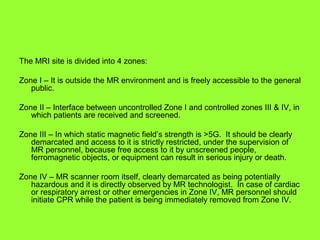
The MRI site is divided into 4 zones:
Zone I – It is outside the MR environment and is freely accessible to the general
public.
Zone II – Interface between uncontrolled Zone I and controlled zones III & IV, in
which patients are received and screened.
Zone III – In which static magnetic field’s strength is >5G. It should be clearly
demarcated and access to it is strictly restricted, under the supervision of
MR personnel, because free access to it by unscreened people,
ferromagnetic objects, or equipment can result in serious injury or death.
Zone IV – MR scanner room itself, clearly demarcated as being potentially
hazardous and it is directly observed by MR technologist. In case of cardiac
or respiratory arrest or other emergencies in Zone IV, MR personnel should
initiate CPR while the patient is being immediately removed from Zone IV.
All individual working in Zone III should complete at least
one MR Safety Lecture which should be repeated at
least annually.
There are 2 levels of MR Personnel:
Level I Personnel will have minimal safety educational
effort to ensure their own safety as they work in Zone III.
Level II Personnel will have more training and education to
deal with thermal loading and burns and neuromuscular
excitation from changing gradiant.
General precautions
All patients and non MR personel should be screened
before entering Zone III.
No one should enter the bore of MR imager during MR
process.
Non-MR personnel should be accompanied by or under the
immediate supervision of MR Personnel in Zones III &
IV.
Patients and their accompanying, non-MR personnel
should be screened at least once.
General precautions
Any individual undergoing MR procedures must remove all readily removal
metallic objects or particles.
Prior to entering Zone III, every individual with a history of potential
ferromagnetic foreign object penetration must undergo further investigation
(past history, plain x-rays, prior CT or MR examination, written
documentation, written testing of the implant, product labeling, and/or peerreviewed publication regarding MR compatibility and safety.)
In case of prior orbit trauma by a potential ferromagnetic foreign body, the orbits
must be cleared by x-rays, or contiguous CT slices if previous x-rays, CT or
MR orbit done after the trauma is not available.
Conscious patient or family member of unconscious patient should complete
written MR Safety Screening Questionnaires prior to enter Zone III.
aneurysmal clip precautions
Particular screening for an intracranial aneurysm clip.

In case of MR examination is urgently needed while no
reliable patient metal exposure can be obtained, one or
more of the following investigations is / are needed.
• Previous x-rays, CT or MR
• Physical examination of the patient to look for entrance
of ferromagnet foreign body implant.
• X-rays for skull, orbit and chest.
Thermal injury precautions
Monitoring unconscious or sedated patient
for thermal injury can be performed by
physical examination after each image
sequence or putting cold compress or ice
upon all necessary electrically conductive
material that touch the patient during
scanning.
Time varying radiofrequency
magnetic field-related issues
All unnecessary or unused electrically conducted
material should be removed from MR system,
because current can be induced within them
during scanning and this might result in heating.
No large caliber, electrically conductive loops
including patient issue (arm or legs) are allowed
in MR scanner because it is possible that
resonant circuitry between RF and the lead
which may result in rapid heating.
Swan-Ganz and Foley catheter are at risk for MR.
If wires are necessary to be in the bore, they
should be as far as possible from inner
wall of the bore and if they touch the
patient, they should be separated from the
patient by pads.
Patient tissues should not touch inner bore.
If non-ferromagnetic skin staples are within
the irradiated region by RF, they may
heat. Patient should be aware or staples
covered by cold compress.
Drug-delivery patches and pads
Some drug-delivery patches contain
metallic foil may cause thermal injury. The
delivered dose may be altered if patch is
removed or repositioned. Case to be
discussed with physician or foil covered by
cold compress.
Cardiac patients precautions
Any individual with implanted cardiac
pacemaker, auto-defibrillator;
diaphragmatic pacemaker, or other
electromechanically activated device
should be precluded from Zone IV and
restrained from Zone III.
Prisoners precautions
Prisoners with metallic device or RFID
tracking bracelet should be accompanied
by an appropriate authorities who can and
will remove the device prior to MR study
and replace it after examination.
Fire precautions
Assigning appropriately trained security personnel to be the
1st (first) called person in case of fire, cardiac arrest in
MR site. He will join MR unit before firefighter and code
blue team and will guide them at their arrival.
MR site should be provided with MR compatible fire
extinguishing equipment stored in Zones III & IV.
If there is a fire and Zones III & IV needs to be entered by
firefighter or emergency response personnel and their
equipments, quenching the magnet should be
considered. Firefighter can enter after being sure that
magnetic field is no longer detectable.
Pregnancy Related Issues
Healthcare practitioner pregnancies:
Pregnant healthcare practitioner are permitted to work in and around
MR environment but not to remain within the MR scanner bore or
Zone IV during scanning.
Patient pregnancies:
•
Pregnant patients can undergo MR scan when: the information
requested from MR cannot be acquired by ultrasound, will affect the
care of the patient or fetus during pregnancy and cannot be delayed
until the patient is no more pregnant.
•
Pregnant patient should sign consent.
•
Fetal MR contrast agents can pass placental barrier and should
not be used except if benefits overweighs risks.
Pediatric MR Safety Concerns
Sedation and monitoring issues:
Sedation is given by anesthesia staff or pediatric clinic
and according to anesthesia guidelines: Child should be
fasting, monitored during and after procedure. Chloral
hydrate can be prescribed by pediatrician and given by
MR nurse. Resuscitation equipment including oxygen
and suction should be available.
Pediatric screening issues:
Children clothes should be removed and replace by
gown before entering Zone IV.
MR safety of accompanying family and personnel.
MRI screening procedures

MRI screening procedures

  • 1.
  • 3.
    The MRI siteis divided into 4 zones: Zone I – It is outside the MR environment and is freely accessible to the general public. Zone II – Interface between uncontrolled Zone I and controlled zones III & IV, in which patients are received and screened. Zone III – In which static magnetic field’s strength is >5G. It should be clearly demarcated and access to it is strictly restricted, under the supervision of MR personnel, because free access to it by unscreened people, ferromagnetic objects, or equipment can result in serious injury or death. Zone IV – MR scanner room itself, clearly demarcated as being potentially hazardous and it is directly observed by MR technologist. In case of cardiac or respiratory arrest or other emergencies in Zone IV, MR personnel should initiate CPR while the patient is being immediately removed from Zone IV.
  • 5.
    All individual workingin Zone III should complete at least one MR Safety Lecture which should be repeated at least annually. There are 2 levels of MR Personnel: Level I Personnel will have minimal safety educational effort to ensure their own safety as they work in Zone III. Level II Personnel will have more training and education to deal with thermal loading and burns and neuromuscular excitation from changing gradiant.
  • 7.
    General precautions All patientsand non MR personel should be screened before entering Zone III. No one should enter the bore of MR imager during MR process. Non-MR personnel should be accompanied by or under the immediate supervision of MR Personnel in Zones III & IV. Patients and their accompanying, non-MR personnel should be screened at least once.
  • 8.
    General precautions Any individualundergoing MR procedures must remove all readily removal metallic objects or particles. Prior to entering Zone III, every individual with a history of potential ferromagnetic foreign object penetration must undergo further investigation (past history, plain x-rays, prior CT or MR examination, written documentation, written testing of the implant, product labeling, and/or peerreviewed publication regarding MR compatibility and safety.) In case of prior orbit trauma by a potential ferromagnetic foreign body, the orbits must be cleared by x-rays, or contiguous CT slices if previous x-rays, CT or MR orbit done after the trauma is not available. Conscious patient or family member of unconscious patient should complete written MR Safety Screening Questionnaires prior to enter Zone III.
  • 9.
    aneurysmal clip precautions Particularscreening for an intracranial aneurysm clip. In case of MR examination is urgently needed while no reliable patient metal exposure can be obtained, one or more of the following investigations is / are needed. • Previous x-rays, CT or MR • Physical examination of the patient to look for entrance of ferromagnet foreign body implant. • X-rays for skull, orbit and chest.
  • 10.
    Thermal injury precautions Monitoringunconscious or sedated patient for thermal injury can be performed by physical examination after each image sequence or putting cold compress or ice upon all necessary electrically conductive material that touch the patient during scanning.
  • 11.
    Time varying radiofrequency magneticfield-related issues All unnecessary or unused electrically conducted material should be removed from MR system, because current can be induced within them during scanning and this might result in heating. No large caliber, electrically conductive loops including patient issue (arm or legs) are allowed in MR scanner because it is possible that resonant circuitry between RF and the lead which may result in rapid heating. Swan-Ganz and Foley catheter are at risk for MR.
  • 12.
    If wires arenecessary to be in the bore, they should be as far as possible from inner wall of the bore and if they touch the patient, they should be separated from the patient by pads. Patient tissues should not touch inner bore. If non-ferromagnetic skin staples are within the irradiated region by RF, they may heat. Patient should be aware or staples covered by cold compress.
  • 13.
    Drug-delivery patches andpads Some drug-delivery patches contain metallic foil may cause thermal injury. The delivered dose may be altered if patch is removed or repositioned. Case to be discussed with physician or foil covered by cold compress.
  • 14.
    Cardiac patients precautions Anyindividual with implanted cardiac pacemaker, auto-defibrillator; diaphragmatic pacemaker, or other electromechanically activated device should be precluded from Zone IV and restrained from Zone III.
  • 15.
    Prisoners precautions Prisoners withmetallic device or RFID tracking bracelet should be accompanied by an appropriate authorities who can and will remove the device prior to MR study and replace it after examination.
  • 16.
    Fire precautions Assigning appropriatelytrained security personnel to be the 1st (first) called person in case of fire, cardiac arrest in MR site. He will join MR unit before firefighter and code blue team and will guide them at their arrival. MR site should be provided with MR compatible fire extinguishing equipment stored in Zones III & IV. If there is a fire and Zones III & IV needs to be entered by firefighter or emergency response personnel and their equipments, quenching the magnet should be considered. Firefighter can enter after being sure that magnetic field is no longer detectable.
  • 17.
    Pregnancy Related Issues Healthcarepractitioner pregnancies: Pregnant healthcare practitioner are permitted to work in and around MR environment but not to remain within the MR scanner bore or Zone IV during scanning. Patient pregnancies: • Pregnant patients can undergo MR scan when: the information requested from MR cannot be acquired by ultrasound, will affect the care of the patient or fetus during pregnancy and cannot be delayed until the patient is no more pregnant. • Pregnant patient should sign consent. • Fetal MR contrast agents can pass placental barrier and should not be used except if benefits overweighs risks.
  • 18.
    Pediatric MR SafetyConcerns Sedation and monitoring issues: Sedation is given by anesthesia staff or pediatric clinic and according to anesthesia guidelines: Child should be fasting, monitored during and after procedure. Chloral hydrate can be prescribed by pediatrician and given by MR nurse. Resuscitation equipment including oxygen and suction should be available. Pediatric screening issues: Children clothes should be removed and replace by gown before entering Zone IV. MR safety of accompanying family and personnel.