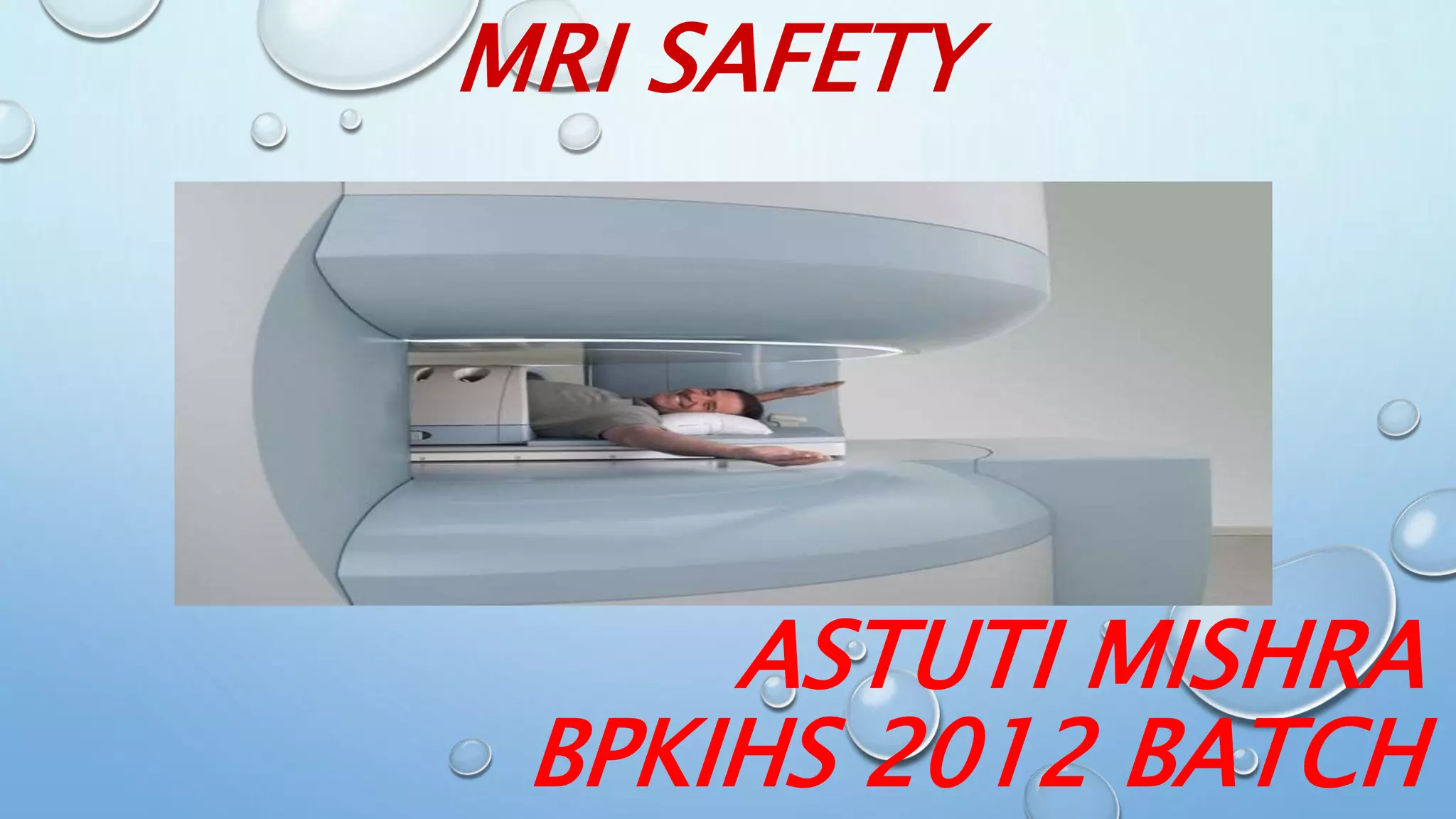








MRI SAFETY
ASTUTI MISHRA
BPKIHS 2012 BATCH
 The MRI magnets are ALWAYS
on (24 hours/day, 365
days/year).
 There is a STRONG fringe
magnetic field around the
magnets.
THE POWERFUL MAGNETIC FIELD OF THE MR
SYSTEM WILL ATTRACT IRON-CONTAINING (ALSO
KNOWN AS FERROMAGNETIC) OBJECTS AND MAY
CAUSE THEM TO MOVE SUDDENLY AND WITH
GREAT FORCE.
THIS CAN POSE A POSSIBLE RISK TO THE PATIENT
OR ANYONE IN THE OBJECT'S "FLIGHT PATH."
GREAT CARE IS TAKEN TO BE CERTAIN THAT
EXTERNAL OBJECTS SUCH AS FERROMAGNETIC
SCREWDRIVERS AND OXYGEN TANKS ARE NOT
BROUGHT INTO THE MR SYSTEM AREA.
to the area of the body undergoing the MRI examination.
As a patient, it is vital that you remove all metallic belongings in
advance of an MRI exam, including hearing aids, watches,
jewelry, cell phones, and items of clothing that have metallic
threads or fasteners. Additionally, makeup, nail polish, or other
cosmetics that may contain metallic particles should be
removed if applied.
The powerful magnetic field of the MR system will pull on any
iron-containing object in the body, such as certain aneurysm
clips or certain medication pump may damage an external
hearing aid or cause a heart pacemaker, electrical stimulator,
or neurostimulator to malfunction or cause injury. If the
patient have a bullet or any other metallic fragment in their
body there is a potential risk that it could change position and
possibly cause an injury.
In addition, a metallic implant or other object may cause signal
loss or distort the MR images. This may be unavoidable, but if
the radiologist knows about it, allowances can be made when
obtaining and interpreting the MR images.
For some MRI exams, a contrast material called gadolinium
injected into a vein to help improve the information seen on
the MR images. Unlike contrast materials used in x-ray
exams or computed tomography (CT) scans, gadolinium does
not contain iodine and, therefore, rarely causes an allergic
reaction or other problem. However, if the patient have a
history of kidney disease, kidney failure, kidney transplant,
liver disease, or other conditions, they must inform the MRI
technologist before receiving gadolinium based dye.
IN DETAIL:
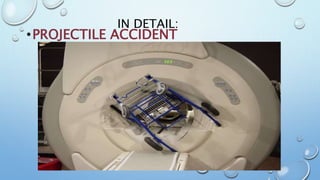
•PROJECTILE ACCIDENT
The fringe magnetic field can cause ferrous
metal objects to fly into the bore of the
magnet with great force and speed.
Ferrous metal objects contain iron (steel)
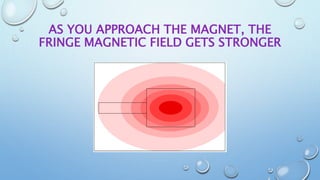
The closer you are to the bore of the
magnet, the stronger the fringe field.
AS YOU APPROACH THE MAGNET, THE
FRINGE MAGNETIC FIELD GETS STRONGER
The fringe magnetic field can be deadly.
Valhalla, New York
Westchester County Medical Center
July 27, 2001
Six year old Michael Colombini was fatally injured “when an
oxygen canister was turned into a guided missile by the
powerful MRI magnet”
A 6-year-old boy died after undergoing an MRI exam at a New
York-area hospital when the machine's powerful magnetic field
jerked a metal oxygen tank across the room, crushing the
child's head.
The force of the device's 10-ton magnet is about 30,000 times
as powerful as Earth's magnetic field, and 200 times stronger
than a common refrigerator magnet. For further detail please
FOREIGN MATERIALS IN THE BODY
FOREIGN MATERIAL IN THE BODY IS A MAJOR
CONCERN IN MRI.
FOREIGN MATERIAL IS ANY MATERIAL IN THE
BODY OTHER THAN THE FLESH AND BONES
THAT WE ARE BORN WITH.
WIDE VARIETY OF FOREIGN MATERIAL IS
INTENTIONALLY AND UNINTENTIONALLY
PRESENT IN PATIENTS, HEALTH CARE
PROVIDERS AND OTHERS.
REMEMBER THIS MNEMONIC:
MRI =
METAL RESULTS (IN) INJURY
ALL THE PACEMAKER, ANEURYSM
CLIP,
DENTAL PROSTHESIS , ORTHOPEDIC
IMPLANT AND SOME OTHER SMALL
CLIPS OR IMPLANTS INSIDE BODY ARE
NOT ALL MR COMPATIBLE.
WHAT CAN YOU TAKE INTO A MAGNETIC
FIELD?
• ONLY ITEMS THAT ARE MRI COMPATIBLE. SUCH
AS…
• BRASS
• ALUMINUM
• PLASTIC
• IF YOU ARE NOT SURE IF AN OBJECT IS MRI
SAFE…DON’T TAKE IT INTO THE ROOM. ASK A
TECHNOLOGIST!!!!!!!!
THE PRESENCE OF CERTAIN FOREIGN MATERIALS IN
THE BODY CAN BE FATAL IN AN MRI MAGNET.
DEATHS HAVE OCCURRED DUE TO THE PRESENCE
OF ANEURYSM CLIPS AND CARDIAC PACEMAKERS
IN PATIENTS UNDERGOING MRI.
SIGHT HAS BEEN LOST BY MOVEMENT OF FERROUS
METAL IN THE EYE RESULTING IN VITREOUS
HEMORRHAGE (2.0 MM X 3.5 MM IRON FRAGMENT
@ 0.35 T).
PROSTHESES ARE USUALLY SECURELY ANCHORED
TO BONE AND ARE USUALLY NON-FERROUS.
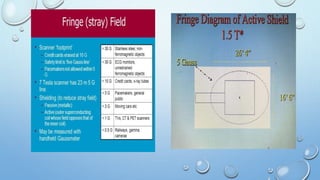
FRINGE MAGNETIC FIELDS STRONGER THAN 5
GAUSS CAN AFFECT CARDIAC PACEMAKERS.
TO PROTECT PATIENTS AND OTHERS HAVING
PACEMAKERS THERE IS A 5 GAUSS EXCLUSION
ZONE AROUND MRI MAGNETS.
Heating of metals and implants has not been
significant (even for large prostheses)
There are resources for assessing safety of foreign
materials in MRI.
www.mrisafety.com
F.G. Shellock. Reference manual for Magnetic
Resonance Safety: 2017 Edition (© 2017 730 pages;
ISBN 978-0-9891632-4-8)
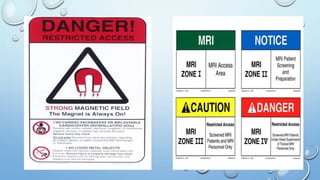
SIGNAGE
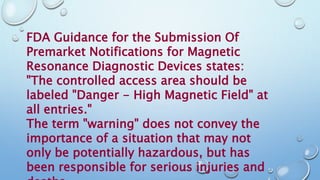
FDA Guidance for the Submission Of
Premarket Notifications for Magnetic
Resonance Diagnostic Devices states:
"The controlled access area should be
labeled "Danger - High Magnetic Field" at
all entries."
The term "warning" does not convey the
importance of a situation that may not
only be potentially hazardous, but has
been responsible for serious injuries and
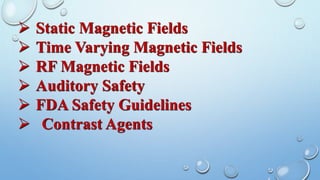
OTHER SAFETY ISSUES
 Static Magnetic Fields
 Time Varying Magnetic Fields
 RF Magnetic Fields
 Auditory Safety
 FDA Safety Guidelines
 Contrast Agents
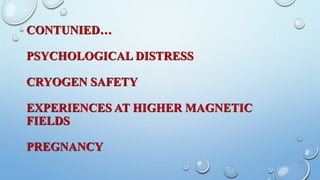
CONTUNIED…
PSYCHOLOGICAL DISTRESS
CRYOGEN SAFETY
EXPERIENCES AT HIGHER MAGNETIC
FIELDS
PREGNANCY
Biological effect of Static Magnetic Fields
-No evidence of mutagenic effects (in vitro or in vivo)
-No evidence of an effect on organ development in vivo
-No pronounced threshold
-No trends suggestive of a dose response curve
“In general, there is no conclusive evidence for irreversible or
significant biological effects related to acute, short-term exposure
of humans to static magnetic field strengths up to 2.0 T.”
MRI systems up to 8T are in use for human imaging.
Biological effect of RF Magnetic Fields
RF magnetic fields are oscillating magnetic fields
-These fields produce heating of tissue
-Energy deposited (degree of heating) is measured by the Specific
Absorption Rate (SAR) in units of Watts/kilogram
- SAR depends upon flip angle, TR, tissue density, RF pulse duration and
frequency, RF coil radius, tissue conductivity and static magnetic field.
-Guidelines restrict rise in core temperature to <1 oC
-Similar to ultrasound since as long as the energy deposited is
below established limits, minimal heating of tissues occurs.
-Extra precautions are necessary for patients with compromised
thermoregulation: fever, diabetes, obesity, cardiovascular disease,
old age, medicated (  and Ca channel blockers), anesthesia
AUDITORY SAFETY
ACTIVATION OF GRADIENT MAGNETIC FIELDS
PRODUCES SIGNIFICANT VIBRATIONS IN THE
GRADIENT COILS.
MRI ACOUSTICAL NOISE HAS BEEN SHOWN TO
PRODUCE REVERSIBLE HEARING IMPAIRMENT AND
COULD POTENTIALLY PRODUCE PERMANENT
DAMAGE.
HEARING PROTECTION IS RECOMMENDED FOR ALL
PATIENTS UNDERGOING AN MRI PROCEDURE ON A
HIGH-FIELD MRI SYSTEM (1.5T AND 3.0T).
NOISE ATTENUATING EAR-PLUGS OR HEAD PHONES
ARE ROUTINELY USED IN MRI
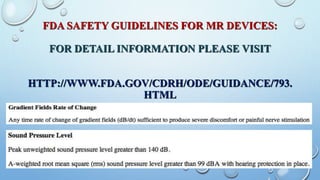
FDA SAFETY GUIDELINES FOR MR DEVICES:
FOR DETAIL INFORMATION PLEASE VISIT
HTTP://WWW.FDA.GOV/CDRH/ODE/GUIDANCE/793.
HTML
CONTRAST AGENTS
-GD-DTPA IS SIGNIFICANTLY SAFER THAN IODINE
BASED CONTRAST AGENTS USED IN X-RAY
PROCEDURES (X 10).
-SEVERE REACTIONS DO OCCUR.
-PREGNANCY: GD-DTPA MAY HAVE POOR
CLEARANCE FROM AMNIOTIC FLUID,
-GADOLINIUM MAY CAUSE NEPHROGENIC
SYSTEMIC FIBROSIS (NSF)
Contunied…
FDA Requests Boxed Warning for Contrast Agents
Used to Improve MRI
… patients with severe kidney insufficiency who
receive gadolinium-based agents are at risk for
developing a debilitating, and a potentially fatal
disease known as nephrogenic systemic fibrosis
(NSF). In addition, it would state that patients just
before or just after liver transplantation, or those
with chronic liver disease, are also at risk for
developing NSF if they are experiencing kidney
insufficiency of any severity
Psychological Distress(before, during and after mr scan)
Claustrophobia
Anxiety
Depression
Panic Disorders
-RF coils need to be near the body for high signal to
noise
-Usually transient (2 cases of claustrophobia
persisted requiring psychiatric treatment)
-Countermeasures:
Briefing
Friend or relative in scan room
Physical or verbal contact with patient
Prone
Mirrors, prism glasses, video goggles
Blindfold
Relaxation strategies
Psychological desensitization techniques
SUPERCONDUCTING MRI MAGNETS USE CRYOGENS
(1700 LITERS OF LIQUID HELIUM.
MAGNETS CAN QUENCH RESULTING IN
CONVERSION OF THE LIQUID HELIUM TO GASEOUS
HELIUM.
1700 LITERS OF LIQUID HELIUM BECOMES 53,000
CUBIC FEET OF GASEOUS HELIUM IN ABOUT 1
MINUTE.
MAGNETS ARE DESIGNED TO DUMP THE GASEOUS
HELIUM DIRECTLY OUTDOORS THROUGH A
QUENCH PIPE.
IF THE QUENCH PIPE FAILS, GASEOUS HELIUM C OULD BE
DUMPED INTO THE SCAN ROOM, DISPLACING THE
OXYGEN.
IN SOME HEALTH CENTER MRI SCAN ROOMS HAVE
OXYGEN MONITORS THAT AUTOMATICALLY ACTIVATE
EMERGENCY.
EXHAUST SYSTEMS IN THE EVENT THE OXYGEN LEVEL
DROPS BELOW 18% (AN ALARM SOUNDS).
TILL NOW THERE HAS BEEN ONE FATALITY BY
ASPHYXIATION RELATED TO A LIQUID NITROGEN
LEAK IN MRI.
EXPERIENCES AT HIGHER MAGNETIC
FIELDS
SEVERAL 7 – 8 T SYSTEMS
SEVERAL 4 T SYSTEMS
NUMEROUS 3T SYSTEMS
BIOEFFECTS:
MAGNETOPHOSPHENES
VERTIGO
NAUSEA
HEADACHES
METALLIC TASTE
PREGNANCY:
MRI IS NOT CONSIDERED TO BE HAZARDOUS
TO THE FETUS.
LIMITED STUDIES HAVE EXAMINED
TERATOGENIC EFFECTS.
CELLS THAT ARE REPRODUCING RAPIDLY, AS
IN THE FIRST TRIMESTER, ARE SUSCEPTIBLE
TO DAMAGE FROM A VARIETY OF PHYSICAL
AGENTS.
FDA: “the safety of MR imaging when used to image the fetus and
infant has not been established”
British National Radiological Protection Board: “It might be
prudent to exclude pregnant women during the first three months
of pregnancy”
“Particular caution should be exercised with the use of MRI during
the first trimester because there is a high spontaneous abortion
rate (30%) with associated potential medicolegal implications.”
May be preferred over studies requiring ionizing radiation
Should only be performed if the result is expected to be an
important factor in the management of the patient
THANKS FOR THE COOPERATION

Mri safety (1)

  • 1.
  • 2.
     The MRImagnets are ALWAYS on (24 hours/day, 365 days/year).  There is a STRONG fringe magnetic field around the magnets.
  • 3.
    THE POWERFUL MAGNETICFIELD OF THE MR SYSTEM WILL ATTRACT IRON-CONTAINING (ALSO KNOWN AS FERROMAGNETIC) OBJECTS AND MAY CAUSE THEM TO MOVE SUDDENLY AND WITH GREAT FORCE. THIS CAN POSE A POSSIBLE RISK TO THE PATIENT OR ANYONE IN THE OBJECT'S "FLIGHT PATH." GREAT CARE IS TAKEN TO BE CERTAIN THAT EXTERNAL OBJECTS SUCH AS FERROMAGNETIC SCREWDRIVERS AND OXYGEN TANKS ARE NOT BROUGHT INTO THE MR SYSTEM AREA.
  • 4.
    to the areaof the body undergoing the MRI examination. As a patient, it is vital that you remove all metallic belongings in advance of an MRI exam, including hearing aids, watches, jewelry, cell phones, and items of clothing that have metallic threads or fasteners. Additionally, makeup, nail polish, or other cosmetics that may contain metallic particles should be removed if applied. The powerful magnetic field of the MR system will pull on any iron-containing object in the body, such as certain aneurysm clips or certain medication pump may damage an external hearing aid or cause a heart pacemaker, electrical stimulator, or neurostimulator to malfunction or cause injury. If the patient have a bullet or any other metallic fragment in their body there is a potential risk that it could change position and possibly cause an injury.
  • 5.
    In addition, ametallic implant or other object may cause signal loss or distort the MR images. This may be unavoidable, but if the radiologist knows about it, allowances can be made when obtaining and interpreting the MR images. For some MRI exams, a contrast material called gadolinium injected into a vein to help improve the information seen on the MR images. Unlike contrast materials used in x-ray exams or computed tomography (CT) scans, gadolinium does not contain iodine and, therefore, rarely causes an allergic reaction or other problem. However, if the patient have a history of kidney disease, kidney failure, kidney transplant, liver disease, or other conditions, they must inform the MRI technologist before receiving gadolinium based dye.
  • 6.
  • 7.
    The fringe magneticfield can cause ferrous metal objects to fly into the bore of the magnet with great force and speed. Ferrous metal objects contain iron (steel) The closer you are to the bore of the magnet, the stronger the fringe field.
  • 8.
    AS YOU APPROACHTHE MAGNET, THE FRINGE MAGNETIC FIELD GETS STRONGER
  • 9.
    The fringe magneticfield can be deadly. Valhalla, New York Westchester County Medical Center July 27, 2001 Six year old Michael Colombini was fatally injured “when an oxygen canister was turned into a guided missile by the powerful MRI magnet” A 6-year-old boy died after undergoing an MRI exam at a New York-area hospital when the machine's powerful magnetic field jerked a metal oxygen tank across the room, crushing the child's head. The force of the device's 10-ton magnet is about 30,000 times as powerful as Earth's magnetic field, and 200 times stronger than a common refrigerator magnet. For further detail please
  • 10.
  • 11.
    FOREIGN MATERIAL INTHE BODY IS A MAJOR CONCERN IN MRI. FOREIGN MATERIAL IS ANY MATERIAL IN THE BODY OTHER THAN THE FLESH AND BONES THAT WE ARE BORN WITH. WIDE VARIETY OF FOREIGN MATERIAL IS INTENTIONALLY AND UNINTENTIONALLY PRESENT IN PATIENTS, HEALTH CARE PROVIDERS AND OTHERS.
  • 12.
    REMEMBER THIS MNEMONIC: MRI= METAL RESULTS (IN) INJURY
  • 13.
    ALL THE PACEMAKER,ANEURYSM CLIP, DENTAL PROSTHESIS , ORTHOPEDIC IMPLANT AND SOME OTHER SMALL CLIPS OR IMPLANTS INSIDE BODY ARE NOT ALL MR COMPATIBLE.
  • 14.
    WHAT CAN YOUTAKE INTO A MAGNETIC FIELD? • ONLY ITEMS THAT ARE MRI COMPATIBLE. SUCH AS… • BRASS • ALUMINUM • PLASTIC • IF YOU ARE NOT SURE IF AN OBJECT IS MRI SAFE…DON’T TAKE IT INTO THE ROOM. ASK A TECHNOLOGIST!!!!!!!!
  • 15.
    THE PRESENCE OFCERTAIN FOREIGN MATERIALS IN THE BODY CAN BE FATAL IN AN MRI MAGNET. DEATHS HAVE OCCURRED DUE TO THE PRESENCE OF ANEURYSM CLIPS AND CARDIAC PACEMAKERS IN PATIENTS UNDERGOING MRI. SIGHT HAS BEEN LOST BY MOVEMENT OF FERROUS METAL IN THE EYE RESULTING IN VITREOUS HEMORRHAGE (2.0 MM X 3.5 MM IRON FRAGMENT @ 0.35 T). PROSTHESES ARE USUALLY SECURELY ANCHORED TO BONE AND ARE USUALLY NON-FERROUS.
  • 16.
    FRINGE MAGNETIC FIELDSSTRONGER THAN 5 GAUSS CAN AFFECT CARDIAC PACEMAKERS. TO PROTECT PATIENTS AND OTHERS HAVING PACEMAKERS THERE IS A 5 GAUSS EXCLUSION ZONE AROUND MRI MAGNETS.
  • 18.
    Heating of metalsand implants has not been significant (even for large prostheses) There are resources for assessing safety of foreign materials in MRI. www.mrisafety.com F.G. Shellock. Reference manual for Magnetic Resonance Safety: 2017 Edition (© 2017 730 pages; ISBN 978-0-9891632-4-8)
  • 19.
  • 20.
    FDA Guidance forthe Submission Of Premarket Notifications for Magnetic Resonance Diagnostic Devices states: "The controlled access area should be labeled "Danger - High Magnetic Field" at all entries." The term "warning" does not convey the importance of a situation that may not only be potentially hazardous, but has been responsible for serious injuries and
  • 22.
  • 23.
     Static MagneticFields  Time Varying Magnetic Fields  RF Magnetic Fields  Auditory Safety  FDA Safety Guidelines  Contrast Agents
  • 24.
  • 25.
    Biological effect ofStatic Magnetic Fields -No evidence of mutagenic effects (in vitro or in vivo) -No evidence of an effect on organ development in vivo -No pronounced threshold -No trends suggestive of a dose response curve “In general, there is no conclusive evidence for irreversible or significant biological effects related to acute, short-term exposure of humans to static magnetic field strengths up to 2.0 T.” MRI systems up to 8T are in use for human imaging.
  • 26.
    Biological effect ofRF Magnetic Fields RF magnetic fields are oscillating magnetic fields -These fields produce heating of tissue -Energy deposited (degree of heating) is measured by the Specific Absorption Rate (SAR) in units of Watts/kilogram - SAR depends upon flip angle, TR, tissue density, RF pulse duration and frequency, RF coil radius, tissue conductivity and static magnetic field. -Guidelines restrict rise in core temperature to <1 oC -Similar to ultrasound since as long as the energy deposited is below established limits, minimal heating of tissues occurs. -Extra precautions are necessary for patients with compromised thermoregulation: fever, diabetes, obesity, cardiovascular disease, old age, medicated (  and Ca channel blockers), anesthesia
  • 27.
    AUDITORY SAFETY ACTIVATION OFGRADIENT MAGNETIC FIELDS PRODUCES SIGNIFICANT VIBRATIONS IN THE GRADIENT COILS. MRI ACOUSTICAL NOISE HAS BEEN SHOWN TO PRODUCE REVERSIBLE HEARING IMPAIRMENT AND COULD POTENTIALLY PRODUCE PERMANENT DAMAGE. HEARING PROTECTION IS RECOMMENDED FOR ALL PATIENTS UNDERGOING AN MRI PROCEDURE ON A HIGH-FIELD MRI SYSTEM (1.5T AND 3.0T). NOISE ATTENUATING EAR-PLUGS OR HEAD PHONES ARE ROUTINELY USED IN MRI
  • 28.
    FDA SAFETY GUIDELINESFOR MR DEVICES: FOR DETAIL INFORMATION PLEASE VISIT HTTP://WWW.FDA.GOV/CDRH/ODE/GUIDANCE/793. HTML
  • 29.
    CONTRAST AGENTS -GD-DTPA ISSIGNIFICANTLY SAFER THAN IODINE BASED CONTRAST AGENTS USED IN X-RAY PROCEDURES (X 10). -SEVERE REACTIONS DO OCCUR. -PREGNANCY: GD-DTPA MAY HAVE POOR CLEARANCE FROM AMNIOTIC FLUID, -GADOLINIUM MAY CAUSE NEPHROGENIC SYSTEMIC FIBROSIS (NSF)
  • 30.
    Contunied… FDA Requests BoxedWarning for Contrast Agents Used to Improve MRI … patients with severe kidney insufficiency who receive gadolinium-based agents are at risk for developing a debilitating, and a potentially fatal disease known as nephrogenic systemic fibrosis (NSF). In addition, it would state that patients just before or just after liver transplantation, or those with chronic liver disease, are also at risk for developing NSF if they are experiencing kidney insufficiency of any severity
  • 31.
    Psychological Distress(before, duringand after mr scan) Claustrophobia Anxiety Depression Panic Disorders -RF coils need to be near the body for high signal to noise -Usually transient (2 cases of claustrophobia persisted requiring psychiatric treatment)
  • 32.
    -Countermeasures: Briefing Friend or relativein scan room Physical or verbal contact with patient Prone Mirrors, prism glasses, video goggles Blindfold Relaxation strategies Psychological desensitization techniques
  • 33.
    SUPERCONDUCTING MRI MAGNETSUSE CRYOGENS (1700 LITERS OF LIQUID HELIUM. MAGNETS CAN QUENCH RESULTING IN CONVERSION OF THE LIQUID HELIUM TO GASEOUS HELIUM. 1700 LITERS OF LIQUID HELIUM BECOMES 53,000 CUBIC FEET OF GASEOUS HELIUM IN ABOUT 1 MINUTE. MAGNETS ARE DESIGNED TO DUMP THE GASEOUS HELIUM DIRECTLY OUTDOORS THROUGH A QUENCH PIPE.
  • 34.
    IF THE QUENCHPIPE FAILS, GASEOUS HELIUM C OULD BE DUMPED INTO THE SCAN ROOM, DISPLACING THE OXYGEN. IN SOME HEALTH CENTER MRI SCAN ROOMS HAVE OXYGEN MONITORS THAT AUTOMATICALLY ACTIVATE EMERGENCY. EXHAUST SYSTEMS IN THE EVENT THE OXYGEN LEVEL DROPS BELOW 18% (AN ALARM SOUNDS). TILL NOW THERE HAS BEEN ONE FATALITY BY ASPHYXIATION RELATED TO A LIQUID NITROGEN LEAK IN MRI.
  • 35.
    EXPERIENCES AT HIGHERMAGNETIC FIELDS SEVERAL 7 – 8 T SYSTEMS SEVERAL 4 T SYSTEMS NUMEROUS 3T SYSTEMS BIOEFFECTS: MAGNETOPHOSPHENES VERTIGO NAUSEA HEADACHES METALLIC TASTE
  • 36.
    PREGNANCY: MRI IS NOTCONSIDERED TO BE HAZARDOUS TO THE FETUS. LIMITED STUDIES HAVE EXAMINED TERATOGENIC EFFECTS. CELLS THAT ARE REPRODUCING RAPIDLY, AS IN THE FIRST TRIMESTER, ARE SUSCEPTIBLE TO DAMAGE FROM A VARIETY OF PHYSICAL AGENTS.
  • 37.
    FDA: “the safetyof MR imaging when used to image the fetus and infant has not been established” British National Radiological Protection Board: “It might be prudent to exclude pregnant women during the first three months of pregnancy” “Particular caution should be exercised with the use of MRI during the first trimester because there is a high spontaneous abortion rate (30%) with associated potential medicolegal implications.” May be preferred over studies requiring ionizing radiation Should only be performed if the result is expected to be an important factor in the management of the patient
  • 38.
    THANKS FOR THECOOPERATION