Renal Doppler Ultrasound
The essentials
Dr/Ahmed Bahnassy
Consultant Radiologist
MBCHB-MSc-FRCR(UK)
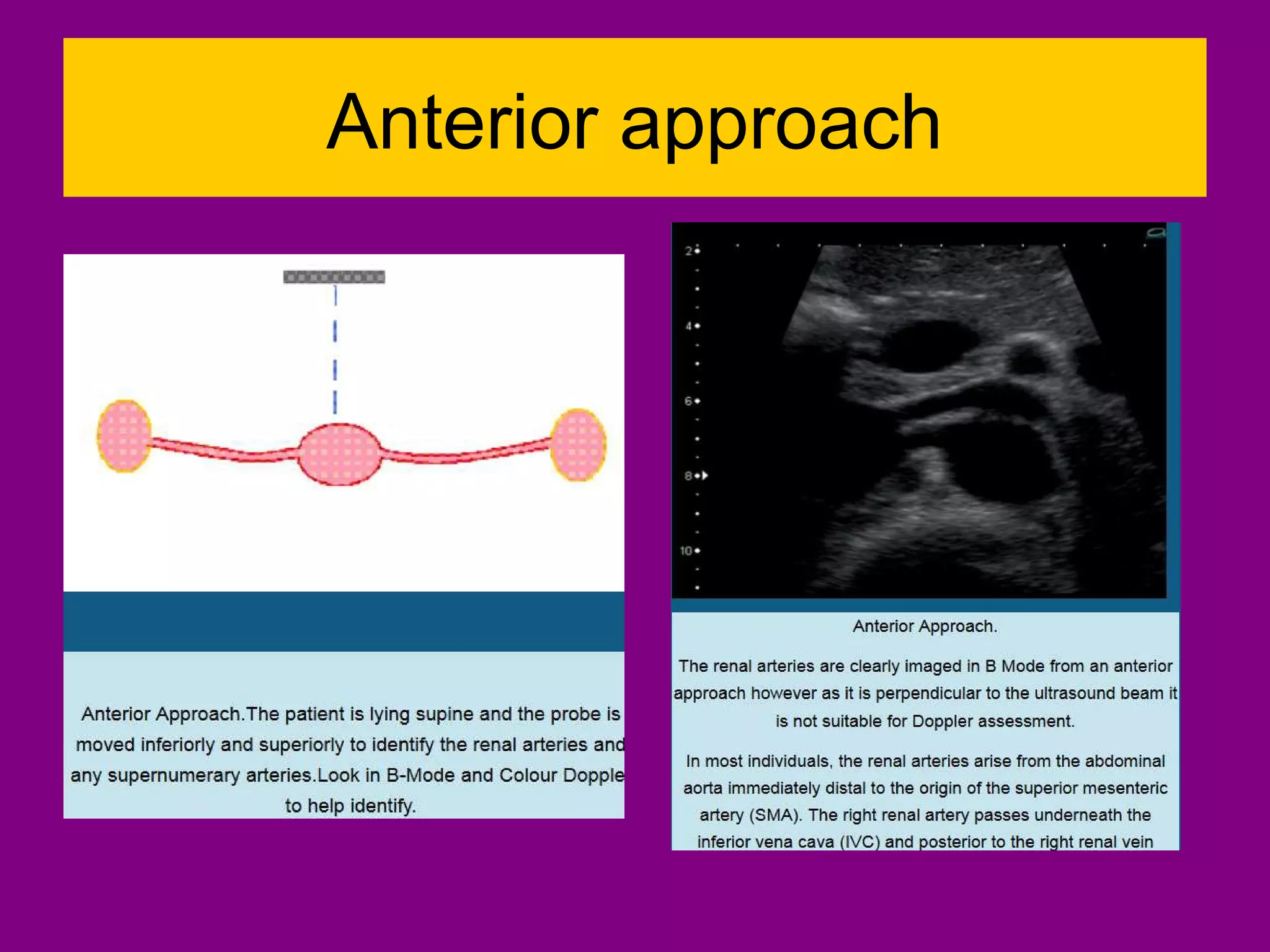
Anterior approach
Oblique approach
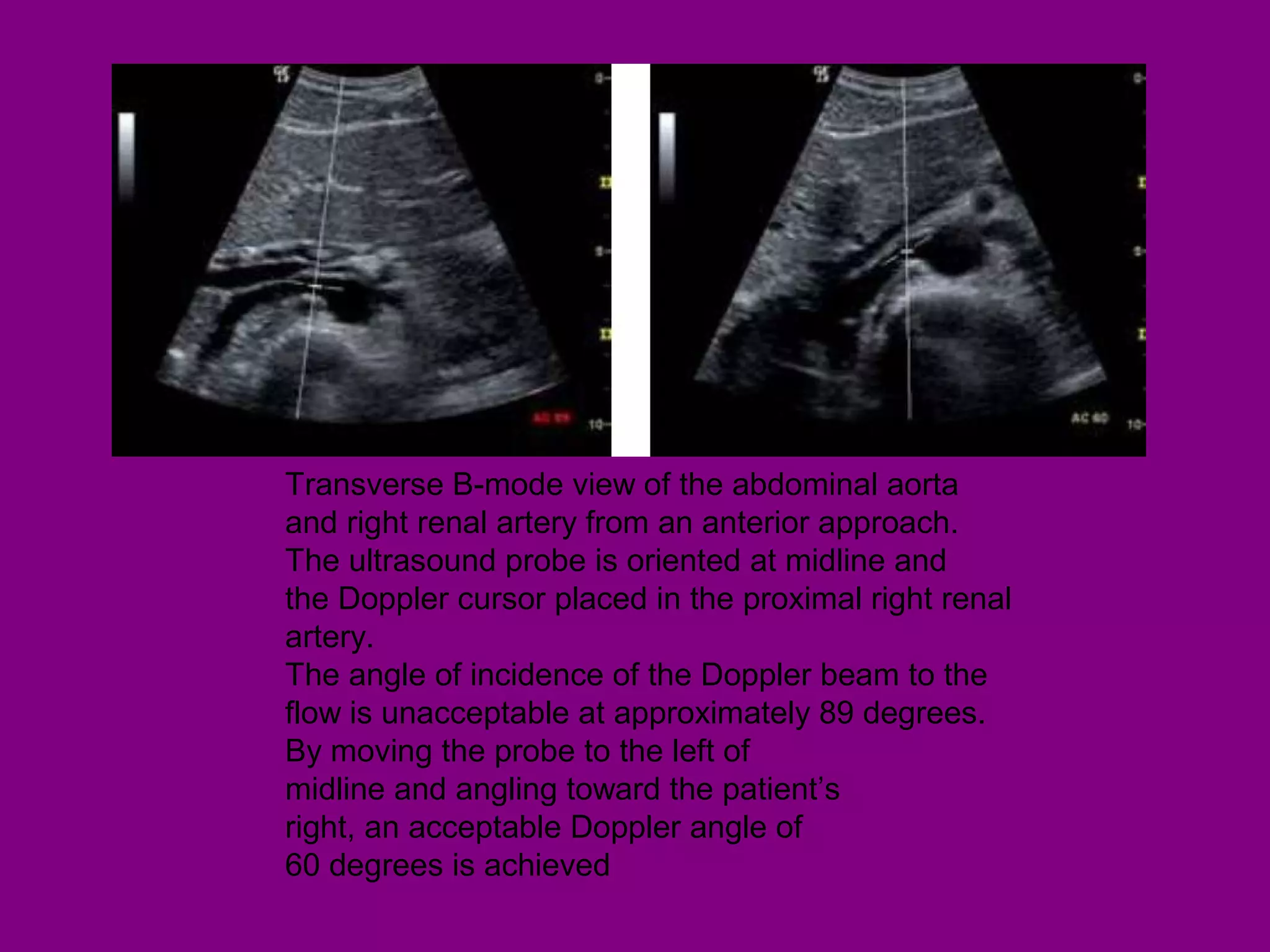
Transverse B-mode view of the abdominal aorta
and right renal artery from an anterior approach.
The ultrasound probe is oriented at midline and
the Doppler cursor placed in the proximal right renal
artery.
The angle of incidence of the Doppler beam to the
flow is unacceptable at approximately 89 degrees.
By moving the probe to the left of
midline and angling toward the patient’s
right, an acceptable Doppler angle of
60 degrees is achieved
Flank approach
The Doppler sample volume is placed
within the proximal right renal artery. In
this view, an acceptable Doppler angle of
60 degrees or less is easily obtained.
values
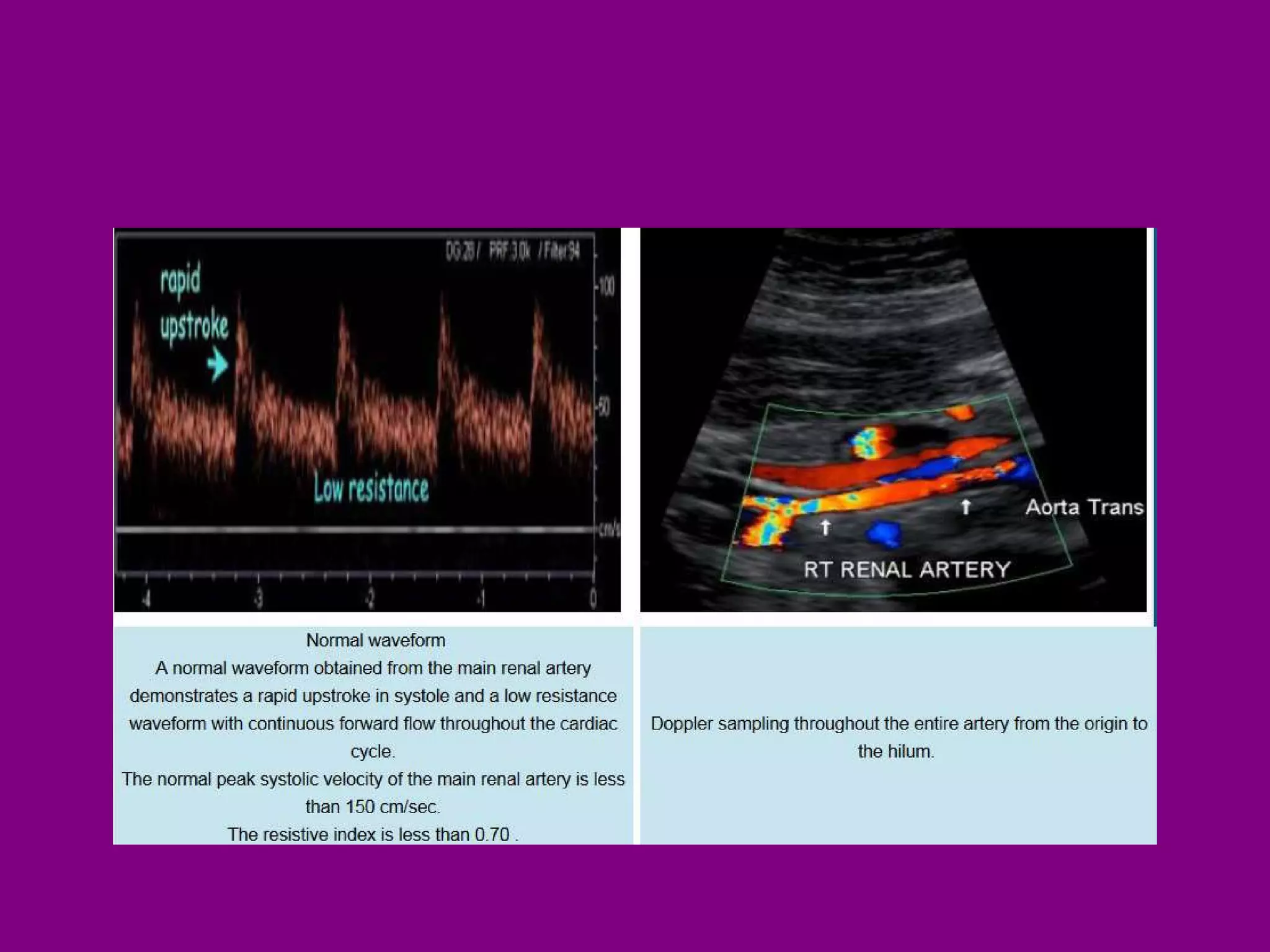
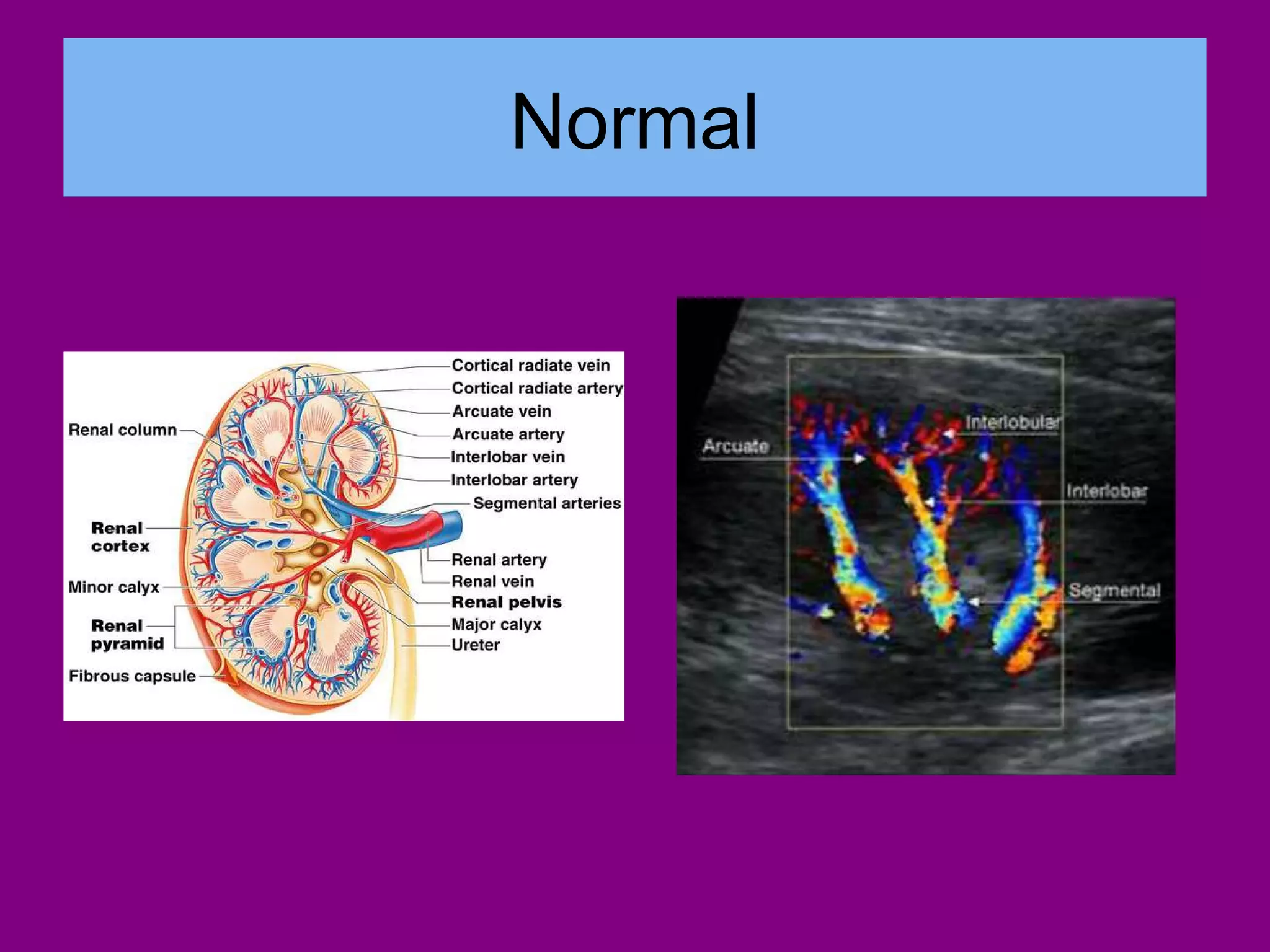
Normal
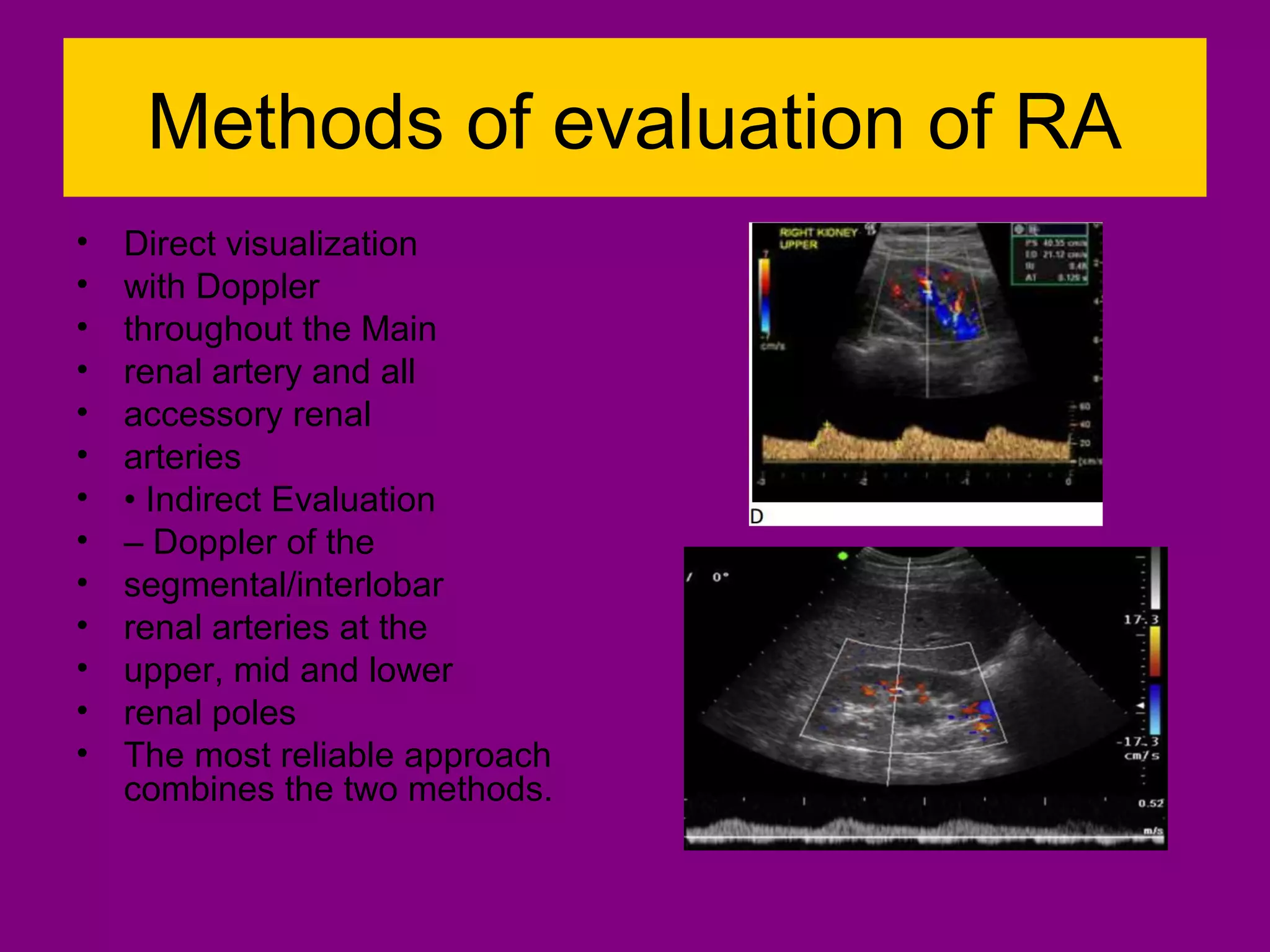
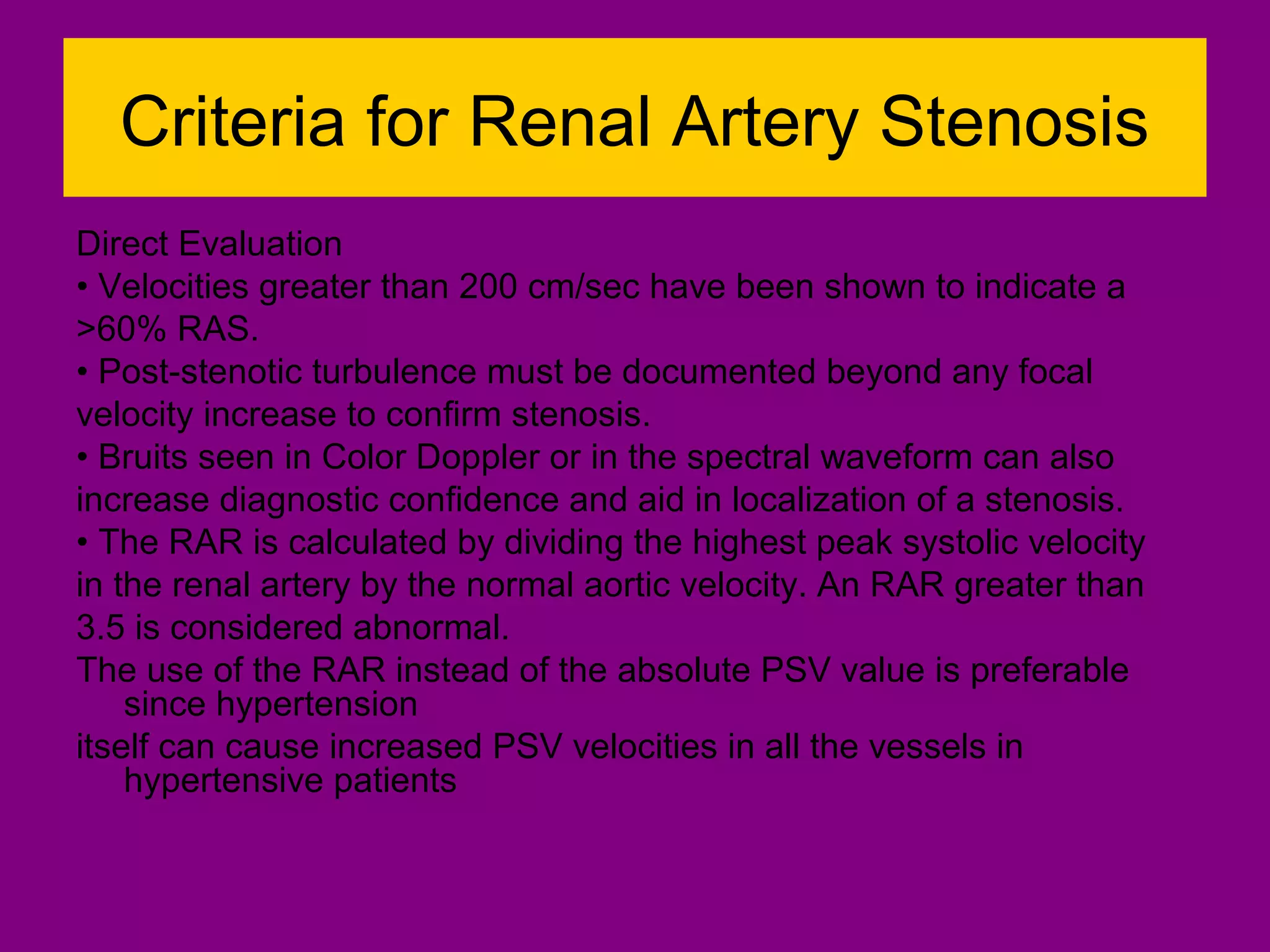
Methods of evaluation of RA
• Direct visualization
• with Doppler
• throughout the Main
• renal artery and all
• accessory renal
• arteries
• • Indirect Evaluation
• – Doppler of the
• segmental/interlobar
• renal arteries at the
• upper, mid and lower
• renal poles
• The most reliable approach
combines the two methods.
Criteria for Renal Artery Stenosis
Direct Evaluation
• Velocities greater than 200 cm/sec have been shown to indicate a
>60% RAS.
• Post-stenotic turbulence must be documented beyond any focal
velocity increase to confirm stenosis.
• Bruits seen in Color Doppler or in the spectral waveform can also
increase diagnostic confidence and aid in localization of a stenosis.
• The RAR is calculated by dividing the highest peak systolic velocity
in the renal artery by the normal aortic velocity. An RAR greater than
3.5 is considered abnormal.
The use of the RAR instead of the absolute PSV value is preferable
since hypertension
itself can cause increased PSV velocities in all the vessels in
hypertensive patients
Image A is a color Doppler image of a stenotic right renal artery origin.
A color bruit is seen in the tissue surrounding the area of the post stenotic turbulence.
The presence of the bruit can help to identify the location of the stenosis and increase
diagnostic confidence.
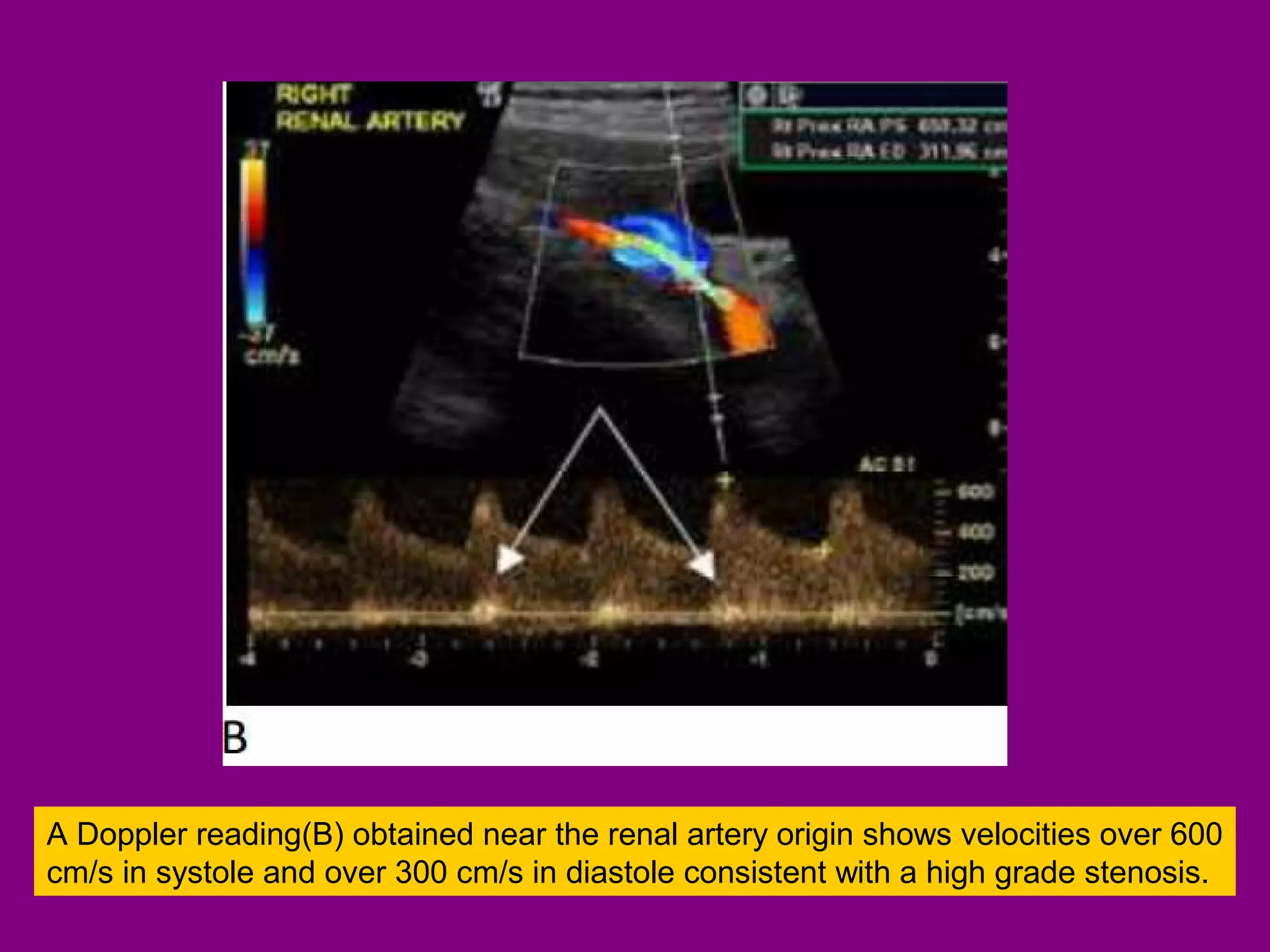
A Doppler reading(B) obtained near the renal artery origin shows velocities over 600
cm/s in systole and over 300 cm/s in diastole consistent with a high grade stenosis.
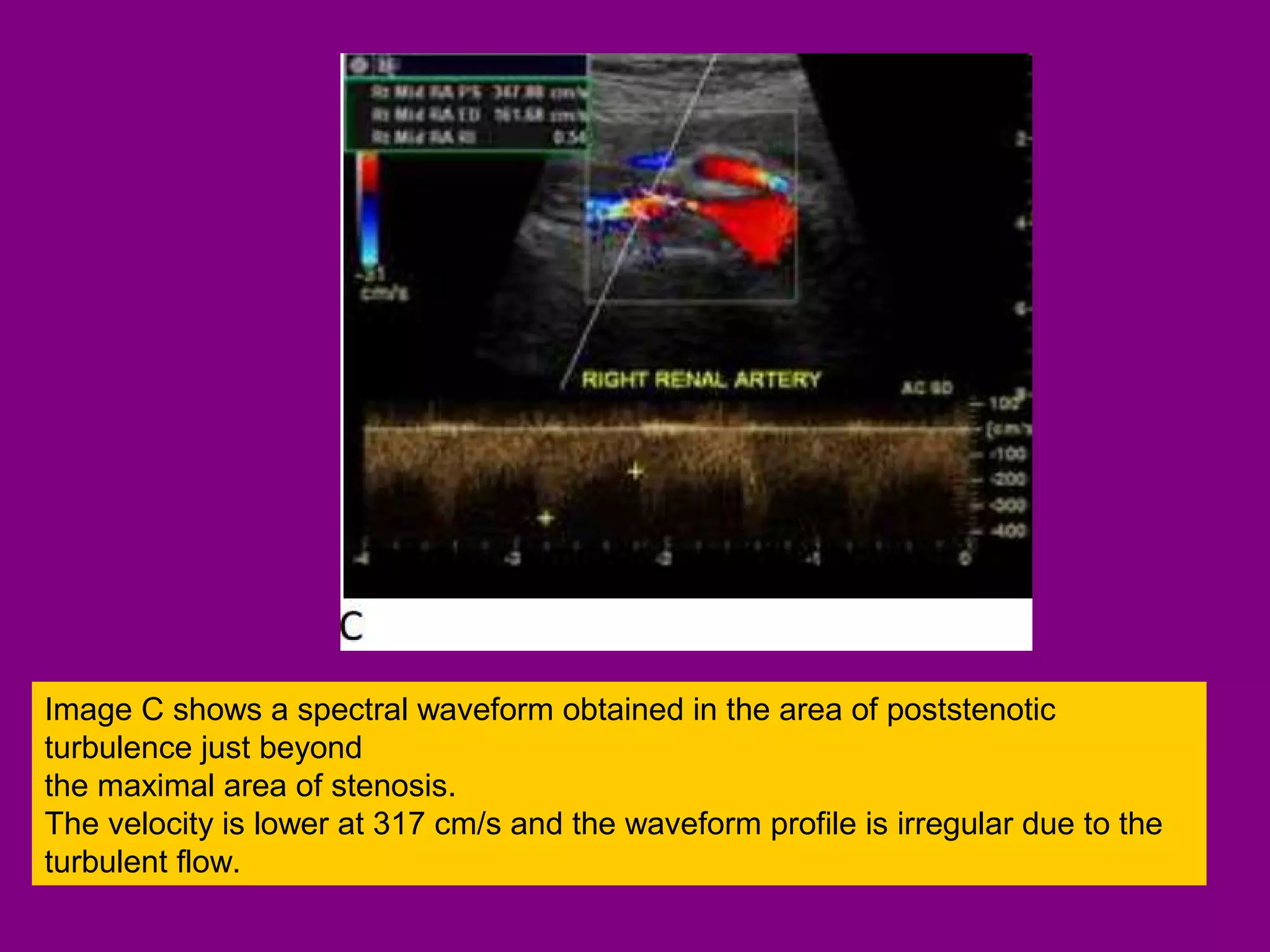
Image C shows a spectral waveform obtained in the area of poststenotic
turbulence just beyond
the maximal area of stenosis.
The velocity is lower at 317 cm/s and the waveform profile is irregular due to the
turbulent flow.
Tardus–parvus waveform in a patient with RA stenosis. Note the delayed and
dampened
upstroke yielding a rounded appearance to the waveform.
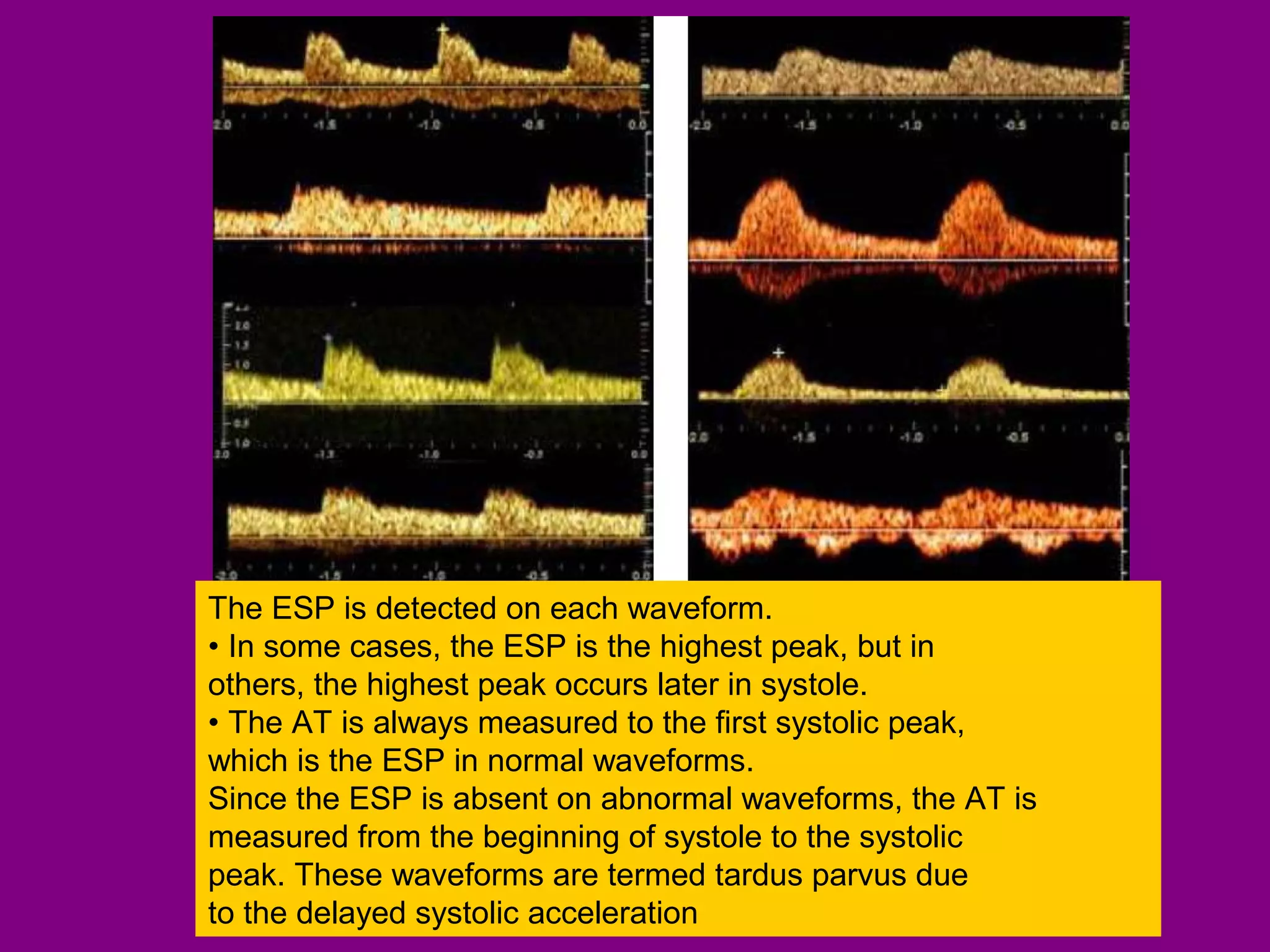
The ESP is detected on each waveform.
• In some cases, the ESP is the highest peak, but in
others, the highest peak occurs later in systole.
• The AT is always measured to the first systolic peak,
which is the ESP in normal waveforms.
Since the ESP is absent on abnormal waveforms, the AT is
measured from the beginning of systole to the systolic
peak. These waveforms are termed tardus parvus due
to the delayed systolic acceleration
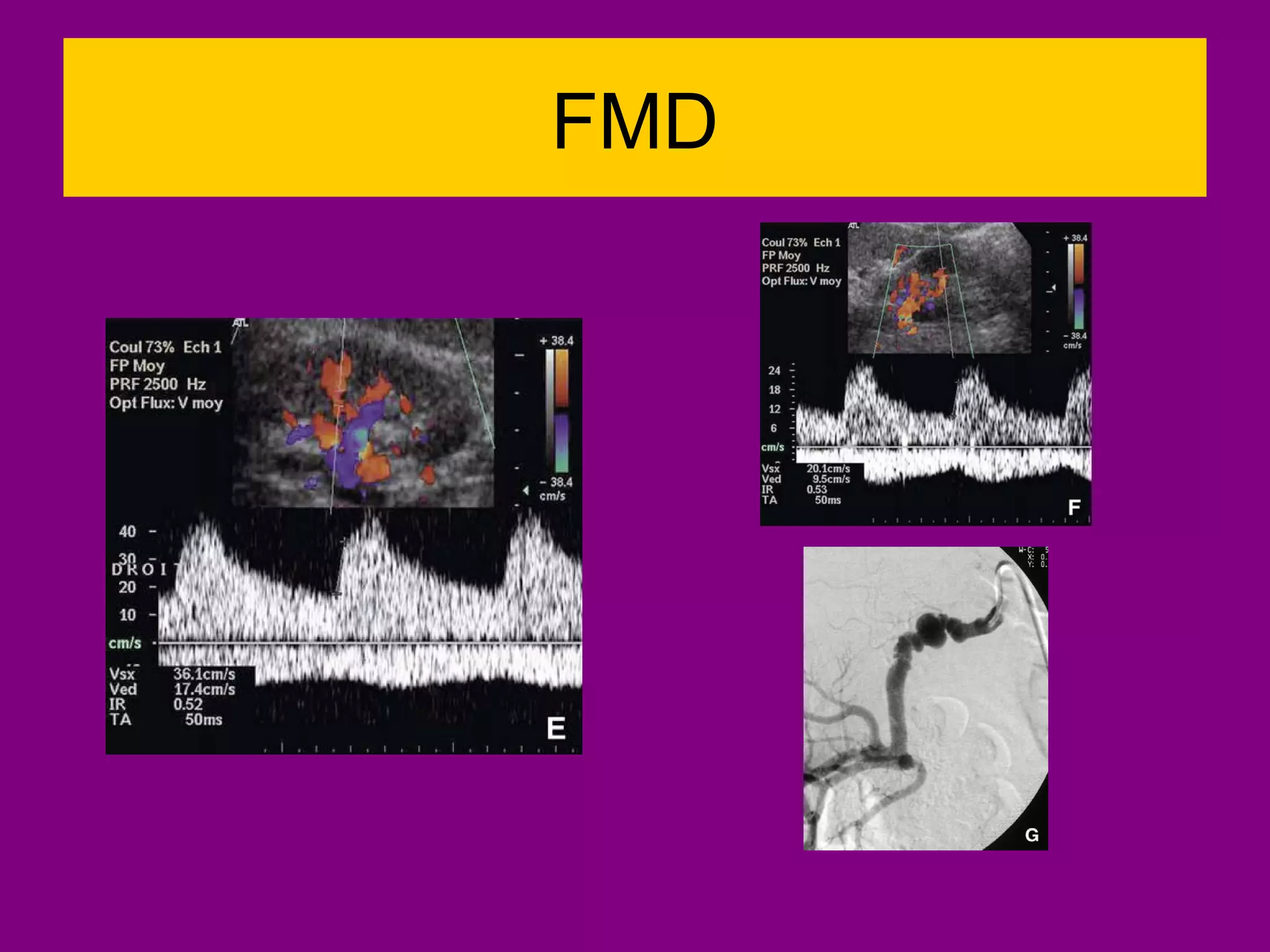
Fibromuscular dysplasia
FMD
Atheromatous plaque
Atheromatous stenosis
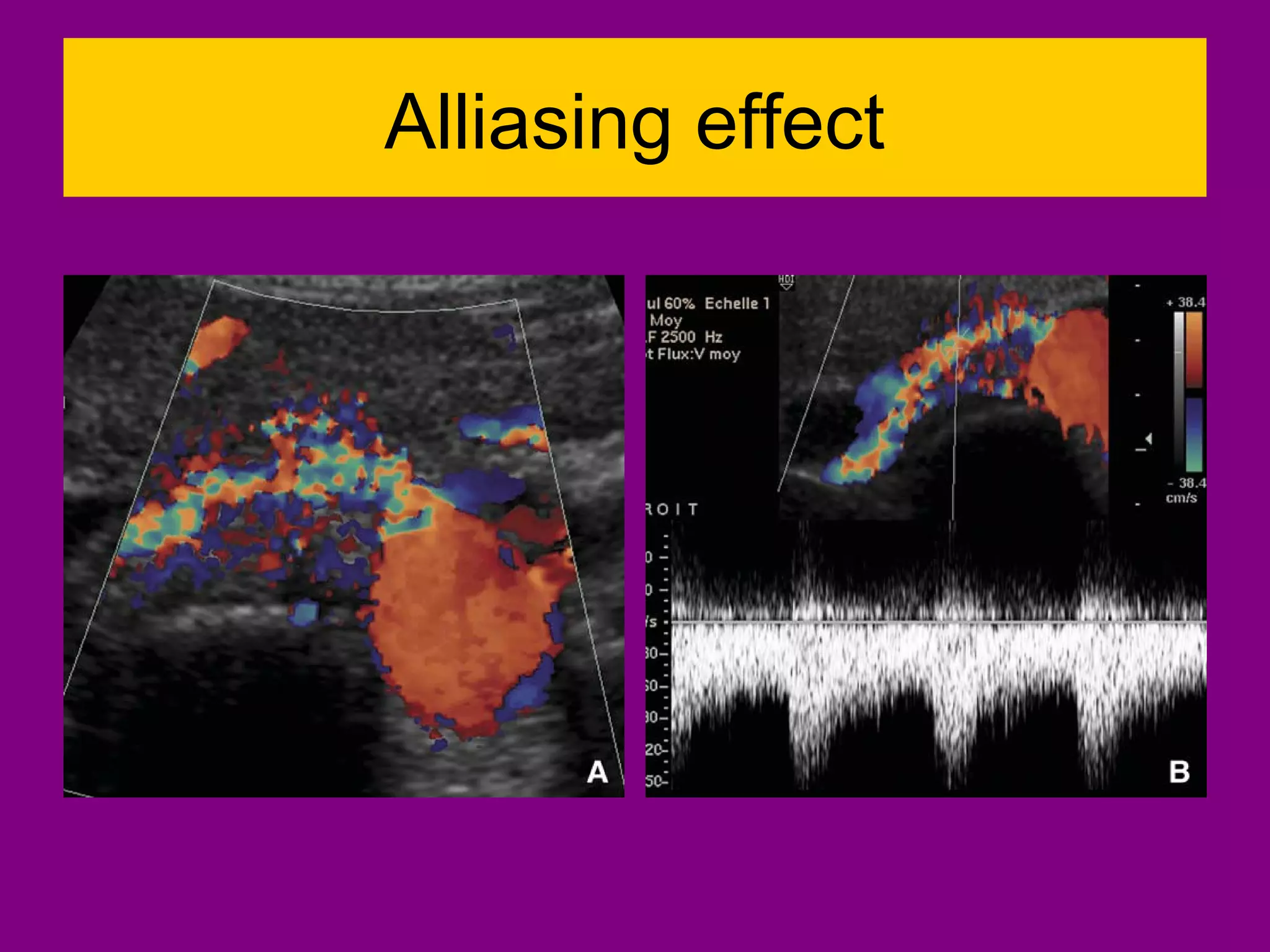
Alliasing effect
Severe stenosis criteria
Absent pic
Stenosis grading
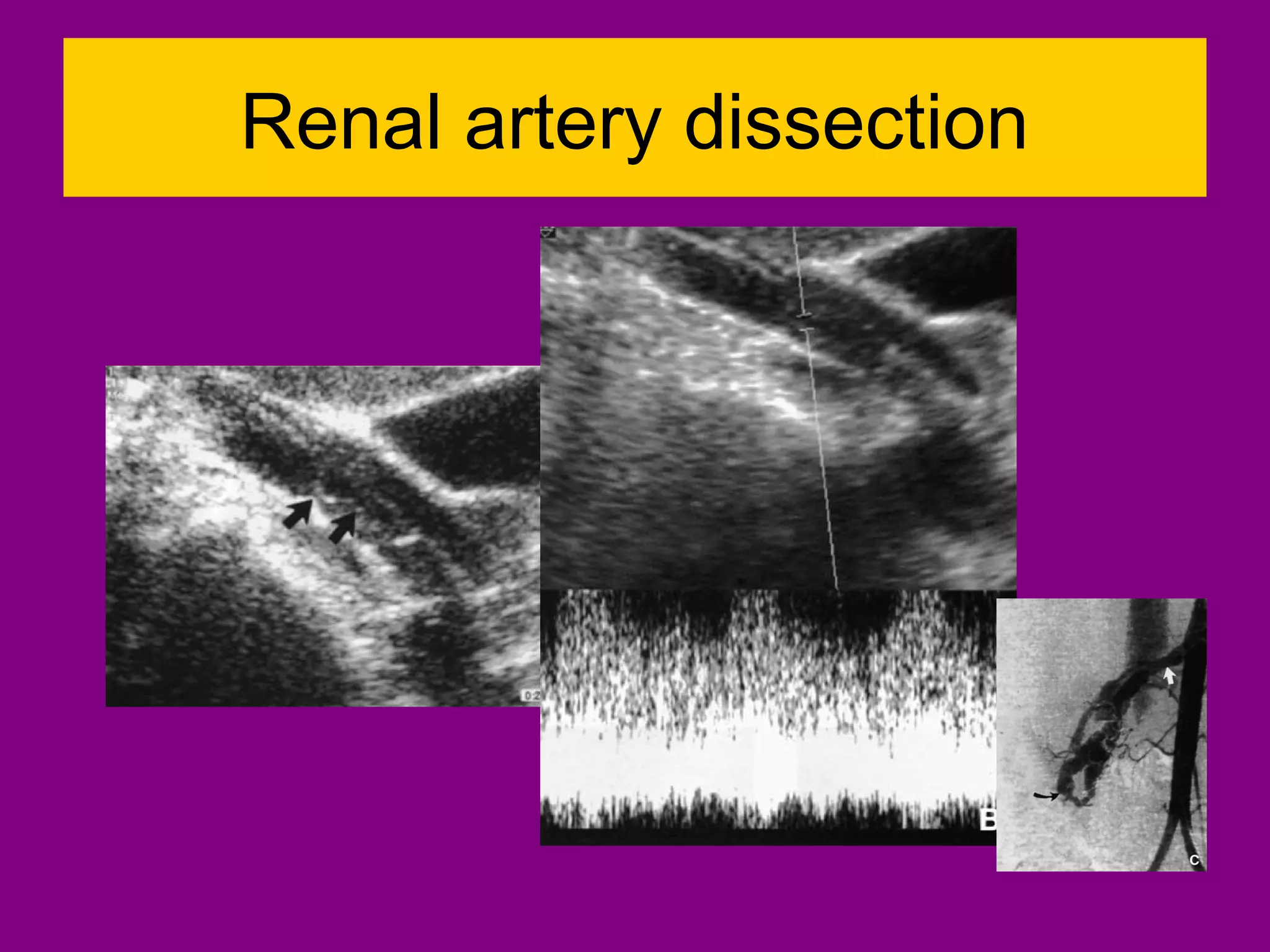
Renal artery dissection
AVM
AVM
AVF
AVF
Aneurysm
Nutcracker
Renal mass
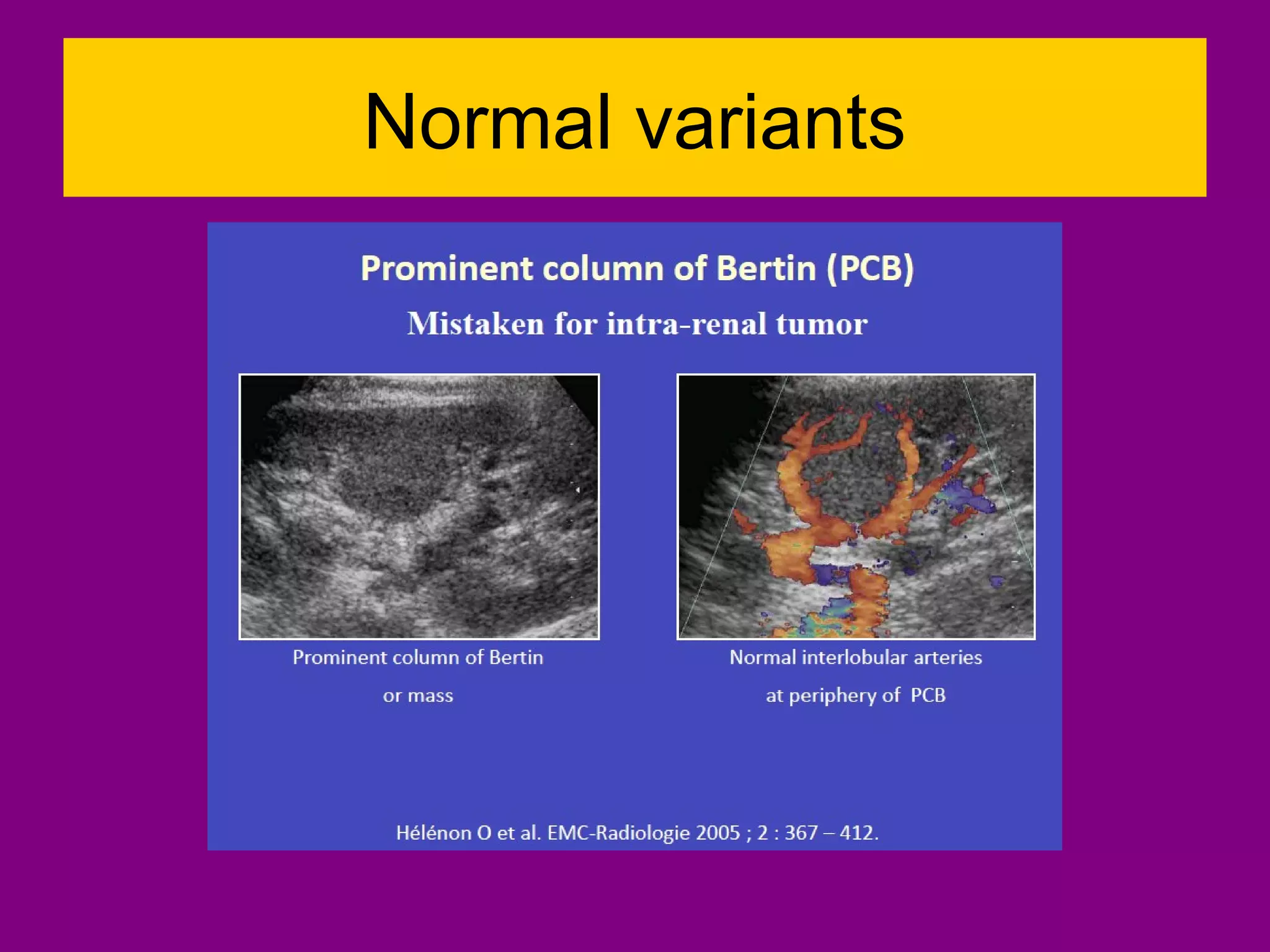
Normal variants
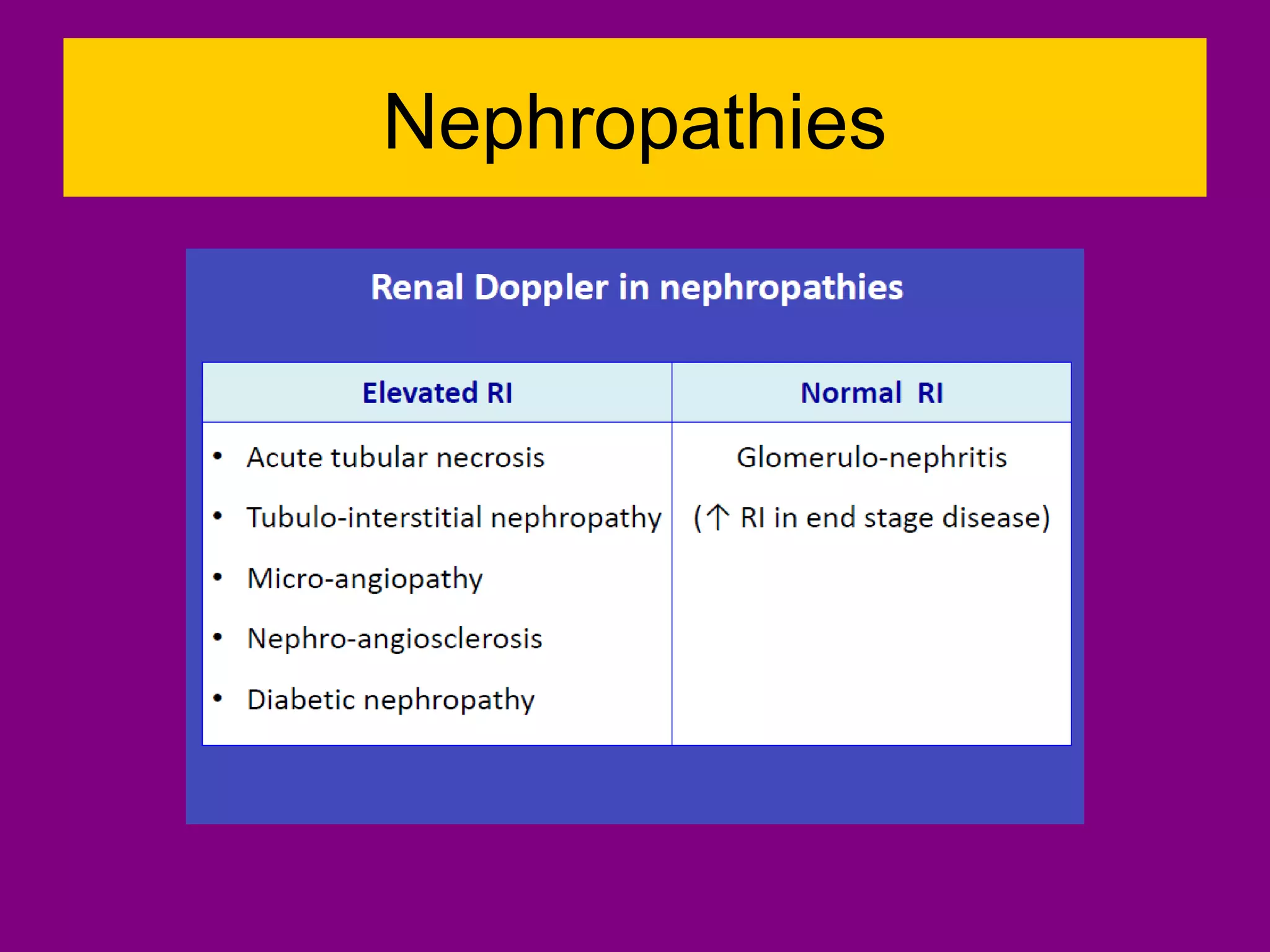
Nephropathies
Lithiasis
twinkle artefact
Hydronephrosis
Renal vein evaluation
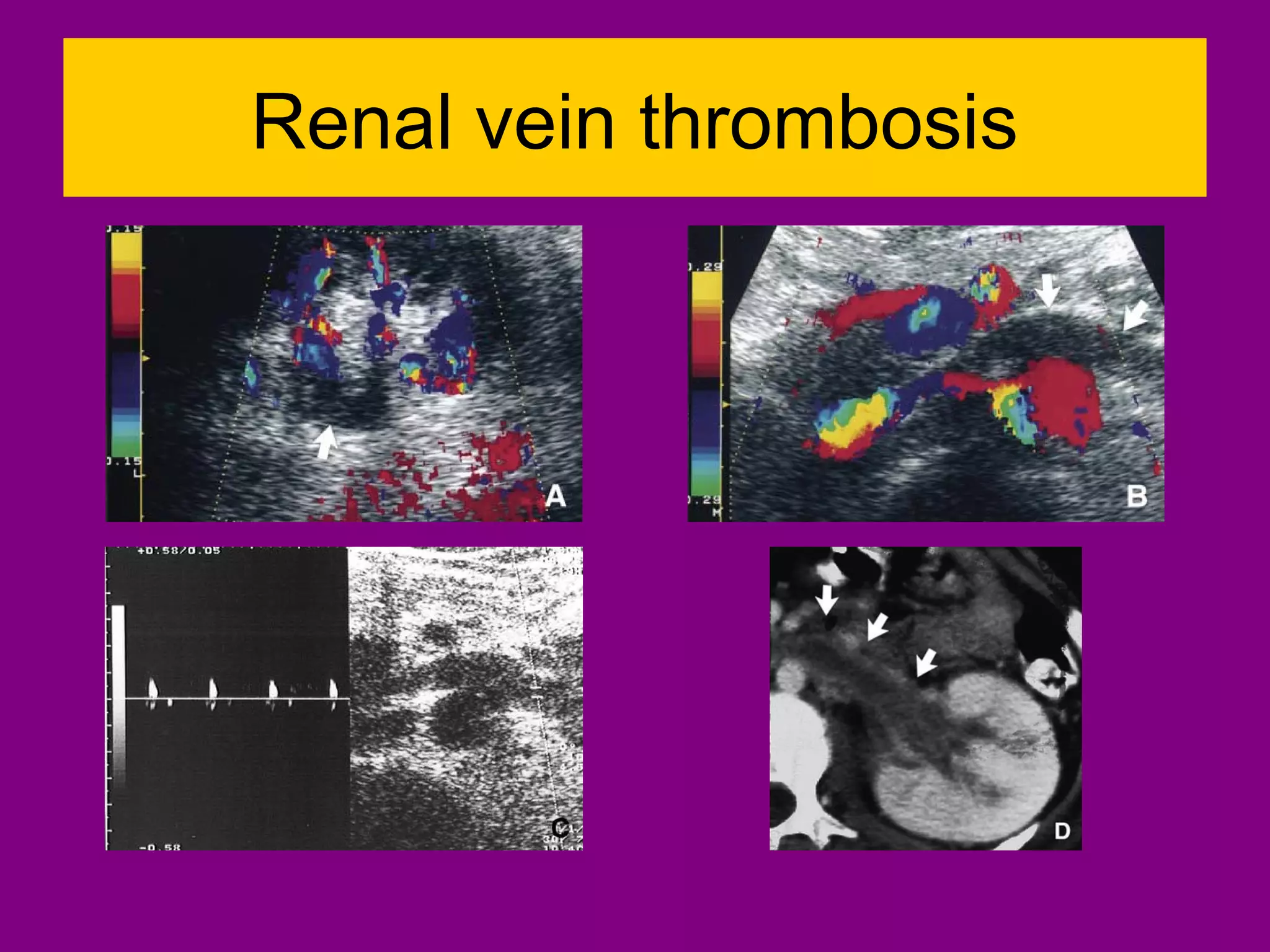
Renal vein thrombosis
Renal doppler ultrasound

Renal doppler ultrasound

  • 1.
    Renal Doppler Ultrasound Theessentials Dr/Ahmed Bahnassy Consultant Radiologist MBCHB-MSc-FRCR(UK)
  • 3.
  • 4.
  • 5.
    Transverse B-mode viewof the abdominal aorta and right renal artery from an anterior approach. The ultrasound probe is oriented at midline and the Doppler cursor placed in the proximal right renal artery. The angle of incidence of the Doppler beam to the flow is unacceptable at approximately 89 degrees. By moving the probe to the left of midline and angling toward the patient’s right, an acceptable Doppler angle of 60 degrees is achieved
  • 7.
  • 8.
    The Doppler samplevolume is placed within the proximal right renal artery. In this view, an acceptable Doppler angle of 60 degrees or less is easily obtained.
  • 9.
  • 10.
  • 11.
    Methods of evaluationof RA • Direct visualization • with Doppler • throughout the Main • renal artery and all • accessory renal • arteries • • Indirect Evaluation • – Doppler of the • segmental/interlobar • renal arteries at the • upper, mid and lower • renal poles • The most reliable approach combines the two methods.
  • 12.
    Criteria for RenalArtery Stenosis Direct Evaluation • Velocities greater than 200 cm/sec have been shown to indicate a >60% RAS. • Post-stenotic turbulence must be documented beyond any focal velocity increase to confirm stenosis. • Bruits seen in Color Doppler or in the spectral waveform can also increase diagnostic confidence and aid in localization of a stenosis. • The RAR is calculated by dividing the highest peak systolic velocity in the renal artery by the normal aortic velocity. An RAR greater than 3.5 is considered abnormal. The use of the RAR instead of the absolute PSV value is preferable since hypertension itself can cause increased PSV velocities in all the vessels in hypertensive patients
  • 13.
    Image A isa color Doppler image of a stenotic right renal artery origin. A color bruit is seen in the tissue surrounding the area of the post stenotic turbulence. The presence of the bruit can help to identify the location of the stenosis and increase diagnostic confidence.
  • 14.
    A Doppler reading(B)obtained near the renal artery origin shows velocities over 600 cm/s in systole and over 300 cm/s in diastole consistent with a high grade stenosis.
  • 15.
    Image C showsa spectral waveform obtained in the area of poststenotic turbulence just beyond the maximal area of stenosis. The velocity is lower at 317 cm/s and the waveform profile is irregular due to the turbulent flow.
  • 16.
    Tardus–parvus waveform ina patient with RA stenosis. Note the delayed and dampened upstroke yielding a rounded appearance to the waveform.
  • 17.
    The ESP isdetected on each waveform. • In some cases, the ESP is the highest peak, but in others, the highest peak occurs later in systole. • The AT is always measured to the first systolic peak, which is the ESP in normal waveforms. Since the ESP is absent on abnormal waveforms, the AT is measured from the beginning of systole to the systolic peak. These waveforms are termed tardus parvus due to the delayed systolic acceleration
  • 18.
  • 19.
  • 20.
  • 21.
  • 22.
  • 23.
  • 24.
  • 25.
  • 26.
  • 27.
  • 28.
  • 29.
  • 30.
  • 31.
  • 32.
  • 33.
  • 37.
  • 38.
  • 41.
  • 43.
  • 44.
  • 45.
  • 51.
  • 52.