Dr/Ahmed Bahnassy 
Consultant radiologist 
PSMMC
Importance of subject 
Although internal hernias have an 
overall incidence of less than 
1%, they constitute up to 5.8% of 
all small-bowel obstructions, 
which, if left untreated, have been reported 
to have an overall mortality exceeding 50% 
if strangulation is present
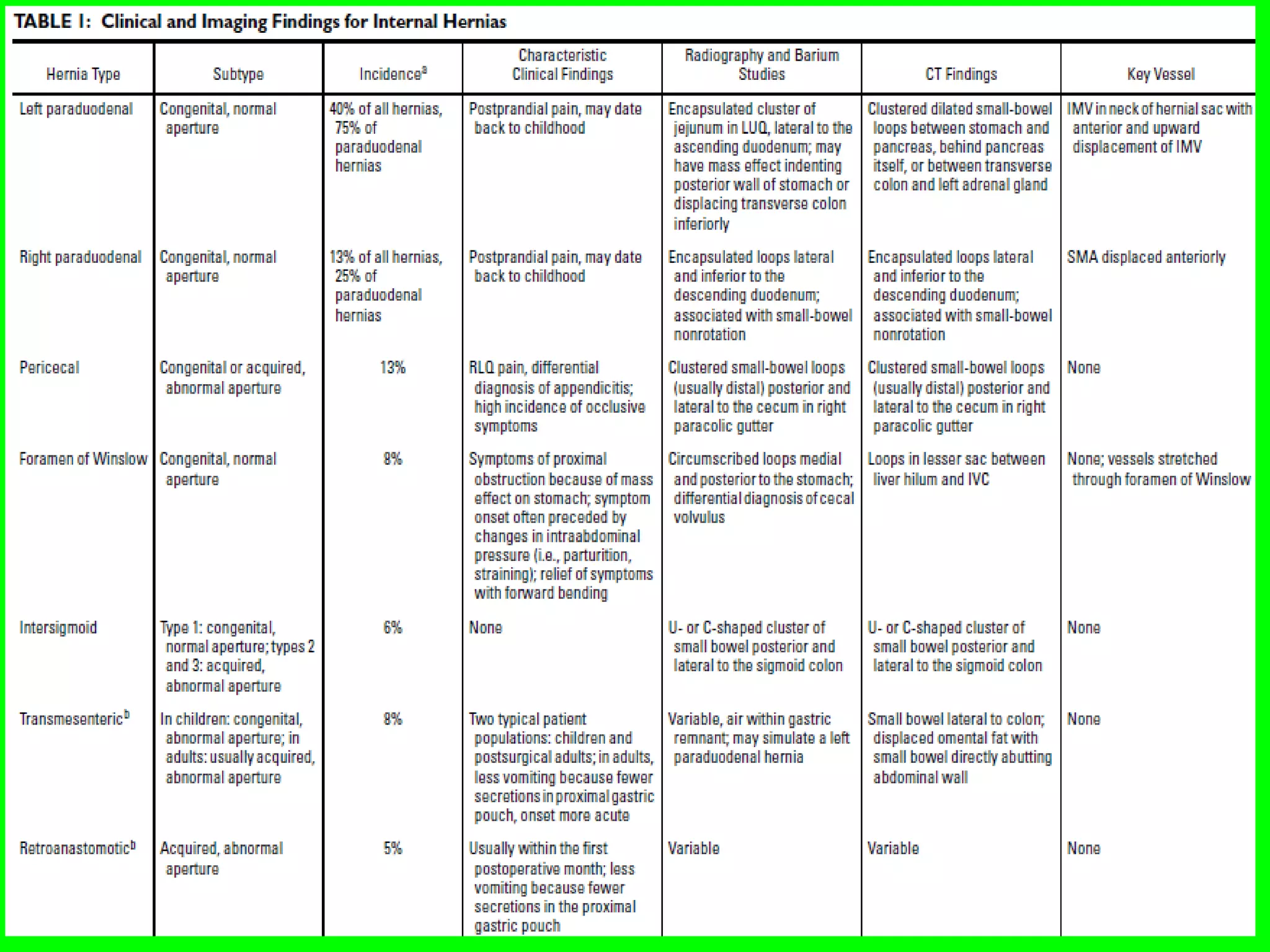
Types of hernias 
Hernias are of two main types, external and 
internal . External hernias refer to prolapse 
of intestinal loops through a defect in the wall 
of the abdomen or pelvis, and internal hernias 
are defined by the protrusion of a viscus 
through a normal or abnormal peritoneal or 
mesenteric aperture within the confines of the 
peritoneal cavity. The orifice can be either acquired, 
such as a postsurgical, traumatic, or 
postinflammatory defect, or congenital, including 
both normal apertures, such as the foramen 
of Winslow, and abnormal apertures 
arising from anomalies of internal rotation 
and peritoneal attachment.
Clinical presentation 
Clinically, internal hernias can be 
asymptomatic or cause significant 
discomfort ranging from constant vague 
epigastric pain to intermittent colicky 
periumbilical pain. 
symptoms include nausea, vomiting 
(especially after a large meal), and 
recurrent intestinal obstruction
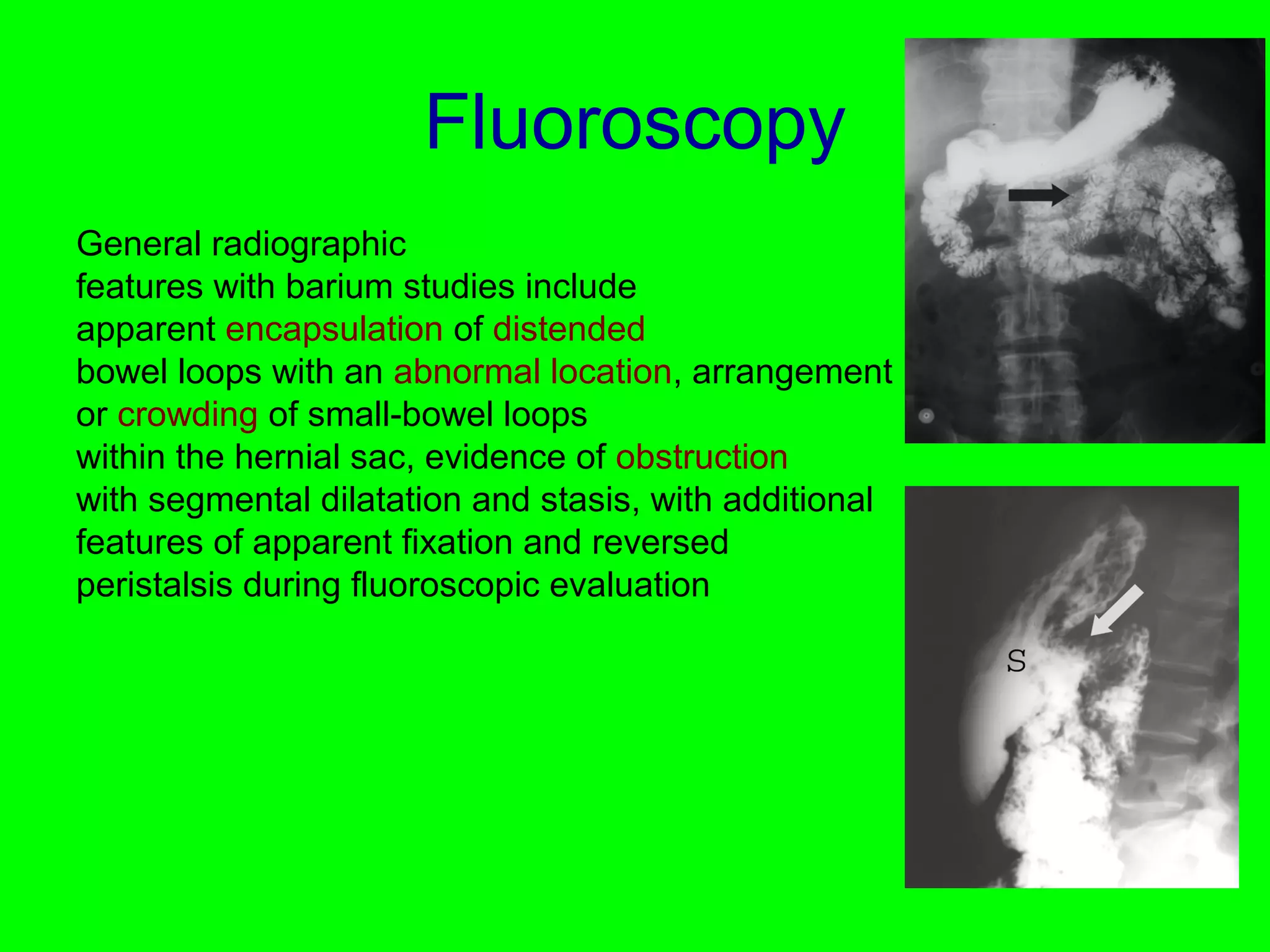
Fluoroscopy 
General radiographic 
features with barium studies include 
apparent encapsulation of distended 
bowel loops with an abnormal location, arrangement 
or crowding of small-bowel loops 
within the hernial sac, evidence of obstruction 
with segmental dilatation and stasis, with additional 
features of apparent fixation and reversed 
peristalsis during fluoroscopic evaluation
CT 
On CT, additional findings include 
mesenteric vessel abnormalities, 
with engorgement, crowding, twisting, 
and stretching of these vessels commonly 
found and providing an important clue to the 
underlying diagnosis
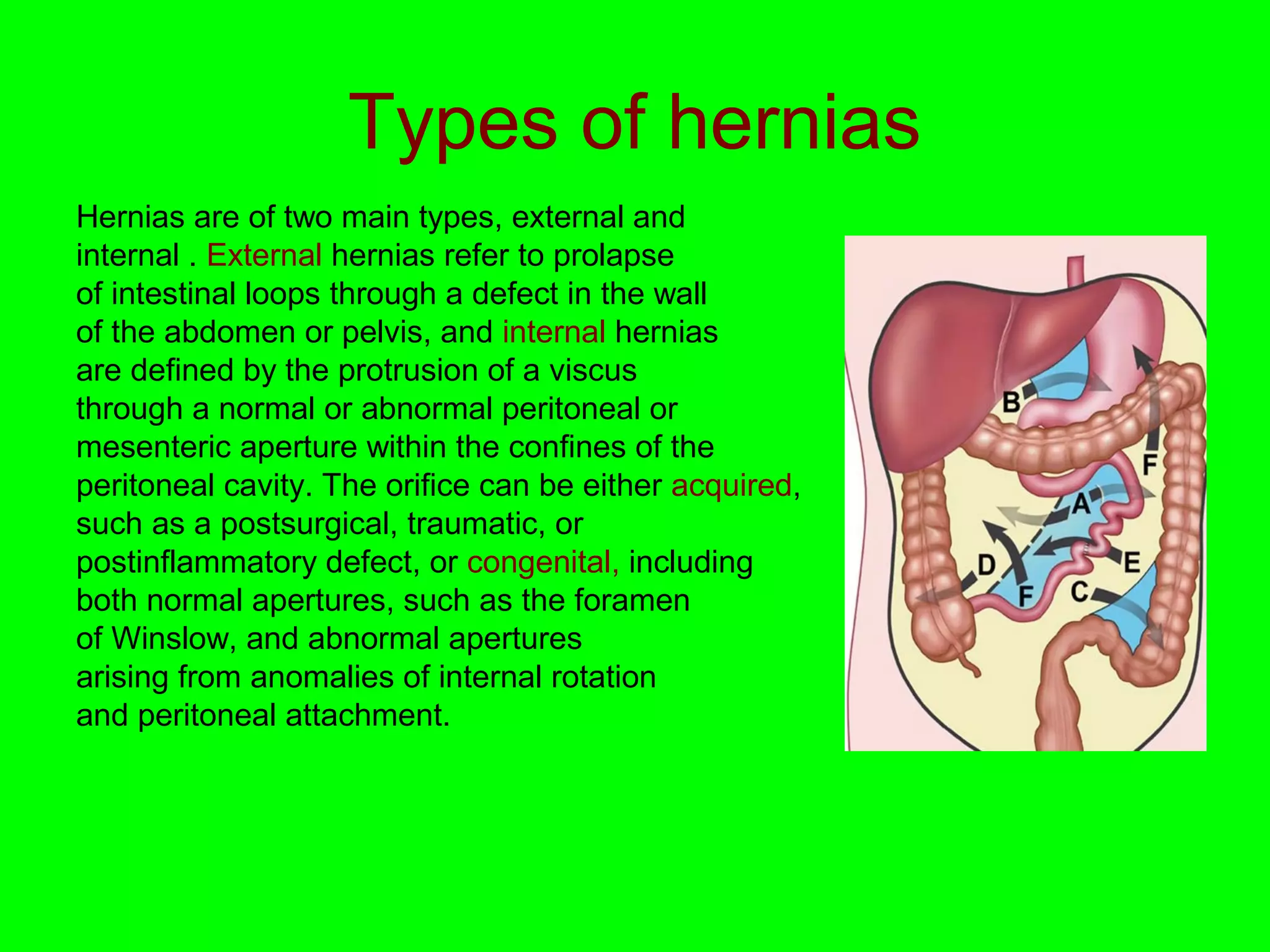
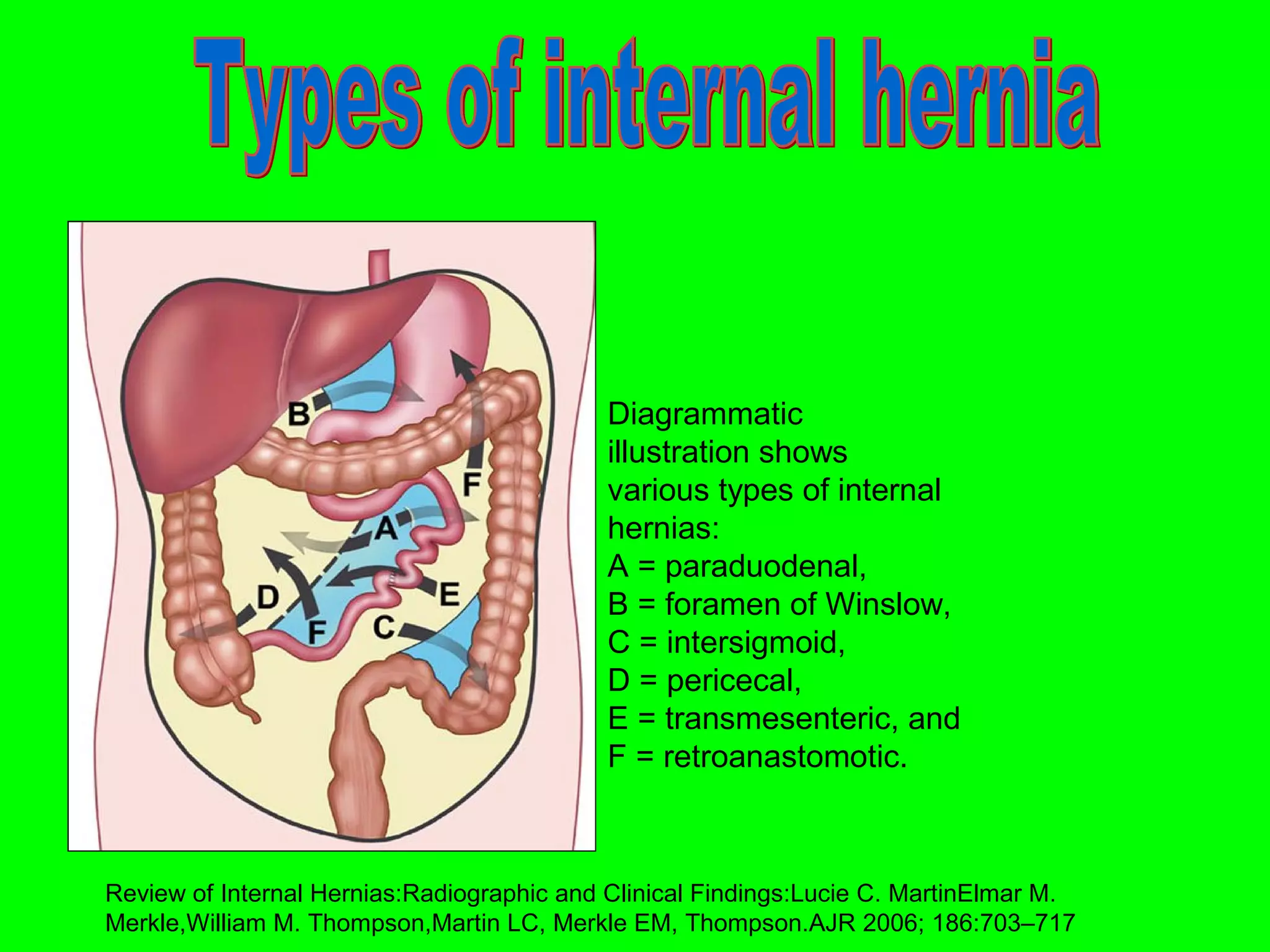
Diagrammatic 
illustration shows 
various types of internal 
hernias: 
A = paraduodenal, 
B = foramen of Winslow, 
C = intersigmoid, 
D = pericecal, 
E = transmesenteric, and 
F = retroanastomotic. 
Review of Internal Hernias:Radiographic and Clinical Findings:Lucie C. MartinElmar M. 
Merkle,William M. Thompson,Martin LC, Merkle EM, Thompson.AJR 2006; 186:703–717
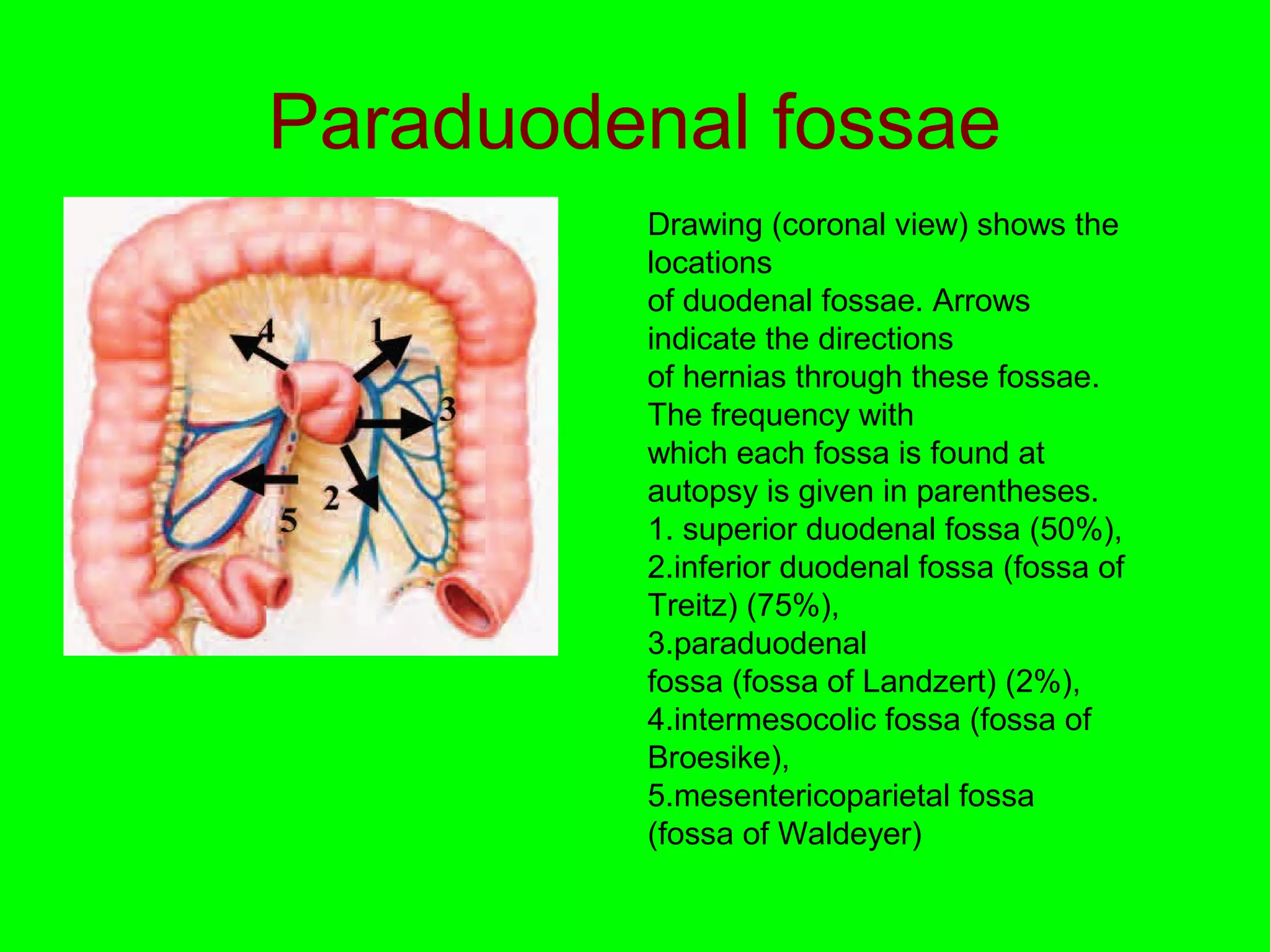
Paraduodenal fossae 
Drawing (coronal view) shows the 
locations 
of duodenal fossae. Arrows 
indicate the directions 
of hernias through these fossae. 
The frequency with 
which each fossa is found at 
autopsy is given in parentheses. 
1. superior duodenal fossa (50%), 
2.inferior duodenal fossa (fossa of 
Treitz) (75%), 
3.paraduodenal 
fossa (fossa of Landzert) (2%), 
4.intermesocolic fossa (fossa of 
Broesike), 
5.mesentericoparietal fossa 
(fossa of Waldeyer)
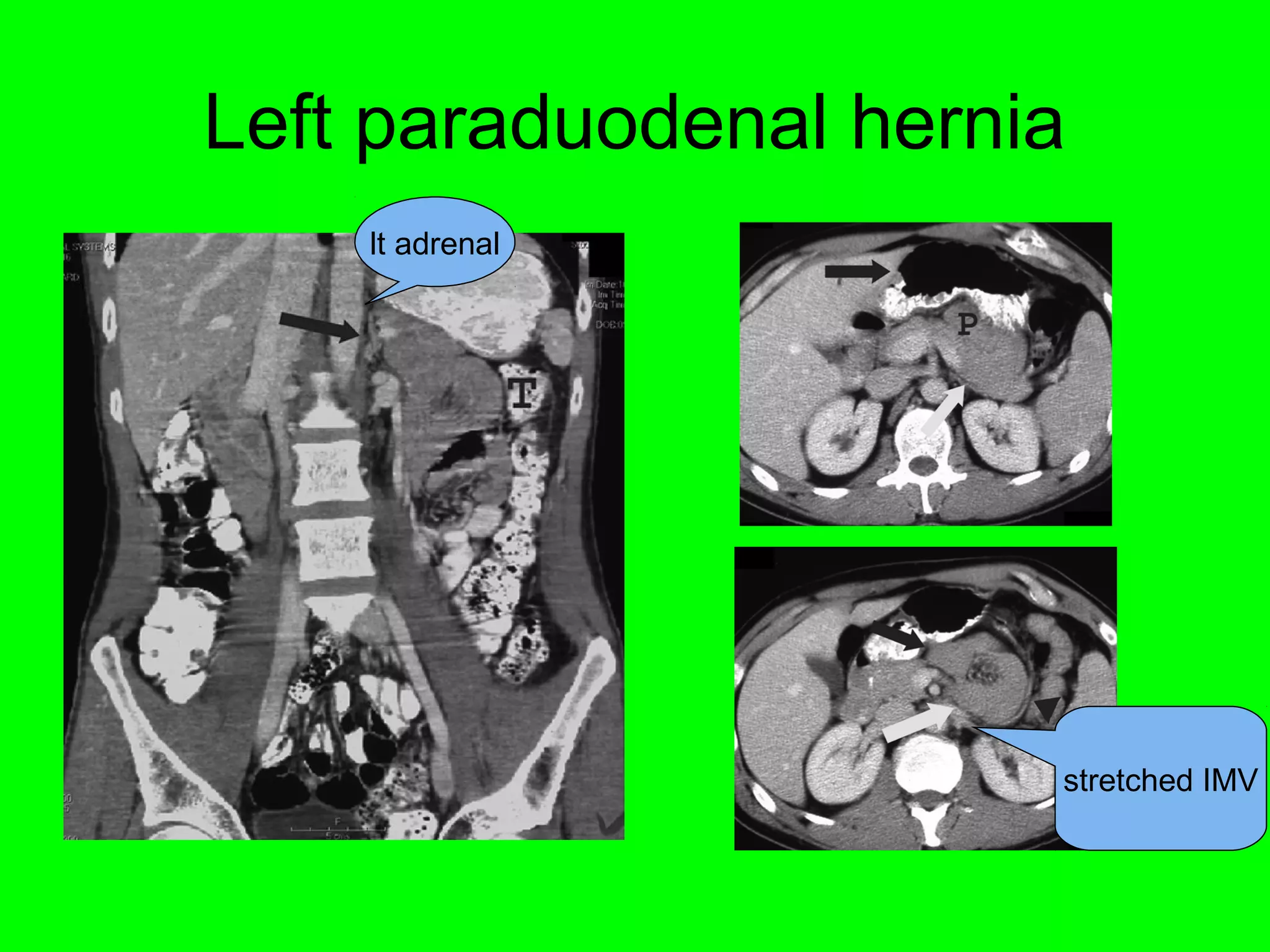
Left paraduodenal hernia 
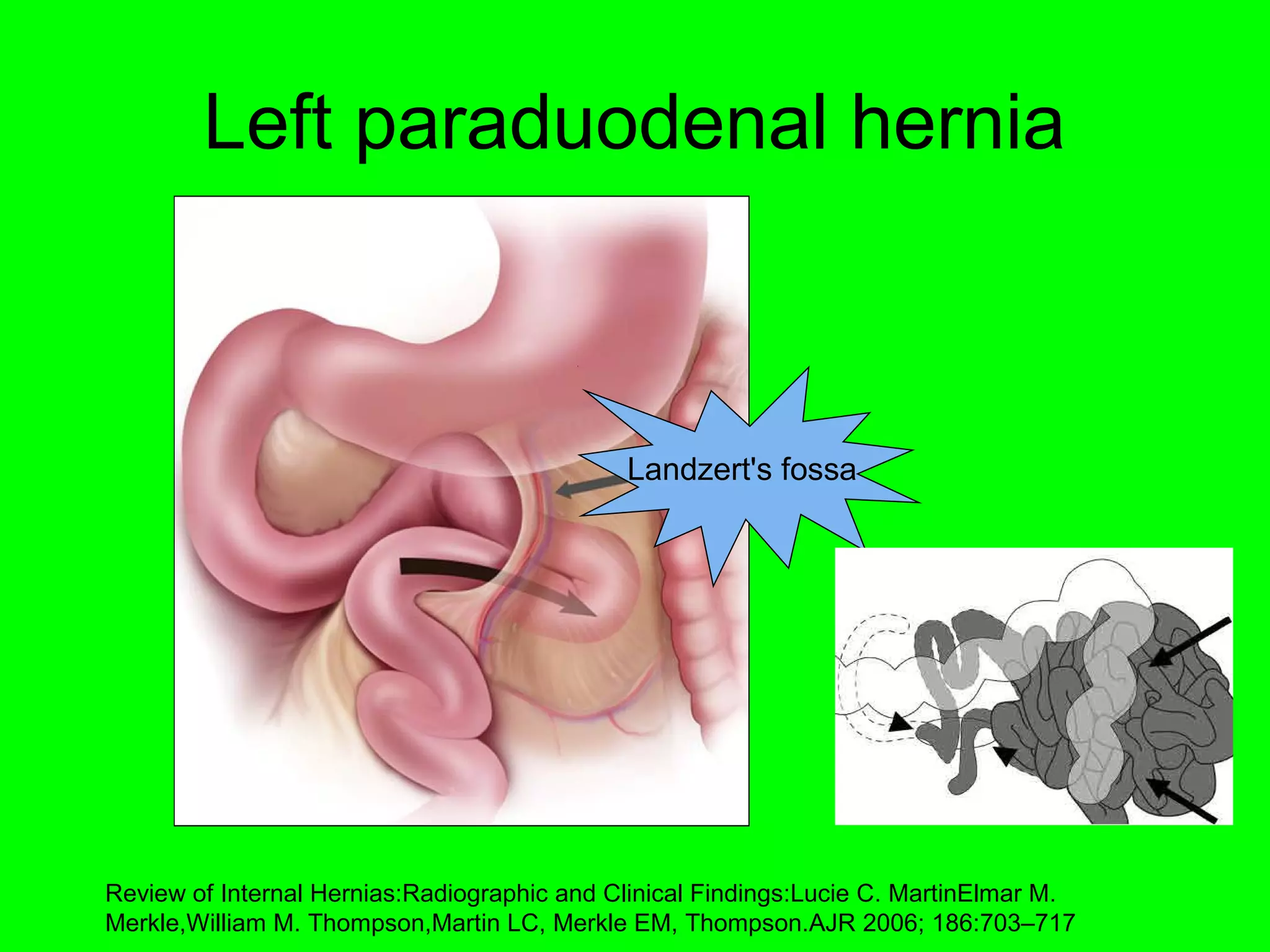
Landzert's fossa 
Review of Internal Hernias:Radiographic and Clinical Findings:Lucie C. MartinElmar M. 
Merkle,William M. Thompson,Martin LC, Merkle EM, Thompson.AJR 2006; 186:703–717
Left paraduodenal hernia 
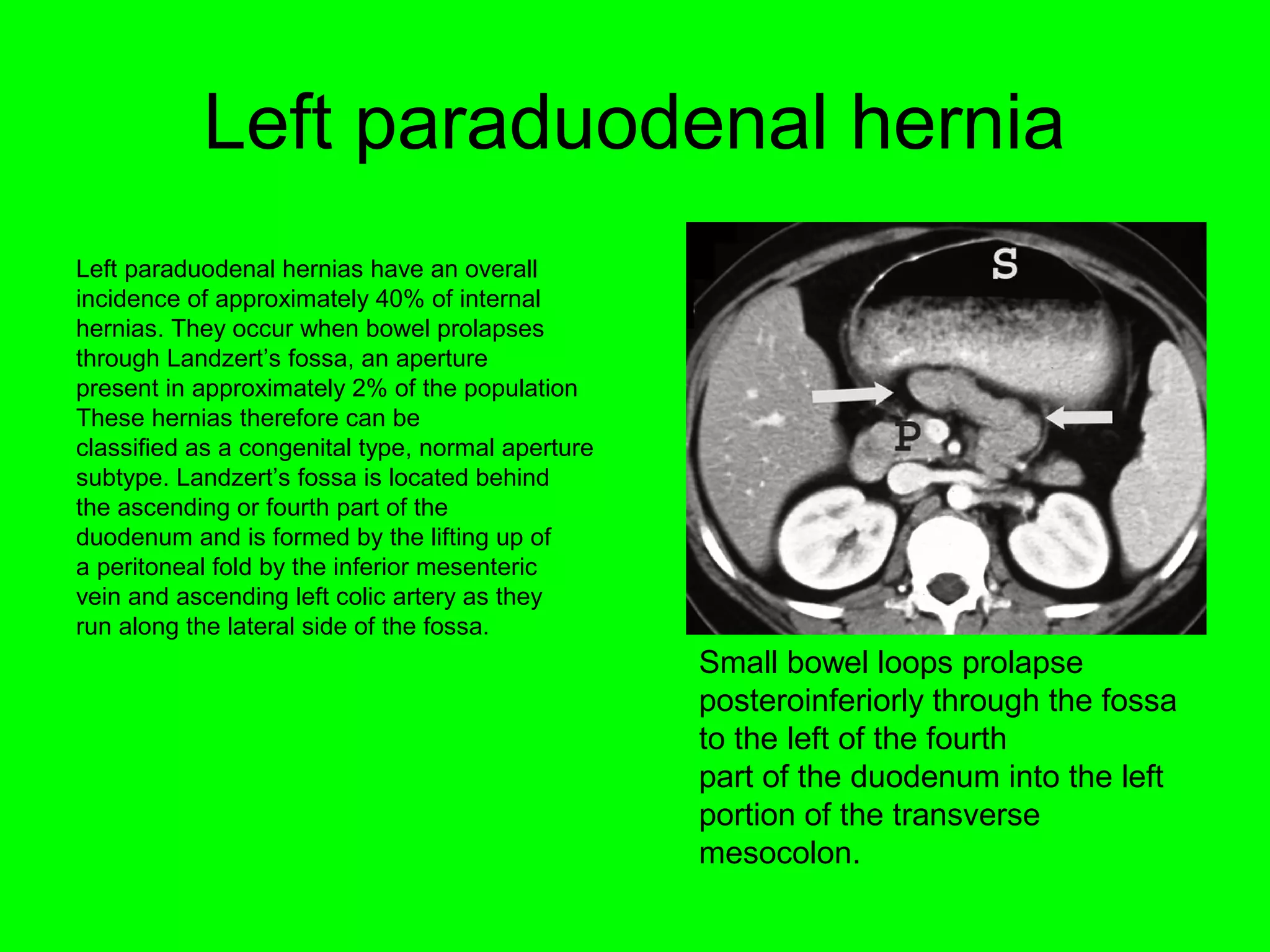
Left paraduodenal hernias have an overall 
incidence of approximately 40% of internal 
hernias. They occur when bowel prolapses 
through Landzert’s fossa, an aperture 
present in approximately 2% of the population 
These hernias therefore can be 
classified as a congenital type, normal aperture 
subtype. Landzert’s fossa is located behind 
the ascending or fourth part of the 
duodenum and is formed by the lifting up of 
a peritoneal fold by the inferior mesenteric 
vein and ascending left colic artery as they 
run along the lateral side of the fossa. 
Small bowel loops prolapse 
posteroinferiorly through the fossa 
to the left of the fourth 
part of the duodenum into the left 
portion of the transverse 
mesocolon.
Left paraduodenal hernia 
lt adrenal 
stretched IMV
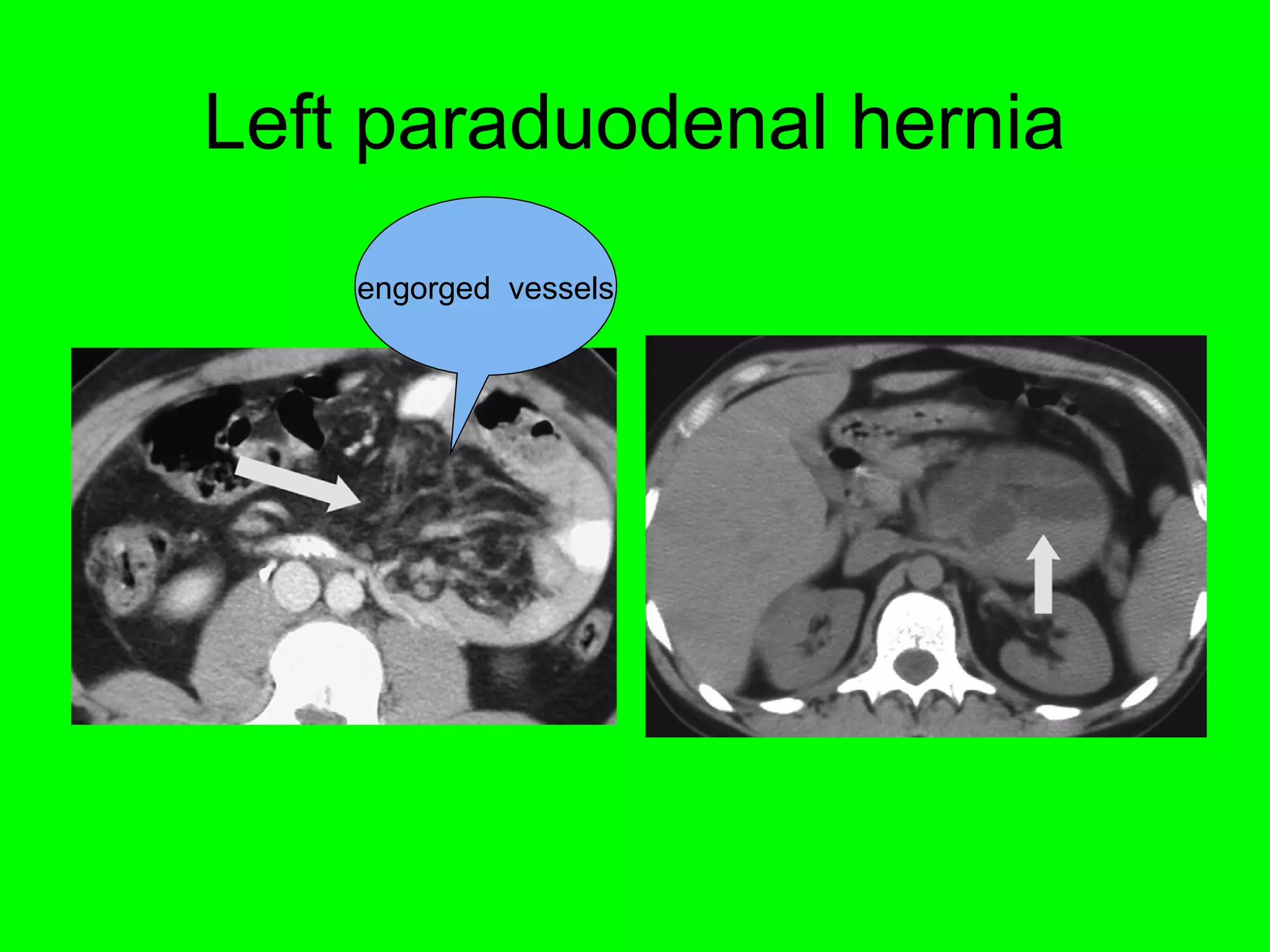
Left paraduodenal hernia 
engorged vessels
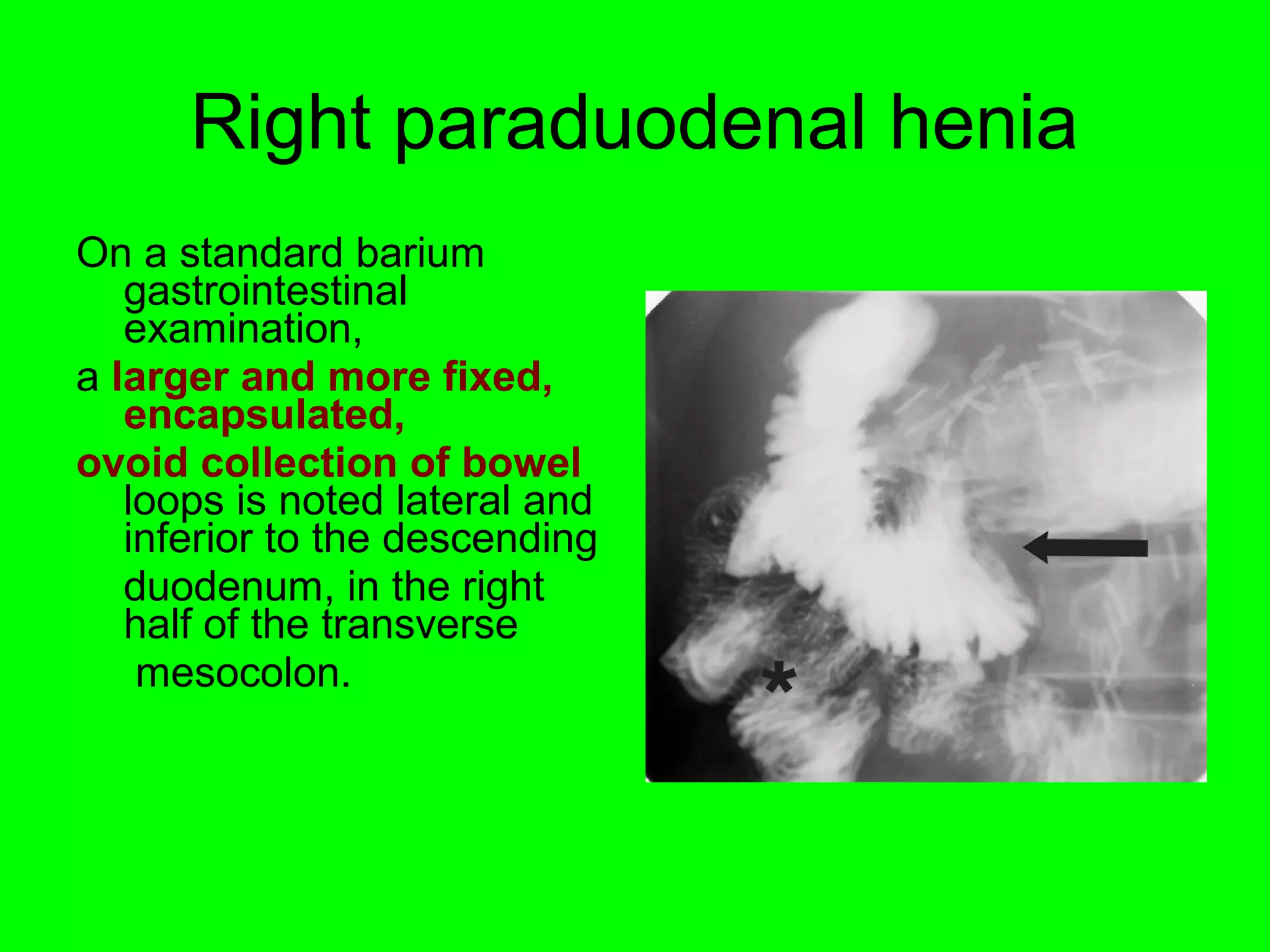
Right paraduodenal henia 
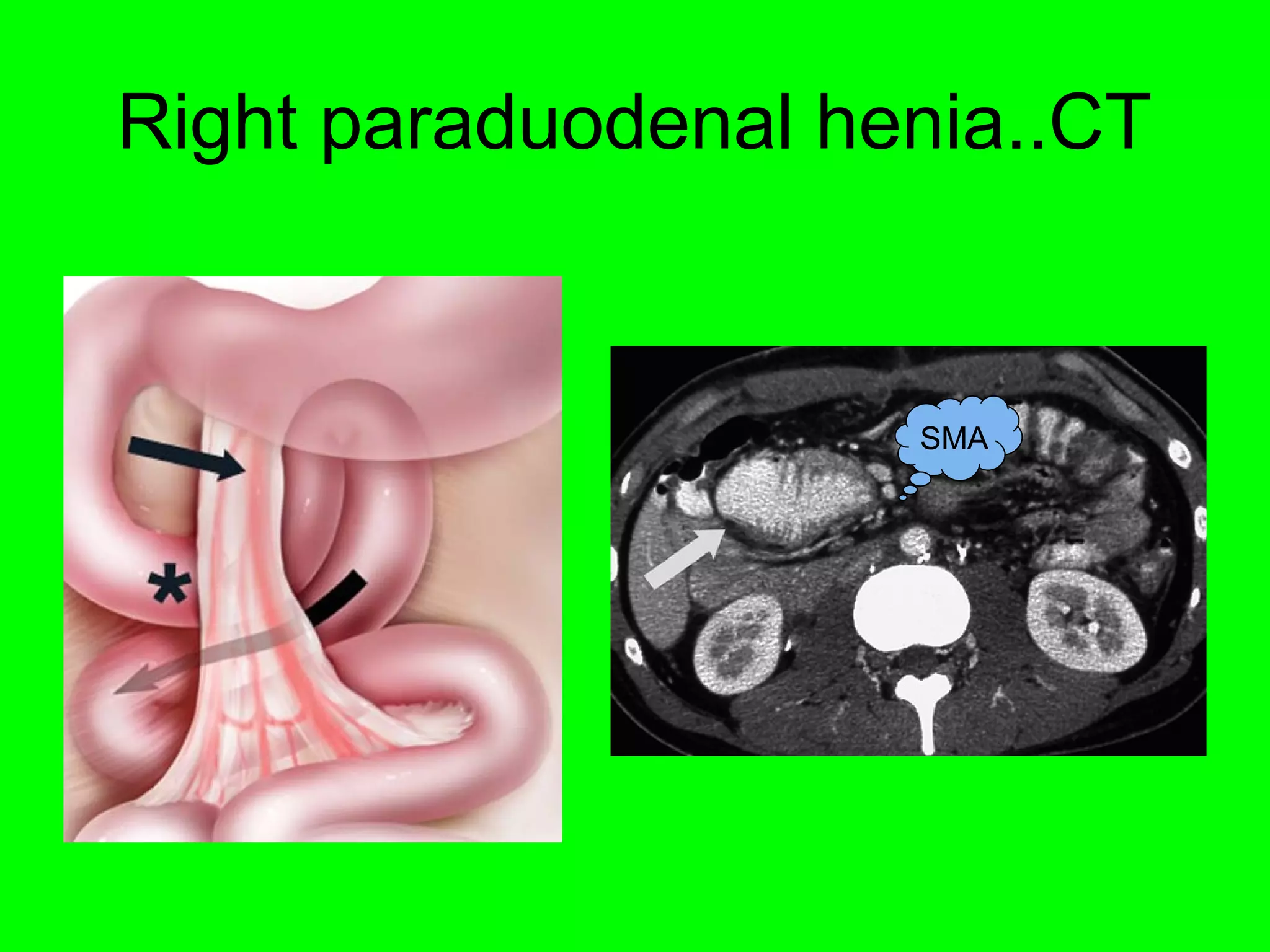
Right paraduodenal hernias have an overall 
incidence of approximately 13% and 
occur when bowel herniates through 
Waldeyer’s fossa (representing a defect in 
the first part of the jejunal mesentery), behind 
the superior mesenteric artery and inferior 
to the transverse or third portion of the 
duodenum . 
This type of hernia occurs more frequently in the 
setting of nonrotated small bowel .
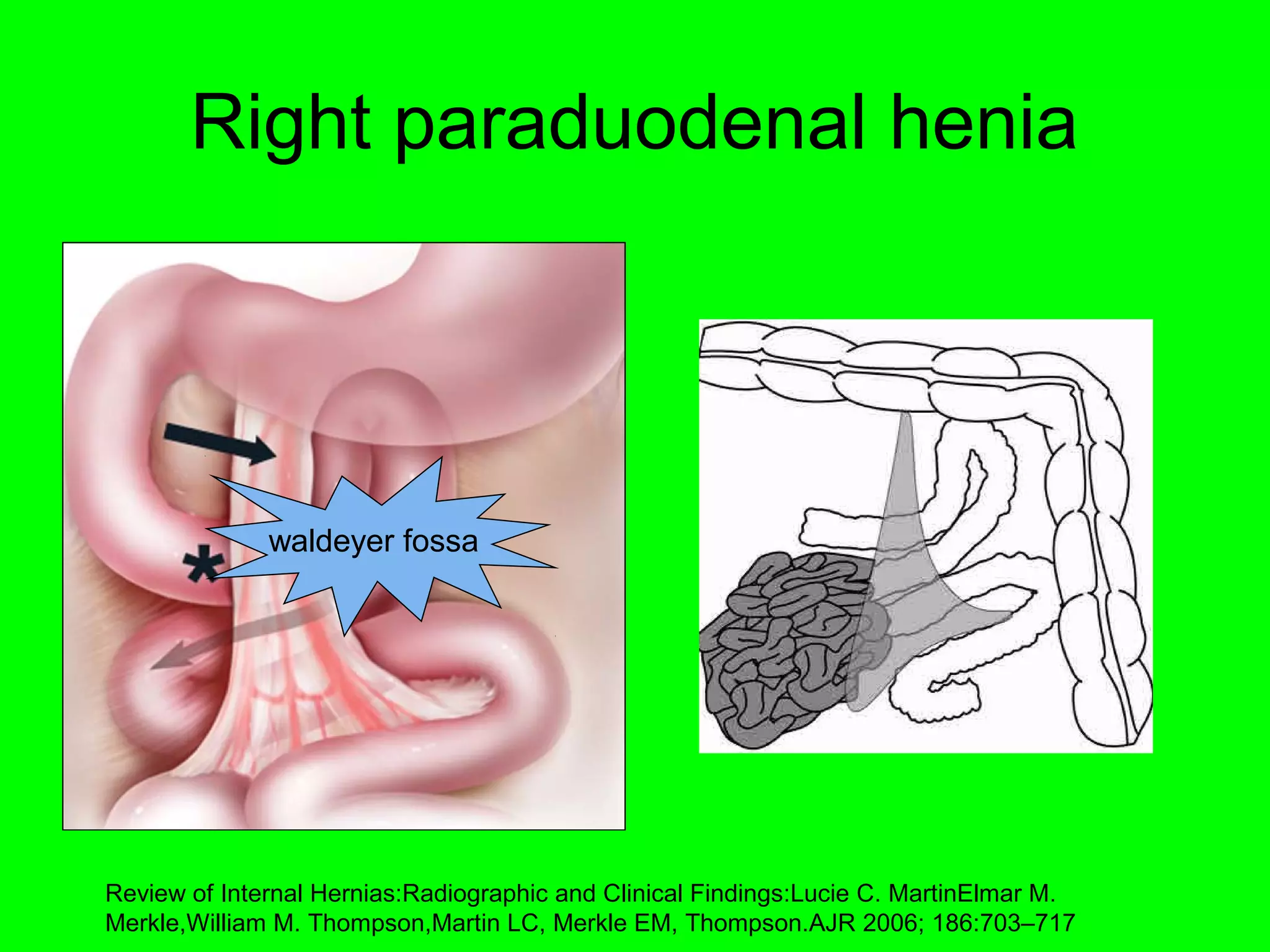
Right paraduodenal henia 
waldeyer fossa 
Review of Internal Hernias:Radiographic and Clinical Findings:Lucie C. MartinElmar M. 
Merkle,William M. Thompson,Martin LC, Merkle EM, Thompson.AJR 2006; 186:703–717
Right paraduodenal henia 
On a standard barium 
gastrointestinal 
examination, 
a larger and more fixed, 
encapsulated, 
ovoid collection of bowel 
loops is noted lateral and 
inferior to the descending 
duodenum, in the right 
half of the transverse 
mesocolon.
Right paraduodenal henia..CT 
SMA
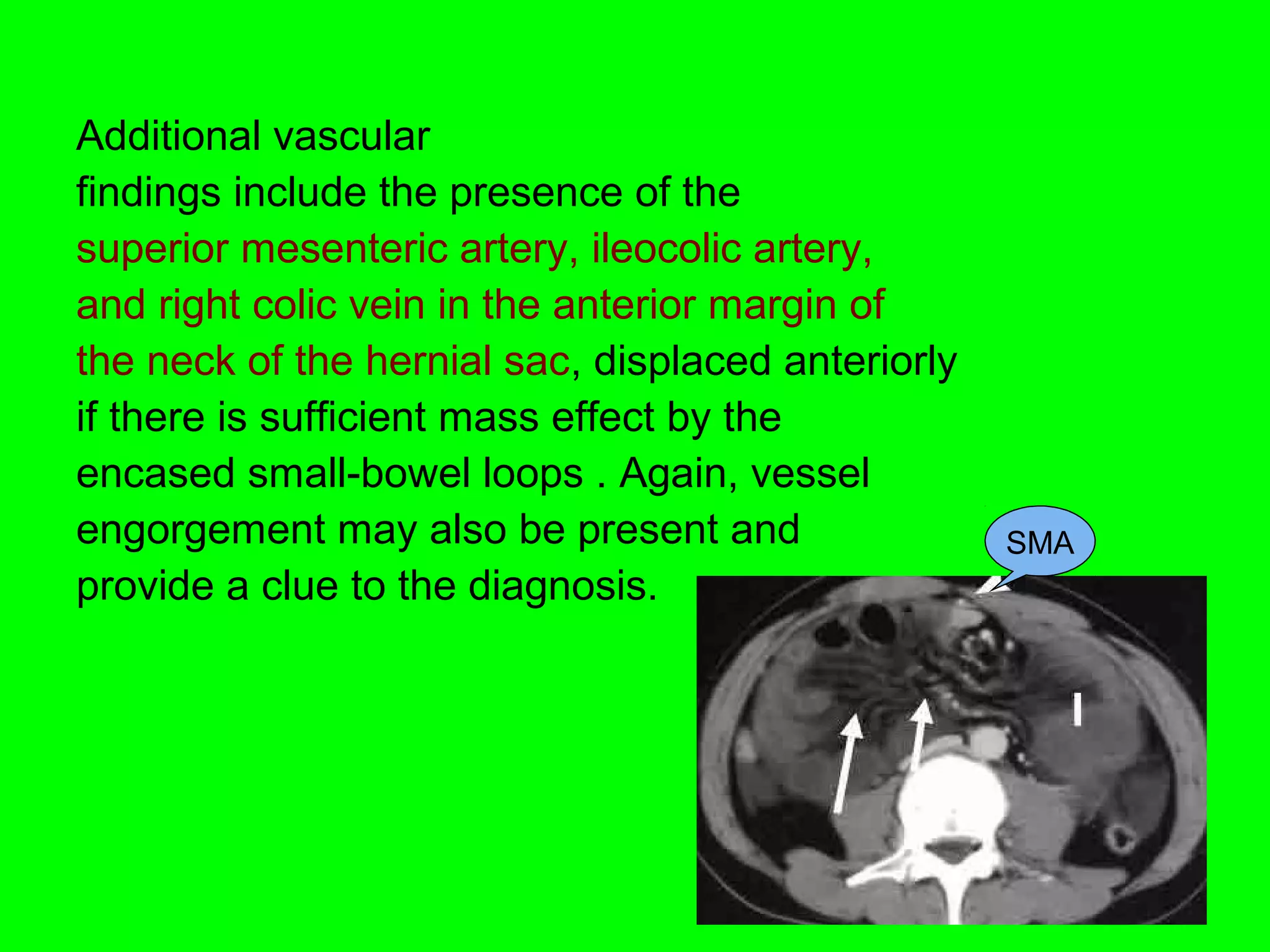
Additional vascular 
findings include the presence of the 
superior mesenteric artery, ileocolic artery, 
and right colic vein in the anterior margin of 
the neck of the hernial sac, displaced anteriorly 
if there is sufficient mass effect by the 
encased small-bowel loops . Again, vessel 
engorgement may also be present and 
provide a clue to the diagnosis. 
SMA
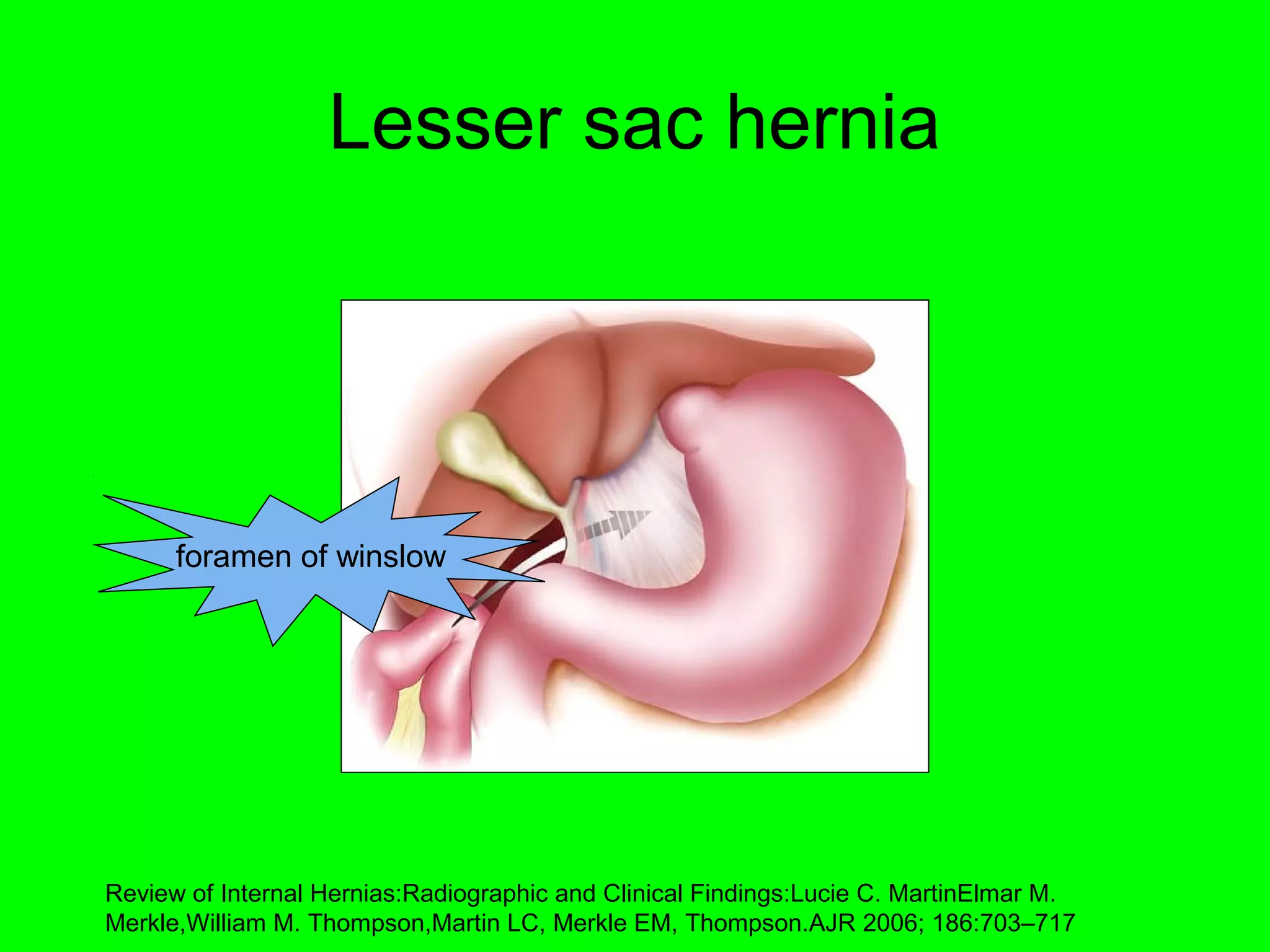
Lesser sac hernia 
foramen of winslow 
Review of Internal Hernias:Radiographic and Clinical Findings:Lucie C. MartinElmar M. 
Merkle,William M. Thompson,Martin LC, Merkle EM, Thompson.AJR 2006; 186:703–717
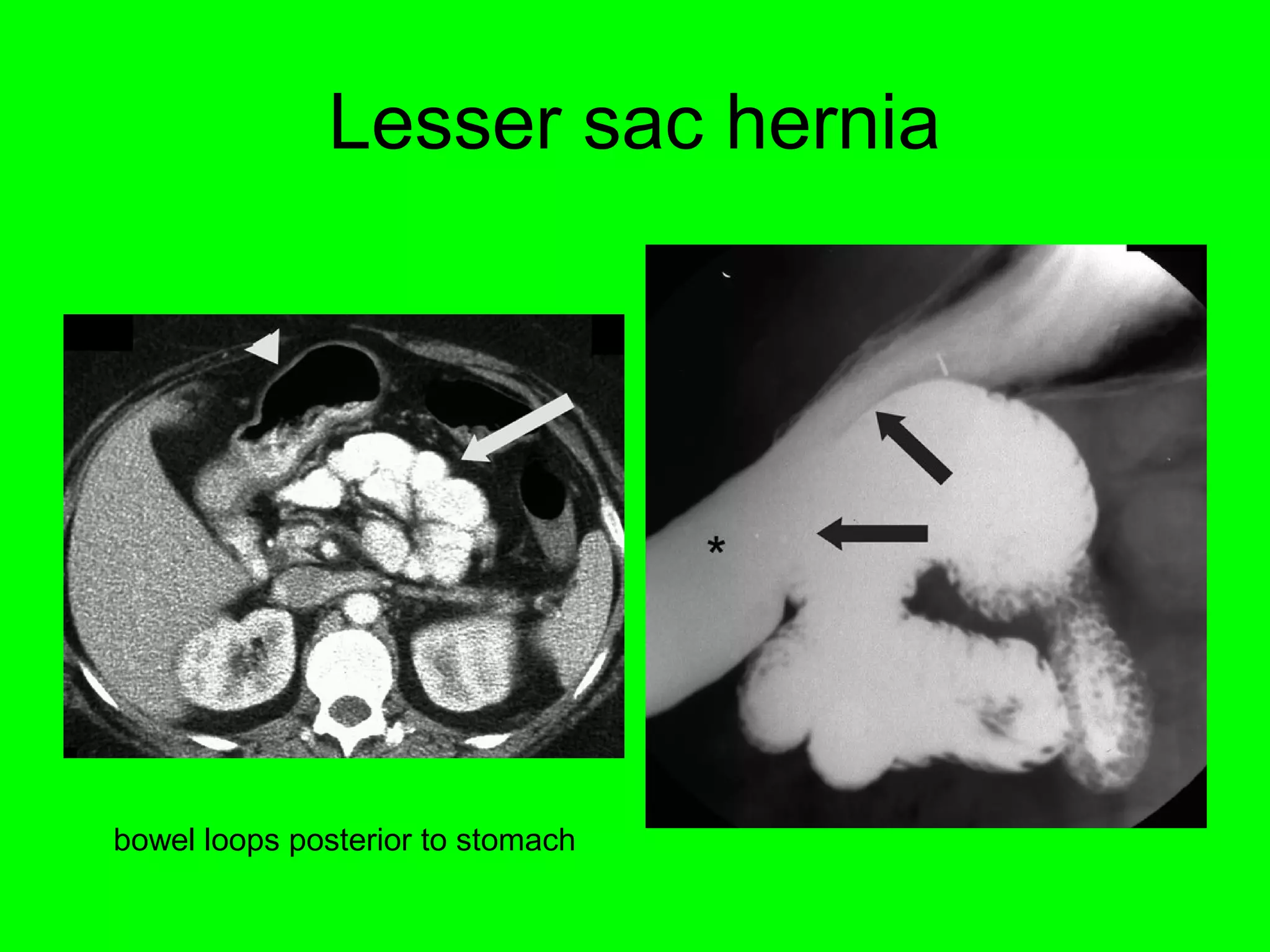
Lesser sac hernia 
Risk factors for this type of hernia include 
an enlarged foramen of Winslow, an 
abnormally long small-bowel mesentery, 
persistence of the ascending mesocolon 
allowing marked mobility of bowel,
Lesser sac hernia 
bowel loops posterior to stomach
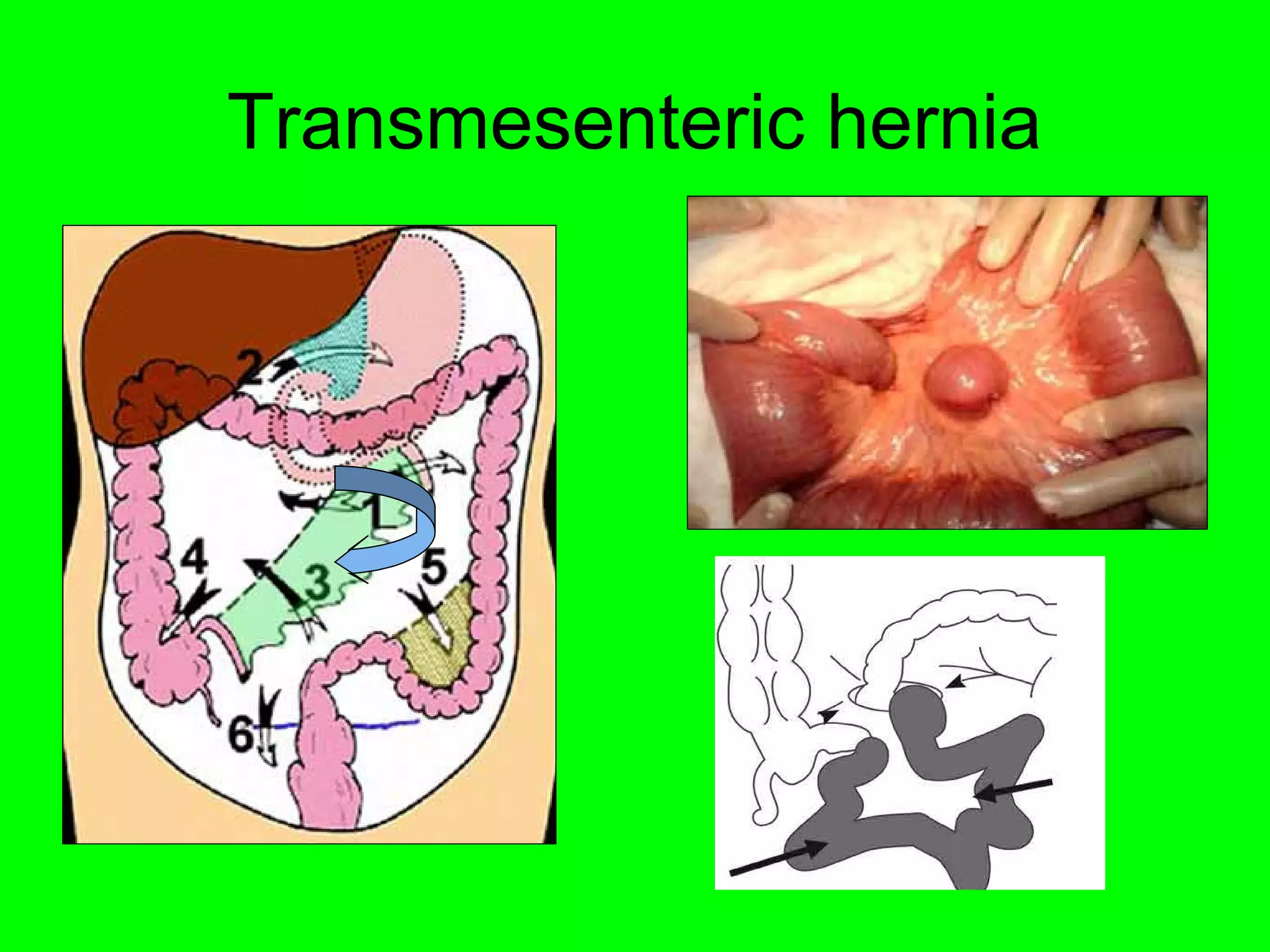
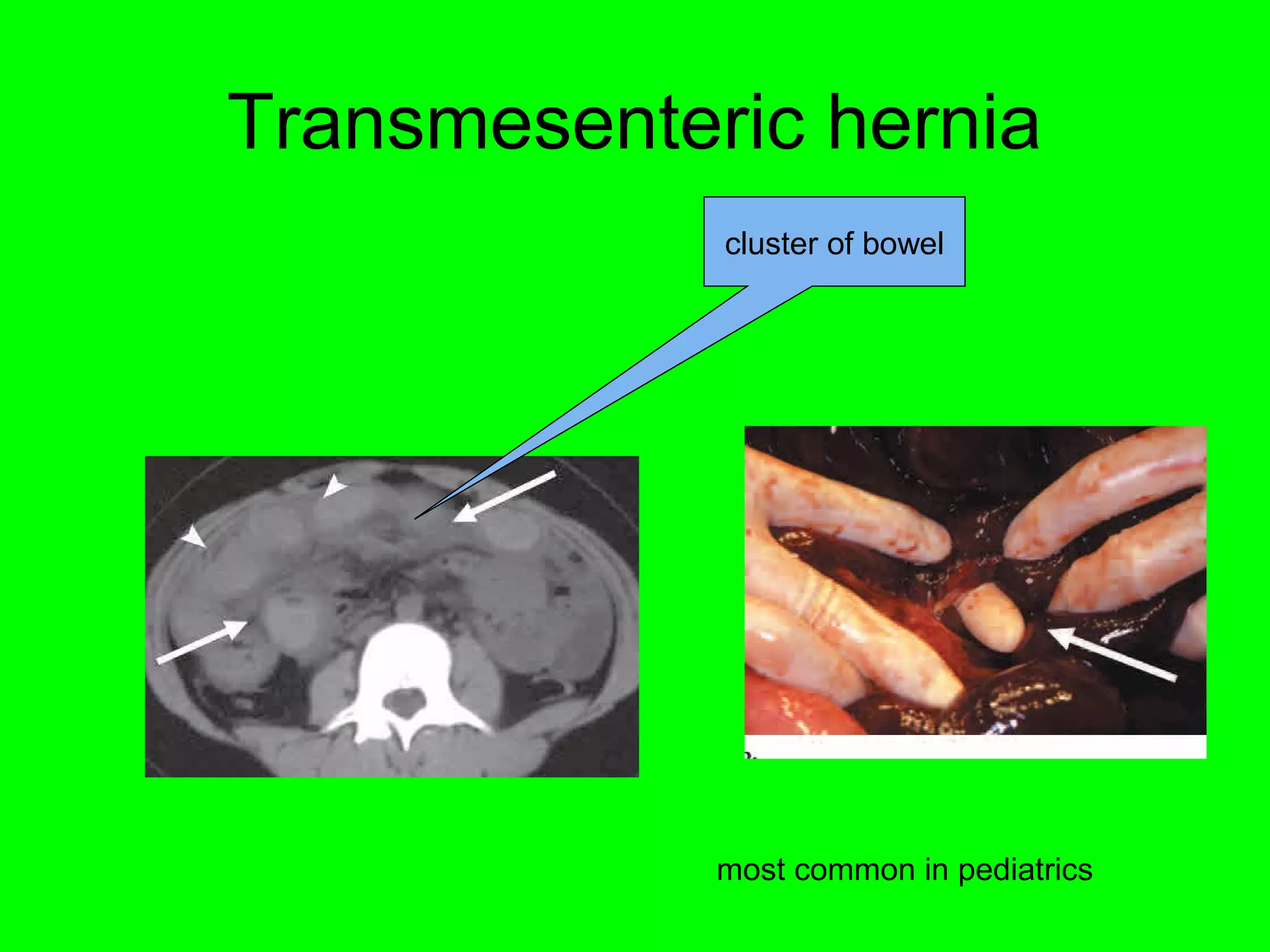
Transmesenteric hernia
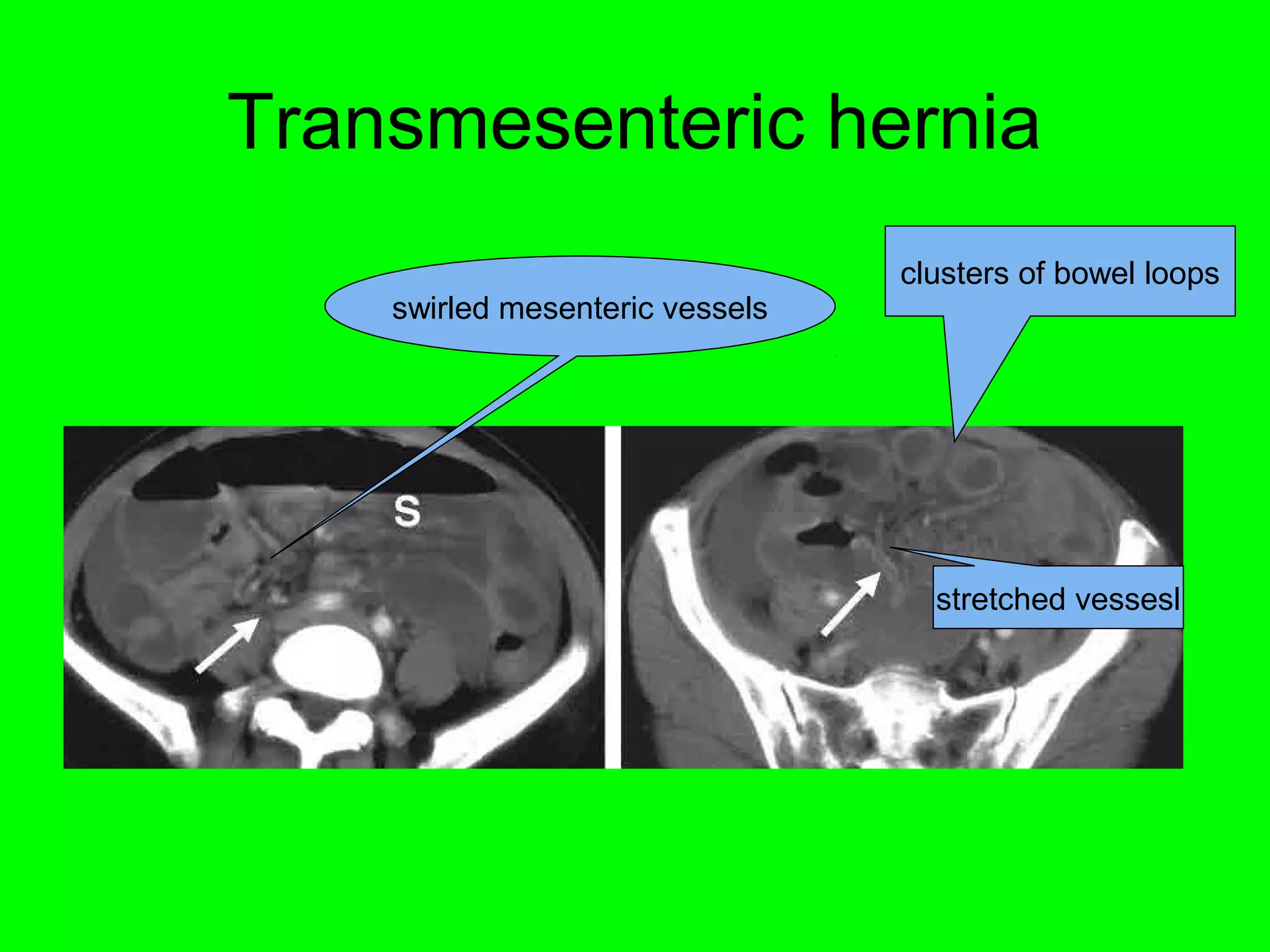
Transmesenteric hernia 
swirled mesenteric vessels 
clusters of bowel loops 
stretched vessesl
Transmesenteric hernia 
cluster of bowel 
most common in pediatrics
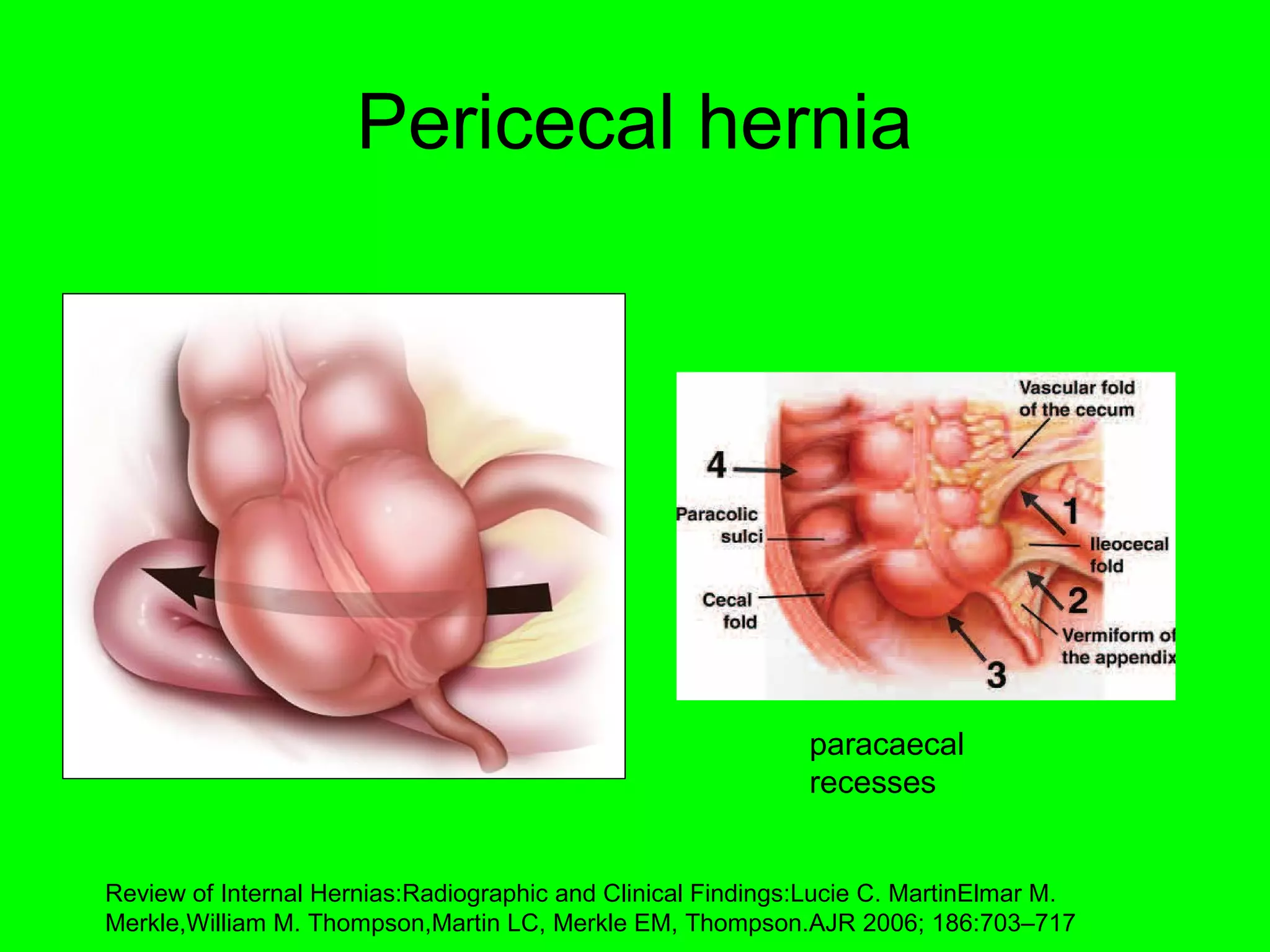
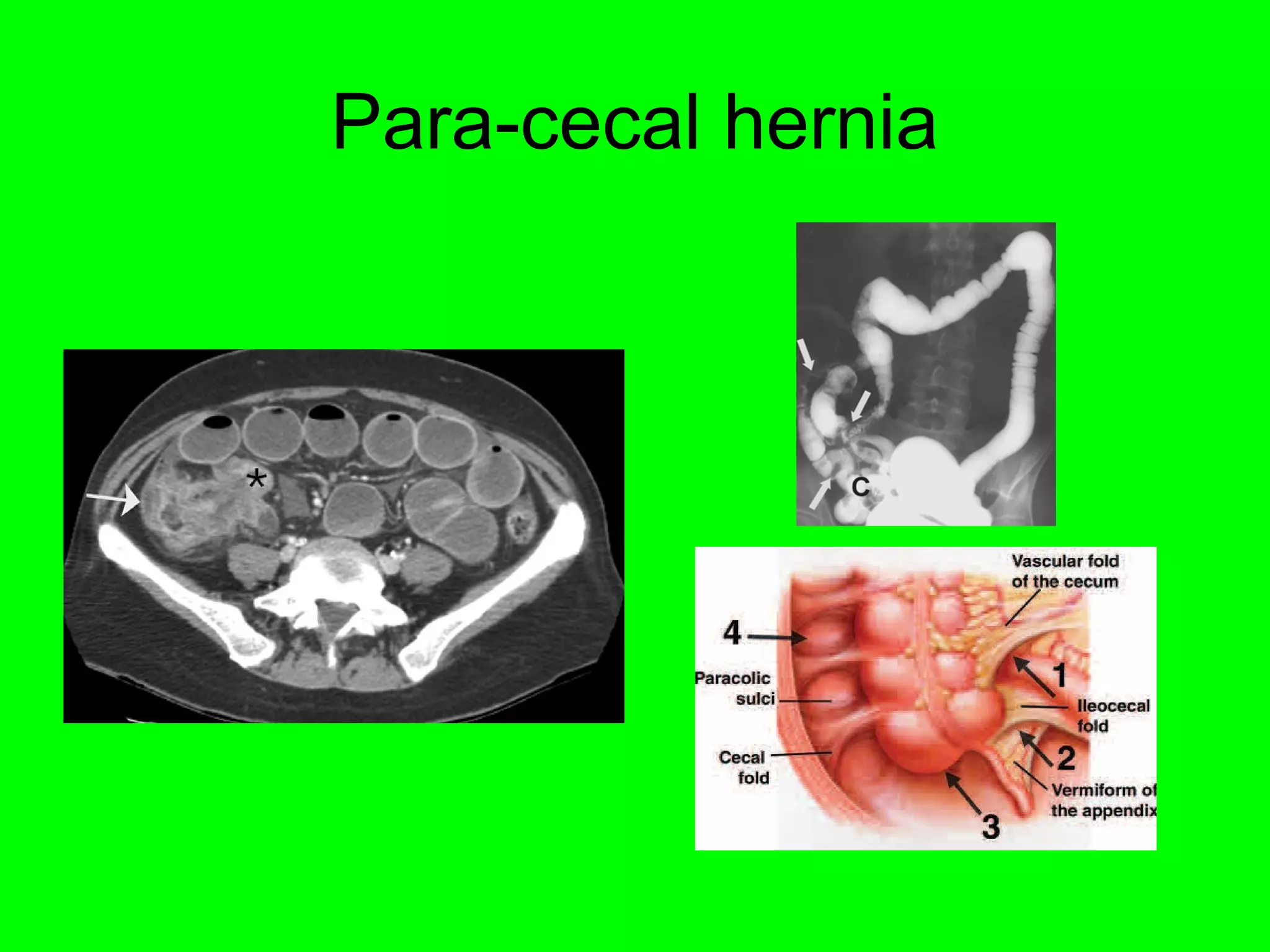
Pericecal hernia 
paracaecal 
recesses 
Review of Internal Hernias:Radiographic and Clinical Findings:Lucie C. MartinElmar M. 
Merkle,William M. Thompson,Martin LC, Merkle EM, Thompson.AJR 2006; 186:703–717
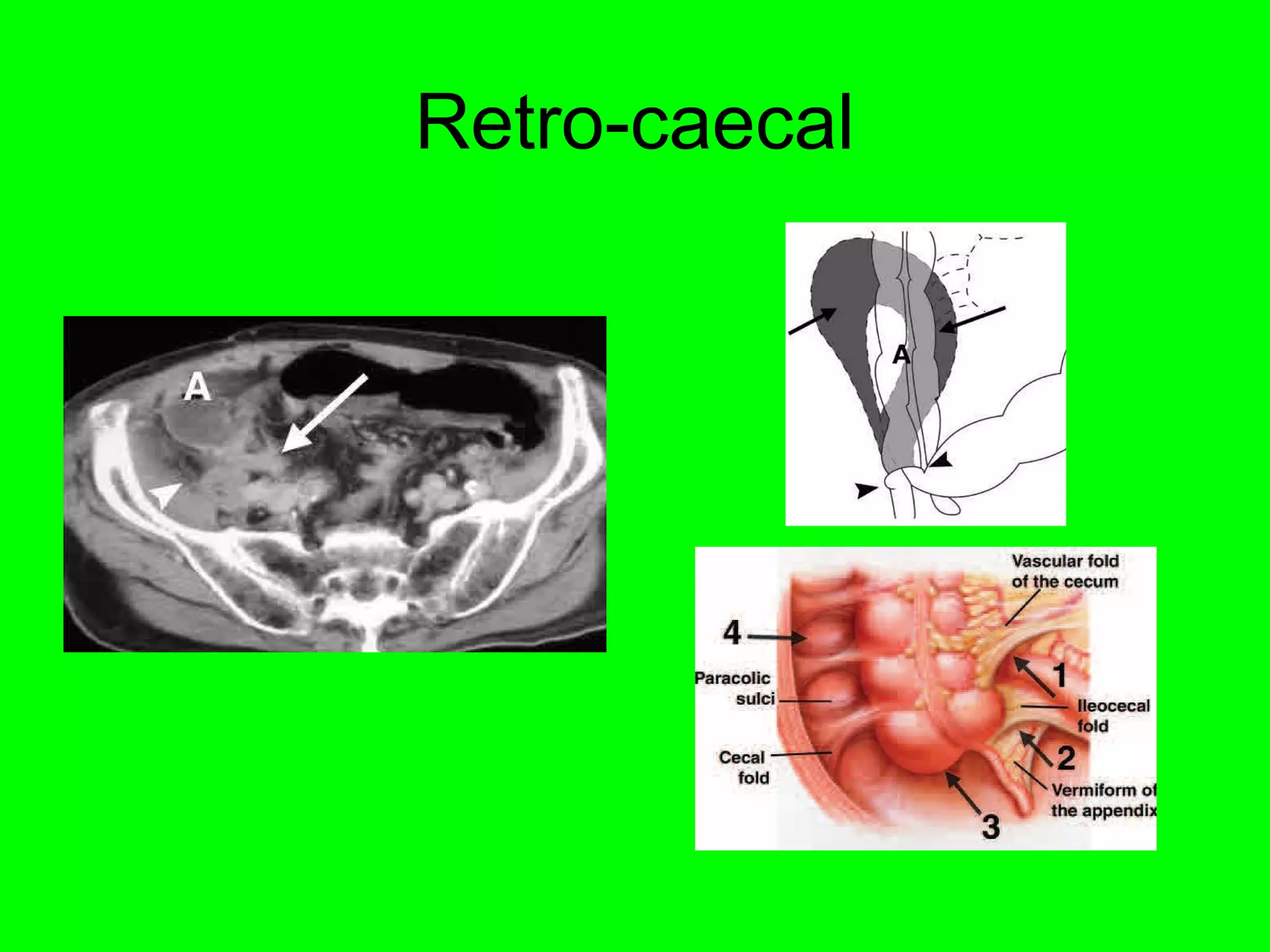
Retro-caecal
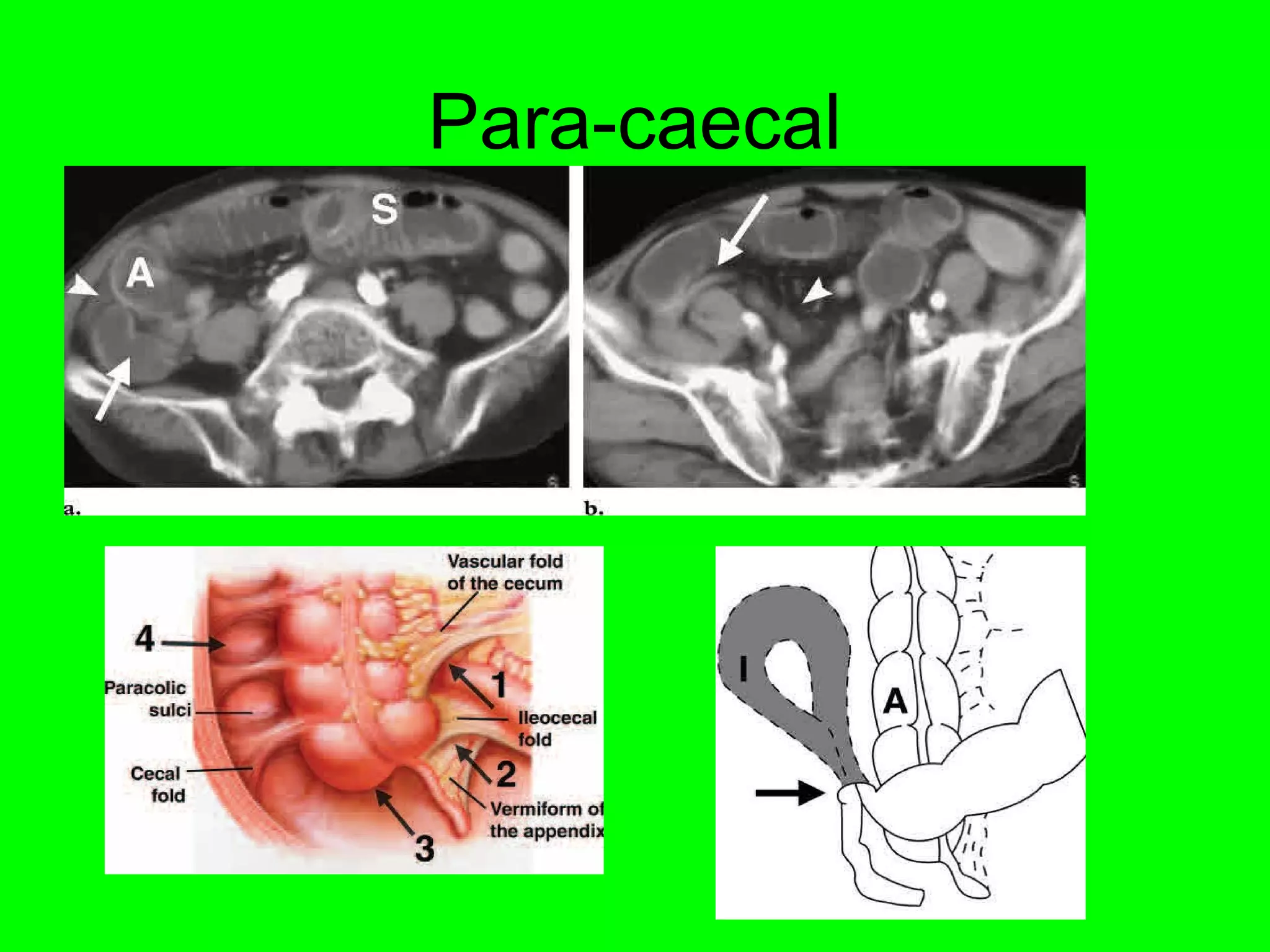
Para-caecal
Para-cecal hernia
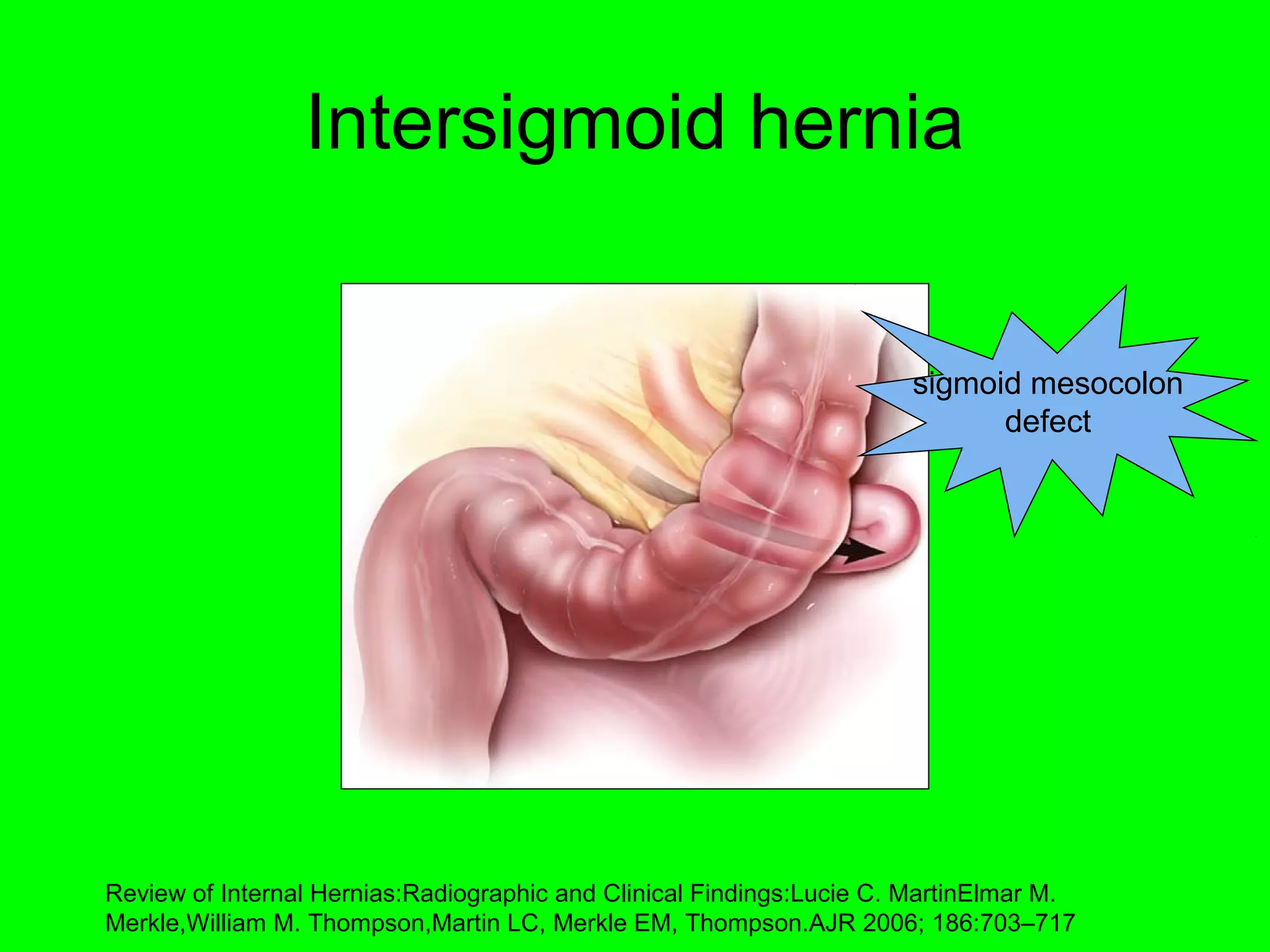
Intersigmoid hernia 
sigmoid mesocolon 
defect 
Review of Internal Hernias:Radiographic and Clinical Findings:Lucie C. MartinElmar M. 
Merkle,William M. Thompson,Martin LC, Merkle EM, Thompson.AJR 2006; 186:703–717
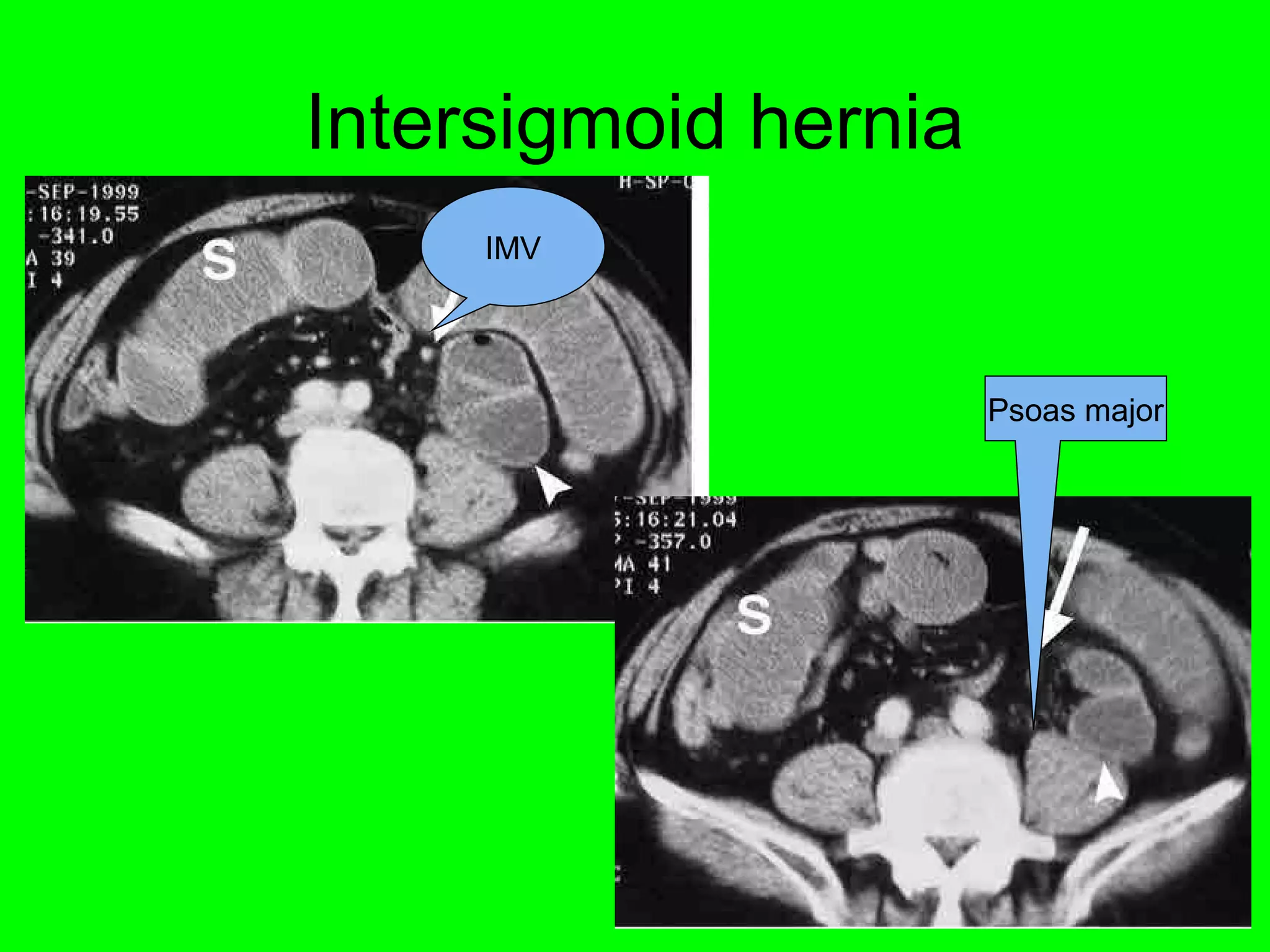
Intersigmoid hernia 
IMV 
Psoas major
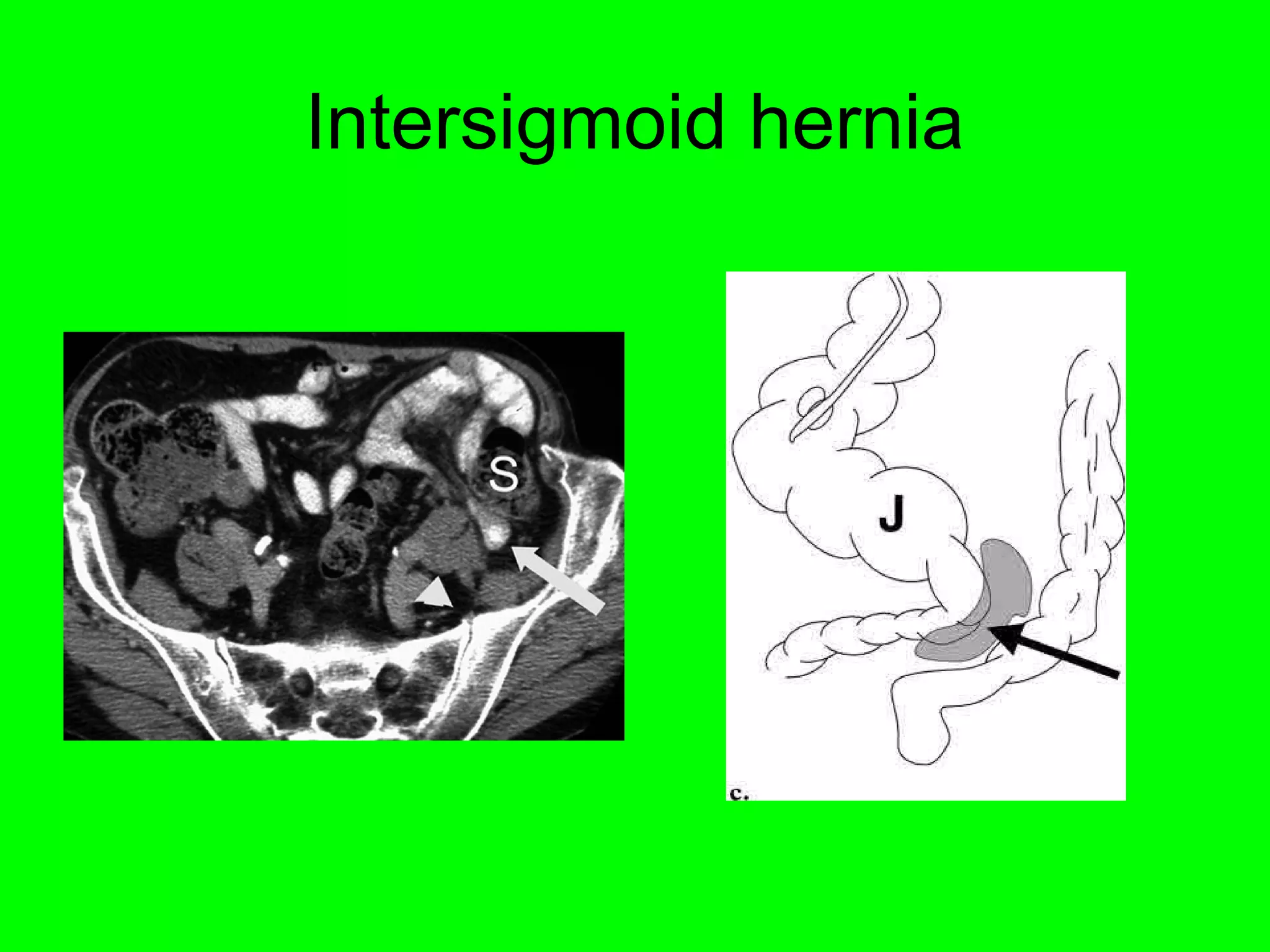
Intersigmoid hernia
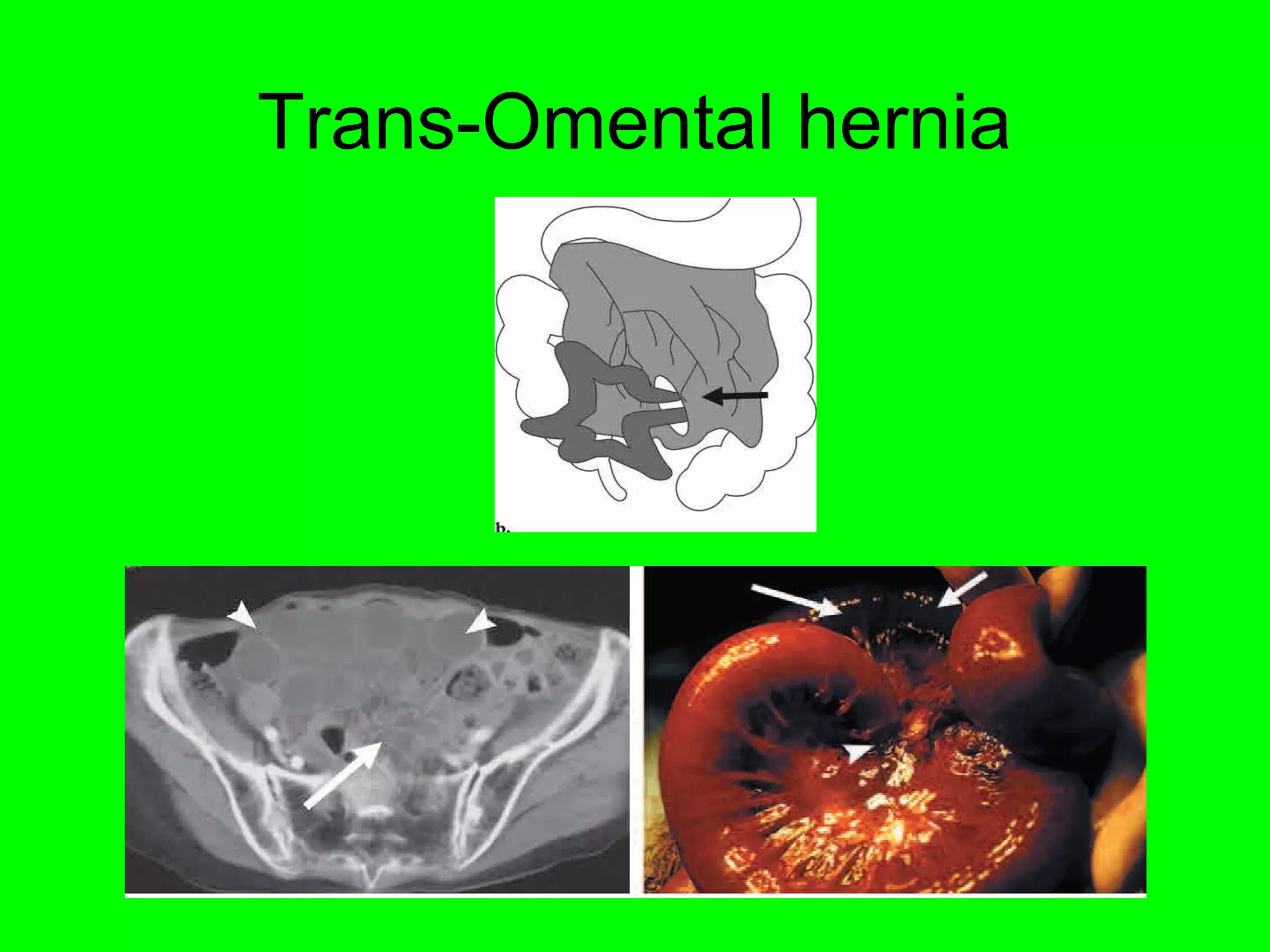
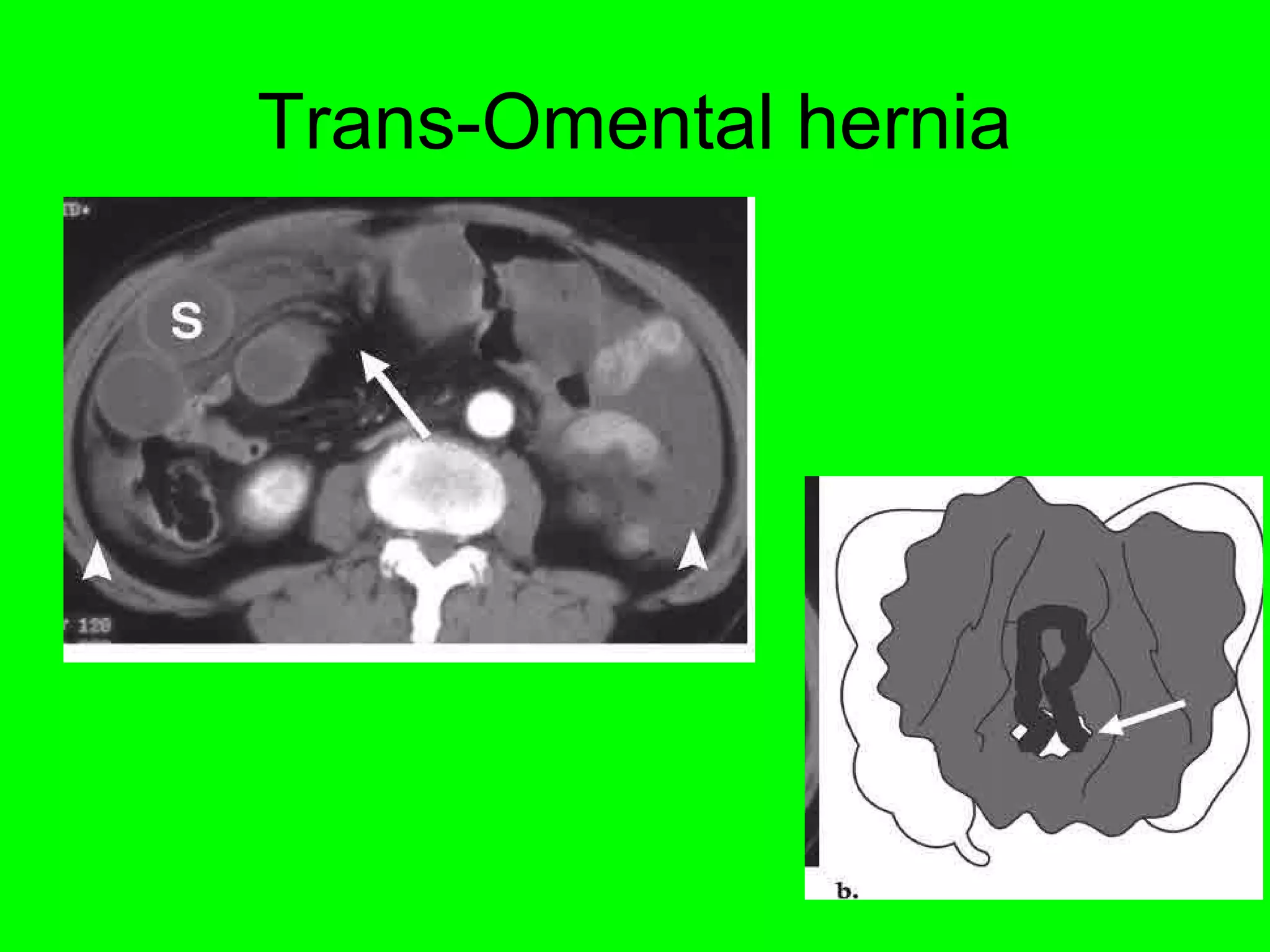
Trans-Omental hernia
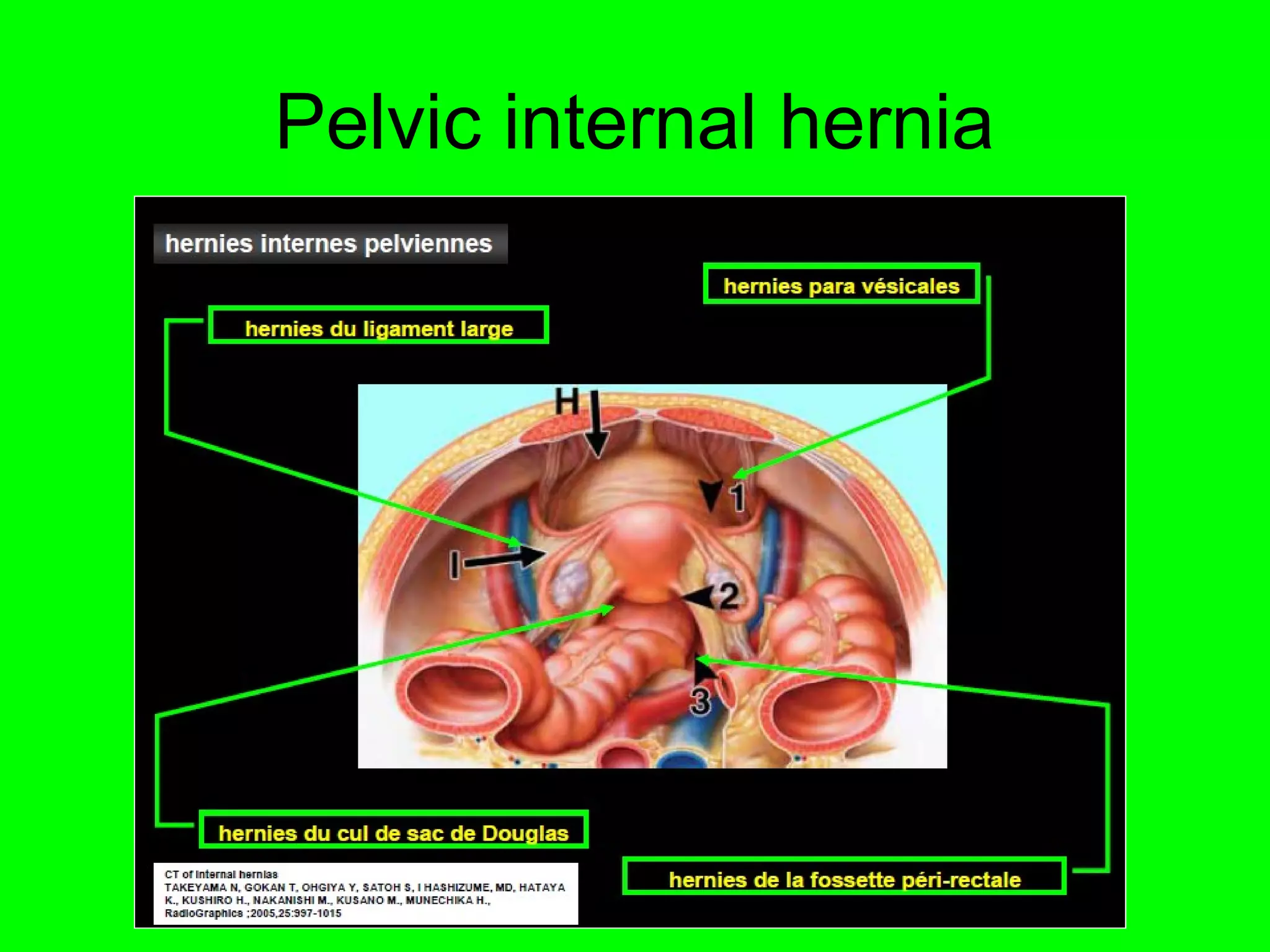
Pelvic internal hernia
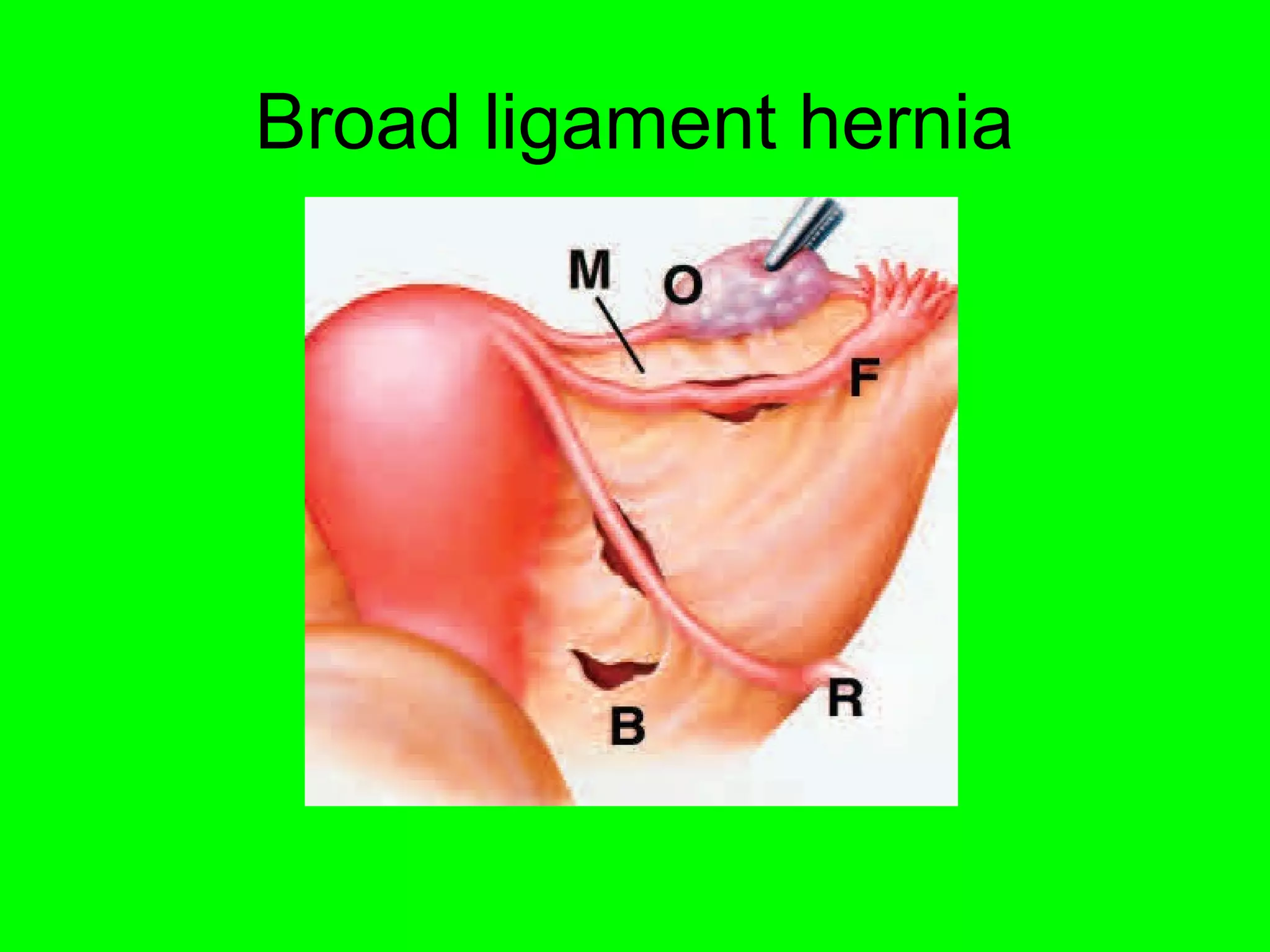
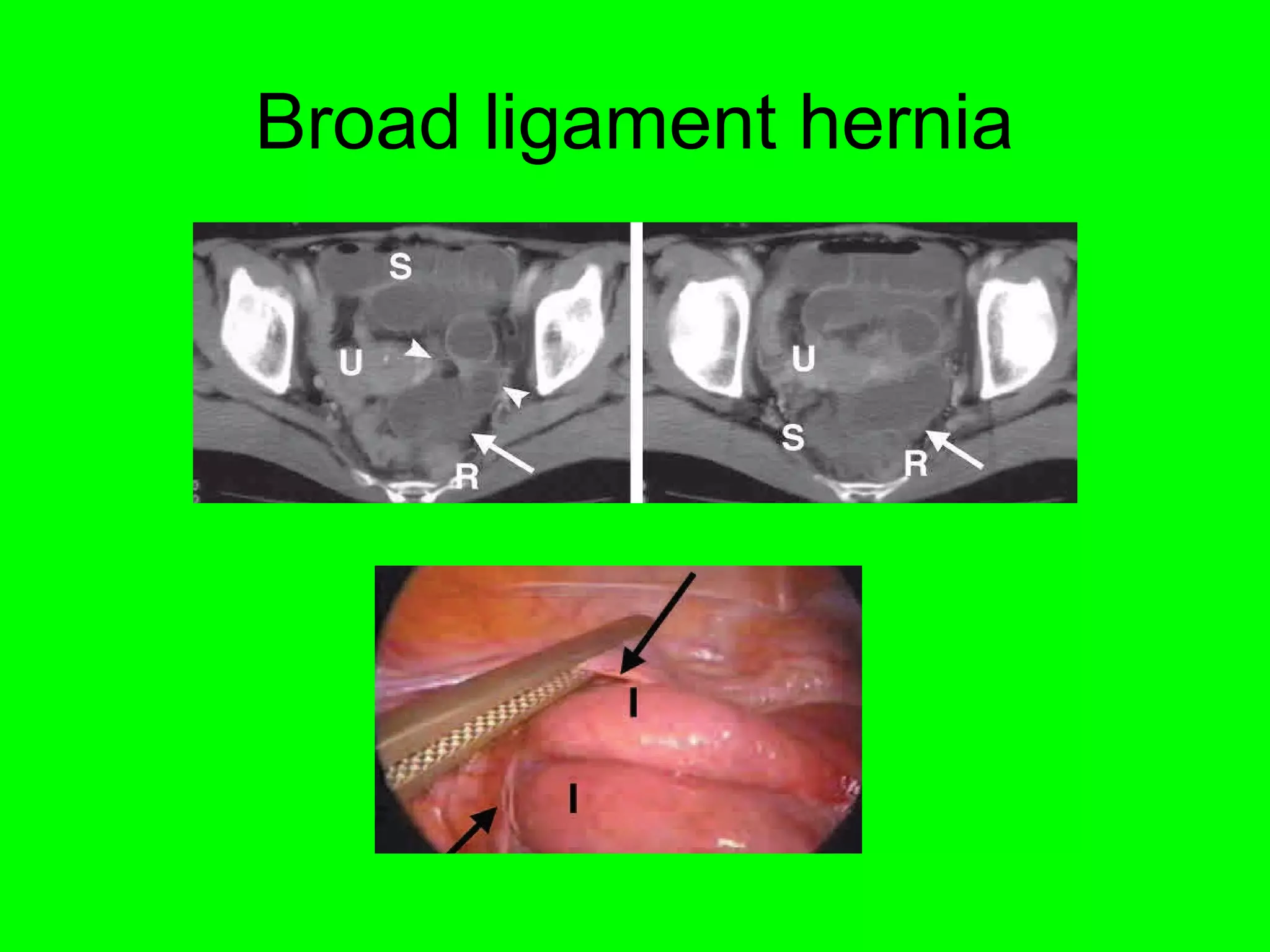
Broad ligament hernia
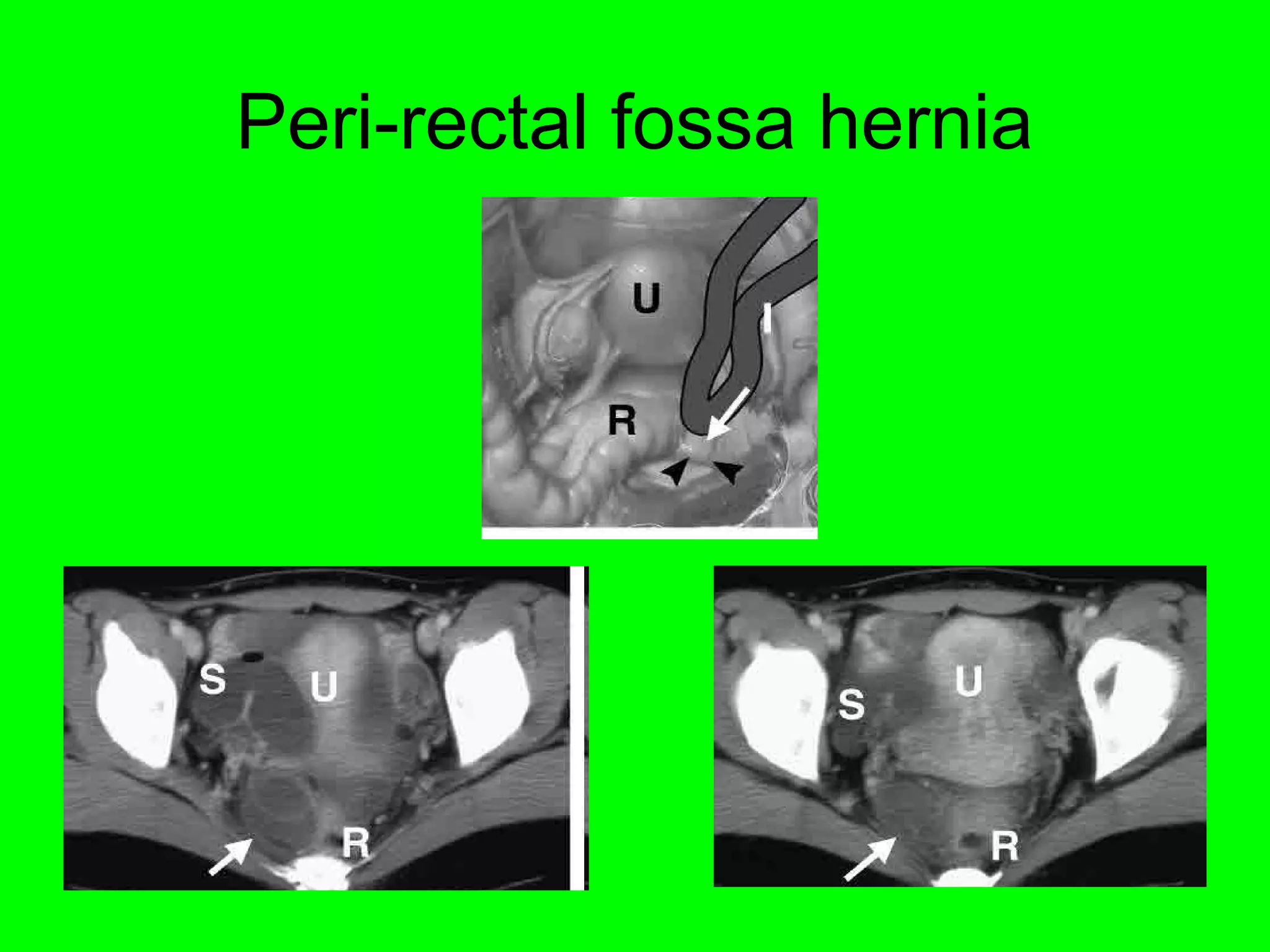
Peri-rectal fossa hernia
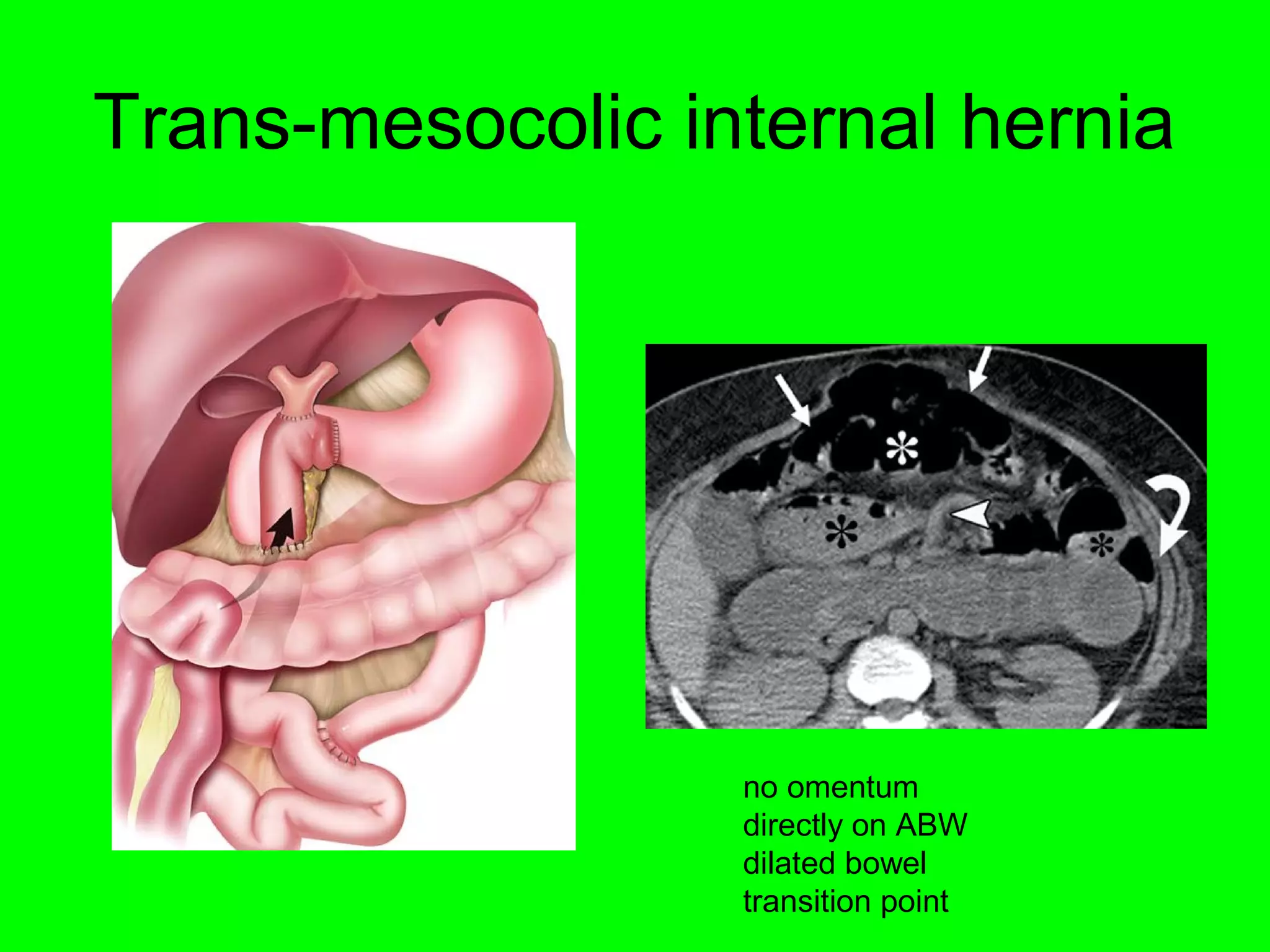
Trans-mesocolic internal hernia 
no omentum 
directly on ABW 
dilated bowel 
transition point
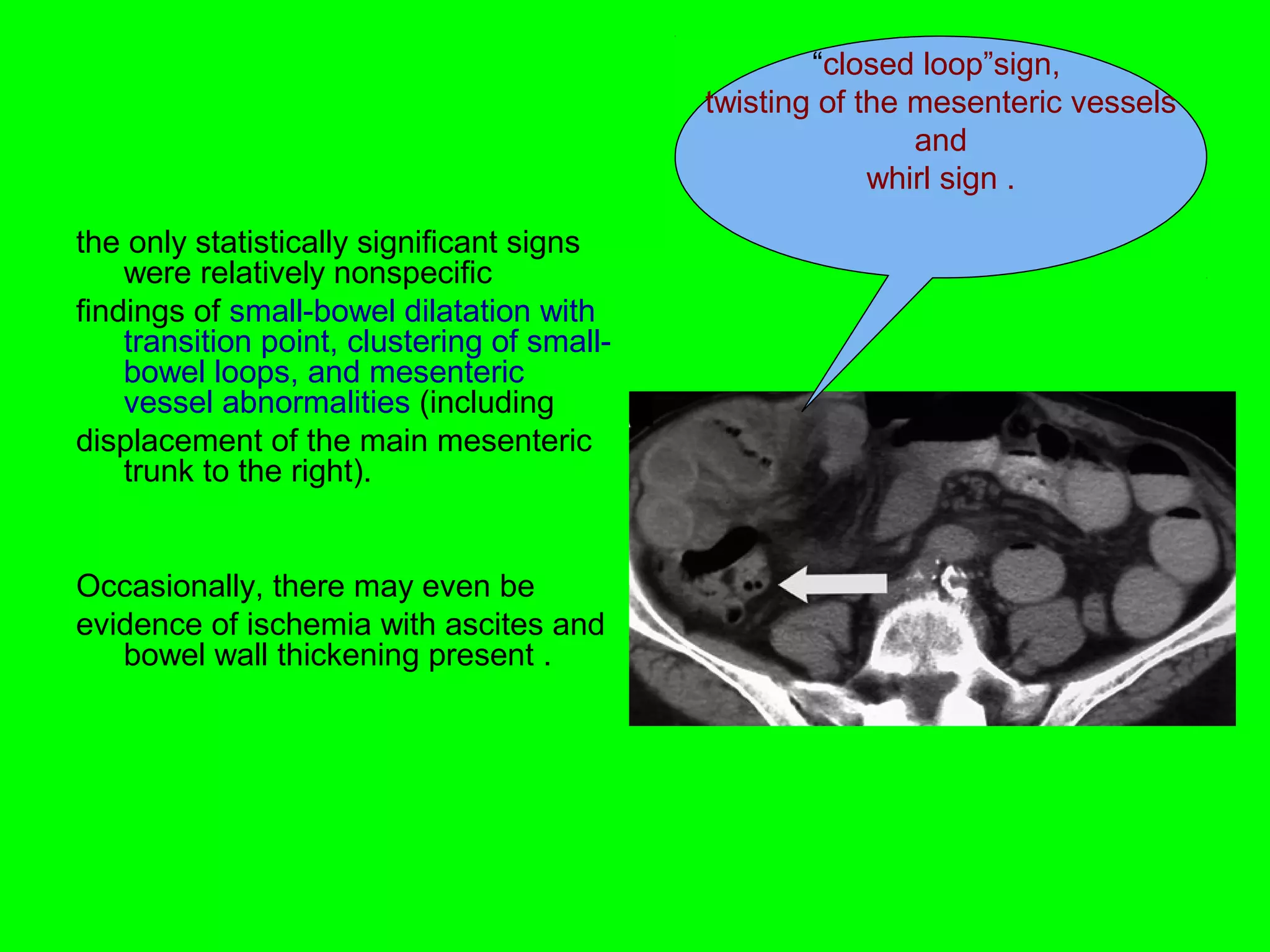
the only statistically significant signs 
were relatively nonspecific 
findings of small-bowel dilatation with 
transition point, clustering of small-bowel 
loops, and mesenteric 
vessel abnormalities (including 
displacement of the main mesenteric 
trunk to the right). 
Occasionally, there may even be 
evidence of ischemia with ascites and 
bowel wall thickening present . 
“closed loop”sign, 
twisting of the mesenteric vessels 
and 
whirl sign .
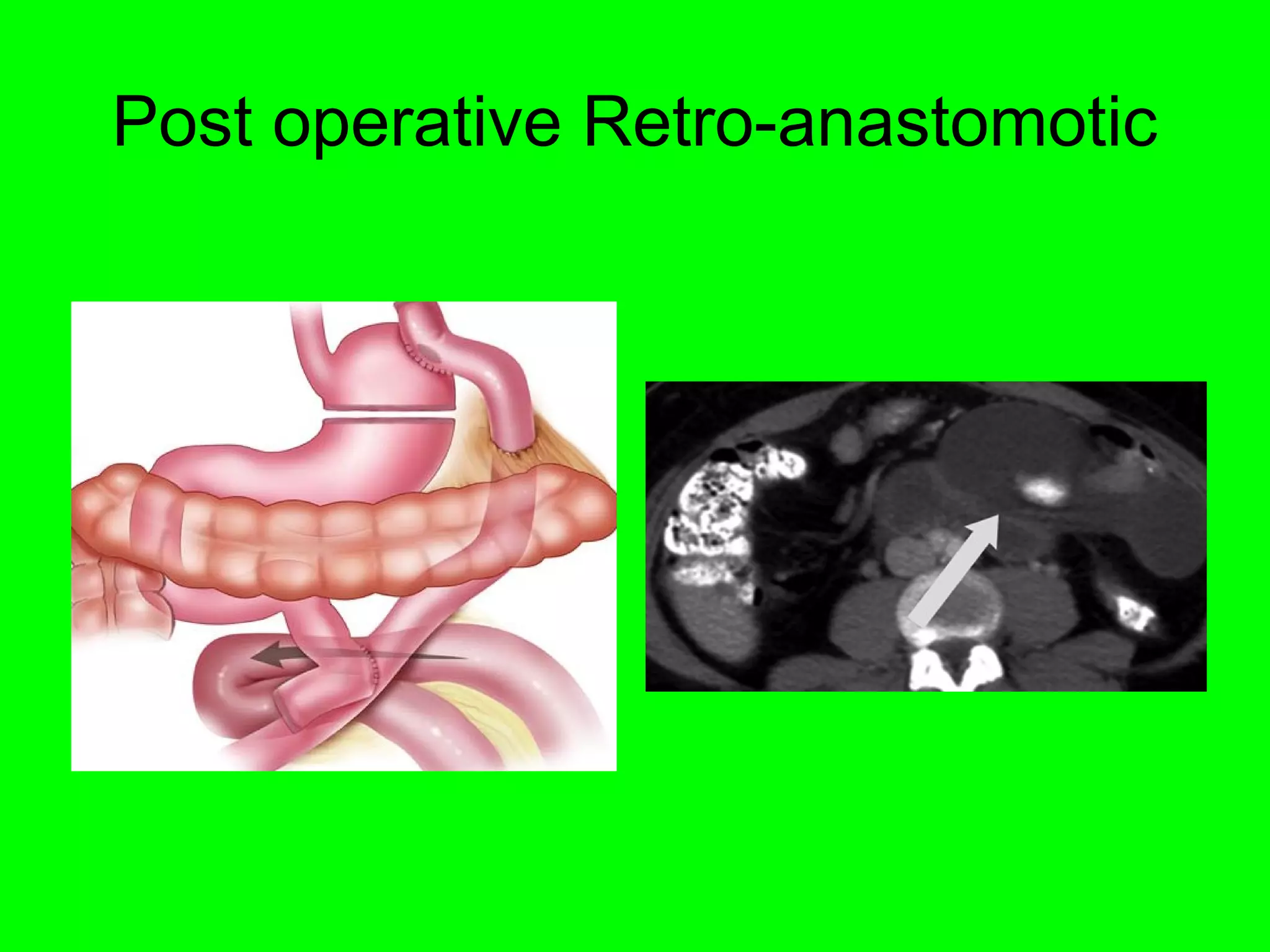
Post operative Retro-anastomotic
Advices 
• locate the abnormal position of bowel. 
• clustering , +/- encapsulation,dilatation. 
• any transitional point 
• Relation to other organs. 
• Study vessels status. 
• is it obstructed (surgical emergency)or not. 
• discuss with the referring physician (an 
abnormality is present i.e.:follow up ,and 
presence of data in patient file is important)
Squeezed through holes: imaging of internal hernia

Squeezed through holes: imaging of internal hernia

  • 1.
  • 2.
    Importance of subject Although internal hernias have an overall incidence of less than 1%, they constitute up to 5.8% of all small-bowel obstructions, which, if left untreated, have been reported to have an overall mortality exceeding 50% if strangulation is present
  • 3.
    Types of hernias Hernias are of two main types, external and internal . External hernias refer to prolapse of intestinal loops through a defect in the wall of the abdomen or pelvis, and internal hernias are defined by the protrusion of a viscus through a normal or abnormal peritoneal or mesenteric aperture within the confines of the peritoneal cavity. The orifice can be either acquired, such as a postsurgical, traumatic, or postinflammatory defect, or congenital, including both normal apertures, such as the foramen of Winslow, and abnormal apertures arising from anomalies of internal rotation and peritoneal attachment.
  • 4.
    Clinical presentation Clinically,internal hernias can be asymptomatic or cause significant discomfort ranging from constant vague epigastric pain to intermittent colicky periumbilical pain. symptoms include nausea, vomiting (especially after a large meal), and recurrent intestinal obstruction
  • 7.
    Fluoroscopy General radiographic features with barium studies include apparent encapsulation of distended bowel loops with an abnormal location, arrangement or crowding of small-bowel loops within the hernial sac, evidence of obstruction with segmental dilatation and stasis, with additional features of apparent fixation and reversed peristalsis during fluoroscopic evaluation
  • 8.
    CT On CT,additional findings include mesenteric vessel abnormalities, with engorgement, crowding, twisting, and stretching of these vessels commonly found and providing an important clue to the underlying diagnosis
  • 9.
    Diagrammatic illustration shows various types of internal hernias: A = paraduodenal, B = foramen of Winslow, C = intersigmoid, D = pericecal, E = transmesenteric, and F = retroanastomotic. Review of Internal Hernias:Radiographic and Clinical Findings:Lucie C. MartinElmar M. Merkle,William M. Thompson,Martin LC, Merkle EM, Thompson.AJR 2006; 186:703–717
  • 10.
    Paraduodenal fossae Drawing(coronal view) shows the locations of duodenal fossae. Arrows indicate the directions of hernias through these fossae. The frequency with which each fossa is found at autopsy is given in parentheses. 1. superior duodenal fossa (50%), 2.inferior duodenal fossa (fossa of Treitz) (75%), 3.paraduodenal fossa (fossa of Landzert) (2%), 4.intermesocolic fossa (fossa of Broesike), 5.mesentericoparietal fossa (fossa of Waldeyer)
  • 11.
    Left paraduodenal hernia Landzert's fossa Review of Internal Hernias:Radiographic and Clinical Findings:Lucie C. MartinElmar M. Merkle,William M. Thompson,Martin LC, Merkle EM, Thompson.AJR 2006; 186:703–717
  • 12.
    Left paraduodenal hernia Left paraduodenal hernias have an overall incidence of approximately 40% of internal hernias. They occur when bowel prolapses through Landzert’s fossa, an aperture present in approximately 2% of the population These hernias therefore can be classified as a congenital type, normal aperture subtype. Landzert’s fossa is located behind the ascending or fourth part of the duodenum and is formed by the lifting up of a peritoneal fold by the inferior mesenteric vein and ascending left colic artery as they run along the lateral side of the fossa. Small bowel loops prolapse posteroinferiorly through the fossa to the left of the fourth part of the duodenum into the left portion of the transverse mesocolon.
  • 13.
    Left paraduodenal hernia lt adrenal stretched IMV
  • 14.
    Left paraduodenal hernia engorged vessels
  • 15.
    Right paraduodenal henia Right paraduodenal hernias have an overall incidence of approximately 13% and occur when bowel herniates through Waldeyer’s fossa (representing a defect in the first part of the jejunal mesentery), behind the superior mesenteric artery and inferior to the transverse or third portion of the duodenum . This type of hernia occurs more frequently in the setting of nonrotated small bowel .
  • 16.
    Right paraduodenal henia waldeyer fossa Review of Internal Hernias:Radiographic and Clinical Findings:Lucie C. MartinElmar M. Merkle,William M. Thompson,Martin LC, Merkle EM, Thompson.AJR 2006; 186:703–717
  • 17.
    Right paraduodenal henia On a standard barium gastrointestinal examination, a larger and more fixed, encapsulated, ovoid collection of bowel loops is noted lateral and inferior to the descending duodenum, in the right half of the transverse mesocolon.
  • 18.
  • 19.
    Additional vascular findingsinclude the presence of the superior mesenteric artery, ileocolic artery, and right colic vein in the anterior margin of the neck of the hernial sac, displaced anteriorly if there is sufficient mass effect by the encased small-bowel loops . Again, vessel engorgement may also be present and provide a clue to the diagnosis. SMA
  • 20.
    Lesser sac hernia foramen of winslow Review of Internal Hernias:Radiographic and Clinical Findings:Lucie C. MartinElmar M. Merkle,William M. Thompson,Martin LC, Merkle EM, Thompson.AJR 2006; 186:703–717
  • 21.
    Lesser sac hernia Risk factors for this type of hernia include an enlarged foramen of Winslow, an abnormally long small-bowel mesentery, persistence of the ascending mesocolon allowing marked mobility of bowel,
  • 22.
    Lesser sac hernia bowel loops posterior to stomach
  • 23.
  • 24.
    Transmesenteric hernia swirledmesenteric vessels clusters of bowel loops stretched vessesl
  • 25.
    Transmesenteric hernia clusterof bowel most common in pediatrics
  • 26.
    Pericecal hernia paracaecal recesses Review of Internal Hernias:Radiographic and Clinical Findings:Lucie C. MartinElmar M. Merkle,William M. Thompson,Martin LC, Merkle EM, Thompson.AJR 2006; 186:703–717
  • 27.
  • 28.
  • 29.
  • 30.
    Intersigmoid hernia sigmoidmesocolon defect Review of Internal Hernias:Radiographic and Clinical Findings:Lucie C. MartinElmar M. Merkle,William M. Thompson,Martin LC, Merkle EM, Thompson.AJR 2006; 186:703–717
  • 31.
  • 32.
  • 33.
  • 34.
  • 35.
  • 36.
  • 37.
  • 38.
  • 39.
    Trans-mesocolic internal hernia no omentum directly on ABW dilated bowel transition point
  • 40.
    the only statisticallysignificant signs were relatively nonspecific findings of small-bowel dilatation with transition point, clustering of small-bowel loops, and mesenteric vessel abnormalities (including displacement of the main mesenteric trunk to the right). Occasionally, there may even be evidence of ischemia with ascites and bowel wall thickening present . “closed loop”sign, twisting of the mesenteric vessels and whirl sign .
  • 41.
  • 42.
    Advices • locatethe abnormal position of bowel. • clustering , +/- encapsulation,dilatation. • any transitional point • Relation to other organs. • Study vessels status. • is it obstructed (surgical emergency)or not. • discuss with the referring physician (an abnormality is present i.e.:follow up ,and presence of data in patient file is important)