Magnetic Resonance Imaging
(MRI)
By:-
Mr. Vikas Chandra Sharma
Asst. Prof., Department of Chemistry
SHRI SHANKARACHARYA MAHAVIDYALAYA
Junwani- Bhilai
ROADMAP
Introduction
History
Principle of MRI
Mechanism
Types of MRI
Types of MRI scan
Applications
Conclusion
Reference
Introduction
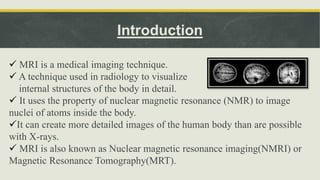
 MRI is a medical imaging technique.
 A technique used in radiology to visualize
internal structures of the body in detail.
 It uses the property of nuclear magnetic resonance (NMR) to image
nuclei of atoms inside the body.
It can create more detailed images of the human body than are possible
with X-rays.
 MRI is also known as Nuclear magnetic resonance imaging(NMRI) or
Magnetic Resonance Tomography(MRT).
History
YEAR NAME OF SCIENTIST DISCOV ERIES
1952 Herman Carr One dimensional image of MRI.
1971 Raymond Damadian Reported that tumors and normal tissues can be
distinguished in vivo by nuclear magnetic resonance.
1972 Raymond Damadian First discovery of MRI machine.
1974 Paul Lauteber Ways to get 2D and 3D images of MRI
Late 1970’s Peter Mansfield A mathematical technique that would allow scans in
seconds than hours.
1980 Paul Bottomley Overcome various problems of MRI.
2003 Paul Lauterbur & Peter Mansfield They got Noble Prize for discoveries concerning MRI.
Principle of mri
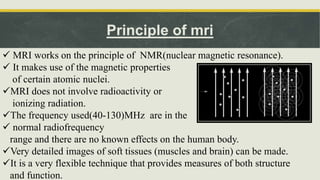
 MRI works on the principle of NMR(nuclear magnetic resonance).
 It makes use of the magnetic properties
of certain atomic nuclei.
MRI does not involve radioactivity or
ionizing radiation.
The frequency used(40-130)MHz are in the
 normal radiofrequency
range and there are no known effects on the human body.
Very detailed images of soft tissues (muscles and brain) can be made.
It is a very flexible technique that provides measures of both structure
and function.
Mechanism
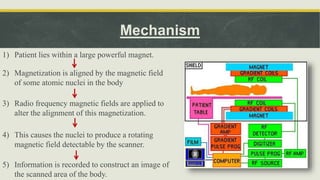
1) Patient lies within a large powerful magnet.
2) Magnetization is aligned by the magnetic field
of some atomic nuclei in the body
3) Radio frequency magnetic fields are applied to
alter the alignment of this magnetization.
4) This causes the nuclei to produce a rotating
magnetic field detectable by the scanner.
5) Information is recorded to construct an image of
the scanned area of the body.
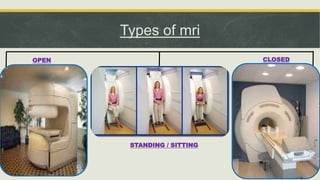
Types of mri
OPEN CLOSEDSTANDING / SITTING
•This machine has a
larger opening than
standard MRI’S .
•It has magnets that do
not completely surround
your body.
•Open MRI’S is good for
those who get nervous.
• This machine is useful in
specific cases.
•This machine allows the
patient to sit or stand.
•Currently they do not
provide a good image
quality.(may improve in
future)
•Useful in specific cases.
•This machine scan
patients faster.
•It has high field strength
and are capable of
achieving greater
resolution and thinner
slices for viewing smaller
parts of the anatomy.
•Useful in detecting
stroke, sclerosis knee
defect etc.
OPEN
STANDING / SITTING
CLOSED
Types of mri scan
MRI OR MAGNETIC RESONANCE IMAGING
applications
MRI’s are administrated to patients suffering from the following:-
• Inflammation or infection in an organ
• Degenerative diseases.
• Strokes
• Muscoskeletal disorders
• Tumors
• Other irregularities that exist in tissue or organs in their body.
High-resolution images of the organs or any area of the body can be made without the need
for using X-rays because MRI’s use radiofrequency(RF) light. Since they use RF light, MRI’s
do not present any known health risks to the patients, however anyone with mental implants
could not receive a MRI. If a person’s nervous system needed to be studied, an MRI would be
the best imaging method to use, especially if the brain or spinal cord needed to be
investigated.
Functionally MRI’s are done to determine which parts of the brain have control over which
uses of the human body. These MRI’s are critical in determining motor imagery, speech
portions of the brain, and diagnosing which parts of the brain may be effected by a tumor.
Some operations are deferred because a portion of the brain that is vital may be removed, and
this is only determined via functional MRI’s.
applications
conclusion
•MRI are a relatively new technology to hit the medical world, and have completely
revolutionized medical imaging and the diagnosing process as we know it.
• In- vivo images can be taken of the human body, meaning that internal images can
be seen without making any incisions.
•Completely non-intrusive procedures are used, which makes MRI’s very effective,
but somewhat expensive, for doctors to use.
References
•www.google.com
•NMR- Wikipedia, The free encyclopedia
•MRI- Wikipedia, The free encyclopedia
•Briatanica.com
•Webnet.com
THANK
YOU

MRI

  • 1.
    Magnetic Resonance Imaging (MRI) By:- Mr.Vikas Chandra Sharma Asst. Prof., Department of Chemistry SHRI SHANKARACHARYA MAHAVIDYALAYA Junwani- Bhilai
  • 2.
    ROADMAP Introduction History Principle of MRI Mechanism Typesof MRI Types of MRI scan Applications Conclusion Reference
  • 3.
    Introduction  MRI isa medical imaging technique.  A technique used in radiology to visualize internal structures of the body in detail.  It uses the property of nuclear magnetic resonance (NMR) to image nuclei of atoms inside the body. It can create more detailed images of the human body than are possible with X-rays.  MRI is also known as Nuclear magnetic resonance imaging(NMRI) or Magnetic Resonance Tomography(MRT).
  • 4.
    History YEAR NAME OFSCIENTIST DISCOV ERIES 1952 Herman Carr One dimensional image of MRI. 1971 Raymond Damadian Reported that tumors and normal tissues can be distinguished in vivo by nuclear magnetic resonance. 1972 Raymond Damadian First discovery of MRI machine. 1974 Paul Lauteber Ways to get 2D and 3D images of MRI Late 1970’s Peter Mansfield A mathematical technique that would allow scans in seconds than hours. 1980 Paul Bottomley Overcome various problems of MRI. 2003 Paul Lauterbur & Peter Mansfield They got Noble Prize for discoveries concerning MRI.
  • 5.
    Principle of mri MRI works on the principle of NMR(nuclear magnetic resonance).  It makes use of the magnetic properties of certain atomic nuclei. MRI does not involve radioactivity or ionizing radiation. The frequency used(40-130)MHz are in the  normal radiofrequency range and there are no known effects on the human body. Very detailed images of soft tissues (muscles and brain) can be made. It is a very flexible technique that provides measures of both structure and function.
  • 6.
    Mechanism 1) Patient lieswithin a large powerful magnet. 2) Magnetization is aligned by the magnetic field of some atomic nuclei in the body 3) Radio frequency magnetic fields are applied to alter the alignment of this magnetization. 4) This causes the nuclei to produce a rotating magnetic field detectable by the scanner. 5) Information is recorded to construct an image of the scanned area of the body.
  • 7.
    Types of mri OPENCLOSEDSTANDING / SITTING •This machine has a larger opening than standard MRI’S . •It has magnets that do not completely surround your body. •Open MRI’S is good for those who get nervous. • This machine is useful in specific cases. •This machine allows the patient to sit or stand. •Currently they do not provide a good image quality.(may improve in future) •Useful in specific cases. •This machine scan patients faster. •It has high field strength and are capable of achieving greater resolution and thinner slices for viewing smaller parts of the anatomy. •Useful in detecting stroke, sclerosis knee defect etc. OPEN STANDING / SITTING CLOSED
  • 8.
    Types of mriscan MRI OR MAGNETIC RESONANCE IMAGING
  • 9.
    applications MRI’s are administratedto patients suffering from the following:- • Inflammation or infection in an organ • Degenerative diseases. • Strokes • Muscoskeletal disorders • Tumors • Other irregularities that exist in tissue or organs in their body.
  • 10.
    High-resolution images ofthe organs or any area of the body can be made without the need for using X-rays because MRI’s use radiofrequency(RF) light. Since they use RF light, MRI’s do not present any known health risks to the patients, however anyone with mental implants could not receive a MRI. If a person’s nervous system needed to be studied, an MRI would be the best imaging method to use, especially if the brain or spinal cord needed to be investigated. Functionally MRI’s are done to determine which parts of the brain have control over which uses of the human body. These MRI’s are critical in determining motor imagery, speech portions of the brain, and diagnosing which parts of the brain may be effected by a tumor. Some operations are deferred because a portion of the brain that is vital may be removed, and this is only determined via functional MRI’s. applications
  • 11.
    conclusion •MRI are arelatively new technology to hit the medical world, and have completely revolutionized medical imaging and the diagnosing process as we know it. • In- vivo images can be taken of the human body, meaning that internal images can be seen without making any incisions. •Completely non-intrusive procedures are used, which makes MRI’s very effective, but somewhat expensive, for doctors to use.
  • 12.
    References •www.google.com •NMR- Wikipedia, Thefree encyclopedia •MRI- Wikipedia, The free encyclopedia •Briatanica.com •Webnet.com
  • 13.