PARAMETERS AND
ASSOCIATED Trade-Offs:
RESULTS OF
OPTIMIZING IMAGE
QUALITY
BY: NEHA SINGH
MRIT 3rd SEMESTER.
CONTENT
• INTRODUCTION:
PROTOCOL,PARAMETER
• SIGNAL-TO-NOISE RATIO
• CONTRAST-TO-NOISE RATIO
• SPATIAL RESOLUTION
• SCAN TIME
• TRADE-OFFS
• PROTOCOL DEVELOPMENT AND
MODIFICATION
• REFERENCE
• QUEESTIONS
INTRODUCTION
• PROTOCOL: It is defined as a “set of rules”. It is the combination of
various sequences, to assess the particular region of the body.
• PARAMETERS: They are selected by the operator. They include extrinsic
contrast parameters, geometry parameters and variety of imaging options
and data acquisition methods. They are variable.
Importance of optimization of image
• MRI provides better soft tissue contrast than CT and can differentiate better
between fat, water, muscle.
• These images are useful in diagnosing a wide variety of conditions.
• These image should have better diagnostic value, and has positive benefit to
the patient.
• Image optimization is a challenge because a change to improve one scan
parameter often leads to worsening of another.
The four main consideration determine image
quality are:
• SNR: signal to noise ratio
• CNR: contrast to noise ratio
• Spatial resolution
• Scan time
SIGNAL TO NOISE RATIO:
• Definition: It is defined as the ratio of amplitude of signal received to the
average amplitude of noise.
• SIGNAL: It is the voltage induced in the receiver coil by the precession of
NMV in the transverse plane.
• NOISE: It represent frequencies that exist randomly in space and time,
which is generated by the presence of the patient in the magnet and the
background electrical noise of the system.
Any factor that affect the signal amplitude in turn
affects the SNR. The factor that affect the SNR include:
• Magnetic field strength
• Proton density of the area under examination
• Voxel volume
• TR, TE, Flip angle
• NEX/NSA: Number of signal average
• Receive bandwidth
• Coil type
Magnetic field strength:
• It plays important role in determining SNR.
• If the net magnetization vector increasing at higher field strength, so, there is
more available magnetization to image the patient.
• SNR is directly proportional magnetic filed strength.
• It Bo increases than SNR will also increase.
PROTON DENSITY :
• Number of proton determine the amplitude of received signal from area
under examination.
• Area of low proton density has low signal leads to have low SNR. Example :
lungs.
• Area of high proton density has high signal leads to have high SNR.
Example: pelvis
TYPE OF COIL:
• The type of coil affects the amount of received signal, therefore, SNR.
• The use of appropriate receiver coil will plays an extremely important role in
optimizing SNR.
• The larger coil receive more noise is proportional to signal.
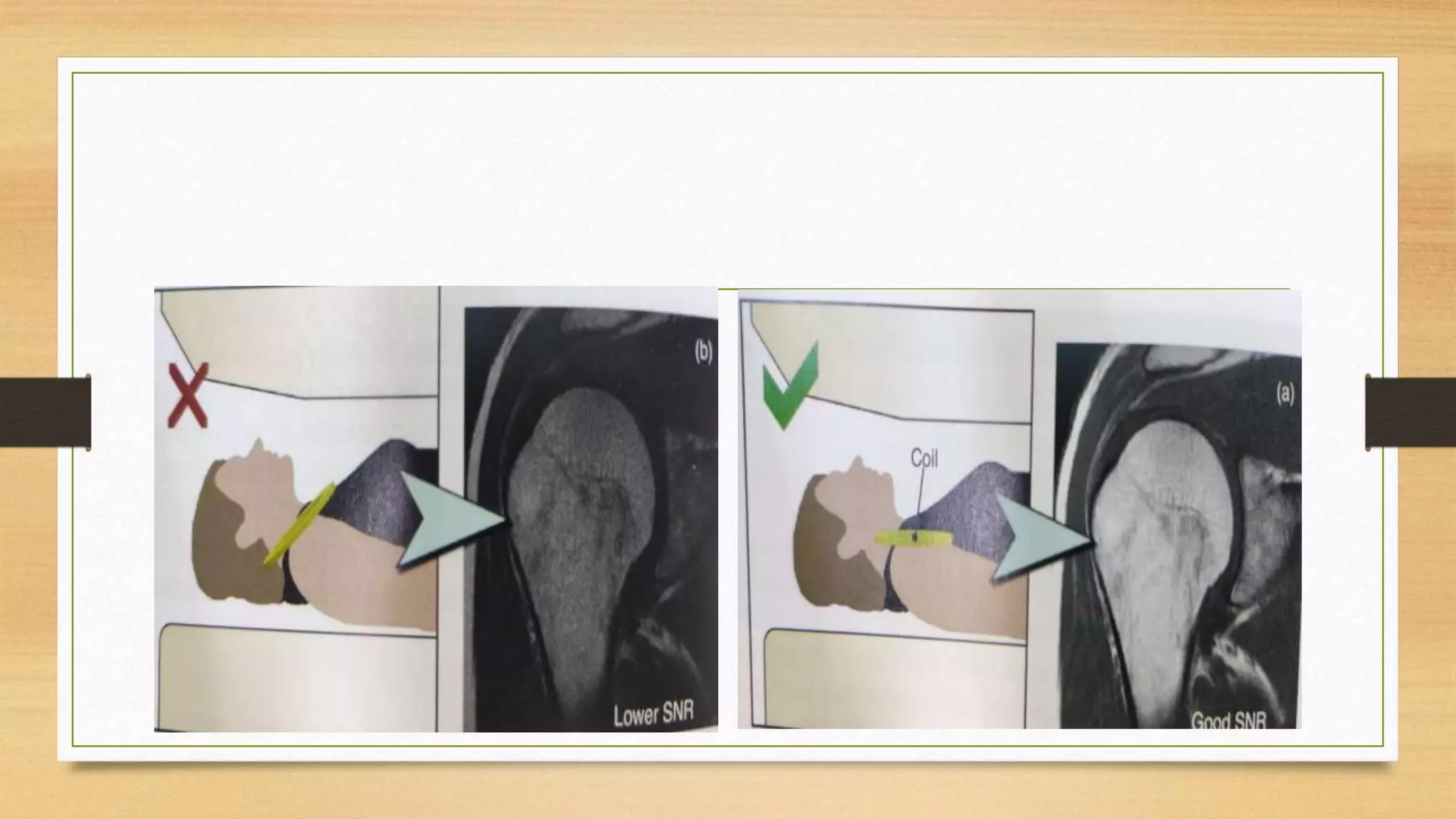
• If the coil is positioned properly than it receive more signal therefore increased
SNR.
• Example: quadrature coils increase SNR because several coils are used to receive
signal.
TR, TE, FLIP ANGLE:
• These parameters affect the SNR and therefore also image quality.
• TR{time of repeat}: it is the time interval between start of one RF pulse
and the start of next RF pulse.
• It controls the amount of longitudinal magnetization that recovers before
the next RF excitation applied .
• Increased TR- Increased SNR
• FLIP ANGLE: It control the amount of Transverse magnetization created
by RF excitation pulse which induce the signal in the receiver coil.
• If the TR is long, maximum signal amplitude is created with flip angle of 90
degree.
• It is because the full recovery of longitudinal magnetization occurs with long
TR and this is fully converted into transverse magnetization.
• Increased flip angle- increased SNR.
• TE{time of echo}: it is the interval between the start of RF pulse and
reception of the echo(signal).
• It control the amount of coherent magnetization that decay before an echo
is collected.
• SNR decreases as the TE increases, because there is less transverse
magnetization available to rephase and produce an echo.
• Example: the T2 weighted sequence that uses long TE has decreased SNR.
• Increased TE- decreases SNR.
NAS/NEX: Number of signal average
• It control the amount of data stored in each line of K-space.
• It is the number of times data are collected with the same amplitude.
Therefore, how many times a line of K-space is filled with data.
• If NSA will be doubled than SNR also increases subsequently leads to
increase in scan time by four.
• increased NSA – increased SNR .
RECEIVER BANDWIDTH:
• It is the range of frequencies that are accurately sampled during the sampling
window.
• As the receiver bandwidth decreases, SNR increases as less noise is sampled
as a proportion of signal.
• Decreased bandwidth- increased SNR- increased chemical shift
artefact.
Voxel volume:
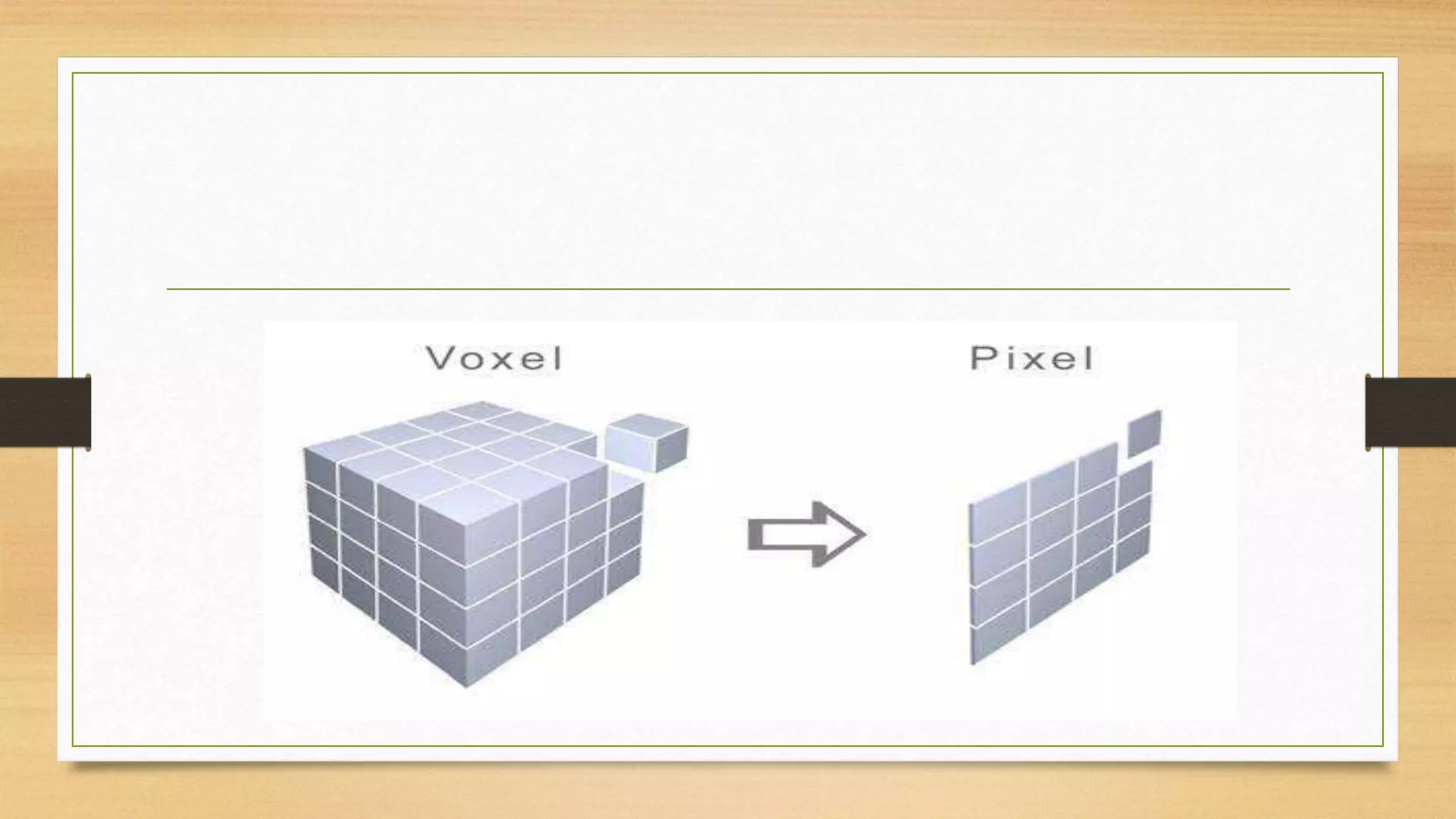
• Pixel: it is the building unit of digital image. It defines a point in 2-D space.
The pixel area is determined by FOV and no. of pixel in FOV.
• Voxel: it defines the point in 3-D space. Voxel dimension if determined by
pixel area and slice thickness.
• Large voxel contains more nuclei than small voxel, therefore more nuclei to
contribute towards signal.
• Increased voxel volume- increased SNR
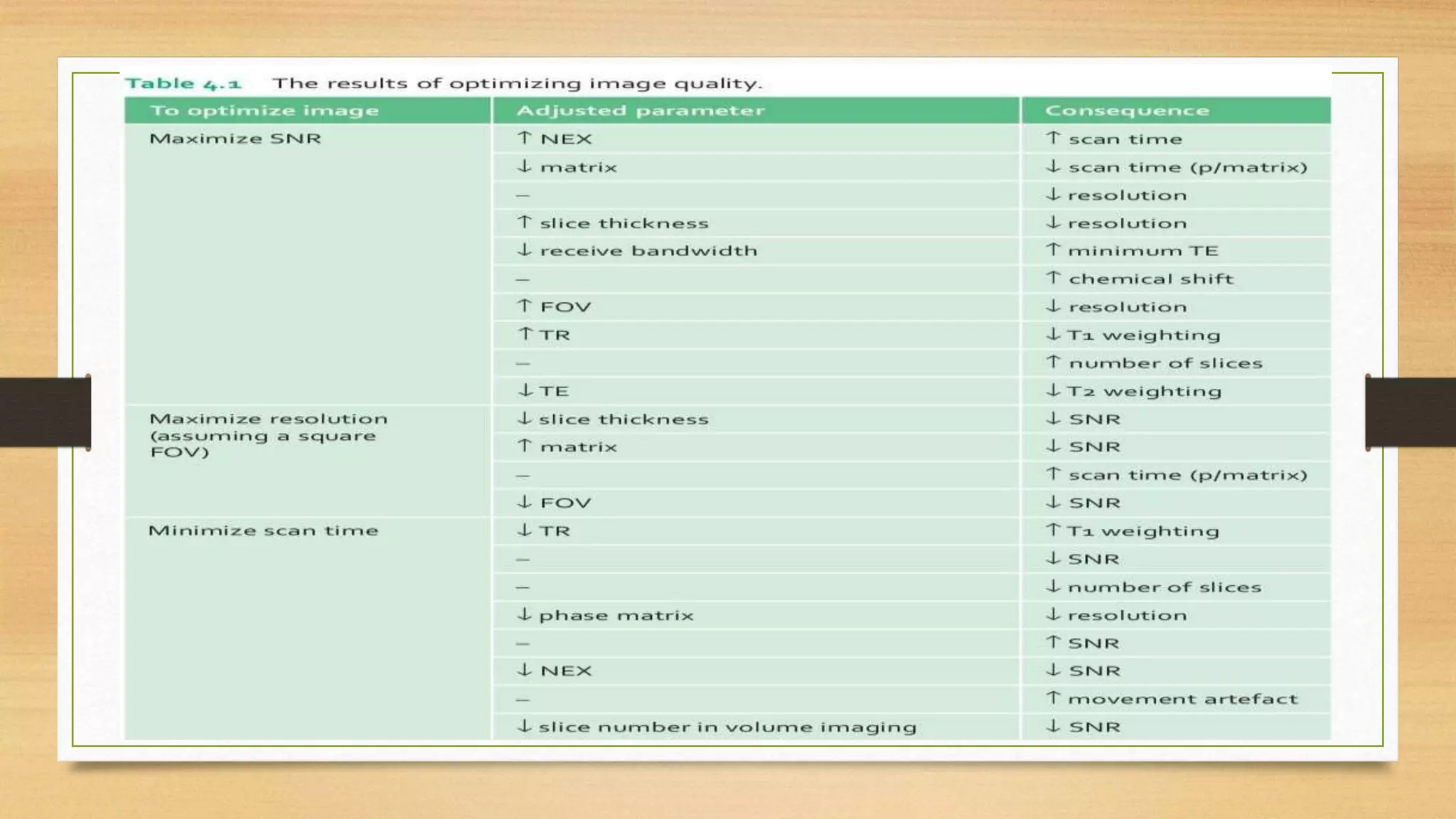
To optimize the SNR select the following parameter
in scan protocol:
• Changing the slice thickness: increased slice thickness- increased SNR.
• Changing FOV: increased FOV- increased SNR:
• Long TR and short TE.
• Use correct coil.
• High NSA.
• Narrow band width.
SUMMARY
• Signal amplitude is altered in several ways including using long TR, short TE,
a large flip angle and a good coil.
• Noise is random and largely not altered although when using a narrow
receiver bandwidth, fewer noise frequency is sampled.
• SNR increases relative to increased signal and decreased noise.
CONTRAST TO NOISE RATIO:
• Definition: it is defined as the difference in the SNR between two adjacent area.
• It is the critical factor, affects image quality as it directly determines the eyes
ability to distinguish areas of high signal from low signal.
• CNR is increased in following ways:
1.Contrast agent
2.T2 weighting
3.Flow related technique
4.Magnetization transfer contrast (MTC)
To optimize the CNR, select following
parameters in the scan protocol:
• Very long TE and TR.
• Technique that remove signal from certain nuclei {flow related technique}
• Saturation technique
• Use contrast agent
Summary:
• CNR is the difference in SNR between two adjacent areas.
• It is important to maximize the CNR so that pathology is clearly seen as
distinct from normal anatomy or so that one structure is clearly seen next to
another.
• CNR is improved by increasing the signal from pathology or structure that
are important to see. Example: positive contrast agent, T2 weighing, flow
technique.
• CNR is improved by decreasing signal from normal structure. example:
MTC.
SPATIAL RESOLUTION
• Definition: it is the ability to distinguish between two points as separate and
distinct and is controlled by voxel size.
• Small voxel results in high spatial resolution, as small structures are easily
differentiated.
• Partial voluming: in large voxel, individual signal intensities are averaged
together and not represented as distinct within the voxel.
The spatial resolution is affected by:
• Slice thickness: Thin slice increases spatial resolution, hence decreases
SNR.
• FOV: small FOV has increased spatial resolution.
• Image matrix: small pixel has increased spatial resolution.
To optimize the spatial resolution select the
following parameter in the scan protocol:
• Thin slice thickness
• Small FOV
• Small pixel.
SCAN TIME
• Definition: it is defined as the time to complete data acquisition or the time to fill
the K-space.
• Scan time is directly proportional to following:
1. Increased TR – increases scan time
2. Increased phase matrix- increased scan time
3. Increased NSA- increased scan time.
Scan time optimization is important, because long scan time allow the patient
to move.
To optimize scan time select the following
parameters in the scan protocol:
• Short TR
• Low phase matrix
• Low NSA
• Use imaging options that reduces scan time
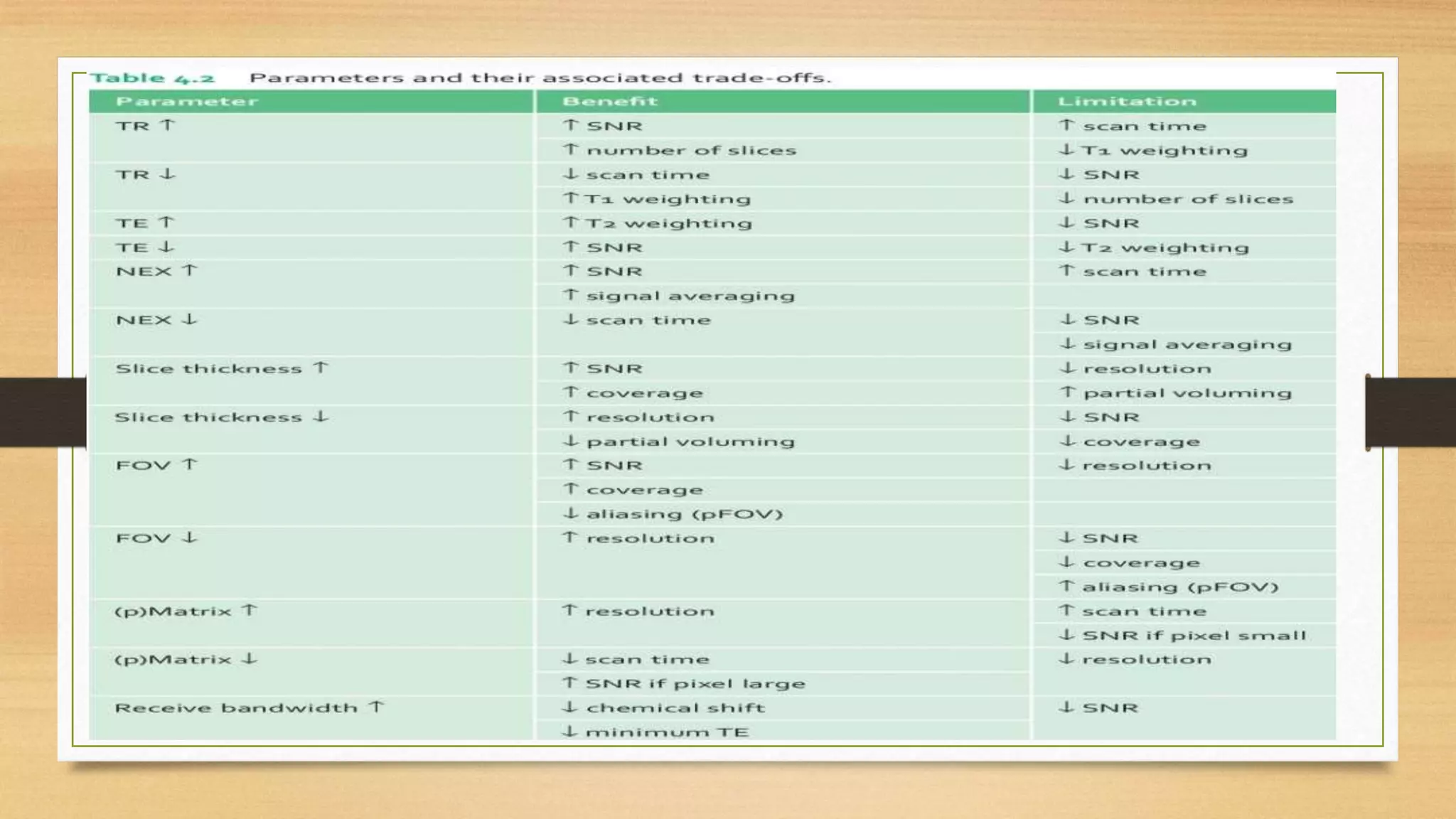
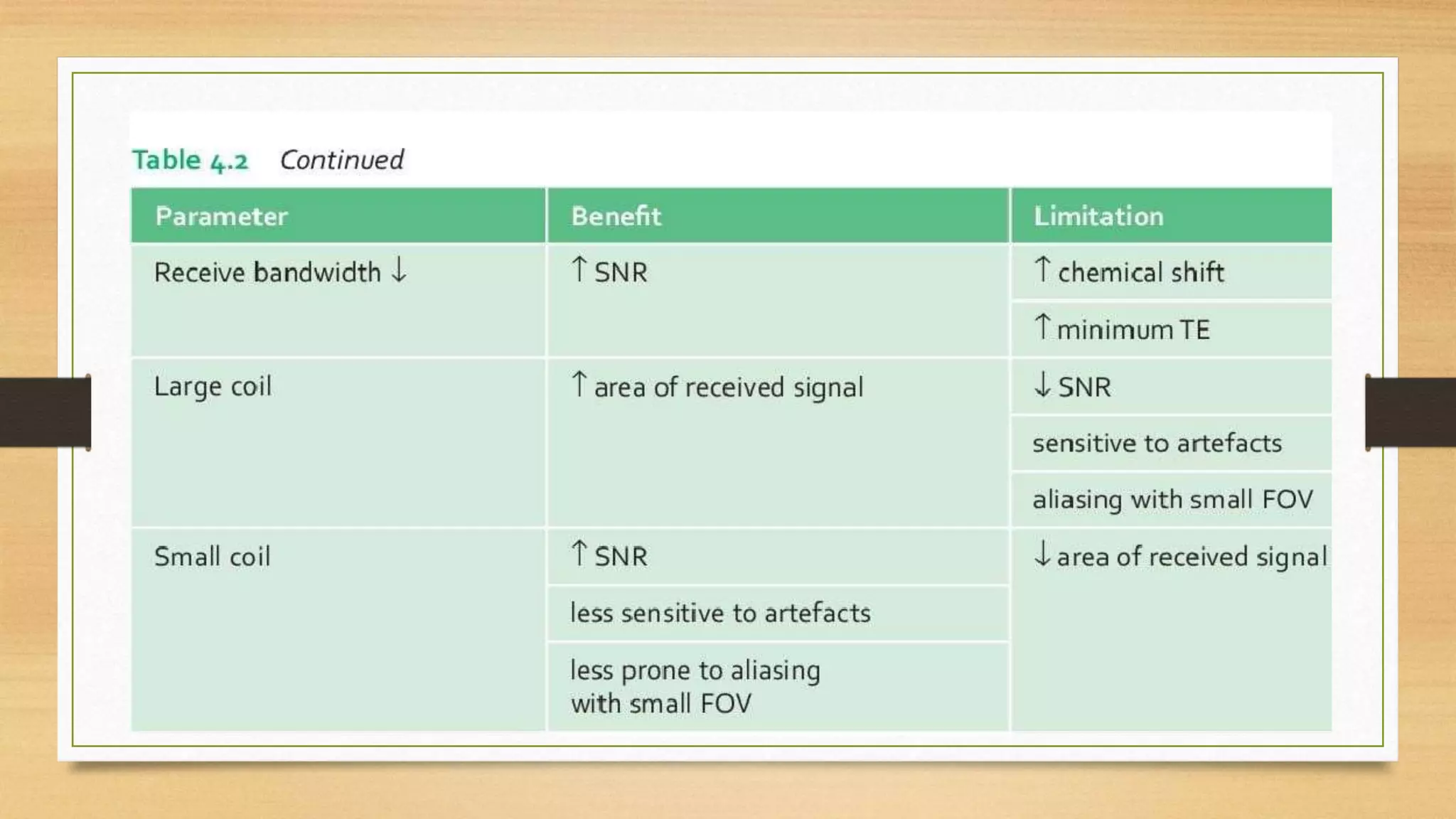
TRADE-OFFS
• Ideally an image has high SNR, good spatial resolution and acquired in a very
short scan time.
• However, this is rarely achieved.
• Definition :the change in any parameters affect another. These are called
trade-offs.
Protocol development and modification:
• There is no rules in MRI.
• Protocol modification depends on the areas under examination and
condition and co-operation of the patient.
Tips to modify protocol to achieve desired
image quality:
• Always choose the correct coil and positioned it correctly. This often makes
the difference between good and bad quality examination.
• Immobilize the patient as much as possible to reduce the movement.
• Try to ascertain from the radiologist exactly what protocols are required
before scan, it also save a lot of time.
• SNR is important parameter, so it should be maintained.
• It is important to keep the scan time short.
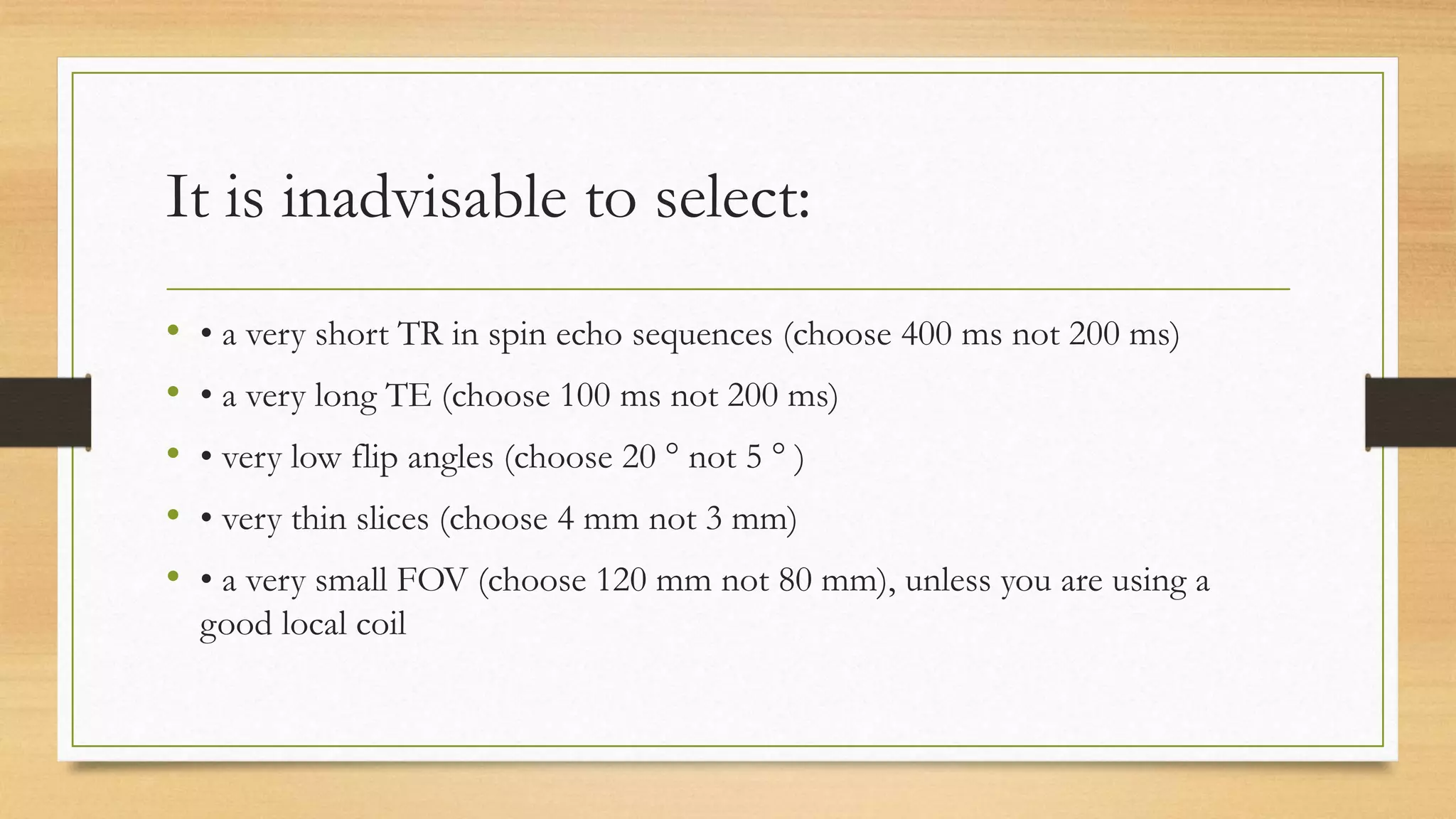
It is inadvisable to select:
• • a very short TR in spin echo sequences (choose 400 ms not 200 ms)
• • a very long TE (choose 100 ms not 200 ms)
• • very low flip angles (choose 20 ° not 5 ° )
• • very thin slices (choose 4 mm not 3 mm)
• • a very small FOV (choose 120 mm not 80 mm), unless you are using a
good local coil
REFERENCES:
• MRI in practice: Catherine westbrook, john talbot
• https://pubmed.ncbi.nlm.nih.gov/33252752/
Questions:
1. Effect of TR over SNR?
2. What is TE?
3. What if CNR?
4. What is spatial resolution?
PARAMETERS AND ASSOCIATED  Trade-Offs, MRI

PARAMETERS AND ASSOCIATED Trade-Offs, MRI

  • 1.
    PARAMETERS AND ASSOCIATED Trade-Offs: RESULTSOF OPTIMIZING IMAGE QUALITY BY: NEHA SINGH MRIT 3rd SEMESTER.
  • 2.
    CONTENT • INTRODUCTION: PROTOCOL,PARAMETER • SIGNAL-TO-NOISERATIO • CONTRAST-TO-NOISE RATIO • SPATIAL RESOLUTION • SCAN TIME • TRADE-OFFS • PROTOCOL DEVELOPMENT AND MODIFICATION • REFERENCE • QUEESTIONS
  • 3.
    INTRODUCTION • PROTOCOL: Itis defined as a “set of rules”. It is the combination of various sequences, to assess the particular region of the body. • PARAMETERS: They are selected by the operator. They include extrinsic contrast parameters, geometry parameters and variety of imaging options and data acquisition methods. They are variable.
  • 4.
    Importance of optimizationof image • MRI provides better soft tissue contrast than CT and can differentiate better between fat, water, muscle. • These images are useful in diagnosing a wide variety of conditions. • These image should have better diagnostic value, and has positive benefit to the patient. • Image optimization is a challenge because a change to improve one scan parameter often leads to worsening of another.
  • 5.
    The four mainconsideration determine image quality are: • SNR: signal to noise ratio • CNR: contrast to noise ratio • Spatial resolution • Scan time
  • 6.
    SIGNAL TO NOISERATIO: • Definition: It is defined as the ratio of amplitude of signal received to the average amplitude of noise. • SIGNAL: It is the voltage induced in the receiver coil by the precession of NMV in the transverse plane. • NOISE: It represent frequencies that exist randomly in space and time, which is generated by the presence of the patient in the magnet and the background electrical noise of the system.
  • 7.
    Any factor thataffect the signal amplitude in turn affects the SNR. The factor that affect the SNR include: • Magnetic field strength • Proton density of the area under examination • Voxel volume • TR, TE, Flip angle • NEX/NSA: Number of signal average • Receive bandwidth • Coil type
  • 8.
    Magnetic field strength: •It plays important role in determining SNR. • If the net magnetization vector increasing at higher field strength, so, there is more available magnetization to image the patient. • SNR is directly proportional magnetic filed strength. • It Bo increases than SNR will also increase.
  • 9.
    PROTON DENSITY : •Number of proton determine the amplitude of received signal from area under examination. • Area of low proton density has low signal leads to have low SNR. Example : lungs. • Area of high proton density has high signal leads to have high SNR. Example: pelvis
  • 10.
    TYPE OF COIL: •The type of coil affects the amount of received signal, therefore, SNR. • The use of appropriate receiver coil will plays an extremely important role in optimizing SNR. • The larger coil receive more noise is proportional to signal. • If the coil is positioned properly than it receive more signal therefore increased SNR. • Example: quadrature coils increase SNR because several coils are used to receive signal.
  • 12.
    TR, TE, FLIPANGLE: • These parameters affect the SNR and therefore also image quality. • TR{time of repeat}: it is the time interval between start of one RF pulse and the start of next RF pulse. • It controls the amount of longitudinal magnetization that recovers before the next RF excitation applied . • Increased TR- Increased SNR
  • 13.
    • FLIP ANGLE:It control the amount of Transverse magnetization created by RF excitation pulse which induce the signal in the receiver coil. • If the TR is long, maximum signal amplitude is created with flip angle of 90 degree. • It is because the full recovery of longitudinal magnetization occurs with long TR and this is fully converted into transverse magnetization. • Increased flip angle- increased SNR.
  • 14.
    • TE{time ofecho}: it is the interval between the start of RF pulse and reception of the echo(signal). • It control the amount of coherent magnetization that decay before an echo is collected. • SNR decreases as the TE increases, because there is less transverse magnetization available to rephase and produce an echo. • Example: the T2 weighted sequence that uses long TE has decreased SNR. • Increased TE- decreases SNR.
  • 15.
    NAS/NEX: Number ofsignal average • It control the amount of data stored in each line of K-space. • It is the number of times data are collected with the same amplitude. Therefore, how many times a line of K-space is filled with data. • If NSA will be doubled than SNR also increases subsequently leads to increase in scan time by four. • increased NSA – increased SNR .

  • 16.
    RECEIVER BANDWIDTH: • Itis the range of frequencies that are accurately sampled during the sampling window. • As the receiver bandwidth decreases, SNR increases as less noise is sampled as a proportion of signal. • Decreased bandwidth- increased SNR- increased chemical shift artefact.
  • 17.
    Voxel volume: • Pixel:it is the building unit of digital image. It defines a point in 2-D space. The pixel area is determined by FOV and no. of pixel in FOV. • Voxel: it defines the point in 3-D space. Voxel dimension if determined by pixel area and slice thickness. • Large voxel contains more nuclei than small voxel, therefore more nuclei to contribute towards signal. • Increased voxel volume- increased SNR
  • 19.
    To optimize theSNR select the following parameter in scan protocol: • Changing the slice thickness: increased slice thickness- increased SNR. • Changing FOV: increased FOV- increased SNR: • Long TR and short TE. • Use correct coil. • High NSA. • Narrow band width.
  • 20.
    SUMMARY • Signal amplitudeis altered in several ways including using long TR, short TE, a large flip angle and a good coil. • Noise is random and largely not altered although when using a narrow receiver bandwidth, fewer noise frequency is sampled. • SNR increases relative to increased signal and decreased noise.
  • 21.
    CONTRAST TO NOISERATIO: • Definition: it is defined as the difference in the SNR between two adjacent area. • It is the critical factor, affects image quality as it directly determines the eyes ability to distinguish areas of high signal from low signal. • CNR is increased in following ways: 1.Contrast agent 2.T2 weighting 3.Flow related technique 4.Magnetization transfer contrast (MTC)
  • 22.
    To optimize theCNR, select following parameters in the scan protocol: • Very long TE and TR. • Technique that remove signal from certain nuclei {flow related technique} • Saturation technique • Use contrast agent
  • 23.
    Summary: • CNR isthe difference in SNR between two adjacent areas. • It is important to maximize the CNR so that pathology is clearly seen as distinct from normal anatomy or so that one structure is clearly seen next to another. • CNR is improved by increasing the signal from pathology or structure that are important to see. Example: positive contrast agent, T2 weighing, flow technique. • CNR is improved by decreasing signal from normal structure. example: MTC.
  • 24.
    SPATIAL RESOLUTION • Definition:it is the ability to distinguish between two points as separate and distinct and is controlled by voxel size. • Small voxel results in high spatial resolution, as small structures are easily differentiated. • Partial voluming: in large voxel, individual signal intensities are averaged together and not represented as distinct within the voxel.
  • 25.
    The spatial resolutionis affected by: • Slice thickness: Thin slice increases spatial resolution, hence decreases SNR. • FOV: small FOV has increased spatial resolution. • Image matrix: small pixel has increased spatial resolution.
  • 26.
    To optimize thespatial resolution select the following parameter in the scan protocol: • Thin slice thickness • Small FOV • Small pixel.
  • 27.
    SCAN TIME • Definition:it is defined as the time to complete data acquisition or the time to fill the K-space. • Scan time is directly proportional to following: 1. Increased TR – increases scan time 2. Increased phase matrix- increased scan time 3. Increased NSA- increased scan time. Scan time optimization is important, because long scan time allow the patient to move.
  • 28.
    To optimize scantime select the following parameters in the scan protocol: • Short TR • Low phase matrix • Low NSA • Use imaging options that reduces scan time
  • 29.
    TRADE-OFFS • Ideally animage has high SNR, good spatial resolution and acquired in a very short scan time. • However, this is rarely achieved. • Definition :the change in any parameters affect another. These are called trade-offs.
  • 30.
    Protocol development andmodification: • There is no rules in MRI. • Protocol modification depends on the areas under examination and condition and co-operation of the patient.
  • 31.
    Tips to modifyprotocol to achieve desired image quality: • Always choose the correct coil and positioned it correctly. This often makes the difference between good and bad quality examination. • Immobilize the patient as much as possible to reduce the movement. • Try to ascertain from the radiologist exactly what protocols are required before scan, it also save a lot of time. • SNR is important parameter, so it should be maintained. • It is important to keep the scan time short.
  • 35.
    It is inadvisableto select: • • a very short TR in spin echo sequences (choose 400 ms not 200 ms) • • a very long TE (choose 100 ms not 200 ms) • • very low flip angles (choose 20 ° not 5 ° ) • • very thin slices (choose 4 mm not 3 mm) • • a very small FOV (choose 120 mm not 80 mm), unless you are using a good local coil
  • 36.
    REFERENCES: • MRI inpractice: Catherine westbrook, john talbot • https://pubmed.ncbi.nlm.nih.gov/33252752/
  • 37.
    Questions: 1. Effect ofTR over SNR? 2. What is TE? 3. What if CNR? 4. What is spatial resolution?