Magnetic resonance iMaging
•
•
•
•
•
MRI is a radiology technique
That uses magnetism, radio waves, and a computer to
produce images of body structures.
MRI is based on the principles of NMR
In1997 the first MRI exam was performed on a human
being.
It took 5 hours to produce one image.
MRI
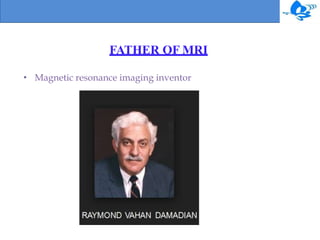
FATHER OF MRI
• Magnetic resonance imaging inventor
WHAT CAN BE DIAGNOSED BY AN MRI
SCAN?
•
•
•
•
•
•
•
•
•
•
Most ailments of the brain, including tumours
Sport injuries
Musculoskeletal problems
Most spinal conditions/injuries
Vascular abnormalities
Female pelvic problems
Prostate problems
Some gastrointestinal tract conditions
Certain ear, nose and throat (ENT) conditions
Soft tissue and bone pathology/conditions
WHO CAN’T HAVE AN MRI SCAN?
•
•
•
•
•
•
A cardiac pacemaker
Certain clips in your head from brain operations
A cochlear implant
A metallic foreign body in your eye
Had surgery in the last 8 weeks
If you are pregnant
PRINCIPLE
• MRI makes use of the magnetic properties of certain
atomic nuclei.
• Hydrogen nucleus (single proton) present in water
molecules, and therefore in all body tissues.
• The hydrogen nuclei partially aligned by a strong
magnetic field in the scanner.
CONTI..
•
•
•
•
The nuclei can be rotated using radio waves, and they
subsequently oscillate in the magnetic field while returning
to equilibrium.
Simultaneously they emit a radio signal.
This is detected using antennas (coils)
Very detailed images can be made of soft tissues.
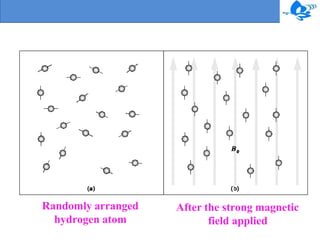
Randomly arranged
hydrogen atom
After the strong magnetic
field applied
MAIN COMPONENTS OF MRI
•
•
•
Scanner
Computers
Recording hardware
SCANNER
•
•
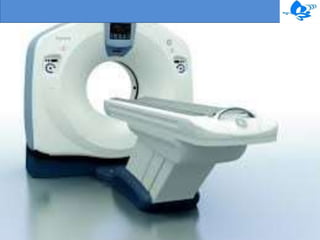
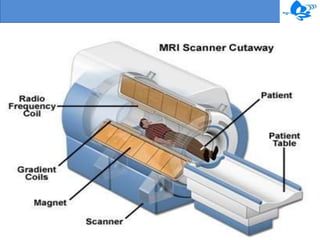
An MRI scanner is a large tube that contains powerful
magnets.
Main components of scanner
– Static magnetic field coils
– Gradient coils
– RF (radiofrequency) coils
Static Magnetic Field Coils
• Three methods to generate magnetic field
1. Fixed magnet
2. Resistive magnet
3. Super conducting magnet
•
•
•
Fixed magnets and resistive magnets are generally
restricted to field strengths below 0.4t
High-resolution imaging systems use super conducting
magnets.
The super-conducting magnets are large and complex
GRADIENT COILS
•
•
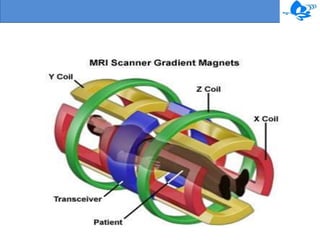
Gradient coils are used to produce deliberate variations in
the main magnetic field
There are usually three sets of gradient coils, one for each
direction.
RADIOFREQUENCY COIL
•
•
•
•
RF coils act as transmitter and receiver
RF coils are the "antenna" of the MRI system
That transmit the RF signal and receives the return signal.
They are simply a loop of wire either circular or
rectangular
ADVANTAGES OF MRI
•
•
•
•
MRI is particularly useful for the scanning and detection of
abnormalities in soft tissue structures in the body like the
cartilage tissues
and soft organs like the brain or the heart.
There is no involvement of any kind of radiations in the MRI,
so it is safe for the people who can be vulnerable to the effects
of radiations such as babies.
MRI scan can provide information about the blood circulation
throughout the body and blood vessels and also enabling the
detection of problems related to the blood
circulation.
DISADVANTAGES OF MRI
•
•
•
•
•
·MRI scan is done in an enclosed space, so the people
who are claustrophobic, i.e. fearful of being in a closely
enclosed surface, are facing problems with MRI to be
done.
MRI scans involve really loud noises while processing
because they involve a really high amount of electric
current supply.
MRI scanners are usually expensive.
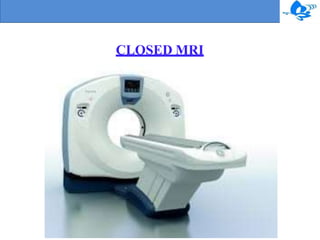
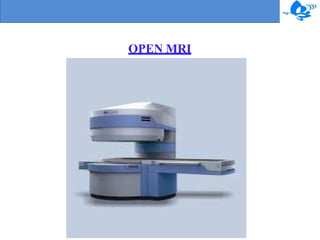
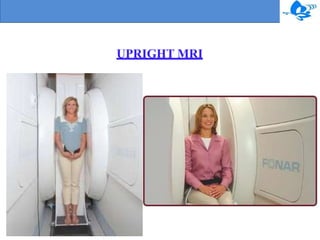
SHAPES OF MRI MACHINE
CLOSED MRI
OPEN MRI
UPRIGHT MRI
Lecture 7 Slidessssssssssssssssssss.pptx

Lecture 7 Slidessssssssssssssssssss.pptx

  • 1.
  • 2.
    • • • • • MRI is aradiology technique That uses magnetism, radio waves, and a computer to produce images of body structures. MRI is based on the principles of NMR In1997 the first MRI exam was performed on a human being. It took 5 hours to produce one image. MRI
  • 4.
    FATHER OF MRI •Magnetic resonance imaging inventor
  • 5.
    WHAT CAN BEDIAGNOSED BY AN MRI SCAN? • • • • • • • • • • Most ailments of the brain, including tumours Sport injuries Musculoskeletal problems Most spinal conditions/injuries Vascular abnormalities Female pelvic problems Prostate problems Some gastrointestinal tract conditions Certain ear, nose and throat (ENT) conditions Soft tissue and bone pathology/conditions
  • 6.
    WHO CAN’T HAVEAN MRI SCAN? • • • • • • A cardiac pacemaker Certain clips in your head from brain operations A cochlear implant A metallic foreign body in your eye Had surgery in the last 8 weeks If you are pregnant
  • 7.
    PRINCIPLE • MRI makesuse of the magnetic properties of certain atomic nuclei. • Hydrogen nucleus (single proton) present in water molecules, and therefore in all body tissues. • The hydrogen nuclei partially aligned by a strong magnetic field in the scanner.
  • 8.
    CONTI.. • • • • The nuclei canbe rotated using radio waves, and they subsequently oscillate in the magnetic field while returning to equilibrium. Simultaneously they emit a radio signal. This is detected using antennas (coils) Very detailed images can be made of soft tissues.
  • 9.
    Randomly arranged hydrogen atom Afterthe strong magnetic field applied
  • 10.
    MAIN COMPONENTS OFMRI • • • Scanner Computers Recording hardware
  • 11.
    SCANNER • • An MRI scanneris a large tube that contains powerful magnets. Main components of scanner – Static magnetic field coils – Gradient coils – RF (radiofrequency) coils
  • 13.
    Static Magnetic FieldCoils • Three methods to generate magnetic field 1. Fixed magnet 2. Resistive magnet 3. Super conducting magnet • • • Fixed magnets and resistive magnets are generally restricted to field strengths below 0.4t High-resolution imaging systems use super conducting magnets. The super-conducting magnets are large and complex
  • 14.
    GRADIENT COILS • • Gradient coilsare used to produce deliberate variations in the main magnetic field There are usually three sets of gradient coils, one for each direction.
  • 16.
    RADIOFREQUENCY COIL • • • • RF coilsact as transmitter and receiver RF coils are the "antenna" of the MRI system That transmit the RF signal and receives the return signal. They are simply a loop of wire either circular or rectangular
  • 17.
    ADVANTAGES OF MRI • • • • MRIis particularly useful for the scanning and detection of abnormalities in soft tissue structures in the body like the cartilage tissues and soft organs like the brain or the heart. There is no involvement of any kind of radiations in the MRI, so it is safe for the people who can be vulnerable to the effects of radiations such as babies. MRI scan can provide information about the blood circulation throughout the body and blood vessels and also enabling the detection of problems related to the blood circulation.
  • 18.
    DISADVANTAGES OF MRI • • • • • ·MRIscan is done in an enclosed space, so the people who are claustrophobic, i.e. fearful of being in a closely enclosed surface, are facing problems with MRI to be done. MRI scans involve really loud noises while processing because they involve a really high amount of electric current supply. MRI scanners are usually expensive.
  • 19.
  • 20.
  • 21.
  • 22.