MPLS VPN
Network Security Presentation
By Shahzeb Mahesar
Contents
• Introduction
• Point-to-point (pseudowire)
• Layer 2 VPN (VPLS)
• How Does MPLS VPN Work?
• Resources
Introduction
• MPLS VPN is a family of methods for using multiprotocol
label switching (MPLS) to create virtual private networks
(VPNs).
• MPLS VPN is a flexible method to transport and route
several types of network traffic using an MPLS backbone.
• There are three types of MPLS VPNs deployed in networks
today:
1. Point-to-point (Pseudowire)
2. Layer 2 (VPLS)
3. Layer 3 (VPRN)
Point-to-point (pseudowire)
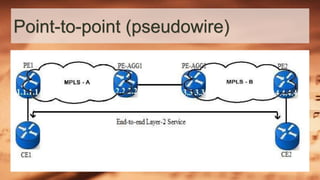
• Point-to-point MPLS VPNs employ VLL (virtual leased lines)
for providing Layer2 point-to-point connectivity between two
sites.
• Ethernet, TDM, and ATM frames can be encapsulated within
these VLLs.
• Some examples of how point-to-point VPNs might be used
by utilities include:
• encapsulating TDM T1 circuits attached to Remote Terminal Units
• forwarding non-routed DNP3 traffic across the backbone network
to the SCADA master controller.
Point-to-point (pseudowire)
Layer 2 VPN (VPLS)
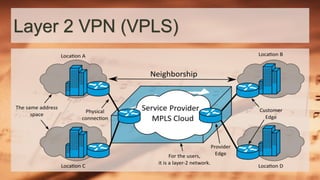
• Layer 2 MPLS VPNs, or VPLS (virtual private LAN service),
offers a “switch in the cloud” style service.
• VPLS provides the ability to span VLANs between sites.
• L2 VPNs are typically used to route voice, video, and AMI
traffic between substation and data center locations.
Layer 2 VPN (VPLS)
Layer 3 VPN (VPRN)
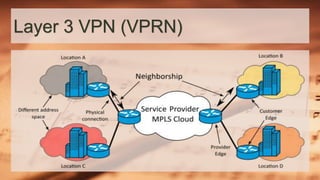
• Layer 3, or VPRN (virtual private routed network), utilizes
layer 3 VRF (VPN/virtual routing and forwarding) to segment
routing tables for each customer utilizing the service.
• The customer peers with the service provider router and the
two exchange routes, which are placed into a routing table
specific to the customer.
Layer 3 VPN (VPRN)
• Multiprotocol BGP (MP-BGP) is required in the cloud to
utilize the service, which increases complexity of design and
implementation.
• L3 VPNs are typically not deployed on utility networks due to
their complexity; however, a L3 VPN could be used to route
traffic between corporate or datacenter locations.
Layer 3 VPN (VPRN)
How Does MPLS VPN Work?
• In order to understand how MPLS VPN works, we need to
be aware of the equipment involved.
• Typically, in an MPLS network, there will be:
1. Customer Edge (CE) routers
2. Provider Edge (PE) routers
3. Provider (P) routers
How Does MPLS VPN Work?
1. Initially, the routing information and data packet are passed
from CE to PE using static routes or a routing protocol such as
Border Gateway Protocol (BGP).
2. Based on the routing information, PE devices attach a label to
the data packet and forward it to the provider core network, i.e.
the P router.
3. The P router in the provider network forwards the packet to the
right PE device on the other side of the network, based on the
label.
4. When the destination PE receives the labeled packet, it pops
the label and uses it to direct the packet to the right
(destination) CE device.
Resources
• https://en.wikipedia.org/wiki/MPLS_VPN
• https://www.cisco.com/c/en/us/support/docs/multiprotocol-
label-switching-mpls/mpls/13733-mpls-vpn-basic.html
• https://www.tpx.com/learn/how-does-mpls-vpn-work
• http://www.firewall.cx/networking-topics/wan-
technologies/821-mpls-ip-vpn-security.html
• https://help.uis.cam.ac.uk/service/network-
services/datanetwork/mpls-vpn

MPLS VPN

  • 1.
    MPLS VPN Network SecurityPresentation By Shahzeb Mahesar
  • 2.
    Contents • Introduction • Point-to-point(pseudowire) • Layer 2 VPN (VPLS) • Layer 2 VPN (VPLS) • How Does MPLS VPN Work? • Resources
  • 3.
    Introduction • MPLS VPNis a family of methods for using multiprotocol label switching (MPLS) to create virtual private networks (VPNs). • MPLS VPN is a flexible method to transport and route several types of network traffic using an MPLS backbone. • There are three types of MPLS VPNs deployed in networks today: 1. Point-to-point (Pseudowire) 2. Layer 2 (VPLS) 3. Layer 3 (VPRN)
  • 4.
    Point-to-point (pseudowire) • Point-to-pointMPLS VPNs employ VLL (virtual leased lines) for providing Layer2 point-to-point connectivity between two sites. • Ethernet, TDM, and ATM frames can be encapsulated within these VLLs. • Some examples of how point-to-point VPNs might be used by utilities include: • encapsulating TDM T1 circuits attached to Remote Terminal Units • forwarding non-routed DNP3 traffic across the backbone network to the SCADA master controller.
  • 5.
  • 6.
    Layer 2 VPN(VPLS) • Layer 2 MPLS VPNs, or VPLS (virtual private LAN service), offers a “switch in the cloud” style service. • VPLS provides the ability to span VLANs between sites. • L2 VPNs are typically used to route voice, video, and AMI traffic between substation and data center locations.
  • 7.
  • 8.
    Layer 3 VPN(VPRN) • Layer 3, or VPRN (virtual private routed network), utilizes layer 3 VRF (VPN/virtual routing and forwarding) to segment routing tables for each customer utilizing the service. • The customer peers with the service provider router and the two exchange routes, which are placed into a routing table specific to the customer.
  • 9.
    Layer 3 VPN(VPRN) • Multiprotocol BGP (MP-BGP) is required in the cloud to utilize the service, which increases complexity of design and implementation. • L3 VPNs are typically not deployed on utility networks due to their complexity; however, a L3 VPN could be used to route traffic between corporate or datacenter locations.
  • 10.
  • 11.
    How Does MPLSVPN Work? • In order to understand how MPLS VPN works, we need to be aware of the equipment involved. • Typically, in an MPLS network, there will be: 1. Customer Edge (CE) routers 2. Provider Edge (PE) routers 3. Provider (P) routers
  • 12.
    How Does MPLSVPN Work? 1. Initially, the routing information and data packet are passed from CE to PE using static routes or a routing protocol such as Border Gateway Protocol (BGP). 2. Based on the routing information, PE devices attach a label to the data packet and forward it to the provider core network, i.e. the P router. 3. The P router in the provider network forwards the packet to the right PE device on the other side of the network, based on the label. 4. When the destination PE receives the labeled packet, it pops the label and uses it to direct the packet to the right (destination) CE device.
  • 13.
    Resources • https://en.wikipedia.org/wiki/MPLS_VPN • https://www.cisco.com/c/en/us/support/docs/multiprotocol- label-switching-mpls/mpls/13733-mpls-vpn-basic.html •https://www.tpx.com/learn/how-does-mpls-vpn-work • http://www.firewall.cx/networking-topics/wan- technologies/821-mpls-ip-vpn-security.html • https://help.uis.cam.ac.uk/service/network- services/datanetwork/mpls-vpn