MPLS Introduction Multi-Protocol Label Switching Presented by:  WebKul India
MPLS Introduction Motivation MPLS Basics Components and Protocols Operation Advantages and Disadvantages
Motivation IP The first defined and used protocol De facto the only protocol for global Internet working …   but there are disadvantages
Motivation (cont.) IP Routing disadvantages  Connectionless - e.g. no QoS Large IP Header - At least 20 bytes Routing in Network Layer - Slower than Switching Usually designed to obtain shortest path - Do not take into account additional metrics
Motivation (cont.) ATM connection oriented - Supports QoS fast packet switching with fixed length packets (cells) integration of different traffic types (voice, data, video) …   but there are also disadvantages
Motivation (cont.) ATM disadvantages Complex Expensive Not widely adopted
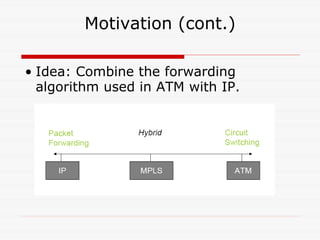
Motivation (cont.) Idea: Combine the forwarding algorithm used in ATM with IP.
MPLS Introduction Motivation MPLS Basics Components and Protocols Operation Advantages and Disadvantages
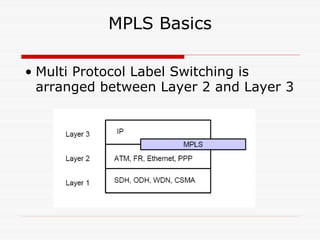
MPLS Basics Multi Protocol Label Switching is arranged between Layer 2 and Layer 3
MPLS Basics (cont.) MPLS Characteristics Mechanisms to manage traffic flows of various granularities ( Flow Management ) Is independent of Layer-2 and Layer-3 protocols  Maps IP-addresses to fixed length labels Supports ATM, Frame-Relay and Ethernet
MPLS Introduction Motivation MPLS Basics MPLS Components and Protocols MPLS Operation Advantages and Disadvantages
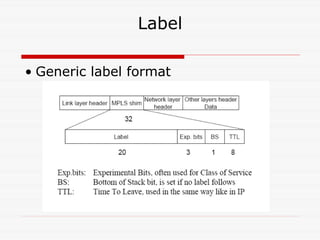
Label Generic label format
Label Edge Router - LER Resides at the edge of an MPLS network and assigns and removes the labels from the packets. Support multiple ports connected to dissimilar networks (such as frame relay, ATM, and Ethernet).
Label Switching Router - LSR Is a high speed router in the core on an MPLS network. ATM switches can be used as LSRs without changing their hardware. Label switching is equivalent to VP/VC switching.
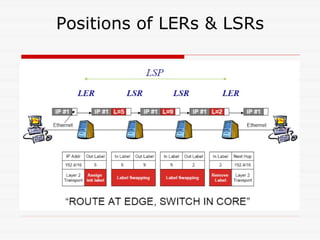
Positions of LERs & LSRs
Label Distribution Protocol - LDP  An application layer protocol for the distribution of label binding information to LSRs. It is used to map FECs to labels, which, in turn, create LSPs.  LDP sessions are established between LDP peers in the MPLS network (not necessarily adjacent). Sometimes employs OSPF or BGP.
Traffic Engineering In MPLS, traffic engineering is inherently provided using explicitly routed paths.  The LSPs are created independently, specifying different paths that are based on user-defined policies. However, this may require extensive operator intervention.  RSVP-TE and CR-LDP are two possible approaches to supply dynamic traffic engineering and QoS in MPLS.
MPLS Introduction Motivation MPLS Basics Components and Protocols Operation Advantages and Disadvantages
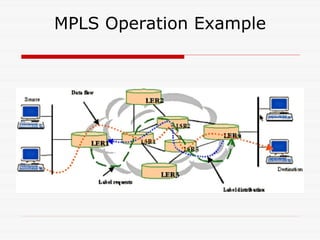
MPLS Operation  The following steps must be taken for a data packet to travel through an MPLS domain.  label creation and distribution  table creation at each router  label-switched path creation  label insertion/table lookup  packet forwarding
MPLS Operation Example
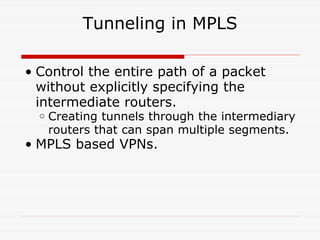
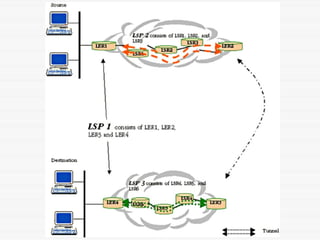
Tunneling in MPLS Control the entire path of a packet without explicitly specifying the intermediate routers.  Creating tunnels through the intermediary routers that can span multiple segments.  MPLS based VPNs.
 
MPLS Introduction Motivation Basics Components and Protocols Operation Advantages and Disadvantages
MPLS Advantages  Improves packet-forwarding performance in the network  Supports QoS and CoS for service differentiation  Supports network scalability  Integrates IP and ATM in the network  Builds interoperable networks
MPLS Disadvantages An additional layer is added The router has to understand MPLS
References http://www.iec.org/online/tutorials/mpls/index.html http://www.iaik.tu-graz.ac.at/teaching/03_advanced%20computer%20networks/ss2004/vo3/MPLS.pdf http://ica1www.epfl.ch/cn2/0304/doc/lecture/mpls.pdf
MPLS Introduction Q & A
MPLS Introduction Thank you!

MPLS (Multi-Protocol Label Switching)

  • 1.
    MPLS Introduction Multi-ProtocolLabel Switching Presented by: WebKul India
  • 2.
    MPLS Introduction MotivationMPLS Basics Components and Protocols Operation Advantages and Disadvantages
  • 3.
    Motivation IP Thefirst defined and used protocol De facto the only protocol for global Internet working … but there are disadvantages
  • 4.
    Motivation (cont.) IPRouting disadvantages Connectionless - e.g. no QoS Large IP Header - At least 20 bytes Routing in Network Layer - Slower than Switching Usually designed to obtain shortest path - Do not take into account additional metrics
  • 5.
    Motivation (cont.) ATMconnection oriented - Supports QoS fast packet switching with fixed length packets (cells) integration of different traffic types (voice, data, video) … but there are also disadvantages
  • 6.
    Motivation (cont.) ATMdisadvantages Complex Expensive Not widely adopted
  • 7.
    Motivation (cont.) Idea:Combine the forwarding algorithm used in ATM with IP.
  • 8.
    MPLS Introduction MotivationMPLS Basics Components and Protocols Operation Advantages and Disadvantages
  • 9.
    MPLS Basics MultiProtocol Label Switching is arranged between Layer 2 and Layer 3
  • 10.
    MPLS Basics (cont.)MPLS Characteristics Mechanisms to manage traffic flows of various granularities ( Flow Management ) Is independent of Layer-2 and Layer-3 protocols Maps IP-addresses to fixed length labels Supports ATM, Frame-Relay and Ethernet
  • 11.
    MPLS Introduction MotivationMPLS Basics MPLS Components and Protocols MPLS Operation Advantages and Disadvantages
  • 12.
  • 13.
    Label Edge Router- LER Resides at the edge of an MPLS network and assigns and removes the labels from the packets. Support multiple ports connected to dissimilar networks (such as frame relay, ATM, and Ethernet).
  • 14.
    Label Switching Router- LSR Is a high speed router in the core on an MPLS network. ATM switches can be used as LSRs without changing their hardware. Label switching is equivalent to VP/VC switching.
  • 15.
  • 16.
    Label Distribution Protocol- LDP An application layer protocol for the distribution of label binding information to LSRs. It is used to map FECs to labels, which, in turn, create LSPs. LDP sessions are established between LDP peers in the MPLS network (not necessarily adjacent). Sometimes employs OSPF or BGP.
  • 17.
    Traffic Engineering InMPLS, traffic engineering is inherently provided using explicitly routed paths. The LSPs are created independently, specifying different paths that are based on user-defined policies. However, this may require extensive operator intervention. RSVP-TE and CR-LDP are two possible approaches to supply dynamic traffic engineering and QoS in MPLS.
  • 18.
    MPLS Introduction MotivationMPLS Basics Components and Protocols Operation Advantages and Disadvantages
  • 19.
    MPLS Operation The following steps must be taken for a data packet to travel through an MPLS domain. label creation and distribution table creation at each router label-switched path creation label insertion/table lookup packet forwarding
  • 20.
  • 21.
    Tunneling in MPLSControl the entire path of a packet without explicitly specifying the intermediate routers. Creating tunnels through the intermediary routers that can span multiple segments. MPLS based VPNs.
  • 22.
  • 23.
    MPLS Introduction MotivationBasics Components and Protocols Operation Advantages and Disadvantages
  • 24.
    MPLS Advantages Improves packet-forwarding performance in the network Supports QoS and CoS for service differentiation Supports network scalability Integrates IP and ATM in the network Builds interoperable networks
  • 25.
    MPLS Disadvantages Anadditional layer is added The router has to understand MPLS
  • 26.
  • 27.
  • 28.