Prepared by :-
Thamizharasan k
VARIABLE FREQUENCY DRIVE
CONTENTS
1. What is Ac and Dc
2. Sine wave generation
3. What is Hz
4. What is Single phase and three phase.
5. What is starter and history
6. Type of starter
7. Explain each starter
8. What is VFD
9. Type of speed controlling method
10. Block diagram
11. Circuit diagram
12. Circuit diagram explanation
13. How its working
14. Application
15. Advantage and disadvantage
15. Troubleshoot in VFD.
16. What are the Communication in VFD.
17. Type of VFD.
18. Where is used VFD in our industry.
DURATION HRS :- 1.00 Hrs
Total Slide:-93
What is AC and DC
Alternating current
Direct current
What is Alternating current?
The current, which reverses its
direction periodically in second , is called
“Alternating Current”.
What is Direct current?
Direct current is the unidirectional
flow of an electric charge.
Sine wave generation
 A.C voltage may
be generated by rotating a coil in
a magnetic field or by rotating a
magnetic field within a stationary
coil. Induction.
 It says that whenever there is
a relative motion between the
conductor and the magnetic field
in which it is kept,an e.m.f gets
induced in the conductor
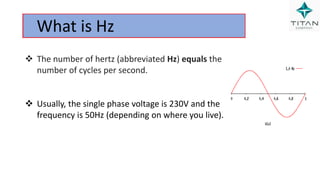
 The number of hertz (abbreviated Hz) equals the
number of cycles per second.
 Usually, the single phase voltage is 230V and the
frequency is 50Hz (depending on where you live).
What is Hz
Difference Between 1φ and 3φ Power Supplies
 Almost 90% of the electrical energy we use in our
day-to-day life is from alternating source like.
I) Our home appliances,
II)Office equipment
III)Industrial machines, etc..,
 Depending on the application, AC Power can be
delivered in either a Single Phase or a Three Phase
system.
Difference Between 1φ and 3φ Power Supplies
What is Single Phase Power Supply?
 As mentioned earlier, in a Single Phase Power
Supply, the power is distributed using only two
wires called Phase and neutral.
 Since AC Power takes the shape of a sinusoidal
wave, the voltage in a single phase supply peaks
at 900 during the positive cycle and again at
2700 during the negative cycle.
Difference Between 1φ and 3φ Power Supplies
.  The phase wire carries the current to
the load and the neutral wire
provides the return path of the
current.
 Since the voltage in a single phase
supply rises and falls, a constant
power cannot be delivered to the
load
Sine wave generation
What is three Phase Power Supply?
 A Three Phase Power Supply consists of three
power wires (or the three phases).
Additionally, depending on the type of the
circuit (which there are two types), you might
or might not have a neutral wire.
Sine wave generation
 In a three phase power supply system,
each AC Power Signal is 1200 out of phase
with each other. during one cycle of
3600,
This steady stream of power and ability to
handle higher loads makes a three phase
supply suitable for industrial commercial
operations.
What is Starter
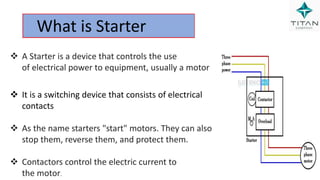
 A Starter is a device that controls the use
of electrical power to equipment, usually a motor
 It is a switching device that consists of electrical
contacts
 As the name starters "start" motors. They can also
stop them, reverse them, and protect them.
 Contactors control the electric current to
the motor.
DOL Starter
Star Delta Starter
Auto Transformer starter
Soft Starter
VFD Starter
Type of Stater
Direct On Line Starter
 Direct on line starter (DOL) mainly used
small capacity motors (below 5 HP)
doesn’t have very high starting current,
such motors can withstand the starting
currents.
 There is no need to reduce the voltage to
the motor at start and hence motor can
be connected directly to the supply lines.
Star Delta starter
Star Delta starter
 A star delta starter is the most
commonly used method for the
starting of a 3 phase induction motor.
 When motor reaches about 80% of
its full load speed, it will begin to run
in a delta connected stator winding.
 A star delta starter is a type of
reduced voltage starter
Auto Transformer Starter
 Three-phase auto transformer is connected
in series with the motor. This transformer
reduces the voltage applied to the motor
and hence the current.
 This starter consists of changeover switch
that switches the motor between reduced
voltage and full voltage conditions. When
this switch is in the start position, a reduced
voltage is applied to the motor.
Soft Stater
Soft Stater
 In this method, semiconductor power
switches are employed for reducing the
starting current to the induction motor.
 It is another type of reduced voltage starter
and it connected in series with the line
voltage applied to the motor.
 This starter consists of back to back thyristors
or TRIACs in each phase of the stator winding
VFD Stater
What is VFD
A variable frequency drive (VFD) is a type of motor controller
that drives an electric motor by varying the frequency and voltage of
its power supply.
The VFD also has the capacity to control ramp-up and ramp-down of
the motor during start or stop, respectively.
Other names:-
I). Adjustable speed drive
II). Adjustable frequency drive
III). AC drive (or) inverter.
Speed controlling methods:
Change supply voltage
Changing rotor resistance
Change frequency
Frequency Changing method
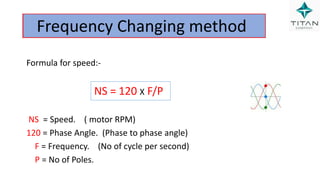
Formula for speed:-
NS = 120 X F/P
NS = Speed. ( motor RPM)
120 = Phase Angle. (Phase to phase angle)
F = Frequency. (No of cycle per second)
P = No of Poles.
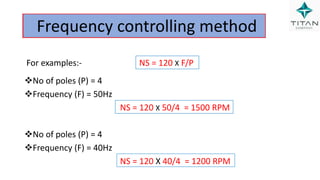
No of poles (P) = 4
Frequency (F) = 50Hz
NS = 120 X 50/4 = 1500 RPM
No of poles (P) = 4
Frequency (F) = 40Hz
NS = 120 X 40/4 = 1200 RPM
Frequency controlling method
For examples:- NS = 120 X F/P
Block diagram of VFD system
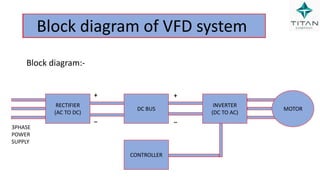
Block diagram:-
DC BUS
CONTROLLER
INVERTER
(DC TO AC)
RECTIFIER
(AC TO DC)
MOTOR
3PHASE
POWER
SUPPLY
+
_
+
_
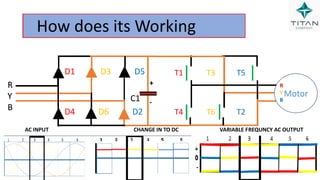
How does its Working
D1 D3 D5 T1 T3 T5
C1
D4 D6 D2 T4 T6 T2
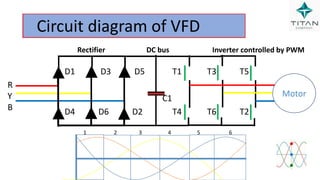
Circuit diagram of VFD
Motor
R
Y
B
1 2 3 4 5 6
Rectifier DC bus Inverter controlled by PWM
Components are :- Area:-
Diodes
Capacitor
 MOSFET or IGBT
Pulse width Modulations
What are the major components used
RECTIFIER
(AC TO DC)
DC BUS
INVERTER
(DC TO AC)
CONTROLLER
D1 D3 D5 T1 T3 T5
C1
D4 D6 D2 T4 T6 T2
Circuit diagram of VFD
Motor
R
Y
B
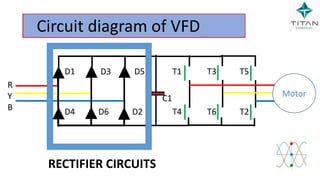
RECTIFIER CIRCUITS
Rectifier:-
Rectifier:-
 A diode is defined as a two-terminal
semiconductor device.
Anode (+)
Cathode(-)
 That only conducts current in one direction.
(so long as it is operated within a specified
voltage level).
Rectifier:-
Rectifier:-
Rectifier:-
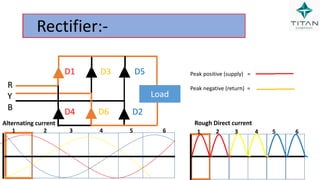
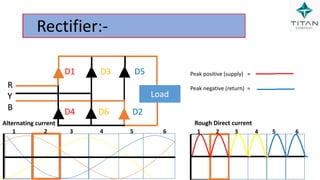
 A bridge rectifier makes use of four
diodes in a bridge arrangement to
achieve full-wave rectification.
 The Red colour indicates that those
diodes are in forward bias and the
black colour indicates that those
diodes are in reverse bias
Rectifier:-
 The arrows shows the direction of
current flow.
 At a particular time any of the two
diodes will be Forward Biased and
the other two will be Reverse Biased,
Rectifier:-
R
Y
B
1 2 3 4 5 6
Load
D1 D3 D5
D4 D6 D2
Diode = D1 to D6
Load = Dc motor
R
Y
B
1 2 3 4 5 6
Load
R
Y
B
Alternating current
1 2 3 4 5 6
Rectifier:-
Peak positive (supply) =
Peak negative (return) =
Rough Direct current
D1 D3 D5
D4 D6 D2
R
Y
B
1 2 3 4 5 6
Load
R
Y
B
Alternating current
1 2 3 4 5 6
Rectifier:-
Peak positive (supply) =
Peak negative (return) =
Rough Direct current
D1 D3 D5
D4 D6 D2
R
Y
B
1 2 3 4 5 6
Load
R
Y
B
Alternating current
1 2 3 4 5 6
Rectifier:-
Peak positive (supply) =
Peak negative (return) =
Rough Direct current
D1 D3 D5
D4 D6 D2
R
Y
B
1 2 3 4 5 6
Load
R
Y
B
1 2 3 4 5 6
Rectifier:-
Alternating current
Peak positive (supply) =
Peak negative (return) =
Rough Direct current
D1 D3 D5
D4 D6 D2
R
Y
B
1 2 3 4 5 6
Load
R
Y
B
Alternating current
1 2 3 4 5 6
Rectifier:-
Peak positive (supply) =
Peak negative (return) =
Rough Direct current
D1 D3 D5
D4 D6 D2
R
Y
B
1 2 3 4 5 6
Load
R
Y
B
Alternating current
1 2 3 4 5 6
Rectifier:-
Peak positive (supply) =
Peak negative (return) =
Rough Direct current
D1 D3 D5
D4 D6 D2
D1 D3 D5 T1 T3 T5
C1
D4 D6 D2 T6 T4 T2
Circuit diagram of VFD
Motor
R
Y
B
DC BUS CIRCUIT
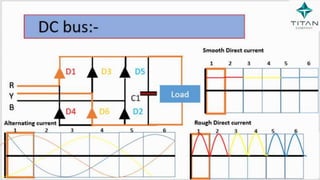
DC bus:-
DC bus:-
 DC bus is nothing but It capacitor
 Its function is to store the electrical energy and
give this energy again to the circuit when
necessary.
 In other words, it charges and discharges the
electric charge stored in it.
 It blocks the flow of DC and permits the flow of
AC.
DC bus:-
DC bus:-
R
Y
B
1 2 3 4 5 6
R
Y
B
Alternating current
1 2 3 4 5 6
Load
Rough Direct current
Smooth Direct current
1 2 3 4 5 6
D1 D3 D5
C1
D4 D6 D2
R
Y
B
1 2 3 4 5 6
R
Y
B
Alternating current
1 2 3 4 5 6
Load
Rough Direct current
Smooth Direct current
1 2 3 4 5 6
DC bus:-
D1 D3 D5
C1
D4 D6 D2
R
Y
B
1 2 3 4 5 6
R
Y
B
Alternating current
1 2 3 4 5 6
Load
Rough Direct current
Smooth Direct current
1 2 3 4 5 6
DC bus:-
D1 D3 D5
C1
D4 D6 D2
R
Y
B
1 2 3 4 5 6
R
Y
B
1 2 3 4 5 6
Load
Smooth Direct current
Rough Direct current
1 2 3 4 5 6
DC bus:-
Alternating current
D1 D3 D5
C1
D4 D6 D2
R
Y
B
1 2 3 4 5 6
R
Y
B
Alternating current
1 2 3 4 5 6
Load
Rough Direct current
Smooth Direct current
1 2 3 4 5 6
DC bus:-
D1 D3 D5
C1
D4 D6 D2
R
Y
B
1 2 3 4 5 6
Load
R
Y
B
Alternating current Rough Direct current
1 2 3 4 5 6
1 2 3 4 5 6
Smooth Direct current
DC bus:-
D1 D3 D5
C1
D4 D6 D2
Inverter
D1 D3 D5 T1 T3 T5
C1
D4 D6 D2 T6 T4 T2
Circuit diagram of VFD
Motor
R
Y
B
INVERTER CIRCUIT
Inverter
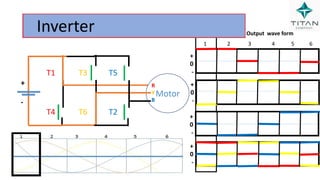
 Inverter converted Direct current to
Alternating current.
 Mainly using the components are:
 IGBT -----using in high capacity
application.
(OR)
 MOSFET---- using in Low capacity
application.
Inverter
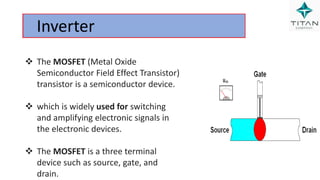
 The MOSFET (Metal Oxide
Semiconductor Field Effect Transistor)
transistor is a semiconductor device.
 which is widely used for switching
and amplifying electronic signals in
the electronic devices.
 The MOSFET is a three terminal
device such as source, gate, and
drain.
Inverter
.
 An insulated-gate bipolar transistor
(IGBT) is a three-terminal power
semiconductor device.
 It is primarily used as an electronic
switch which, as it was developed,
came to combine high efficiency and
fast switching.
Inverter
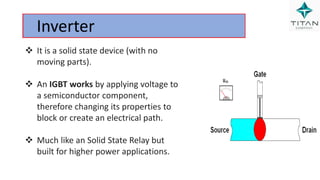
 It is a solid state device (with no
moving parts).
 An IGBT works by applying voltage to
a semiconductor component,
therefore changing its properties to
block or create an electrical path.
 Much like an Solid State Relay but
built for higher power applications.
Inverter
 PWM – Pulse width modulation Digital
control is used to create a square wave,
a signal switched between on and off.
 The duration off "on time" is called
the pulse width.
 Inverter signal controlled by Pulse
width modulation
Inverter
 Duty cycle is the percentage of
the ratio of pulse duration,
or pulse width (PW) to the total period
(T) of the waveform.
Pulse Width Modulation (PWM)
Inverter
Motor
+
0
-
+
0
-
+
0
-
1 2 3 4 5 6
Output wave form
R
Y
B
+
-
IGBT OR MOSET = T1 TO T6
T1 T3 T5
T4 T6 T2
+
0
-
Alternating current Waveform
Inverter
Motor
+
0
-
+
0
-
+
0
-
+
0
-
1 2 3 4 5 6
Output wave form
R
Y
B
+
-
T1 T3 T5
T4 T6 T2
Inverter
Motor
+
0
-
+
0
-
+
0
-
+
0
-
1 2 3 4 5 6
Output wave form
R
Y
B
+
-
T1 T3 T5
T4 T6 T2
Inverter
Motor
+
0
-
+
0
-
+
0
-
+
0
-
1 2 3 4 5 6
Output wave form
R
Y
B
+
-
T1 T3 T5
T4 T6 T2
Inverter
Motor
+
0
-
+
0
-
+
0
-
+
0
-
1 2 3 4 5 6
Output wave form
R
Y
B
+
-
T1 T3 T5
T4 T6 T2
Inverter
Motor
+
0
-
+
0
-
+
0
-
+
0
-
1 2 3 4 5 6
Output wave form
R
Y
B
+
-
T1 T3 T5
T4 T6 T2
Inverter
Motor
+
0
-
+
0
-
+
0
-
+
0
-
1 2 3 4 5 6
Output wave form
R
Y
B
+
-
T1 T3 T5
T4 T6 T2
How does its Working
T1 T3 T5
T4 T6 T2
Motor
R
Y
B
+
-
R
Y
B
R
Y
B
D1 D3 D5
C1
D4 D6 D2
AC INPUT CHANGE IN TO DC VARIABLE FREQUNCY AC OUTPUT
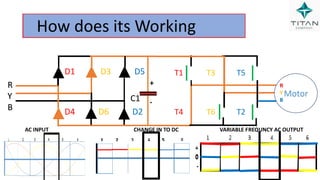
How does its Working
R
Y
B
R
Y
B
Motor
R
Y
B
+
-
D1 D3 D5
C1
D4 D6 D2
T1 T3 T5
T4 T6 T2
AC INPUT CHANGE IN TO DC VARIABLE FREQUNCY AC OUTPUT
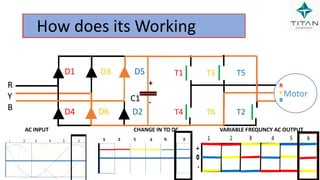
How does its Working
R
Y
B
R
Y
B
Motor
R
Y
B
+
-
D1 D3 D5
C1
D4 D6 D2
T1 T3 T5
T4 T6 T2
AC INPUT CHANGE IN TO DC VARIABLE FREQUNCY AC OUTPUT
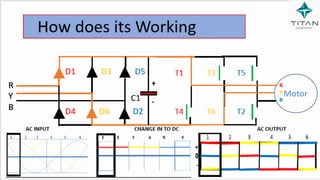
How does its Working
R
Y
B
R
Y
B
Motor
R
Y
B
+
-
D1 D3 D5
C1
D4 D6 D2
T1 T3 T5
T4 T6 T2
AC INPUT CHANGE IN TO DC VARIABLE FREQUNCY AC OUTPUT
How does its Working
R
Y
B
R
Y
B
Motor
R
Y
B
+
-
D1 D3 D5
C1
D4 D6 D2
T1 T3 T5
T4 T6 T2
AC INPUT CHANGE IN TO DC VARIABLE FREQUNCY AC OUTPUT
How does its Working
R
Y
B
R
Y
B
Motor
R
Y
B
+
-
D1 D3 D5
C1
D4 D6 D2
T1 T3 T5
T4 T6 T2
AC INPUT CHANGE IN TO DC VARIABLE FREQUNCY AC OUTPUT
How does its Working
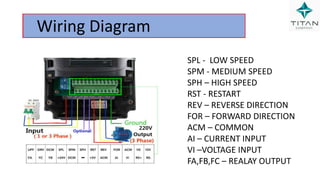
VFD Basic wiring connection
T1 T2 T3
L1 L2 L3
3POLE MCB
3PHASE INDUCTION
MOTOR
3 PHASE LINE
COM|FOR|REV|LOW|MID|HIG|
+VDC|REF|COM
Wiring Diagram
SPL - LOW SPEED
SPM - MEDIUM SPEED
SPH – HIGH SPEED
RST - RESTART
REV – REVERSE DIRECTION
FOR – FORWARD DIRECTION
ACM – COMMON
AI – CURRENT INPUT
VI –VOLTAGE INPUT
FA,FB,FC – REALAY OUTPUT
Some of the VFD Application
Cooling Tower
 Compressor
Blower
Boiler
Lathe work shops
Modern lift system
Pumping system etc..,
Advantage and Disadvantage of VFD
Advantage:-
 Smooth starting.
 Smooth acceleration & deceleration time.
 Zero RPM Achive.
 Stopping methods.
 Power saving
Disadvantage:-
 Cost is higher
 Skilled person required to change the parameter
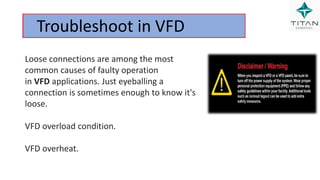
Troubleshoot in VFD
Loose connections are among the most
common causes of faulty operation
in VFD applications. Just eyeballing a
connection is sometimes enough to know it's
loose.
VFD overload condition.
VFD overheat.
What are the communication
1. Delta VFD (MODBUS RS-485COMMUNICATION).
2. SIEMENS VFD(PROFI BUS COMMUNICATION).
3. ABB VFD (MODBUS COMMUNICATION).
4. Schneider (MODBUS COMMUNICATION) .
Where is used VFD in our industry
1. scrubber Schneider VFD 22kw 11kw
2. Cooling 150TR ABB VFD 5Kw
3. Secondary pump Vogon VFD 11Kw
4. Dust collector ABB VFD 4kw
Thank you ’’’’
’

VFD SYSTEM- Variable Frequency Drive applications

  • 1.
    Prepared by :- Thamizharasank VARIABLE FREQUENCY DRIVE
  • 2.
    CONTENTS 1. What isAc and Dc 2. Sine wave generation 3. What is Hz 4. What is Single phase and three phase. 5. What is starter and history 6. Type of starter 7. Explain each starter 8. What is VFD 9. Type of speed controlling method 10. Block diagram 11. Circuit diagram 12. Circuit diagram explanation 13. How its working 14. Application 15. Advantage and disadvantage 15. Troubleshoot in VFD. 16. What are the Communication in VFD. 17. Type of VFD. 18. Where is used VFD in our industry. DURATION HRS :- 1.00 Hrs Total Slide:-93
  • 3.
    What is ACand DC Alternating current Direct current What is Alternating current? The current, which reverses its direction periodically in second , is called “Alternating Current”. What is Direct current? Direct current is the unidirectional flow of an electric charge.
  • 4.
    Sine wave generation A.C voltage may be generated by rotating a coil in a magnetic field or by rotating a magnetic field within a stationary coil. Induction.  It says that whenever there is a relative motion between the conductor and the magnetic field in which it is kept,an e.m.f gets induced in the conductor
  • 5.
     The numberof hertz (abbreviated Hz) equals the number of cycles per second.  Usually, the single phase voltage is 230V and the frequency is 50Hz (depending on where you live). What is Hz
  • 7.
    Difference Between 1φand 3φ Power Supplies  Almost 90% of the electrical energy we use in our day-to-day life is from alternating source like. I) Our home appliances, II)Office equipment III)Industrial machines, etc..,  Depending on the application, AC Power can be delivered in either a Single Phase or a Three Phase system.
  • 8.
    Difference Between 1φand 3φ Power Supplies What is Single Phase Power Supply?  As mentioned earlier, in a Single Phase Power Supply, the power is distributed using only two wires called Phase and neutral.  Since AC Power takes the shape of a sinusoidal wave, the voltage in a single phase supply peaks at 900 during the positive cycle and again at 2700 during the negative cycle.
  • 9.
    Difference Between 1φand 3φ Power Supplies .  The phase wire carries the current to the load and the neutral wire provides the return path of the current.  Since the voltage in a single phase supply rises and falls, a constant power cannot be delivered to the load
  • 10.
    Sine wave generation Whatis three Phase Power Supply?  A Three Phase Power Supply consists of three power wires (or the three phases). Additionally, depending on the type of the circuit (which there are two types), you might or might not have a neutral wire.
  • 11.
    Sine wave generation In a three phase power supply system, each AC Power Signal is 1200 out of phase with each other. during one cycle of 3600, This steady stream of power and ability to handle higher loads makes a three phase supply suitable for industrial commercial operations.
  • 12.
    What is Starter A Starter is a device that controls the use of electrical power to equipment, usually a motor  It is a switching device that consists of electrical contacts  As the name starters "start" motors. They can also stop them, reverse them, and protect them.  Contactors control the electric current to the motor.
  • 14.
    DOL Starter Star DeltaStarter Auto Transformer starter Soft Starter VFD Starter Type of Stater
  • 15.
  • 16.
    Direct On LineStarter  Direct on line starter (DOL) mainly used small capacity motors (below 5 HP) doesn’t have very high starting current, such motors can withstand the starting currents.  There is no need to reduce the voltage to the motor at start and hence motor can be connected directly to the supply lines.
  • 17.
  • 18.
    Star Delta starter A star delta starter is the most commonly used method for the starting of a 3 phase induction motor.  When motor reaches about 80% of its full load speed, it will begin to run in a delta connected stator winding.  A star delta starter is a type of reduced voltage starter
  • 19.
  • 20.
    Auto Transformer Starter Three-phase auto transformer is connected in series with the motor. This transformer reduces the voltage applied to the motor and hence the current.  This starter consists of changeover switch that switches the motor between reduced voltage and full voltage conditions. When this switch is in the start position, a reduced voltage is applied to the motor.
  • 21.
  • 22.
    Soft Stater  Inthis method, semiconductor power switches are employed for reducing the starting current to the induction motor.  It is another type of reduced voltage starter and it connected in series with the line voltage applied to the motor.  This starter consists of back to back thyristors or TRIACs in each phase of the stator winding
  • 23.
  • 24.
    What is VFD Avariable frequency drive (VFD) is a type of motor controller that drives an electric motor by varying the frequency and voltage of its power supply. The VFD also has the capacity to control ramp-up and ramp-down of the motor during start or stop, respectively. Other names:- I). Adjustable speed drive II). Adjustable frequency drive III). AC drive (or) inverter.
  • 25.
    Speed controlling methods: Changesupply voltage Changing rotor resistance Change frequency
  • 26.
  • 27.
    Frequency Changing method Formulafor speed:- NS = 120 X F/P NS = Speed. ( motor RPM) 120 = Phase Angle. (Phase to phase angle) F = Frequency. (No of cycle per second) P = No of Poles.
  • 28.
    No of poles(P) = 4 Frequency (F) = 50Hz NS = 120 X 50/4 = 1500 RPM No of poles (P) = 4 Frequency (F) = 40Hz NS = 120 X 40/4 = 1200 RPM Frequency controlling method For examples:- NS = 120 X F/P
  • 29.
    Block diagram ofVFD system Block diagram:- DC BUS CONTROLLER INVERTER (DC TO AC) RECTIFIER (AC TO DC) MOTOR 3PHASE POWER SUPPLY + _ + _
  • 30.
    How does itsWorking
  • 31.
    D1 D3 D5T1 T3 T5 C1 D4 D6 D2 T4 T6 T2 Circuit diagram of VFD Motor R Y B 1 2 3 4 5 6 Rectifier DC bus Inverter controlled by PWM
  • 32.
    Components are :-Area:- Diodes Capacitor  MOSFET or IGBT Pulse width Modulations What are the major components used RECTIFIER (AC TO DC) DC BUS INVERTER (DC TO AC) CONTROLLER
  • 33.
    D1 D3 D5T1 T3 T5 C1 D4 D6 D2 T4 T6 T2 Circuit diagram of VFD Motor R Y B RECTIFIER CIRCUITS
  • 34.
  • 35.
    Rectifier:-  A diodeis defined as a two-terminal semiconductor device. Anode (+) Cathode(-)  That only conducts current in one direction. (so long as it is operated within a specified voltage level).
  • 36.
  • 37.
  • 38.
    Rectifier:-  A bridgerectifier makes use of four diodes in a bridge arrangement to achieve full-wave rectification.  The Red colour indicates that those diodes are in forward bias and the black colour indicates that those diodes are in reverse bias
  • 39.
    Rectifier:-  The arrowsshows the direction of current flow.  At a particular time any of the two diodes will be Forward Biased and the other two will be Reverse Biased,
  • 40.
    Rectifier:- R Y B 1 2 34 5 6 Load D1 D3 D5 D4 D6 D2 Diode = D1 to D6 Load = Dc motor
  • 41.
    R Y B 1 2 34 5 6 Load R Y B Alternating current 1 2 3 4 5 6 Rectifier:- Peak positive (supply) = Peak negative (return) = Rough Direct current D1 D3 D5 D4 D6 D2
  • 42.
    R Y B 1 2 34 5 6 Load R Y B Alternating current 1 2 3 4 5 6 Rectifier:- Peak positive (supply) = Peak negative (return) = Rough Direct current D1 D3 D5 D4 D6 D2
  • 43.
    R Y B 1 2 34 5 6 Load R Y B Alternating current 1 2 3 4 5 6 Rectifier:- Peak positive (supply) = Peak negative (return) = Rough Direct current D1 D3 D5 D4 D6 D2
  • 44.
    R Y B 1 2 34 5 6 Load R Y B 1 2 3 4 5 6 Rectifier:- Alternating current Peak positive (supply) = Peak negative (return) = Rough Direct current D1 D3 D5 D4 D6 D2
  • 45.
    R Y B 1 2 34 5 6 Load R Y B Alternating current 1 2 3 4 5 6 Rectifier:- Peak positive (supply) = Peak negative (return) = Rough Direct current D1 D3 D5 D4 D6 D2
  • 46.
    R Y B 1 2 34 5 6 Load R Y B Alternating current 1 2 3 4 5 6 Rectifier:- Peak positive (supply) = Peak negative (return) = Rough Direct current D1 D3 D5 D4 D6 D2
  • 48.
    D1 D3 D5T1 T3 T5 C1 D4 D6 D2 T6 T4 T2 Circuit diagram of VFD Motor R Y B DC BUS CIRCUIT
  • 49.
  • 50.
    DC bus:-  DCbus is nothing but It capacitor  Its function is to store the electrical energy and give this energy again to the circuit when necessary.  In other words, it charges and discharges the electric charge stored in it.  It blocks the flow of DC and permits the flow of AC.
  • 51.
  • 52.
    DC bus:- R Y B 1 23 4 5 6 R Y B Alternating current 1 2 3 4 5 6 Load Rough Direct current Smooth Direct current 1 2 3 4 5 6 D1 D3 D5 C1 D4 D6 D2
  • 53.
    R Y B 1 2 34 5 6 R Y B Alternating current 1 2 3 4 5 6 Load Rough Direct current Smooth Direct current 1 2 3 4 5 6 DC bus:- D1 D3 D5 C1 D4 D6 D2
  • 54.
    R Y B 1 2 34 5 6 R Y B Alternating current 1 2 3 4 5 6 Load Rough Direct current Smooth Direct current 1 2 3 4 5 6 DC bus:- D1 D3 D5 C1 D4 D6 D2
  • 55.
    R Y B 1 2 34 5 6 R Y B 1 2 3 4 5 6 Load Smooth Direct current Rough Direct current 1 2 3 4 5 6 DC bus:- Alternating current D1 D3 D5 C1 D4 D6 D2
  • 56.
    R Y B 1 2 34 5 6 R Y B Alternating current 1 2 3 4 5 6 Load Rough Direct current Smooth Direct current 1 2 3 4 5 6 DC bus:- D1 D3 D5 C1 D4 D6 D2
  • 57.
    R Y B 1 2 34 5 6 Load R Y B Alternating current Rough Direct current 1 2 3 4 5 6 1 2 3 4 5 6 Smooth Direct current DC bus:- D1 D3 D5 C1 D4 D6 D2
  • 59.
  • 60.
    D1 D3 D5T1 T3 T5 C1 D4 D6 D2 T6 T4 T2 Circuit diagram of VFD Motor R Y B INVERTER CIRCUIT
  • 61.
    Inverter  Inverter convertedDirect current to Alternating current.  Mainly using the components are:  IGBT -----using in high capacity application. (OR)  MOSFET---- using in Low capacity application.
  • 62.
    Inverter  The MOSFET(Metal Oxide Semiconductor Field Effect Transistor) transistor is a semiconductor device.  which is widely used for switching and amplifying electronic signals in the electronic devices.  The MOSFET is a three terminal device such as source, gate, and drain.
  • 63.
    Inverter .  An insulated-gatebipolar transistor (IGBT) is a three-terminal power semiconductor device.  It is primarily used as an electronic switch which, as it was developed, came to combine high efficiency and fast switching.
  • 64.
    Inverter  It isa solid state device (with no moving parts).  An IGBT works by applying voltage to a semiconductor component, therefore changing its properties to block or create an electrical path.  Much like an Solid State Relay but built for higher power applications.
  • 65.
    Inverter  PWM –Pulse width modulation Digital control is used to create a square wave, a signal switched between on and off.  The duration off "on time" is called the pulse width.  Inverter signal controlled by Pulse width modulation
  • 66.
    Inverter  Duty cycleis the percentage of the ratio of pulse duration, or pulse width (PW) to the total period (T) of the waveform.
  • 67.
  • 68.
  • 69.
    Inverter Motor + 0 - + 0 - + 0 - 1 2 34 5 6 Output wave form R Y B + - IGBT OR MOSET = T1 TO T6 T1 T3 T5 T4 T6 T2 + 0 - Alternating current Waveform
  • 70.
    Inverter Motor + 0 - + 0 - + 0 - + 0 - 1 2 34 5 6 Output wave form R Y B + - T1 T3 T5 T4 T6 T2
  • 71.
    Inverter Motor + 0 - + 0 - + 0 - + 0 - 1 2 34 5 6 Output wave form R Y B + - T1 T3 T5 T4 T6 T2
  • 72.
    Inverter Motor + 0 - + 0 - + 0 - + 0 - 1 2 34 5 6 Output wave form R Y B + - T1 T3 T5 T4 T6 T2
  • 73.
    Inverter Motor + 0 - + 0 - + 0 - + 0 - 1 2 34 5 6 Output wave form R Y B + - T1 T3 T5 T4 T6 T2
  • 74.
    Inverter Motor + 0 - + 0 - + 0 - + 0 - 1 2 34 5 6 Output wave form R Y B + - T1 T3 T5 T4 T6 T2
  • 75.
    Inverter Motor + 0 - + 0 - + 0 - + 0 - 1 2 34 5 6 Output wave form R Y B + - T1 T3 T5 T4 T6 T2
  • 77.
    How does itsWorking
  • 78.
    How does itsWorking T1 T3 T5 T4 T6 T2 Motor R Y B + - R Y B R Y B D1 D3 D5 C1 D4 D6 D2 AC INPUT CHANGE IN TO DC VARIABLE FREQUNCY AC OUTPUT
  • 79.
    How does itsWorking R Y B R Y B Motor R Y B + - D1 D3 D5 C1 D4 D6 D2 T1 T3 T5 T4 T6 T2 AC INPUT CHANGE IN TO DC VARIABLE FREQUNCY AC OUTPUT
  • 80.
    How does itsWorking R Y B R Y B Motor R Y B + - D1 D3 D5 C1 D4 D6 D2 T1 T3 T5 T4 T6 T2 AC INPUT CHANGE IN TO DC VARIABLE FREQUNCY AC OUTPUT
  • 81.
    How does itsWorking R Y B R Y B Motor R Y B + - D1 D3 D5 C1 D4 D6 D2 T1 T3 T5 T4 T6 T2 AC INPUT CHANGE IN TO DC VARIABLE FREQUNCY AC OUTPUT
  • 82.
    How does itsWorking R Y B R Y B Motor R Y B + - D1 D3 D5 C1 D4 D6 D2 T1 T3 T5 T4 T6 T2 AC INPUT CHANGE IN TO DC VARIABLE FREQUNCY AC OUTPUT
  • 83.
    How does itsWorking R Y B R Y B Motor R Y B + - D1 D3 D5 C1 D4 D6 D2 T1 T3 T5 T4 T6 T2 AC INPUT CHANGE IN TO DC VARIABLE FREQUNCY AC OUTPUT
  • 85.
    How does itsWorking
  • 86.
    VFD Basic wiringconnection T1 T2 T3 L1 L2 L3 3POLE MCB 3PHASE INDUCTION MOTOR 3 PHASE LINE COM|FOR|REV|LOW|MID|HIG| +VDC|REF|COM
  • 87.
    Wiring Diagram SPL -LOW SPEED SPM - MEDIUM SPEED SPH – HIGH SPEED RST - RESTART REV – REVERSE DIRECTION FOR – FORWARD DIRECTION ACM – COMMON AI – CURRENT INPUT VI –VOLTAGE INPUT FA,FB,FC – REALAY OUTPUT
  • 88.
    Some of theVFD Application Cooling Tower  Compressor Blower Boiler Lathe work shops Modern lift system Pumping system etc..,
  • 89.
    Advantage and Disadvantageof VFD Advantage:-  Smooth starting.  Smooth acceleration & deceleration time.  Zero RPM Achive.  Stopping methods.  Power saving Disadvantage:-  Cost is higher  Skilled person required to change the parameter
  • 90.
    Troubleshoot in VFD Looseconnections are among the most common causes of faulty operation in VFD applications. Just eyeballing a connection is sometimes enough to know it's loose. VFD overload condition. VFD overheat.
  • 91.
    What are thecommunication 1. Delta VFD (MODBUS RS-485COMMUNICATION). 2. SIEMENS VFD(PROFI BUS COMMUNICATION). 3. ABB VFD (MODBUS COMMUNICATION). 4. Schneider (MODBUS COMMUNICATION) .
  • 92.
    Where is usedVFD in our industry 1. scrubber Schneider VFD 22kw 11kw 2. Cooling 150TR ABB VFD 5Kw 3. Secondary pump Vogon VFD 11Kw 4. Dust collector ABB VFD 4kw
  • 93.