THE POWER
FACTOR
PRESENTED BY –
Dushyant Trivedi / 4 RD YEAR
DEPARTMENT ELECTRICAL MITS
JADAN PALI
GUIDE BY :
Mr. HITESH JAIN (Asst. Professor)
ELECTRICAL DEPARMENT
MITS JADAN,PALI
OBJECTIVES -
 DEFINATION OF POWER FACTOR
 MEASURMENT OF POWER FACTOR
 DISADVANTAGES OF POOR POWER FACTOR
 IMPROVEMENT OF THE POWER FACTOR
 VARIOUS METHODS TO IMPROVE THE POWER FACTOR
 ADVANTAGE OF HIGH POWER FACTOR
DEFINATION OF POWER FACTOR
POWER FACTOR – The ratio between actual power to the
apparent power is known as power factor
 Power factor is also defined as the cosine of phase angle phai
between voltage (V) and the current(I).
 Means P.F.= cos
 Power factor is denoted by P.F.
 Power factor = Actual power / Apparentpower
 P.F.= KW/KVA
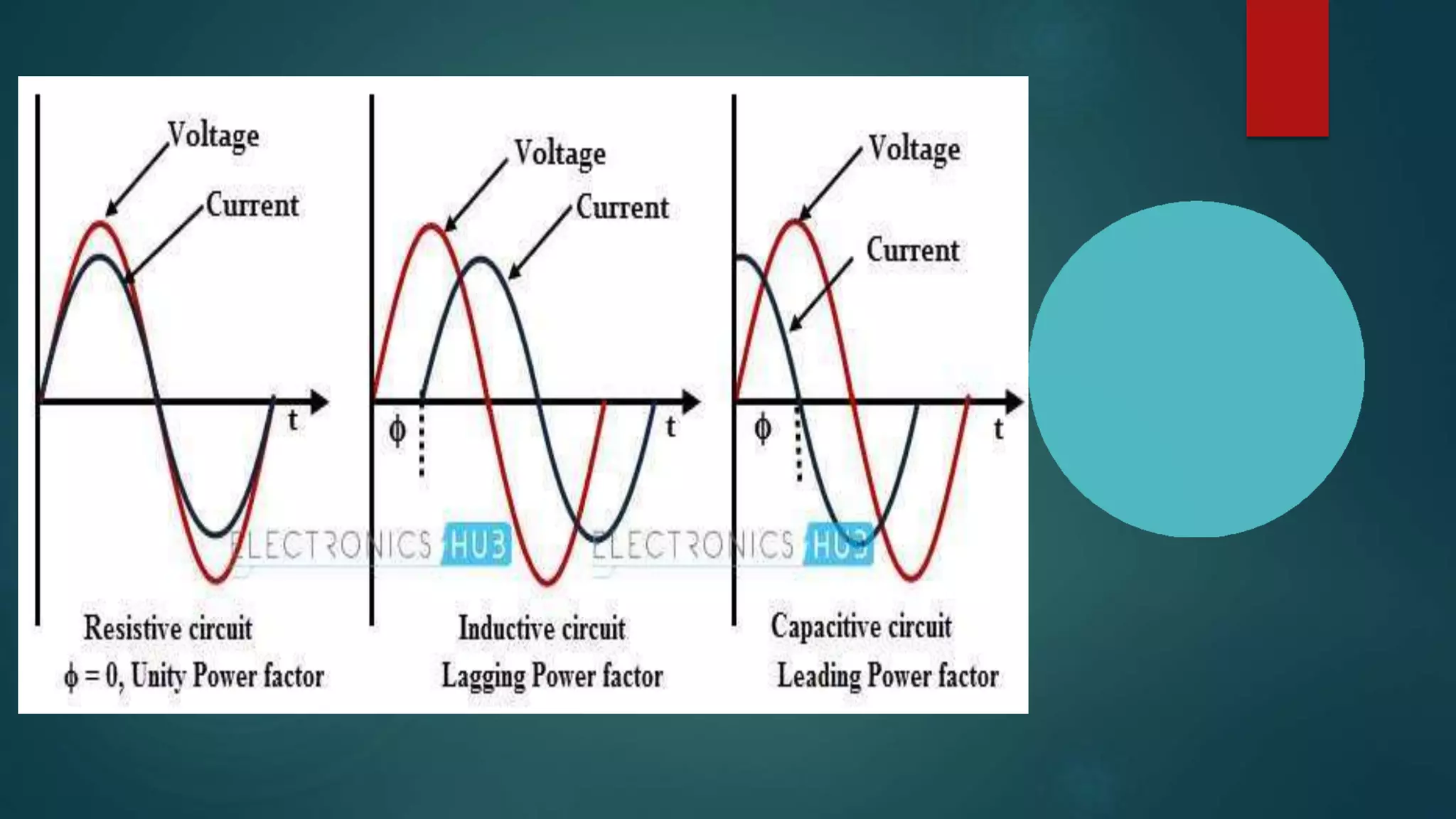
TYPES OF POWER FACTOR
In an electrical system power factor can be
classified into three types depending on the
types of load :-
Lagging power factor
Leading power factor
Unity power factor
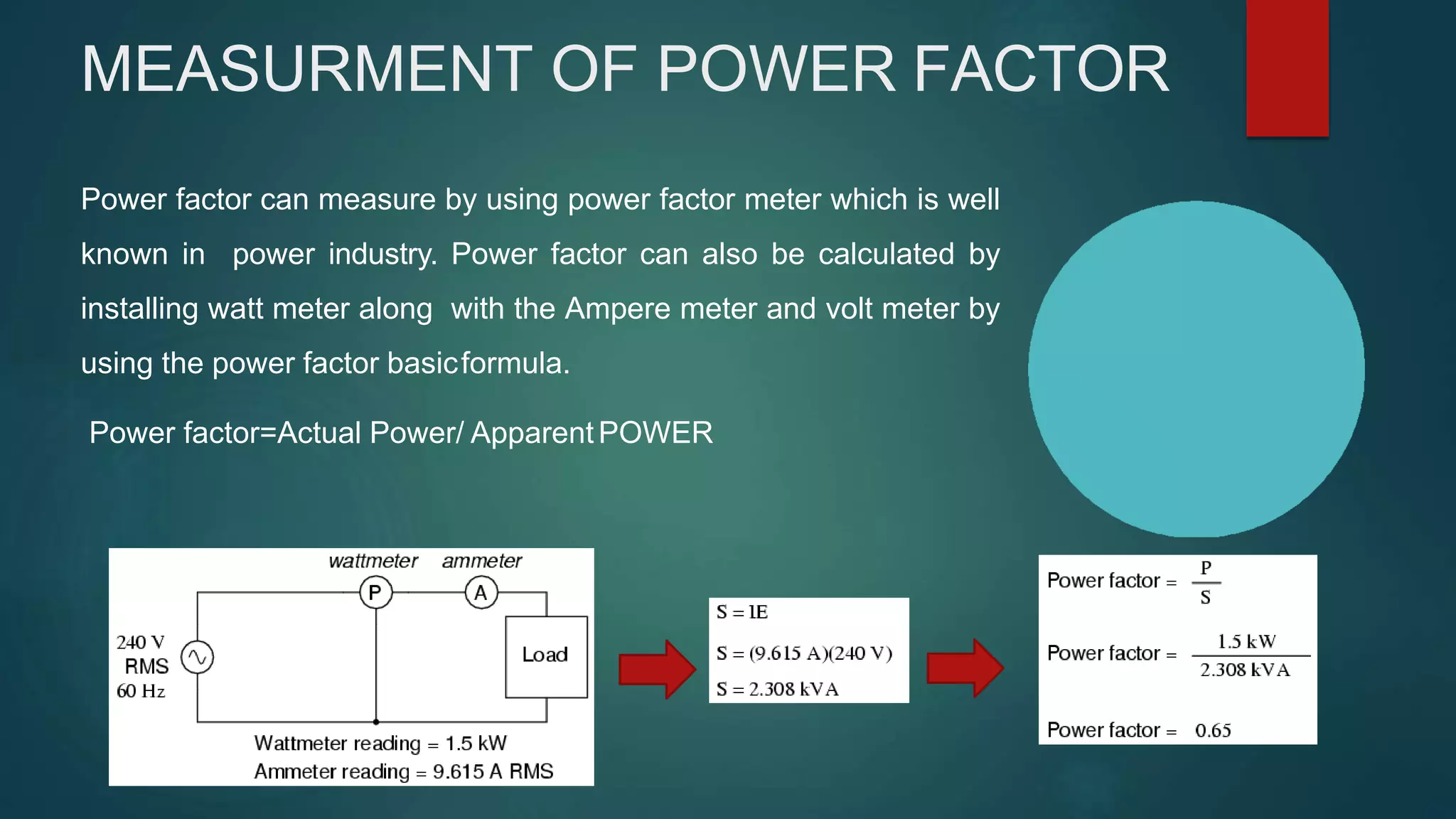
MEASURMENT OF POWER FACTOR
Power factor can measure by using power factor meter which is well
known in power industry. Power factor can also be calculated by
installing watt meter along with the Ampere meter and volt meter by
using the power factor basicformula.
Power factor=Actual Power/ ApparentPOWER
CAUSES OF LOW POWER FACTOR
Inductive Loads
Variations In Power System Loading
Harmonic Currents
Arc lamp
Reactors
Arc furnace
Transmission line
ACTIVE POWER
The power which is actually consumed or utilized in an AC
Circuit is called True power or Active Power or real power. It
is measured in kilo watt (kW) or MW. It is the actual outcomes
of the electrical system which runs the electric circuits or load.
Real Power formulas:
 P = V I (In DC circuits)
 P = VI Cosθ (in Single phase AC Circuits)
 P = √3 VL IL Cosθ (in Three Phase AC Circuits)
REACTIVE POWER
REACTIVE POWER – The power which flows back and front that mean
it moves in both the direction in the circuit or react upon itself, is called
Reactive Power.The reactive power is measured in kilo volt ampere
reactive (kVAR) or MVAR.
Reactive Power Formulas:
 Q = V I Sinθ
 Reactive Power=√ (Apparent Power2– True power2)
 VAR =√ (VA2 – P2)
 kVAR = √ (kVA2 – kW2)
APPARENT POWER
 APPARENT POWER – The product of root mean square (RMS) value of
voltage and current is known as Apparent Power. This power is measuredin
kVA or MVA.
 Apparent Power Formulas:
 S = V I
 Apparent Power = √ (True power2 + ReactivePower2)
 kVA = √kW2 +kVAR2
ADVANTAGES OF HIGH POWER FACTOR
 Reduced copper losses.
 Smaller conductor size.
 Improved voltage regulation.
 Increased system capacity.
 Less energy bill
DISADVANTAAGE OF POOR POWER FACTOR
 Increases heating losses in the transformers and distribution equipments.
 Reduce plant life.
 Unstabilise voltage levels.
 Increase power losses.
 Upgrade costly equipments.
 Decrease energy efficiency.
 Increase electricity costs by paying power factor
 surcharges.
HOW TO IMPROVE THE POWER FACTOR?
 Power factor decreases with the installation of non
resistive loads such as induction motors, Transformers.
Lighting ballasts and electronic equipments. Power
factors can be corrected by using capacitors. These are
rated in electrical units called VAR or KVAR.One VAR is
equivalent to one volt of reactive power. VAR then are
units of measurement for indicating just how much
reactive power the capacitor will supply.
HOW TO IMPROVE THE POWEER FACTOR
 The amount of Power Capacitor KVAR required to correct A system to a
desired Power Factor level is the difference between the amount of KVAR in the
uncorrected system and the amount of desired KVAR in the corrected system.
 The most efficient location for power factor capacitorsis at the load.
 Capacitors work from the point of installation back to the generating source.
 Individual motor correction is not always practical, sometimes it is more
practical to connect larger capacitors on the distribution bus or install an
automatic system at the incoming service along with fixed capacitors at the
load.
POWER FACTOR CORRECTION METHODS
 Static Var Compensator(SVC)
 Fixed Capcitors
 Switch Capacitors
 Synchronous Condensors
 Static Synchronous Compensator(STATCOM)
 Modulated power filter capacitor compensator
STATIC VAR COMPENSATOR (SVC)
 The Static Var Compensator (SVC) is a shunt device of the Flexible AC Transmission
Systems (FACTS) family using power electronics to control power flow and improve
transient stability on power grids . The SVC regulates voltage at its terminals by
controlling the amount of reactive power injected into or absorbed from the power
system. When system voltage is low, the SVC generates reactive power (SVC
capacitive). When system voltage is high, it absorbs reactive power The variation of
reactive power is performed by switching
 three-phase capacitor banks and inductor banks connected on the secondary side of
a coupling transformer. Each capacitor bank is switched on and off by three thyristor
switches (Thyristor Switched Capacitor or TSC). Reactors are either switched on-off
(Thyristor Switched Reactor or TSR) or phase-controlled (Thyristor Controlled Reactor
Capacitors:
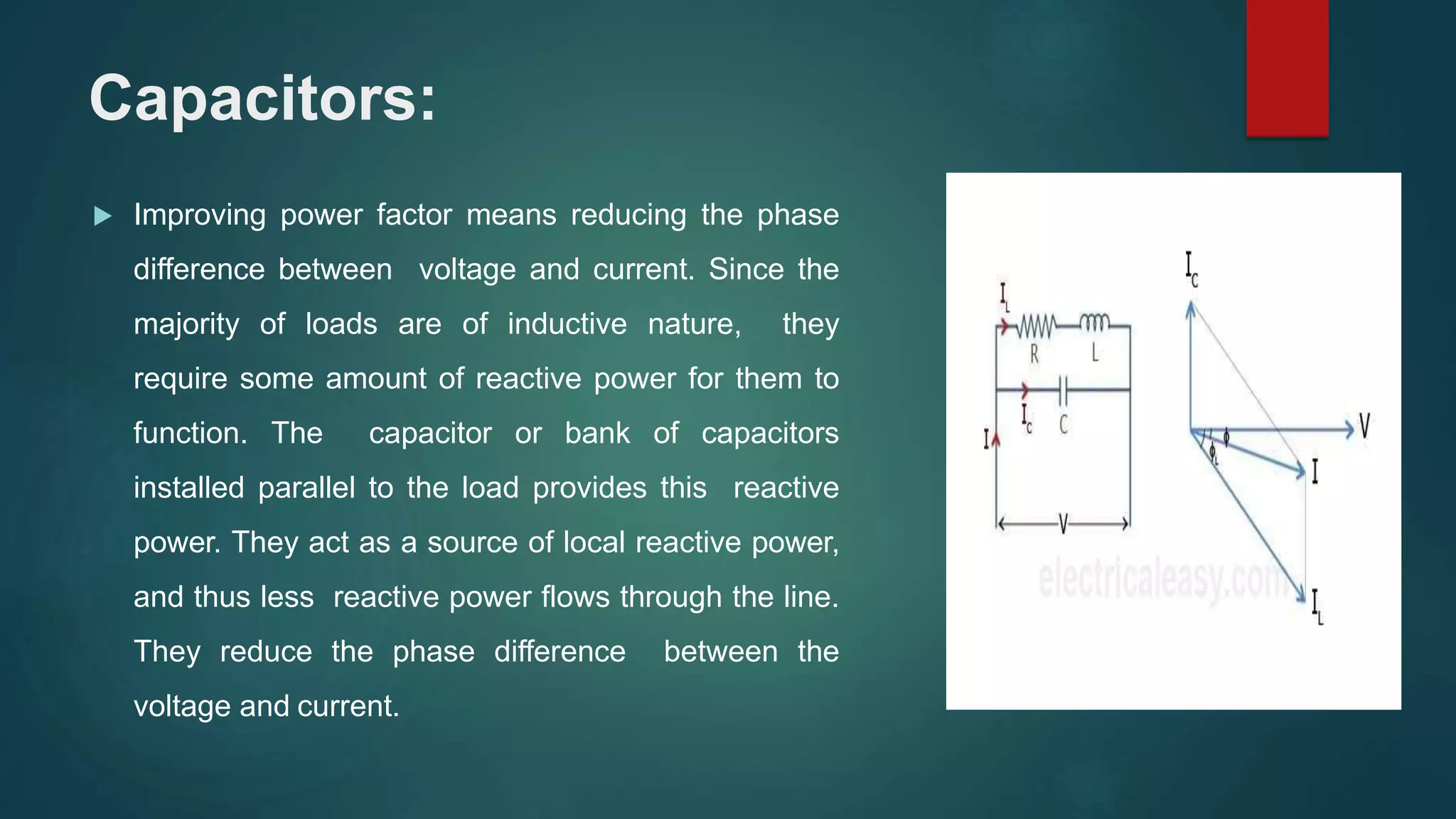
 Improving power factor means reducing the phase
difference between voltage and current. Since the
majority of loads are of inductive nature, they
require some amount of reactive power for them to
function. The capacitor or bank of capacitors
installed parallel to the load provides this reactive
power. They act as a source of local reactive power,
and thus less reactive power flows through the line.
They reduce the phase difference between the
voltage and current.
Synchronous Condenser:
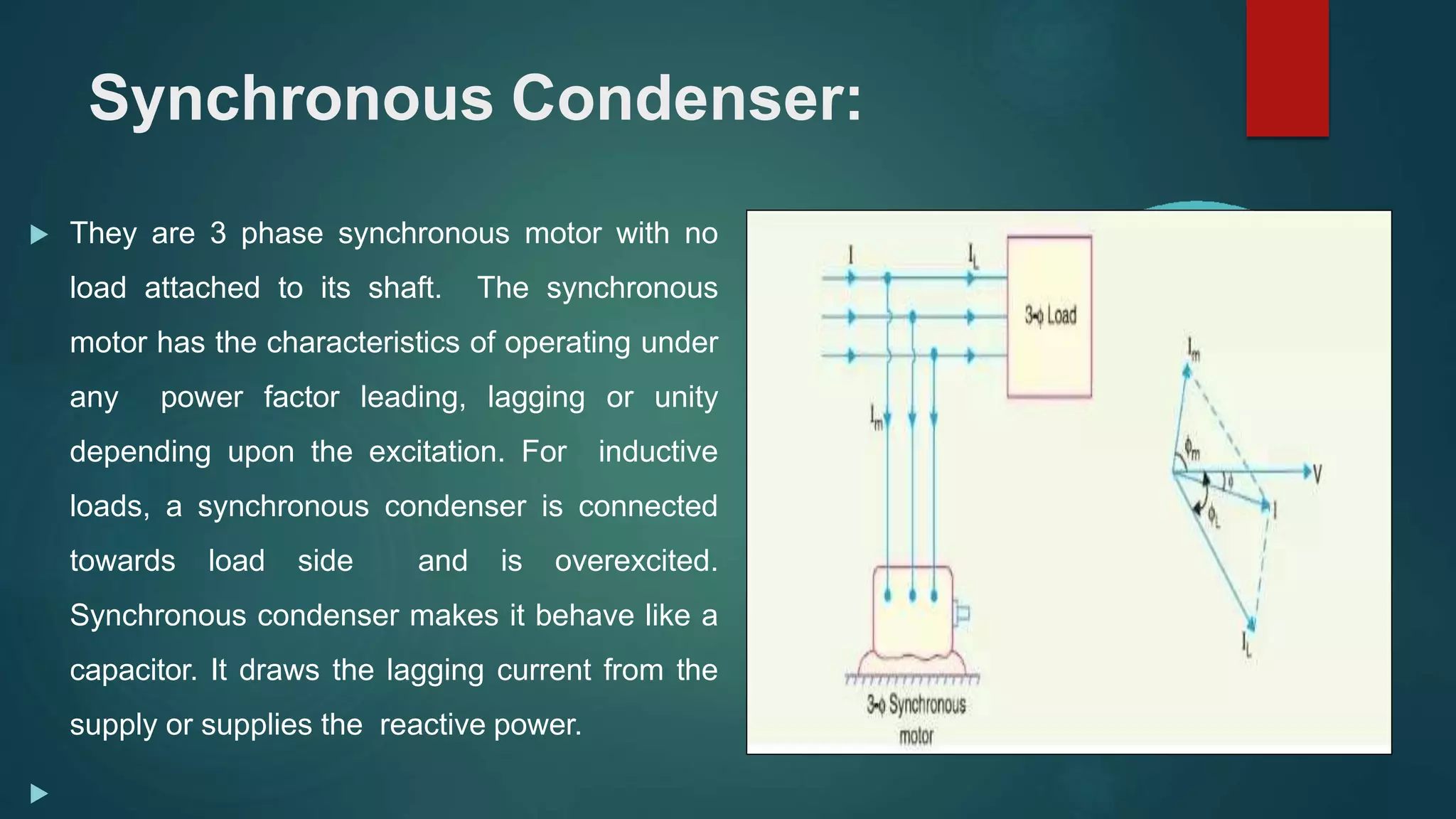
 They are 3 phase synchronous motor with no
load attached to its shaft. The synchronous
motor has the characteristics of operating under
any power factor leading, lagging or unity
depending upon the excitation. For inductive
loads, a synchronous condenser is connected
towards load side and is overexcited.
Synchronous condenser makes it behave like a
capacitor. It draws the lagging current from the
supply or supplies the reactive power.

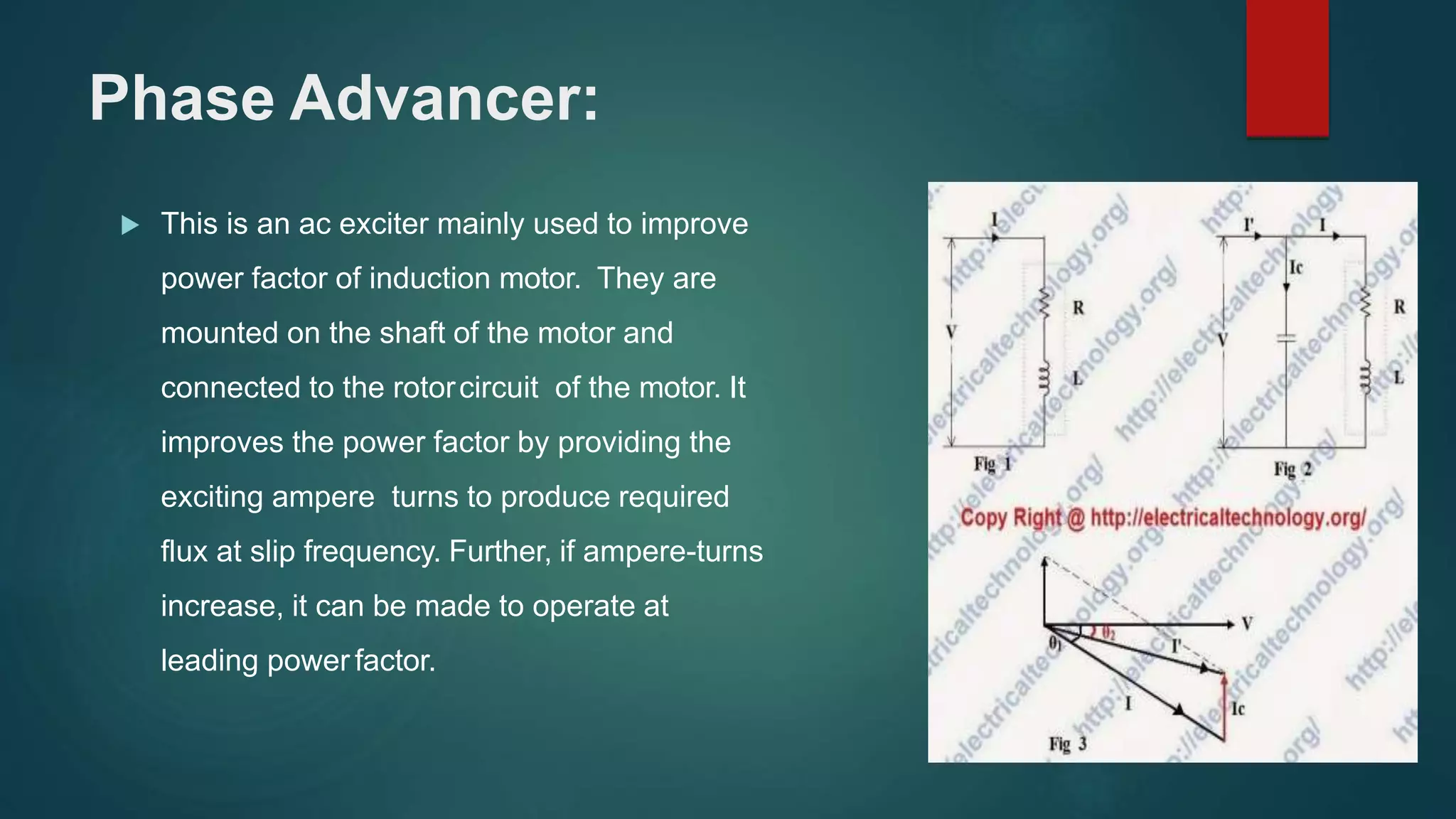
Phase Advancer:
 This is an ac exciter mainly used to improve
power factor of induction motor. They are
mounted on the shaft of the motor and
connected to the rotorcircuit of the motor. It
improves the power factor by providing the
exciting ampere turns to produce required
flux at slip frequency. Further, if ampere-turns
increase, it can be made to operate at
leading power factor.
THANK YOU
THANK YOU

POWER FACTOR IMPROVE

  • 1.
    THE POWER FACTOR PRESENTED BY– Dushyant Trivedi / 4 RD YEAR DEPARTMENT ELECTRICAL MITS JADAN PALI GUIDE BY : Mr. HITESH JAIN (Asst. Professor) ELECTRICAL DEPARMENT MITS JADAN,PALI
  • 2.
    OBJECTIVES -  DEFINATIONOF POWER FACTOR  MEASURMENT OF POWER FACTOR  DISADVANTAGES OF POOR POWER FACTOR  IMPROVEMENT OF THE POWER FACTOR  VARIOUS METHODS TO IMPROVE THE POWER FACTOR  ADVANTAGE OF HIGH POWER FACTOR
  • 3.
    DEFINATION OF POWERFACTOR POWER FACTOR – The ratio between actual power to the apparent power is known as power factor  Power factor is also defined as the cosine of phase angle phai between voltage (V) and the current(I).  Means P.F.= cos  Power factor is denoted by P.F.  Power factor = Actual power / Apparentpower  P.F.= KW/KVA
  • 5.
    TYPES OF POWERFACTOR In an electrical system power factor can be classified into three types depending on the types of load :- Lagging power factor Leading power factor Unity power factor
  • 7.
    MEASURMENT OF POWERFACTOR Power factor can measure by using power factor meter which is well known in power industry. Power factor can also be calculated by installing watt meter along with the Ampere meter and volt meter by using the power factor basicformula. Power factor=Actual Power/ ApparentPOWER
  • 8.
    CAUSES OF LOWPOWER FACTOR Inductive Loads Variations In Power System Loading Harmonic Currents Arc lamp Reactors Arc furnace Transmission line
  • 9.
    ACTIVE POWER The powerwhich is actually consumed or utilized in an AC Circuit is called True power or Active Power or real power. It is measured in kilo watt (kW) or MW. It is the actual outcomes of the electrical system which runs the electric circuits or load. Real Power formulas:  P = V I (In DC circuits)  P = VI Cosθ (in Single phase AC Circuits)  P = √3 VL IL Cosθ (in Three Phase AC Circuits)
  • 10.
    REACTIVE POWER REACTIVE POWER– The power which flows back and front that mean it moves in both the direction in the circuit or react upon itself, is called Reactive Power.The reactive power is measured in kilo volt ampere reactive (kVAR) or MVAR. Reactive Power Formulas:  Q = V I Sinθ  Reactive Power=√ (Apparent Power2– True power2)  VAR =√ (VA2 – P2)  kVAR = √ (kVA2 – kW2)
  • 11.
    APPARENT POWER  APPARENTPOWER – The product of root mean square (RMS) value of voltage and current is known as Apparent Power. This power is measuredin kVA or MVA.  Apparent Power Formulas:  S = V I  Apparent Power = √ (True power2 + ReactivePower2)  kVA = √kW2 +kVAR2
  • 12.
    ADVANTAGES OF HIGHPOWER FACTOR  Reduced copper losses.  Smaller conductor size.  Improved voltage regulation.  Increased system capacity.  Less energy bill
  • 13.
    DISADVANTAAGE OF POORPOWER FACTOR  Increases heating losses in the transformers and distribution equipments.  Reduce plant life.  Unstabilise voltage levels.  Increase power losses.  Upgrade costly equipments.  Decrease energy efficiency.  Increase electricity costs by paying power factor  surcharges.
  • 14.
    HOW TO IMPROVETHE POWER FACTOR?  Power factor decreases with the installation of non resistive loads such as induction motors, Transformers. Lighting ballasts and electronic equipments. Power factors can be corrected by using capacitors. These are rated in electrical units called VAR or KVAR.One VAR is equivalent to one volt of reactive power. VAR then are units of measurement for indicating just how much reactive power the capacitor will supply.
  • 15.
    HOW TO IMPROVETHE POWEER FACTOR  The amount of Power Capacitor KVAR required to correct A system to a desired Power Factor level is the difference between the amount of KVAR in the uncorrected system and the amount of desired KVAR in the corrected system.  The most efficient location for power factor capacitorsis at the load.  Capacitors work from the point of installation back to the generating source.  Individual motor correction is not always practical, sometimes it is more practical to connect larger capacitors on the distribution bus or install an automatic system at the incoming service along with fixed capacitors at the load.
  • 16.
    POWER FACTOR CORRECTIONMETHODS  Static Var Compensator(SVC)  Fixed Capcitors  Switch Capacitors  Synchronous Condensors  Static Synchronous Compensator(STATCOM)  Modulated power filter capacitor compensator
  • 17.
    STATIC VAR COMPENSATOR(SVC)  The Static Var Compensator (SVC) is a shunt device of the Flexible AC Transmission Systems (FACTS) family using power electronics to control power flow and improve transient stability on power grids . The SVC regulates voltage at its terminals by controlling the amount of reactive power injected into or absorbed from the power system. When system voltage is low, the SVC generates reactive power (SVC capacitive). When system voltage is high, it absorbs reactive power The variation of reactive power is performed by switching  three-phase capacitor banks and inductor banks connected on the secondary side of a coupling transformer. Each capacitor bank is switched on and off by three thyristor switches (Thyristor Switched Capacitor or TSC). Reactors are either switched on-off (Thyristor Switched Reactor or TSR) or phase-controlled (Thyristor Controlled Reactor
  • 18.
    Capacitors:  Improving powerfactor means reducing the phase difference between voltage and current. Since the majority of loads are of inductive nature, they require some amount of reactive power for them to function. The capacitor or bank of capacitors installed parallel to the load provides this reactive power. They act as a source of local reactive power, and thus less reactive power flows through the line. They reduce the phase difference between the voltage and current.
  • 19.
    Synchronous Condenser:  Theyare 3 phase synchronous motor with no load attached to its shaft. The synchronous motor has the characteristics of operating under any power factor leading, lagging or unity depending upon the excitation. For inductive loads, a synchronous condenser is connected towards load side and is overexcited. Synchronous condenser makes it behave like a capacitor. It draws the lagging current from the supply or supplies the reactive power. 
  • 20.
    Phase Advancer:  Thisis an ac exciter mainly used to improve power factor of induction motor. They are mounted on the shaft of the motor and connected to the rotorcircuit of the motor. It improves the power factor by providing the exciting ampere turns to produce required flux at slip frequency. Further, if ampere-turns increase, it can be made to operate at leading power factor.
  • 21.