Motivation in Adult Learners Joe Ryan Cape Cod Community College
Topics for the Session Brain Based Biology of Motivation Some assumptions about adult learners What do adult learners need from us? Characteristics and Skills of a Motivating Instructor
The Brain and Adult Motivation
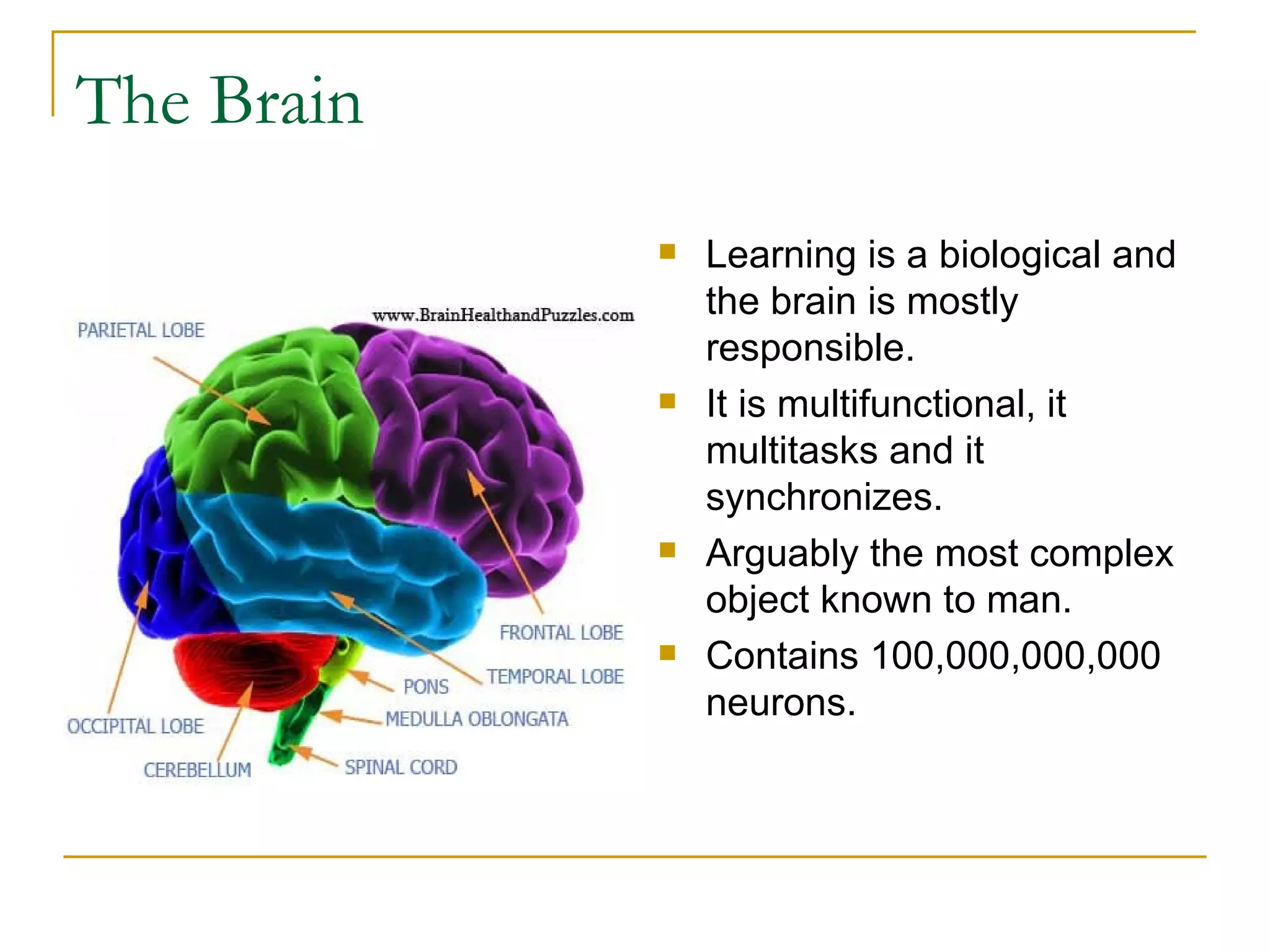
The Brain Learning is a biological and the brain is mostly responsible. It is multifunctional, it multitasks and it synchronizes. Arguably the most complex object known to man. Contains 100,000,000,000 neurons.
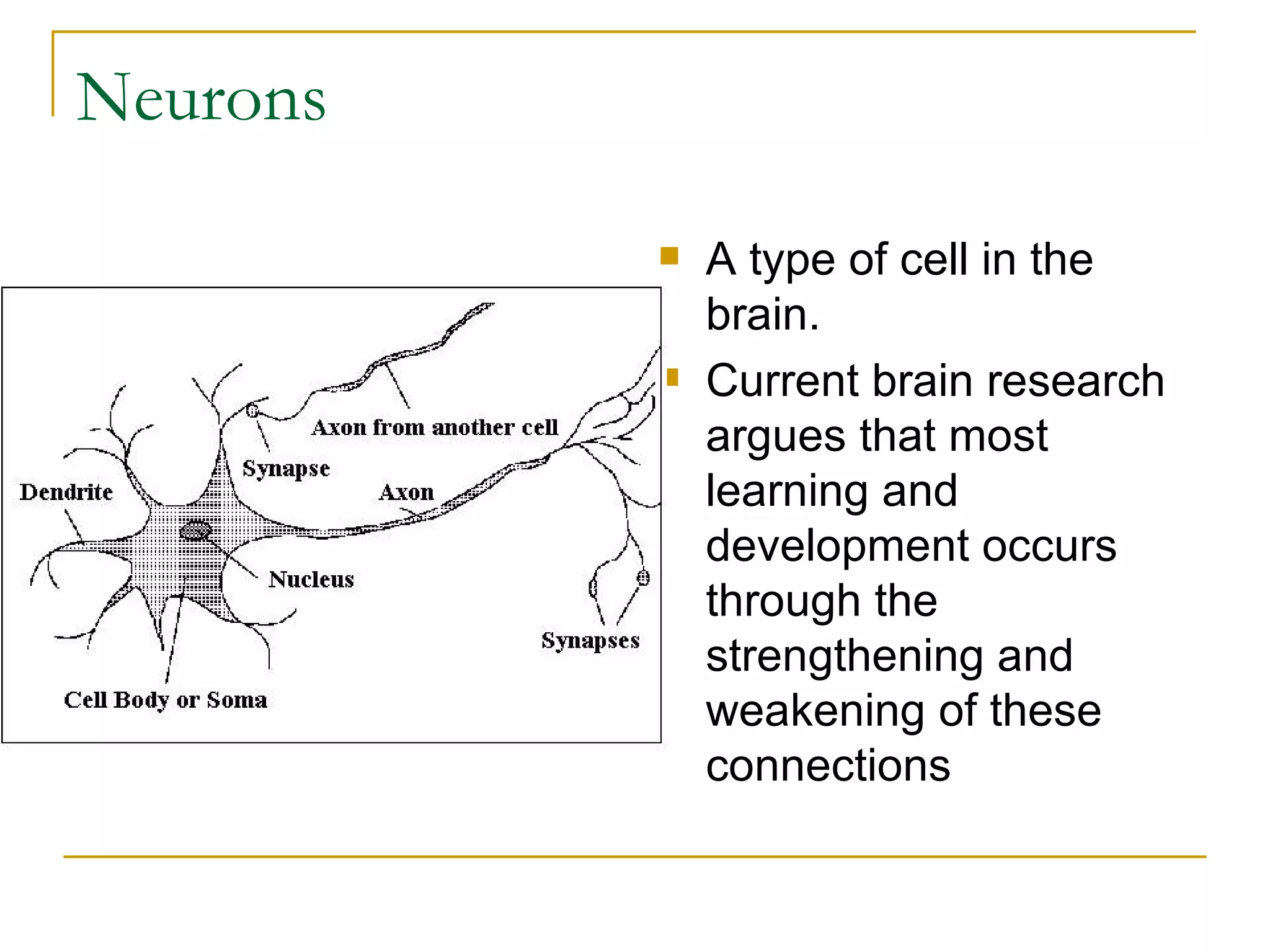
Neurons A type of cell in the brain. Current brain research argues that most learning and development occurs through the strengthening and weakening of these connections
Stack em up! kokogiak.com
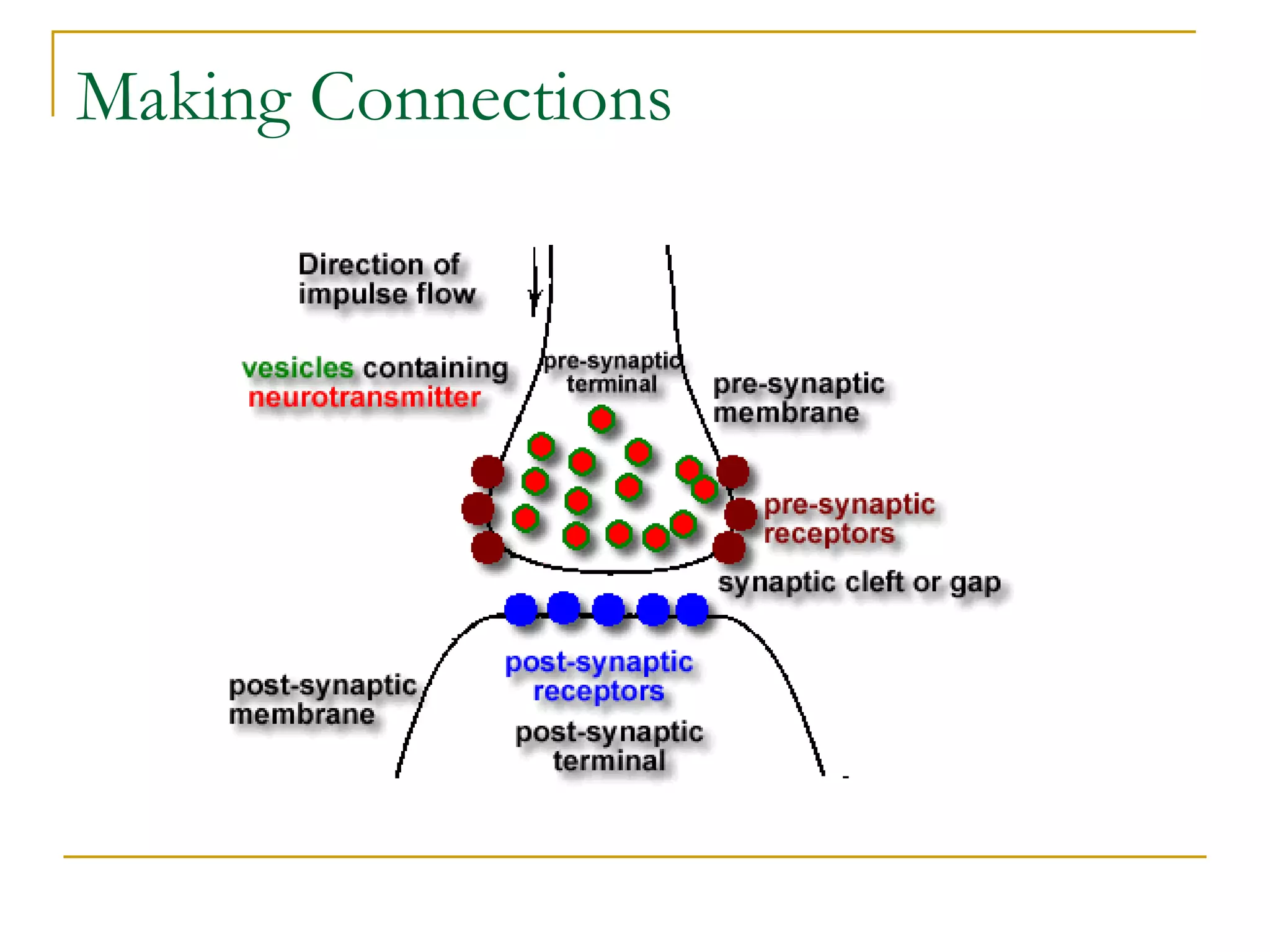
Making Connections
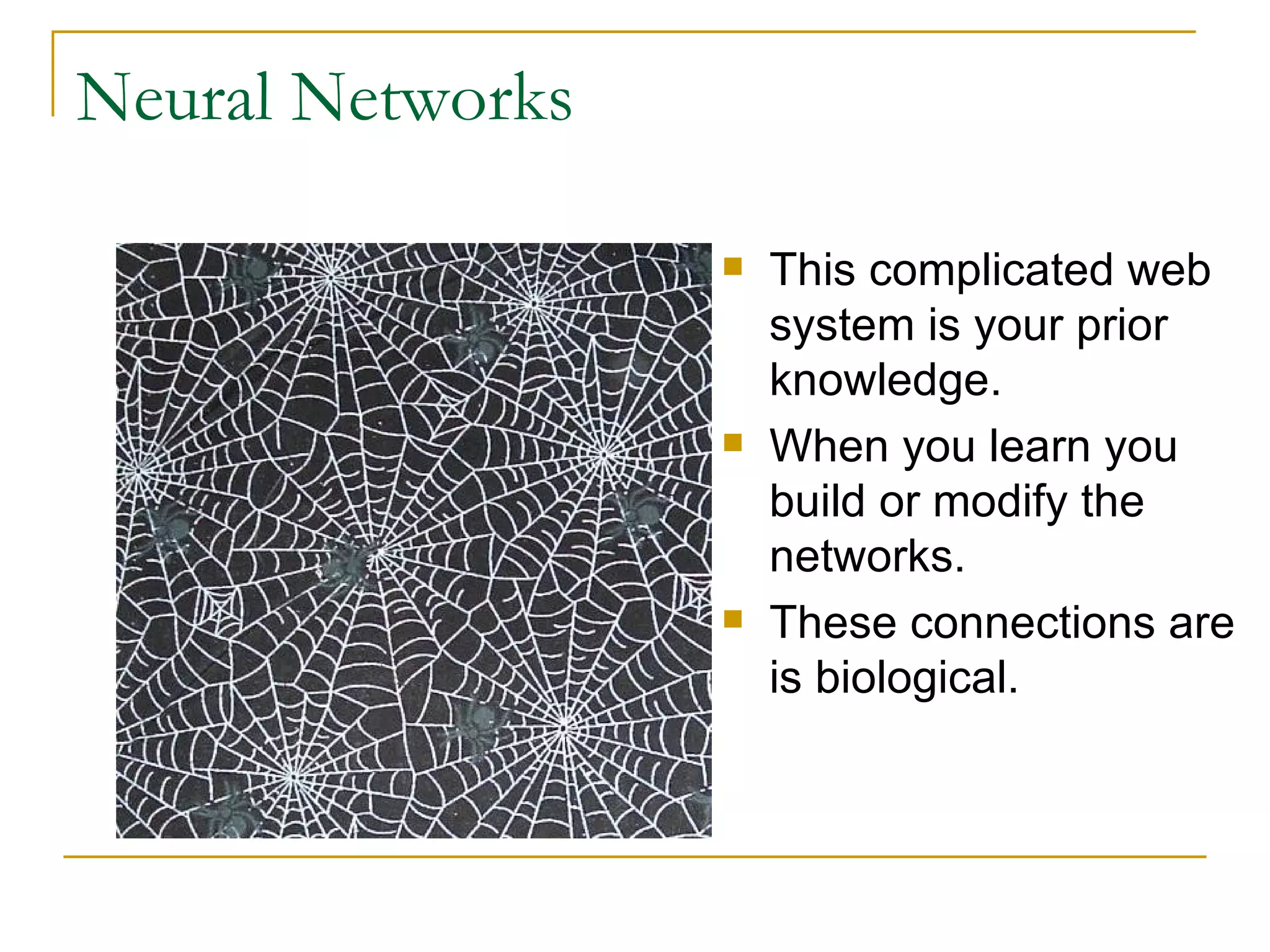
Neural Networks This complicated web system is your prior knowledge. When you learn you build or modify the networks. These connections are is biological.
What Implications does it have on Adult Learning? Instructors cannot explain something away because it is a physical entity. (Zull, 2002) To change takes lots of practice, repetition and time. This has huge implications on adult learning, and in particular, motivation.
Assumptions About Adult Learners
Adults are Pragmatic Learners Pragmatism? Adults learn for practical reasons . Responsibility is the cornerstone of adult motivation.  (Wlodkowski,2008)  Responsibility for family, work, making life better… The deep value for responsibility is why competence is such a force among learners.  (Wlodkowski,2008)
Adults are Intrinsically Motivated Intrinsic motivation is the motivation where people behave for the satisfaction in the behavior itself.  (Ryan and Deci, 2000) In general: People are curious, active and make meaning from experiences and pursuits they value.  (McColms and Whisler, 1997) When people see learning that is  relevant  to their values and perspectives, motivation emerges.  (Wlodkowski, 2008)
What do Adult Learners Need from Us?
Motivational Framework for Culturally Responsible Teaching Establishing inclusion Developing attitude Enhancing meaning Engendering competence Wlodkowski, 2008
Establishing Inclusion Inclusion : awareness that adults are a part of the learning environment in which they and the instructor are respected by, and connected to, one another. The environment is a safe place, physically and emotionally. Cultural perspectives are recognized and validated. Wlodkowski, 2008
Developing Attitudes Attitudes:  Concepts, information and emotions that result in a predisposition to respond favorably (or unfavorably) toward a learning experience. Can be enhanced by the potential of success and retarded with the prospect of failure. Students make judgments about the instructor from the moment he/she enters the room. Wlodkowski, 2008
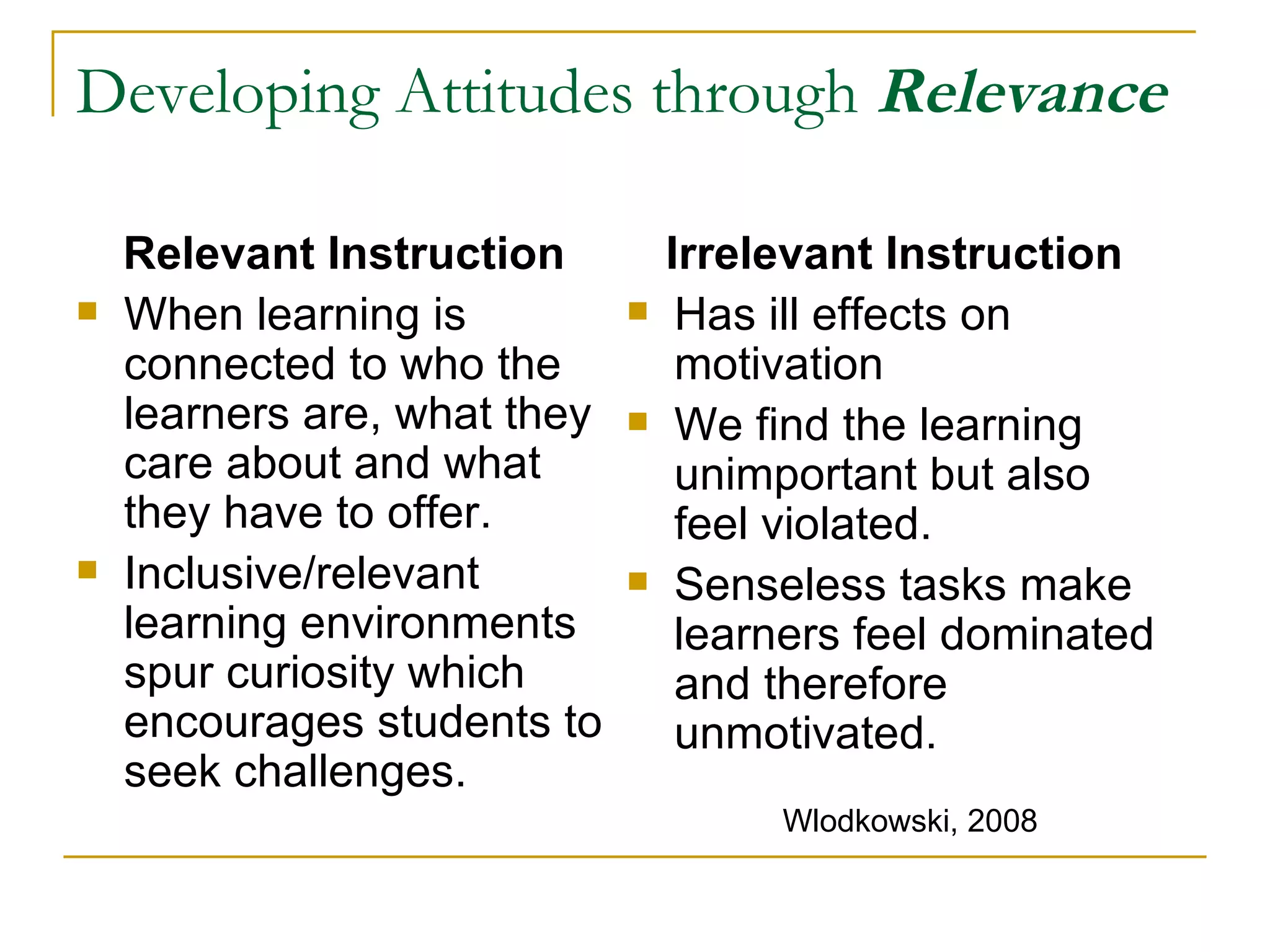
Developing Attitudes through  Relevance Relevant Instruction When learning is connected to who the learners are, what they care about and what they have to offer. Inclusive/relevant learning environments spur curiosity which encourages students to seek challenges. Irrelevant Instruction Has ill effects on motivation We find the learning unimportant but also feel violated.  Senseless tasks make learners feel dominated and therefore unmotivated. Wlodkowski, 2008
Developing Attitudes through  Choice Choice:  When adults see themselves as  personally endorsing their own learning. If he/she has chosen it, the learner sees themselves pursuing a valued goal. People are consistently battling against oppressive control in pursuit of autonomy in their lives…learning is no different. Wlodkowski, 2008
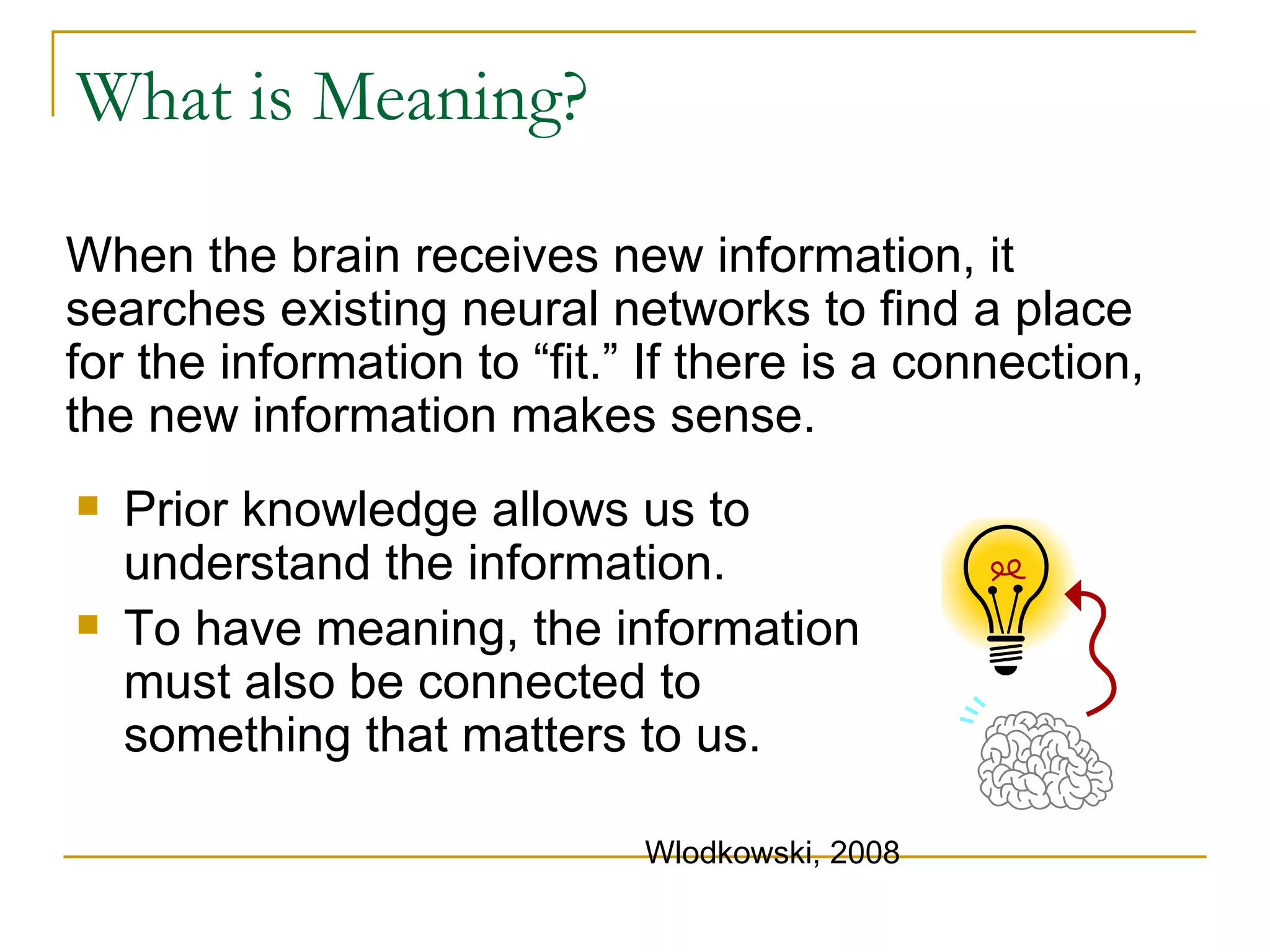
What is Meaning? When the brain receives new information, it searches existing neural networks to find a place for the information to “fit.” If there is a connection, the new information makes sense.  Prior knowledge allows us to understand the information.  To have meaning, the information must also be connected to something that matters to us.  Wlodkowski, 2008
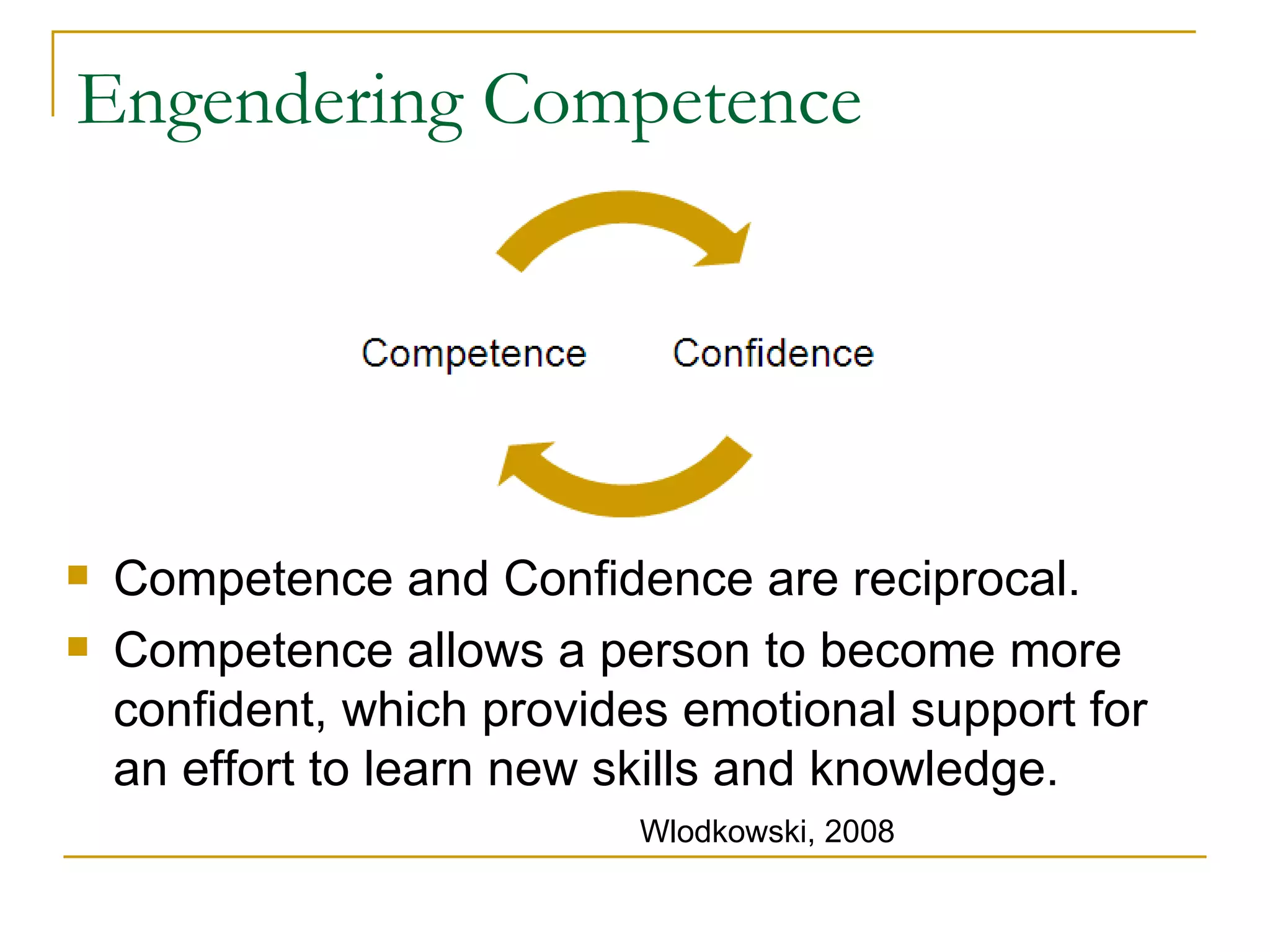
Engendering Competence  Competence and Confidence are reciprocal.  Competence allows a person to become more confident, which provides emotional support for an effort to learn new skills and knowledge. Wlodkowski, 2008
What Qualifies a Motivating Instructor Expertise Empathy Enthusiasm Clarity Cultural Responsiveness
Expertise:  The Power of Knowledge Three Parts 1. We know something that is beneficial for adults. 2. We know it well. 3. We are ready to convey or construct it through instruction. Wlodkowski, 2008
Expertise:  The Power of Knowledge Qualifying your Expertise Do I really understand what I want to teach? Can I explain it in more than one way? Can I personally demonstrate the skill? Do I know how to bridge the what I am teaching to the world of the learners through their prior knowledge, experience, and interests? Do I know what I don’t know? Wlodkowski, 2008
Empathy: The Power of Understanding and Compassion Having a realistic understanding of what the learners’ goals, perspectives and expectations are for the learning. Adapting our instruction to the learners’ levels of experience and skill level. Being conscious of learners perspectives and feelings. Wlodkowski, 2008
Enthusiasm:  The Power of Commitment and Expressiveness Enthusiasm comes from the Greek verb  enthousiazein “to be empowered or possessed by a god.” Dictionary definitions:  strong excitement feeling on the behalf of a cause or subject a persons inner feelings expressed in outward behavior. Wlodkowski, 2008
Enthusiasm:  The Power of Commitment and Expressiveness Enthusiasm has long been linked with increased motivation and student achievement. There are physical and psychological reasons… Research shows that observers are prone to embody the emotions of those whom they are watching.  (Cruikshank, et. al. 1980) “We are lobbying for our subject”
Instruments that Measure Teacher Enthusiasm Speaking with variation in tone pitch volume and speed Gesturing Moving about the room to illustrate points and to respond to questions Making varied, emotional facial expressions as called for Displaying energy and vitality Larkins, et. al. 1985
Clarity:  The Power of Organization and Language Clarity is teaching something in a manner that it easy for the students to understand and that is organized so that they can smoothly follow and participate in the lesson. Wlodkowski, 2008
Clarity: Plan So That All Can Understand Anticipate problems that students may have and build in activities to deepen understanding. Create graphics and analogies. Advance organizers and visual tools. Have checkpoints for questions and assessing for understanding. Wlodkowski, 2008
Cultural Responsiveness : The Power of Respect Create a safe and inclusive environment. Be Aware of: Your own cultural perspective and how it is different than others. Specific knowledge about history, perspectives and values of your audience. Wlodkowski, 2008
Summary Adult motivation to learn is brain based. Adult learners are pragmatic but intrinsic learners Adult students need a culturally responsive environment to enhance motivation. Instructors can help or hinder adult learner motivation. Motivational instruction can be learned and developed.
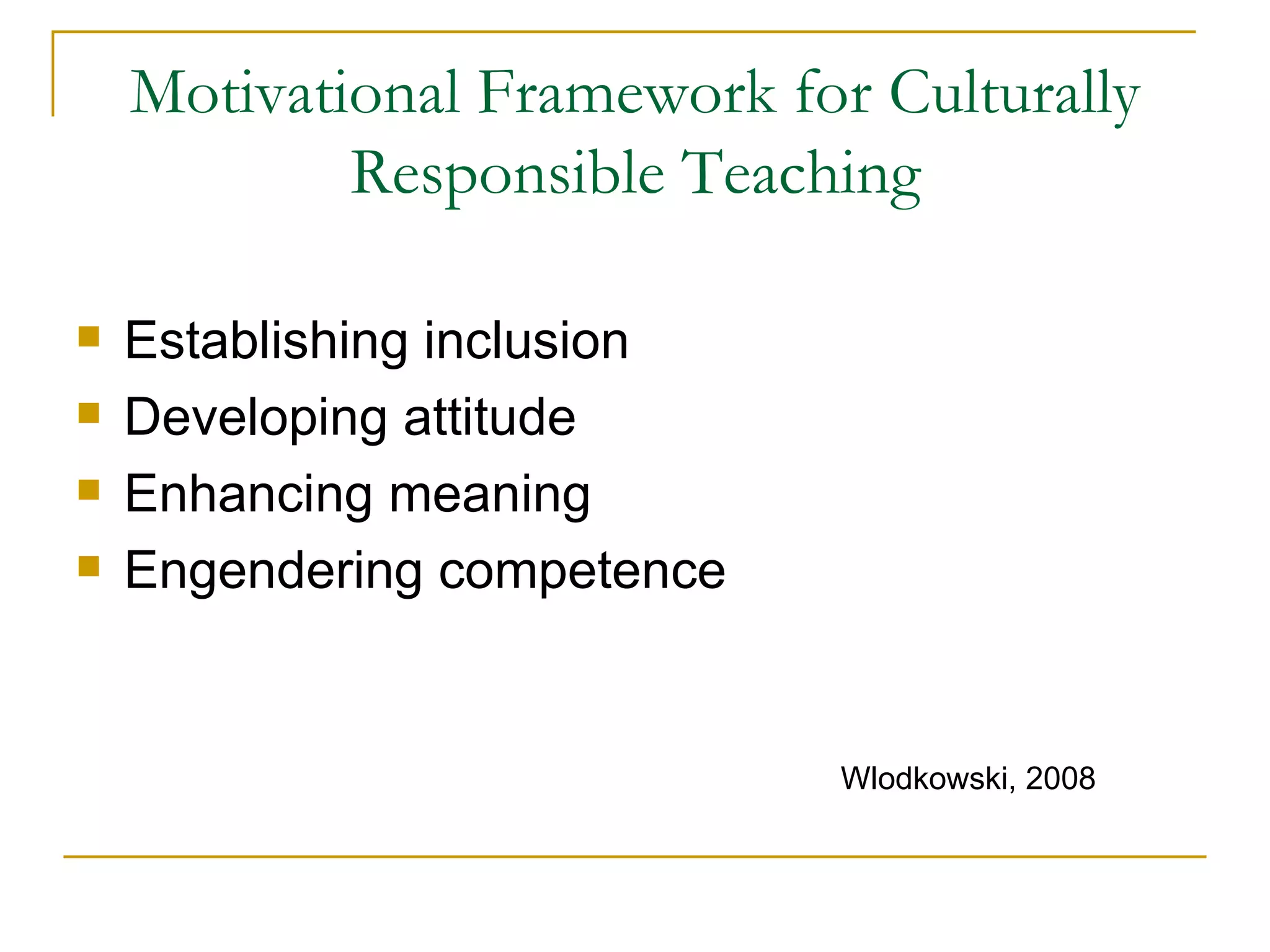
References Cruikshank, D. R. et al. Teaching is Tough. Upper Saddle River, NJ : Prentice Hall, 1980. Larkins A.G. et. al.,  Teacher Enthusiasm: A Critical Review.  Hattiesburg, MS: Educational and Psychological Research, 1985 . Larkins A.G. et. al.,  Teacher Enthusiasm: A Critical Review.  Hattiesburg, MS: Educational and Psychological Research, 1985 . Ryan, R.M. and Deci, E.L. “When Rewards Compete with Nature,” In Sansone and J.M. Harakiewicz,  Intrinsic and Extrinsic Motivation: In Search for Optimal Motivation and Performance,  San Diego: Academic Press, 2000. Wlodkowski, R. J.  Enhancing Adult Motivation to Learn: A Comprehensive Guide for Teaching All Adults, 3 rd  ed . San Francisco: Jossey Bass A Wiley Imprint, 2008. Zull, J.R.  The Art of Changing the Brain . Sterling, VA: Stylus, 2002.
Acknowledgements Cassandra Datena, Professor Canice McGarry,

Motivation in Adult Learning

  • 1.
    Motivation in AdultLearners Joe Ryan Cape Cod Community College
  • 2.
    Topics for theSession Brain Based Biology of Motivation Some assumptions about adult learners What do adult learners need from us? Characteristics and Skills of a Motivating Instructor
  • 3.
    The Brain andAdult Motivation
  • 4.
    The Brain Learningis a biological and the brain is mostly responsible. It is multifunctional, it multitasks and it synchronizes. Arguably the most complex object known to man. Contains 100,000,000,000 neurons.
  • 5.
    Neurons A typeof cell in the brain. Current brain research argues that most learning and development occurs through the strengthening and weakening of these connections
  • 6.
    Stack em up!kokogiak.com
  • 7.
  • 8.
    Neural Networks Thiscomplicated web system is your prior knowledge. When you learn you build or modify the networks. These connections are is biological.
  • 9.
    What Implications doesit have on Adult Learning? Instructors cannot explain something away because it is a physical entity. (Zull, 2002) To change takes lots of practice, repetition and time. This has huge implications on adult learning, and in particular, motivation.
  • 10.
  • 11.
    Adults are PragmaticLearners Pragmatism? Adults learn for practical reasons . Responsibility is the cornerstone of adult motivation. (Wlodkowski,2008) Responsibility for family, work, making life better… The deep value for responsibility is why competence is such a force among learners. (Wlodkowski,2008)
  • 12.
    Adults are IntrinsicallyMotivated Intrinsic motivation is the motivation where people behave for the satisfaction in the behavior itself. (Ryan and Deci, 2000) In general: People are curious, active and make meaning from experiences and pursuits they value. (McColms and Whisler, 1997) When people see learning that is relevant to their values and perspectives, motivation emerges. (Wlodkowski, 2008)
  • 13.
    What do AdultLearners Need from Us?
  • 14.
    Motivational Framework forCulturally Responsible Teaching Establishing inclusion Developing attitude Enhancing meaning Engendering competence Wlodkowski, 2008
  • 15.
    Establishing Inclusion Inclusion: awareness that adults are a part of the learning environment in which they and the instructor are respected by, and connected to, one another. The environment is a safe place, physically and emotionally. Cultural perspectives are recognized and validated. Wlodkowski, 2008
  • 16.
    Developing Attitudes Attitudes: Concepts, information and emotions that result in a predisposition to respond favorably (or unfavorably) toward a learning experience. Can be enhanced by the potential of success and retarded with the prospect of failure. Students make judgments about the instructor from the moment he/she enters the room. Wlodkowski, 2008
  • 17.
    Developing Attitudes through Relevance Relevant Instruction When learning is connected to who the learners are, what they care about and what they have to offer. Inclusive/relevant learning environments spur curiosity which encourages students to seek challenges. Irrelevant Instruction Has ill effects on motivation We find the learning unimportant but also feel violated. Senseless tasks make learners feel dominated and therefore unmotivated. Wlodkowski, 2008
  • 18.
    Developing Attitudes through Choice Choice: When adults see themselves as personally endorsing their own learning. If he/she has chosen it, the learner sees themselves pursuing a valued goal. People are consistently battling against oppressive control in pursuit of autonomy in their lives…learning is no different. Wlodkowski, 2008
  • 19.
    What is Meaning?When the brain receives new information, it searches existing neural networks to find a place for the information to “fit.” If there is a connection, the new information makes sense. Prior knowledge allows us to understand the information. To have meaning, the information must also be connected to something that matters to us. Wlodkowski, 2008
  • 20.
    Engendering Competence Competence and Confidence are reciprocal. Competence allows a person to become more confident, which provides emotional support for an effort to learn new skills and knowledge. Wlodkowski, 2008
  • 21.
    What Qualifies aMotivating Instructor Expertise Empathy Enthusiasm Clarity Cultural Responsiveness
  • 22.
    Expertise: ThePower of Knowledge Three Parts 1. We know something that is beneficial for adults. 2. We know it well. 3. We are ready to convey or construct it through instruction. Wlodkowski, 2008
  • 23.
    Expertise: ThePower of Knowledge Qualifying your Expertise Do I really understand what I want to teach? Can I explain it in more than one way? Can I personally demonstrate the skill? Do I know how to bridge the what I am teaching to the world of the learners through their prior knowledge, experience, and interests? Do I know what I don’t know? Wlodkowski, 2008
  • 24.
    Empathy: The Powerof Understanding and Compassion Having a realistic understanding of what the learners’ goals, perspectives and expectations are for the learning. Adapting our instruction to the learners’ levels of experience and skill level. Being conscious of learners perspectives and feelings. Wlodkowski, 2008
  • 25.
    Enthusiasm: ThePower of Commitment and Expressiveness Enthusiasm comes from the Greek verb enthousiazein “to be empowered or possessed by a god.” Dictionary definitions: strong excitement feeling on the behalf of a cause or subject a persons inner feelings expressed in outward behavior. Wlodkowski, 2008
  • 26.
    Enthusiasm: ThePower of Commitment and Expressiveness Enthusiasm has long been linked with increased motivation and student achievement. There are physical and psychological reasons… Research shows that observers are prone to embody the emotions of those whom they are watching. (Cruikshank, et. al. 1980) “We are lobbying for our subject”
  • 27.
    Instruments that MeasureTeacher Enthusiasm Speaking with variation in tone pitch volume and speed Gesturing Moving about the room to illustrate points and to respond to questions Making varied, emotional facial expressions as called for Displaying energy and vitality Larkins, et. al. 1985
  • 28.
    Clarity: ThePower of Organization and Language Clarity is teaching something in a manner that it easy for the students to understand and that is organized so that they can smoothly follow and participate in the lesson. Wlodkowski, 2008
  • 29.
    Clarity: Plan SoThat All Can Understand Anticipate problems that students may have and build in activities to deepen understanding. Create graphics and analogies. Advance organizers and visual tools. Have checkpoints for questions and assessing for understanding. Wlodkowski, 2008
  • 30.
    Cultural Responsiveness :The Power of Respect Create a safe and inclusive environment. Be Aware of: Your own cultural perspective and how it is different than others. Specific knowledge about history, perspectives and values of your audience. Wlodkowski, 2008
  • 31.
    Summary Adult motivationto learn is brain based. Adult learners are pragmatic but intrinsic learners Adult students need a culturally responsive environment to enhance motivation. Instructors can help or hinder adult learner motivation. Motivational instruction can be learned and developed.
  • 32.
    References Cruikshank, D.R. et al. Teaching is Tough. Upper Saddle River, NJ : Prentice Hall, 1980. Larkins A.G. et. al., Teacher Enthusiasm: A Critical Review. Hattiesburg, MS: Educational and Psychological Research, 1985 . Larkins A.G. et. al., Teacher Enthusiasm: A Critical Review. Hattiesburg, MS: Educational and Psychological Research, 1985 . Ryan, R.M. and Deci, E.L. “When Rewards Compete with Nature,” In Sansone and J.M. Harakiewicz, Intrinsic and Extrinsic Motivation: In Search for Optimal Motivation and Performance, San Diego: Academic Press, 2000. Wlodkowski, R. J. Enhancing Adult Motivation to Learn: A Comprehensive Guide for Teaching All Adults, 3 rd ed . San Francisco: Jossey Bass A Wiley Imprint, 2008. Zull, J.R. The Art of Changing the Brain . Sterling, VA: Stylus, 2002.
  • 33.
    Acknowledgements Cassandra Datena,Professor Canice McGarry,

Editor's Notes

  • #5 In other words the brain has several jobs (frontol lobe, (in purple) sustains attention, solves problems. Temporal lobe (turquoise color) helps us speak and hear, occipital lobe (royal blue) controls emotions It multitasks: so it does more than one It synchronizes: it dos things at the same time
  • #6 A type of cell in the brain. Neurons have a cell body, called an axon, multiple shorter branches called dendrites. The junction where signals pass from one neuron to another is called a synapse. Each neuron can have one to 10,000,000 synaptic connections. Making some of the possible number of different patterns and possible connections a staggering forty quadrillion.
  • #7 Football field, lincoln memorial, A little over one quadrillion. 1000 trillions.
  • #8 Dopamine and epinephrine which commonly are involved in our moods. When we learn something new connections are made between the neurons that represent what we are learning. Through practice and repetition we strengthen the connections and learn.
  • #9 With all of these multiple connections: Think of the most complex web system imaginable…show on the spider web.
  • #10 Learning is strengthening and weakening if these synapse connections.
  • #12 Malcolm Knowles, developer of Andragogy and humanist learning theory in Making of an Adult Educator…makes two assumptions 1 . adults have the self concept of being responsible for their own lives and being seen by others as competent. 2 adults become ready to learn certain things if it will help them deal with real live situations. What are children are motivated by?
  • #13 In general meaning from the fields of neuroscience and constructivist learning theory. How do we bridge responsibility with intrinsic motivation to motivate learners…?
  • #16 Have you ever been in a classroom where you are singled out or felt as if you did not belong? How did it effect your motivation? Have you ever been asked to share a personal interest or a success that you have had? How did that? Sharing stories is a great tool.
  • #17 Have you ever come into a learning environment that was so positive, you knew right away you were going to succeed? Have you ever come into a learning environment where the teacher/professor attempts to weed out students. Developing attitudes needs to be done at the beginning.
  • #21 Kyle Marble: Final given Tuesday night, had him for one other class. Class clown. He’s really improved
  • #23 Teaching is all about what you know. Just because you have expertise, does that mean you can teach it?
  • #25 1.How can I do this? Take an inventory. 2. Have you ever been in a course where you do not have the skills or background necessary to participate? We don’t want students to fail. We have a very diverse population. 3. It is important to listen. It is important to validate. What does this do for the student?
  • #26 Describe your favorite teacher.
  • #27 When we care about a topic we tend to be expressive about it. Additionally students tend to do better on test with teachers who are demonstrative.
  • #28 Can you remember a teacher like this?