
Training Programs
  Adult Learners
      2013
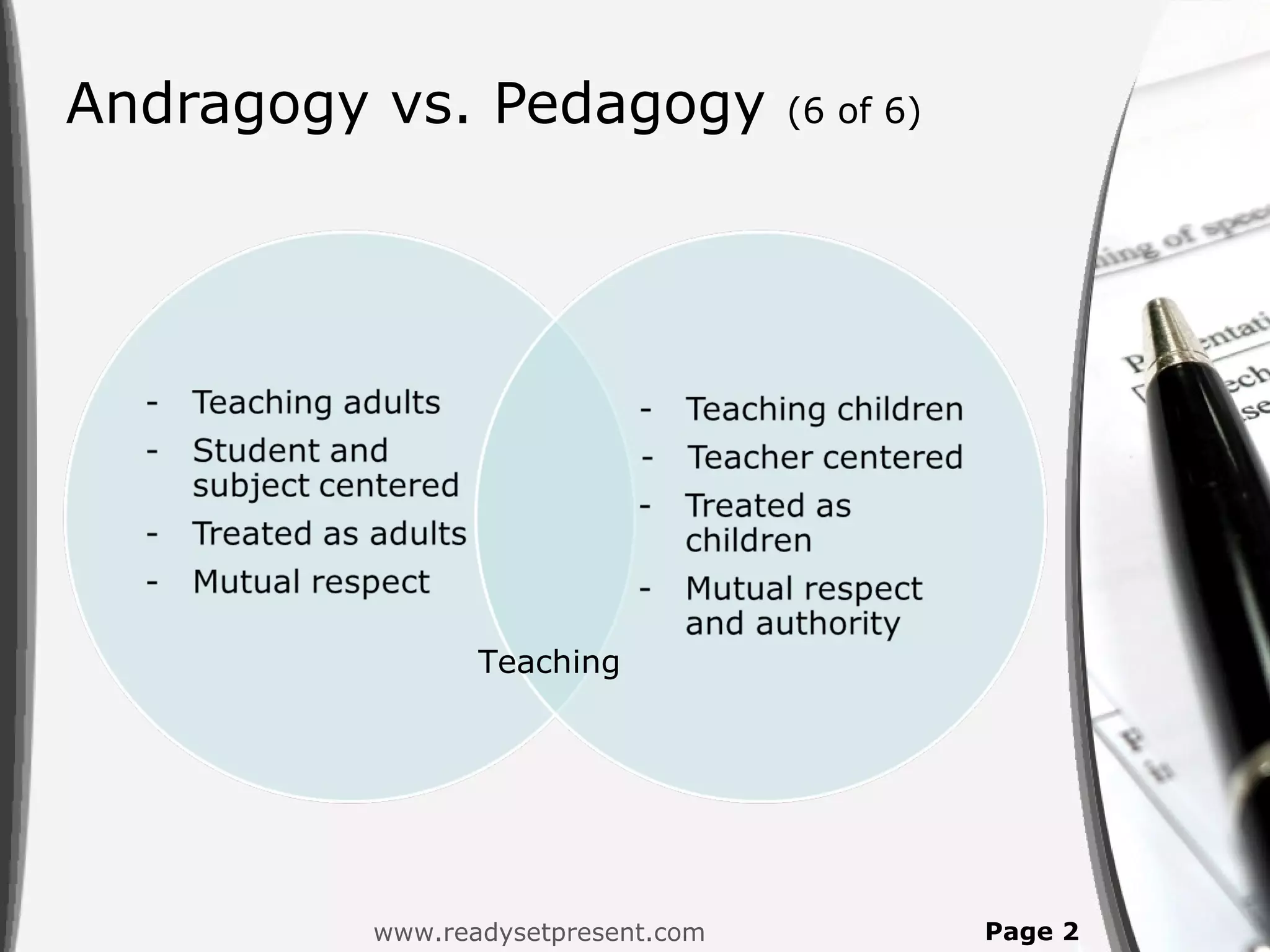
Andragogy vs. Pedagogy             (6 of 6)


                Teaching


         www.readysetpresent.com              Page 2
Program Objectives             (1 of 2)


      To know the characteristics,
       needs, and styles of the
       adult learner.
      Identify your own style of
       learning and communicating.
      To know what to expect from
       adult learners.
      To know how adults compare
       to children.


             www.readysetpresent.com      Page 3
Program Objectives            (2 of 2)


      To know tools/methods to
       foster adult learning.
      How to motivate adult
       learners.
      Understand and create the
       optimal conditions and
       environment for adult
       learning.
      To understand how adult
       learning leads to
       organizational success.

            www.readysetpresent.com      Page 4
Definition

      By definition of an adult is
       someone who has achieved
       the self concept of being
       responsible for their own life.


             www.readysetpresent.com     Page 5
Andragogy
                              vs.
                           Pedagogy


www.readysetpresent.com          Page 6
Andragogy vs. Pedagogy               (1 of 5)


     This is known as andragogy
      and contrasts with
      pedagogy, the teaching of
      children (including
      undergraduates ages 18-
      22).
     Pedagogy is teacher-
      centered and subject-
      centered, while andragogy is
      student-centered.


           www.readysetpresent.com              Page 7
Andragogy vs. Pedagogy               (5 of 5)


  Theory of Adult Education
     Knowles stated that
      andragogy (Greek meaning:
      "man-leading") should be
      distinguished from the more
      commonly used pedagogy
      (Greek meaning: "child-
      leading").


           www.readysetpresent.com              Page 8
More On Androgogy . . .

      Andragogy has been used by
       some to allow a discussion of
       the difference between self
       directed education and
       taught education.
      So based on your
       knowledge, describe in
       simple terms the similarities
       and differences between
       andragogy and pedagogy in
       relation to instructional
       design and development?
             www.readysetpresent.com   Page 9
Malcolm Knowles          (1 of 2)


  Theory of Adult Education
     Knowles' theory can be
      stated as four simple
      postulates:
       – Adults need to be involved in
         the planning and evaluation of
         their instruction.
       – Experience (including mistakes)
         provides the basis for learning
         activities.


            www.readysetpresent.com        Page 10
The Four Learning Styles              (1 of 12)


   Adult learners bring their past
   learning experiences into any
   new learning situation.
   There are four basic learners:
       1. The Perceiver
       2. The Observer
       3. The Feeler
       4. The Thinker


            www.readysetpresent.com               Page 11
Tips for Instruction          (9 of 13)


   Have a Strategy
      Instructors must learn why
       their students are enrolled and
       what is keeping them from
       learning.
      A successful strategy includes
       showing adult learners the
       relationship between training
       and an expected or desired
       promotion.


             www.readysetpresent.com      Page 12
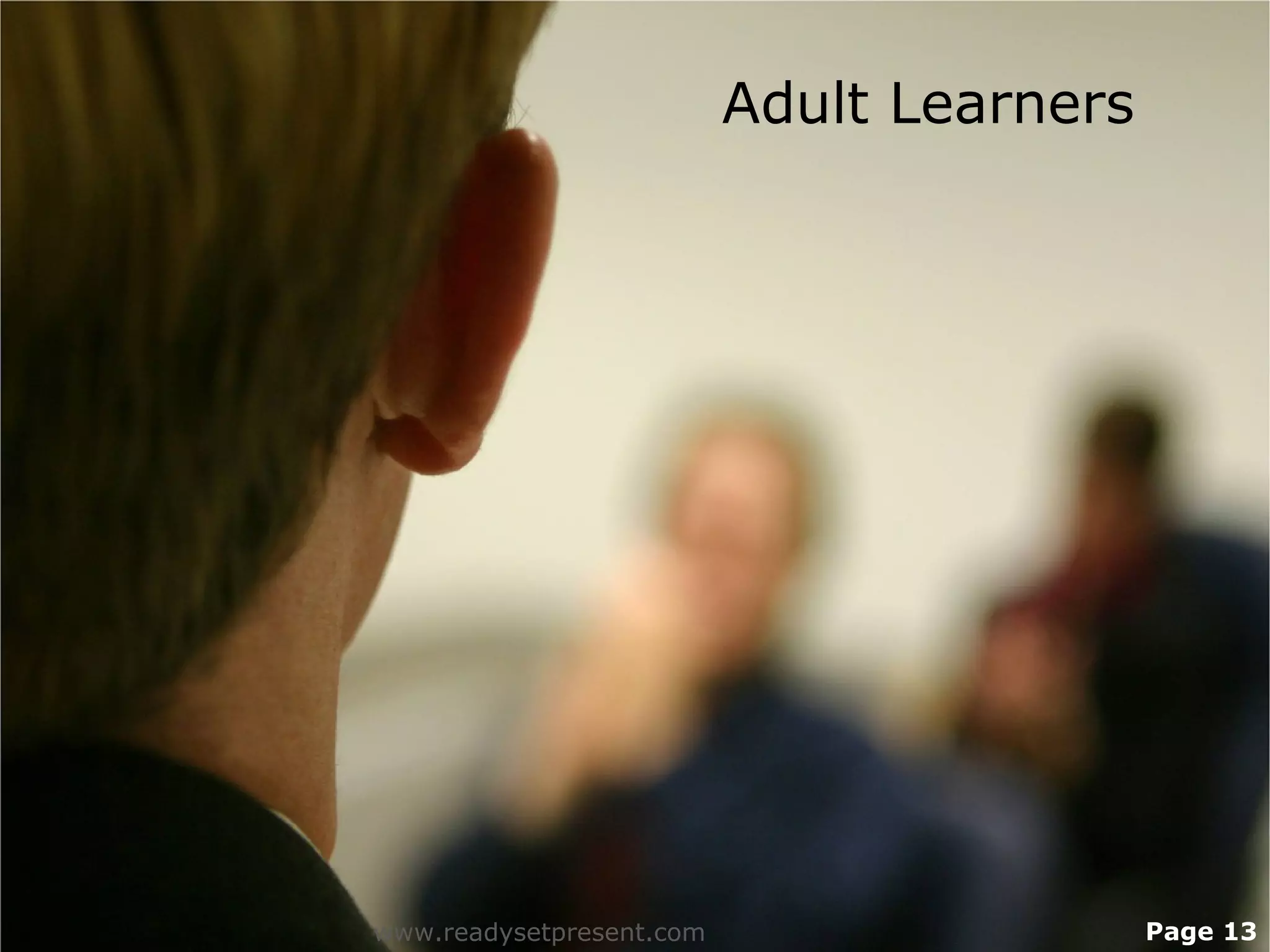
Adult Learners


www.readysetpresent.com                    Page 13
Design &
                          Development


www.readysetpresent.com                 Page 14
Download
  “Training Programs: Adult Learners”
          PowerPoint presentation
        at ReadySetPresent.com
160 slides include: 7 points on andragogy versus pedagogy,
 6 points on Malcolm Knowles, 14 slides on adult learners, 19
   points on adult learners as a two-way street, 9 points on
choosing or losing, 44 points on the 4 learning styles, 3 slides
   on multiple intelligences, 6 points on what learning styles
   effect, 35 points on design and development, 4 points on
  adults versus children, 36 tips for instruction, 12 points on
   energy for learning, 16 points on motivation principles, 2
  points on the right path, 38 points on technology and adult
learners, 4 points on different people and options, 4 points on
 what is on the line to lose, 6 points on the educator’s goals,
                16 action steps and much more!

    Royalty Free – Use Them Over and Over Again.

       Updated & Expanded 2013
Now: more content, graphics, and diagrams

                www.readysetpresent.com                    Page 15

Training Adult Learners PowerPoint PPT Content Modern Sample

  • 1.
    Training Programs Adult Learners 2013
  • 2.
    Andragogy vs. Pedagogy (6 of 6) Teaching www.readysetpresent.com Page 2
  • 3.
    Program Objectives (1 of 2)  To know the characteristics, needs, and styles of the adult learner.  Identify your own style of learning and communicating.  To know what to expect from adult learners.  To know how adults compare to children. www.readysetpresent.com Page 3
  • 4.
    Program Objectives (2 of 2)  To know tools/methods to foster adult learning.  How to motivate adult learners.  Understand and create the optimal conditions and environment for adult learning.  To understand how adult learning leads to organizational success. www.readysetpresent.com Page 4
  • 5.
    Definition  By definition of an adult is someone who has achieved the self concept of being responsible for their own life. www.readysetpresent.com Page 5
  • 6.
    Andragogy vs. Pedagogy www.readysetpresent.com Page 6
  • 7.
    Andragogy vs. Pedagogy (1 of 5)  This is known as andragogy and contrasts with pedagogy, the teaching of children (including undergraduates ages 18- 22).  Pedagogy is teacher- centered and subject- centered, while andragogy is student-centered. www.readysetpresent.com Page 7
  • 8.
    Andragogy vs. Pedagogy (5 of 5) Theory of Adult Education  Knowles stated that andragogy (Greek meaning: "man-leading") should be distinguished from the more commonly used pedagogy (Greek meaning: "child- leading"). www.readysetpresent.com Page 8
  • 9.
    More On Androgogy. . .  Andragogy has been used by some to allow a discussion of the difference between self directed education and taught education.  So based on your knowledge, describe in simple terms the similarities and differences between andragogy and pedagogy in relation to instructional design and development? www.readysetpresent.com Page 9
  • 10.
    Malcolm Knowles (1 of 2) Theory of Adult Education  Knowles' theory can be stated as four simple postulates: – Adults need to be involved in the planning and evaluation of their instruction. – Experience (including mistakes) provides the basis for learning activities. www.readysetpresent.com Page 10
  • 11.
    The Four LearningStyles (1 of 12) Adult learners bring their past learning experiences into any new learning situation. There are four basic learners: 1. The Perceiver 2. The Observer 3. The Feeler 4. The Thinker www.readysetpresent.com Page 11
  • 12.
    Tips for Instruction (9 of 13) Have a Strategy  Instructors must learn why their students are enrolled and what is keeping them from learning.  A successful strategy includes showing adult learners the relationship between training and an expected or desired promotion. www.readysetpresent.com Page 12
  • 13.
  • 14.
    Design & Development www.readysetpresent.com Page 14
  • 15.
    Download “TrainingPrograms: Adult Learners” PowerPoint presentation at ReadySetPresent.com 160 slides include: 7 points on andragogy versus pedagogy, 6 points on Malcolm Knowles, 14 slides on adult learners, 19 points on adult learners as a two-way street, 9 points on choosing or losing, 44 points on the 4 learning styles, 3 slides on multiple intelligences, 6 points on what learning styles effect, 35 points on design and development, 4 points on adults versus children, 36 tips for instruction, 12 points on energy for learning, 16 points on motivation principles, 2 points on the right path, 38 points on technology and adult learners, 4 points on different people and options, 4 points on what is on the line to lose, 6 points on the educator’s goals, 16 action steps and much more! Royalty Free – Use Them Over and Over Again. Updated & Expanded 2013 Now: more content, graphics, and diagrams www.readysetpresent.com Page 15