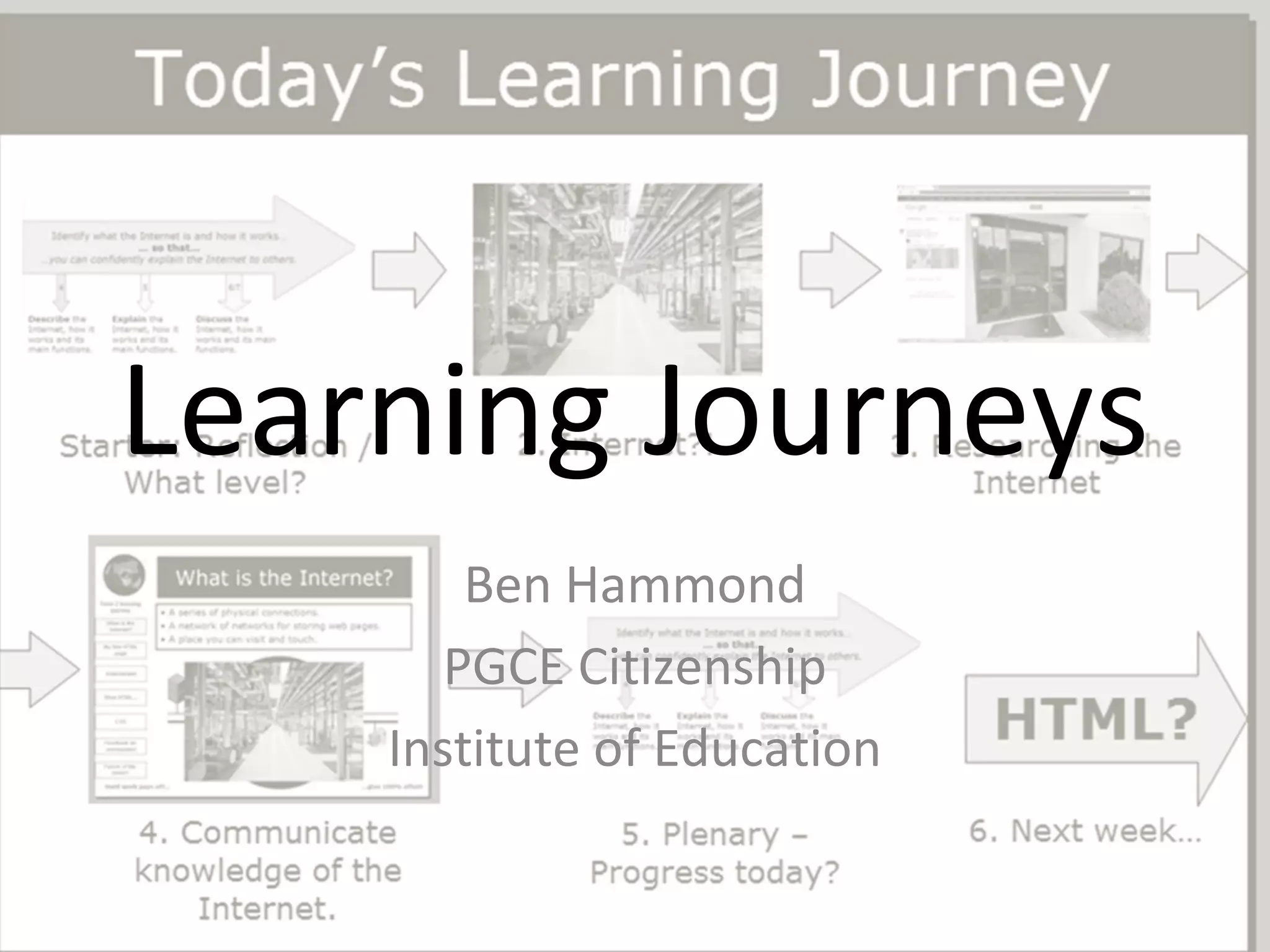
Learning Journeys
        Ben Hammond
       PGCE Citizenship
    Institute of Education
Definition
• A learning journey explains what students will do and
  learn over the course of a series of lessons (or an
  individual lesson), and often details how their learning will
  proceed.
• It is synonymous with the ‘big picture’ of a scheme of
  learning/scheme of work.
• As such it covers the main points not each tiny
  step/activity – the key learning activity/ies in each lesson
• It can use any combination of words and pictures, or take
  video or mp3 form
Rationale
Communicating the learning journey at the beginning of a
unit (& regularly referring back to it) helps to...
•Increase student motivation and interest (so long as it’s an
interesting learning journey!)
•Increase student perception of control over where they
are going with their learning
•Foster more independent learning
•Reduce time spent by teacher explaining and re-explaining
what students need to do
•Increase clarity and understanding over a scheme of
learning by both the teacher and students
Key Ingredients
• Essentially: where students are going on their journey,
  what they’ll do on their journey and why they are going
  on it in the first place, i.e.
   – Main activities - what students will be doing
   – Finale / result – what students will build up to
   – The purpose / point – why students are doing it
   – Assessment opportunities – how students will
     measure their success / show their learning
Planning an effective learning journey (1)
• Make it memorable!
• Make it clear – students need to be able to understand the key
  sections/activities. Don’t include too much (remember it’s the
  combination of your visuals and explanation that makes a
  learning journey effective)
• Practice how you will introduce the learning journey – know it
  inside out and work out what you will say.
• Break down the learning journey into lessons, activities or logical
  parts.
• It’s not all about looks – its just as much about how you
  introduce and explain the learning journey
• Refer back to it at key junctures in the learning journey
• Useful to use for plenaries – questioning students on their
  progress so far in the learning journey, and where they will go
  next and why
Planning an effective learning journey (2)
• The explanation of the learning journey is key. Students
  must understand where they are going and why. Ensure
  you check understanding before moving on.
• As a teacher you don’t always have to stand in front of
  the learning journey and do the explaining. You could…
   – get students to look at the learning journey and
     predict what they’ll be doing
   – Play a memorisation game with students recalling key
     points in the learning journey
   – Pre-brief a student to introduce it themselves
   – Give students a quiz on the learning journey
Example learning journeys
• Look at the examples on the following pages
  – Which do you think are more effective? Why?
  – Which key ingredients are present or missing in
    each?
  – How would you improve them?
  – What would be another way of presenting a
    learning journey?
• Remember the key is how a learning journey
  is presented and explained, not just what one
  looks like!
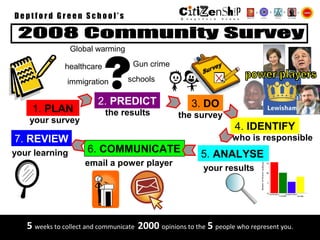
Deptford Green School’s


                Global warming

              healthcare            Gun crime

               immigration        schools

                         2. PREDICT                   3. DO
    1. PLAN                the results            the survey
    your survey
                                                                   4. IDENTIFY
7. REVIEW                                                          who is responsible
your learning        6. COMMUNICATE                      5. ANALYSE
                     email a power player
                                                          your results


   5 weeks to collect and communicate 2000 opinions to the 5 people who represent you.
The Ultimate Unification Bout
  Create-a-Country
COMPETITION
   -vs-
             Contenders
             -vs-        -vs-            -vs-

           -vs-        -vs-       -vs-


Title: DG Country of the Year 2008
Rounds: 5
Venue: Deptford Green School SE14
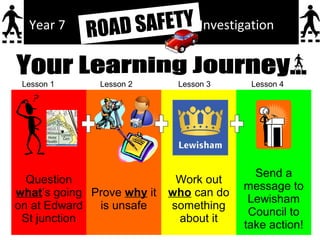
Year 7    Road Safety ETY Investigation
             ROAD SAF

 Lesson 1      Lesson 2      Lesson 3     Lesson 4


                                           Send a
  Question                   Work out
                                         message to
what’s going Prove why it   who can do
                                          Lewisham
on at Edward  is unsafe     something
                                          Council to
 St junction                 about it
                                         take action!
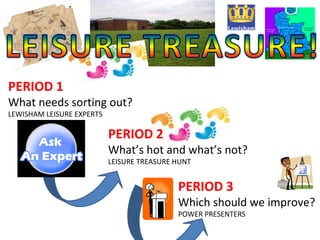
PERIOD 1
What needs sorting out?
LEWISHAM LEISURE EXPERTS

                           PERIOD 2
                           What’s hot and what’s not?
                           LEISURE TREASURE HUNT


                                            PERIOD 3
                                            Which should we improve?
                                            POWER PRESENTERS
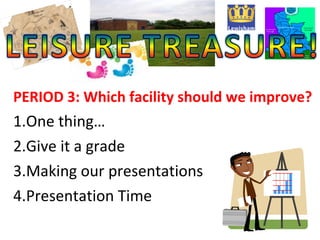
PERIOD 3: Which facility should we improve?
1.One thing…
2.Give it a grade
3.Making our presentations
4.Presentation Time
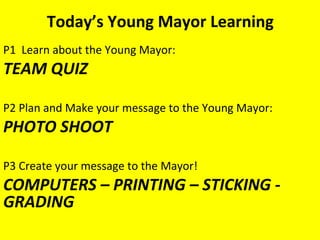
Today’s Young Mayor Learning
P1 Learn about the Young Mayor:
TEAM QUIZ

P2 Plan and Make your message to the Young Mayor:
PHOTO SHOOT

P3 Create your message to the Mayor!
COMPUTERS – PRINTING – STICKING -
GRADING
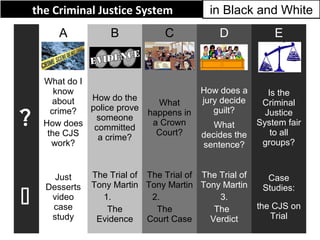
the Criminal Justice System              in Black and White
         A           B            C             D             E


      What do I
         know                              How does a        Is the
         about  How do the                 jury decide
                               What                        Criminal
                police prove
?       crime?               happens in       guilt?        Justice
                 someone
      How does committed      a Crown         What        System fair
       the CJS                 Court?      decides the        to all
                 a crime?
        work?                              sentence?       groups?


        Just     The Trial of The Trial of The Trial of     Case
      Desserts   Tony Martin Tony Martin Tony Martin       Studies:
      video
       case
                   1.
                    The
                               2.
                                The
                                               3.
                                              The         the CJS on
       study      Evidence    Court Case     Verdict         Trial
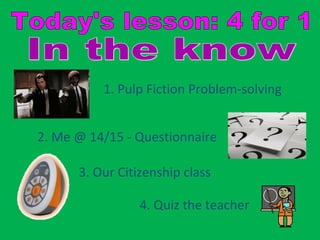
1. Pulp Fiction Problem-solving


2. Me @ 14/15 - Questionnaire

      3. Our Citizenship class

                 4. Quiz the teacher
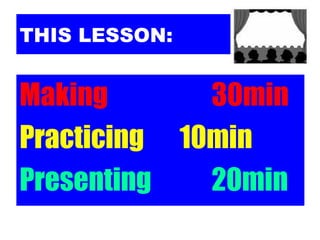
THIS LESSON:


Making       30min
Practicing 10min
Presenting   20min
Video examples (these can be referred to
again and again by students whenever they wish –
 the two examples below are old but should give
                  you the idea!)

• Citizenship coursework –
  http://www.youtube.com/watch?v=Sc1xBL2XLFQ

• School council scheme of learning -
  http://www.youtube.com/watch?v=HfhQnrduHiI

Learning Journeys

  • 1.
    Learning Journeys Ben Hammond PGCE Citizenship Institute of Education
  • 2.
    Definition • A learningjourney explains what students will do and learn over the course of a series of lessons (or an individual lesson), and often details how their learning will proceed. • It is synonymous with the ‘big picture’ of a scheme of learning/scheme of work. • As such it covers the main points not each tiny step/activity – the key learning activity/ies in each lesson • It can use any combination of words and pictures, or take video or mp3 form
  • 3.
    Rationale Communicating the learningjourney at the beginning of a unit (& regularly referring back to it) helps to... •Increase student motivation and interest (so long as it’s an interesting learning journey!) •Increase student perception of control over where they are going with their learning •Foster more independent learning •Reduce time spent by teacher explaining and re-explaining what students need to do •Increase clarity and understanding over a scheme of learning by both the teacher and students
  • 4.
    Key Ingredients • Essentially:where students are going on their journey, what they’ll do on their journey and why they are going on it in the first place, i.e. – Main activities - what students will be doing – Finale / result – what students will build up to – The purpose / point – why students are doing it – Assessment opportunities – how students will measure their success / show their learning
  • 5.
    Planning an effectivelearning journey (1) • Make it memorable! • Make it clear – students need to be able to understand the key sections/activities. Don’t include too much (remember it’s the combination of your visuals and explanation that makes a learning journey effective) • Practice how you will introduce the learning journey – know it inside out and work out what you will say. • Break down the learning journey into lessons, activities or logical parts. • It’s not all about looks – its just as much about how you introduce and explain the learning journey • Refer back to it at key junctures in the learning journey • Useful to use for plenaries – questioning students on their progress so far in the learning journey, and where they will go next and why
  • 6.
    Planning an effectivelearning journey (2) • The explanation of the learning journey is key. Students must understand where they are going and why. Ensure you check understanding before moving on. • As a teacher you don’t always have to stand in front of the learning journey and do the explaining. You could… – get students to look at the learning journey and predict what they’ll be doing – Play a memorisation game with students recalling key points in the learning journey – Pre-brief a student to introduce it themselves – Give students a quiz on the learning journey
  • 7.
    Example learning journeys •Look at the examples on the following pages – Which do you think are more effective? Why? – Which key ingredients are present or missing in each? – How would you improve them? – What would be another way of presenting a learning journey? • Remember the key is how a learning journey is presented and explained, not just what one looks like!
  • 8.
    Deptford Green School’s Global warming healthcare Gun crime immigration schools 2. PREDICT 3. DO 1. PLAN the results the survey your survey 4. IDENTIFY 7. REVIEW who is responsible your learning 6. COMMUNICATE 5. ANALYSE email a power player your results 5 weeks to collect and communicate 2000 opinions to the 5 people who represent you.
  • 9.
    The Ultimate UnificationBout Create-a-Country COMPETITION -vs- Contenders -vs- -vs- -vs- -vs- -vs- -vs- Title: DG Country of the Year 2008 Rounds: 5 Venue: Deptford Green School SE14
  • 10.
    Year 7 Road Safety ETY Investigation ROAD SAF Lesson 1 Lesson 2 Lesson 3 Lesson 4 Send a Question Work out message to what’s going Prove why it who can do Lewisham on at Edward is unsafe something Council to St junction about it take action!
  • 12.
    PERIOD 1 What needssorting out? LEWISHAM LEISURE EXPERTS PERIOD 2 What’s hot and what’s not? LEISURE TREASURE HUNT PERIOD 3 Which should we improve? POWER PRESENTERS
  • 13.
    PERIOD 3: Whichfacility should we improve? 1.One thing… 2.Give it a grade 3.Making our presentations 4.Presentation Time
  • 14.
    Today’s Young MayorLearning P1 Learn about the Young Mayor: TEAM QUIZ P2 Plan and Make your message to the Young Mayor: PHOTO SHOOT P3 Create your message to the Mayor! COMPUTERS – PRINTING – STICKING - GRADING
  • 15.
    the Criminal JusticeSystem in Black and White A B C D E What do I know How does a Is the about How do the jury decide What Criminal police prove ? crime? happens in guilt? Justice someone How does committed a Crown What System fair the CJS Court? decides the to all a crime? work? sentence? groups? Just The Trial of The Trial of The Trial of Case Desserts Tony Martin Tony Martin Tony Martin Studies:  video case 1. The 2. The 3. The the CJS on study Evidence Court Case Verdict Trial
  • 18.
    1. Pulp FictionProblem-solving 2. Me @ 14/15 - Questionnaire 3. Our Citizenship class 4. Quiz the teacher
  • 19.
    THIS LESSON: Making 30min Practicing 10min Presenting 20min
  • 20.
    Video examples (thesecan be referred to again and again by students whenever they wish – the two examples below are old but should give you the idea!) • Citizenship coursework – http://www.youtube.com/watch?v=Sc1xBL2XLFQ • School council scheme of learning - http://www.youtube.com/watch?v=HfhQnrduHiI