





Motivation & the
Adult Learner
Presented by:
Dorea M. Hardy, M.Ed.
Update Article Assignment for:
ACED 9400 - Dr. Vesta R. Whisler
Selected Article
Andragogy and Pedagogy as Foundational
Theory
for Student Motivation in Higher Education
Stephen Pew, PhD
Associate Professor of Healthcare
Leadership
Park University
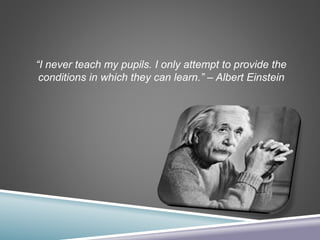
“I never teach my pupils. I only attempt to provide the
conditions in which they can learn.” – Albert Einstein
Points of Discussion
 What is Motivation?
 Philosophies of Motivation
 Extrinsic versus Intrinsic
 Andragogy & Pedagogy – Who is responsible?
 Implications
 Aligning Student & Instructor Motivations?
 Potential Roadblocks
 Motivational hand up or hand out?
Motivation
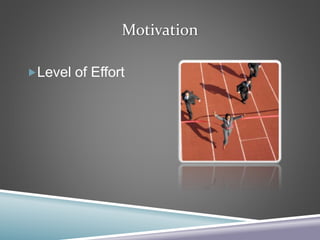
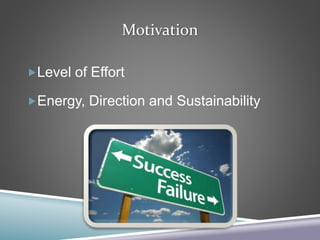
Level of Effort
Motivation
Level of Effort
Energy, Direction and Sustainability
Motivation
Level of Effort
Energy, Direction and Sustainability
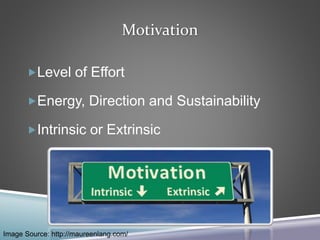
Intrinsic or Extrinsic
Image Source: http://maureenlang.com/
Motivation
Level of Effort
Energy, Direction and Sustainability
Intrinsic or Extrinsic
Theories
Motivation
Theories
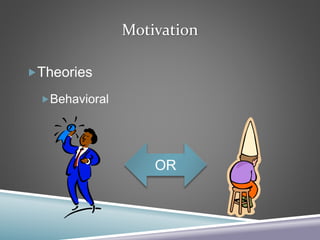
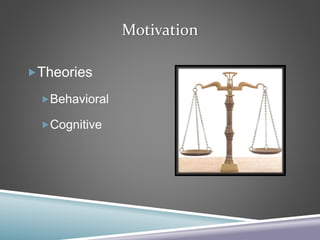
Behavioral
OR
Motivation
Theories
Behavioral
Cognitive
Motivation
Theories
Behavioral
Cognitive
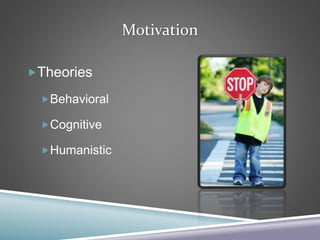
Humanistic
Motivation
Theories
Behavioral
Cognitive
Humanistic
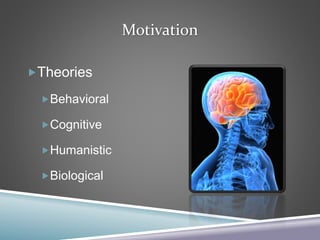
Biological
Philosophies of Motivation
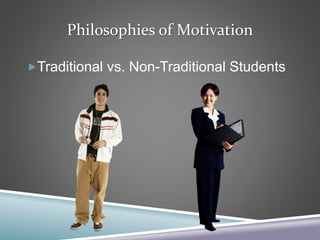
Traditional vs. Non-Traditional Students
Philosophies of Motivation
Traditional vs. Non-Traditional Students
Readjustment
Philosophies of Motivation
Traditional vs. Non-Traditional Students
Readjustment
Experiences in the Classroom
Philosophies of Motivation
Traditional vs. Non-Traditional Students
Readjustment
Experiences in the Classroom
 Temporary Motivation
 Internal Motivation
Philosophies of Motivation
Traditional vs. Non-Traditional Students
Readjustment
Experiences in the Classroom
 Temporary Motivation
 Internal Motivation
Responsibility & Source of Motivation
Extrinsic versus Intrinsic
Motivators
 Minimum effort
 Controls & Rewards
 Culturally driven &
observable
 A commodity/investment
Extrinsic versus Intrinsic
Motivators
 Minimum effort
 Controls & Rewards
 Culturally driven &
observable
 A commodity/investment
 Demand more effort
 Inherently interesting or
enjoyable
 Credit for results
 Available & portable
 Accomplishment
Andragogy & Pedagogy
Who is responsible?
Who is to be motivated?
Andragogy & Pedagogy
Who is responsible?
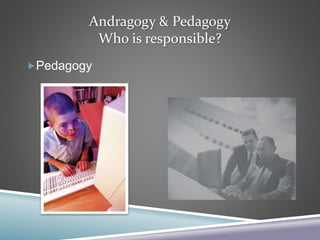
Pedagogy
Andragogy & Pedagogy
Who is responsible?
Andragogy
Implications
Must understand who is responsible for
motivation
Implications
Must understand who is responsible for
motivation
Experience and baggage
Implications
Must understand who is responsible for
motivation
Experience and baggage
Cannot know what motivates others
Implications
Must understand who is responsible for
motivation
Experience and baggage
Cannot know what motivates others
The “platinum rule”
Aligning Student & Instructor Motivations?
Create learning environments
Aligning Student & Instructor Motivations?
Create learning environments
 Internal Resources
Aligning Student & Instructor Motivations?
Create learning environments
 Internal Resources
 Gain Knowledge
Aligning Student & Instructor Motivations?
Create learning environments
 Internal Resources
 Gain Knowledge
 Skills in:
 Critical Thinking
 Problem Solving
Aligning Student & Instructor Motivations?
Create learning environments
 Internal Resources
 Gain Knowledge
 Skills in:
 Critical Thinking
 Problem Solving
Understand potential road blocks
Potential Roadblocks
Tradition
Image Source: http://www.fastcompany.com
Potential Roadblocks
Tradition
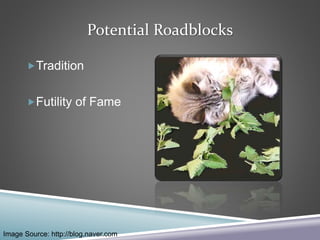
Futility of Fame
Image Source: http://blog.naver.com
Potential Roadblocks
Tradition
Futility of Fame
Low Expectations
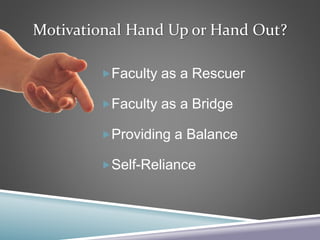
Motivational Hand Up or Hand Out?
Faculty as a Rescuer
Motivational Hand Up or Hand Out?
Faculty as a Rescuer
Faculty as a Bridge
Motivational Hand Up or Hand Out?
Faculty as a Rescuer
Faculty as a Bridge
Providing a Balance
Motivational Hand Up or Hand Out?
Faculty as a Rescuer
Faculty as a Bridge
Providing a Balance
Self-Reliance
References
 Pew, Stephen. (2007). Andragogy and Pedagogy as
Foundational Theory for Student Motivation in Higher
Education. InSight : A Collection of Faculty Scholarship,
2, 14-25.
Q & A

Motivation & the Adult Learner

Editor's Notes

  • #2 Hello everyone, I am Dorea Hardy and this presentation is on “Motivation and the Adult Learner”
  • #3 Link: http://www.insightjournal.net/Volume2/Andragogy%20and%20Pedagogy%20as%20Foundational%20Theory%20for%20Student%20Motivation%20in%20Higher%20Education.pdf The article I selected for this assignment was “Andragogy and Pedagogy as Foundational Theory for Student Motivation in Higher Education” authored by Dr. Stephen Pew, Associate Professor of Healthcare Leadership at Park University.
  • #4 Dr. Pew started the paper off with a quote from Albert Einstein “I never teach my pupils. I only attempt to provide the conditions in which they can learn” (Pew, 2007, p. 14).
  • #5 This paper covered the definition of motivation, philosophies of motivation, as well as differences between extrinsic and intrinsic motivation. Dr. Pew also discussed responsibility for motivation, implications, the process of aligning motivations, potential issues and whether instructors efforts are a hand up or a hand out.
  • #6 Dr. Pew quoted Brennen, who defined motivation “as the level of effort an individual is willing to expend toward the achievement of a certain goal” (Pew, 2007, p. 14).
  • #7 And according to McDevitt and Ormond, it “energizes, directs and sustains behavior…” (Pew, 2007, p. 14)
  • #8 “…and can be either intrinsic or extrinsic.” (Pew, 2007, p. 14)
  • #9 From here, Dr. Pew discusses four theories related to motivation.
  • #10 (Pew, 2007, p. 14) The first is behavioral theories, where he refers to the work of B.F. Skinner. Pew briefly discusses the increased positive behavior through positive and negative stimuli. This theory is an extrinsic form of motivation, which we will discuss later.
  • #11 (Pew, 2007, p. 14-15) The second theory is the cognitive view. As an intrinsic motivator, the view here is that cognitive dissonance will cause students to strive for a reestablishment of an equilibrium.
  • #12 (Pew, 2007, p. 15) The third theory is the humanistic view which is based on Abraham Maslow’s work. If physical and safety needs are met, the theory holds that students will become intrinsically motivated to learn.
  • #13 (Pew, 2007, p. 15) The fourth theory is biological or neural. Stating that synaptic events in the brain will influence behavioral outcomes.
  • #14 (Pew, 2007, p. 15) In discussing instructor philosophies of motivation, Dr. Pew begins by talking about the changes occurring in the college demographics. Specifically the shift from traditional towards non-traditional students.
  • #15 (Pew, 2007, p. 15) This change, he points out, requires instructors to make changes in their approach of instruction. The “readjustment” here will not be just for instructors though. It will be an adjustment for the students as well.
  • #16 (Pew, 2007, p. 15) As the “underlying philosophies” shift, it will adjust the types of experiences students will have in the classroom.
  • #17 (Pew, 2007, p. 15) Dr. Pew states that “these experiences” can be the difference between temporarily motivated and intrinsically motivated students.
  • #18 (Pew, 2007, p. 15) The key issues here with motivation are: 1.) who is responsible, and 2.) who or what is the source of motivation.
  • #19 (Pew, 2007, p. 15-17) At this point, Dr. Pew begins to discuss the differences between extrinsic and intrinsic motivation. Some of the key points he makes about extrinsic motivation are: 1.) that it requires minimum effort from the motivated person, 2.) it typically can be a controls and rewards method, 3.) has been known to be culturally driven & observable, and 4.) has turned into a commodity or an investment for many people
  • #20 (Pew, 2007, p. 15-17) In Moving form pedagogy to andragogy by Knowles in 1984, he stated “when a person becomes older, his motivation to learn comes more from his own self” (p 12). Those who are intrinsically motivated tend to demand more effort of themselves. To them, what they do is inherently interesting or enjoyable. They like taking credit for their results. This type of motivation is freely available and portable. (They can take it anywhere they go.) And the sense of accomplishment from this motivator can surpass external gratification.
  • #21 (Pew, 2007, p. 17-18) Understanding extrinsic and intrinsic motivation, we can now look at andragogy and pedagogy. We can discuss who is to be motivated and who’s responsibility it is to be the motivator.
  • #22 (Pew, 2007, p. 17) Pedagogy is a teacher-directed model of education. In this model, teachers are assuming all of the responsibility for teaching and this teaching is focused typically on transmitting information to children.
  • #23 (Pew, 2007, p. 17-18) Conversely, andragogy is focused on helping adults acquire knowledge as well as critically thinking about the acquired information. For the adults in this situation, the learning to them is for intrinsic value. The adult, therefore, takes on the primary responsibility for their learning.
  • #24 (Pew, 2007, p. 18-19) As instructors, we must consider what the implications are of this information. First, we must understand who is ultimately responsible for motivating the learner in our particular circumstance.
  • #25 (Pew, 2007, p. 18-19) If we are teaching adults, we must remember that each person comes with their own experience and baggage. They do not leave it at the door of your classroom.
  • #26 (Pew, 2007, p. 18-19) We must remember that we cannot know what motivates anyone else. We can only know what motivates us.
  • #27 (Pew, 2007, p. 18-19) Dr. Pew also recommends that college level instructors apply the “platinum rule.” This rule “states that we might motivate others as they want to be motivated, not as we might want to motivate them” (Pew, 2007, p. 19).
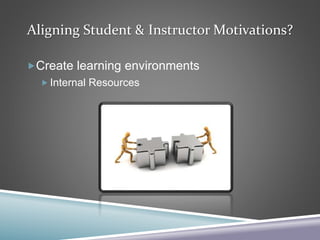
  • #28 (Pew, 2007, p. 20) Knowing this, how do we align our motivates with our students motivations? We start by creating learning environments that…
  • #29 (Pew, 2007, p. 20) Help the students use their “internal resources.” What brought them to college and how can instructors use that?
  • #30 (Pew, 2007, p. 20) The environment should also allow the students to gain knowledge…
  • #31 (Pew, 2007, p. 20) …and develop skills in both critical thinking and problem solving.
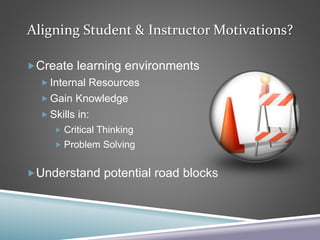
  • #32 (Pew, 2007, p. 20-22) Instructors must also understand and be prepared to deal with potential road blocks.
  • #33 (Pew, 2007, p. 20-22) One road block an instructor might come against is “tradition”. Many people do not like change and like to keep the “status quo”. Pedagogy is the current “way” to teach and not everyone will want to break from that tradition.
  • #34 (Pew, 2007, p. 20-22) A second road block one might encounter is the “futility of fame” which Dr. Pew calls “the catnip of motivator educators” (Pew, 2007, p. 21). Trying to motivate students can actually make students more dependent. Dr. Pew mentions the concepts of “enabling” and “codependency”. He states on page 21 that “this addiction is some times so strong, the codependent will cause the other person to continue to be needy; this behavior is called enabling.”
  • #35 (Pew, 2007, p. 20-22) The final example Dr. Pew dives in this paper is “a mutual pact of low expectations” (Pew, 2007, p. 21). He implies that this could be College Administrations’ fault for pushing instructors to cater to students, thereby making the faculty’s motivation be “self-serving” instead of student centered.
  • #36 (Pew, 2007, p. 22-23) Motivation is obviously need by our students in order for them to succeed in college. So how do we help them without hurting them? Dr. Pew mentions that the “faculty as a rescuer” is not helping the student. In actuality it is enabling the students, thereby making the faculty person an enabler.
  • #37 (Pew, 2007, p. 22-23) Dr. Pew then states that some faculty may attempt to be a motivational bridge, if only temporarily. Unfortunately, while this may help a struggling student, those in the class that do not need the motivation will suffer. This is because the instructor’s resources will be devoted to motivating instead of instruction.
  • #38 (Pew, 2007, p. 22-23) Dr. Pew instead encourages finding a balance in developing “adult-to-adult interactions” (Pew, 2007, p. 22), whereby the instructor can be a facilitator of learning.
  • #39 (Pew, 2007, p. 22-23) Dr. Pew doesn’t give us a definitive answer to this question of motivation. Instead he wants us to critically think about our part in motivation. He points out though, that ultimately we must depend on self-reliance for motivation. We cannot be responsible for motivating others. They must learn to be self-reliant and find their motivation in themselves.
  • #40 Link: http://www.insightjournal.net/Volume2/Andragogy%20and%20Pedagogy%20as%20Foundational%20Theory%20for%20Student%20Motivation%20in%20Higher%20Education.pdf