
Arousal  : suggests orientation toward a  goal Drive:   caring enough to do something about achieving  the goal
* lack of positive relationship * learned helplessness * awareness of disrespect toward one’s culture  or  ethnicity * perception of threats * brain anomalies * drug use * perception that class assignments or tasks are irrelevant.
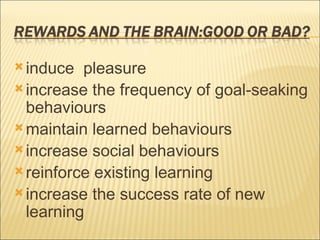
induce  pleasure increase the frequency of goal-seaking behaviours maintain learned behaviours increase social behaviours reinforce existing learning increase the success rate of new learning
*Use rewards judiciously *Use low-cost, concrete rewards *Use abstract rewards *Avoid going “cold turkey” *Begin to develop intrinsic motivation *Step up the abstract rewards
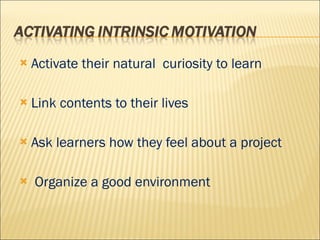
Activate their natural  curiosity to learn Link contents to their lives Ask learners how they feel about a project Organize a good environment
Students should have a process model to follow or a strong end goal Working tools are needed Provide encouragement but not direct reward Students should choose, little or big things Provide a variety of relevant experiences Increase feedback to the learners
All external behaviours have a relationship with brain’s internal processes Millions of neurons cooperate to form complex systems that represent  what is called “states” States change as our sensations,feelings and thoughts They combine our emotional, cognitive and physical interactions to allow us to make decisions The states are always changing
Choose the target state for your audience Read present states Plan your strategy (who,how,when) Create a back-up plan Set up the state change Begin the change of state Monitor and adjust during the process
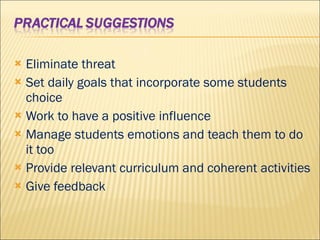
Eliminate threat Set daily goals that incorporate some students choice Work to have a positive influence  Manage students emotions and teach them to do it too Provide relevant curriculum and coherent activities Give feedback
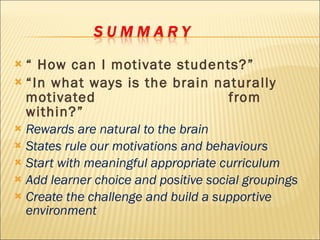
“  How can I motivate students?” “ In what ways is the brain naturally motivated  from within?” Rewards are natural to the brain States rule our motivations and behaviours Start with meaningful appropriate curriculum Add learner choice and positive social groupings Create the challenge and build a supportive environment
Thank  you!! Blanca  and  Mariela September  12, 2011

Motivation

  • 1.
  • 2.
    Arousal :suggests orientation toward a goal Drive: caring enough to do something about achieving the goal
  • 3.
    * lack ofpositive relationship * learned helplessness * awareness of disrespect toward one’s culture or ethnicity * perception of threats * brain anomalies * drug use * perception that class assignments or tasks are irrelevant.
  • 4.
    induce pleasureincrease the frequency of goal-seaking behaviours maintain learned behaviours increase social behaviours reinforce existing learning increase the success rate of new learning
  • 5.
    *Use rewards judiciously*Use low-cost, concrete rewards *Use abstract rewards *Avoid going “cold turkey” *Begin to develop intrinsic motivation *Step up the abstract rewards
  • 6.
    Activate their natural curiosity to learn Link contents to their lives Ask learners how they feel about a project Organize a good environment
  • 7.
    Students should havea process model to follow or a strong end goal Working tools are needed Provide encouragement but not direct reward Students should choose, little or big things Provide a variety of relevant experiences Increase feedback to the learners
  • 8.
    All external behaviourshave a relationship with brain’s internal processes Millions of neurons cooperate to form complex systems that represent what is called “states” States change as our sensations,feelings and thoughts They combine our emotional, cognitive and physical interactions to allow us to make decisions The states are always changing
  • 9.
    Choose the targetstate for your audience Read present states Plan your strategy (who,how,when) Create a back-up plan Set up the state change Begin the change of state Monitor and adjust during the process
  • 10.
    Eliminate threat Setdaily goals that incorporate some students choice Work to have a positive influence Manage students emotions and teach them to do it too Provide relevant curriculum and coherent activities Give feedback
  • 11.
    “ Howcan I motivate students?” “ In what ways is the brain naturally motivated from within?” Rewards are natural to the brain States rule our motivations and behaviours Start with meaningful appropriate curriculum Add learner choice and positive social groupings Create the challenge and build a supportive environment
  • 12.
    Thank you!!Blanca and Mariela September 12, 2011