An Atomic Meme Learning Hub Initiative Dianne Rees, JD, PhD
The underpinnings of andragogy (adult learning theory)
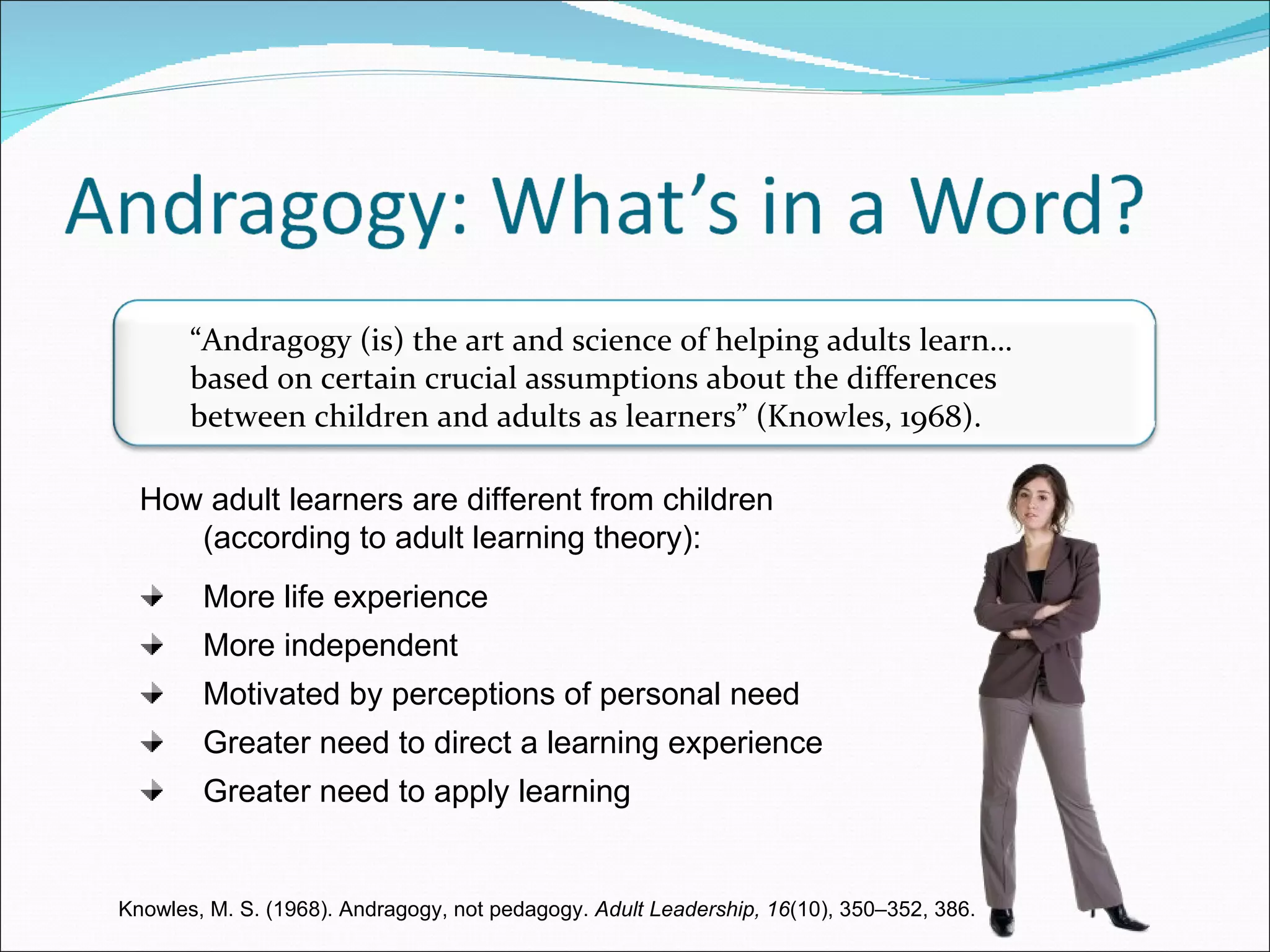
How adult learners are different from children  (according to adult learning theory): More life experience More independent Motivated by perceptions of personal need Greater need to direct a learning experience Greater need to apply learning Knowles, M. S. (1968). Andragogy, not pedagogy.  Adult Leadership, 16 (10), 350–352, 386. “ Andragogy (is) the art and science of helping adults learn…based on certain crucial assumptions about the differences between children and adults as learners” (Knowles, 1968).
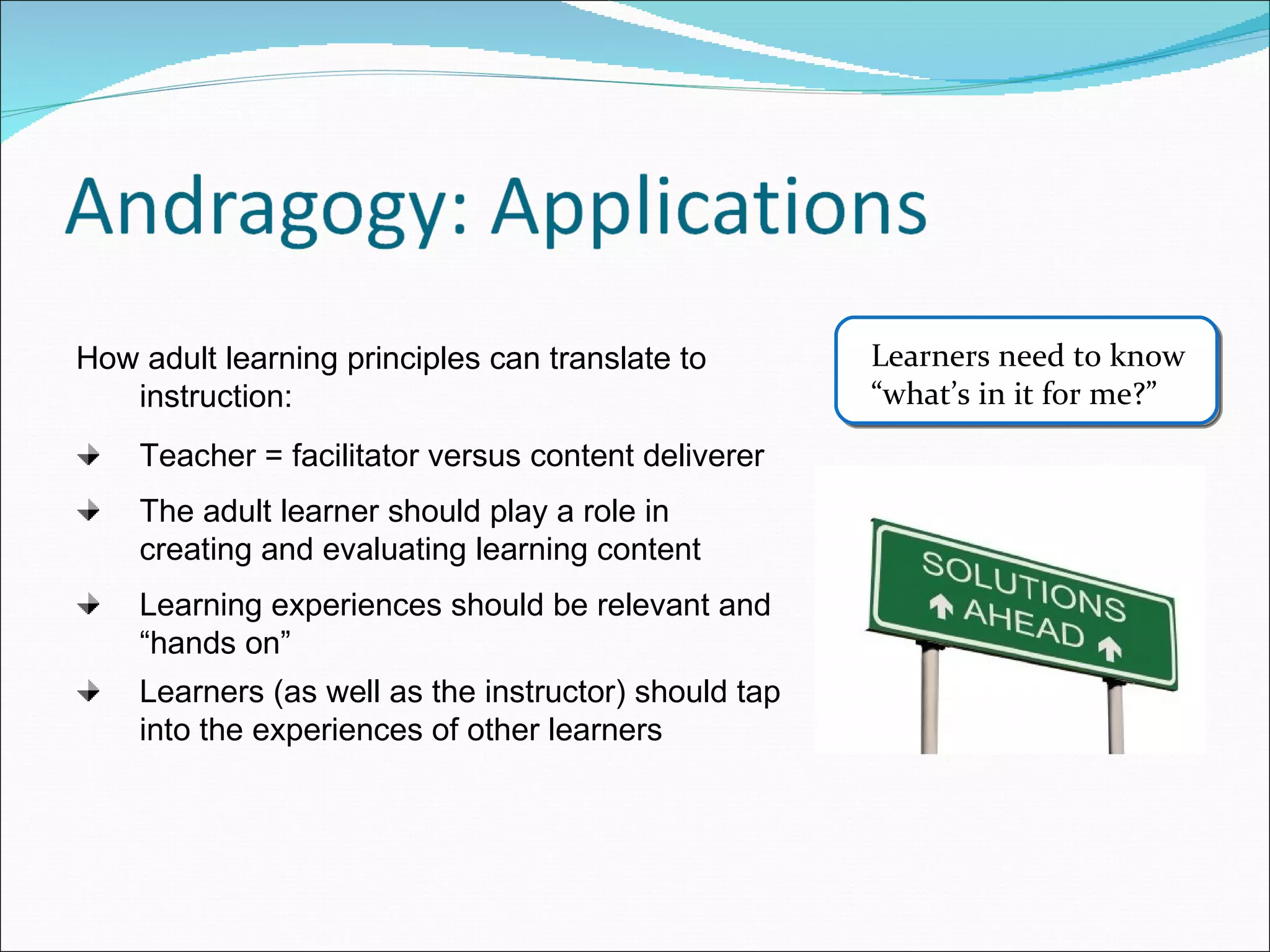
How adult learning principles can translate to instruction: Teacher = facilitator versus content deliverer The adult learner should play a role in creating and evaluating learning content Learning experiences should be relevant and “hands on” Learners (as well as the instructor) should tap into the experiences of other learners Learners need to know  “what’s in it for me?”
With adult learning theory in mind
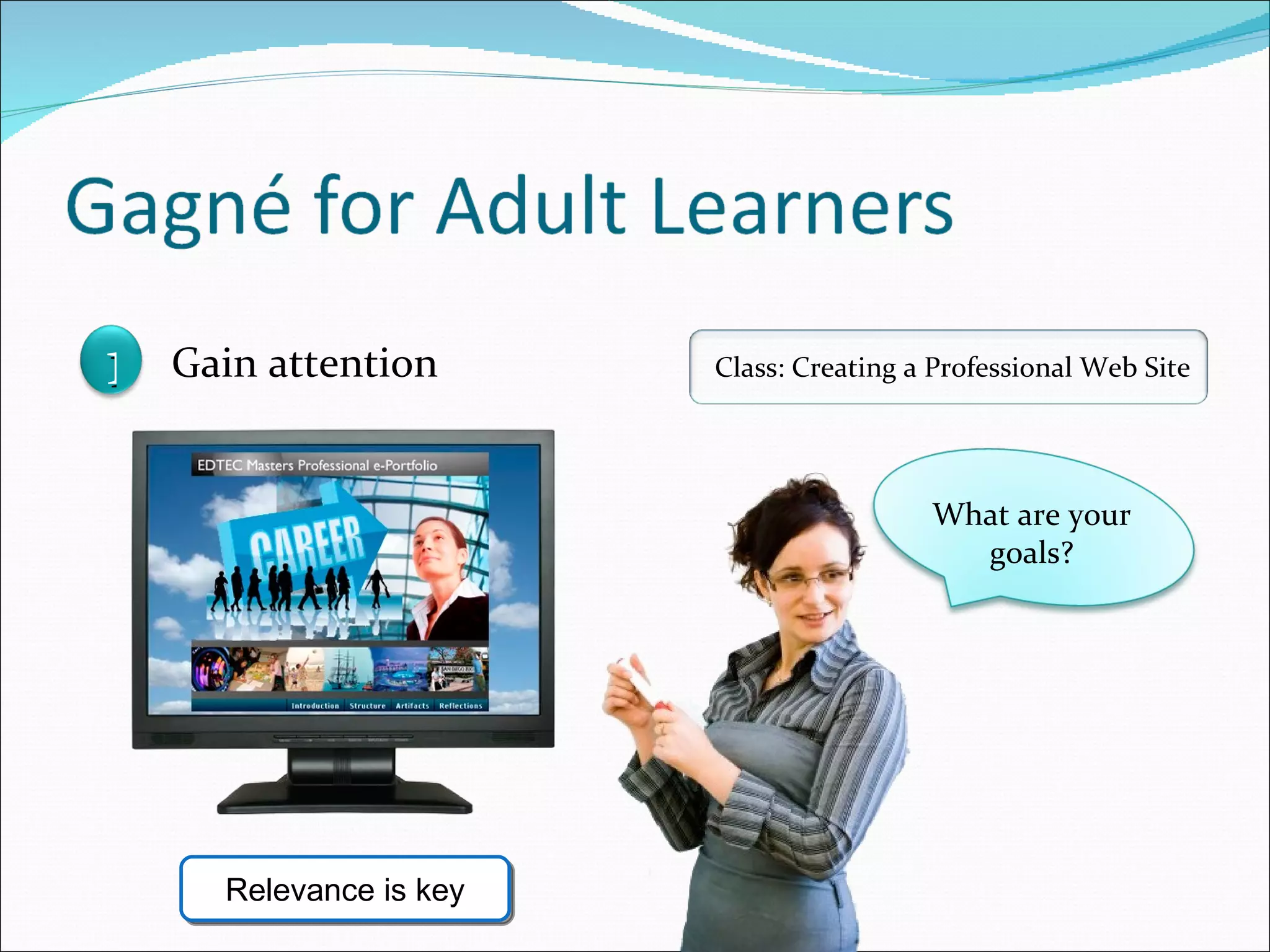
What are your goals? Relevance is key 1 Gain attention Class: Creating a Professional Web Site
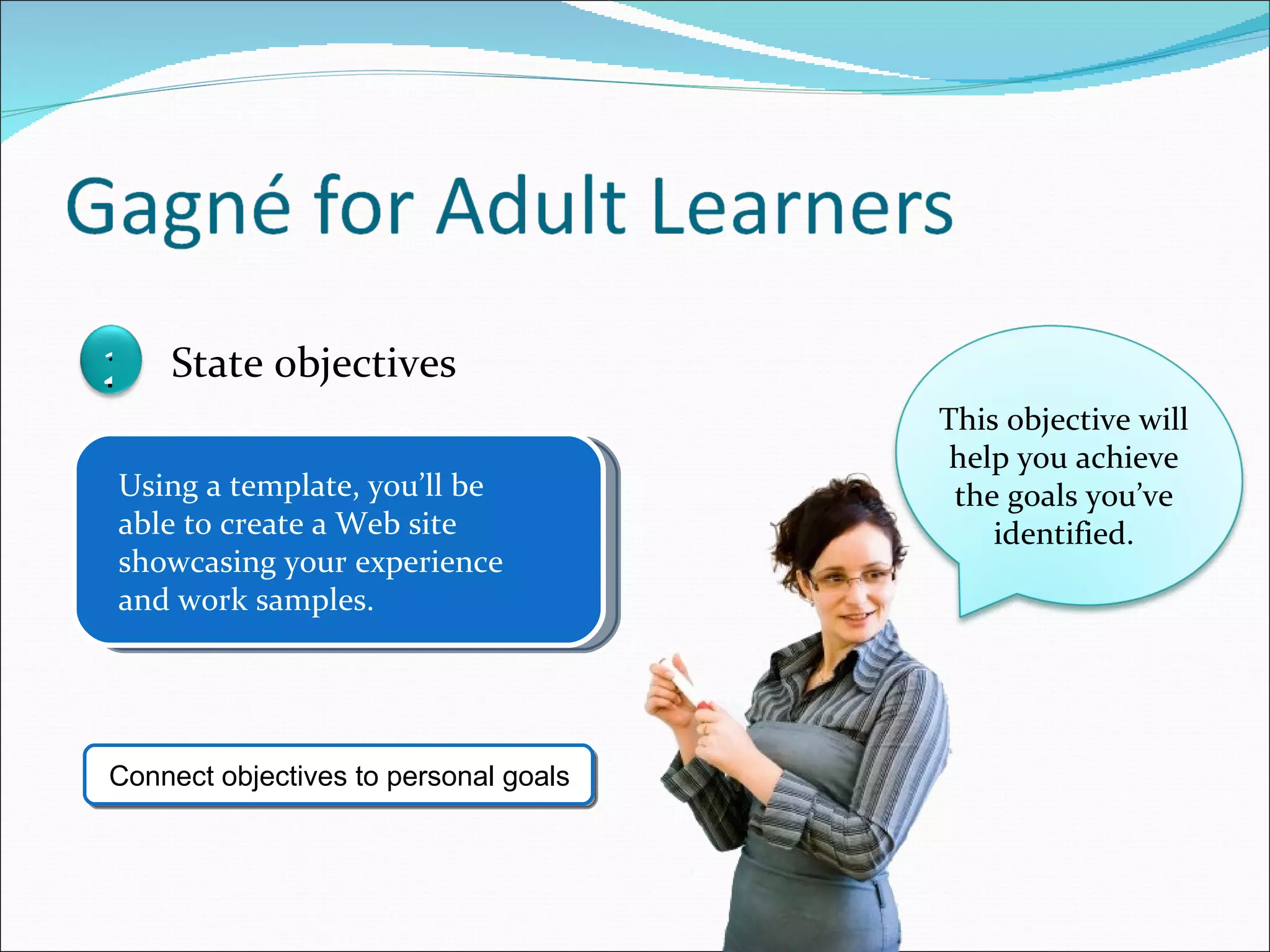
Using a template, you’ll be able to create a Web site showcasing your experience and work samples. This objective will help you achieve the goals you’ve identified. Connect objectives to personal goals 2 State objectives
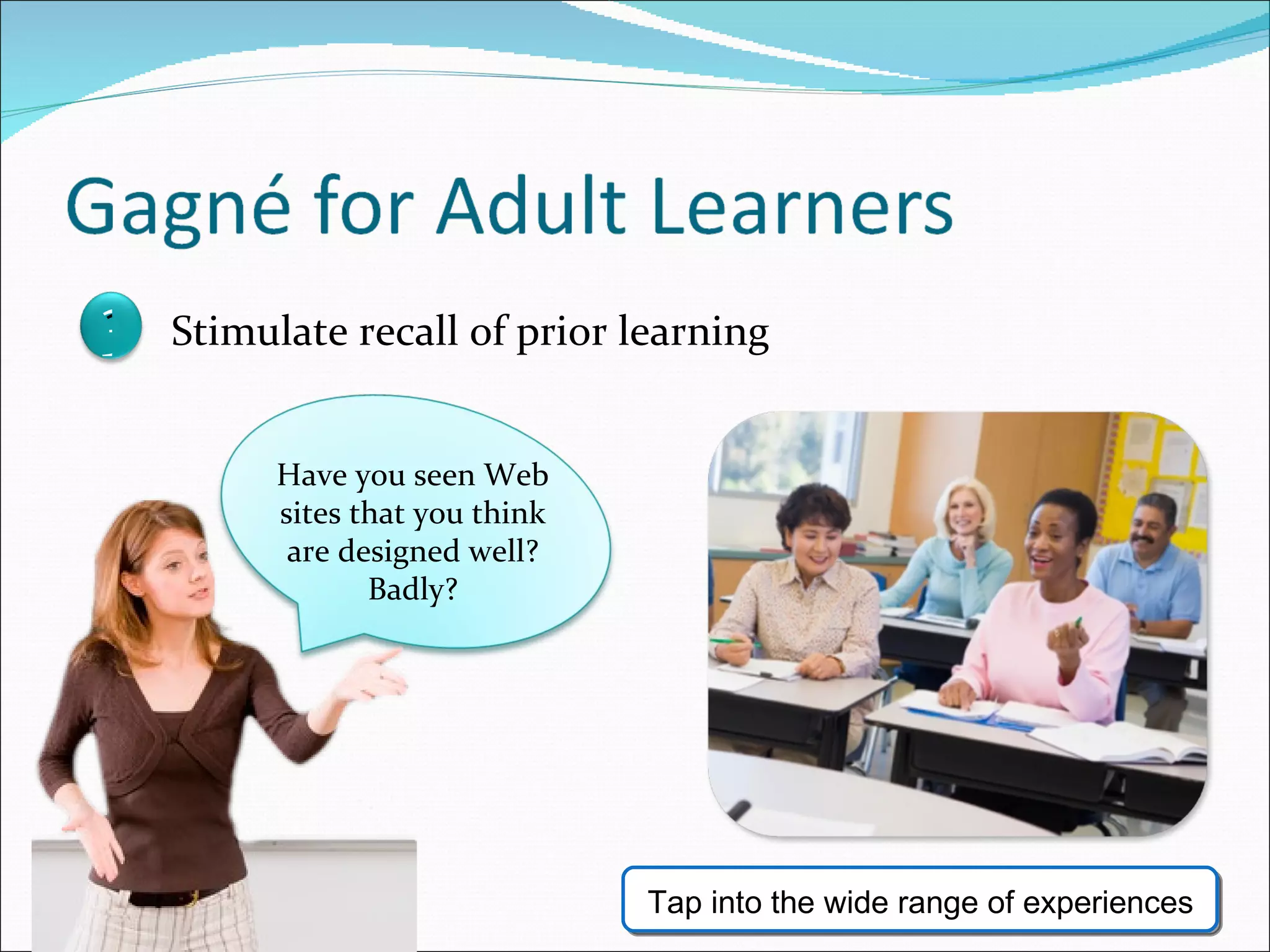
Have you seen Web sites that you think are designed well? Badly? Tap into the wide range of experiences 3 Stimulate recall of prior learning
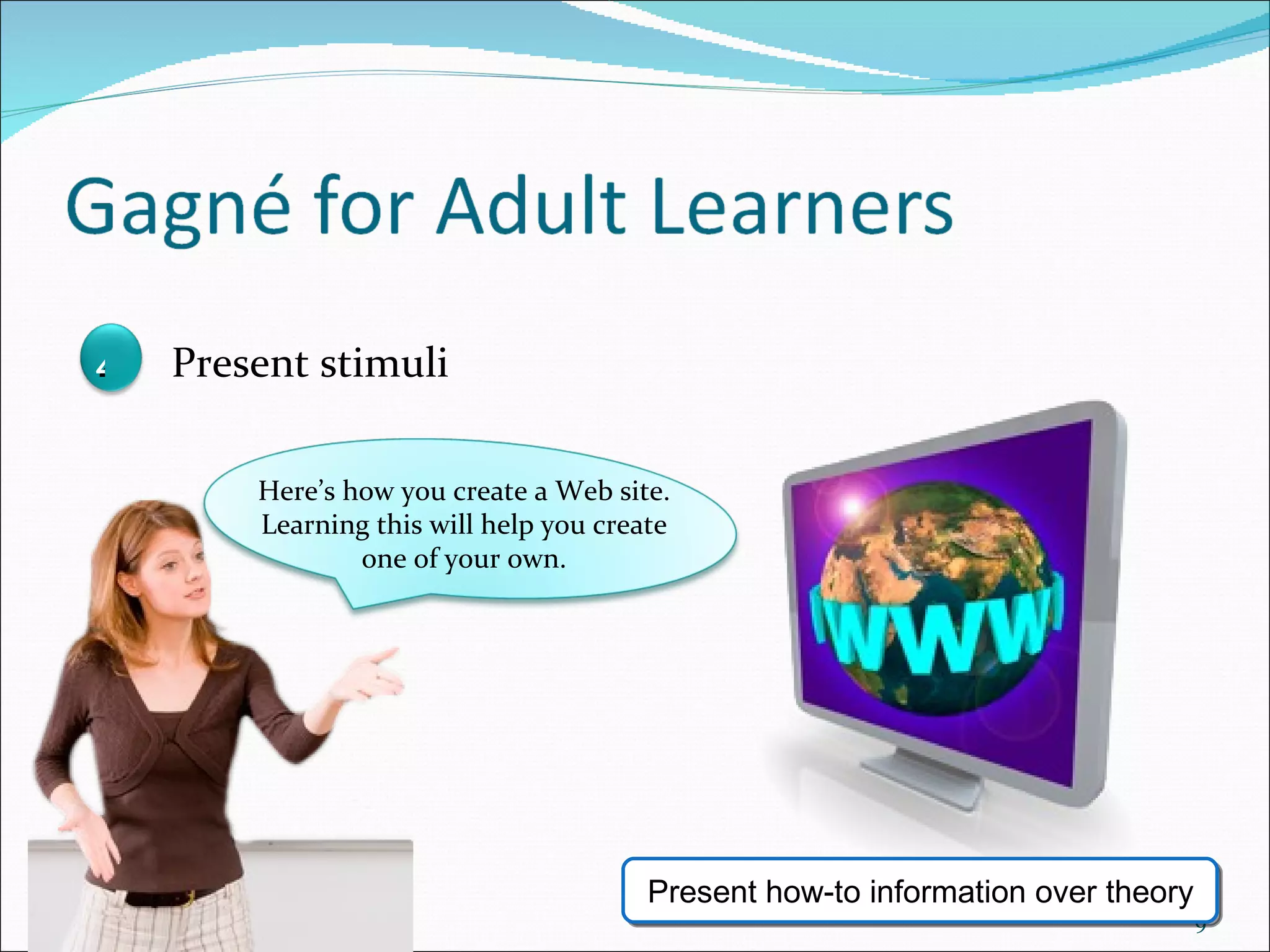
Here’s how you create a Web site. Learning this will help you create one of your own. Present how-to information over theory 4 Present stimuli
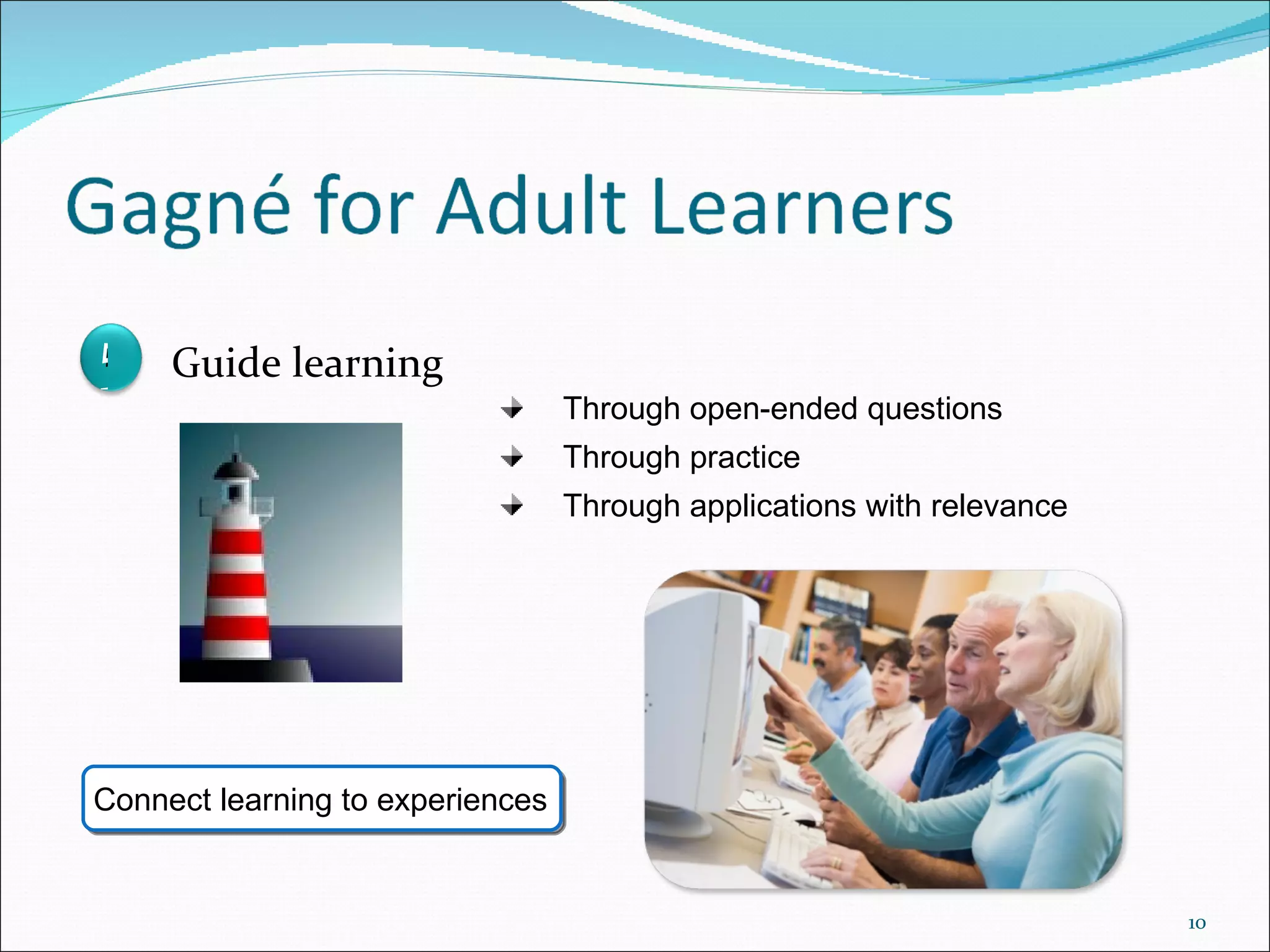
Through open-ended questions Through practice Through applications with relevance Connect learning to experiences 5 Guide learning
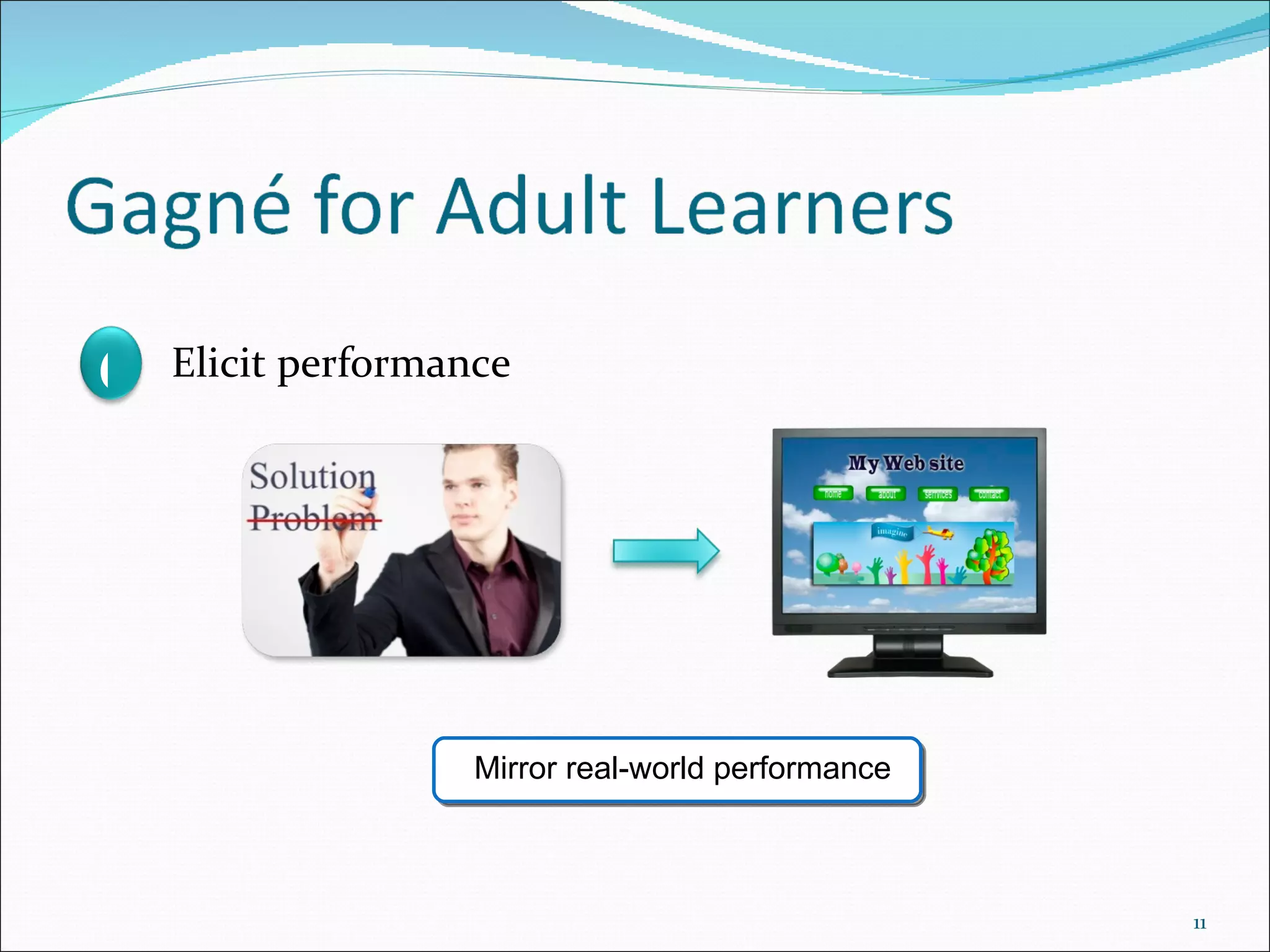
Mirror real-world performance 6 Elicit performance
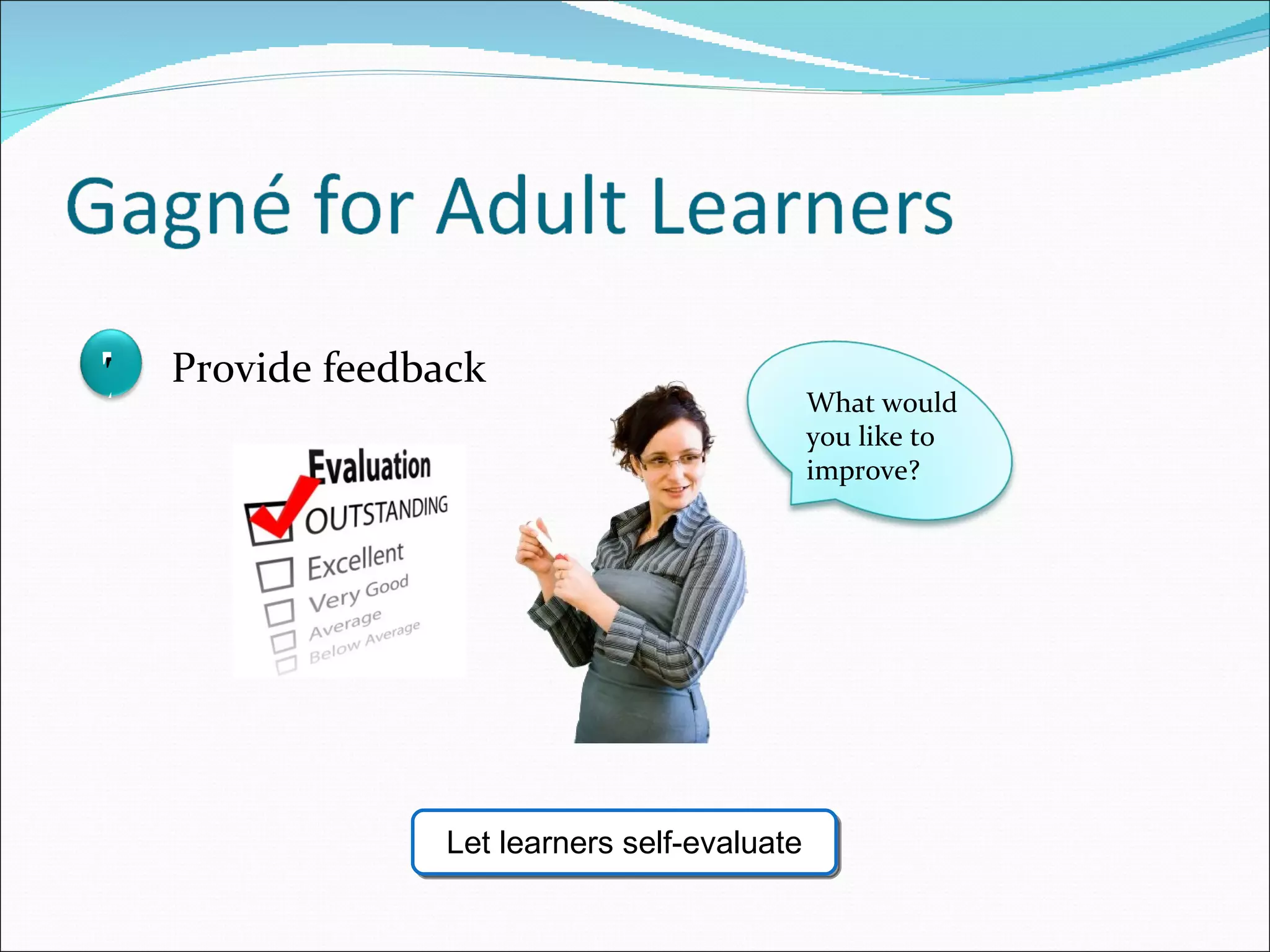
What would you like to improve? Let learners self-evaluate 7 Provide feedback
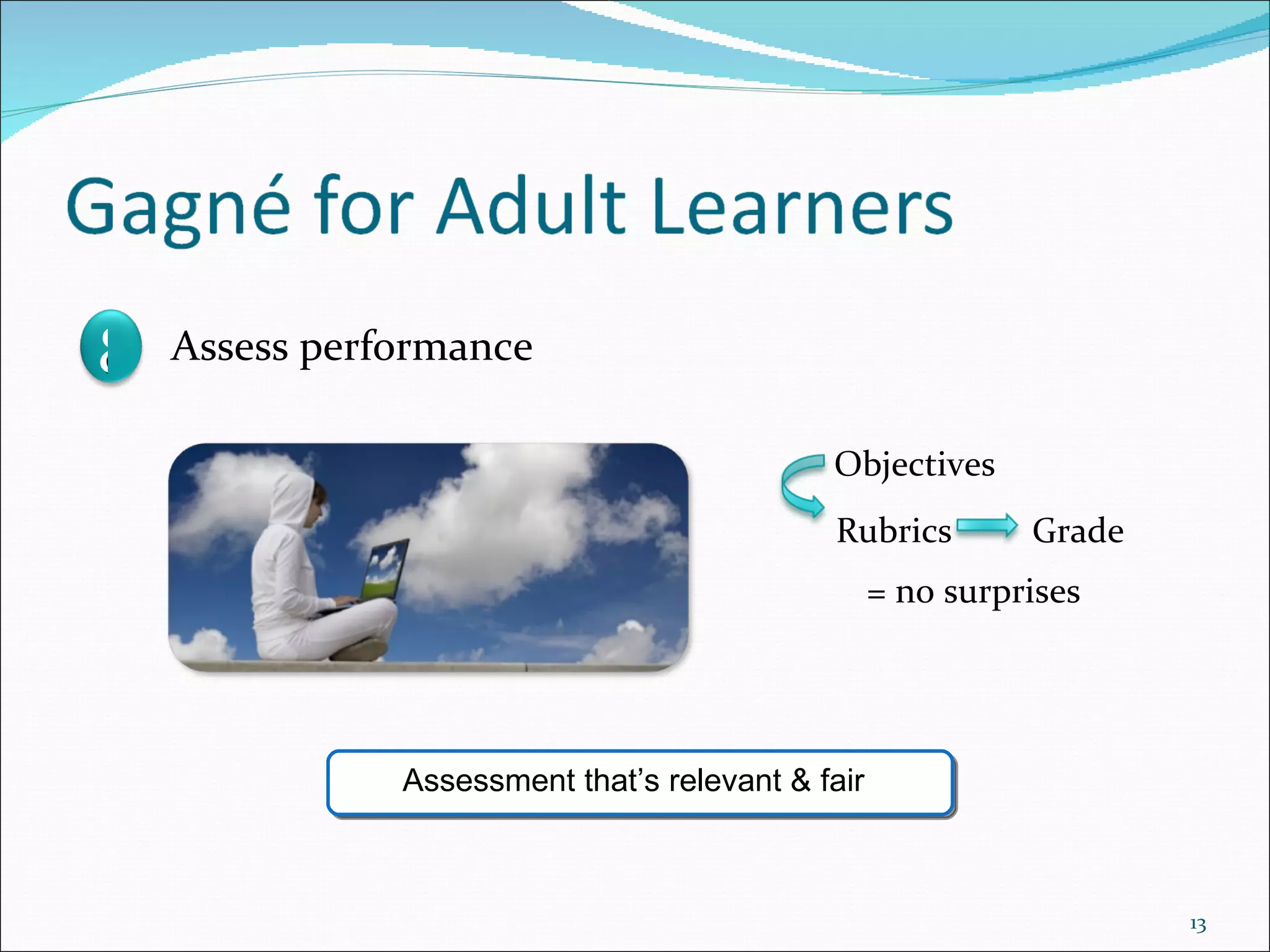
8 Assess performance Rubrics Grade = no surprises Objectives Assessment that’s relevant & fair
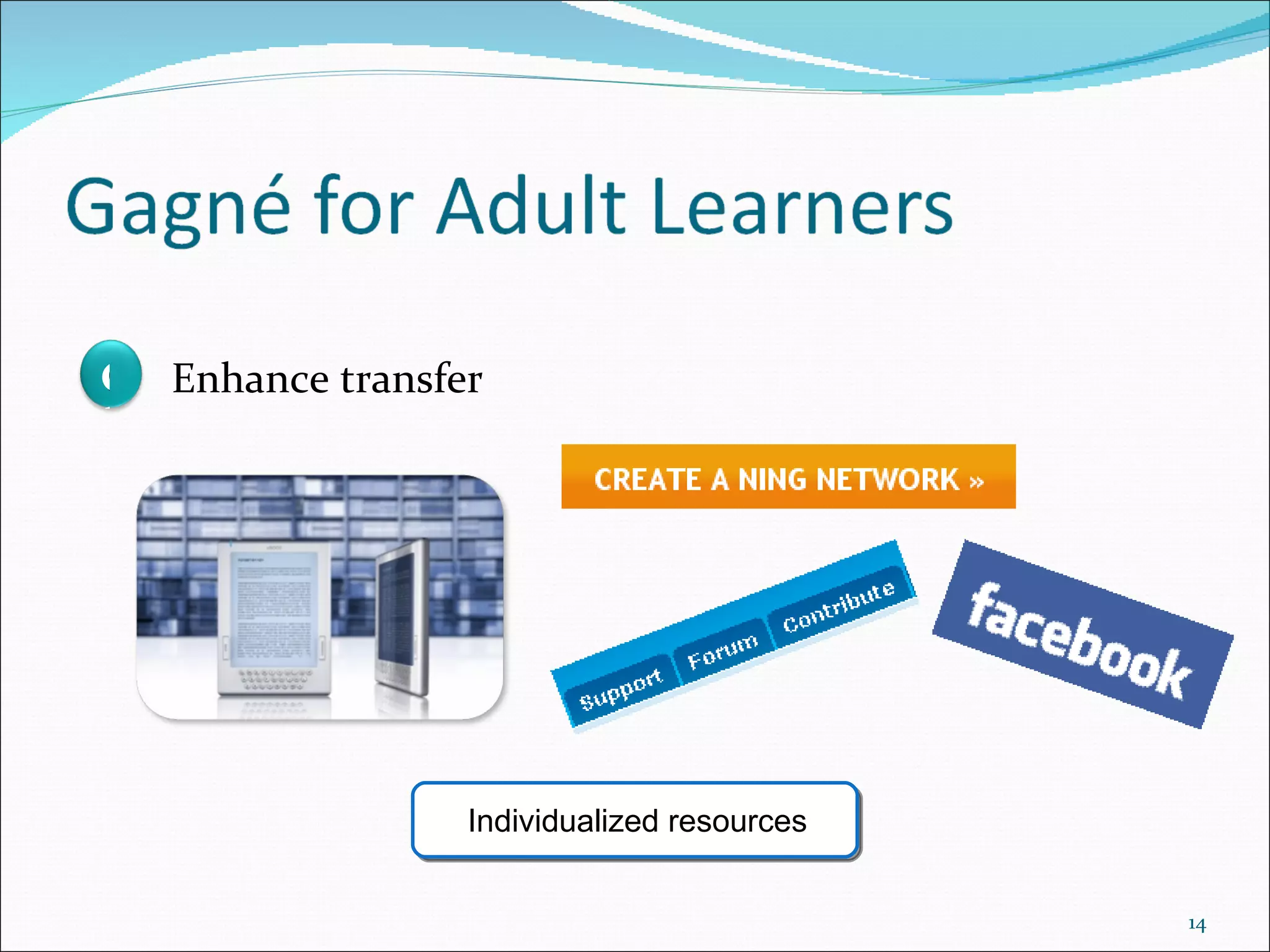
Individualized resources 9 Enhance transfer
Reconsidering adult learning theory
The learning challenge: moving from a passive to an active learner—are your adult learners prepared? Criticisms of adult learning theory (Clardy, 2005) Adults aren’t fundamentally different from children when it comes to learning needs: It’s a question of degree Adults have heterogeneous learning needs: One theory doesn’t fit all Not all adults are ready to be self-directed learners Clardy, A. (2005).  Andragogy: Adult learning and education at its best?  Towson, MD: Towson University. Retrieved March, 2010, from  http://eric.ed.gov/ERICDocs/data/ericdocs2/content_storage_01/0000000b/80/33/7a/6f.pdf

Adult learning theory principles and practice

  • 1.
    An Atomic MemeLearning Hub Initiative Dianne Rees, JD, PhD
  • 2.
    The underpinnings ofandragogy (adult learning theory)
  • 3.
    How adult learnersare different from children (according to adult learning theory): More life experience More independent Motivated by perceptions of personal need Greater need to direct a learning experience Greater need to apply learning Knowles, M. S. (1968). Andragogy, not pedagogy. Adult Leadership, 16 (10), 350–352, 386. “ Andragogy (is) the art and science of helping adults learn…based on certain crucial assumptions about the differences between children and adults as learners” (Knowles, 1968).
  • 4.
    How adult learningprinciples can translate to instruction: Teacher = facilitator versus content deliverer The adult learner should play a role in creating and evaluating learning content Learning experiences should be relevant and “hands on” Learners (as well as the instructor) should tap into the experiences of other learners Learners need to know “what’s in it for me?”
  • 5.
    With adult learningtheory in mind
  • 6.
    What are yourgoals? Relevance is key 1 Gain attention Class: Creating a Professional Web Site
  • 7.
    Using a template,you’ll be able to create a Web site showcasing your experience and work samples. This objective will help you achieve the goals you’ve identified. Connect objectives to personal goals 2 State objectives
  • 8.
    Have you seenWeb sites that you think are designed well? Badly? Tap into the wide range of experiences 3 Stimulate recall of prior learning
  • 9.
    Here’s how youcreate a Web site. Learning this will help you create one of your own. Present how-to information over theory 4 Present stimuli
  • 10.
    Through open-ended questionsThrough practice Through applications with relevance Connect learning to experiences 5 Guide learning
  • 11.
    Mirror real-world performance6 Elicit performance
  • 12.
    What would youlike to improve? Let learners self-evaluate 7 Provide feedback
  • 13.
    8 Assess performanceRubrics Grade = no surprises Objectives Assessment that’s relevant & fair
  • 14.
  • 15.
  • 16.
    The learning challenge:moving from a passive to an active learner—are your adult learners prepared? Criticisms of adult learning theory (Clardy, 2005) Adults aren’t fundamentally different from children when it comes to learning needs: It’s a question of degree Adults have heterogeneous learning needs: One theory doesn’t fit all Not all adults are ready to be self-directed learners Clardy, A. (2005). Andragogy: Adult learning and education at its best? Towson, MD: Towson University. Retrieved March, 2010, from http://eric.ed.gov/ERICDocs/data/ericdocs2/content_storage_01/0000000b/80/33/7a/6f.pdf

Editor's Notes

  • #2 This short module provides an overview of adult learning theory and ways it can be applied to create a lesson plan.
  • #3 First, let’s take a look at the principles of adult learning theory.
  • #4 Andragogy or adult learning theory posits that adults and children have different learning needs and that considering adult learning needs can improve instructional outcomes.
  • #5 An important aspect of andragogy or adult learning theory is the concept of the instructor as a facilitator versus a content deliverer. Adult learners should be involved in structuring their own learning experiences.
  • #6 Now that you’ve read about the principles of adult learning theory, let’s see how to create a lesson plan with these principles in mind.
  • #7 The example we’ll consider is a class on creating a professional Web site. We’ll take a look at how we can modify Gagné’s nine events of instruction to incorporate adult learning theory. As you might imagine, relevance is key to gaining the attention of adult learners. In this example class, the instructor could ask learners what they hope to gain from the class and could tell learners what they’ll be able to achieve.
  • #8 The instructor should not only state objectives but should also connect objectives to learners’ personal goals.
  • #9 When stimulating recall of prior learning, remember that your target audience will have a wide range of experiences that should be tapped into. For example, the instructor could discuss the learners’ personal experiences with Web design in this type of class.
  • #10 As you present stimuli, consider that adults appreciate content clearly linked to objectives. “How to” information is preferred over theory. Here, the instructor could remind learners how the content presented ties into the big picture of enabling them to create their own Web site.
  • #11 When guiding learning, remember that adult learners like applications that have personal relevance. Also remember that it’s important to respect the experiences of adult learners since they might feel condescended to if you adapt an overly pedagological approach. For example, in a class on Web design, the instructor could use open-ended questions to discuss how learners would modify Web template pages.
  • #12 Learning performance should relate as closely as possible to real-world performance. In this class, the instructor would task learners to practice creating their own web pages.
  • #13 When providing feedback, remember that adult learners are self-directed. They should also be involved in evaluating their own performance.
  • #14 The final assessment task should be related to personal goals and real-world tasks. For example, in this case learners would be asked to put together all they’ve learned to create their own Web site. The learners would be made aware of the rubric used to evaluate their work.
  • #15 When enhancing transfer, consider that adult learners are heterogeneous. In a class on Web design, materials that enhance transfer could include resources and opportunities for self-directed growth. For example, an instructor could provide access to forums to allow learners to discuss ongoing Web design projects.
  • #16 Andragogy or adult learning theory is not without controversy.
  • #17 While there may be critiques of the theory, applying some of the principles of adult learning theory can be used to improve outcomes so long as the approach is flexible.