Motivation
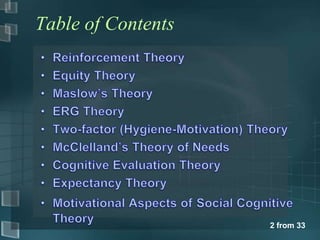
Table of Contents


                    2 from 33
Definition

   – The process that accounts for an individual‟s
              ,          , and              of effort
     towards attaining a goal.


                                                3 from 33
Reinforcement theory


                       4 from 33
Reinforcement theory (Con.)


                              5 from 33
Reinforcement theory (Con.)


    they have been reinforced (rewarded) for that
    behavior in the past.


    The process of using reinforcement principles to
    change behavior.


                                              6 from 33
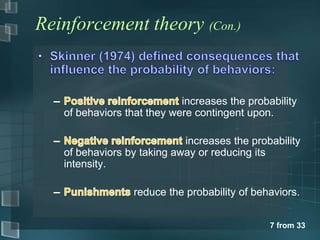
Reinforcement theory (Con.)


                            increases the probability
   of behaviors that they were contingent upon.

                            increases the probability
   of behaviors by taking away or reducing its
   intensity.

                 reduce the probability of behaviors.


                                               7 from 33
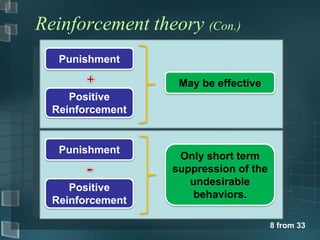
Reinforcement theory (Con.)
   Punishment

                   May be effective
     Positive
  Reinforcement


   Punishment
                   Only short term
                  suppression of the
                     undesirable
     Positive
                     behaviors.
  Reinforcement

                                       8 from 33
Reinforcement theory (Con.)

   a fearful atmosphere, which undermines learning
     and the effectiveness of communication.


   – Use reward to get individuals engaged in an
     activity, and then gradually withdraw the reward
     when they show some interest.
   – Make sure that it is clear to individuals what
     behavior the reward is contingent.
   – Reward genuine achievements, such as high
     levels of effort and persistence. Avoid rewarding
     performance that required little or no effort.

                                                9 from 33
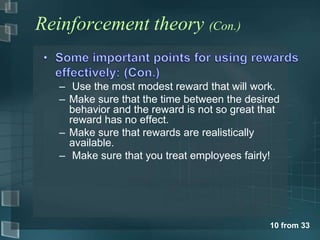
Reinforcement theory (Con.)


   – Use the most modest reward that will work.
   – Make sure that the time between the desired
     behavior and the reward is not so great that
     reward has no effect.
   – Make sure that rewards are realistically
     available.
   – Make sure that you treat employees fairly!


                                              10 from 33
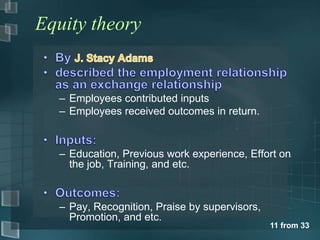
Equity theory


  – Employees contributed inputs
  – Employees received outcomes in return.


  – Education, Previous work experience, Effort on
    the job, Training, and etc.


  – Pay, Recognition, Praise by supervisors,
    Promotion, and etc.
                                               11 from 33
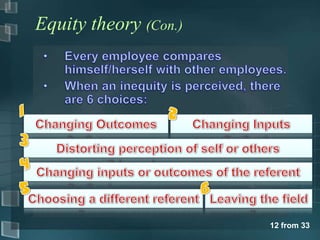
Equity theory (Con.)


                       12 from 33
Equity theory (Con.)


    – has strong impact on


    – is more important for
                        .

Procedural                        Perceived
  Justice                     Distributed Justice
                                                    13 from 33
14 from 33
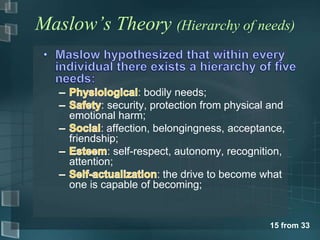
Maslow’s Theory (Hierarchy of needs)


                     : bodily needs;
           : security, protection from physical and
    emotional harm;
           : affection, belongingness, acceptance,
    friendship;
             : self-respect, autonomy, recognition,
    attention;
                         : the drive to become what
    one is capable of becoming;


                                               15 from 33
Maslow’s Theory (Con.)


                         16 from 33
Maslow’s Theory (Con.)


                         17 from 33
ERG Theory (Alderfer, 1970)


     Existence         Relatedness         Growth


   – More than one need may be operative at the
     same time
   – Order of needs may differ in different cultures
   – If fulfillment of a higher level need is prevented,
     the desire to satisfy a lower level need
     increases.

                                                    18 from 33
McClelland’s Theory of Needs

  – Need for Achievement
  – Need for Power
  – Need for Affiliation


    Achievement                Job
       Need                Performance

                                    19 from 33
Two-factor (hygiene-motivation) Theory

   „What do people want from their jobs?‟


                     such as
     advancement, recognition, responsibility, and
     achievements seemed to be          to
                .

                      was             to
              such as supervision, pay, company
     policies, and working condition.

   – Satisfaction and Dissatisfaction are not two
     opposite sides of a continuum               20 from 33
Two-factor Theory (Con.)

  Satisfaction                         No Satisfaction

               :
      Recognition, Responsibility, Advancement


  Dissatisfaction                    No Dissatisfaction

                      :
      Pay, Policies, Work Condition, Supervision


                                                  21 from 33
Cognitive Evaluation Theory

  – Allocating          rewards for behavior that
    had been previously                rewarding
    tends to decrease overall level of motivation.


  – Individuals experiences a loss of control over his
    or her own behavior so that the previous intrinsic
    motivation diminishes.


                                               22 from 33
23 from 33
Expectancy Theory

 – use rational approaches
 – suggest that individuals choose behaviors based on
    expectations of the outcomes of actions,
    seeking to achieve the most desirable outcome


                                              24 from 33
Vroom’s expectancy theory

                          =
                  ×                   ×

               is the importance that the individual places upon
   the expected outcome of a situation and is related to an
   individual‟s expected incentive, preferences, and values.
                  is the belief that output from the
   individual (EFFORT) and the success of the
   situation are linked, e.g. if I work harder then this
   will be better.
                          is the belief that the success of the
   situation is linked to the expected outcome of the         25 from 33
   situation, e.g. it's gone really well, so I'd expect praise.
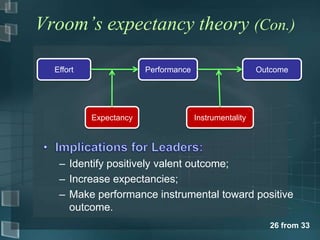
Vroom’s expectancy theory (Con.)

  Effort                Performance                     Outcome


           Expectancy                 Instrumentality


   – Identify positively valent outcome;
   – Increase expectancies;
   – Make performance instrumental toward positive
     outcome.
                                                           26 from 33
Group Task


  – An employee‟s motivation to become a manager;

  – An employee‟s motivation to participate in a
    training program.


                                              27 from 33
Motivational Aspects of Social
Cognitive Theory

    “beliefs in one‟s capabilities to
    organize and execute the
    courses of action required to
    produce given attainments” (               )


                                        28 from 33
Motivational Aspects of Social
Cognitive Theory (Con.)

   – The more people believe in their capabilities for
     given domains and tasks, the more likely they
     will put effort into and persist with their activities,
     especially when there are failures (
           ).

   – An individual‟s self-efficacy also influences what
     he or she chooses to do.

   – Leaders high in leadership efficacy experience
     low level of anxiety (                ).

                                                     29 from 33
Motivational Aspects of Social
Cognitive Theory (Con.)

   – Leaders‟ self-efficacy for leadership influence
     follower‟s self-efficacy (                 ).


                                                 30 from 33
Motivational Aspects of Social
Cognitive Theory (Con.)
                               : Successful experiences are likely
   to enhance self-efficacy, while failures may reduce self-efficacy.
   These are the most influential sources of self-efficacy.
                                  : refer to those by which people
   appraise their capabilities in relation to others‟ attainments. The
   information acquired from these experiences is likely to be
   more influential for one‟s self-efficacy when the others are
   similar to the individual.
                             : persuasion that one possesses certain
   capabilities can affect self-efficacy. However, verbal persuasion
   may be ineffective when it is used alone and inconsistent with
   other sources, especially mastery experiences.
                                            : Personal efficacy may
   also be appraised when people interpret their physiological or
   affective states. People may judge their fatigue, aches, pains,
   and tensions to be signs of physical or affective incapability.
                                                           31 from 33
Motivational Aspects of Social
Cognitive Theory (Con.)
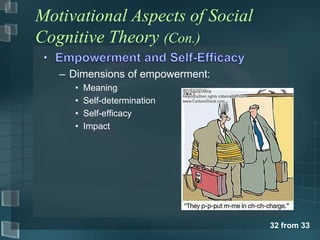
   – Dimensions of empowerment:
     •   Meaning
     •   Self-determination
     •   Self-efficacy
     •   Impact


                                  32 from 33
Motivational Aspects of Social
Cognitive Theory (Con.)
   – Collective efficacy is defined as a group‟s shared
     belief in its conjoint capabilities to organize and
     execute the course of action required to produce
     given levels of attainments” (
         ).

   – Sources of collective efficacy
      can be similar to sources of
     self-efficacy.


                                                 33 from 33

Motivation

  • 1.
  • 2.
  • 3.
    Definition – The process that accounts for an individual‟s , , and of effort towards attaining a goal. 3 from 33
  • 4.
  • 5.
  • 6.
    Reinforcement theory (Con.) they have been reinforced (rewarded) for that behavior in the past. The process of using reinforcement principles to change behavior. 6 from 33
  • 7.
    Reinforcement theory (Con.) increases the probability of behaviors that they were contingent upon. increases the probability of behaviors by taking away or reducing its intensity. reduce the probability of behaviors. 7 from 33
  • 8.
    Reinforcement theory (Con.) Punishment May be effective Positive Reinforcement Punishment Only short term suppression of the undesirable Positive behaviors. Reinforcement 8 from 33
  • 9.
    Reinforcement theory (Con.) a fearful atmosphere, which undermines learning and the effectiveness of communication. – Use reward to get individuals engaged in an activity, and then gradually withdraw the reward when they show some interest. – Make sure that it is clear to individuals what behavior the reward is contingent. – Reward genuine achievements, such as high levels of effort and persistence. Avoid rewarding performance that required little or no effort. 9 from 33
  • 10.
    Reinforcement theory (Con.) – Use the most modest reward that will work. – Make sure that the time between the desired behavior and the reward is not so great that reward has no effect. – Make sure that rewards are realistically available. – Make sure that you treat employees fairly! 10 from 33
  • 11.
    Equity theory – Employees contributed inputs – Employees received outcomes in return. – Education, Previous work experience, Effort on the job, Training, and etc. – Pay, Recognition, Praise by supervisors, Promotion, and etc. 11 from 33
  • 12.
  • 13.
    Equity theory (Con.) – has strong impact on – is more important for . Procedural Perceived Justice Distributed Justice 13 from 33
  • 14.
  • 15.
    Maslow’s Theory (Hierarchyof needs) : bodily needs; : security, protection from physical and emotional harm; : affection, belongingness, acceptance, friendship; : self-respect, autonomy, recognition, attention; : the drive to become what one is capable of becoming; 15 from 33
  • 16.
  • 17.
  • 18.
    ERG Theory (Alderfer,1970) Existence Relatedness Growth – More than one need may be operative at the same time – Order of needs may differ in different cultures – If fulfillment of a higher level need is prevented, the desire to satisfy a lower level need increases. 18 from 33
  • 19.
    McClelland’s Theory ofNeeds – Need for Achievement – Need for Power – Need for Affiliation Achievement Job Need Performance 19 from 33
  • 20.
    Two-factor (hygiene-motivation) Theory „What do people want from their jobs?‟ such as advancement, recognition, responsibility, and achievements seemed to be to . was to such as supervision, pay, company policies, and working condition. – Satisfaction and Dissatisfaction are not two opposite sides of a continuum 20 from 33
  • 21.
    Two-factor Theory (Con.) Satisfaction No Satisfaction : Recognition, Responsibility, Advancement Dissatisfaction No Dissatisfaction : Pay, Policies, Work Condition, Supervision 21 from 33
  • 22.
    Cognitive Evaluation Theory – Allocating rewards for behavior that had been previously rewarding tends to decrease overall level of motivation. – Individuals experiences a loss of control over his or her own behavior so that the previous intrinsic motivation diminishes. 22 from 33
  • 23.
  • 24.
    Expectancy Theory –use rational approaches – suggest that individuals choose behaviors based on expectations of the outcomes of actions, seeking to achieve the most desirable outcome 24 from 33
  • 25.
    Vroom’s expectancy theory = × × is the importance that the individual places upon the expected outcome of a situation and is related to an individual‟s expected incentive, preferences, and values. is the belief that output from the individual (EFFORT) and the success of the situation are linked, e.g. if I work harder then this will be better. is the belief that the success of the situation is linked to the expected outcome of the 25 from 33 situation, e.g. it's gone really well, so I'd expect praise.
  • 26.
    Vroom’s expectancy theory(Con.) Effort Performance Outcome Expectancy Instrumentality – Identify positively valent outcome; – Increase expectancies; – Make performance instrumental toward positive outcome. 26 from 33
  • 27.
    Group Task – An employee‟s motivation to become a manager; – An employee‟s motivation to participate in a training program. 27 from 33
  • 28.
    Motivational Aspects ofSocial Cognitive Theory “beliefs in one‟s capabilities to organize and execute the courses of action required to produce given attainments” ( ) 28 from 33
  • 29.
    Motivational Aspects ofSocial Cognitive Theory (Con.) – The more people believe in their capabilities for given domains and tasks, the more likely they will put effort into and persist with their activities, especially when there are failures ( ). – An individual‟s self-efficacy also influences what he or she chooses to do. – Leaders high in leadership efficacy experience low level of anxiety ( ). 29 from 33
  • 30.
    Motivational Aspects ofSocial Cognitive Theory (Con.) – Leaders‟ self-efficacy for leadership influence follower‟s self-efficacy ( ). 30 from 33
  • 31.
    Motivational Aspects ofSocial Cognitive Theory (Con.) : Successful experiences are likely to enhance self-efficacy, while failures may reduce self-efficacy. These are the most influential sources of self-efficacy. : refer to those by which people appraise their capabilities in relation to others‟ attainments. The information acquired from these experiences is likely to be more influential for one‟s self-efficacy when the others are similar to the individual. : persuasion that one possesses certain capabilities can affect self-efficacy. However, verbal persuasion may be ineffective when it is used alone and inconsistent with other sources, especially mastery experiences. : Personal efficacy may also be appraised when people interpret their physiological or affective states. People may judge their fatigue, aches, pains, and tensions to be signs of physical or affective incapability. 31 from 33
  • 32.
    Motivational Aspects ofSocial Cognitive Theory (Con.) – Dimensions of empowerment: • Meaning • Self-determination • Self-efficacy • Impact 32 from 33
  • 33.
    Motivational Aspects ofSocial Cognitive Theory (Con.) – Collective efficacy is defined as a group‟s shared belief in its conjoint capabilities to organize and execute the course of action required to produce given levels of attainments” ( ). – Sources of collective efficacy can be similar to sources of self-efficacy. 33 from 33