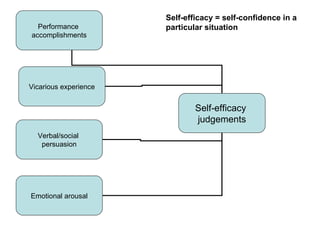
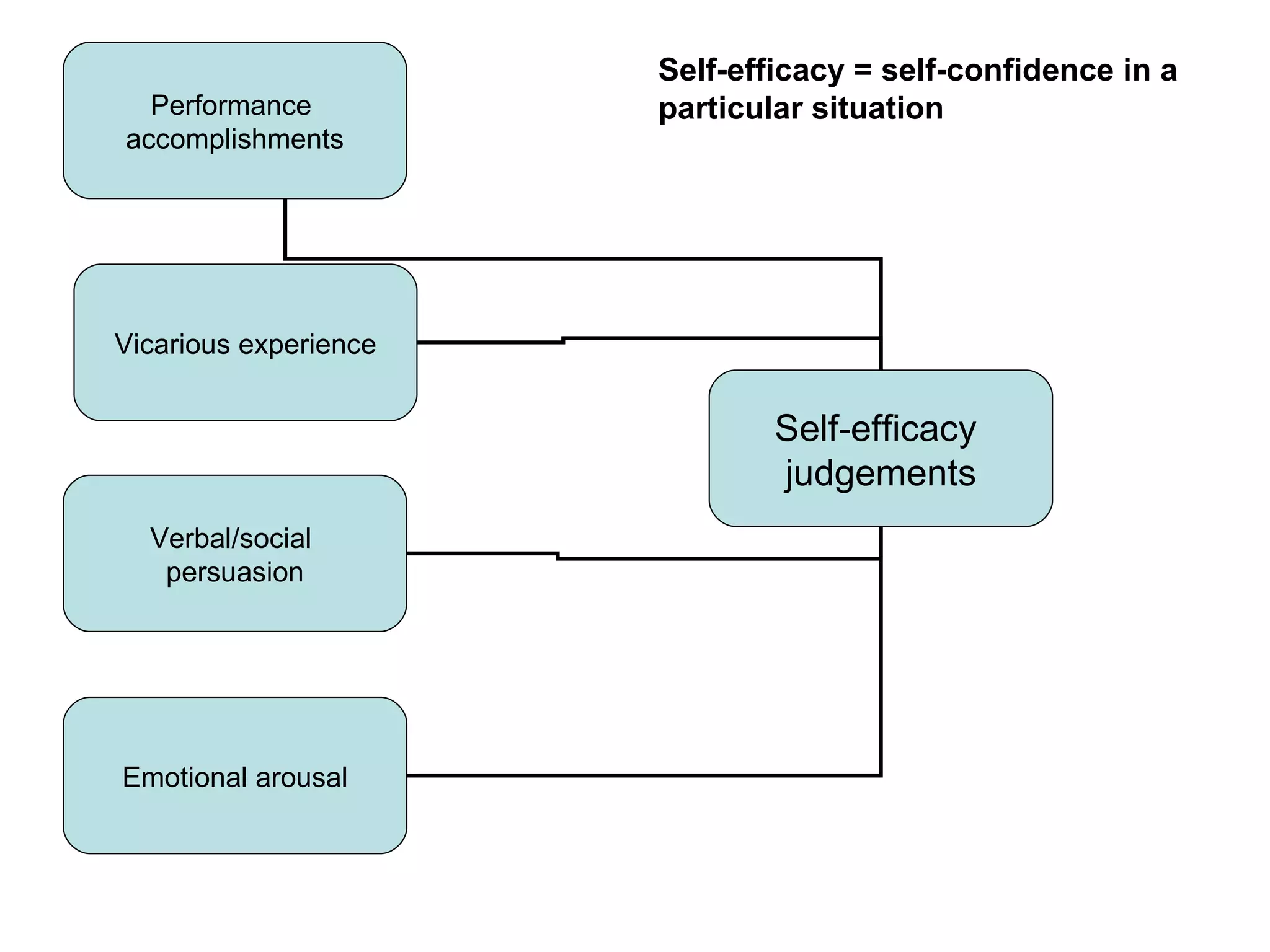
Self-efficacy = self-confidence in a
  Performance          particular situation
accomplishments


Vicarious experience


                               Self-efficacy
                               judgements
  Verbal/social
   persuasion


Emotional arousal
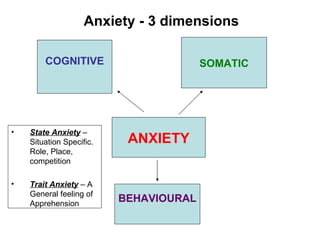
Anxiety - 3 dimensions

        COGNITIVE                       SOMATIC


•   State Anxiety –
    Situation Specific.    ANXIETY
    Role, Place,
    competition

•   Trait Anxiety – A
    General feeling of
    Apprehension
                          BEHAVIOURAL
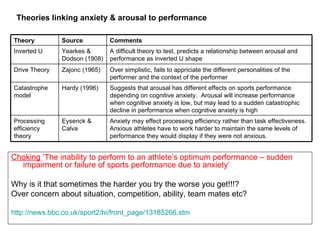
Theories linking anxiety & arousal to performance

Theory         Source          Comments
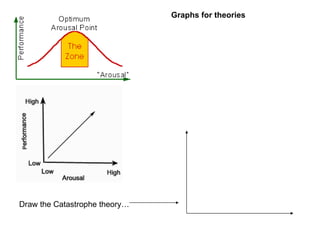
Inverted U     Yearkes &       A difficult theory to test, predicts a relationship between arousal and
               Dodson (1908)   performance as inverted U shape
Drive Theory   Zajonc (1965)   Over simplistic, fails to appriciate the different personalities of the
                               performer and the context of the performer
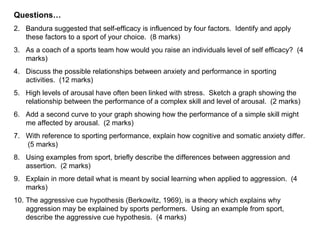
Catastrophe    Hardy (1996)    Suggests that arousal has different effects on sports performance
model                          depending on cognitive anxiety. Arousal will increase performance
                               when cognitive anxiety is low, but may lead to a sudden catastrophic
                               decline in performance when cognitive anxiety is high
Processing     Eysenck &       Anxiety may effect processing efficiency rather than task effectiveness.
efficiency     Calva           Anxious athletes have to work harder to maintain the same levels of
theory                         performance they would display if they were not anxious.


Choking ‘The inability to perform to an athlete’s optimum performance – sudden
  impairment or failure of sports performance due to anxiety’

Why is it that sometimes the harder you try the worse you get!!!?
Over concern about situation, competition, ability, team mates etc?

http://news.bbc.co.uk/sport2/hi/front_page/13185266.stm
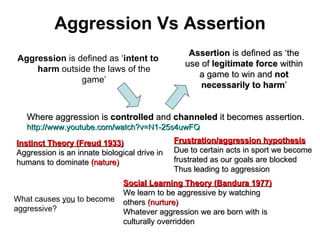
Graphs for theories


Draw the Catastrophe theory…
Aggression Vs Assertion
                                                  Assertion is defined as ‘the
Aggression is defined as ‘intent to
                                                 use of legitimate force within
    harm outside the laws of the
                                                    a game to win and not
               game’
                                                     necessarily to harm’


   Where aggression is controlled and channeled it becomes assertion.
   http://www.youtube.com/watch?v=N1-25s4uwFQ

Instinct Theory (Freud 1933)                  Frustration/aggression hypothesis
Aggression is an innate biological drive in   Due to certain acts in sport we become
humans to dominate (nature)                   frustrated as our goals are blocked
                                              Thus leading to aggression
                               Social Learning Theory (Bandura 1977)
                               We learn to be aggressive by watching
What causes you to become      others (nurture)
aggressive?                    Whatever aggression we are born with is
                               culturally overridden
Questions…
2. Bandura suggested that self-efficacy is influenced by four factors. Identify and apply
   these factors to a sport of your choice. (8 marks)
3. As a coach of a sports team how would you raise an individuals level of self efficacy? (4
   marks)
4. Discuss the possible relationships between anxiety and performance in sporting
   activities. (12 marks)
5. High levels of arousal have often been linked with stress. Sketch a graph showing the
   relationship between the performance of a complex skill and level of arousal. (2 marks)
6. Add a second curve to your graph showing how the performance of a simple skill might
   me affected by arousal. (2 marks)
7. With reference to sporting performance, explain how cognitive and somatic anxiety differ.
   (5 marks)
8. Using examples from sport, briefly describe the differences between aggression and
   assertion. (2 marks)
9. Explain in more detail what is meant by social learning when applied to aggression. (4
   marks)
10. The aggressive cue hypothesis (Berkowitz, 1969), is a theory which explains why
    aggression may be explained by sports performers. Using an example from sport,
    describe the aggressive cue hypothesis. (4 marks)
Choking usually occurs when a performer is overly
concerned with what others think about the performance

So we need to formulate strategies to overcome anxiety & as a result choking…
What do you do before a big event? Sporting or otherwise.

• Set your own achievable goals
• Use imagery before a competition to review strategy and technique
and create a sense of confidence
• Use positive talk, both in preparation and in competition
• Practice relaxation sessions – somatic (physical, progressive
muscular relaxation) and cognitive (mental, centering)
• Use music prior to a competition to help maintain focus by controlling
negative thoughts
• Behavioral coping skills – understand that pressure is a perception
not a fact, requires a change in attitude so that a pressure situation
becomes enjoyable.
• Performance monitoring – watch races and identify what they like
when they produce a good performance
• Simulation training – practice under conditions that mimic anticipated
pressure situations
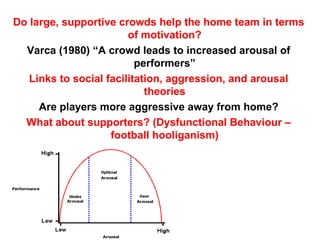
Do large, supportive crowds help the home team in terms
                        of motivation?
  Varca (1980) “A crowd leads to increased arousal of
                          performers”
   Links to social facilitation, aggression, and arousal
                            theories
     Are players more aggressive away from home?
  What about supporters? (Dysfunctional Behaviour –
                    football hooliganism)
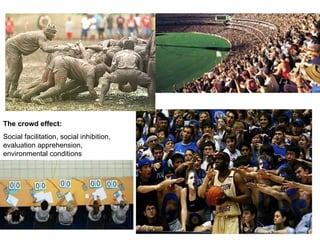
The crowd effect:
Social facilitation, social inhibition,
evaluation apprehension,
environmental conditions
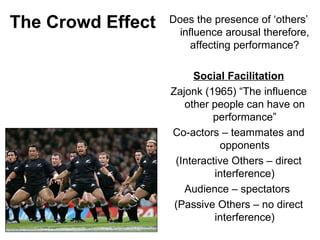
The Crowd Effect   Does the presence of ‘others’
                     influence arousal therefore,
                        affecting performance?

                        Social Facilitation
                   Zajonk (1965) “The influence
                      other people can have on
                            performance”
                   Co-actors – teammates and
                              opponents
                    (Interactive Others – direct
                             interference)
                      Audience – spectators
                    (Passive Others – no direct
                             interference)
Social Inhibition
 “The negative effect of an audience
            on a performer”
Effects –    Arousal levels,
             Competitive Drive,
             Speed of Performance

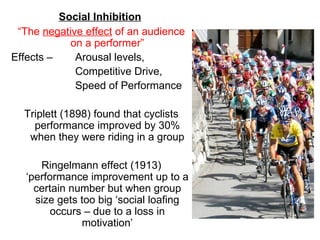
  Triplett (1898) found that cyclists
    performance improved by 30%
   when they were riding in a group

      Ringelmann effect (1913)
   ‘performance improvement up to a
     certain number but when group
     size gets too big ‘social loafing
         occurs – due to a loss in
               motivation’
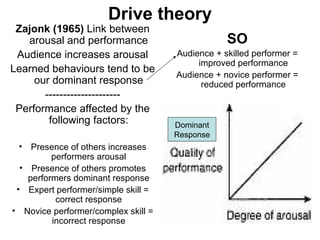
Drive theory
 Zajonk (1965) Link between
   arousal and performance                       SO
 Audience increases arousal          Audience + skilled performer =
                                          improved performance
Learned behaviours tend to be
                                     Audience + novice performer =
     our dominant response                 reduced performance
       ---------------------
 Performance affected by the
        following factors:           Dominant
                                     Response
 •   Presence of others increases
          performers arousal
  • Presence of others promotes
    performers dominant response
 • Expert performer/simple skill =
           correct response
• Novice performer/complex skill =
          incorrect response
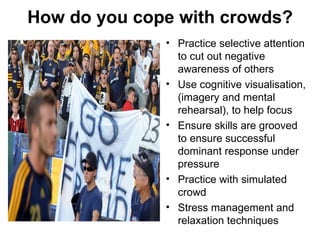
How do you cope with crowds?
              • Practice selective attention
                to cut out negative
                awareness of others
              • Use cognitive visualisation,
                (imagery and mental
                rehearsal), to help focus
              • Ensure skills are grooved
                to ensure successful
                dominant response under
                pressure
              • Practice with simulated
                crowd
              • Stress management and
                relaxation techniques
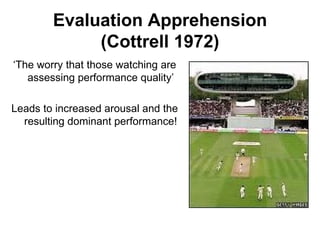
Evaluation Apprehension
             (Cottrell 1972)
‘The worry that those watching are
   assessing performance quality’

Leads to increased arousal and the
  resulting dominant performance!
The importance of Competition
   Martens et al (1998) –
   Theory of competitive                  Strategies for
        state anxiety                         Coping
                                               (with
‘Competitive anxiety is defined as an       competitive
   individual’s tendency to perceive
         competitive situations as
                                              anxiety)
      threatening and to respond to
    these situations by experiencing            TASK
              state anxiety’
 The more important the competition     Read the information on
       the higher the level of state        pages 38 and 39.
                 anxiety                    Give one specific
                                          example of how each
  An athlete’s perception of external     of the four techniques
      sources is the key to anxiety!        may be used by a
          (media, audience etc)           player in your chosen
                                                   sport
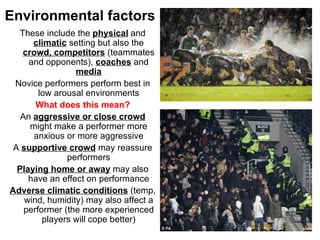
Environmental factors
  These include the physical and
      climatic setting but also the
   crowd, competitors (teammates
     and opponents), coaches and
                 media
 Novice performers perform best in
        low arousal environments
       What does this mean?
   An aggressive or close crowd
     might make a performer more
      anxious or more aggressive
 A supportive crowd may reassure
               performers
  Playing home or away may also
     have an effect on performance
Adverse climatic conditions (temp,
    wind, humidity) may also affect a
    performer (the more experienced
         players will cope better)
Questions…

2. What is meant by social facilitation and what is its
   main effect? (3 marks)
3. What effects can be experienced by an individual
   if there is an audience present? (6 marks)
4. What is meant by evaluation apprehension? (2
   marks)
5. As a coach of an individual who is affected
   adversely by the presence of an audience, how
   would you help him or her to overcome the
   negative influences? (4 marks)

Short term psych revision

  • 1.
    Self-efficacy = self-confidencein a Performance particular situation accomplishments Vicarious experience Self-efficacy judgements Verbal/social persuasion Emotional arousal
  • 2.
    Anxiety - 3dimensions COGNITIVE SOMATIC • State Anxiety – Situation Specific. ANXIETY Role, Place, competition • Trait Anxiety – A General feeling of Apprehension BEHAVIOURAL
  • 3.
    Theories linking anxiety& arousal to performance Theory Source Comments Inverted U Yearkes & A difficult theory to test, predicts a relationship between arousal and Dodson (1908) performance as inverted U shape Drive Theory Zajonc (1965) Over simplistic, fails to appriciate the different personalities of the performer and the context of the performer Catastrophe Hardy (1996) Suggests that arousal has different effects on sports performance model depending on cognitive anxiety. Arousal will increase performance when cognitive anxiety is low, but may lead to a sudden catastrophic decline in performance when cognitive anxiety is high Processing Eysenck & Anxiety may effect processing efficiency rather than task effectiveness. efficiency Calva Anxious athletes have to work harder to maintain the same levels of theory performance they would display if they were not anxious. Choking ‘The inability to perform to an athlete’s optimum performance – sudden impairment or failure of sports performance due to anxiety’ Why is it that sometimes the harder you try the worse you get!!!? Over concern about situation, competition, ability, team mates etc? http://news.bbc.co.uk/sport2/hi/front_page/13185266.stm
  • 4.
    Graphs for theories Drawthe Catastrophe theory…
  • 5.
    Aggression Vs Assertion Assertion is defined as ‘the Aggression is defined as ‘intent to use of legitimate force within harm outside the laws of the a game to win and not game’ necessarily to harm’ Where aggression is controlled and channeled it becomes assertion. http://www.youtube.com/watch?v=N1-25s4uwFQ Instinct Theory (Freud 1933) Frustration/aggression hypothesis Aggression is an innate biological drive in Due to certain acts in sport we become humans to dominate (nature) frustrated as our goals are blocked Thus leading to aggression Social Learning Theory (Bandura 1977) We learn to be aggressive by watching What causes you to become others (nurture) aggressive? Whatever aggression we are born with is culturally overridden
  • 6.
    Questions… 2. Bandura suggestedthat self-efficacy is influenced by four factors. Identify and apply these factors to a sport of your choice. (8 marks) 3. As a coach of a sports team how would you raise an individuals level of self efficacy? (4 marks) 4. Discuss the possible relationships between anxiety and performance in sporting activities. (12 marks) 5. High levels of arousal have often been linked with stress. Sketch a graph showing the relationship between the performance of a complex skill and level of arousal. (2 marks) 6. Add a second curve to your graph showing how the performance of a simple skill might me affected by arousal. (2 marks) 7. With reference to sporting performance, explain how cognitive and somatic anxiety differ. (5 marks) 8. Using examples from sport, briefly describe the differences between aggression and assertion. (2 marks) 9. Explain in more detail what is meant by social learning when applied to aggression. (4 marks) 10. The aggressive cue hypothesis (Berkowitz, 1969), is a theory which explains why aggression may be explained by sports performers. Using an example from sport, describe the aggressive cue hypothesis. (4 marks)
  • 7.
    Choking usually occurswhen a performer is overly concerned with what others think about the performance So we need to formulate strategies to overcome anxiety & as a result choking… What do you do before a big event? Sporting or otherwise. • Set your own achievable goals • Use imagery before a competition to review strategy and technique and create a sense of confidence • Use positive talk, both in preparation and in competition • Practice relaxation sessions – somatic (physical, progressive muscular relaxation) and cognitive (mental, centering) • Use music prior to a competition to help maintain focus by controlling negative thoughts • Behavioral coping skills – understand that pressure is a perception not a fact, requires a change in attitude so that a pressure situation becomes enjoyable. • Performance monitoring – watch races and identify what they like when they produce a good performance • Simulation training – practice under conditions that mimic anticipated pressure situations
  • 8.
    Do large, supportivecrowds help the home team in terms of motivation? Varca (1980) “A crowd leads to increased arousal of performers” Links to social facilitation, aggression, and arousal theories Are players more aggressive away from home? What about supporters? (Dysfunctional Behaviour – football hooliganism)
  • 9.
    The crowd effect: Socialfacilitation, social inhibition, evaluation apprehension, environmental conditions
  • 10.
    The Crowd Effect Does the presence of ‘others’ influence arousal therefore, affecting performance? Social Facilitation Zajonk (1965) “The influence other people can have on performance” Co-actors – teammates and opponents (Interactive Others – direct interference) Audience – spectators (Passive Others – no direct interference)
  • 11.
    Social Inhibition “Thenegative effect of an audience on a performer” Effects – Arousal levels, Competitive Drive, Speed of Performance Triplett (1898) found that cyclists performance improved by 30% when they were riding in a group Ringelmann effect (1913) ‘performance improvement up to a certain number but when group size gets too big ‘social loafing occurs – due to a loss in motivation’
  • 12.
    Drive theory Zajonk(1965) Link between arousal and performance SO Audience increases arousal Audience + skilled performer = improved performance Learned behaviours tend to be Audience + novice performer = our dominant response reduced performance --------------------- Performance affected by the following factors: Dominant Response • Presence of others increases performers arousal • Presence of others promotes performers dominant response • Expert performer/simple skill = correct response • Novice performer/complex skill = incorrect response
  • 13.
    How do youcope with crowds? • Practice selective attention to cut out negative awareness of others • Use cognitive visualisation, (imagery and mental rehearsal), to help focus • Ensure skills are grooved to ensure successful dominant response under pressure • Practice with simulated crowd • Stress management and relaxation techniques
  • 14.
    Evaluation Apprehension (Cottrell 1972) ‘The worry that those watching are assessing performance quality’ Leads to increased arousal and the resulting dominant performance!
  • 15.
    The importance ofCompetition Martens et al (1998) – Theory of competitive Strategies for state anxiety Coping (with ‘Competitive anxiety is defined as an competitive individual’s tendency to perceive competitive situations as anxiety) threatening and to respond to these situations by experiencing TASK state anxiety’ The more important the competition Read the information on the higher the level of state pages 38 and 39. anxiety Give one specific example of how each An athlete’s perception of external of the four techniques sources is the key to anxiety! may be used by a (media, audience etc) player in your chosen sport
  • 16.
    Environmental factors These include the physical and climatic setting but also the crowd, competitors (teammates and opponents), coaches and media Novice performers perform best in low arousal environments What does this mean? An aggressive or close crowd might make a performer more anxious or more aggressive A supportive crowd may reassure performers Playing home or away may also have an effect on performance Adverse climatic conditions (temp, wind, humidity) may also affect a performer (the more experienced players will cope better)
  • 17.
    Questions… 2. What ismeant by social facilitation and what is its main effect? (3 marks) 3. What effects can be experienced by an individual if there is an audience present? (6 marks) 4. What is meant by evaluation apprehension? (2 marks) 5. As a coach of an individual who is affected adversely by the presence of an audience, how would you help him or her to overcome the negative influences? (4 marks)