Downloaded 10 times
![490 REVIEW OF ECONOMIC STUDIES
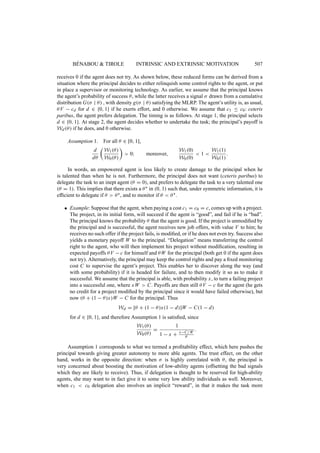
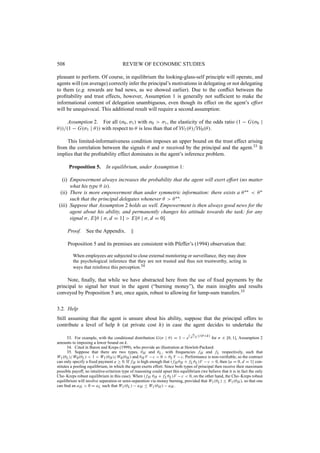
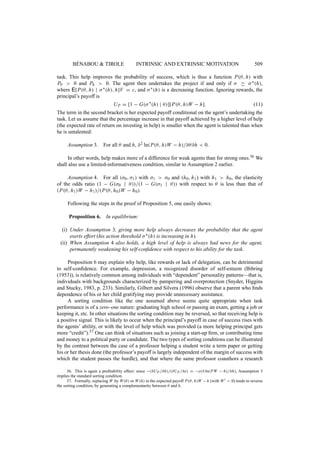
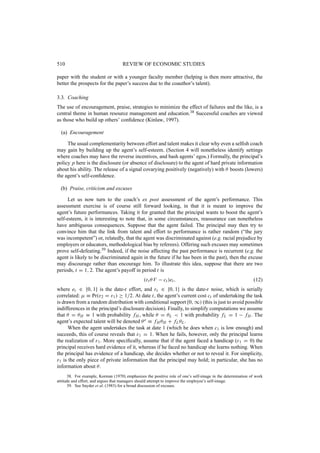
Indeed, a substantial body of experimental and field evidence indicates that extrinsic moti-vation
(contingent rewards) can sometimes conflict with intrinsic motivation (the individual’s
desire to perform the task for its own sake). In a now classical experiment (see Deci, 1975),
college students were either paid or not paid to work for a certain time on an interesting puzzle.
Those in the no-reward condition played with the puzzle significantly more in a later unrewarded
“free-time” period than paid subjects, and also reported a greater interest in the task. This experi-ment
has since been replicated many times, with numerous variations in design (e.g.Wilson, Hull
and Johnson, 1981) and in types of subjects. For instance, similar effects were found for high-school
students in tasks involving verbal skills (Kruglanski, Friedman and Zeevi, 1971), and for
preschool children in activities involving drawing with new materials (Lepper, Greene and Nis-bett,
1973). In daily life, parents are quite familiar with what we shall call the “forbidden fruit”
effect: powerful or salient constraints employed by adults to enforce the prohibition of some
activity often decrease the child’s subsequent internalization of the adults’ disapproval.1 Kohn
(1993) surveys the results from a variety of programmes aimed at getting people to lose weight,
stop smoking, or wear seat belts, either offering or not offering rewards. Consistently, individ-uals
in “reward” treatments showed better compliance at the beginning, but worse compliance
in the long run than those in the “no-reward” or “untreated controls” groups. Taken together,
these many findings indicate a limited impact of rewards on “engagement” (current activity) and
a negative one on “re-engagement” (persistence).
A related body of work transposes these ideas from the educational setting to the workplace.
In well-known contributions, Etzioni (1971) argues that workers find control of their behaviour
via incentives “alienating” and “dehumanizing”, and Deci and Ryan (1985) devote a chapter of
their book to a criticism of the use of performance-contingent rewards in the work setting.2 And,
without condemning contingent compensation, Baron and Kreps (1999, p. 99) conclude that:
There is no doubt that the benefits of [piece-rate systems or pay-for-performance incentive
devices] can be considerably compromised when the systems undermine workers’ intrinsic
motivation.
Kreps (1997) reports his uneasiness when teaching human resources management and
discussing the impact of incentive devices in a way that is somewhat foreign to standard
economic theory. And indeed, recent experimental evidence on the use of performance-contingent
wages or fines confirms that explicit incentives sometimes result in worse compliance
than incomplete labour contracts (Fehr and Falk (1999), Fehr and Schmidt (2000), Gneezy
and Rustichini (2000a)). Relatedly, Gneezy and Rustichini (2000b) find that offering monetary
incentives to subjects for answering questions taken from an IQ test strictly decreases their
performance, unless the “piece rate” is raised to a high enough level. In the policy domain,
Frey and Oberholzer-Gee (1997) surveyed citizens in Swiss cantons where the government was
considering locating a nuclear waste repository; they found that the fraction supporting siting of
the facility in their community fell by half when public compensation was offered.
Our aim here will be twofold. First, we want to analyse the “hidden costs” of rewards
and punishments from an economic and cognitive perspective, rather than just posit an aversive
impact on motivation. Indeed, given that incentives work quite effectively in many instances, one
needs to understand in what cases they should be used with caution. More generally, we seek
to give a precise content to the loosely defined notions of intrinsic and extrinsic motivation, and
to clarify when, in the terminology of Frey (1997), the latter should be expected to “crowd out”
1. See, e.g. Lepper and Greene (1978). Relatedly, Akerlof and Dickens (1982) suggest that imposing stiffer
penalties for crimes might be counterproductive, if it undermines individuals’ “internal justification” for obeying the law.
2. See also Lepper and Greene (1978), Kohn (1993) and Frey (1997).](https://image.slidesharecdn.com/tirolemotivationbenabou2003-141025220458-conversion-gate01/85/Tirole-on-Intrinsic-and-Extrinsic-Motivation-2-320.jpg)
![].
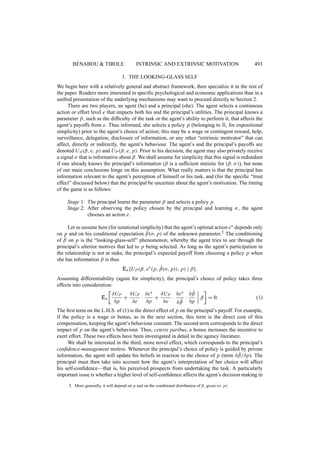
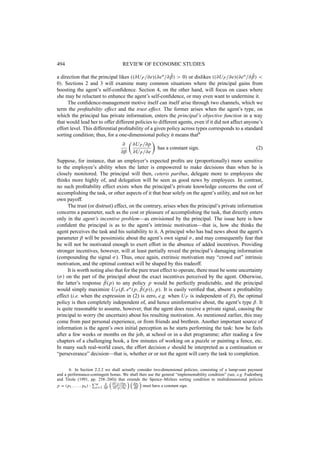
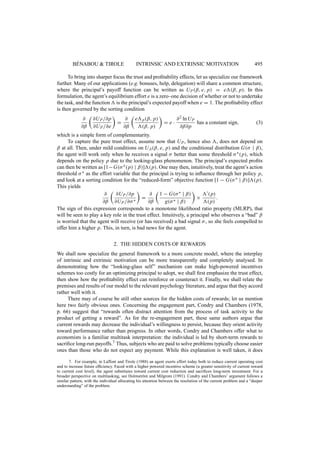
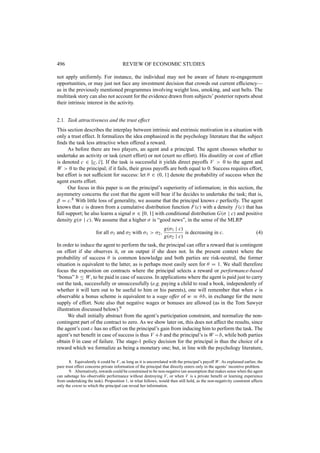
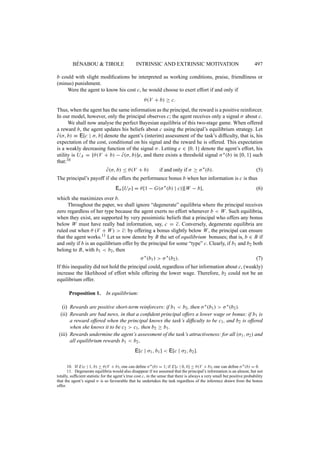
Assuming differentiability (again for simplicity), the principal’s choice of policy takes three
effects into consideration:
E
@UP
@p
+
@UP
@e
·
@e
@p
+
@UP
@e
·
@e
@](https://image.slidesharecdn.com/tirolemotivationbenabou2003-141025220458-conversion-gate01/85/Tirole-on-Intrinsic-and-Extrinsic-Motivation-18-320.jpg)

This document summarizes and analyzes the interaction between intrinsic and extrinsic motivation from an economic and cognitive perspective. It discusses how performance incentives offered by an informed principal can impact an agent's perception of a task and their abilities. Incentives are shown to be only weak motivators in the short-run and potentially negative motivators in the long-run if they undermine intrinsic motivation. The document also examines how empowerment, help, and criticism impact motivation within relationships where parties have asymmetric information.


