NSCA TSAC REPORT • ISSUE 17                                                                                           APRIL 2011


                                         The Mental Toughness Coach:
                                         A Role for the Strength and
                                         Conditioning Coach
                                         John E. Coumbe-Lilley, PhD, CSCS, USAW
  Contents                               Given the nature of the strength and           and conditioning coach is ideally placed
                                         conditioning training room, helping            to create the conditions for progressive
  17.1                                   develop mental toughness in athletes is        pressure and recovery physically, men-
  The Mental Toughness                   critical to the success of the tactical ath-   tally and emotionally that will help pre-
  Coach: A Role for                      lete, team or squad. Ideally, the strength     pare tactical athletes for competition or
  the Strength and                       and conditioning coach is placed in the        deployment. This article will show how
                                         role of the mental toughness coach. This       strength and conditioning coaches can
  Conditioning Coach
                                         article will lay out what mental tough-        train mental toughness in their tactical
                                         ness is, how it is measured and how the        athletes.
  17.4
                                         strength and conditioning coach can
  Posterior Chain Exercises
                                         train it and become the mental tough-          Defining Mental Toughness
  to Enhance Tactical
                                         ness coach for their tactical athletes.        (MT)
  Performance
                                                                                        MT is a phrase often used to describe
  17.6                                   Research investigations on mental              how we observe an athlete’s behavior es-
  The Importance and                     toughness have been ongoing for more           pecially when we perceive that they over-
                                         than a decade. In recent years, applied        come challenging events beyond what is
  Potential of Integrating
                                         sport psychology research has investi-         normally expected in a given context.
  Psychological and
                                         gated the effects of mental toughness on       Often, MT is used as a catch-all, general
  Physical Conditioning
                                         sport performance in cricket, Australian       phrase to describe many attributes but
  For Elite Performance
                                         Rules Football, indoor triathlon and           lacks the necessary depth that explains
                                         soccer (1,4,13,15,23,24).                      and promotes the development of criti-
                                                                                        cal characteristics necessary to achieving
                                         It has been suggested that individual          top-level performance.
                                         displays of mental toughness are a com-
                                         bination of attitudes, beliefs, behaviors      Several definitions have been used to de-
                                         and emotions and these can be prospec-         fine mental toughness but for the pur-
                                         tively developed within three inductive-       pose of this article we will use the defi-
                                         ly found categories that are behaviors,        nition of mental toughness provided by
                                         characteristics and situations (4). This       Gucciardi:
                                         is important because as tactical athletes      “Mental toughness is a collection of values, at-
                                         prepare for competition or deployment,         titudes, behaviors and emotions, which enable
                                         they will manage behaviors, situations         an individual to persevere and overcome any
                                         and the development of personal charac-        obstacle, adversity or pressure experienced, but
                                         teristics to cope with imposed demands         also to maintain concentration and motivation
                                         that require preparation. The strength

National Strength and Conditioning Association • www.nsca-lift.org/TSAC                                                     page 17.1
NSCA TSAC REPORT • ISSUE 17                                                                                                 APRIL 2011

  Figure 1: Pull-Ups                                                      Figure 2: Squat Jumps
when things are going well, to consistently pro-   study of cricketers that used the Cricket        corrective and encouraging language
duce high levels of performance,” (14).            Mental Toughness Inventory (CMTI) to             to recognize the effort being put
                                                   determine the affective intelligence, at-        forth (24).
This definition is led from findings of            tentional control, resilience, self-belief,    • Use basic imagery techniques to
previous studies showing the attributes            and desire to achieve that elite crick-          project positive and realistic future
of MT that include self-belief, control            eters had in their competitive selves.           outcomes and generate excitement
of attention (concentration and focus),            Both studies showed positive signs of            about what the athlete can achieve
resilience, motivation, commitment                 construct validity and internal reliabil-        and what is within their control.
and determination , positive and tough             ity. Unfortunately, a general MT test in
attitude, resilience, enjoying, han-               sport measure is not agreed upon but           • Help the athlete learn from critical
dling pressure and quality preparation             contextual sport-specific measures show          incidents in performance and
(1,8,10,11,12,17,19,21,22).                        promise. More work continues to be               support their development of
                                                                                                    helpful coping strategies for the
                                                   done to develop effective measures and
Measuring MT                                                                                        performance and personal lives
                                                   research in this area.
Several MT inventories have been de-                                                                (4,20).
veloped since 2002 and used to measure             Training MT                                    • Include a post competition
MT. The first acknowledged MT mea-                 Research has shown that MT can be                reflection exercise and focus on
surement tool in organized research was            trained in a variety of complementary            what was learned and what will
the MT48 which measured three ele-                 ways using practical strategies that to-         be required to enhance future
ments of hardiness: confidence, control            gether create mental momentum and                performance (4).
and commitment (2). Another generic                focus effort and intensity on achieving        • Concentrate coaching on having
MT assessment tool that proposes to cap-           performance goals. The following sec-            tactical athletes achieve mastery,
ture MT attributes across all sports was           tion describes the tools and approaches          experience enjoyment through
developed by The Sport Mental Tough-               that strength and conditioning coaches           training and develop a competitive
ness Questionnaire (SMTQ) which fo-                can take to build mental toughness in            mindset that focuses on performance
cused on measuring three MT factors:               their tactical athletes. These tools and         and builds a belief of superiority (9).
constancy, confidence and control (21).            approaches are based on work that devel-
The MT48 supported previous intuitive              oped a framework for developing mental
notions of MT attributes in its construc-          toughness in athletes (2).
                                                                                                 Conclusion
tion but lacked psychometric reliability                                                         The strength and conditioning coach
(4). According to the SMTQ, the MT48                                                             is usually a trusted, reliable and skilled
                                                   Strategies to Build a Strong
had yet to yield significant construct                                                           professional that enhances athletic per-
                                                   MT Base
validity (4,7). Later sport-specific re-                                                         formance day in and day out and works
                                                    • Set long-term athletic goals and then
search by Gucciardi, studying MT of                                                              at the base of the sport performance pyr-
                                                      use short-term achievable goals to
youth players in Australian Rules Foot-                                                          amid on physical performance. Is there
                                                      direct intensity.
ball, measured MT using the Australian                                                           anyone better to train and develop MT
                                                    • Set the conditions for maximal             on a day-to-day basis than someone who
Football Mental Toughness Inventory
                                                      effort to be given, when required,         can see the tactical athlete’s effort, per-
(AFMTI) which focused on measuring
                                                      and shape the training environment         sistence and desire to succeed than the
four MT factors: thrive through chal-
                                                      in terms of space and equipment            strength and conditioning coach? This is
lenge, sport awareness, tough attitude
                                                      organization.                              why strength coaches are in a prime posi-
and desire for success (14).
                                                    • Apply progressive physical and             tion to be the number one MT coach in
The AFMTI found significant levels of                 mental challenges to be completed          an athlete’s preparation. When strength
contextual test construct reliability and             under pressure always emphasizing          coaches add the MT coaching skill set,
validity. Measuring specific MT in a                  that the athlete is personally             they become more valuable to the tacti-
given sport was further supported by a                responsible for their own success.         cal athlete. The strength coach is likely
                                                      Use a 5:1 ratio of supportive,             to achieve greater satisfaction in their

National Strength and Conditioning Association • www.nsca-lift.org/TSAC                                                          page 17.2
NSCA TSAC REPORT • ISSUE 17                                                                                                               APRIL 2011


job as their athletes perform better under pressure and are able                12. Gould, D, Dieffenbach, K, and Moffett, A. Psychological
to cope more and compete consistently at the highest levels. °                  characteristics and their development in Olympic champions. Journal of
                                                                                Applied Sport Psychology 14; 172 – 204, 2002.

References                                                                      13. Gucciardi, D, Gordon, S, and Dimmock, JA. Towards an
1. Bull, SJ, Shambrook, CJ, James, W, Brooks, JE. Towards an                    understanding of mental toughness in Australian Football. Journal of
understanding of mental toughness in elite English cricketers. Journal of       Applied Sport Psychology 20; 261 – 281, 2008.
Applied Sport Psychology 17; 209 – 227, 2005.
                                                                                14. Gucciardi, D. Do developmental differences in mental toughness
2. Clough, PJ, Earle, K, and Sewell, D. Solutions in sport psychology.          exist between specialized and invested Australian footballers?
London: Thomson Publishing; 32 – 43, 2002.                                      Personality and Individual Differences 47; 985 – 989, 2009.

3. Connaughton, D, Hanton, S, Jones, G, and Wadey, R. Mental toughness          15. Gucciardi, D, Gordon, S, and Dimmock, JA. Evaluation of a mental
research: Key issues in this area. International Journal Sport Psychology       toughness training program for youth-aged Australian footballers: I. A
39; 192 – 204, 2008.                                                            qualitative analysis, Journal of Applied Sport Psychology 21; 307 – 323,
                                                                                2009.
4. Connaughton, D, Hanton, S, and Jones, G. The development and
maintenance of mental toughness in the world’s best performers. The             16. Gucciardi, DF, Gordon, S, and Dimmock, JA. Evaluation of a mental
Sport Psychologist 24; 168 – 193, 2010.                                         toughness training program for youth-aged Australian footballers: II. A
                                                                                Qualitative Analysis’, Journal of Applied Sport Psychology 21: 3; 324 – 339,
5. Coulter, TJ, Mallett, CJ, and Gucciardi, DF. Understanding mental            2009.
toughness in Australian soccer: Perceptions of players, parents, and
coaches. Journal of Sports Sciences 28; 699 – 716, 2010.                        17. Jones, G, Hanton, S, and Connaughton, D. What is this thing called
                                                                                mental toughness? An investigation of elite sport performers. Journal of
6. Crust, L. A review and conceptual re-examination of mental                   Applied Sport Psychology 14; 205 – 218, 2002.
toughness: Implications for future researchers. Science Direct 45; 576 –
583, 2008.                                                                      18. Jones, G, Hanton, S, and Connaughton, D. A framework of mental
                                                                                toughness in the world’s best performers. The Sport Psychologist 21; 243
7. Crust, L, and Swann, C. Comparing two measures of mental                     – 264, 2007.
toughness. Personality and individual Differences. Science Direct 50; 217
– 221, 2011.                                                                    19. Loehr, J. The new mental toughness training for sport: achieving
                                                                                athletic excellence. Lexington, MA. 109 – 131, 1986.
8. Fawcett, T. Perceptions of mental toughness from adventurer/
explorer/“medal winning” elite athlete and elite coach perspectives:            20. Orlick, T. In pursuit of excellence: How to win in sport and life
A grounded theory analysis. In Morris, T, Terry, P, Gordon, S, Hanrahan,        through mental training. (4th ed.). Champaign, IL: Human Kinetics; 98 –
S, Levleva, L, Kolt, G, and Tremayne,P. Psychology promoting health &           135, 2007.
performance for life: Proceedings of the ISSP 11th World Congress of
Sport [CDROM]. Sydney: International Society of Sport Psychology (ISBN          21. Sheard, M. Progress towards construct validation of the sports
1877040363). 2005.                                                              mental toughness questionnaire (SMTQ). European Journal of
                                                                                Psychological Assessment 25; 186 – 193, 2010.
9. Feltz, DL, Short, S, and Sullivan, P. Self-efficacy in sport: research and
strategies for working with athletes, teams, and coaches. Champaign, IL:        22. Thelwell, R, and Weston, N. Defining and understanding mental
Human Kinetics. 129 – 144, 2008.                                                toughness within soccer. Journal of Applied Sport Psychology 17; 326 –
                                                                                332, 2005.
10. Fourie, S, and Potgieter, JR. The nature of mental toughness in
sport. South African Journal for Research in Sport, Physical Education &        23. Thelwell, R, Weston, N, and Greenlees, I. Developing mental
Recreation 23; 63 – 72, 2001.                                                   toughness within in soccer. Journal of Applied Sport Psychology 17:4; 326
                                                                                – 332, 2010.
11. Gordon, S, and Sridhar, C. Identification and development of mental
toughness in elite cricket. In T. Morris, P. Terry, S. Gordon, S. Hanrahan,     24. Thompson, J. Double goal coach. New York, NY: Harper Collins. 88 –
L. Ievleva, G. Kolt, & P. Tremayne (Eds.), Psychology promoting health &        104, 2003.
performance for life: Proceedings of the ISSP 11th World Congress of
Sport [CDROM]. Sydney: International Society of Sport Psychology (ISBN
1877040363). 2005


National Strength and Conditioning Association • www.nsca-lift.org/TSAC                                                                         page 17.3
NSCA TSAC REPORT • ISSUE 17                                                                                          APRIL 2011


Posterior Chain Exercises to Enhance Tactical Performance
Ray Bear CSCS, USAW

One of the biggest areas of neglect for
the tactical athlete is the posterior chain
which consists of hamstrings, gluteals
and low back. Neglecting these muscle
groups increases the risk for injury dur-
ing periods of intense exertion, thereby
prohibiting the tactical athlete from en-
gaging in further missions or even com-
pleting the current one. Also, neglecting
these areas can lead to chronic pain in
the low back, hips and knees.

Many exercises exist that enhance the
functionality of the posterior chain.
Squats and deadlifts are often cited for
developing these areas, but auxiliary lifts    Figure 1. Romanian Deadlift starting        Figure 2. Romanian Deadlift finishing
will also help develop these areas and can     position                                    position
help enhance performance. Examples
include the following exercises and will      Gluteal Ham Raises                          Medicine Ball
be explained in more detail: Romanian         (partner assisted)                          Hamstring Curl
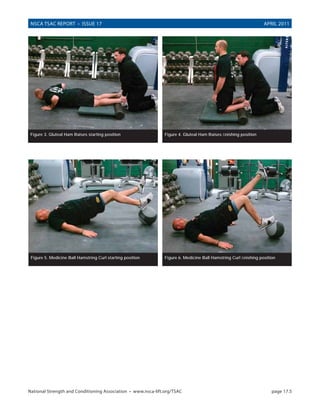
Deadlift (RDL), Gluteal Ham Raises,           Place the ankles on a foam roller or com-   Begin with the back on the ground, with
which utilizes assistance from a partner,     parable pad with a partner holding the      the knees bent and heel of one foot on
and an unconventional Medicine Ball           ankles and position the knees on the        a medicine ball (Figure 5). The opposite
Hamstring Curl.                               pad (Figure 3). From the down position,     leg should be kept off of the ground and
                                              raise the body by flexing the knees and     straight. Lift the hips with the heel of
Romanian Deadlift (RDL)                       contracting the hamstrings and gluteals     the foot and bend at the knee. Roll the
This exercise is used to increase strength    until the body is upright (Figure 4).       ball on the bottom of the foot until fully
in the hamstrings, gluteals and low back.     Lower the body by straightening the         flexed, keeping the foot dorsiflexed at all
This exercise may be performed with the       knees until the body is horizontal and      times (Figure 6). Extend the knee to the
use of a straight bar, dumbbells or kettle-   back in the down position. While per-       original position to complete one repeti-
bells. Begin with the feet shoulder-width     forming this exercise, be aware that the    tion. Keep the core tight and the hips off
apart with a slight bend in the knees         hips need to stay in an extended, neutral   of the ground during the entire exercise.
(Figure 1). Keeping the back straight,        position and not in a hyper extended or     Repeat on opposite leg.
chest out and shoulders contracted,           flexed position.
bend at the hips. Keep the bar close to                                                   Incorporating these exercises into a work-
the body. Lower the upper body until it                                                   out routine based on the supervision of a
is at a 90° angle to the ground or until a                                                certified strength and conditioning spe-
stretch in the hamstrings is felt (Figure                                                 cialist will decrease the chance of injury
2). Using the hamstrings, raise the upper                                                 and increase performance in the tactical
body until perpendicular with the floor.                                                  arena. °


National Strength and Conditioning Association • www.nsca-lift.org/TSAC                                                   page 17.4
NSCA TSAC REPORT • ISSUE 17                                                                                     APRIL 2011


Figure 3. Gluteal Ham Raises starting position                 Figure 4. Gluteal Ham Raises finishing position


 Figure 5. Medicine Ball Hamstring Curl starting position      Figure 6. Medicine Ball Hamstring Curl finishing position


National Strength and Conditioning Association • www.nsca-lift.org/TSAC                                              page 17.5
NSCA TSAC REPORT • ISSUE 17                                                                                                     APRIL 2011


The Importance and Potential of Integrating Psychological
and Physical Conditioning For Elite Performance
Michael J. Asken, PhD, Tyler Christensen, CSCS and Mark D. Stephenson, CSCS, MS, ATC

Military and police (warrior) training has, and continues, to        tion of one article that suggested elevated heart rates do not
evolve in many crucial ways. Paper targets have been replaced        have stress or psychological etiologies, none of these articles,
by mannequins and computerized targets; rubber knives by             nor the programmatic changes occurring in military fitness de-
shock knives; plastic guns by simuntitions or live fire: and         scribed above, discuss the inclusion or benefit of psychological
descriptive examples of skill applications by reality-based sce-     and mental toughness skills training (6).
nario training.
                                                                     On one hand, this is a bit surprising, as the importance of
This evolution continues. In regards to performance training         psychological training and skills is readily recognized in many
and readiness, several changes in military training have been        other areas of elite human performance.
described. White has discussed a paradigm shift in the U.S.
Marine Corps Combat Fitness Test (26). Likewise Henning              Elite warrior Lt. Colonel Jany served overseas with the United
and Khamoui describe a review of the future of the Army’s            States Marine Corps. He has an extensive military special op-
Combat-relevant Physical Fitness Test (11). In response to an        erations background and is also a Police Sergeant and Tactical
unacceptably high drop-out/failure rate in the Army’s Special        Team Supervisor in Washington State. Commenting on men-
Operations Assessment and Selection program Humpage de-              tal training, he has stated:
scribed the design and delivery of the SELECTED! Program
(13).                                                                “For years, so many of us involved in military or law enforcement tacti-
                                                                     cal training opted for the “sexier side” of our skill sets, working on deadly
A highly relevant and particularly important development has         force, discriminative marksmanship, or defensive tactics, but rarely, if
been the (ongoing) adaptation of sport science and strength          ever, factoring in the mental side and its importance to our success,” (18).
and conditioning principles and techniques to military and
police training arenas as captured in the concept of the tactical    On the other hand, it is perhaps not so surprising that inte-
athlete (18,19). This conceptualization and these applications       grating psychological and mental toughness skills training with
have great promise to develop truly elite warriors.                  physical conditioning is not as advanced as it could be. This
                                                                     integration of psychological knowledge and skills has always
However one area that has not developed at the same pace in          been a bit slow in any field of performance including sport. It
tactical athlete training is the inclusion of training warriors in   has been characterized this way by Dillman, former Director of
psychological skills that can maximize performance and which         Sports Medicine for the U.S. Olympic Committee:
form the basis of what is termed, “mental toughness.” This
might be considered a form of “training tunnel vision” that          “Similar to all applied disciplines, sport psychology experienced a slow
slows the development of psychological readiness and maximal         and unsteady start in sport, but has now progressed over the last few years
performance for many tactical athletes.                              into an area that is widely accepted by coaches and athletes,” (16).


A cursory review of the content of the articles published in the     This statement must be seen in the context of sport psychology
NSCA TSAC Report from 2007 until the present shows a wide            coming of age in the 1980s despite the first sport psychology
variety of critical and innovative topics. Training enhancement      study occurring in the 1890s and the Russians and East Ger-
is promoted by advancing the importance of approaches from           mans integrating sport psychology in their elite athletic train-
nutrient management to agility load and progression to train-        ing since the 1930s and 1940s (16).
ing the human weapons platform to fitness operation orders to
Grizzly Bear circuit training to the need for certified strength     So while the integration, or lack, of psychological and mental
and conditioning specialists being involved with special forces      toughness training into tactical athlete training may simply rep-
groups training (4,10,18,20,21,25). However, with the excep-         resent a natural evolution, the time to move this development


National Strength and Conditioning Association • www.nsca-lift.org/TSAC                                                              page 17.6
NSCA TSAC REPORT • ISSUE 17                                                                                             APRIL 2011


forward is now for several reasons. These      Therefore, strength and physical condi-      skills performed better on the Army
reasons include the potential contribu-        tioning training has traditionally been a    Physical Fitness Test and those who had
tions to performance, the demonstration        method (albeit indirect and somewhat         weak psychological skills, or a negative
of psychological influence on warrior fit-     haphazard) for promoting psychological       psychological skills profile of a fearful fo-
ness performance and the essential role        performance skills and mental tough-         cus cluster, performed most poorly (9).
strength and conditioning specialists can      ness. Further, the physical (and mental)
play in integrating the two perspectives       challenges of strength and physical con-     While part of the reason for the oversight
for maximal results.                           ditioning continue to present an excel-      of consistent integration of psychologi-
                                               lent paradigm to test and train persis-      cal and physical skill training may have
As noted, the psychological factor is          tence which is perhaps the hallmark of       been the absence of a comprehensive de-
recognized, if not always integrated, in       mental toughness.                            scription of concepts and techniques for
many areas of human performance. It                                                         a tactical athlete, this, unfortunately is
is, in fact, the understanding and use         The integration of psychological and         no longer true. In addition to the grow-
of psychological performance skills that       physical performance skills is timely and    ing literature cited above, more compre-
promotes what is called, “mental tough-        necessary. It is also prompted by an in-     hensive resources are now available for
ness.”                                         creasing body of research demonstrating      police and the military (2,3). It should
                                               the symbiotic effects of such interac-       also be clear that applied performance
Thus, psychological performance tech-          tions. The value of psychological skills     psychology is different from traditional
niques and mental toughness are a set of       for sport performance has already been       clinical psychology, making it of greater
skills that can be trained directly, just as   documented in the sport psychology lit-      interest and greater acceptability to the
physical conditioning skills. Too often in     erature (14,15).                             communities of tactical athletes.
the past, mental toughness was assumed
to develop as an indirect result or side       Further, research shows that psychologi-     Finally, tactical athlete training is an
effect of other difficult and strenuous        cal performance skills such as self-talk     ideal opportunity and venue for devel-
(usually physical) training. Just as with      can positively enhance specific physical     oping psychological performance skills
combat fitness programs, the military          skills such as the vertical jump and dy-     and mental toughness. This is so, first,
has begun to question if this is maximal-      namic balance performance (1,24). Per-       because of the tradition of associating
ly effective training.                         haps even more important and worthy          physical and mental toughness. Second-
                                               of attention is recent research on the im-   ly, the challenge of elite physical train-
Thompson and McCreary, in discussing           pact of integrated psychological training    ing continues to provide a challenge to
the enhancement of mental readiness            with physical and combat skills training.    psychological skills. Thirdly, psycho-
in military personnel, note that there                                                      logical performance skills can enhance
are several problems with the “implicit”       The evaluation of a comprehensive,           performance. Finally, the strength and
training of psychological skills; expect-      structured and integrated mental tough-      conditioning specialist provides training
ing mental toughness to develop as an          ness program for skill learning and per-     valued by tactical athletes and engenders
indirect result of physical training and       formance enhancement conducted by            a respect that lends credibility and mo-
drills (22). This approach can; make           the Walter Reed Army Research Insti-         tivation to psychological performance
mental toughness skills harder to learn,       tute and the Army Center for Enhanced        skills when presented in an integrated
delay the learning of physical and tech-       Performance at West Point provided           program.
nical skills because of a lack of mental       evidence that comprehensive “mental
toughness, undermine operational effec-        fitness training during basic combat         To summarize, psychological perfor-
tiveness because of sub-optimal mental         training” had a positive and significant     mance skills/mental toughness and
toughness, and result in a sub-group of        effect for warriors during Army Physical     strength and conditioning expertise can
individuals who never develop sufficient       Fitness Training, on marksmanship (shot      be a synergistic combination to maxi-
mental toughness. The explicit and de-         groupings) and with skills like the slide    mize elite performance in our warriors
signed training of mental toughness is         to victory (8). A related study showed       undergoing tactical athlete training. °
more likely to be successful.                  that warriors strong in psychological

National Strength and Conditioning Association • www.nsca-lift.org/TSAC                                                       page 17.7
NSCA TSAC REPORT • ISSUE 17                                                                                                              APRIL 2011

References                                          13. Humpage, A. Design and delivery of the           21. Stephenson, M. Training the human
1. Araki, K, Mintah, J, Mack, M, Huddleston,        SELECTED! Program for SORB. NSCA TSAC                weapons’ platform: The squat. NSCA TSAC
S, Larson, L, Jacobs, K. Belief in self-talk and    Report 13(12 – 13). 2010.                            Report 12: 7, 2010.
dynamic balance performance. Athletic Insight
8(4); 1 – 12, 2006.                                 14. LeUnes, A, and Nation, J. Sport Psychology:      22. Thompson, M, and McCreary, D. Enhancing
                                                    An Introduction. Chicago, IL: Nelson-Hall;           mental readiness in military personnel. Human
2. Asken, M. MindSighting: Mental Toughness         1989.                                                Dimensions in Military Operations Military
Skills for Police Officers in High Stress                                                                Leaders’ Strategies for Addressing Stress and
Situations; http://www.mindsighting.com.            15. Morris, T, Spittle, M, and Watt, T. Imagery in   Psychological Support 4(1 – 12); 2006.
2005.                                               Sport. Champaign, IL: Human Kinetics; 2005.
                                                                                                         23. Castro, C, and Adler, A. Military Life: The
3. Asken, M, Grossman, D, and Christensen, L.       16. Nideffer, R. Applied sport psychology. In        Psychology of Serving in Peace and Combat.
Warrior MindSet. Milstadt, IL: Warrior Science      J. May and M. Asken, (eds). Sport Psychology:        (Volume 1). Westport, CN: Praeger Security
Group Press; 1 – 256, 2009.                         The Psychological Health of the Athlete. New         International; 54 – 79, 2006.
                                                    York: PMA Publishers; 1987.
4. Christiansen, T. Fitness operative orders.                                                            24. Tod, D, Thatcher, R, McGuigan, M, and
NSCA TSAC Report 10: 1 – 2, 2009                    17. Rogers, R. (2010). Agility load and              Thatcher, J. (2009). Effects of instructional and
                                                    progression. NSCA TSAC Report 13: 10 – 11,           motivational self-talk on the vertical jump.
5. Dillman, C. In May, J and Asken, M (eds).        2010.                                                Journal of Strength and Conditioning Research
Sport Psychology: The Psychological Health                                                               23(1); 196 – 202, 2009.
of the Athlete. New York: PMA Publishers. XIX,      18. Snyder, S. Introduction to tactical strength
1987.                                               and conditioning. NSCA TSAC Report 2: 1 – 2,         25. Wilson, E. The grizzlybear: A circuit training
                                                    2007.                                                program. NSCA TSAC Report 15: 6 – 11, 2010.
6. Domyancic, M, and Sterland, T. Utilization
of heart rate monitors during operational           19. Stephenson, M. The tactical athlete. NSCA        26. White, J. The U.S. Marine Corps combat
training. NSCA TSAC Report 7: 8 – 10, 2008.         TSAC Report 1: 1, 2007.                              fitness test: What’s driving the paradigm shift?
                                                                                                         NSCA TSAC Report 9: 1 – 2, 2009.
7. Groopman, J. How Doctors Think. New York:        20. Stephenson, M. The need for certified
Houghton-Mifflin; 169, 2007.                        strength and conditioning specialists in
                                                    Special Forces. NSCA TSAC Report 8: 1 – 2, 2009.
8. Hammermeister, J, Pickering, M, Holliday, B,
Williams, J, Harada, C, Ohlson, C, Csoka, L, and
Adler, A. Mental skills in basic combat training:
A group randomized trial. Paper presented at
the 118th Annual Convention of the American
Psychological Association, San Diego, CA;
2010.


9. Hammermeister, J, Pickering, M, McGraw,
L, and Ohlson, C. Realtionship between
psychological skill profiles and soldier physical
fitness performance. Military Psychology 22;
399 – 411, 2010.


10. Harvey, T. Nutrient timing for tactical
performance. NSCA TSAC Report 11: 5 – 7, 2009.


11. Henning, P, and Khamoui, V. The Army’s              800-815-6826 | www.nsca-lift.org/NatCon2011
combat-relevant physical fitness test: A look
ahead. NSCA TSAC Report 15(1 – 3). 2010.


12. Hewitt, J. Get mental with the psychology
of strength. http://www.bodybuilding.com.
2010


National Strength and Conditioning Association • www.nsca-lift.org/TSAC                                                                        page 17.8
Can’t travel but
                 need to earn CEUs?
Attend live or recorded webinars presented by top industry experts from the comfort of your
home, office, or any place with an Internet connection. Open to all fitness professionals, NSCA
webinars offer valuable, research-based strength and conditioning information on current
topics. Register early for discounts and a chance to win a live or recorded webinar. NSCA
Certified Members can take the free webinar quiz to earn an additional 0.5 CEUs.

                                  May Webinar Topic
              MMA Training: Current Training Trends & Misconceptions
              May 25, 2011 at Noon MST | Presented by Martin Rooney


                                 June Webinar Topic
                              Bending the Aging Curve:
                    A Periodized Approach to Targeted Exercise
             June 16, 2011 at Noon MST | Presented by Joseph Signorile


                            0.1 CEU • NSCA Webinar
                       0.5 CEUs • NSCA Webinar Quizzes


                                                   information / registration 800-815-6826
      National Strength and
      Conditioning Association                www.nsca-lift.org
NSCA TSAC REPORT • ISSUE 17                                                                                         APRIL 2011


                                             Tyler Christensen
Contributors                                 Tyler coaches a variety of tactical ath-
Michael J. Asken
                                             letes. He received his Bachelor’s degree
Michael is the psychologist for the Penn-
                                             in Exercise Sport Science from Iowa
sylvania State Police where he is involved                                                NSCA Mission
                                             State University and served in the Army
in the selection and training of troopers.
                                             National Guard for 8 years. Tyler is also    As the worldwide authority on
He functions as the psychologist for the                                                  strength and conditioning, we
                                             a veteran of Operation Enduring Free-
PSP Special Emergency Response Team                                                       support and disseminate research-
                                             dom.
where he consults with both tactical op-                                                  based knowledge
                                                                                          and its practical application,
erators and crisis negotiators. He teaches   John E. Coumbe-Lilley                        to improve athletic performance
and is involved with cadet performance       John is a Clinical Assistant Professor       and fitness.
issues at the Pennsylvania State Police      in the Department of Kinesiology and
Academy. He is on the Editorial Board        Nutrition at the University of Illinois      TSAC Editorial Review
of The FireArms Instructor, written ar-                                                   Mark Abel, PhD
                                             at Chicago. He was a police officer in
ticles for PoliceOne.com, SWAT Digest,       England and is a former national team        Raymond E. Bear, MS
The Crisis Negotiator, The Tactical Edge,    rugby league player and national team        LTC Matthew Garber PT, DSc,
Law Officer, and The Bulletin of the                                                        OCS, FAAOMPT
                                             rugby union head coach. He has trained,
Pennsylvania Chiefs of Police. Michael                                                    Kelly Kennedy, PhD, CSCS
                                             coached and consulted a range of abili-
received his Doctoral degree in Clinical     ties from recreational to Olympic levels     Doug Kleiner, PhD, ATC, CSCS,*D
Psychology with a minor in Medical Psy-      of competition and he was one of Team        Joe Martin, DC
chology from West Virginia University        USA’s sport psychology consultants at        Danny McMillian, PT, DSc,
                                             the Vancouver Olympic Games. His re-           OCS, CSCS
Mark Stephenson                                                                           Katie Sell, PhD, CSCS
                                             cent research and practice focus is boxing
Mark is a certified Strength and Con-                                                     Stew Smith, CSCS
                                             and triathlon training, mental toughness
ditioning Specialist (CSCS) with the
                                             and team performance.                        Mark Stephenson, MS, ATC, CSCS,*D
National Strength and Conditioning As-
sociation (NSCA) and is recognized as                                                     Staff
                                             Ray Bear                                     Editor
a Certified Athletic Trainer (ATC) with      Ray is a veteran of the US Army and has      T. Jeff Chandler, EdD, CSCS,*D,
the National Athletic Trainers Associa-      over 15 years of experience as a Strength       NSCA-CPT,*D, FNSCA
tion (NATA). Mark has over 19 years          and Conditioning coach in Division 1         Publisher
experience working with elite, profes-                                                    Keith Cinea, MA, CSCS,*D,
                                             athletics, Major League Baseball and the
                                                                                            NSCA-CPT,*D
sional, Olympic, collegiate, and high        National Hockey League. He currently
school athletes. His work also includes                                                   Copy Editor
                                             serves as the Human Performance Coor-        Matthew Sandstead
consulting with members of the US            dinator for the US Special Forces. Ray
Army’s Special Forces Recruiting Com-        holds CSCS through the NSCA as well
                                                                                          Contact
                                                                                          NSCA TSAC
mand preparing soldiers for assessment       as the USAW Club Coach certification.        1885 Bob Johnson Drive
and selection. Mark has co-authored                                                       Colorado Springs, CO 80906
over six manuals related to Tactical Fit-                                                 phone: 800-815-6826
ness with the NSCA.                                                                       email: TSAC@nsca-lift.org

                                                                                          © 2011National Strength and
                                                                                          Conditioning Association.
                                                                                          Reproduction without permission is
                                                                                          prohibited.


                                                                                          TSAC powered by…


National Strength and Conditioning Association • www.nsca-lift.org/TSAC                                                 page 17.10

Tactical Strength And Conditiong Report 17

  • 1.
    NSCA TSAC REPORT• ISSUE 17 APRIL 2011 The Mental Toughness Coach: A Role for the Strength and Conditioning Coach John E. Coumbe-Lilley, PhD, CSCS, USAW Contents Given the nature of the strength and and conditioning coach is ideally placed conditioning training room, helping to create the conditions for progressive 17.1 develop mental toughness in athletes is pressure and recovery physically, men- The Mental Toughness critical to the success of the tactical ath- tally and emotionally that will help pre- Coach: A Role for lete, team or squad. Ideally, the strength pare tactical athletes for competition or the Strength and and conditioning coach is placed in the deployment. This article will show how role of the mental toughness coach. This strength and conditioning coaches can Conditioning Coach article will lay out what mental tough- train mental toughness in their tactical ness is, how it is measured and how the athletes. 17.4 strength and conditioning coach can Posterior Chain Exercises train it and become the mental tough- Defining Mental Toughness to Enhance Tactical ness coach for their tactical athletes. (MT) Performance MT is a phrase often used to describe 17.6 Research investigations on mental how we observe an athlete’s behavior es- The Importance and toughness have been ongoing for more pecially when we perceive that they over- than a decade. In recent years, applied come challenging events beyond what is Potential of Integrating sport psychology research has investi- normally expected in a given context. Psychological and gated the effects of mental toughness on Often, MT is used as a catch-all, general Physical Conditioning sport performance in cricket, Australian phrase to describe many attributes but For Elite Performance Rules Football, indoor triathlon and lacks the necessary depth that explains soccer (1,4,13,15,23,24). and promotes the development of criti- cal characteristics necessary to achieving It has been suggested that individual top-level performance. displays of mental toughness are a com- bination of attitudes, beliefs, behaviors Several definitions have been used to de- and emotions and these can be prospec- fine mental toughness but for the pur- tively developed within three inductive- pose of this article we will use the defi- ly found categories that are behaviors, nition of mental toughness provided by characteristics and situations (4). This Gucciardi: is important because as tactical athletes “Mental toughness is a collection of values, at- prepare for competition or deployment, titudes, behaviors and emotions, which enable they will manage behaviors, situations an individual to persevere and overcome any and the development of personal charac- obstacle, adversity or pressure experienced, but teristics to cope with imposed demands also to maintain concentration and motivation that require preparation. The strength National Strength and Conditioning Association • www.nsca-lift.org/TSAC page 17.1
  • 2.
    NSCA TSAC REPORT• ISSUE 17 APRIL 2011 Figure 1: Pull-Ups Figure 2: Squat Jumps when things are going well, to consistently pro- study of cricketers that used the Cricket corrective and encouraging language duce high levels of performance,” (14). Mental Toughness Inventory (CMTI) to to recognize the effort being put determine the affective intelligence, at- forth (24). This definition is led from findings of tentional control, resilience, self-belief, • Use basic imagery techniques to previous studies showing the attributes and desire to achieve that elite crick- project positive and realistic future of MT that include self-belief, control eters had in their competitive selves. outcomes and generate excitement of attention (concentration and focus), Both studies showed positive signs of about what the athlete can achieve resilience, motivation, commitment construct validity and internal reliabil- and what is within their control. and determination , positive and tough ity. Unfortunately, a general MT test in attitude, resilience, enjoying, han- sport measure is not agreed upon but • Help the athlete learn from critical dling pressure and quality preparation contextual sport-specific measures show incidents in performance and (1,8,10,11,12,17,19,21,22). promise. More work continues to be support their development of helpful coping strategies for the done to develop effective measures and Measuring MT performance and personal lives research in this area. Several MT inventories have been de- (4,20). veloped since 2002 and used to measure Training MT • Include a post competition MT. The first acknowledged MT mea- Research has shown that MT can be reflection exercise and focus on surement tool in organized research was trained in a variety of complementary what was learned and what will the MT48 which measured three ele- ways using practical strategies that to- be required to enhance future ments of hardiness: confidence, control gether create mental momentum and performance (4). and commitment (2). Another generic focus effort and intensity on achieving • Concentrate coaching on having MT assessment tool that proposes to cap- performance goals. The following sec- tactical athletes achieve mastery, ture MT attributes across all sports was tion describes the tools and approaches experience enjoyment through developed by The Sport Mental Tough- that strength and conditioning coaches training and develop a competitive ness Questionnaire (SMTQ) which fo- can take to build mental toughness in mindset that focuses on performance cused on measuring three MT factors: their tactical athletes. These tools and and builds a belief of superiority (9). constancy, confidence and control (21). approaches are based on work that devel- The MT48 supported previous intuitive oped a framework for developing mental notions of MT attributes in its construc- toughness in athletes (2). Conclusion tion but lacked psychometric reliability The strength and conditioning coach (4). According to the SMTQ, the MT48 is usually a trusted, reliable and skilled Strategies to Build a Strong had yet to yield significant construct professional that enhances athletic per- MT Base validity (4,7). Later sport-specific re- formance day in and day out and works • Set long-term athletic goals and then search by Gucciardi, studying MT of at the base of the sport performance pyr- use short-term achievable goals to youth players in Australian Rules Foot- amid on physical performance. Is there direct intensity. ball, measured MT using the Australian anyone better to train and develop MT • Set the conditions for maximal on a day-to-day basis than someone who Football Mental Toughness Inventory effort to be given, when required, can see the tactical athlete’s effort, per- (AFMTI) which focused on measuring and shape the training environment sistence and desire to succeed than the four MT factors: thrive through chal- in terms of space and equipment strength and conditioning coach? This is lenge, sport awareness, tough attitude organization. why strength coaches are in a prime posi- and desire for success (14). • Apply progressive physical and tion to be the number one MT coach in The AFMTI found significant levels of mental challenges to be completed an athlete’s preparation. When strength contextual test construct reliability and under pressure always emphasizing coaches add the MT coaching skill set, validity. Measuring specific MT in a that the athlete is personally they become more valuable to the tacti- given sport was further supported by a responsible for their own success. cal athlete. The strength coach is likely Use a 5:1 ratio of supportive, to achieve greater satisfaction in their National Strength and Conditioning Association • www.nsca-lift.org/TSAC page 17.2
  • 3.
    NSCA TSAC REPORT• ISSUE 17 APRIL 2011 job as their athletes perform better under pressure and are able 12. Gould, D, Dieffenbach, K, and Moffett, A. Psychological to cope more and compete consistently at the highest levels. ° characteristics and their development in Olympic champions. Journal of Applied Sport Psychology 14; 172 – 204, 2002. References 13. Gucciardi, D, Gordon, S, and Dimmock, JA. Towards an 1. Bull, SJ, Shambrook, CJ, James, W, Brooks, JE. Towards an understanding of mental toughness in Australian Football. Journal of understanding of mental toughness in elite English cricketers. Journal of Applied Sport Psychology 20; 261 – 281, 2008. Applied Sport Psychology 17; 209 – 227, 2005. 14. Gucciardi, D. Do developmental differences in mental toughness 2. Clough, PJ, Earle, K, and Sewell, D. Solutions in sport psychology. exist between specialized and invested Australian footballers? London: Thomson Publishing; 32 – 43, 2002. Personality and Individual Differences 47; 985 – 989, 2009. 3. Connaughton, D, Hanton, S, Jones, G, and Wadey, R. Mental toughness 15. Gucciardi, D, Gordon, S, and Dimmock, JA. Evaluation of a mental research: Key issues in this area. International Journal Sport Psychology toughness training program for youth-aged Australian footballers: I. A 39; 192 – 204, 2008. qualitative analysis, Journal of Applied Sport Psychology 21; 307 – 323, 2009. 4. Connaughton, D, Hanton, S, and Jones, G. The development and maintenance of mental toughness in the world’s best performers. The 16. Gucciardi, DF, Gordon, S, and Dimmock, JA. Evaluation of a mental Sport Psychologist 24; 168 – 193, 2010. toughness training program for youth-aged Australian footballers: II. A Qualitative Analysis’, Journal of Applied Sport Psychology 21: 3; 324 – 339, 5. Coulter, TJ, Mallett, CJ, and Gucciardi, DF. Understanding mental 2009. toughness in Australian soccer: Perceptions of players, parents, and coaches. Journal of Sports Sciences 28; 699 – 716, 2010. 17. Jones, G, Hanton, S, and Connaughton, D. What is this thing called mental toughness? An investigation of elite sport performers. Journal of 6. Crust, L. A review and conceptual re-examination of mental Applied Sport Psychology 14; 205 – 218, 2002. toughness: Implications for future researchers. Science Direct 45; 576 – 583, 2008. 18. Jones, G, Hanton, S, and Connaughton, D. A framework of mental toughness in the world’s best performers. The Sport Psychologist 21; 243 7. Crust, L, and Swann, C. Comparing two measures of mental – 264, 2007. toughness. Personality and individual Differences. Science Direct 50; 217 – 221, 2011. 19. Loehr, J. The new mental toughness training for sport: achieving athletic excellence. Lexington, MA. 109 – 131, 1986. 8. Fawcett, T. Perceptions of mental toughness from adventurer/ explorer/“medal winning” elite athlete and elite coach perspectives: 20. Orlick, T. In pursuit of excellence: How to win in sport and life A grounded theory analysis. In Morris, T, Terry, P, Gordon, S, Hanrahan, through mental training. (4th ed.). Champaign, IL: Human Kinetics; 98 – S, Levleva, L, Kolt, G, and Tremayne,P. Psychology promoting health & 135, 2007. performance for life: Proceedings of the ISSP 11th World Congress of Sport [CDROM]. Sydney: International Society of Sport Psychology (ISBN 21. Sheard, M. Progress towards construct validation of the sports 1877040363). 2005. mental toughness questionnaire (SMTQ). European Journal of Psychological Assessment 25; 186 – 193, 2010. 9. Feltz, DL, Short, S, and Sullivan, P. Self-efficacy in sport: research and strategies for working with athletes, teams, and coaches. Champaign, IL: 22. Thelwell, R, and Weston, N. Defining and understanding mental Human Kinetics. 129 – 144, 2008. toughness within soccer. Journal of Applied Sport Psychology 17; 326 – 332, 2005. 10. Fourie, S, and Potgieter, JR. The nature of mental toughness in sport. South African Journal for Research in Sport, Physical Education & 23. Thelwell, R, Weston, N, and Greenlees, I. Developing mental Recreation 23; 63 – 72, 2001. toughness within in soccer. Journal of Applied Sport Psychology 17:4; 326 – 332, 2010. 11. Gordon, S, and Sridhar, C. Identification and development of mental toughness in elite cricket. In T. Morris, P. Terry, S. Gordon, S. Hanrahan, 24. Thompson, J. Double goal coach. New York, NY: Harper Collins. 88 – L. Ievleva, G. Kolt, & P. Tremayne (Eds.), Psychology promoting health & 104, 2003. performance for life: Proceedings of the ISSP 11th World Congress of Sport [CDROM]. Sydney: International Society of Sport Psychology (ISBN 1877040363). 2005 National Strength and Conditioning Association • www.nsca-lift.org/TSAC page 17.3
  • 4.
    NSCA TSAC REPORT• ISSUE 17 APRIL 2011 Posterior Chain Exercises to Enhance Tactical Performance Ray Bear CSCS, USAW One of the biggest areas of neglect for the tactical athlete is the posterior chain which consists of hamstrings, gluteals and low back. Neglecting these muscle groups increases the risk for injury dur- ing periods of intense exertion, thereby prohibiting the tactical athlete from en- gaging in further missions or even com- pleting the current one. Also, neglecting these areas can lead to chronic pain in the low back, hips and knees. Many exercises exist that enhance the functionality of the posterior chain. Squats and deadlifts are often cited for developing these areas, but auxiliary lifts Figure 1. Romanian Deadlift starting Figure 2. Romanian Deadlift finishing will also help develop these areas and can position position help enhance performance. Examples include the following exercises and will Gluteal Ham Raises Medicine Ball be explained in more detail: Romanian (partner assisted) Hamstring Curl Deadlift (RDL), Gluteal Ham Raises, Place the ankles on a foam roller or com- Begin with the back on the ground, with which utilizes assistance from a partner, parable pad with a partner holding the the knees bent and heel of one foot on and an unconventional Medicine Ball ankles and position the knees on the a medicine ball (Figure 5). The opposite Hamstring Curl. pad (Figure 3). From the down position, leg should be kept off of the ground and raise the body by flexing the knees and straight. Lift the hips with the heel of Romanian Deadlift (RDL) contracting the hamstrings and gluteals the foot and bend at the knee. Roll the This exercise is used to increase strength until the body is upright (Figure 4). ball on the bottom of the foot until fully in the hamstrings, gluteals and low back. Lower the body by straightening the flexed, keeping the foot dorsiflexed at all This exercise may be performed with the knees until the body is horizontal and times (Figure 6). Extend the knee to the use of a straight bar, dumbbells or kettle- back in the down position. While per- original position to complete one repeti- bells. Begin with the feet shoulder-width forming this exercise, be aware that the tion. Keep the core tight and the hips off apart with a slight bend in the knees hips need to stay in an extended, neutral of the ground during the entire exercise. (Figure 1). Keeping the back straight, position and not in a hyper extended or Repeat on opposite leg. chest out and shoulders contracted, flexed position. bend at the hips. Keep the bar close to Incorporating these exercises into a work- the body. Lower the upper body until it out routine based on the supervision of a is at a 90° angle to the ground or until a certified strength and conditioning spe- stretch in the hamstrings is felt (Figure cialist will decrease the chance of injury 2). Using the hamstrings, raise the upper and increase performance in the tactical body until perpendicular with the floor. arena. ° National Strength and Conditioning Association • www.nsca-lift.org/TSAC page 17.4
  • 5.
    NSCA TSAC REPORT• ISSUE 17 APRIL 2011 Figure 3. Gluteal Ham Raises starting position Figure 4. Gluteal Ham Raises finishing position Figure 5. Medicine Ball Hamstring Curl starting position Figure 6. Medicine Ball Hamstring Curl finishing position National Strength and Conditioning Association • www.nsca-lift.org/TSAC page 17.5
  • 6.
    NSCA TSAC REPORT• ISSUE 17 APRIL 2011 The Importance and Potential of Integrating Psychological and Physical Conditioning For Elite Performance Michael J. Asken, PhD, Tyler Christensen, CSCS and Mark D. Stephenson, CSCS, MS, ATC Military and police (warrior) training has, and continues, to tion of one article that suggested elevated heart rates do not evolve in many crucial ways. Paper targets have been replaced have stress or psychological etiologies, none of these articles, by mannequins and computerized targets; rubber knives by nor the programmatic changes occurring in military fitness de- shock knives; plastic guns by simuntitions or live fire: and scribed above, discuss the inclusion or benefit of psychological descriptive examples of skill applications by reality-based sce- and mental toughness skills training (6). nario training. On one hand, this is a bit surprising, as the importance of This evolution continues. In regards to performance training psychological training and skills is readily recognized in many and readiness, several changes in military training have been other areas of elite human performance. described. White has discussed a paradigm shift in the U.S. Marine Corps Combat Fitness Test (26). Likewise Henning Elite warrior Lt. Colonel Jany served overseas with the United and Khamoui describe a review of the future of the Army’s States Marine Corps. He has an extensive military special op- Combat-relevant Physical Fitness Test (11). In response to an erations background and is also a Police Sergeant and Tactical unacceptably high drop-out/failure rate in the Army’s Special Team Supervisor in Washington State. Commenting on men- Operations Assessment and Selection program Humpage de- tal training, he has stated: scribed the design and delivery of the SELECTED! Program (13). “For years, so many of us involved in military or law enforcement tacti- cal training opted for the “sexier side” of our skill sets, working on deadly A highly relevant and particularly important development has force, discriminative marksmanship, or defensive tactics, but rarely, if been the (ongoing) adaptation of sport science and strength ever, factoring in the mental side and its importance to our success,” (18). and conditioning principles and techniques to military and police training arenas as captured in the concept of the tactical On the other hand, it is perhaps not so surprising that inte- athlete (18,19). This conceptualization and these applications grating psychological and mental toughness skills training with have great promise to develop truly elite warriors. physical conditioning is not as advanced as it could be. This integration of psychological knowledge and skills has always However one area that has not developed at the same pace in been a bit slow in any field of performance including sport. It tactical athlete training is the inclusion of training warriors in has been characterized this way by Dillman, former Director of psychological skills that can maximize performance and which Sports Medicine for the U.S. Olympic Committee: form the basis of what is termed, “mental toughness.” This might be considered a form of “training tunnel vision” that “Similar to all applied disciplines, sport psychology experienced a slow slows the development of psychological readiness and maximal and unsteady start in sport, but has now progressed over the last few years performance for many tactical athletes. into an area that is widely accepted by coaches and athletes,” (16). A cursory review of the content of the articles published in the This statement must be seen in the context of sport psychology NSCA TSAC Report from 2007 until the present shows a wide coming of age in the 1980s despite the first sport psychology variety of critical and innovative topics. Training enhancement study occurring in the 1890s and the Russians and East Ger- is promoted by advancing the importance of approaches from mans integrating sport psychology in their elite athletic train- nutrient management to agility load and progression to train- ing since the 1930s and 1940s (16). ing the human weapons platform to fitness operation orders to Grizzly Bear circuit training to the need for certified strength So while the integration, or lack, of psychological and mental and conditioning specialists being involved with special forces toughness training into tactical athlete training may simply rep- groups training (4,10,18,20,21,25). However, with the excep- resent a natural evolution, the time to move this development National Strength and Conditioning Association • www.nsca-lift.org/TSAC page 17.6
  • 7.
    NSCA TSAC REPORT• ISSUE 17 APRIL 2011 forward is now for several reasons. These Therefore, strength and physical condi- skills performed better on the Army reasons include the potential contribu- tioning training has traditionally been a Physical Fitness Test and those who had tions to performance, the demonstration method (albeit indirect and somewhat weak psychological skills, or a negative of psychological influence on warrior fit- haphazard) for promoting psychological psychological skills profile of a fearful fo- ness performance and the essential role performance skills and mental tough- cus cluster, performed most poorly (9). strength and conditioning specialists can ness. Further, the physical (and mental) play in integrating the two perspectives challenges of strength and physical con- While part of the reason for the oversight for maximal results. ditioning continue to present an excel- of consistent integration of psychologi- lent paradigm to test and train persis- cal and physical skill training may have As noted, the psychological factor is tence which is perhaps the hallmark of been the absence of a comprehensive de- recognized, if not always integrated, in mental toughness. scription of concepts and techniques for many areas of human performance. It a tactical athlete, this, unfortunately is is, in fact, the understanding and use The integration of psychological and no longer true. In addition to the grow- of psychological performance skills that physical performance skills is timely and ing literature cited above, more compre- promotes what is called, “mental tough- necessary. It is also prompted by an in- hensive resources are now available for ness.” creasing body of research demonstrating police and the military (2,3). It should the symbiotic effects of such interac- also be clear that applied performance Thus, psychological performance tech- tions. The value of psychological skills psychology is different from traditional niques and mental toughness are a set of for sport performance has already been clinical psychology, making it of greater skills that can be trained directly, just as documented in the sport psychology lit- interest and greater acceptability to the physical conditioning skills. Too often in erature (14,15). communities of tactical athletes. the past, mental toughness was assumed to develop as an indirect result or side Further, research shows that psychologi- Finally, tactical athlete training is an effect of other difficult and strenuous cal performance skills such as self-talk ideal opportunity and venue for devel- (usually physical) training. Just as with can positively enhance specific physical oping psychological performance skills combat fitness programs, the military skills such as the vertical jump and dy- and mental toughness. This is so, first, has begun to question if this is maximal- namic balance performance (1,24). Per- because of the tradition of associating ly effective training. haps even more important and worthy physical and mental toughness. Second- of attention is recent research on the im- ly, the challenge of elite physical train- Thompson and McCreary, in discussing pact of integrated psychological training ing continues to provide a challenge to the enhancement of mental readiness with physical and combat skills training. psychological skills. Thirdly, psycho- in military personnel, note that there logical performance skills can enhance are several problems with the “implicit” The evaluation of a comprehensive, performance. Finally, the strength and training of psychological skills; expect- structured and integrated mental tough- conditioning specialist provides training ing mental toughness to develop as an ness program for skill learning and per- valued by tactical athletes and engenders indirect result of physical training and formance enhancement conducted by a respect that lends credibility and mo- drills (22). This approach can; make the Walter Reed Army Research Insti- tivation to psychological performance mental toughness skills harder to learn, tute and the Army Center for Enhanced skills when presented in an integrated delay the learning of physical and tech- Performance at West Point provided program. nical skills because of a lack of mental evidence that comprehensive “mental toughness, undermine operational effec- fitness training during basic combat To summarize, psychological perfor- tiveness because of sub-optimal mental training” had a positive and significant mance skills/mental toughness and toughness, and result in a sub-group of effect for warriors during Army Physical strength and conditioning expertise can individuals who never develop sufficient Fitness Training, on marksmanship (shot be a synergistic combination to maxi- mental toughness. The explicit and de- groupings) and with skills like the slide mize elite performance in our warriors signed training of mental toughness is to victory (8). A related study showed undergoing tactical athlete training. ° more likely to be successful. that warriors strong in psychological National Strength and Conditioning Association • www.nsca-lift.org/TSAC page 17.7
  • 8.
    NSCA TSAC REPORT• ISSUE 17 APRIL 2011 References 13. Humpage, A. Design and delivery of the 21. Stephenson, M. Training the human 1. Araki, K, Mintah, J, Mack, M, Huddleston, SELECTED! Program for SORB. NSCA TSAC weapons’ platform: The squat. NSCA TSAC S, Larson, L, Jacobs, K. Belief in self-talk and Report 13(12 – 13). 2010. Report 12: 7, 2010. dynamic balance performance. Athletic Insight 8(4); 1 – 12, 2006. 14. LeUnes, A, and Nation, J. Sport Psychology: 22. Thompson, M, and McCreary, D. Enhancing An Introduction. Chicago, IL: Nelson-Hall; mental readiness in military personnel. Human 2. Asken, M. MindSighting: Mental Toughness 1989. Dimensions in Military Operations Military Skills for Police Officers in High Stress Leaders’ Strategies for Addressing Stress and Situations; http://www.mindsighting.com. 15. Morris, T, Spittle, M, and Watt, T. Imagery in Psychological Support 4(1 – 12); 2006. 2005. Sport. Champaign, IL: Human Kinetics; 2005. 23. Castro, C, and Adler, A. Military Life: The 3. Asken, M, Grossman, D, and Christensen, L. 16. Nideffer, R. Applied sport psychology. In Psychology of Serving in Peace and Combat. Warrior MindSet. Milstadt, IL: Warrior Science J. May and M. Asken, (eds). Sport Psychology: (Volume 1). Westport, CN: Praeger Security Group Press; 1 – 256, 2009. The Psychological Health of the Athlete. New International; 54 – 79, 2006. York: PMA Publishers; 1987. 4. Christiansen, T. Fitness operative orders. 24. Tod, D, Thatcher, R, McGuigan, M, and NSCA TSAC Report 10: 1 – 2, 2009 17. Rogers, R. (2010). Agility load and Thatcher, J. (2009). Effects of instructional and progression. NSCA TSAC Report 13: 10 – 11, motivational self-talk on the vertical jump. 5. Dillman, C. In May, J and Asken, M (eds). 2010. Journal of Strength and Conditioning Research Sport Psychology: The Psychological Health 23(1); 196 – 202, 2009. of the Athlete. New York: PMA Publishers. XIX, 18. Snyder, S. Introduction to tactical strength 1987. and conditioning. NSCA TSAC Report 2: 1 – 2, 25. Wilson, E. The grizzlybear: A circuit training 2007. program. NSCA TSAC Report 15: 6 – 11, 2010. 6. Domyancic, M, and Sterland, T. Utilization of heart rate monitors during operational 19. Stephenson, M. The tactical athlete. NSCA 26. White, J. The U.S. Marine Corps combat training. NSCA TSAC Report 7: 8 – 10, 2008. TSAC Report 1: 1, 2007. fitness test: What’s driving the paradigm shift? NSCA TSAC Report 9: 1 – 2, 2009. 7. Groopman, J. How Doctors Think. New York: 20. Stephenson, M. The need for certified Houghton-Mifflin; 169, 2007. strength and conditioning specialists in Special Forces. NSCA TSAC Report 8: 1 – 2, 2009. 8. Hammermeister, J, Pickering, M, Holliday, B, Williams, J, Harada, C, Ohlson, C, Csoka, L, and Adler, A. Mental skills in basic combat training: A group randomized trial. Paper presented at the 118th Annual Convention of the American Psychological Association, San Diego, CA; 2010. 9. Hammermeister, J, Pickering, M, McGraw, L, and Ohlson, C. Realtionship between psychological skill profiles and soldier physical fitness performance. Military Psychology 22; 399 – 411, 2010. 10. Harvey, T. Nutrient timing for tactical performance. NSCA TSAC Report 11: 5 – 7, 2009. 11. Henning, P, and Khamoui, V. The Army’s 800-815-6826 | www.nsca-lift.org/NatCon2011 combat-relevant physical fitness test: A look ahead. NSCA TSAC Report 15(1 – 3). 2010. 12. Hewitt, J. Get mental with the psychology of strength. http://www.bodybuilding.com. 2010 National Strength and Conditioning Association • www.nsca-lift.org/TSAC page 17.8
  • 9.
    Can’t travel but need to earn CEUs? Attend live or recorded webinars presented by top industry experts from the comfort of your home, office, or any place with an Internet connection. Open to all fitness professionals, NSCA webinars offer valuable, research-based strength and conditioning information on current topics. Register early for discounts and a chance to win a live or recorded webinar. NSCA Certified Members can take the free webinar quiz to earn an additional 0.5 CEUs. May Webinar Topic MMA Training: Current Training Trends & Misconceptions May 25, 2011 at Noon MST | Presented by Martin Rooney June Webinar Topic Bending the Aging Curve: A Periodized Approach to Targeted Exercise June 16, 2011 at Noon MST | Presented by Joseph Signorile 0.1 CEU • NSCA Webinar 0.5 CEUs • NSCA Webinar Quizzes information / registration 800-815-6826 National Strength and Conditioning Association www.nsca-lift.org
  • 10.
    NSCA TSAC REPORT• ISSUE 17 APRIL 2011 Tyler Christensen Contributors Tyler coaches a variety of tactical ath- Michael J. Asken letes. He received his Bachelor’s degree Michael is the psychologist for the Penn- in Exercise Sport Science from Iowa sylvania State Police where he is involved NSCA Mission State University and served in the Army in the selection and training of troopers. National Guard for 8 years. Tyler is also As the worldwide authority on He functions as the psychologist for the strength and conditioning, we a veteran of Operation Enduring Free- PSP Special Emergency Response Team support and disseminate research- dom. where he consults with both tactical op- based knowledge and its practical application, erators and crisis negotiators. He teaches John E. Coumbe-Lilley to improve athletic performance and is involved with cadet performance John is a Clinical Assistant Professor and fitness. issues at the Pennsylvania State Police in the Department of Kinesiology and Academy. He is on the Editorial Board Nutrition at the University of Illinois TSAC Editorial Review of The FireArms Instructor, written ar- Mark Abel, PhD at Chicago. He was a police officer in ticles for PoliceOne.com, SWAT Digest, England and is a former national team Raymond E. Bear, MS The Crisis Negotiator, The Tactical Edge, rugby league player and national team LTC Matthew Garber PT, DSc, Law Officer, and The Bulletin of the OCS, FAAOMPT rugby union head coach. He has trained, Pennsylvania Chiefs of Police. Michael Kelly Kennedy, PhD, CSCS coached and consulted a range of abili- received his Doctoral degree in Clinical ties from recreational to Olympic levels Doug Kleiner, PhD, ATC, CSCS,*D Psychology with a minor in Medical Psy- of competition and he was one of Team Joe Martin, DC chology from West Virginia University USA’s sport psychology consultants at Danny McMillian, PT, DSc, the Vancouver Olympic Games. His re- OCS, CSCS Mark Stephenson Katie Sell, PhD, CSCS cent research and practice focus is boxing Mark is a certified Strength and Con- Stew Smith, CSCS and triathlon training, mental toughness ditioning Specialist (CSCS) with the and team performance. Mark Stephenson, MS, ATC, CSCS,*D National Strength and Conditioning As- sociation (NSCA) and is recognized as Staff Ray Bear Editor a Certified Athletic Trainer (ATC) with Ray is a veteran of the US Army and has T. Jeff Chandler, EdD, CSCS,*D, the National Athletic Trainers Associa- over 15 years of experience as a Strength NSCA-CPT,*D, FNSCA tion (NATA). Mark has over 19 years and Conditioning coach in Division 1 Publisher experience working with elite, profes- Keith Cinea, MA, CSCS,*D, athletics, Major League Baseball and the NSCA-CPT,*D sional, Olympic, collegiate, and high National Hockey League. He currently school athletes. His work also includes Copy Editor serves as the Human Performance Coor- Matthew Sandstead consulting with members of the US dinator for the US Special Forces. Ray Army’s Special Forces Recruiting Com- holds CSCS through the NSCA as well Contact NSCA TSAC mand preparing soldiers for assessment as the USAW Club Coach certification. 1885 Bob Johnson Drive and selection. Mark has co-authored Colorado Springs, CO 80906 over six manuals related to Tactical Fit- phone: 800-815-6826 ness with the NSCA. email: TSAC@nsca-lift.org © 2011National Strength and Conditioning Association. Reproduction without permission is prohibited. TSAC powered by… National Strength and Conditioning Association • www.nsca-lift.org/TSAC page 17.10