Introduction
Immortalised cell lines are widely used as a
simple model for more complex biological
systems.
for example for the analysis of the
biochemistry and cell biology of mammalian
(including human) cells.
The main advantage of using an immortal cell
line for research is its immortality
Introduction
Immortal cell lines are a very important tool
for research into the biochemistry and cell
biology of multicellular organisms.
Immortalised cell lines have also found uses in
biotechnology.
Immortal mean living forever; never dying or
decaying.
Introduction
Senescence from Latin: senescere, meaning
"to grow old,"
Or biological aging (also spelled biological
ageing).
Grown for Pronlonged Period in vitro.
Prolonged =continuing for a long time or
longer than usual; lengthy.
Introduction
The mutations required for immortality can
occur naturally or be intentionally induced for
experimental purposes.
Immortal cell lines are a very important tool
for research into the biochemistry and cell
biology of multicellular organisms.
Introduction
An immortalised cell line should not be
confused with stem cells
Which can also divide indefinitely
But form a normal part of the development of
a multicellular organism.
Stem cell mean an undifferentiated cell of a
multicellular organism which is capable of
giving rise to indefinitely more cells of the
same type.
Introduction
Immortalised cell lines can also be cloned .
Giving rise to a clonal population which can, in
turn, be propagated indefinitely.
Immortalised cell lines find use in
biotechnology where they are a cost-effective
way of growing cells similar to those found in
a multicellular organism in vitro.
Introduction
There are several methods for generating
immortalised cell lines which are described by
other nembers but some methods names are
below..
1-Isolation from a naturally occurring cancer.
2-Spontaneous or induced random
mutagenesis
Introduction
Mutagenesis in the laboratory is an important
technique whereby DNA mutations are
engineered to produce mutant genes,
proteins, strains of bacteria, or other
genetically modified organisms.
EXAMPLES
• There are several examples of immortalised
cell lines, each with different properties.
Most immortalised cell lines are classified
by the cell type they originated from or
are most similar to biologically.
• A549 cells – derived from the tumor of a
cancer patient
• HeLa cells – an extremely widely used
human cell line isolated from a cervical
cancer, probably derived from epithelial cells
• HEK 293 cells – derived from aborted
human fetal cells and a virus
• Jurkat – a human T lymphocyte cell line
isolated from a case of leukemia
• 3T3 – a mouse fibroblast cell line derived
from a spontaneous mutation in cultured
mouse embryo tissue
• Vero cells – a monkey cell line
• F11 Cells - a line of neurons from the
dorsal root ganglia of rats.
HeLa CELLS
• HELA CELL is a cell type in an
immortal cell line used in scientific
research. It is the oldest and most
commonly used human cell line.The
line was derived from cervical cancer
cells taken on February 8, 1951 from
Henrietta Lacks, a patient who died
of her cancer on October 4, 1951.
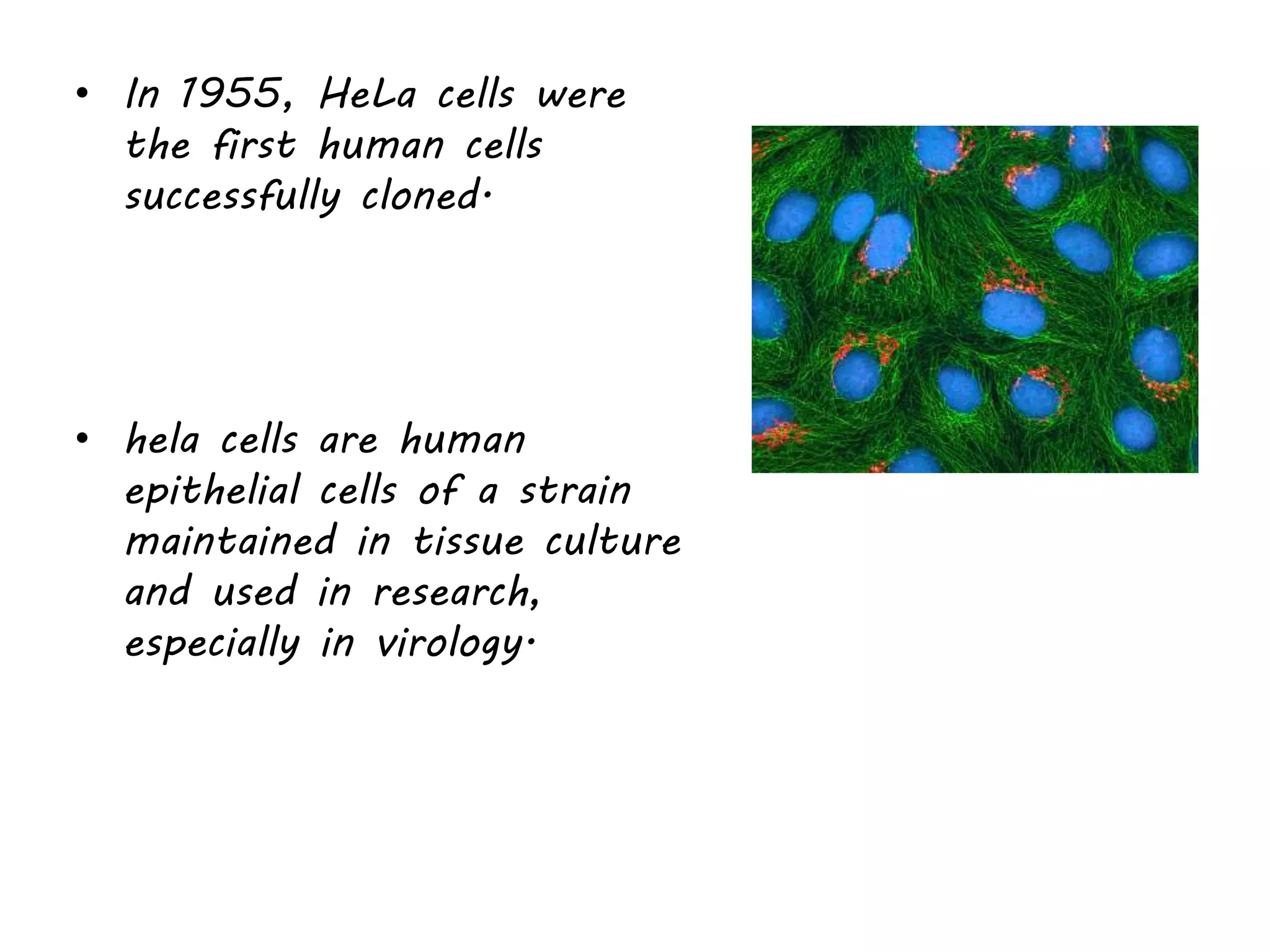
• In 1955, HeLa cells were
the first human cells
successfully cloned.
• hela cells are human
epithelial cells of a strain
maintained in tissue culture
and used in research,
especially in virology.
Vero cell
• Vero cells are lineages of cells used in cell
cultures.The 'Vero' lineage was isolated
from kidney epithelial cells extracted from
an African green monkey.
• The lineage was developed on 27 March
1962, by Yasumura and Kawakita at the
Chiba University in Chiba, Japan.
Vero cells are used for many
purposes, including:
• screening for the toxin of
Escherichia coli
• as host cells for growing virus
• as host cells for eukaryotic
parasites
Relation to natural biology and
pathology
• There are various immortal cell lines. Some of
them are normal cell lines - e.g. derived from
stem cells
• Other immortalised cell lines are the in
vitro equivalent of cancerous cells.
• The culture history of normal cells were divided
into 3phases
• Phase I represented initial culture,phase II, the
period of exponential cell increase and phase III,
the death of cells
• Phase III was not due to the inadequate nutrition
or other failures in techniques for death of
cultured cells.
• Moorhead and Hayflick demonstrated that death
of cultured normal or untransformed cells is an
inherent property of cells themselves.
• That observation has now been confirmed in
hundreds of laboratories .
• They interpreted the phase III to be aging at cell
level.
• Cancer occurs when a somatic cell which
normally cannot divide undergoes mutations
which cause de-regulation of the normal cell
cycle controls leading to uncontrolled
proliferation
• Immortalised cell lines have undergone
similar mutations allowing a cell type which
would normally not be able to divide to be
proliferated in vitro.
Spontaneously Immortalized Cells
• The best example of this would be cancer cells, which
may have undergone genetic changes to resist
senescence and are immortal.
• However, many cancer cell lines may not have these
changes, in fact, George Gey, the scientist who created
the first immortalized and arguably the most famous
cell line: HeLa cells, had to test hundreds of cancer
lines before stumbling upon the highly metaplastic
ovarian cells of Henrietta Lacks.
• Thus, other methodologies may be required to help
even cancer cells become immortal.
How to Introduce Immortality to a
Primary Cell Line
• As many primary cells lines are frustratingly difficult to
transfect, the easiest and most effective way to introduce
genetic changes into a primary cell line is through viral
infection.
• The most popular method is through replication-deficient
lentiviruses, since they are relatively safer then
adenoviruses which have the ability to re-infect cells and
thus contain live virus for a much longer period of time
• Retroviruses can also be used to transfect cells, however,
they can only infect actively dividing cells, thus reducing the
number of cells that may be transduced with virus.
Words of Caution: Immortality May
Not be the Best Route!
• By introducing genetic changes into cells, one may be
profoundly altering the phenotype of your cell line.
Although this does make your cell line more useful in
some ways: it may make your cells more homogeneous
allowing for replication of results, you can create large
stocks of cells for future use and they may be easier to
experimentally, there is still many benefits to using
primary cell lines.
• As primary lines adapt to being culture and being
immortalized, cell populations and cellular mechanisms
are altered. This may lead to results. In addition, there
is much debate about how accurately immortalized
cells model real tissue

Mortal and immortal cell lines

  • 1.
    Introduction Immortalised cell linesare widely used as a simple model for more complex biological systems. for example for the analysis of the biochemistry and cell biology of mammalian (including human) cells. The main advantage of using an immortal cell line for research is its immortality
  • 2.
    Introduction Immortal cell linesare a very important tool for research into the biochemistry and cell biology of multicellular organisms. Immortalised cell lines have also found uses in biotechnology. Immortal mean living forever; never dying or decaying.
  • 3.
    Introduction Senescence from Latin:senescere, meaning "to grow old," Or biological aging (also spelled biological ageing). Grown for Pronlonged Period in vitro. Prolonged =continuing for a long time or longer than usual; lengthy.
  • 4.
    Introduction The mutations requiredfor immortality can occur naturally or be intentionally induced for experimental purposes. Immortal cell lines are a very important tool for research into the biochemistry and cell biology of multicellular organisms.
  • 5.
    Introduction An immortalised cellline should not be confused with stem cells Which can also divide indefinitely But form a normal part of the development of a multicellular organism. Stem cell mean an undifferentiated cell of a multicellular organism which is capable of giving rise to indefinitely more cells of the same type.
  • 6.
    Introduction Immortalised cell linescan also be cloned . Giving rise to a clonal population which can, in turn, be propagated indefinitely. Immortalised cell lines find use in biotechnology where they are a cost-effective way of growing cells similar to those found in a multicellular organism in vitro.
  • 7.
    Introduction There are severalmethods for generating immortalised cell lines which are described by other nembers but some methods names are below.. 1-Isolation from a naturally occurring cancer. 2-Spontaneous or induced random mutagenesis
  • 8.
    Introduction Mutagenesis in thelaboratory is an important technique whereby DNA mutations are engineered to produce mutant genes, proteins, strains of bacteria, or other genetically modified organisms.
  • 9.
    EXAMPLES • There areseveral examples of immortalised cell lines, each with different properties. Most immortalised cell lines are classified by the cell type they originated from or are most similar to biologically. • A549 cells – derived from the tumor of a cancer patient • HeLa cells – an extremely widely used human cell line isolated from a cervical cancer, probably derived from epithelial cells
  • 10.
    • HEK 293cells – derived from aborted human fetal cells and a virus • Jurkat – a human T lymphocyte cell line isolated from a case of leukemia • 3T3 – a mouse fibroblast cell line derived from a spontaneous mutation in cultured mouse embryo tissue • Vero cells – a monkey cell line • F11 Cells - a line of neurons from the dorsal root ganglia of rats.
  • 11.
    HeLa CELLS • HELACELL is a cell type in an immortal cell line used in scientific research. It is the oldest and most commonly used human cell line.The line was derived from cervical cancer cells taken on February 8, 1951 from Henrietta Lacks, a patient who died of her cancer on October 4, 1951.
  • 12.
    • In 1955,HeLa cells were the first human cells successfully cloned. • hela cells are human epithelial cells of a strain maintained in tissue culture and used in research, especially in virology.
  • 13.
    Vero cell • Verocells are lineages of cells used in cell cultures.The 'Vero' lineage was isolated from kidney epithelial cells extracted from an African green monkey. • The lineage was developed on 27 March 1962, by Yasumura and Kawakita at the Chiba University in Chiba, Japan.
  • 14.
    Vero cells areused for many purposes, including: • screening for the toxin of Escherichia coli • as host cells for growing virus • as host cells for eukaryotic parasites
  • 15.
    Relation to naturalbiology and pathology
  • 16.
    • There arevarious immortal cell lines. Some of them are normal cell lines - e.g. derived from stem cells • Other immortalised cell lines are the in vitro equivalent of cancerous cells. • The culture history of normal cells were divided into 3phases • Phase I represented initial culture,phase II, the period of exponential cell increase and phase III, the death of cells
  • 17.
    • Phase IIIwas not due to the inadequate nutrition or other failures in techniques for death of cultured cells. • Moorhead and Hayflick demonstrated that death of cultured normal or untransformed cells is an inherent property of cells themselves. • That observation has now been confirmed in hundreds of laboratories . • They interpreted the phase III to be aging at cell level.
  • 18.
    • Cancer occurswhen a somatic cell which normally cannot divide undergoes mutations which cause de-regulation of the normal cell cycle controls leading to uncontrolled proliferation • Immortalised cell lines have undergone similar mutations allowing a cell type which would normally not be able to divide to be proliferated in vitro.
  • 19.
    Spontaneously Immortalized Cells •The best example of this would be cancer cells, which may have undergone genetic changes to resist senescence and are immortal. • However, many cancer cell lines may not have these changes, in fact, George Gey, the scientist who created the first immortalized and arguably the most famous cell line: HeLa cells, had to test hundreds of cancer lines before stumbling upon the highly metaplastic ovarian cells of Henrietta Lacks. • Thus, other methodologies may be required to help even cancer cells become immortal.
  • 20.
    How to IntroduceImmortality to a Primary Cell Line • As many primary cells lines are frustratingly difficult to transfect, the easiest and most effective way to introduce genetic changes into a primary cell line is through viral infection. • The most popular method is through replication-deficient lentiviruses, since they are relatively safer then adenoviruses which have the ability to re-infect cells and thus contain live virus for a much longer period of time • Retroviruses can also be used to transfect cells, however, they can only infect actively dividing cells, thus reducing the number of cells that may be transduced with virus.
  • 21.
    Words of Caution:Immortality May Not be the Best Route! • By introducing genetic changes into cells, one may be profoundly altering the phenotype of your cell line. Although this does make your cell line more useful in some ways: it may make your cells more homogeneous allowing for replication of results, you can create large stocks of cells for future use and they may be easier to experimentally, there is still many benefits to using primary cell lines. • As primary lines adapt to being culture and being immortalized, cell populations and cellular mechanisms are altered. This may lead to results. In addition, there is much debate about how accurately immortalized cells model real tissue