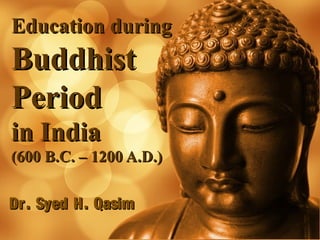
Education duringEducation during
BuddhistBuddhist
PeriodPeriod
in Indiain India
(600 B.C. – 1200 A.D.)(600 B.C. – 1200 A.D.)
Dr. Syed H. QasimDr. Syed H. Qasim
( 600 B.C – 1200 A.D )( 600 B.C – 1200 A.D )
Buddhism believed that world was full of sorrowBuddhism believed that world was full of sorrow
and the salvation could be obtain by renouncingand the salvation could be obtain by renouncing
it. In the beginning it took to education ofit. In the beginning it took to education of
monks only but later to the masses also.monks only but later to the masses also.
Aims & ObjectivesAims & Objectives
 Development of Moral Character.Development of Moral Character.
 Religious and Spiritual development.Religious and Spiritual development.
 Promotion of Social Efficiency.Promotion of Social Efficiency.
 Promotion of Culture.Promotion of Culture.
 Preparation for Life.Preparation for Life.
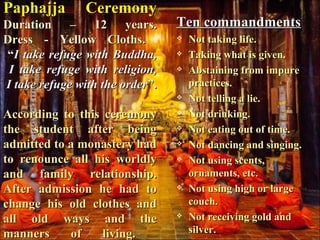
Paphajja CeremonyPaphajja Ceremony
Duration – 12 years.Duration – 12 years.
Dress - Yellow Cloths.Dress - Yellow Cloths.
““I take refuge with Buddha,I take refuge with Buddha,
I take refuge with religion,I take refuge with religion,
I take refuge with the orderI take refuge with the order”.”.
According to this ceremonyAccording to this ceremony
the student after beingthe student after being
admitted to a monastery hadadmitted to a monastery had
to renounce all his worldlyto renounce all his worldly
and family relationship.and family relationship.
After admission he had toAfter admission he had to
change his old clothes andchange his old clothes and
all old ways and theall old ways and the
manners of living.manners of living.
Ten commandmentsTen commandments
 Not taking life.Not taking life.
 Taking what is given.Taking what is given.
 Abstaining from impureAbstaining from impure
practices.practices.
 Not telling a lie.Not telling a lie.
 Not drinking.Not drinking.
 Not eating out of time.Not eating out of time.
 Not dancing and singing.Not dancing and singing.
 Not using scents,Not using scents,
ornaments, etc.ornaments, etc.
 Not using high or largeNot using high or large
couch.couch.
 Not receiving gold andNot receiving gold and
silver.silver.
Upasampada CeremonyUpasampada Ceremony
After the Paphajja ceremony education continuedAfter the Paphajja ceremony education continued
for twelve years. When the student receivedfor twelve years. When the student received
twelve years education he had to undergo thetwelve years education he had to undergo the
Upasampada ceremony. After the UpasampadaUpasampada ceremony. After the Upasampada
ceremony the Shraman was regarded as a full-ceremony the Shraman was regarded as a full-
fledged monk or ‘Bhikshu’. On this occasion allfledged monk or ‘Bhikshu’. On this occasion all
his worldly and family relationship ended. Thishis worldly and family relationship ended. This
period of upasampada was ten years and then heperiod of upasampada was ten years and then he
become an Acharya who could himself receivebecome an Acharya who could himself receive
pupils.pupils.
Main Features of EducationMain Features of Education
Educational InstitutionEducational Institution: Buddhist education was: Buddhist education was
centered around the monastries (viharas or sanghas).centered around the monastries (viharas or sanghas).
Rise of organised educational institution may beRise of organised educational institution may be
attributed to the influence of Buddhism.attributed to the influence of Buddhism.
Admission in monastery: SAdmission in monastery: Student had to presenttudent had to present
themselves before the teacher and request him forthemselves before the teacher and request him for
giving educationgiving education
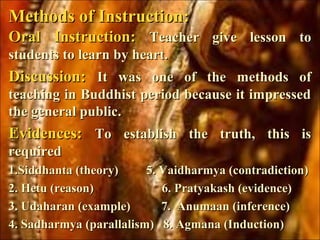
Oral Instruction:Oral Instruction: Teacher give lesson toTeacher give lesson to
students to learn by heart.students to learn by heart.
Discussion:Discussion: It was one of the methods ofIt was one of the methods of
teaching in Buddhist period because it impressedteaching in Buddhist period because it impressed
the general public.the general public.
Evidences:Evidences: To establish the truth, this isTo establish the truth, this is
requiredrequired
1.Siddhanta (theory) 5. Vaidharmya (contradiction)1.Siddhanta (theory) 5. Vaidharmya (contradiction)
2. Hetu (reason) 6. Pratyakash (evidence)2. Hetu (reason) 6. Pratyakash (evidence)
3. Udaharan (example) 7. Anumaan (inference)3. Udaharan (example) 7. Anumaan (inference)
4. Sadharmya (parallalism) 8. Agmana (Induction)4. Sadharmya (parallalism) 8. Agmana (Induction)
Methods of Instruction:Methods of Instruction:
Conferences (Vidwat Sabha):Conferences (Vidwat Sabha): monks putmonks put
forward their doubts freely.forward their doubts freely.
Solitary Meditation (Ekant Sadhna):Solitary Meditation (Ekant Sadhna): isolatedisolated
spiritual meditation in lonely forests and caves.spiritual meditation in lonely forests and caves.
Prominance:Prominance: useful in the development ofuseful in the development of
mental power & knowledgemental power & knowledge
Tours:Tours: long trips to gain practical & reallong trips to gain practical & real
knowledgeknowledge
CurriculumCurriculum
The curriculum was spiritual in nature. The aimThe curriculum was spiritual in nature. The aim
of education was to attain salvation.of education was to attain salvation. In primaryIn primary
educationeducation reading, writing and arithmeticreading, writing and arithmetic werewere
taught and in higher educationtaught and in higher education religion,religion,
philosophy, ayurveda, military training etc.philosophy, ayurveda, military training etc. werewere
included. Everyone was free to choose his subjectincluded. Everyone was free to choose his subject
without any restriction.without any restriction.
Responsibilities of the teacherResponsibilities of the teacher
The pupil and preceptor relation in the BuddhistThe pupil and preceptor relation in the Buddhist
system of education was the same as during thesystem of education was the same as during the
Vedic period. The teacher give the pupil all possibleVedic period. The teacher give the pupil all possible
intellectual and spiritual guidance by teaching, byintellectual and spiritual guidance by teaching, by
putting questions to him and by instruction. Forputting questions to him and by instruction. For
education, cloths, food & residence of the studenteducation, cloths, food & residence of the student
monk, the teacher was wholly responsible. Themonk, the teacher was wholly responsible. The
teacher was also responsible for any treatment ofteacher was also responsible for any treatment of
the student, whenever he fell ill. The teacher used tothe student, whenever he fell ill. The teacher used to
bestow all the affection to his student and used tobestow all the affection to his student and used to
educate him.educate him.
Daily routine of StudentDaily routine of Student
The student used to serve his teacher with allThe student used to serve his teacher with all
devotion on rising in the morning. The studentdevotion on rising in the morning. The student
arrange every thing for the daily routine of hisarrange every thing for the daily routine of his
teacher. He cook his food and clean his cloths andteacher. He cook his food and clean his cloths and
utensils. Whatever he acquired through beggingutensils. Whatever he acquired through begging
alms, he place before teacher. The student had toalms, he place before teacher. The student had to
prepare himself to receive education at any time,prepare himself to receive education at any time,
whenever the teacher required him.whenever the teacher required him.
Women EducationWomen Education
Women occupied a position inferior to men.Women occupied a position inferior to men.
Initially they were prohibited from joining theInitially they were prohibited from joining the
monasteries but later they were granted admissionmonasteries but later they were granted admission
to such congregations.to such congregations. Strict rules were enforcedStrict rules were enforced
for women monks. They were not givenfor women monks. They were not given
any permanent post in the sangh.any permanent post in the sangh.
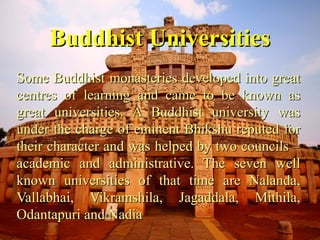
Buddhist UniversitiesBuddhist Universities
Some Buddhist monasteries developed into greatSome Buddhist monasteries developed into great
centres of learning and came to be known ascentres of learning and came to be known as
great universities. A Buddhist university wasgreat universities. A Buddhist university was
under the charge of eminent Bhikshu reputed forunder the charge of eminent Bhikshu reputed for
their character and was helped by two councils –their character and was helped by two councils –
academic and administrative. The seven wellacademic and administrative. The seven well
known universities of that time are Nalanda,known universities of that time are Nalanda,
Vallabhai, Vikramshila, Jagaddala, Mithila,Vallabhai, Vikramshila, Jagaddala, Mithila,
Odantapuri and NadiaOdantapuri and Nadia
Weakness of BuddhistWeakness of Buddhist
educationeducation
 Neglect of worldly lifeNeglect of worldly life
 Neglect of women educationNeglect of women education
 Neglect of Military trainingNeglect of Military training

Buddhist Education System in India

  • 1.
    Education duringEducation during BuddhistBuddhist PeriodPeriod inIndiain India (600 B.C. – 1200 A.D.)(600 B.C. – 1200 A.D.) Dr. Syed H. QasimDr. Syed H. Qasim
  • 2.
    ( 600 B.C– 1200 A.D )( 600 B.C – 1200 A.D ) Buddhism believed that world was full of sorrowBuddhism believed that world was full of sorrow and the salvation could be obtain by renouncingand the salvation could be obtain by renouncing it. In the beginning it took to education ofit. In the beginning it took to education of monks only but later to the masses also.monks only but later to the masses also. Aims & ObjectivesAims & Objectives  Development of Moral Character.Development of Moral Character.  Religious and Spiritual development.Religious and Spiritual development.  Promotion of Social Efficiency.Promotion of Social Efficiency.  Promotion of Culture.Promotion of Culture.  Preparation for Life.Preparation for Life.
  • 3.
    Paphajja CeremonyPaphajja Ceremony Duration– 12 years.Duration – 12 years. Dress - Yellow Cloths.Dress - Yellow Cloths. ““I take refuge with Buddha,I take refuge with Buddha, I take refuge with religion,I take refuge with religion, I take refuge with the orderI take refuge with the order”.”. According to this ceremonyAccording to this ceremony the student after beingthe student after being admitted to a monastery hadadmitted to a monastery had to renounce all his worldlyto renounce all his worldly and family relationship.and family relationship. After admission he had toAfter admission he had to change his old clothes andchange his old clothes and all old ways and theall old ways and the manners of living.manners of living. Ten commandmentsTen commandments  Not taking life.Not taking life.  Taking what is given.Taking what is given.  Abstaining from impureAbstaining from impure practices.practices.  Not telling a lie.Not telling a lie.  Not drinking.Not drinking.  Not eating out of time.Not eating out of time.  Not dancing and singing.Not dancing and singing.  Not using scents,Not using scents, ornaments, etc.ornaments, etc.  Not using high or largeNot using high or large couch.couch.  Not receiving gold andNot receiving gold and silver.silver.
  • 4.
    Upasampada CeremonyUpasampada Ceremony Afterthe Paphajja ceremony education continuedAfter the Paphajja ceremony education continued for twelve years. When the student receivedfor twelve years. When the student received twelve years education he had to undergo thetwelve years education he had to undergo the Upasampada ceremony. After the UpasampadaUpasampada ceremony. After the Upasampada ceremony the Shraman was regarded as a full-ceremony the Shraman was regarded as a full- fledged monk or ‘Bhikshu’. On this occasion allfledged monk or ‘Bhikshu’. On this occasion all his worldly and family relationship ended. Thishis worldly and family relationship ended. This period of upasampada was ten years and then heperiod of upasampada was ten years and then he become an Acharya who could himself receivebecome an Acharya who could himself receive pupils.pupils.
  • 5.
    Main Features ofEducationMain Features of Education Educational InstitutionEducational Institution: Buddhist education was: Buddhist education was centered around the monastries (viharas or sanghas).centered around the monastries (viharas or sanghas). Rise of organised educational institution may beRise of organised educational institution may be attributed to the influence of Buddhism.attributed to the influence of Buddhism. Admission in monastery: SAdmission in monastery: Student had to presenttudent had to present themselves before the teacher and request him forthemselves before the teacher and request him for giving educationgiving education
  • 6.
    Oral Instruction:Oral Instruction:Teacher give lesson toTeacher give lesson to students to learn by heart.students to learn by heart. Discussion:Discussion: It was one of the methods ofIt was one of the methods of teaching in Buddhist period because it impressedteaching in Buddhist period because it impressed the general public.the general public. Evidences:Evidences: To establish the truth, this isTo establish the truth, this is requiredrequired 1.Siddhanta (theory) 5. Vaidharmya (contradiction)1.Siddhanta (theory) 5. Vaidharmya (contradiction) 2. Hetu (reason) 6. Pratyakash (evidence)2. Hetu (reason) 6. Pratyakash (evidence) 3. Udaharan (example) 7. Anumaan (inference)3. Udaharan (example) 7. Anumaan (inference) 4. Sadharmya (parallalism) 8. Agmana (Induction)4. Sadharmya (parallalism) 8. Agmana (Induction) Methods of Instruction:Methods of Instruction:
  • 7.
    Conferences (Vidwat Sabha):Conferences(Vidwat Sabha): monks putmonks put forward their doubts freely.forward their doubts freely. Solitary Meditation (Ekant Sadhna):Solitary Meditation (Ekant Sadhna): isolatedisolated spiritual meditation in lonely forests and caves.spiritual meditation in lonely forests and caves. Prominance:Prominance: useful in the development ofuseful in the development of mental power & knowledgemental power & knowledge Tours:Tours: long trips to gain practical & reallong trips to gain practical & real knowledgeknowledge
  • 8.
    CurriculumCurriculum The curriculum wasspiritual in nature. The aimThe curriculum was spiritual in nature. The aim of education was to attain salvation.of education was to attain salvation. In primaryIn primary educationeducation reading, writing and arithmeticreading, writing and arithmetic werewere taught and in higher educationtaught and in higher education religion,religion, philosophy, ayurveda, military training etc.philosophy, ayurveda, military training etc. werewere included. Everyone was free to choose his subjectincluded. Everyone was free to choose his subject without any restriction.without any restriction.
  • 9.
    Responsibilities of theteacherResponsibilities of the teacher The pupil and preceptor relation in the BuddhistThe pupil and preceptor relation in the Buddhist system of education was the same as during thesystem of education was the same as during the Vedic period. The teacher give the pupil all possibleVedic period. The teacher give the pupil all possible intellectual and spiritual guidance by teaching, byintellectual and spiritual guidance by teaching, by putting questions to him and by instruction. Forputting questions to him and by instruction. For education, cloths, food & residence of the studenteducation, cloths, food & residence of the student monk, the teacher was wholly responsible. Themonk, the teacher was wholly responsible. The teacher was also responsible for any treatment ofteacher was also responsible for any treatment of the student, whenever he fell ill. The teacher used tothe student, whenever he fell ill. The teacher used to bestow all the affection to his student and used tobestow all the affection to his student and used to educate him.educate him.
  • 10.
    Daily routine ofStudentDaily routine of Student The student used to serve his teacher with allThe student used to serve his teacher with all devotion on rising in the morning. The studentdevotion on rising in the morning. The student arrange every thing for the daily routine of hisarrange every thing for the daily routine of his teacher. He cook his food and clean his cloths andteacher. He cook his food and clean his cloths and utensils. Whatever he acquired through beggingutensils. Whatever he acquired through begging alms, he place before teacher. The student had toalms, he place before teacher. The student had to prepare himself to receive education at any time,prepare himself to receive education at any time, whenever the teacher required him.whenever the teacher required him.
  • 11.
    Women EducationWomen Education Womenoccupied a position inferior to men.Women occupied a position inferior to men. Initially they were prohibited from joining theInitially they were prohibited from joining the monasteries but later they were granted admissionmonasteries but later they were granted admission to such congregations.to such congregations. Strict rules were enforcedStrict rules were enforced for women monks. They were not givenfor women monks. They were not given any permanent post in the sangh.any permanent post in the sangh.
  • 12.
    Buddhist UniversitiesBuddhist Universities SomeBuddhist monasteries developed into greatSome Buddhist monasteries developed into great centres of learning and came to be known ascentres of learning and came to be known as great universities. A Buddhist university wasgreat universities. A Buddhist university was under the charge of eminent Bhikshu reputed forunder the charge of eminent Bhikshu reputed for their character and was helped by two councils –their character and was helped by two councils – academic and administrative. The seven wellacademic and administrative. The seven well known universities of that time are Nalanda,known universities of that time are Nalanda, Vallabhai, Vikramshila, Jagaddala, Mithila,Vallabhai, Vikramshila, Jagaddala, Mithila, Odantapuri and NadiaOdantapuri and Nadia
  • 13.
    Weakness of BuddhistWeaknessof Buddhist educationeducation  Neglect of worldly lifeNeglect of worldly life  Neglect of women educationNeglect of women education  Neglect of Military trainingNeglect of Military training