MORPHOLOGY
TSL426
LINGUISTICS FOR LANGUAGE TEACHERS
MORPHOLOGY
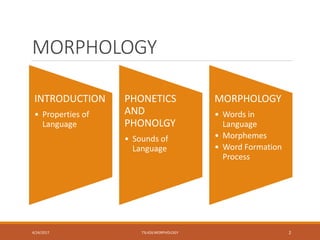
INTRODUCTION
• Properties of
Language
PHONETICS
AND
PHONOLGY
• Sounds of
Language
MORPHOLOGY
• Words in
Language
• Morphemes
• Word Formation
Process
4/24/2017 TSL426 MORPHOLOGY 2
WORDS AND WORD
FORMATION
PROCESS
MORPHOLOGY
4/24/2017 TSL426 MORPHOLOGY 3
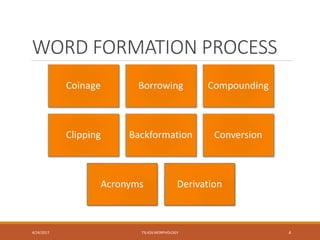
WORD FORMATION PROCESS
Coinage Borrowing Compounding
Clipping Backformation Conversion
Acronyms Derivation
4/24/2017 TSL426 MORPHOLOGY 4
COINAGE
Also called Invention
The invention of a totally new term is called coinage.
◦ Example : nylon
Can be intentionally or accidently
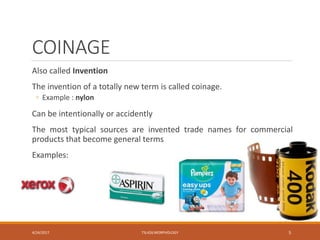
The most typical sources are invented trade names for commercial
products that become general terms
Examples:
4/24/2017 TSL426 MORPHOLOGY 5
COINAGE
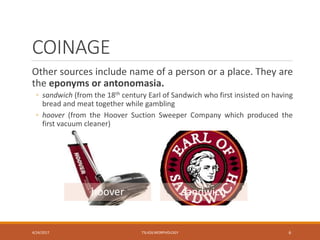
Other sources include name of a person or a place. They are
the eponyms or antonomasia.
◦ sandwich (from the 18th century Earl of Sandwich who first insisted on having
bread and meat together while gambling
◦ hoover (from the Hoover Suction Sweeper Company which produced the
first vacuum cleaner)
4/24/2017 TSL426 MORPHOLOGY 6
hoover sandwich
COINAGE
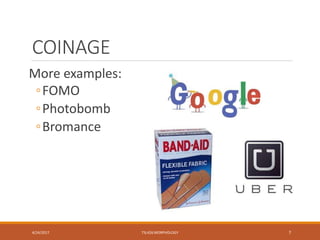
More examples:
◦FOMO
◦Photobomb
◦Bromance
4/24/2017 TSL426 MORPHOLOGY 7
BORROWING
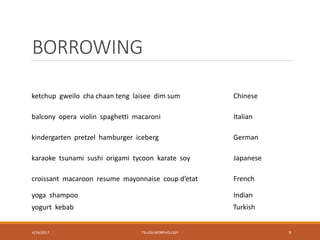
Borrowing is one of the most common sources of new
words in English.
The words formed by borrowing of words from other
languages are called loanwords.
Over 80% of the English words are loanwords - from
over 120 languages.
4/24/2017 TSL426 MORPHOLOGY 8
BORROWING
4/24/2017 TSL426 MORPHOLOGY 9
ketchup gweilo cha chaan teng laisee dim sum Chinese
balcony opera violin spaghetti macaroni Italian
kindergarten pretzel hamburger iceberg German
karaoke tsunami sushi origami tycoon karate soy Japanese
croissant macaroon resume mayonnaise coup d’etat French
yoga shampoo Indian
yogurt kebab Turkish
BORROWING
A special type of borrowing is loan-translation.
Examples:
◦ red packet (Chinese) – loan-translation aka calque
Bahasa Malaysia was once considered the fastest growing language as it
borrows a lot from other languages
◦ Bagasi (baggage)
◦ Others
English also borrowed from Bahasa Melayu
4/24/2017 TSL426 MORPHOLOGY 10
COMPOUNDING
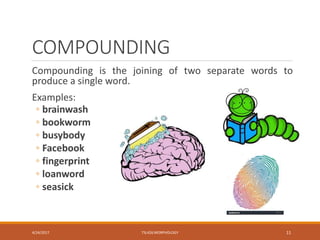
Compounding is the joining of two separate words to
produce a single word.
Examples:
◦ brainwash
◦ bookworm
◦ busybody
◦ Facebook
◦ fingerprint
◦ loanword
◦ seasick
4/24/2017 TSL426 MORPHOLOGY 11
CALQUING
Calquing is the word formation process in which a borrowed word or phrase is
translated from one language to another.
For example, the following common English words are calqued from foreign
languages:
◦ beer garden – German – Biergarten
◦ blue-blood – Spanish – sangre azul
◦ commonplace – Latin – locus commūnis
◦ flea market – French – marché aux puces
◦ free verse – French – vers libre
◦ loanword – German – Lehnwort
◦ long time no see – Chinese – hǎo jiǔ bu jiàn
◦ pineapple – Dutch – pijnappel
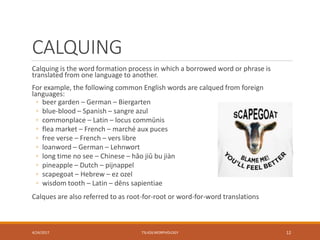
◦ scapegoat – Hebrew – ez ozel
◦ wisdom tooth – Latin – dēns sapientiae
Calques are also referred to as root-for-root or word-for-word translations
4/24/2017 TSL426 MORPHOLOGY 12
CLIPPING
When a word of more than one syllable is reduced to a shorter form,
the process is called clipping.
Examples:
◦ advertisement → ad
◦ telephone → phone
◦ influenza → flu
◦ congratulations – congrats (not congrate hokay!)
4/24/2017 TSL426 MORPHOLOGY 13
BACKFORMATION
Backformation is the process of shortening a long word by cutting off an
affix to form a new word. The new word has a different part of speech
from the original word.
Examples:
televise ← television
donate ← donation
babysit ← babysitter
backform ← backformation
4/24/2017 TSL426 MORPHOLOGY 14
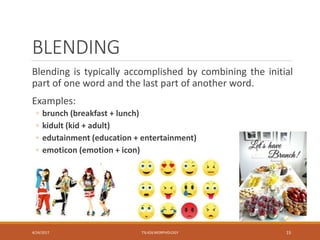
BLENDING
Blending is typically accomplished by combining the initial
part of one word and the last part of another word.
Examples:
◦ brunch (breakfast + lunch)
◦ kidult (kid + adult)
◦ edutainment (education + entertainment)
◦ emoticon (emotion + icon)
4/24/2017 TSL426 MORPHOLOGY 15
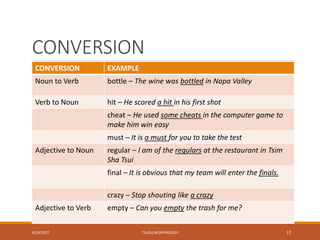
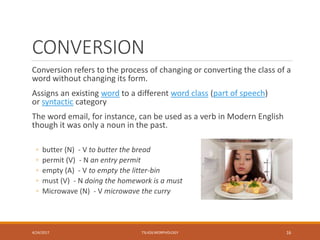
CONVERSION
Conversion refers to the process of changing or converting the class of a
word without changing its form.
Assigns an existing word to a different word class (part of speech)
or syntactic category
The word email, for instance, can be used as a verb in Modern English
though it was only a noun in the past.
◦ butter (N) - V to butter the bread
◦ permit (V) - N an entry permit
◦ empty (A) - V to empty the litter-bin
◦ must (V) - N doing the homework is a must
◦ Microwave (N) - V microwave the curry
4/24/2017 TSL426 MORPHOLOGY 16
CONVERSION
4/24/2017 TSL426 MORPHOLOGY 17
CONVERSION EXAMPLE
Noun to Verb bottle – The wine was bottled in Napa Valley
Verb to Noun hit – He scored a hit in his first shot
cheat – He used some cheats in the computer game to
make him win easy
must – It is a must for you to take the test
Adjective to Noun regular – I am of the regulars at the restaurant in Tsim
Sha Tsui
final – It is obvious that my team will enter the finals.
crazy – Stop shouting like a crazy
Adjective to Verb empty – Can you empty the trash for me?
ACRONYMS
Acronyms is a type of abbreviation, which are new words formed from
the initial letters of a set of words.
They are pronounced as new single words.
Examples:
◦ NATO (The North Atlantic Treaty Organization)
◦ UNICEF (The United Nations Children’s Fund)
◦ SCUBA
◦ CD
4/24/2017 TSL426 MORPHOLOGY 18
DERIVATION
Derivation is also known as affixation.
New words are created by adding affixes to an existing word.
The most common word formation process.
Affixes
Examples:
◦ happy - unhappy, happiness
◦ arrange - rearrange
prefixes vs. suffixes
infixes inside the word
Tell them I’ve gone to Singabloodypore!
4/24/2017 TSL426 MORPHOLOGY 19
DERIVATIONS
Root and Affixes
Affixation is the most common word formation process in English.
Words are formed by adding affixes to roots.
Roots can be free or bound morphemes.
They cannot be further analyzed into smaller parts. They form the base
forms of the words.
Free roots are free morphemes. They can stand alone to function as
words.Examples:
recollect, bilingual, uneasy, mislead, hardly, attractive
4/24/2017 TSL426 MORPHOLOGY 20
DERIVATIONS
Bound roots are bound morphemes.
They cannot stand alone to function as words because they are no longer
used in Modern English.Examples:
receive, reduce
Affixes are bound morphemes. They can be classified into prefixes and
suffixes in English.
A prefix is an affix added to the beginning of other morphemes to form a
word.Examples:
dislike, deactivate, inadequate, immobile, misleading, unaccountable
endurable, underachieve, overdeveloped, prerequisite, postgraduate, recy
cle
4/24/2017 TSL426 MORPHOLOGY 21
ECHOISM/SYMBOLISM/
ONOMOTOPOEIA
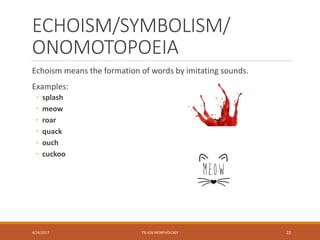
Echoism means the formation of words by imitating sounds.
Examples:
◦ splash
◦ meow
◦ roar
◦ quack
◦ ouch
◦ cuckoo
4/24/2017 TSL426 MORPHOLOGY 22
FOLK ETYMOLOGY
Folk Etymology refers to the changing of a word or a phrase over time
which results from the replacement of an unfamiliar form by a more
familiar one.
Example:
“Bryd-guman” from Old English was changed to bridegroom as the Old
English word guma (man) was obsolete.
In OE, the word for “island” was iegland or igand which ordinarily would
have become iland in modern English. But then the word isle came into
English from Old French which got it from Latin insula.
4/24/2017 TSL426 MORPHOLOGY 23
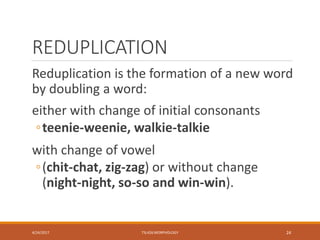
REDUPLICATION
Reduplication is the formation of a new word
by doubling a word:
either with change of initial consonants
◦teenie-weenie, walkie-talkie
with change of vowel
◦(chit-chat, zig-zag) or without change
(night-night, so-so and win-win).
4/24/2017 TSL426 MORPHOLOGY 24
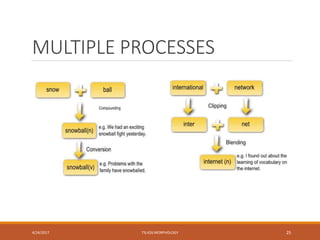
MULTIPLE PROCESSES
4/24/2017 TSL426 MORPHOLOGY 25
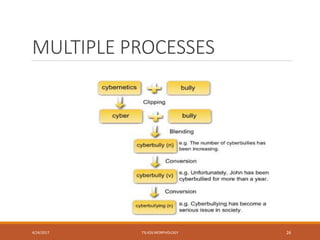
MULTIPLE PROCESSES
4/24/2017 TSL426 MORPHOLOGY 26
THE END
4/24/2017 TSL426 MORPHOLOGY 27

Morphology

  • 1.
  • 2.
    MORPHOLOGY INTRODUCTION • Properties of Language PHONETICS AND PHONOLGY •Sounds of Language MORPHOLOGY • Words in Language • Morphemes • Word Formation Process 4/24/2017 TSL426 MORPHOLOGY 2
  • 3.
  • 4.
    WORD FORMATION PROCESS CoinageBorrowing Compounding Clipping Backformation Conversion Acronyms Derivation 4/24/2017 TSL426 MORPHOLOGY 4
  • 5.
    COINAGE Also called Invention Theinvention of a totally new term is called coinage. ◦ Example : nylon Can be intentionally or accidently The most typical sources are invented trade names for commercial products that become general terms Examples: 4/24/2017 TSL426 MORPHOLOGY 5
  • 6.
    COINAGE Other sources includename of a person or a place. They are the eponyms or antonomasia. ◦ sandwich (from the 18th century Earl of Sandwich who first insisted on having bread and meat together while gambling ◦ hoover (from the Hoover Suction Sweeper Company which produced the first vacuum cleaner) 4/24/2017 TSL426 MORPHOLOGY 6 hoover sandwich
  • 7.
  • 8.
    BORROWING Borrowing is oneof the most common sources of new words in English. The words formed by borrowing of words from other languages are called loanwords. Over 80% of the English words are loanwords - from over 120 languages. 4/24/2017 TSL426 MORPHOLOGY 8
  • 9.
    BORROWING 4/24/2017 TSL426 MORPHOLOGY9 ketchup gweilo cha chaan teng laisee dim sum Chinese balcony opera violin spaghetti macaroni Italian kindergarten pretzel hamburger iceberg German karaoke tsunami sushi origami tycoon karate soy Japanese croissant macaroon resume mayonnaise coup d’etat French yoga shampoo Indian yogurt kebab Turkish
  • 10.
    BORROWING A special typeof borrowing is loan-translation. Examples: ◦ red packet (Chinese) – loan-translation aka calque Bahasa Malaysia was once considered the fastest growing language as it borrows a lot from other languages ◦ Bagasi (baggage) ◦ Others English also borrowed from Bahasa Melayu 4/24/2017 TSL426 MORPHOLOGY 10
  • 11.
    COMPOUNDING Compounding is thejoining of two separate words to produce a single word. Examples: ◦ brainwash ◦ bookworm ◦ busybody ◦ Facebook ◦ fingerprint ◦ loanword ◦ seasick 4/24/2017 TSL426 MORPHOLOGY 11
  • 12.
    CALQUING Calquing is theword formation process in which a borrowed word or phrase is translated from one language to another. For example, the following common English words are calqued from foreign languages: ◦ beer garden – German – Biergarten ◦ blue-blood – Spanish – sangre azul ◦ commonplace – Latin – locus commūnis ◦ flea market – French – marché aux puces ◦ free verse – French – vers libre ◦ loanword – German – Lehnwort ◦ long time no see – Chinese – hǎo jiǔ bu jiàn ◦ pineapple – Dutch – pijnappel ◦ scapegoat – Hebrew – ez ozel ◦ wisdom tooth – Latin – dēns sapientiae Calques are also referred to as root-for-root or word-for-word translations 4/24/2017 TSL426 MORPHOLOGY 12
  • 13.
    CLIPPING When a wordof more than one syllable is reduced to a shorter form, the process is called clipping. Examples: ◦ advertisement → ad ◦ telephone → phone ◦ influenza → flu ◦ congratulations – congrats (not congrate hokay!) 4/24/2017 TSL426 MORPHOLOGY 13
  • 14.
    BACKFORMATION Backformation is theprocess of shortening a long word by cutting off an affix to form a new word. The new word has a different part of speech from the original word. Examples: televise ← television donate ← donation babysit ← babysitter backform ← backformation 4/24/2017 TSL426 MORPHOLOGY 14
  • 15.
    BLENDING Blending is typicallyaccomplished by combining the initial part of one word and the last part of another word. Examples: ◦ brunch (breakfast + lunch) ◦ kidult (kid + adult) ◦ edutainment (education + entertainment) ◦ emoticon (emotion + icon) 4/24/2017 TSL426 MORPHOLOGY 15
  • 16.
    CONVERSION Conversion refers tothe process of changing or converting the class of a word without changing its form. Assigns an existing word to a different word class (part of speech) or syntactic category The word email, for instance, can be used as a verb in Modern English though it was only a noun in the past. ◦ butter (N) - V to butter the bread ◦ permit (V) - N an entry permit ◦ empty (A) - V to empty the litter-bin ◦ must (V) - N doing the homework is a must ◦ Microwave (N) - V microwave the curry 4/24/2017 TSL426 MORPHOLOGY 16
  • 17.
    CONVERSION 4/24/2017 TSL426 MORPHOLOGY17 CONVERSION EXAMPLE Noun to Verb bottle – The wine was bottled in Napa Valley Verb to Noun hit – He scored a hit in his first shot cheat – He used some cheats in the computer game to make him win easy must – It is a must for you to take the test Adjective to Noun regular – I am of the regulars at the restaurant in Tsim Sha Tsui final – It is obvious that my team will enter the finals. crazy – Stop shouting like a crazy Adjective to Verb empty – Can you empty the trash for me?
  • 18.
    ACRONYMS Acronyms is atype of abbreviation, which are new words formed from the initial letters of a set of words. They are pronounced as new single words. Examples: ◦ NATO (The North Atlantic Treaty Organization) ◦ UNICEF (The United Nations Children’s Fund) ◦ SCUBA ◦ CD 4/24/2017 TSL426 MORPHOLOGY 18
  • 19.
    DERIVATION Derivation is alsoknown as affixation. New words are created by adding affixes to an existing word. The most common word formation process. Affixes Examples: ◦ happy - unhappy, happiness ◦ arrange - rearrange prefixes vs. suffixes infixes inside the word Tell them I’ve gone to Singabloodypore! 4/24/2017 TSL426 MORPHOLOGY 19
  • 20.
    DERIVATIONS Root and Affixes Affixationis the most common word formation process in English. Words are formed by adding affixes to roots. Roots can be free or bound morphemes. They cannot be further analyzed into smaller parts. They form the base forms of the words. Free roots are free morphemes. They can stand alone to function as words.Examples: recollect, bilingual, uneasy, mislead, hardly, attractive 4/24/2017 TSL426 MORPHOLOGY 20
  • 21.
    DERIVATIONS Bound roots arebound morphemes. They cannot stand alone to function as words because they are no longer used in Modern English.Examples: receive, reduce Affixes are bound morphemes. They can be classified into prefixes and suffixes in English. A prefix is an affix added to the beginning of other morphemes to form a word.Examples: dislike, deactivate, inadequate, immobile, misleading, unaccountable endurable, underachieve, overdeveloped, prerequisite, postgraduate, recy cle 4/24/2017 TSL426 MORPHOLOGY 21
  • 22.
    ECHOISM/SYMBOLISM/ ONOMOTOPOEIA Echoism means theformation of words by imitating sounds. Examples: ◦ splash ◦ meow ◦ roar ◦ quack ◦ ouch ◦ cuckoo 4/24/2017 TSL426 MORPHOLOGY 22
  • 23.
    FOLK ETYMOLOGY Folk Etymologyrefers to the changing of a word or a phrase over time which results from the replacement of an unfamiliar form by a more familiar one. Example: “Bryd-guman” from Old English was changed to bridegroom as the Old English word guma (man) was obsolete. In OE, the word for “island” was iegland or igand which ordinarily would have become iland in modern English. But then the word isle came into English from Old French which got it from Latin insula. 4/24/2017 TSL426 MORPHOLOGY 23
  • 24.
    REDUPLICATION Reduplication is theformation of a new word by doubling a word: either with change of initial consonants ◦teenie-weenie, walkie-talkie with change of vowel ◦(chit-chat, zig-zag) or without change (night-night, so-so and win-win). 4/24/2017 TSL426 MORPHOLOGY 24
  • 25.
  • 26.
  • 27.