TSL641: CALLLecture 1 : Introduction
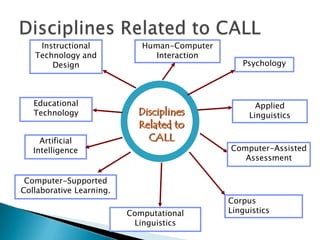
Introduction to CALLDefinitionCALL Applications/MaterialsHistory of CALLDisciplines Related to CALLCAIGeneric CALLMicrosoft WordsContent
Computer-assisted language learning (CALL) was the expression agreed upon at the 1983 TESOL convention in a meeting of all interested participants.
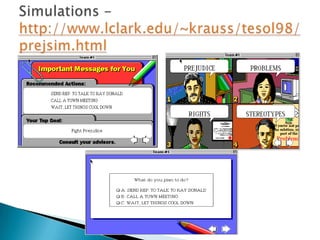
This term is widely used to refer to the area of technology and second language teaching and learning despite the fact that revisions for the term are suggested regularly (Chapelle, 2001, p. 3). What is CALL? Definition
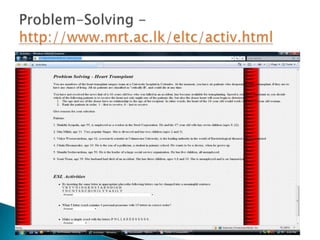
Computer Assisted Language Learning (CALL) may also be defined as the search for and study of applications of the computer in language teaching and learning (Levy, 1997, p.1).What is CALL? Definition
Given the breadth of what may go on in computer-assisted language learning (CALL), a definition of CALL that accommodates its changing nature is any process in which a learner uses a computer and, as a result, improves his or her language(Beatty, 2003, p. 7).What is CALL? Definition
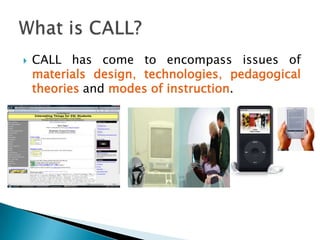
CALL has come to encompass issues of materials design, technologies, pedagogical theoriesand modes of instruction. What is CALL?
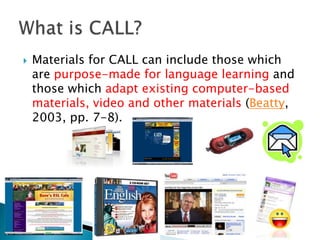
Materials for CALL can include those which are purpose-made for language learning and those which adapt existing computer-based materials, video and other materials (Beatty, 2003, pp. 7-8).What is CALL?
CALL - Computer-assisted language learning, sometimes expanded as computer-aided language learning 
CELL -  Computer-enhanced language learning: suggests the computer's role is to make learning better  
TELL - Technology-enhanced language learning: this accommodates more than just computers, often bringing in video and seeing the computer as just one part of a larger system. It is increasingly popular as a generic term
TALL -  Technology-assisted language learning: variant of CALL and TELL
CALI -  Computer-assisted language instruction: with "instruction" in it, it's more teaching oriented 
CBLT -  Computer-based language training: views elements of language learning as "training" and tends to use an approach with definable, measurable objectives
IT and ICT -  Information Technology/Information and Communication Technologies are common acronyms outside of language teaching, particularly in Europe; sometimes this is presented as IT or ICT for LT (Language Teaching)
NBLT - Network-Based Language Teaching: focuses on computer-mediated communication and the webOther Acronyms
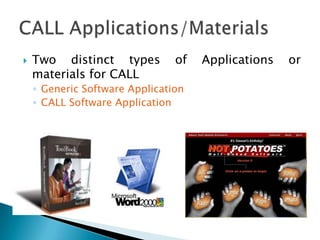
Two distinct types of Applications or materials for CALL
Generic Software Application
CALL Software ApplicationCALL Applications/Materials
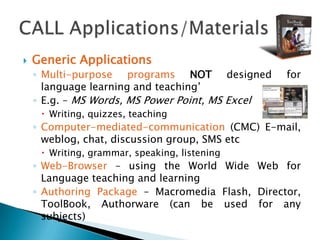
Generic Applications
Multi-purpose programsNOT designed for language learning and teaching’
E.g. – MS Words, MS Power Point, MS Excel
Writing, quizzes, teaching
Computer-mediated-communication (CMC) E-mail, weblog, chat, discussion group, SMS etc
Writing, grammar, speaking, listening
Web-Browser – using the World Wide Web for Language teaching and learning
Authoring Package – Macromedia Flash, Director, ToolBook, Authorware (can be used for any subjects)CALL Applications/Materials
GenericAdaptation of existing computer-based materials, videos and others. Extremely useful in language teaching when used in well-designed activities which seek to apply aspects of the functionality of the software to language learning situations. For example, the use of a word-processor to encourage drafting, critical reflection and editing is an excellent use of generic software to further a number of language learning objectives.CALL Applications/Materials
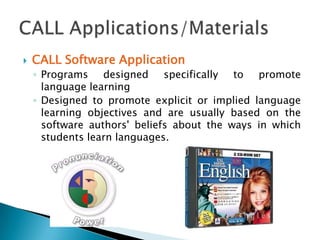
CALL Software Application
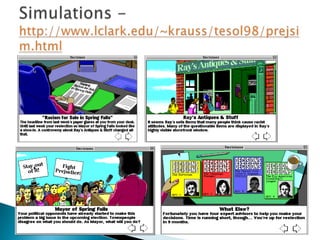
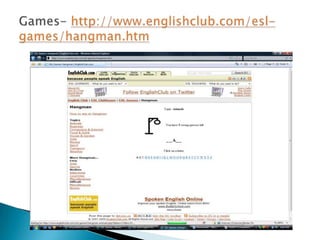
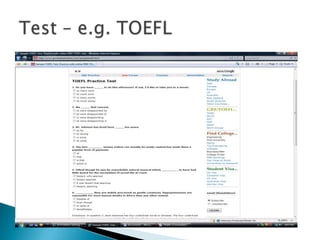
Programs designed specifically to promote language learning
Designed to promote explicit or implied language learning objectives and are usually based on the software authors' beliefs about the ways in which students learn languages. CALL Applications/Materials
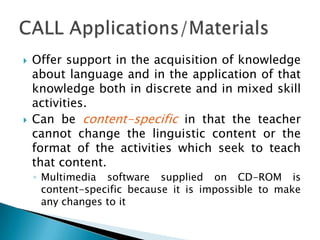
Offer support in the acquisition of knowledge about language and in the application of that knowledge both in discrete and in mixed skill activities.
Can be content-specificin that the teacher cannot change the linguistic content or the format of the activities which seek to teach that content.
Multimedia software supplied on CD-ROM is content-specific because it is impossible to make any changes to itCALL Applications/Materials
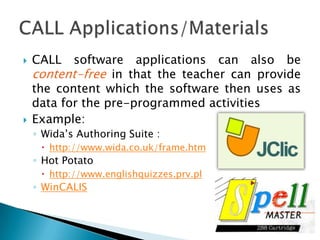
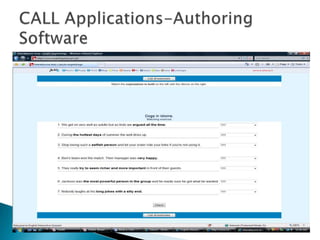
CALL software applications can also be content-free in that the teacher can provide the content which the software then uses as data for the pre-programmed activities
Example:
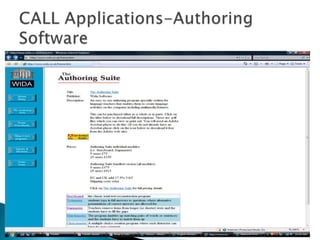
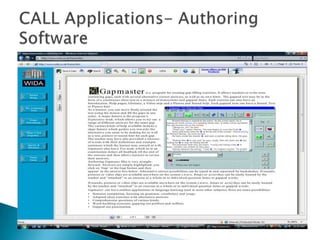
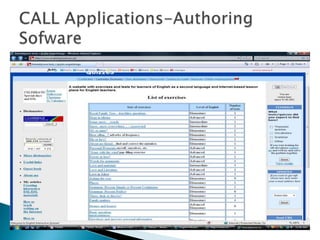
Wida’s Authoring Suite :
http://www.wida.co.uk/frame.htm
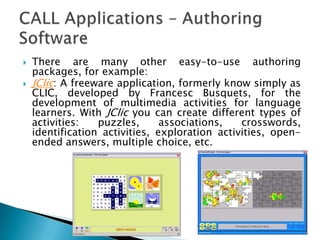
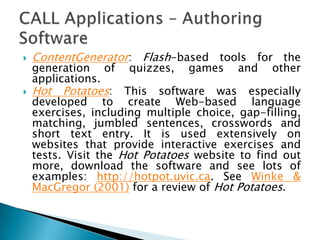
Hot Potato
http://www.englishquizzes.prv.pl
WinCALISCALL Applications/Materials

Tsl641 Lecture 1