LISTENING FOR MAIN IDEA &
SUPPORTING DETAILS
EDU452
MAIN IDEA
• In listening, reading and writing the main idea is the MAIN POINT the
speaker and/ or writer is trying to say.
• It is the most important idea the speaker is trying to communicate
• Chief point an author is making about a topic
• Usually the main idea will be at the start of the lecture / conversation, news
etc
• Followed by the supporting details
• Then the main idea will be repeated again to emphasize the point (to stress
it once again)
• The main idea is the heart of the lecture or conversation
MAIN IDEA
• In most lectures, several main ideas are presented.
• These are the concepts the lecturer wants the audience to remember.
• Sometimes, the lecturer provides a general, or thesis, statement that
includes all the concepts.
• When the lecture is well organized with a clear beginning, middle, and
end, the main idea is easy to identify.
KEYS TO IDENTIFY MAIN IDEAS
• There are four keys to identifying main ideas in lectures and presentations:
1. a speaker may signal a main idea through discourse markers; that is, there are certain
phrases that tell you a main idea is coming. Here are some examples:
• The point I want to make/cover here is...
• The main point is...
• The important thing here is...
• What I’m trying to show is...
• What I’m going to talk about today is...
• The purpose of my remarks is ...
• This afternoon I’d like to explain/focus on...
KEYS TO IDENTIFY MAIN IDEAS
2. Repetition, or how many times a word or phrase is repeated.
If something is repeated several times, it suggests importance.
3. Pace. Pace is the speed of speech.
Unimportant points or small details are usually spoken more quickly.
Important points, such as main ideas, are usually spoken more slowly
and clearly.
4. A lecturer’s visual aids, such as outlines, lists or drawings, often provide
obvious clues to a speaker’s main points.
These visual aids should be taken advantage of.
•
SUPPORTING DETAILS
• A conversation or lectures contains facts, statements, examples-
specifics which guide us to a full understanding of the main idea.
• They clarify, illuminate, explain, describe, expand and illustrate the
main idea and are supporting details.
LISTENING FOR MAIN IDEA AND
SUPPORTING DETAIL
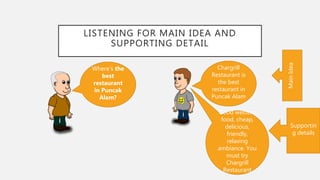
• Suppose I ask you ‘Where is the best restaurant in Puncak Alam?
• The question is the main idea.
• You then continue to say Chargrill Restaurant, western food, cheap,
delicious, many choices, friendly waiters.
• These will be the supporting details.
LISTENING FOR MAIN IDEA AND
SUPPORTING DETAIL
Where’s the
best
restaurant
in Puncak
Alam?
Chargrill
Restaurant is
the best
restaurant in
Puncak Alam
Good western
food, cheap,
delicious,
friendly,
relaxing
ambiance. You
must try
Chargrill
Restaurant
MainIdea
Supportin
g details
LISTENING FOR MAIN IDEA AND
SUPPORTING DETAIL
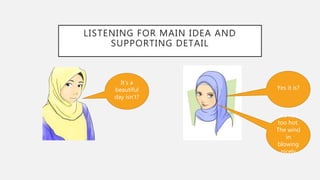
It’s a
beautiful
day isn’t?
Yes it is?
It’s not
too hot.
The wind
in
blowing
nicely
DETECTING THE MAIN IDEA
• The main idea can be detected easily
• It is stated directly – the best restaurant example, statement about the weather
• It is called Stated Main Idea
• Sometimes it is not easy to detect, not easy to pick out or hear
• It is not stated directly in a sentence
• You somewhat have to guess
• You have to imply the main from the supporting details
• It is called Implied Main Idea
DETECTING THE MAIN IDEA
• Listen:
• What do you think is the main idea?
• What is the main thing the speaker is trying to tell you?
• You are right if you say the main idea is that the class had a fun time on
the field trip.
• It was stated in the beginning and followed by the supporting details
DETECTING THE MAIN IDEA
• Listen
• What is the main idea?
• What is the main point the speaker is trying to say?
• The 1st sentence states ‘The aboriginal people of Canada built the homes
from the trees that grew in the forests around them’. The main idea is not
stated directly.
• You have to imply the main idea from the supporting details.
• What do the details have in common? Listen
• Aboriginal people of Canada, forest plants
• Main idea: The aboriginal people of Canada use resources from the forests
to survive
MAIN IDEA AND SUPPORTING DETAILS
• Remember:
• The topic of the lecture or conversation is usually the main idea.
• All the supporting details will make the main idea stronger.
• The main idea will be stated normally in the beginning and emphasized
at the end.
• If the main idea is not stated listen to what the supporting details have
in common and imply the main idea.
• Practice will make Perfect.
LET’S PRACTICE
• Tsunami
• Supreme Court
• African Music
• High Achievement
• Democracy
• Consumers
• Ants
• Adolescents
• Bulimia
• Speech

Listening for main idea & supporting details

  • 1.
    LISTENING FOR MAINIDEA & SUPPORTING DETAILS EDU452
  • 2.
    MAIN IDEA • Inlistening, reading and writing the main idea is the MAIN POINT the speaker and/ or writer is trying to say. • It is the most important idea the speaker is trying to communicate • Chief point an author is making about a topic • Usually the main idea will be at the start of the lecture / conversation, news etc • Followed by the supporting details • Then the main idea will be repeated again to emphasize the point (to stress it once again) • The main idea is the heart of the lecture or conversation
  • 3.
    MAIN IDEA • Inmost lectures, several main ideas are presented. • These are the concepts the lecturer wants the audience to remember. • Sometimes, the lecturer provides a general, or thesis, statement that includes all the concepts. • When the lecture is well organized with a clear beginning, middle, and end, the main idea is easy to identify.
  • 4.
    KEYS TO IDENTIFYMAIN IDEAS • There are four keys to identifying main ideas in lectures and presentations: 1. a speaker may signal a main idea through discourse markers; that is, there are certain phrases that tell you a main idea is coming. Here are some examples: • The point I want to make/cover here is... • The main point is... • The important thing here is... • What I’m trying to show is... • What I’m going to talk about today is... • The purpose of my remarks is ... • This afternoon I’d like to explain/focus on...
  • 5.
    KEYS TO IDENTIFYMAIN IDEAS 2. Repetition, or how many times a word or phrase is repeated. If something is repeated several times, it suggests importance. 3. Pace. Pace is the speed of speech. Unimportant points or small details are usually spoken more quickly. Important points, such as main ideas, are usually spoken more slowly and clearly. 4. A lecturer’s visual aids, such as outlines, lists or drawings, often provide obvious clues to a speaker’s main points. These visual aids should be taken advantage of. •
  • 6.
    SUPPORTING DETAILS • Aconversation or lectures contains facts, statements, examples- specifics which guide us to a full understanding of the main idea. • They clarify, illuminate, explain, describe, expand and illustrate the main idea and are supporting details.
  • 7.
    LISTENING FOR MAINIDEA AND SUPPORTING DETAIL • Suppose I ask you ‘Where is the best restaurant in Puncak Alam? • The question is the main idea. • You then continue to say Chargrill Restaurant, western food, cheap, delicious, many choices, friendly waiters. • These will be the supporting details.
  • 8.
    LISTENING FOR MAINIDEA AND SUPPORTING DETAIL Where’s the best restaurant in Puncak Alam? Chargrill Restaurant is the best restaurant in Puncak Alam Good western food, cheap, delicious, friendly, relaxing ambiance. You must try Chargrill Restaurant MainIdea Supportin g details
  • 9.
    LISTENING FOR MAINIDEA AND SUPPORTING DETAIL It’s a beautiful day isn’t? Yes it is? It’s not too hot. The wind in blowing nicely
  • 10.
    DETECTING THE MAINIDEA • The main idea can be detected easily • It is stated directly – the best restaurant example, statement about the weather • It is called Stated Main Idea • Sometimes it is not easy to detect, not easy to pick out or hear • It is not stated directly in a sentence • You somewhat have to guess • You have to imply the main from the supporting details • It is called Implied Main Idea
  • 11.
    DETECTING THE MAINIDEA • Listen: • What do you think is the main idea? • What is the main thing the speaker is trying to tell you? • You are right if you say the main idea is that the class had a fun time on the field trip. • It was stated in the beginning and followed by the supporting details
  • 12.
    DETECTING THE MAINIDEA • Listen • What is the main idea? • What is the main point the speaker is trying to say? • The 1st sentence states ‘The aboriginal people of Canada built the homes from the trees that grew in the forests around them’. The main idea is not stated directly. • You have to imply the main idea from the supporting details. • What do the details have in common? Listen • Aboriginal people of Canada, forest plants • Main idea: The aboriginal people of Canada use resources from the forests to survive
  • 13.
    MAIN IDEA ANDSUPPORTING DETAILS • Remember: • The topic of the lecture or conversation is usually the main idea. • All the supporting details will make the main idea stronger. • The main idea will be stated normally in the beginning and emphasized at the end. • If the main idea is not stated listen to what the supporting details have in common and imply the main idea. • Practice will make Perfect.
  • 14.
    LET’S PRACTICE • Tsunami •Supreme Court • African Music • High Achievement • Democracy • Consumers • Ants • Adolescents • Bulimia • Speech