MORPHOLOGICAL
PROCESS
By: Ibrahim Muneer
Morphological process is a mean of
changing a stem to adjust its meaning
to fit its syntactic and comunicational
context.
MORPHOLOGICAL
PROCESS?
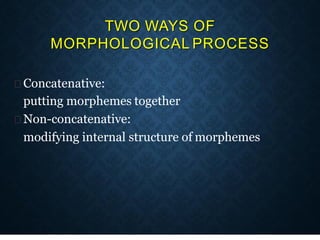
TWO WAYS OF
MORPHOLOGICAL PROCESS
Concatenative:
putting morphemes together
Non-concatenative:
modifying internal structure of morphemes
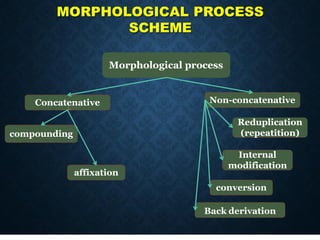
MORPHOLOGICAL PROCESS
SCHEME
Morphological process
Internal
modification
Reduplication
(repeatition)
affixation
compounding
Non-concatenative
Concatenative
conversion
Back derivation
1. COMPOUNDING
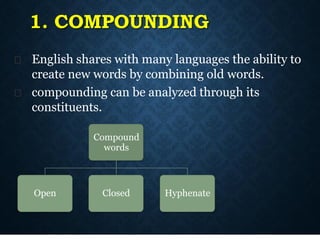
English shares with many languages the ability to
create new words by combining old words.
compounding can be analyzed through its
constituents.
Compound
words
Open Closed Hyphenate
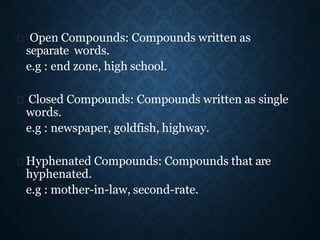
Open Compounds: Compounds written as
separate words.
e.g : end zone, high school.
Closed Compounds: Compounds written as single
words.
e.g : newspaper, goldfish, highway.
Hyphenated Compounds: Compounds that are
hyphenated.
e.g : mother-in-law, second-rate.
Prefixes are letters that are added to the
beginning of a word.
A prefix changes the meaning of a word.
Example:
“preschool”
The prefix is pre-
The prefix pre means “before” so the word preschool
means “before school”
2. AFFIXATION
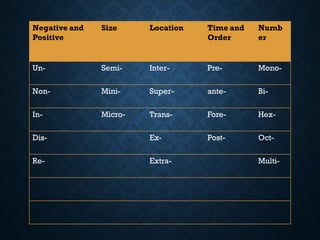
Negative and
Positive
Size Location Time and
Order
Numb
er
Un- Semi- Inter- Pre- Mono-
Non- Mini- Super- ante- Bi-
In- Micro- Trans- Fore- Hex-
Dis- Ex- Post- Oct-
Re- Extra- Multi-
Suffixes are letters added to the end
of a word.
A suffix also changes the meaning and the
word class of a word.
Example:
„careless‟
Thesuffix is –less
The suffix –less means without so the word
careless means “without care”
3. REDUPLICATION (REPETATION)
This process can be classified according to
the amount of form that is duplicated,
weather complete or partial, and it the
letter according to exactly which part.
SEVERAL TYPES OF REDUPLICATION
INENGLISH
Rhyming reduplication: hokey-pokey, razzle-
dazzle, super-duper, boogie-woogie, teenie-weenie,
walkie-talkie
Exact reduplications (baby-talk-like): bye-bye,
choo-choo, night-night, no-no, pee-pee, poo-poo.
Ablaut reduplications: bric-brac, chit-chat, criss-
cross, kitty-cat, knick-knack, pitter-patter, splish-
splash, zig-zag.
4. INTERNAL MODIFICATION
a. Vowel modification
b. Consonan modification
c. Mixed modification
d.Tonal modification
e. Stress modification
f. suppletion
a. Vowel modification
verbs in English:
[I] – [oe] begin – began, ring – rang, sing – sang,
[i:] – [ou] speak –spoke, steal – stole,
[ai] - [au] bind – bound, find – found,
B. CONSONANT MODIFICATION
• Examples:
• Noun/Verb in English:
[f] – [v] belief – believe, grief – grieve, proof – prove,
[s] – [z] advice – advise, device – devise, use – use,
[s] – [d] defense – defend, offence – offend,
[t] – [d] bent – bend, ascent – ascend, descent –descend,
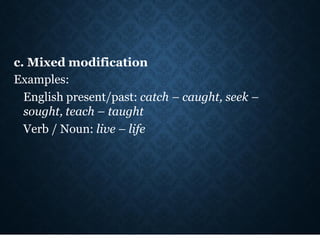
c. Mixed modification
Examples:
English present/past: catch – caught, seek –
sought, teach – taught
Verb / Noun: live – life
D. TONAL MODIFICATION (TONE)
A NUMBER OF AFRICAN LANGUAGES
USE TONAL MODIFICATION FOR VERB
INFLECTION.
he saw'
Near Past :
Perfect :
_ ^ ^ [a:Bo:ne]
^  _ [a:Bo:ne]
(where ^ = high tone, _ = low tone,  = falling tone,
and B is an implosive bilabial stop)
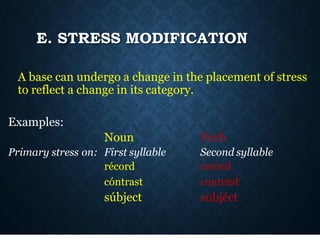
E. STRESS MODIFICATION
A base can undergo a change in the placement of stress
to reflect a change in its category.
Examples:
Noun
Primary stress on: First syllable
récord
cóntrast
súbject
Verb
Second syllable
recórd
contrást
subjéct
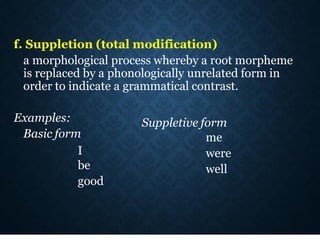
f. Suppletion (total modification)
a morphological process whereby a root morpheme
is replaced by a phonologically unrelated form in
order to indicate a grammatical contrast.
Examples:
Basic form
I
be
good
Suppletive form
me
were
well
5. Conversion
A process by which a word belonging to one
word class without any change of form but
the function of word is change.
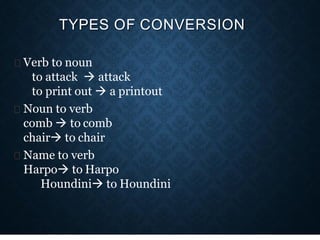
TYPES OF CONVERSION
Verb to noun
to attack  attack
to print out  a printout
Noun to verb
comb  to comb
chair to chair
Name to verb
Harpo to Harpo
Houndini to Houndini
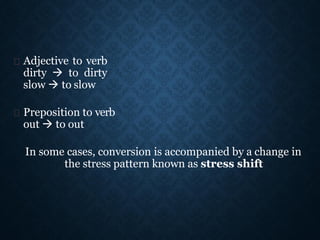
Adjective to verb
dirty  to dirty
slow  to slow
Preposition to verb
out  to out
In some cases, conversion is accompanied by a change in
the stress pattern known as stress shift
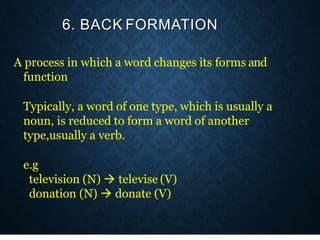
6. BACK FORMATION
A process in which a word changes its forms and
function
Typically, a word of one type, which is usually a
noun, is reduced to form a word of another
type,usually a verb.
e.g
television (N)  televise (V)
donation (N)  donate (V)
THANK
YOU

MORPHOLOGICAL PROCESS

  • 1.
  • 2.
    Morphological process isa mean of changing a stem to adjust its meaning to fit its syntactic and comunicational context. MORPHOLOGICAL PROCESS?
  • 3.
    TWO WAYS OF MORPHOLOGICALPROCESS Concatenative: putting morphemes together Non-concatenative: modifying internal structure of morphemes
  • 4.
  • 5.
    1. COMPOUNDING English shareswith many languages the ability to create new words by combining old words. compounding can be analyzed through its constituents. Compound words Open Closed Hyphenate
  • 6.
    Open Compounds: Compoundswritten as separate words. e.g : end zone, high school. Closed Compounds: Compounds written as single words. e.g : newspaper, goldfish, highway. Hyphenated Compounds: Compounds that are hyphenated. e.g : mother-in-law, second-rate.
  • 7.
    Prefixes are lettersthat are added to the beginning of a word. A prefix changes the meaning of a word. Example: “preschool” The prefix is pre- The prefix pre means “before” so the word preschool means “before school” 2. AFFIXATION
  • 8.
    Negative and Positive Size LocationTime and Order Numb er Un- Semi- Inter- Pre- Mono- Non- Mini- Super- ante- Bi- In- Micro- Trans- Fore- Hex- Dis- Ex- Post- Oct- Re- Extra- Multi-
  • 9.
    Suffixes are lettersadded to the end of a word. A suffix also changes the meaning and the word class of a word. Example: „careless‟ Thesuffix is –less The suffix –less means without so the word careless means “without care”
  • 10.
    3. REDUPLICATION (REPETATION) Thisprocess can be classified according to the amount of form that is duplicated, weather complete or partial, and it the letter according to exactly which part.
  • 11.
    SEVERAL TYPES OFREDUPLICATION INENGLISH Rhyming reduplication: hokey-pokey, razzle- dazzle, super-duper, boogie-woogie, teenie-weenie, walkie-talkie Exact reduplications (baby-talk-like): bye-bye, choo-choo, night-night, no-no, pee-pee, poo-poo. Ablaut reduplications: bric-brac, chit-chat, criss- cross, kitty-cat, knick-knack, pitter-patter, splish- splash, zig-zag.
  • 12.
    4. INTERNAL MODIFICATION a.Vowel modification b. Consonan modification c. Mixed modification d.Tonal modification e. Stress modification f. suppletion
  • 13.
    a. Vowel modification verbsin English: [I] – [oe] begin – began, ring – rang, sing – sang, [i:] – [ou] speak –spoke, steal – stole, [ai] - [au] bind – bound, find – found,
  • 14.
    B. CONSONANT MODIFICATION •Examples: • Noun/Verb in English: [f] – [v] belief – believe, grief – grieve, proof – prove, [s] – [z] advice – advise, device – devise, use – use, [s] – [d] defense – defend, offence – offend, [t] – [d] bent – bend, ascent – ascend, descent –descend,
  • 15.
    c. Mixed modification Examples: Englishpresent/past: catch – caught, seek – sought, teach – taught Verb / Noun: live – life
  • 16.
    D. TONAL MODIFICATION(TONE) A NUMBER OF AFRICAN LANGUAGES USE TONAL MODIFICATION FOR VERB INFLECTION. he saw' Near Past : Perfect : _ ^ ^ [a:Bo:ne] ^ _ [a:Bo:ne] (where ^ = high tone, _ = low tone, = falling tone, and B is an implosive bilabial stop)
  • 17.
    E. STRESS MODIFICATION Abase can undergo a change in the placement of stress to reflect a change in its category. Examples: Noun Primary stress on: First syllable récord cóntrast súbject Verb Second syllable recórd contrást subjéct
  • 18.
    f. Suppletion (totalmodification) a morphological process whereby a root morpheme is replaced by a phonologically unrelated form in order to indicate a grammatical contrast. Examples: Basic form I be good Suppletive form me were well
  • 19.
    5. Conversion A processby which a word belonging to one word class without any change of form but the function of word is change.
  • 20.
    TYPES OF CONVERSION Verbto noun to attack  attack to print out  a printout Noun to verb comb  to comb chair to chair Name to verb Harpo to Harpo Houndini to Houndini
  • 21.
    Adjective to verb dirty to dirty slow  to slow Preposition to verb out  to out In some cases, conversion is accompanied by a change in the stress pattern known as stress shift
  • 22.
    6. BACK FORMATION Aprocess in which a word changes its forms and function Typically, a word of one type, which is usually a noun, is reduced to form a word of another type,usually a verb. e.g television (N)  televise (V) donation (N)  donate (V)
  • 23.