Grammatical Form and
Grammatical Function
By: Ibrahim Muneer
Form and function
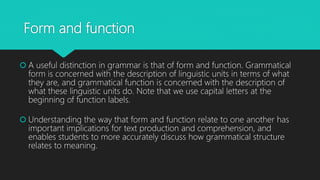
 A useful distinction in grammar is that of form and function. Grammatical
form is concerned with the description of linguistic units in terms of what
they are, and grammatical function is concerned with the description of
what these linguistic units do. Note that we use capital letters at the
beginning of function labels.
 Understanding the way that form and function relate to one another has
important implications for text production and comprehension, and
enables students to more accurately discuss how grammatical structure
relates to meaning.
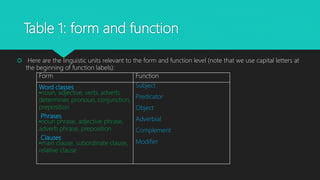
Table 1: form and function
 Here are the linguistic units relevant to the form and function level (note that we use capital letters at
the beginning of function labels):
Form Function
Word classes
•noun, adjective, verb, adverb,
determiner, pronoun, conjunction,
preposition
Phrases
•noun phrase, adjective phrase,
adverb phrase, preposition
Clauses
•main clause, subordinate clause,
relative clause
Subject
Predicator
Object
Adverbial
Complement
Modifier
Form and function
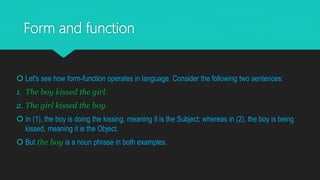
 Let's see how form-function operates in language. Consider the following two sentences:
1. The boy kissed the girl.
2. The girl kissed the boy.
 In (1), the boy is doing the kissing, meaning it is the Subject; whereas in (2), the boy is being
kissed, meaning it is the Object.
 But the boy is a noun phrase in both examples.
Form and function
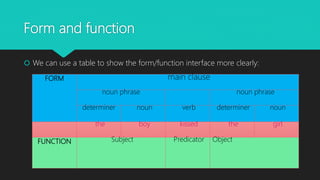
 We can use a table to show the form/function interface more clearly:
FORM main clause
noun phrase noun phrase
determiner noun verb determiner noun
the boy kissed the girl
FUNCTION Subject Predicator Object
Form and function
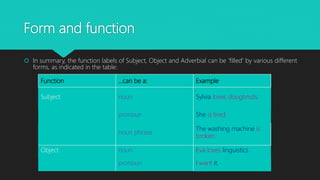
 In summary, the function labels of Subject, Object and Adverbial can be 'filled' by various different
forms, as indicated in the table:
Function …can be a: Example
Subject noun Sylvia loves doughnuts.
pronoun She is tired.
noun phrase
The washing machine is
broken.
Object noun Eva loves linguistics.
pronoun I want it.
Form and function
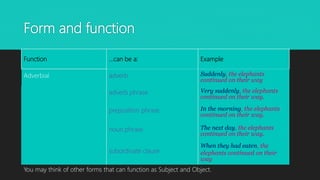
Function …can be a: Example
Adverbial adverb Suddenly, the elephants
continued on their way
adverb phrase Very suddenly, the elephants
continued on their way.
preposition phrase In the morning, the elephants
continued on their way.
noun phrase The next day, the elephants
continued on their way.
subordinate clause
When they had eaten, the
elephants continued on their
way
You may think of other forms that can function as Subject and Object.
Form and function
 If you want to read more about form and function, have a look at these pages on Bas Aarts'
blog:
 Form and Function
https://grammarianism.wordpress.com/2015/09/11/form-and-function/
 Form and Function 2
https://grammarianism.wordpress.com/2017/03/20/form-and-function-2/
 Adverb and Adverbial
https://grammarianism.wordpress.com/2016/10/15/adverb-and-adverbial/
THANK YOU
http://www.englicious.org/lesson/form-and-
function#:~:text=Grammatical%20form%20is%20concerned%20with,the%20beginning%20of%20function%20
labels.

Grammatical form and grammatical function

  • 1.
    Grammatical Form and GrammaticalFunction By: Ibrahim Muneer
  • 2.
    Form and function A useful distinction in grammar is that of form and function. Grammatical form is concerned with the description of linguistic units in terms of what they are, and grammatical function is concerned with the description of what these linguistic units do. Note that we use capital letters at the beginning of function labels.  Understanding the way that form and function relate to one another has important implications for text production and comprehension, and enables students to more accurately discuss how grammatical structure relates to meaning.
  • 3.
    Table 1: formand function  Here are the linguistic units relevant to the form and function level (note that we use capital letters at the beginning of function labels): Form Function Word classes •noun, adjective, verb, adverb, determiner, pronoun, conjunction, preposition Phrases •noun phrase, adjective phrase, adverb phrase, preposition Clauses •main clause, subordinate clause, relative clause Subject Predicator Object Adverbial Complement Modifier
  • 4.
    Form and function Let's see how form-function operates in language. Consider the following two sentences: 1. The boy kissed the girl. 2. The girl kissed the boy.  In (1), the boy is doing the kissing, meaning it is the Subject; whereas in (2), the boy is being kissed, meaning it is the Object.  But the boy is a noun phrase in both examples.
  • 5.
    Form and function We can use a table to show the form/function interface more clearly: FORM main clause noun phrase noun phrase determiner noun verb determiner noun the boy kissed the girl FUNCTION Subject Predicator Object
  • 6.
    Form and function In summary, the function labels of Subject, Object and Adverbial can be 'filled' by various different forms, as indicated in the table: Function …can be a: Example Subject noun Sylvia loves doughnuts. pronoun She is tired. noun phrase The washing machine is broken. Object noun Eva loves linguistics. pronoun I want it.
  • 7.
    Form and function Function…can be a: Example Adverbial adverb Suddenly, the elephants continued on their way adverb phrase Very suddenly, the elephants continued on their way. preposition phrase In the morning, the elephants continued on their way. noun phrase The next day, the elephants continued on their way. subordinate clause When they had eaten, the elephants continued on their way You may think of other forms that can function as Subject and Object.
  • 8.
    Form and function If you want to read more about form and function, have a look at these pages on Bas Aarts' blog:  Form and Function https://grammarianism.wordpress.com/2015/09/11/form-and-function/  Form and Function 2 https://grammarianism.wordpress.com/2017/03/20/form-and-function-2/  Adverb and Adverbial https://grammarianism.wordpress.com/2016/10/15/adverb-and-adverbial/
  • 9.