It is the branch of linguistics that studies the internal
    structure of words.
Morphology means the study of morphemes and
    their combination in words.
Morphology involves a research for minimal units,
    and build up new vocabulary obtaining
    proficiency and competence as components of the
    English language. An appropriate pool of words,
    to learn how to form new ones, to understand
    their structure is necessary as well as the meaning
    and the ability to use them correctly in
    grammatical structures.
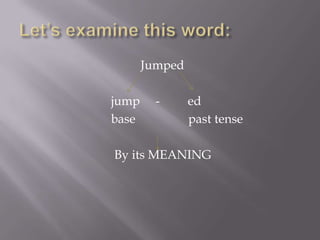
Jumped

jump     -      ed
base            past tense

By its MEANING
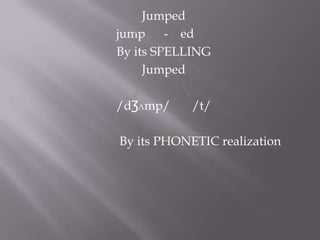
Jumped
jump - ed
By its SPELLING
     Jumped

/dƷʌmp/     /t/

By its PHONETIC realization
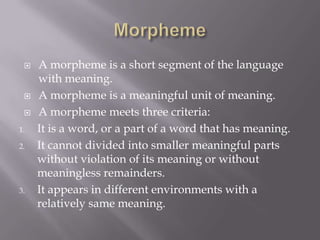
   A morpheme is a short segment of the language
     with meaning.
    A morpheme is a meaningful unit of meaning.
    A morpheme meets three criteria:
1.   It is a word, or a part of a word that has meaning.
2.   It cannot divided into smaller meaningful parts
     without violation of its meaning or without
     meaningless remainders.
3.   It appears in different environments with a
     relatively same meaning.
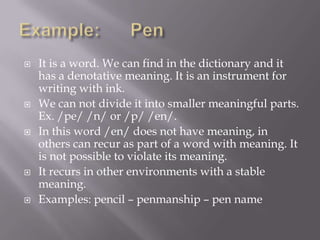
   It is a word. We can find in the dictionary and it
    has a denotative meaning. It is an instrument for
    writing with ink.
   We can not divide it into smaller meaningful parts.
    Ex. /pe/ /n/ or /p/ /en/.
   In this word /en/ does not have meaning, in
    others can recur as part of a word with meaning. It
    is not possible to violate its meaning.
   It recurs in other environments with a stable
    meaning.
   Examples: pencil – penmanship – pen name
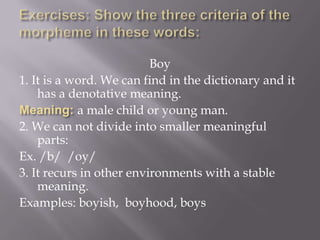
Boy
1. It is a word. We can find in the dictionary and it
    has a denotative meaning.
            a male child or young man.
2. We can not divide into smaller meaningful
    parts:
Ex. /b/ /oy/
3. It recurs in other environments with a stable
    meaning.
Examples: boyish, boyhood, boys
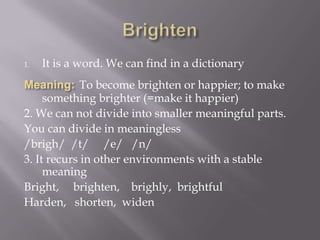
1.   It is a word. We can find in a dictionary
             To become brighten or happier; to make
     something brighter (=make it happier)
2. We can not divide into smaller meaningful parts.
You can divide in meaningless
/brigh/ /t/ /e/ /n/
3. It recurs in other environments with a stable
     meaning
Bright, brighten, brighly, brightful
Harden, shorten, widen
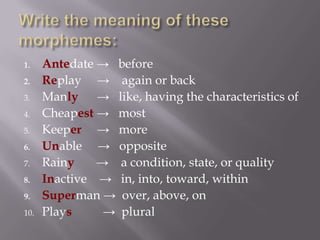
1.    Antedate → before
2.    Replay → again or back
3.    Manly → like, having the characteristics of
4.    Cheapest → most
5.    Keeper → more
6.    Unable → opposite
7.    Rainy    → a condition, state, or quality
8.    Inactive → in, into, toward, within
9.    Superman → over, above, on
10.   Plays     → plural
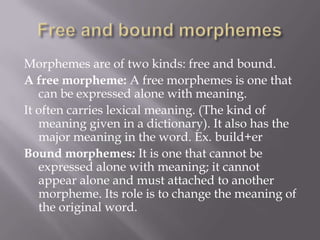
Morphemes are of two kinds: free and bound.
A free morpheme: A free morphemes is one that
   can be expressed alone with meaning.
It often carries lexical meaning. (The kind of
   meaning given in a dictionary). It also has the
   major meaning in the word. Ex. build+er
Bound morphemes: It is one that cannot be
   expressed alone with meaning; it cannot
   appear alone and must attached to another
   morpheme. Its role is to change the meaning of
   the original word.
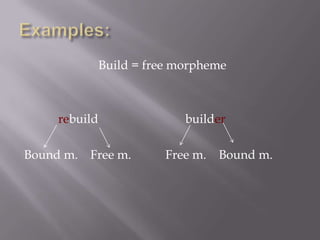
Build = free morpheme


     rebuild                 builder

Bound m.   Free m.        Free m.   Bound m.
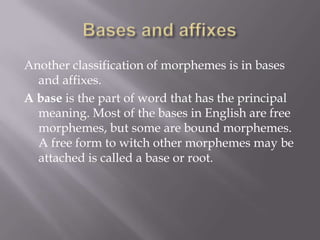
Another classification of morphemes is in bases
  and affixes.
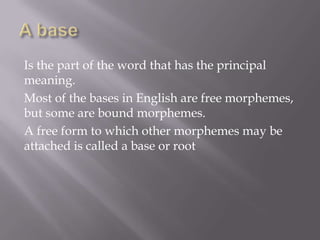
A base is the part of word that has the principal
  meaning. Most of the bases in English are free
  morphemes, but some are bound morphemes.
  A free form to witch other morphemes may be
  attached is called a base or root.
Is the part of the word that has the principal
meaning.
Most of the bases in English are free morphemes,
but some are bound morphemes.
A free form to which other morphemes may be
attached is called a base or root
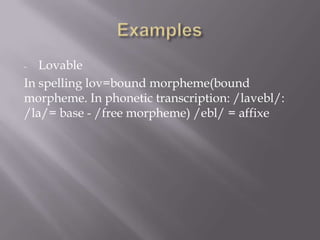
-  Lovable
In spelling lov=bound morpheme(bound
morpheme. In phonetic transcription: /lavebl/:
/la/= base - /free morpheme) /ebl/ = affixe
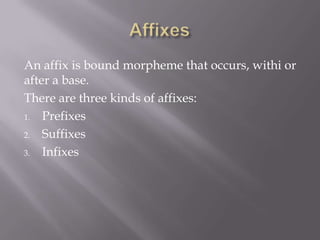
An affix is bound morpheme that occurs, withi or
after a base.
There are three kinds of affixes:
1. Prefixes

2. Suffixes

3. Infixes
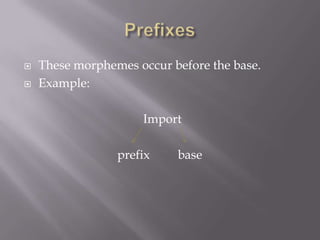
   These morphemes occur before the base.
   Example:

                     Import

                 prefix    base
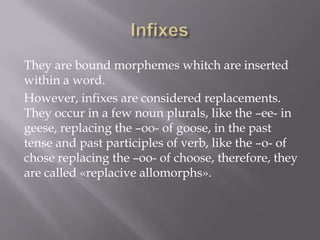
They are bound morphemes whitch are inserted
within a word.
However, infixes are considered replacements.
They occur in a few noun plurals, like the –ee- in
geese, replacing the –oo- of goose, in the past
tense and past participles of verb, like the –o- of
chose replacing the –oo- of choose, therefore, they
are called «replacive allomorphs».
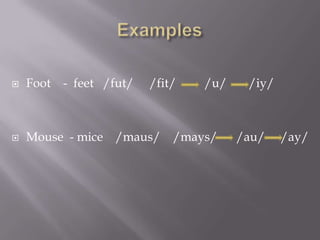
   Foot - feet /fut/   /fit/   /u/    /iy/


   Mouse - mice /maus/     /mays/    /au/    /ay/
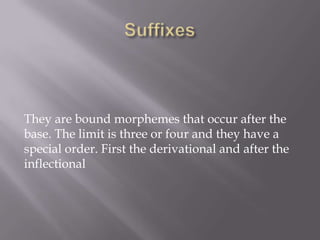
They are bound morphemes that occur after the
base. The limit is three or four and they have a
special order. First the derivational and after the
inflectional
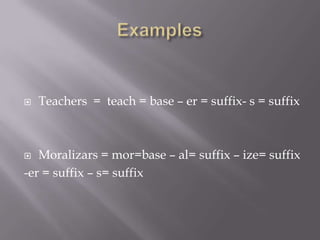
   Teachers = teach = base – er = suffix- s = suffix


  Moralizars = mor=base – al= suffix – ize= suffix
-er = suffix – s= suffix

Morphology por Diego Duma

  • 2.
    It is thebranch of linguistics that studies the internal structure of words. Morphology means the study of morphemes and their combination in words. Morphology involves a research for minimal units, and build up new vocabulary obtaining proficiency and competence as components of the English language. An appropriate pool of words, to learn how to form new ones, to understand their structure is necessary as well as the meaning and the ability to use them correctly in grammatical structures.
  • 3.
    Jumped jump - ed base past tense By its MEANING
  • 4.
    Jumped jump - ed Byits SPELLING Jumped /dƷʌmp/ /t/ By its PHONETIC realization
  • 5.
    A morpheme is a short segment of the language with meaning.  A morpheme is a meaningful unit of meaning.  A morpheme meets three criteria: 1. It is a word, or a part of a word that has meaning. 2. It cannot divided into smaller meaningful parts without violation of its meaning or without meaningless remainders. 3. It appears in different environments with a relatively same meaning.
  • 6.
    It is a word. We can find in the dictionary and it has a denotative meaning. It is an instrument for writing with ink.  We can not divide it into smaller meaningful parts. Ex. /pe/ /n/ or /p/ /en/.  In this word /en/ does not have meaning, in others can recur as part of a word with meaning. It is not possible to violate its meaning.  It recurs in other environments with a stable meaning.  Examples: pencil – penmanship – pen name
  • 7.
    Boy 1. It isa word. We can find in the dictionary and it has a denotative meaning. a male child or young man. 2. We can not divide into smaller meaningful parts: Ex. /b/ /oy/ 3. It recurs in other environments with a stable meaning. Examples: boyish, boyhood, boys
  • 8.
    1. It is a word. We can find in a dictionary To become brighten or happier; to make something brighter (=make it happier) 2. We can not divide into smaller meaningful parts. You can divide in meaningless /brigh/ /t/ /e/ /n/ 3. It recurs in other environments with a stable meaning Bright, brighten, brighly, brightful Harden, shorten, widen
  • 9.
    1. Antedate → before 2. Replay → again or back 3. Manly → like, having the characteristics of 4. Cheapest → most 5. Keeper → more 6. Unable → opposite 7. Rainy → a condition, state, or quality 8. Inactive → in, into, toward, within 9. Superman → over, above, on 10. Plays → plural
  • 10.
    Morphemes are oftwo kinds: free and bound. A free morpheme: A free morphemes is one that can be expressed alone with meaning. It often carries lexical meaning. (The kind of meaning given in a dictionary). It also has the major meaning in the word. Ex. build+er Bound morphemes: It is one that cannot be expressed alone with meaning; it cannot appear alone and must attached to another morpheme. Its role is to change the meaning of the original word.
  • 11.
    Build = freemorpheme rebuild builder Bound m. Free m. Free m. Bound m.
  • 12.
    Another classification ofmorphemes is in bases and affixes. A base is the part of word that has the principal meaning. Most of the bases in English are free morphemes, but some are bound morphemes. A free form to witch other morphemes may be attached is called a base or root.
  • 13.
    Is the partof the word that has the principal meaning. Most of the bases in English are free morphemes, but some are bound morphemes. A free form to which other morphemes may be attached is called a base or root
  • 14.
    - Lovable Inspelling lov=bound morpheme(bound morpheme. In phonetic transcription: /lavebl/: /la/= base - /free morpheme) /ebl/ = affixe
  • 15.
    An affix isbound morpheme that occurs, withi or after a base. There are three kinds of affixes: 1. Prefixes 2. Suffixes 3. Infixes
  • 16.
    These morphemes occur before the base.  Example: Import prefix base
  • 17.
    They are boundmorphemes whitch are inserted within a word. However, infixes are considered replacements. They occur in a few noun plurals, like the –ee- in geese, replacing the –oo- of goose, in the past tense and past participles of verb, like the –o- of chose replacing the –oo- of choose, therefore, they are called «replacive allomorphs».
  • 18.
    Foot - feet /fut/ /fit/ /u/ /iy/  Mouse - mice /maus/ /mays/ /au/ /ay/
  • 19.
    They are boundmorphemes that occur after the base. The limit is three or four and they have a special order. First the derivational and after the inflectional
  • 20.
    Teachers = teach = base – er = suffix- s = suffix  Moralizars = mor=base – al= suffix – ize= suffix -er = suffix – s= suffix