PRESENTATION
ON
MONOPOLY
Presented By :-
Ankit Kumar Gupta
Azad
Devarshi Narda
Ritik kochar
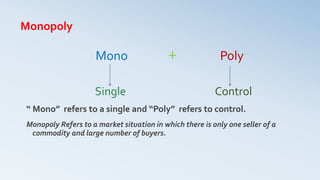
Monopoly
Mono + Poly
Single Control
“ Mono” refers to a single and “Poly” refers to control.
Monopoly Refers to a market situation in which there is only one seller of a
commodity and large number of buyers.
INTRODUCTION
 A Monopoly is a market structure in which there is a
single supplier of a product.
 Monopolies exist because of barriers to entry into a
market that prevent competition.
 The monopoly firm (Monopolist) :
 May be small or large.
 Must be the only supplier of the product.
 Sells a product for which there are only close
substitutes.
Types of Monopoly
 Natural Monopoly : A Monopoly that arises from
economies of scale.The economies of scale arise from natural
supply and demand conditions, and not from government
actions.
 Local Monopoly : A Monopoly that exists in a limited
geographic area.
 Regulated Monopoly : A Monopoly firm whose behaviour
is overseen by a government entity.
 Monopoly Power : Market Power, the power to set prices.
 Monopolization : An attempt by a firm to dominate a
market or become a monopoly.
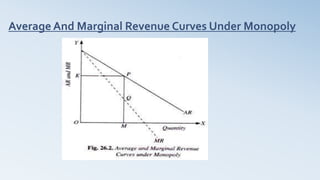
Average And Marginal Revenue Under Monopoly
 In the Case of Monopoly one firm
Constitutes the whole industry.Therefore,
the entire demand of the consumers for a
product faces the monopolist. Since the
demand curve of the consumers for a
product slopes downward, the monopolist
faces a downward sloping demand curve.
Average And Marginal Revenue Curves Under Monopoly
Explanation Of Average & Marginal Curve Under Monopoly
• If the monopoly is price maker firm they cannot
determine both price and quantity at the same time,
they can decide either price or quantity.
• The shape of the Curve is downward because if
monopoly firm wants to maximize their profit or they
want to sell quantity more than they have to decrease
their price level, so Demand Curve is Downward Sloping
Curve .
Characteristics of Monopoly
• There is only a single seller of a product or service in the market.
• The goods produced by a sole seller have not close substitutes.
• The entry of new firm into the new firm into the industry is
effectively bared by legal or natural barriers.
• The firm being the sole supplier of a product constitutes
industry. Firm and industry thus have single identity.
BARRIER TO ENTRY
 Anything that impedes the ability of firms to begin a new
business in an industry in which existing firms are earning
positive economic profits.
 There are general classes of barriers to entry :
 Natural barriers
 Technological barriers
 Sociological barriers
 Government (legal) barriers
 Natural barriers -The firm has a unique ability to produce what other
firms can’t duplicate.
 Technological barriers -The Size of the market can support only one
firm.
Sociological barriers - Entry is prevented by custom or tradition.
 Government barriers - Governments often provide barriers,
creating monopolies. As incentives to innovation, governments often
grant patents, providing firms with legal monopolies on their
products or the use of their inventions or discoveries for a certain
period.
MONOPOLY PRICE DISCRIMINATION
 The practice on the part of the monopolist
to sell the identical goods at the same time
to different buyers at different prices when
the price difference is not justified by in
difference in cost is called Price
Discrimination.
INDIAN RAILWAYS AS A MONOPOLY (Introduction)
• Indian Railways is the state-owned railway company of India.
• Indian Railways has a monopoly on the country’s rail transport.
• It is one of the largest and busiest rail network in the world,
transporting just over six billion passengers and almost 750
million tones of goods annually.
• Indian Railways is a publically owned company controlled by
ministry of Railways ( Government of India) .
Why Indian Railways is Considered as a MONOPOLY ?
 Single Seller Many Buyers.
 No Substitutes ‘not even close’
 Closed Entry
Price Maker
Price Discrimination
 Senior Citizen
 Students
 Army Officials,etc.
HINDUSTAN AERONAUTICS LIMITED (HAL) AS A
MONOPOLY (INTRODUCTION)
• Mission – “To become a global player in the Aerospace Industry”
• Hindustan Aeronautics Limited is the largest Public Sector
Undertaking under the Department of Defence Production and
is a Navratna Company.
• HAL is one of the largest Aerospace Companies in Asia with its
annual turnover to be running above us$ 2 billion.
• It has Several facilities throughout India including Nasik,
Kanpur, Lucknow, Bangalore and Hyderabad.
WHY HINDUSTAN AERONAUTICS LIMITED IS
CONSIDERED AS A MONOPOLY ?
Single Seller Many Buyers.
 No Competition ‘not even close’
HAL competes with only One that is HAL
 A very Big Name Due to their Art of manufacturing of misiles
and other Air Crafts.
Price Maker
Conclusion
 Market Structure with one producer .
 Entry of firm is ban unique product or no
close substitute firm is price maker.
 The monopolist can take the market
demand curve as its own demand curve.
A monopolist therefore faces a downward
sloping.

Monopoly

  • 1.
    PRESENTATION ON MONOPOLY Presented By :- AnkitKumar Gupta Azad Devarshi Narda Ritik kochar
  • 2.
    Monopoly Mono + Poly SingleControl “ Mono” refers to a single and “Poly” refers to control. Monopoly Refers to a market situation in which there is only one seller of a commodity and large number of buyers.
  • 3.
    INTRODUCTION  A Monopolyis a market structure in which there is a single supplier of a product.  Monopolies exist because of barriers to entry into a market that prevent competition.  The monopoly firm (Monopolist) :  May be small or large.  Must be the only supplier of the product.  Sells a product for which there are only close substitutes.
  • 4.
    Types of Monopoly Natural Monopoly : A Monopoly that arises from economies of scale.The economies of scale arise from natural supply and demand conditions, and not from government actions.  Local Monopoly : A Monopoly that exists in a limited geographic area.  Regulated Monopoly : A Monopoly firm whose behaviour is overseen by a government entity.  Monopoly Power : Market Power, the power to set prices.  Monopolization : An attempt by a firm to dominate a market or become a monopoly.
  • 5.
    Average And MarginalRevenue Under Monopoly  In the Case of Monopoly one firm Constitutes the whole industry.Therefore, the entire demand of the consumers for a product faces the monopolist. Since the demand curve of the consumers for a product slopes downward, the monopolist faces a downward sloping demand curve.
  • 6.
    Average And MarginalRevenue Curves Under Monopoly
  • 7.
    Explanation Of Average& Marginal Curve Under Monopoly • If the monopoly is price maker firm they cannot determine both price and quantity at the same time, they can decide either price or quantity. • The shape of the Curve is downward because if monopoly firm wants to maximize their profit or they want to sell quantity more than they have to decrease their price level, so Demand Curve is Downward Sloping Curve .
  • 8.
    Characteristics of Monopoly •There is only a single seller of a product or service in the market. • The goods produced by a sole seller have not close substitutes. • The entry of new firm into the new firm into the industry is effectively bared by legal or natural barriers. • The firm being the sole supplier of a product constitutes industry. Firm and industry thus have single identity.
  • 9.
    BARRIER TO ENTRY Anything that impedes the ability of firms to begin a new business in an industry in which existing firms are earning positive economic profits.  There are general classes of barriers to entry :  Natural barriers  Technological barriers  Sociological barriers  Government (legal) barriers
  • 10.
     Natural barriers-The firm has a unique ability to produce what other firms can’t duplicate.  Technological barriers -The Size of the market can support only one firm. Sociological barriers - Entry is prevented by custom or tradition.  Government barriers - Governments often provide barriers, creating monopolies. As incentives to innovation, governments often grant patents, providing firms with legal monopolies on their products or the use of their inventions or discoveries for a certain period.
  • 11.
    MONOPOLY PRICE DISCRIMINATION The practice on the part of the monopolist to sell the identical goods at the same time to different buyers at different prices when the price difference is not justified by in difference in cost is called Price Discrimination.
  • 12.
    INDIAN RAILWAYS ASA MONOPOLY (Introduction) • Indian Railways is the state-owned railway company of India. • Indian Railways has a monopoly on the country’s rail transport. • It is one of the largest and busiest rail network in the world, transporting just over six billion passengers and almost 750 million tones of goods annually. • Indian Railways is a publically owned company controlled by ministry of Railways ( Government of India) .
  • 13.
    Why Indian Railwaysis Considered as a MONOPOLY ?  Single Seller Many Buyers.  No Substitutes ‘not even close’  Closed Entry Price Maker Price Discrimination  Senior Citizen  Students  Army Officials,etc.
  • 14.
    HINDUSTAN AERONAUTICS LIMITED(HAL) AS A MONOPOLY (INTRODUCTION) • Mission – “To become a global player in the Aerospace Industry” • Hindustan Aeronautics Limited is the largest Public Sector Undertaking under the Department of Defence Production and is a Navratna Company. • HAL is one of the largest Aerospace Companies in Asia with its annual turnover to be running above us$ 2 billion. • It has Several facilities throughout India including Nasik, Kanpur, Lucknow, Bangalore and Hyderabad.
  • 15.
    WHY HINDUSTAN AERONAUTICSLIMITED IS CONSIDERED AS A MONOPOLY ? Single Seller Many Buyers.  No Competition ‘not even close’ HAL competes with only One that is HAL  A very Big Name Due to their Art of manufacturing of misiles and other Air Crafts. Price Maker
  • 16.
    Conclusion  Market Structurewith one producer .  Entry of firm is ban unique product or no close substitute firm is price maker.  The monopolist can take the market demand curve as its own demand curve. A monopolist therefore faces a downward sloping.