PROVINCE OF THE EASTERN CAPE
ECONOMICS
GRADE 12
2020
TOPIC: MONOPOLY
COMPILED BY: S.S. DINGE
1
The dynamics of imperfect market
• Imperfect markets are characterised by
imperfect competition
• One of the conditions of perfect competition
is not satisfied
• Imperfect markets include:
– Monopoly
– Oligopoly
– Monopolistic competition
2
Monopoly
• A market structure with only one producer and seller
of a product or services
• There is usually no close substitute
• Many barriers to entry
• This lack of competitors results in 3 harmful things:
– Less output is produced than in a competitive
environment
– The output is sold for more than the market price would
be if the industry was competitive
– Production is less efficient and costs more than in a
competitive environment
3
Characteristics of monopoly
• There is no competition (one supplier/business)
• The products are unique with no close substitutes
• They are still faced by demand curves
– But because they are the only supplier, they can decide
where on the demand curve they want to be
• They have considerable control over the price
– They can decide on production levels, increasing or
decreasing prices accordingly
• They are exposed to market forces (consumers have
limited budgets
– Monopolies must still compete with all other products
available in the economy
4
Characteristics of monopoly
• They can face substitutes
– They are very few products that have absolutely no
substitutes
– E.g. although there is one supplier of electricity, you can
still use gas to cook or generator to produce electricity
• They are likely to exploit the consumer, because they
are the only supplier of a product
– Most governments guard against this
• They are protected by barriers to entry;
– Legal restriction
• Through government acts, which grant exclusive rights e.g. post
office
5
Characteristics of monopoly
– Patents
• Are legal rights whereby the patent holder obtains exclusive
rights to manufacture a product
– High start-up or development cost
• E.g. it costs a lot to build a power station or buy a fleet of
airplanes (natural monopoly)
– Licensing
• One can only operate if granted a license by government,
e.g. telephone service providers & TV broadcasting
– Technical superiority
• When a business’ technical expertise vastly exceeds its
competitors, it can dominate the market, e.g. microsoft
6
Cost and Revenue Curves
• NB: unlike the perfect competitor, the
production of the monopolist makes up the
total production for the market
• The monopolist therefore faces a normal
market demand curve (one which slopes
downwards from left to right)
7
8
D = AR
MR
Price
=
average
revenue
P1
P2
D
Quantity
Q1 Q2
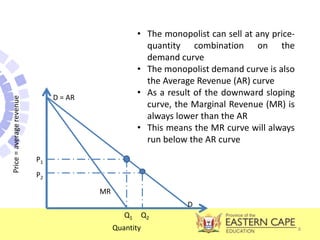
• The monopolist can sell at any price-
quantity combination on the
demand curve
• The monopolist demand curve is also
the Average Revenue (AR) curve
• As a result of the downward sloping
curve, the Marginal Revenue (MR) is
always lower than the AR
• This means the MR curve will always
run below the AR curve
9
D = AR
MR
Price
=
average
revenue
P1
P2
D
Quantity
Q1 Q2
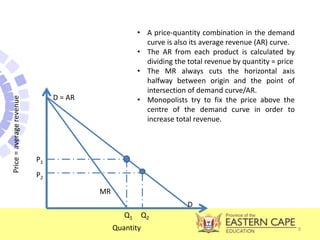
• A price-quantity combination in the demand
curve is also its average revenue (AR) curve.
• The AR from each product is calculated by
dividing the total revenue by quantity = price
• The MR always cuts the horizontal axis
halfway between origin and the point of
intersection of demand curve/AR.
• Monopolists try to fix the price above the
centre of the demand curve in order to
increase total revenue.
Revenue in a monopoly
MR
AR
Costs
and
Revenue
P2
P1
Q1
Quantity
The monopolist is a price-maker. The
level of output is determined by the
demand for the goods and /or
service that the monopolist
provides. In the case of a monopoly
the demand curve is the firm’s
average revenue curve.
Total revenue is calculated using the
following formulae:
Price x Quantity
In this case P1 x Q1. Please note
that the elasticity for the demand
curve for the monopolist changes
depending upon the price at which
and goods are sold - please see the
adjacent diagram.
Elastic demand
Unit elastic demand
Inelastic
demand
11
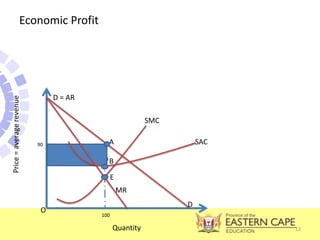
Economic Profit
D = AR
MR
Price
=
average
revenue
P1
D
Quantity
Q1
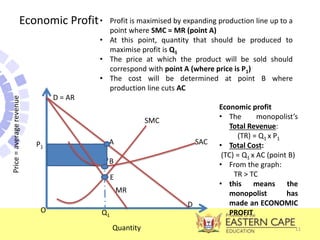
• Profit is maximised by expanding production line up to a
point where SMC = MR (point A)
• At this point, quantity that should be produced to
maximise profit is Q1
• The price at which the product will be sold should
correspond with point A (where price is P1)
• The cost will be determined at point B where
production line cuts AC
SMC
SAC
O
E
B
A
Economic profit
• The monopolist’s
Total Revenue:
(TR) = Q1 x P1
• Total Cost:
(TC) = Q1 x AC (point B)
• From the graph:
TR > TC
• this means the
monopolist has
made an ECONOMIC
PROFIT
12
Economic Profit
D = AR
MR
Price
=
average
revenue
90
D
Quantity
100
SMC
SAC
O
E
B
A
13
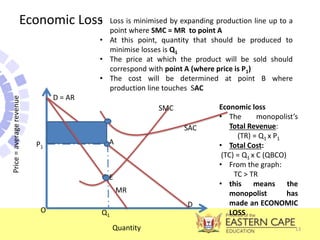
Economic Loss
D = AR
MR
Price
=
average
revenue
P1
D
Quantity
Q1
• Loss is minimised by expanding production line up to a
point where SMC = MR to point A
• At this point, quantity that should be produced to
minimise losses is Q1
• The price at which the product will be sold should
correspond with point A (where price is P1)
• The cost will be determined at point B where
production line touches SAC
SMC
SAC
O
E
A
Economic loss
• The monopolist’s
Total Revenue:
(TR) = Q1 x P1
• Total Cost:
(TC) = Q1 x C (QBCO)
• From the graph:
TC > TR
• this means the
monopolist has
made an ECONOMIC
LOSS
Short term Losses
Economic loss can only be for a short time as
monopolist as price setters will soon raise the
price to cover losses.
In a short term Monopolists can have economic
loss.
14
15
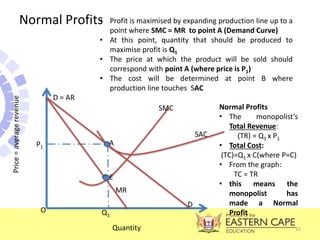
Normal Profits
D = AR
MR
Price
=
average
revenue
P1
D
Quantity
Q1
• Profit is maximised by expanding production line up to a
point where SMC = MR to point A (Demand Curve)
• At this point, quantity that should be produced to
maximise profit is Q1
• The price at which the product will be sold should
correspond with point A (where price is P1)
• The cost will be determined at point B where
production line touches SAC
SMC
SAC
O
E
A
Normal Profits
• The monopolist’s
Total Revenue:
(TR) = Q1 x P1
• Total Cost:
(TC)=Q1 x C(where P=C)
• From the graph:
TC = TR
• this means the
monopolist has
made a Normal
Profit
Monopoly vs Perfect market
• Monopoly
Downward sloping Demand
curve
MR lies below demand
curve
Price setter
Individual business is the
industry(only firm)
Products differentiated
Can make economic profits
even in the long-run
• Perfect market
Horizontal Demand curve
MR curve same as demand
curve
Price-taker
Individual businesses (many)
add up to make the industry.
Product are homogenous
Only normal profit in the
long-run.
16
Summary
1. A monopolist is the sole producer in the industry.
2. The demand curve for the monopolist is a market demand
curve.
3. The average revenue curve is the demand curve.
4. Marginal revenue falls twice as steeply as the average
revenue curve.
5. Profit is maximised where MC=MR on the demand curve.
6. The monopolist is likely to earn abnormal profit because
average revenue will be above the average cost at
equilibrium level of output.
7. The monopolist can practice price discrimination.
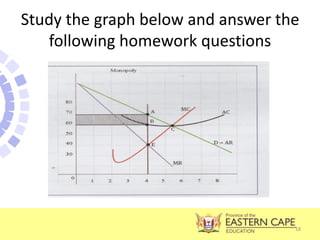
Study the graph below and answer the
following homework questions
18
Homework
1.1 Identify the price charged by the above firm. (1)
1.2 Describe the nature of the product supplied. (1)
1.3 What determines the optimum production level in a
monopoly market? (2)
1.4 Describe economic profit. (2)
1.5 Calculate the economic profit in the above scenario. Show
calculations. (4)
2. Distinguish between artificial monopoly and natural
monopoly. (8)
3. Explain why monopolist can make economic profit even in the
long-run? (8)
HOMEWORK (Day 2)
• Essay – 40 marks
Discuss the characteristics of monopoly as a
market structure. (26)
Compare and contrast the long run position of a
perfect market and that of an monopoly. (10)
20
21
22

a Economics Gr. 12 Monopoly Presentation.pdf

  • 1.
    PROVINCE OF THEEASTERN CAPE ECONOMICS GRADE 12 2020 TOPIC: MONOPOLY COMPILED BY: S.S. DINGE 1
  • 2.
    The dynamics ofimperfect market • Imperfect markets are characterised by imperfect competition • One of the conditions of perfect competition is not satisfied • Imperfect markets include: – Monopoly – Oligopoly – Monopolistic competition 2
  • 3.
    Monopoly • A marketstructure with only one producer and seller of a product or services • There is usually no close substitute • Many barriers to entry • This lack of competitors results in 3 harmful things: – Less output is produced than in a competitive environment – The output is sold for more than the market price would be if the industry was competitive – Production is less efficient and costs more than in a competitive environment 3
  • 4.
    Characteristics of monopoly •There is no competition (one supplier/business) • The products are unique with no close substitutes • They are still faced by demand curves – But because they are the only supplier, they can decide where on the demand curve they want to be • They have considerable control over the price – They can decide on production levels, increasing or decreasing prices accordingly • They are exposed to market forces (consumers have limited budgets – Monopolies must still compete with all other products available in the economy 4
  • 5.
    Characteristics of monopoly •They can face substitutes – They are very few products that have absolutely no substitutes – E.g. although there is one supplier of electricity, you can still use gas to cook or generator to produce electricity • They are likely to exploit the consumer, because they are the only supplier of a product – Most governments guard against this • They are protected by barriers to entry; – Legal restriction • Through government acts, which grant exclusive rights e.g. post office 5
  • 6.
    Characteristics of monopoly –Patents • Are legal rights whereby the patent holder obtains exclusive rights to manufacture a product – High start-up or development cost • E.g. it costs a lot to build a power station or buy a fleet of airplanes (natural monopoly) – Licensing • One can only operate if granted a license by government, e.g. telephone service providers & TV broadcasting – Technical superiority • When a business’ technical expertise vastly exceeds its competitors, it can dominate the market, e.g. microsoft 6
  • 7.
    Cost and RevenueCurves • NB: unlike the perfect competitor, the production of the monopolist makes up the total production for the market • The monopolist therefore faces a normal market demand curve (one which slopes downwards from left to right) 7
  • 8.
    8 D = AR MR Price = average revenue P1 P2 D Quantity Q1Q2 • The monopolist can sell at any price- quantity combination on the demand curve • The monopolist demand curve is also the Average Revenue (AR) curve • As a result of the downward sloping curve, the Marginal Revenue (MR) is always lower than the AR • This means the MR curve will always run below the AR curve
  • 9.
    9 D = AR MR Price = average revenue P1 P2 D Quantity Q1Q2 • A price-quantity combination in the demand curve is also its average revenue (AR) curve. • The AR from each product is calculated by dividing the total revenue by quantity = price • The MR always cuts the horizontal axis halfway between origin and the point of intersection of demand curve/AR. • Monopolists try to fix the price above the centre of the demand curve in order to increase total revenue.
  • 10.
    Revenue in amonopoly MR AR Costs and Revenue P2 P1 Q1 Quantity The monopolist is a price-maker. The level of output is determined by the demand for the goods and /or service that the monopolist provides. In the case of a monopoly the demand curve is the firm’s average revenue curve. Total revenue is calculated using the following formulae: Price x Quantity In this case P1 x Q1. Please note that the elasticity for the demand curve for the monopolist changes depending upon the price at which and goods are sold - please see the adjacent diagram. Elastic demand Unit elastic demand Inelastic demand
  • 11.
    11 Economic Profit D =AR MR Price = average revenue P1 D Quantity Q1 • Profit is maximised by expanding production line up to a point where SMC = MR (point A) • At this point, quantity that should be produced to maximise profit is Q1 • The price at which the product will be sold should correspond with point A (where price is P1) • The cost will be determined at point B where production line cuts AC SMC SAC O E B A Economic profit • The monopolist’s Total Revenue: (TR) = Q1 x P1 • Total Cost: (TC) = Q1 x AC (point B) • From the graph: TR > TC • this means the monopolist has made an ECONOMIC PROFIT
  • 12.
    12 Economic Profit D =AR MR Price = average revenue 90 D Quantity 100 SMC SAC O E B A
  • 13.
    13 Economic Loss D =AR MR Price = average revenue P1 D Quantity Q1 • Loss is minimised by expanding production line up to a point where SMC = MR to point A • At this point, quantity that should be produced to minimise losses is Q1 • The price at which the product will be sold should correspond with point A (where price is P1) • The cost will be determined at point B where production line touches SAC SMC SAC O E A Economic loss • The monopolist’s Total Revenue: (TR) = Q1 x P1 • Total Cost: (TC) = Q1 x C (QBCO) • From the graph: TC > TR • this means the monopolist has made an ECONOMIC LOSS
  • 14.
    Short term Losses Economicloss can only be for a short time as monopolist as price setters will soon raise the price to cover losses. In a short term Monopolists can have economic loss. 14
  • 15.
    15 Normal Profits D =AR MR Price = average revenue P1 D Quantity Q1 • Profit is maximised by expanding production line up to a point where SMC = MR to point A (Demand Curve) • At this point, quantity that should be produced to maximise profit is Q1 • The price at which the product will be sold should correspond with point A (where price is P1) • The cost will be determined at point B where production line touches SAC SMC SAC O E A Normal Profits • The monopolist’s Total Revenue: (TR) = Q1 x P1 • Total Cost: (TC)=Q1 x C(where P=C) • From the graph: TC = TR • this means the monopolist has made a Normal Profit
  • 16.
    Monopoly vs Perfectmarket • Monopoly Downward sloping Demand curve MR lies below demand curve Price setter Individual business is the industry(only firm) Products differentiated Can make economic profits even in the long-run • Perfect market Horizontal Demand curve MR curve same as demand curve Price-taker Individual businesses (many) add up to make the industry. Product are homogenous Only normal profit in the long-run. 16
  • 17.
    Summary 1. A monopolistis the sole producer in the industry. 2. The demand curve for the monopolist is a market demand curve. 3. The average revenue curve is the demand curve. 4. Marginal revenue falls twice as steeply as the average revenue curve. 5. Profit is maximised where MC=MR on the demand curve. 6. The monopolist is likely to earn abnormal profit because average revenue will be above the average cost at equilibrium level of output. 7. The monopolist can practice price discrimination.
  • 18.
    Study the graphbelow and answer the following homework questions 18
  • 19.
    Homework 1.1 Identify theprice charged by the above firm. (1) 1.2 Describe the nature of the product supplied. (1) 1.3 What determines the optimum production level in a monopoly market? (2) 1.4 Describe economic profit. (2) 1.5 Calculate the economic profit in the above scenario. Show calculations. (4) 2. Distinguish between artificial monopoly and natural monopoly. (8) 3. Explain why monopolist can make economic profit even in the long-run? (8)
  • 20.
    HOMEWORK (Day 2) •Essay – 40 marks Discuss the characteristics of monopoly as a market structure. (26) Compare and contrast the long run position of a perfect market and that of an monopoly. (10) 20
  • 21.
  • 22.