Producer’s Equilibrium
Group Presentation By :- iMBA Sem 1
Drashti Vaishnav Priya Ahir
Aditya Rajapara Saloni Kacha
Bhavik Rathod Meet Buddhdev
Jenil Raja Archer Vaghela
Kukreja Payal Riddhi Parekh
Twinkal Makvana Priyanka Memdavadi
Parth Laladiya
Brij Vasant
Producer’s Equilibrium
• Producer’s Equilibrium:
• Equilibrium refers to a state of rest when no
change is required. A firm (producer) is said to be
in equilibrium when it has no inclination to
expand or to contract its output. This state either
reflects maximum profits or minimum losses.
• There are two methods for determination of
Producer’s Equilibrium:
• 1. Total Revenue and Total Cost Approach (TR-TC
Approach)
• 2. Marginal Revenue and Marginal Cost Approach
(MR-MC Approach)
• Before we proceed further, we must be clear
about one more point. Producer can attain the
equilibrium level under two different situations:
• (1) When Price remains Constant. In this
situation, firm has to accept the same price as
determined by the industry. It means, any
quantity of a commodity can be sold at that
particular price.
• (2) When Price Falls with rise in output. In this
situation, firm follows its own pricing policy.
However, it can increase sales only by reducing
the price.
• A firm attains the stage of equilibrium when it
maximises its profits, i.e. when he maximises
the difference between TR and TC. After
reaching such a position, there will be no
incentive for the producer to increase or
decrease the output and the producer will be
said to be at equilibrium.
• Two essential conditions for producer’s
equilibrium are: (Assumption)
• 1)) The difference between TR and TC is
positively maximized
• 2)) Total profits fall after that level of output.
• Producer’s Equilibrium (When Price remains
Constant):
• When price remains same at all output levels ,
each producer aims to produce that level of
output at which he can earn maximum profits,
i.e. when difference between TR and TC is the
maximum. Let us understand this with the
help of Table 8.1, where market price is fixed
at Rs. 10 per unit:
Output
(units)
Price
(Rs.)
TR
(Rs.)
TC
(Rs.)
Profit =
TR-TC
(Rs.)
Remarks
0 10 0 5 -5 Profit rises
1 10 10 8 2 with increase
2 10 20 15 5 in output
3 10 30 21 9
4 10 40 31 9 Producer’s
Equilibrium
5 10 50 42 8 Profit falls
with
6 10 60 54 6 increase in
output
Producer’s Equilibrium (Price remains constant)
Output
(units)
Price
(Rs.)
TR
(Rs.)
TC
(Rs.)
Profit =
TR-TC
(Rs.)
Remarks
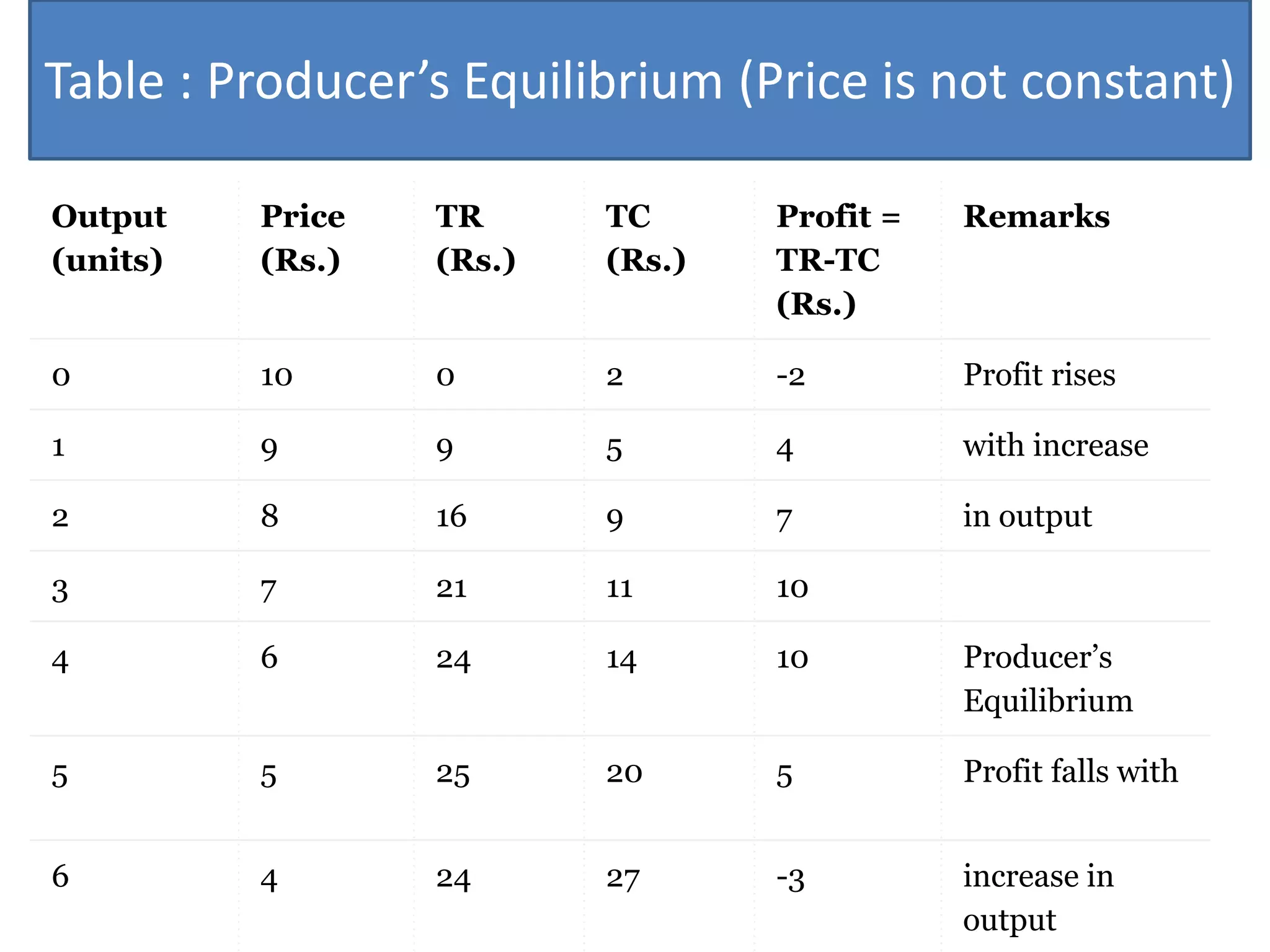
0 10 0 2 -2 Profit rises
1 9 9 5 4 with increase
2 8 16 9 7 in output
3 7 21 11 10
4 6 24 14 10 Producer’s
Equilibrium
5 5 25 20 5 Profit falls with
6 4 24 27 -3 increase in
output
Table : Producer’s Equilibrium (Price is not constant)
• Marginal Revenue-Marginal Cost Approach (MR-MC
Approach):
• According to MR-MC approach, producer’s equilibrium
refers to stage of that output level at which:
• 1. MC = MR:
• As long as MC is less than MR, it is profitable for the
producer to go on producing more because it adds to its
profits. He stops producing more only when MC becomes
equal to MR.
• 2. MC is greater than MR after MC = MR output level:
• When MC is greater than MR after equilibrium, it means
producing more will lead to decline in profits.
• Producer’s Equilibrium (When Price remains
Constant):
• When price remains constant, firms can sell
any quantity of output at the price fixed by
the market. Price remains same at all levels of
output.
• Let us understand this with the help of Table
8.3, where market price is fixed at Rs. 12 per
unit:
Output
(units)
Price
(Rs.)
TR
(Rs.)
TC
(Rs.)
MR
(Rs.)
MC
(Rs.)
Profit
= TR-
TC
(Rs.)
1 12 12 13 12 13 -1
2 12 24 25 12 12 -1
3 12 36 34 12 9 2
4 12 48 42 12 8 6
5 12 60 54 12 12 6
6 12 72 68 12 14 4
Producer’s Equilibrium is determined at OQ
level of output corresponding to point K as at
this point: (i) MC = MR; and (ii) MC is greater
than MR after MC = MR output level. In Fig.
8.3, output is shown on the X-axis and
revenue and costs on the Y-axis. Both AR and
MR curves are straight line parallel to the X-
axis. MC curve is U-shaped. Producer’s
equilibrium will be determined at OQ level of
output corresponding to point K because only
at point K, the following two conditions are
met:
1. MC = MR; and
2. MC is greater than MR after MC = MR
output level
Although MC = MR is also satisfied at point R,
but it is not the point of equilibrium as it
satisfies only the first condition (i.e. MC =
MR). So, the producer will be at equilibrium at
point K when both the conditions are
satisfied.
• Producer’s Equilibrium (When Price Falls with
rise in output):
• When there is no fixed price and price falls
with rise in output, MR curve slope
downwards. Producer aims to produce that
level of output at which MC is equal to MR
and MC curve cuts the MR curve from below.
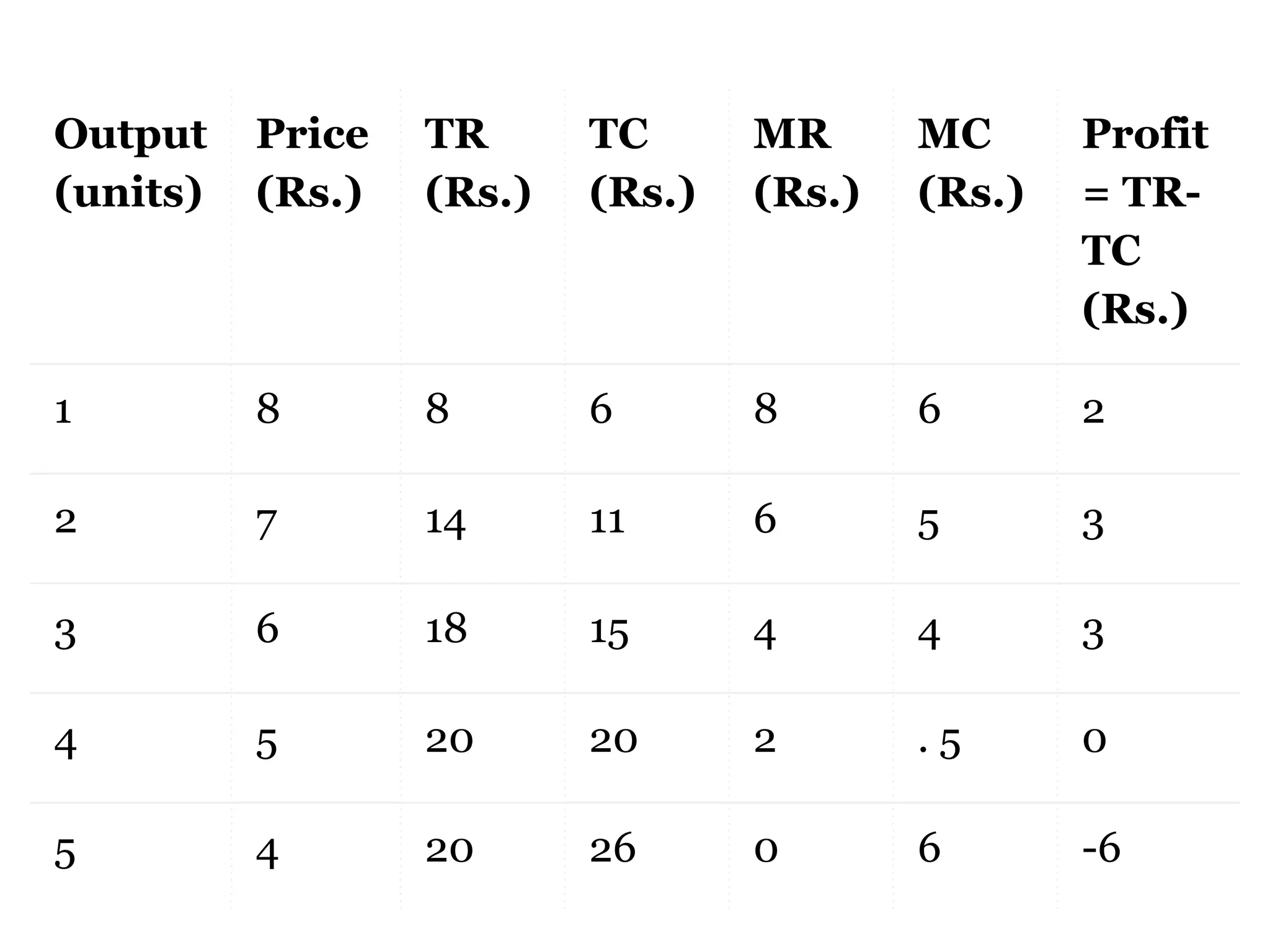
Let us understand this with the help of Table
8.4:
Output
(units)
Price
(Rs.)
TR
(Rs.)
TC
(Rs.)
MR
(Rs.)
MC
(Rs.)
Profit
= TR-
TC
(Rs.)
1 8 8 6 8 6 2
2 7 14 11 6 5 3
3 6 18 15 4 4 3
4 5 20 20 2 . 5 0
5 4 20 26 0 6 -6
Producer’s Equilibrium is determined at
OM level of output corresponding to point E
as at this point: (i) MC = MR; and (ii) MC is
greater than MR after MC = MR output
level.
In Fig. 8.4, output is shown on the X-axis
and revenue and costs on the Y-axis.
Producer’s equilibrium will be determined
at OM level of output corresponding to
point E because at this, the following two
conditions are met:
1. MC = MR; and
2. MC is greater than MR after MC = MR
output level.
So, the producer is at equilibrium at OM
units of output.
PRODUCERS EQUILIBRIUM

PRODUCERS EQUILIBRIUM

  • 1.
    Producer’s Equilibrium Group PresentationBy :- iMBA Sem 1 Drashti Vaishnav Priya Ahir Aditya Rajapara Saloni Kacha Bhavik Rathod Meet Buddhdev Jenil Raja Archer Vaghela Kukreja Payal Riddhi Parekh Twinkal Makvana Priyanka Memdavadi Parth Laladiya Brij Vasant
  • 2.
    Producer’s Equilibrium • Producer’sEquilibrium: • Equilibrium refers to a state of rest when no change is required. A firm (producer) is said to be in equilibrium when it has no inclination to expand or to contract its output. This state either reflects maximum profits or minimum losses. • There are two methods for determination of Producer’s Equilibrium: • 1. Total Revenue and Total Cost Approach (TR-TC Approach) • 2. Marginal Revenue and Marginal Cost Approach (MR-MC Approach)
  • 3.
    • Before weproceed further, we must be clear about one more point. Producer can attain the equilibrium level under two different situations: • (1) When Price remains Constant. In this situation, firm has to accept the same price as determined by the industry. It means, any quantity of a commodity can be sold at that particular price. • (2) When Price Falls with rise in output. In this situation, firm follows its own pricing policy. However, it can increase sales only by reducing the price.
  • 4.
    • A firmattains the stage of equilibrium when it maximises its profits, i.e. when he maximises the difference between TR and TC. After reaching such a position, there will be no incentive for the producer to increase or decrease the output and the producer will be said to be at equilibrium. • Two essential conditions for producer’s equilibrium are: (Assumption) • 1)) The difference between TR and TC is positively maximized • 2)) Total profits fall after that level of output.
  • 5.
    • Producer’s Equilibrium(When Price remains Constant): • When price remains same at all output levels , each producer aims to produce that level of output at which he can earn maximum profits, i.e. when difference between TR and TC is the maximum. Let us understand this with the help of Table 8.1, where market price is fixed at Rs. 10 per unit:
  • 6.
    Output (units) Price (Rs.) TR (Rs.) TC (Rs.) Profit = TR-TC (Rs.) Remarks 0 100 5 -5 Profit rises 1 10 10 8 2 with increase 2 10 20 15 5 in output 3 10 30 21 9 4 10 40 31 9 Producer’s Equilibrium 5 10 50 42 8 Profit falls with 6 10 60 54 6 increase in output Producer’s Equilibrium (Price remains constant)
  • 8.
    Output (units) Price (Rs.) TR (Rs.) TC (Rs.) Profit = TR-TC (Rs.) Remarks 0 100 2 -2 Profit rises 1 9 9 5 4 with increase 2 8 16 9 7 in output 3 7 21 11 10 4 6 24 14 10 Producer’s Equilibrium 5 5 25 20 5 Profit falls with 6 4 24 27 -3 increase in output Table : Producer’s Equilibrium (Price is not constant)
  • 10.
    • Marginal Revenue-MarginalCost Approach (MR-MC Approach): • According to MR-MC approach, producer’s equilibrium refers to stage of that output level at which: • 1. MC = MR: • As long as MC is less than MR, it is profitable for the producer to go on producing more because it adds to its profits. He stops producing more only when MC becomes equal to MR. • 2. MC is greater than MR after MC = MR output level: • When MC is greater than MR after equilibrium, it means producing more will lead to decline in profits.
  • 11.
    • Producer’s Equilibrium(When Price remains Constant): • When price remains constant, firms can sell any quantity of output at the price fixed by the market. Price remains same at all levels of output. • Let us understand this with the help of Table 8.3, where market price is fixed at Rs. 12 per unit:
  • 12.
    Output (units) Price (Rs.) TR (Rs.) TC (Rs.) MR (Rs.) MC (Rs.) Profit = TR- TC (Rs.) 1 1212 13 12 13 -1 2 12 24 25 12 12 -1 3 12 36 34 12 9 2 4 12 48 42 12 8 6 5 12 60 54 12 12 6 6 12 72 68 12 14 4
  • 13.
    Producer’s Equilibrium isdetermined at OQ level of output corresponding to point K as at this point: (i) MC = MR; and (ii) MC is greater than MR after MC = MR output level. In Fig. 8.3, output is shown on the X-axis and revenue and costs on the Y-axis. Both AR and MR curves are straight line parallel to the X- axis. MC curve is U-shaped. Producer’s equilibrium will be determined at OQ level of output corresponding to point K because only at point K, the following two conditions are met: 1. MC = MR; and 2. MC is greater than MR after MC = MR output level Although MC = MR is also satisfied at point R, but it is not the point of equilibrium as it satisfies only the first condition (i.e. MC = MR). So, the producer will be at equilibrium at point K when both the conditions are satisfied.
  • 14.
    • Producer’s Equilibrium(When Price Falls with rise in output): • When there is no fixed price and price falls with rise in output, MR curve slope downwards. Producer aims to produce that level of output at which MC is equal to MR and MC curve cuts the MR curve from below. Let us understand this with the help of Table 8.4:
  • 15.
    Output (units) Price (Rs.) TR (Rs.) TC (Rs.) MR (Rs.) MC (Rs.) Profit = TR- TC (Rs.) 1 88 6 8 6 2 2 7 14 11 6 5 3 3 6 18 15 4 4 3 4 5 20 20 2 . 5 0 5 4 20 26 0 6 -6
  • 16.
    Producer’s Equilibrium isdetermined at OM level of output corresponding to point E as at this point: (i) MC = MR; and (ii) MC is greater than MR after MC = MR output level. In Fig. 8.4, output is shown on the X-axis and revenue and costs on the Y-axis. Producer’s equilibrium will be determined at OM level of output corresponding to point E because at this, the following two conditions are met: 1. MC = MR; and 2. MC is greater than MR after MC = MR output level. So, the producer is at equilibrium at OM units of output.