PSCI 1500:
Introduction to Economics
Monetary Theory
MONEY SUPPLY & ECONOMIC ACTIVITY
REVIEW
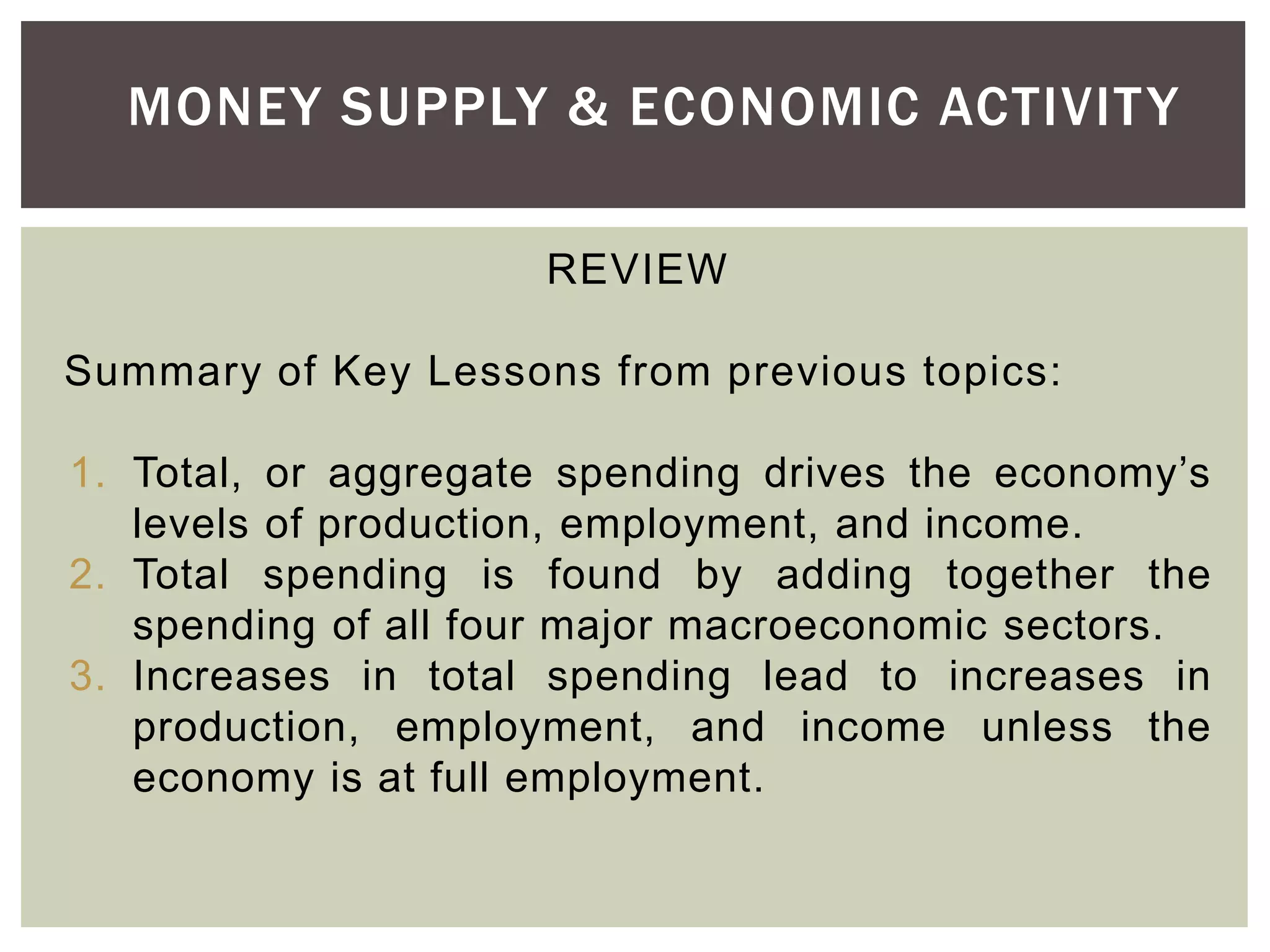
Summary of Key Lessons from previous topics:
1. Total, or aggregate spending drives the economy’s
levels of production, employment, and income.
2. Total spending is found by adding together the
spending of all four major macroeconomic sectors.
3. Increases in total spending lead to increases in
production, employment, and income unless the
economy is at full employment.
MONEY SUPPLY & ECONOMIC ACTIVITY
REVIEW
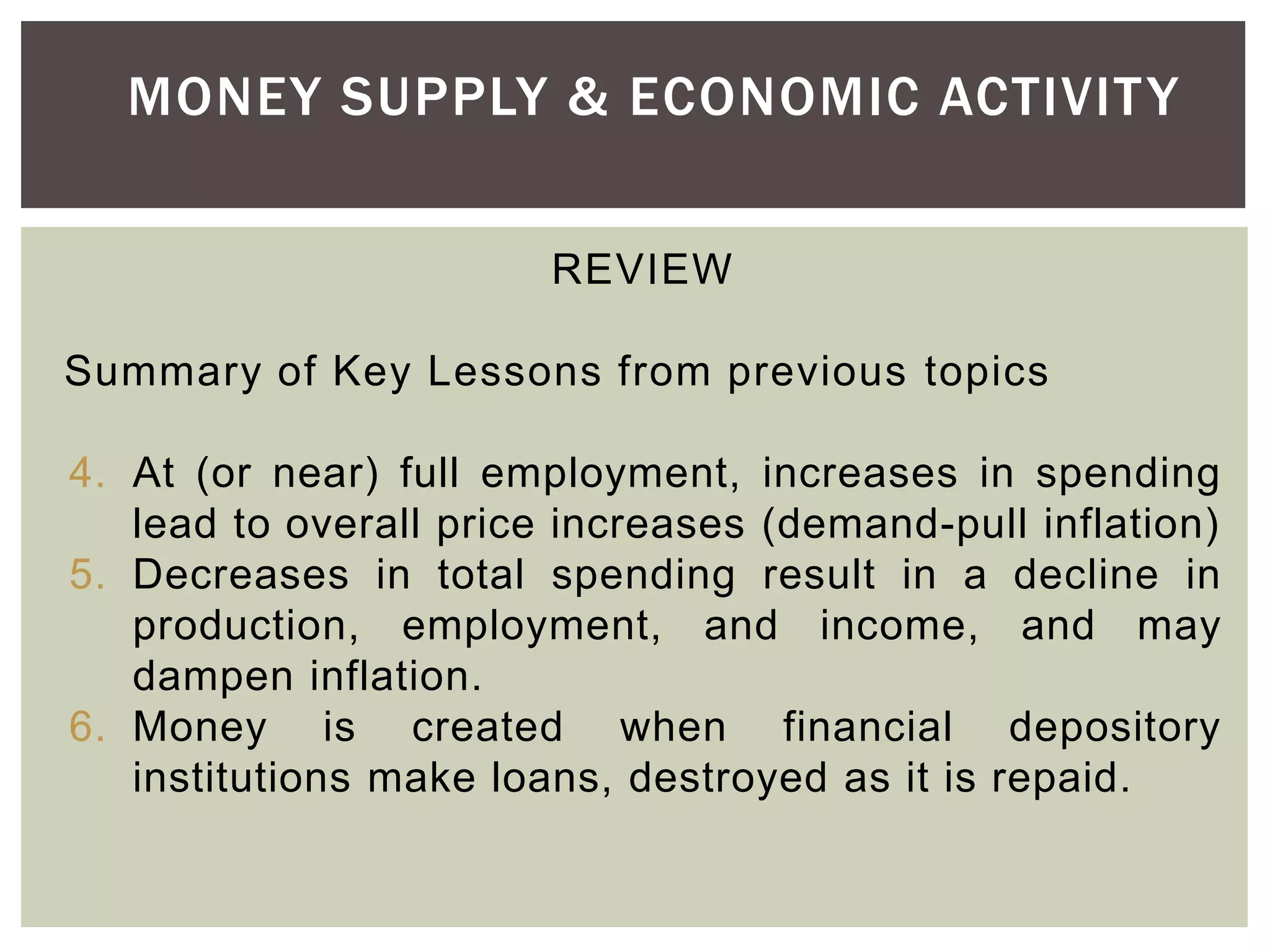
Summary of Key Lessons from previous topics
4. At (or near) full employment, increases in spending
lead to overall price increases (demand-pull inflation)
5. Decreases in total spending result in a decline in
production, employment, and income, and may
dampen inflation.
6. Money is created when financial depository
institutions make loans, destroyed as it is repaid.
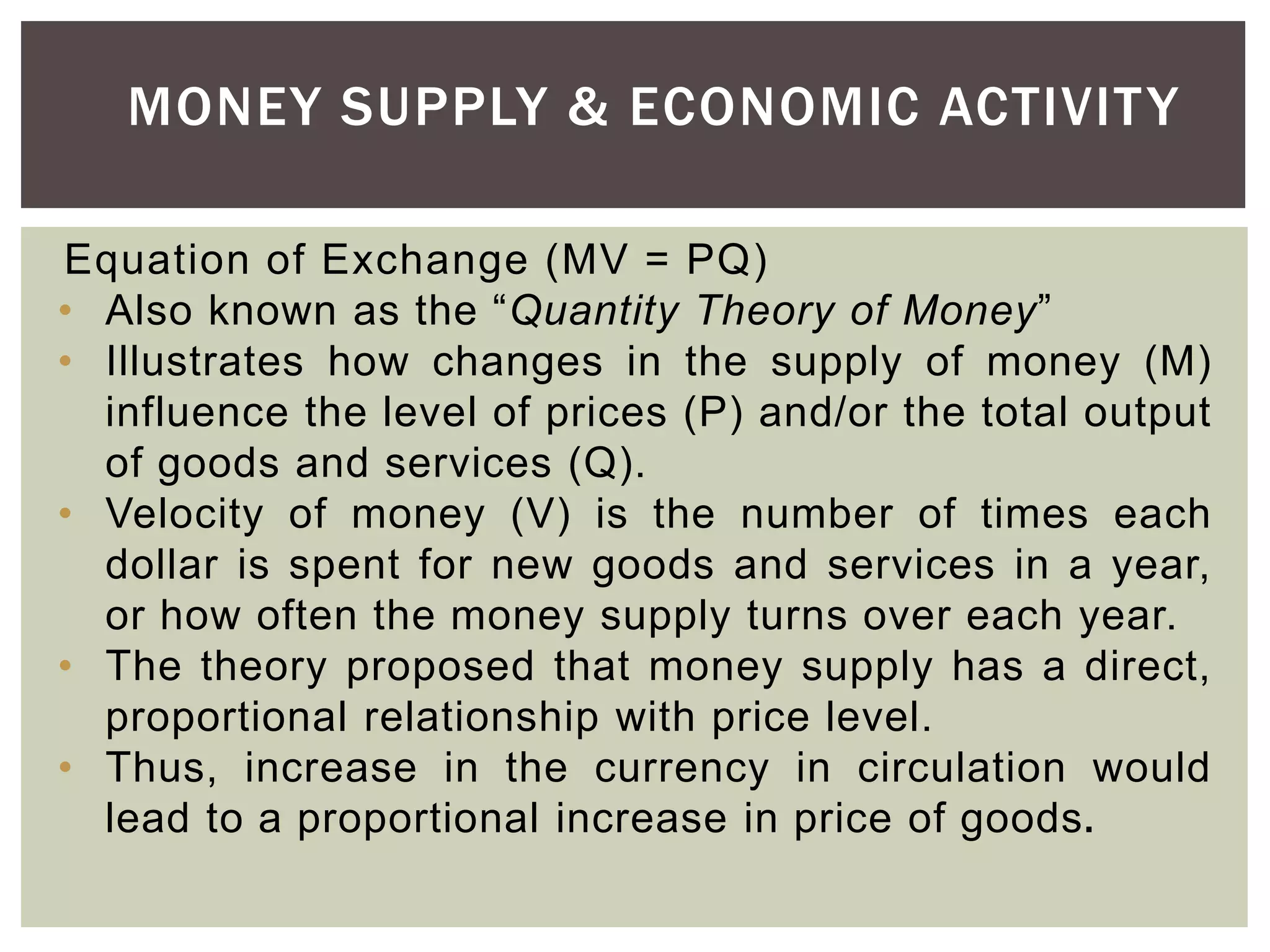
Equation of Exchange (MV = PQ)
• Also known as the “Quantity Theory of Money”
• Illustrates how changes in the supply of money (M)
influence the level of prices (P) and/or the total output
of goods and services (Q).
• Velocity of money (V) is the number of times each
dollar is spent for new goods and services in a year,
or how often the money supply turns over each year.
• The theory proposed that money supply has a direct,
proportional relationship with price level.
• Thus, increase in the currency in circulation would
lead to a proportional increase in price of goods.
MONEY SUPPLY & ECONOMIC ACTIVITY
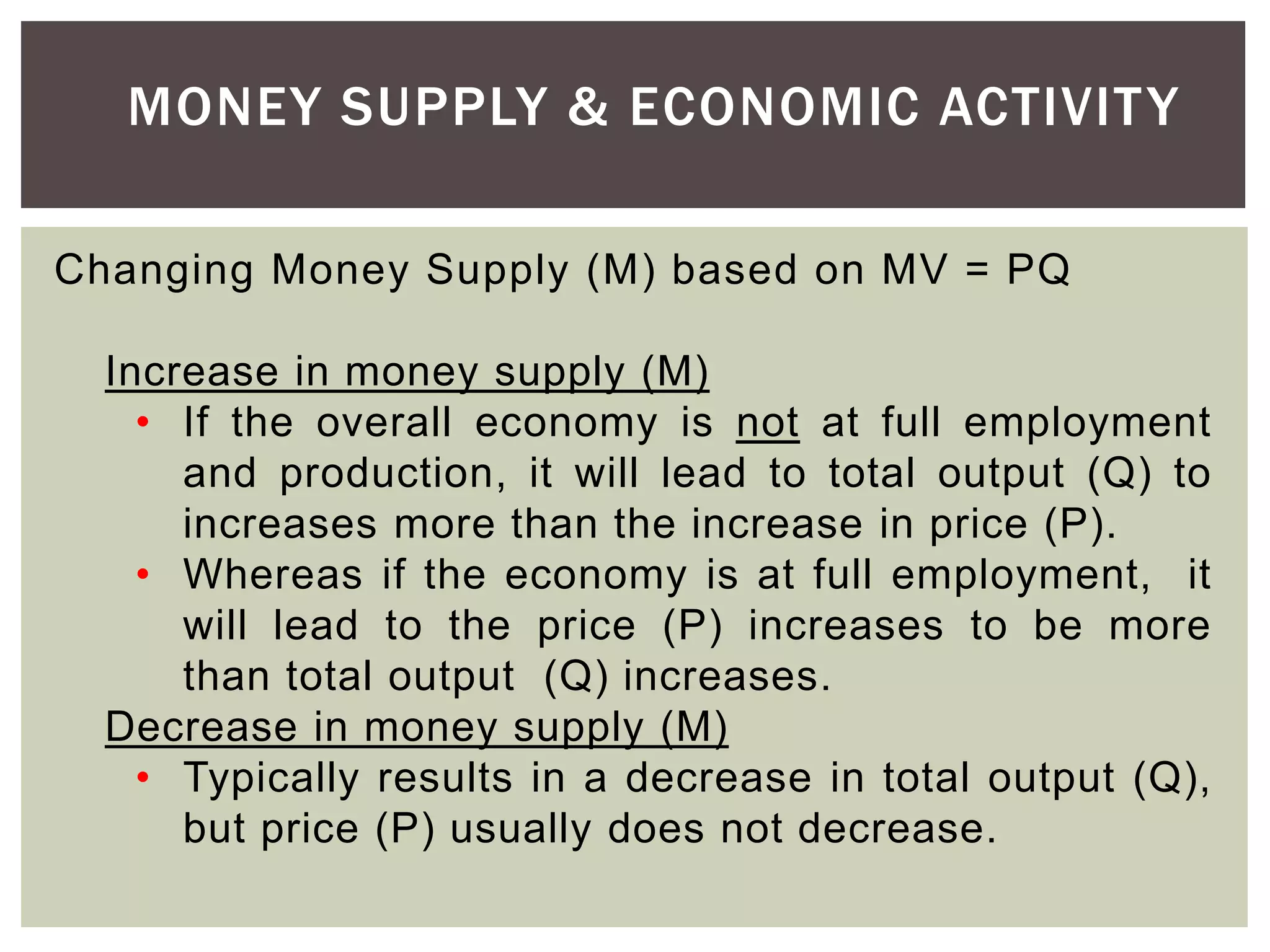
Changing Money Supply (M) based on MV = PQ
Increase in money supply (M)
• If the overall economy is not at full employment
and production, it will lead to total output (Q) to
increases more than the increase in price (P).
• Whereas if the economy is at full employment, it
will lead to the price (P) increases to be more
than total output (Q) increases.
Decrease in money supply (M)
• Typically results in a decrease in total output (Q),
but price (P) usually does not decrease.
MONEY SUPPLY & ECONOMIC ACTIVITY
MONEY CREATION
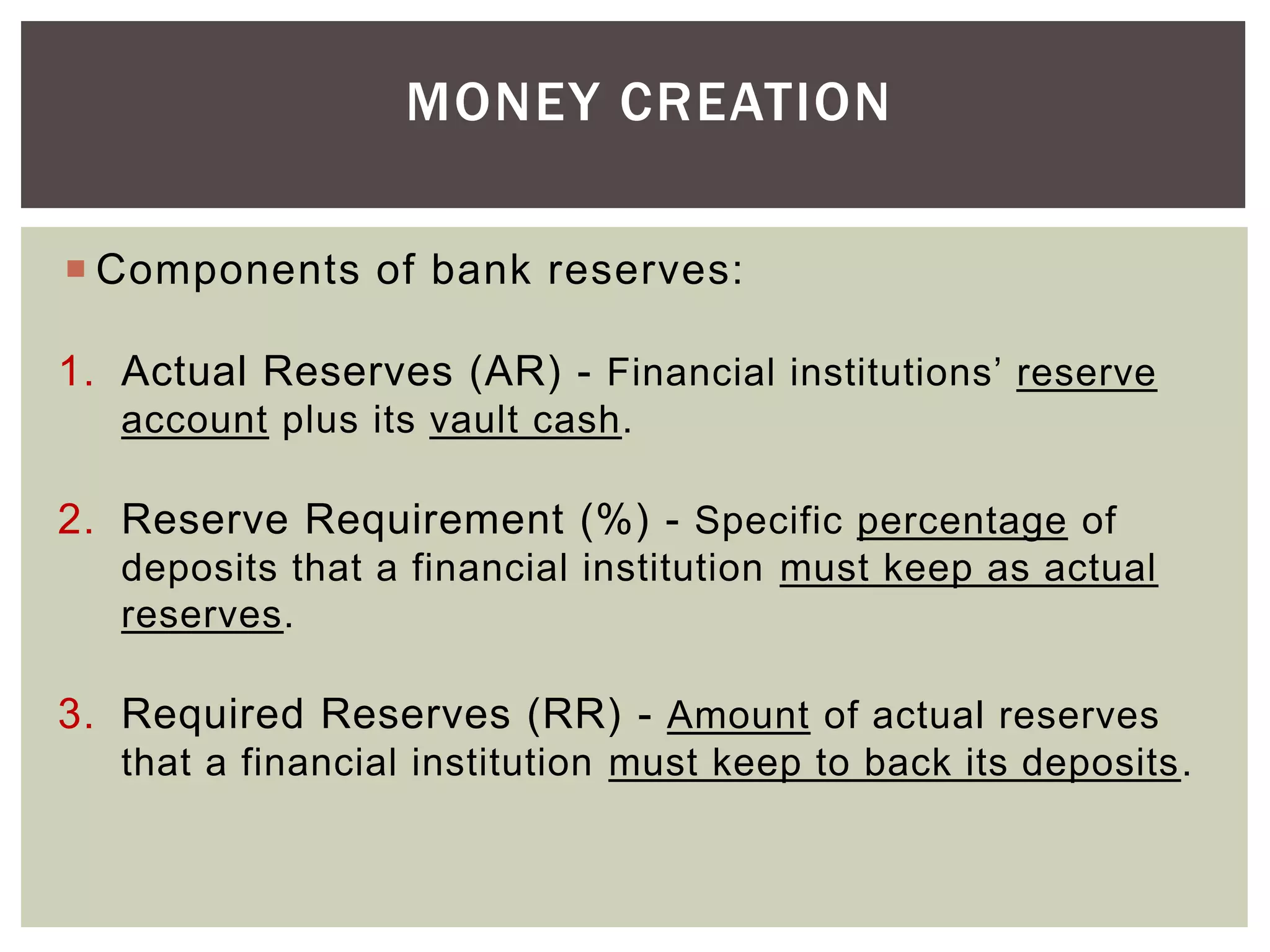
 Components of bank reserves:
1. Actual Reserves (AR) - Financial institutions’ reserve
account plus its vault cash.
2. Reserve Requirement (%) - Specific percentage of
deposits that a financial institution must keep as actual
reserves.
3. Required Reserves (RR) - Amount of actual reserves
that a financial institution must keep to back its deposits.
MONEY CREATION
 Components of bank reserves (cont’d):
4. Excess Reserves (ER)
• Reserves of a financial depository institution
over the amount it is required to maintain in
actual reserves.
• Actual reserves minus required reserves.
• ER = AR - RR
MONEY CREATION
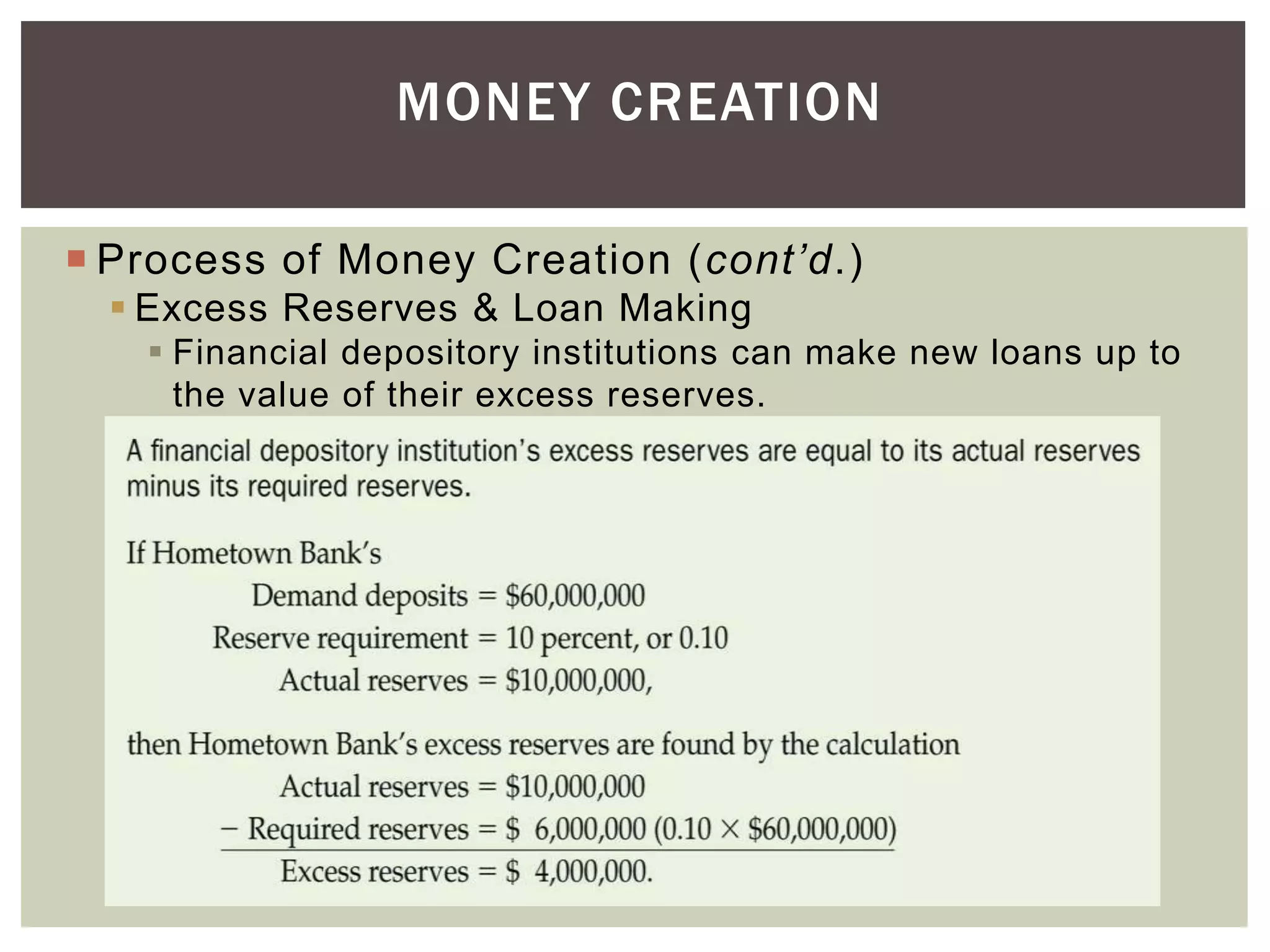
 Process of Money Creation (cont’d.)
 Excess Reserves & Loan Making
 Financial depository institutions can make new loans up to
the value of their excess reserves.
MONEY CREATION
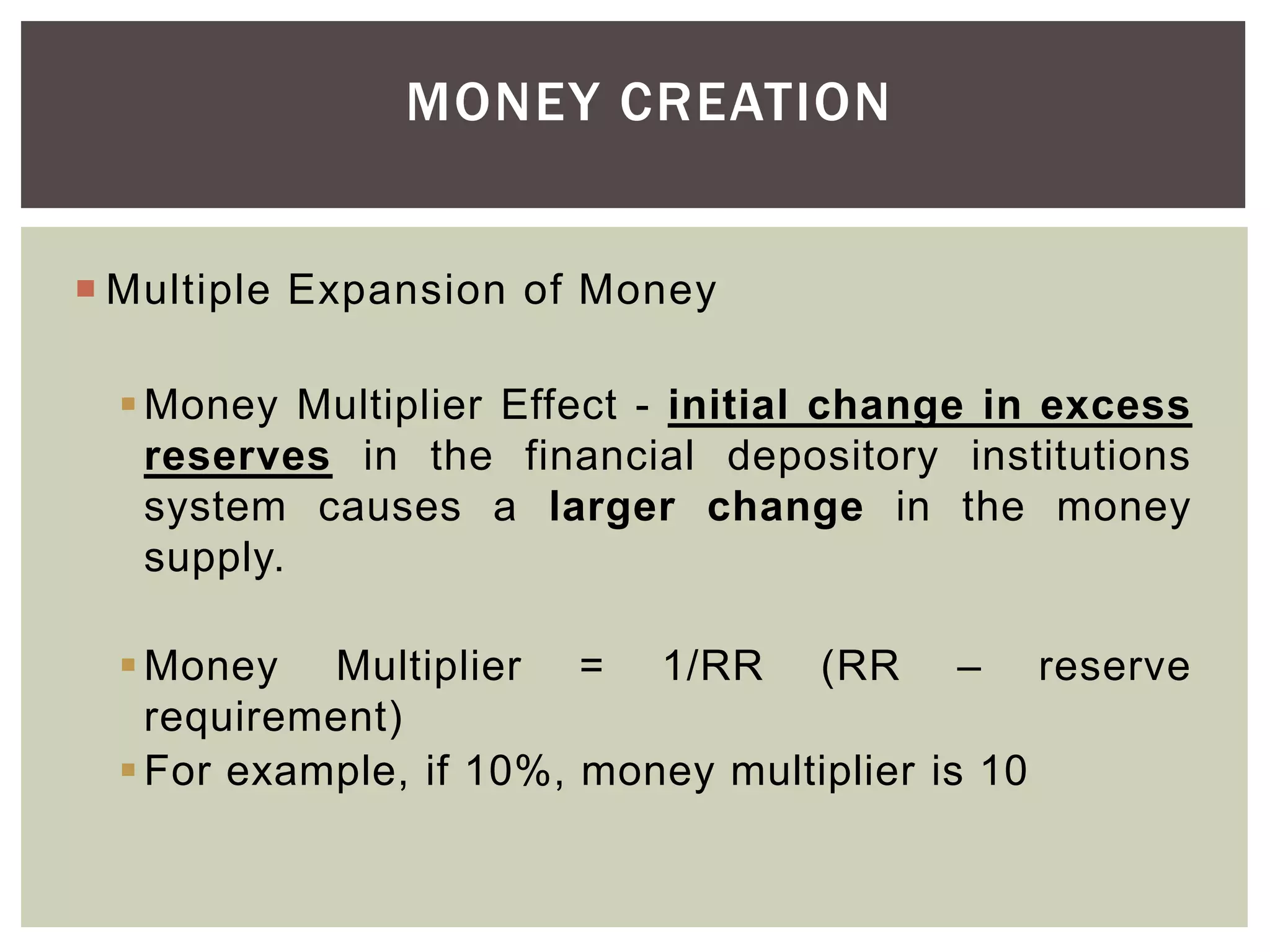
 Multiple Expansion of Money
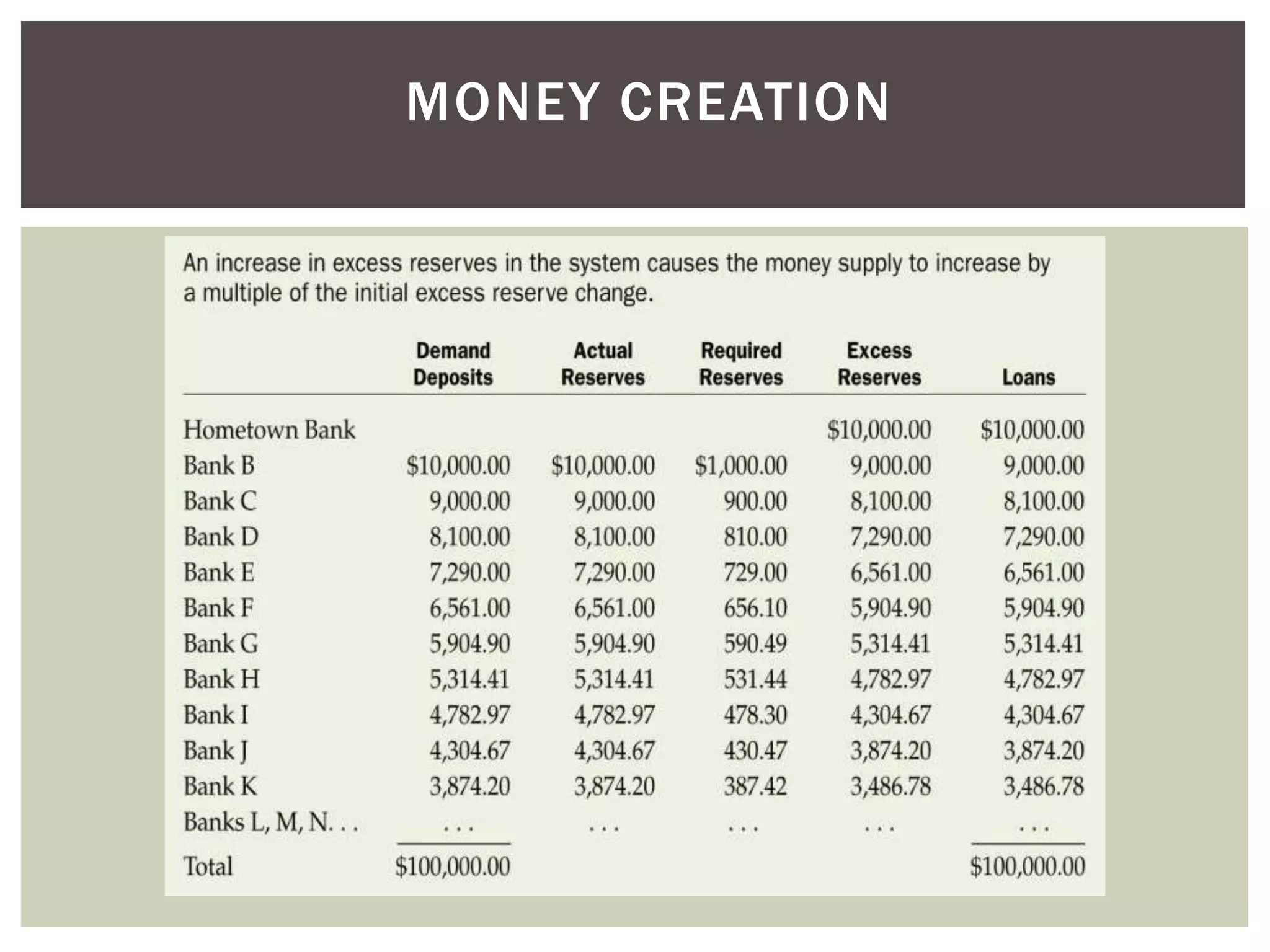
Money Multiplier Effect - initial change in excess
reserves in the financial depository institutions
system causes a larger change in the money
supply.
Money Multiplier = 1/RR (RR – reserve
requirement)
For example, if 10%, money multiplier is 10
MONEY CREATION
EXCESS RESERVE (ER)
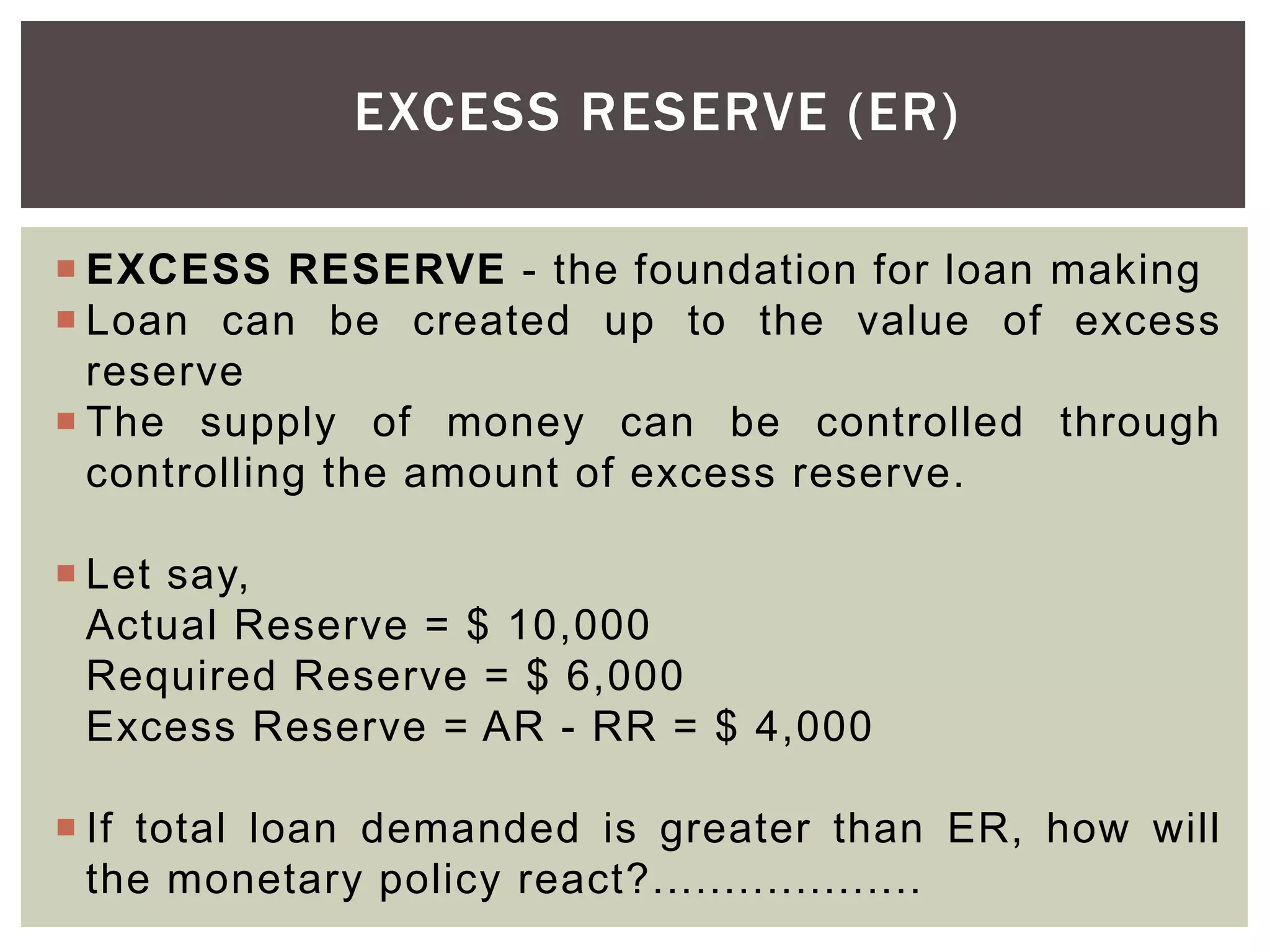
 EXCESS RESERVE - the foundation for loan making
 Loan can be created up to the value of excess
reserve
 The supply of money can be controlled through
controlling the amount of excess reserve.
 Let say,
Actual Reserve = $ 10,000
Required Reserve = $ 6,000
Excess Reserve = AR - RR = $ 4,000
 If total loan demanded is greater than ER, how will
the monetary policy react?...................
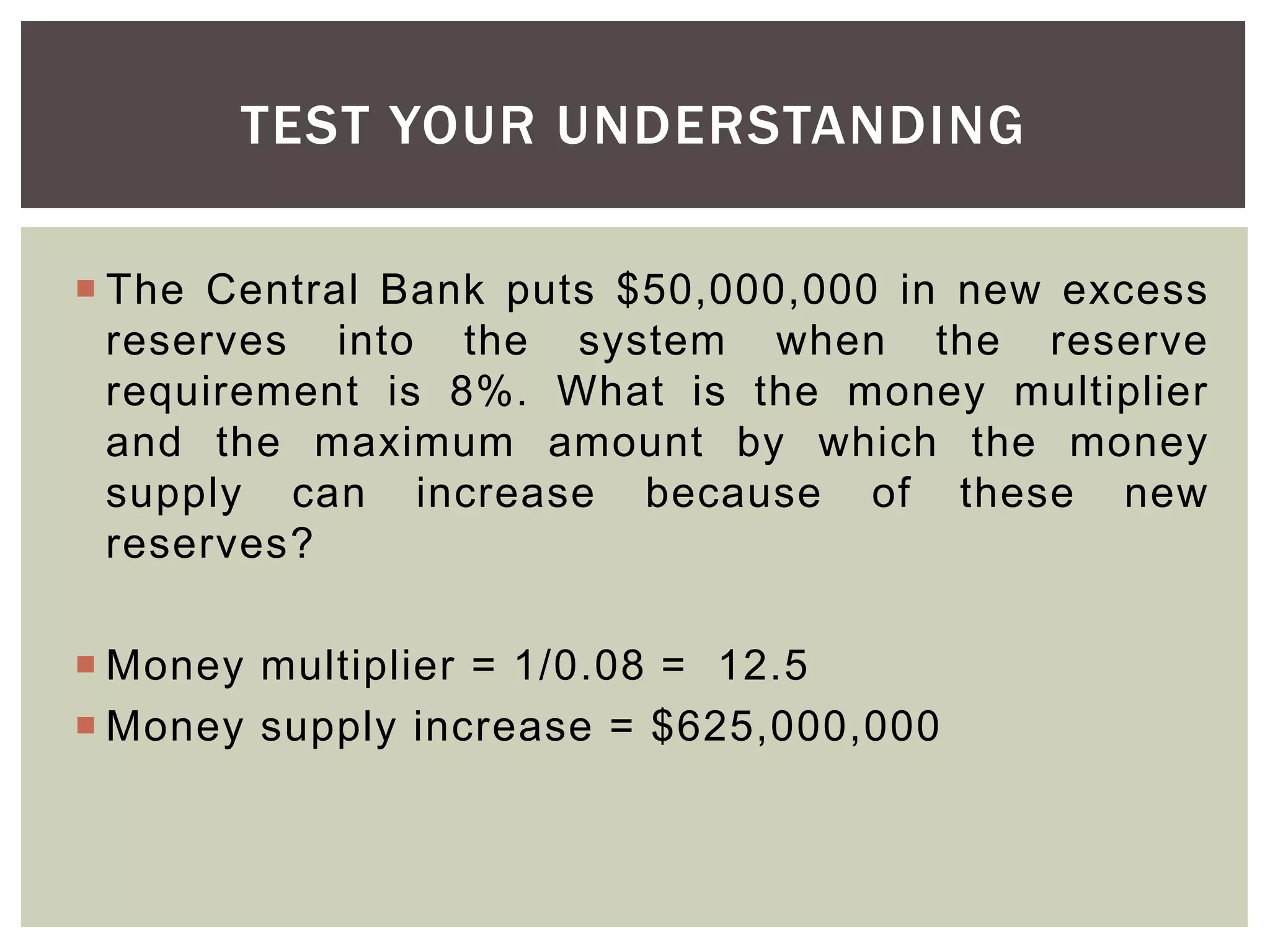
 The Central Bank puts $50,000,000 in new excess
reserves into the system when the reserve
requirement is 8%. What is the money multiplier
and the maximum amount by which the money
supply can increase because of these new
reserves?
 Money multiplier = 1/0.08 = 12.5
 Money supply increase = $625,000,000
TEST YOUR UNDERSTANDING
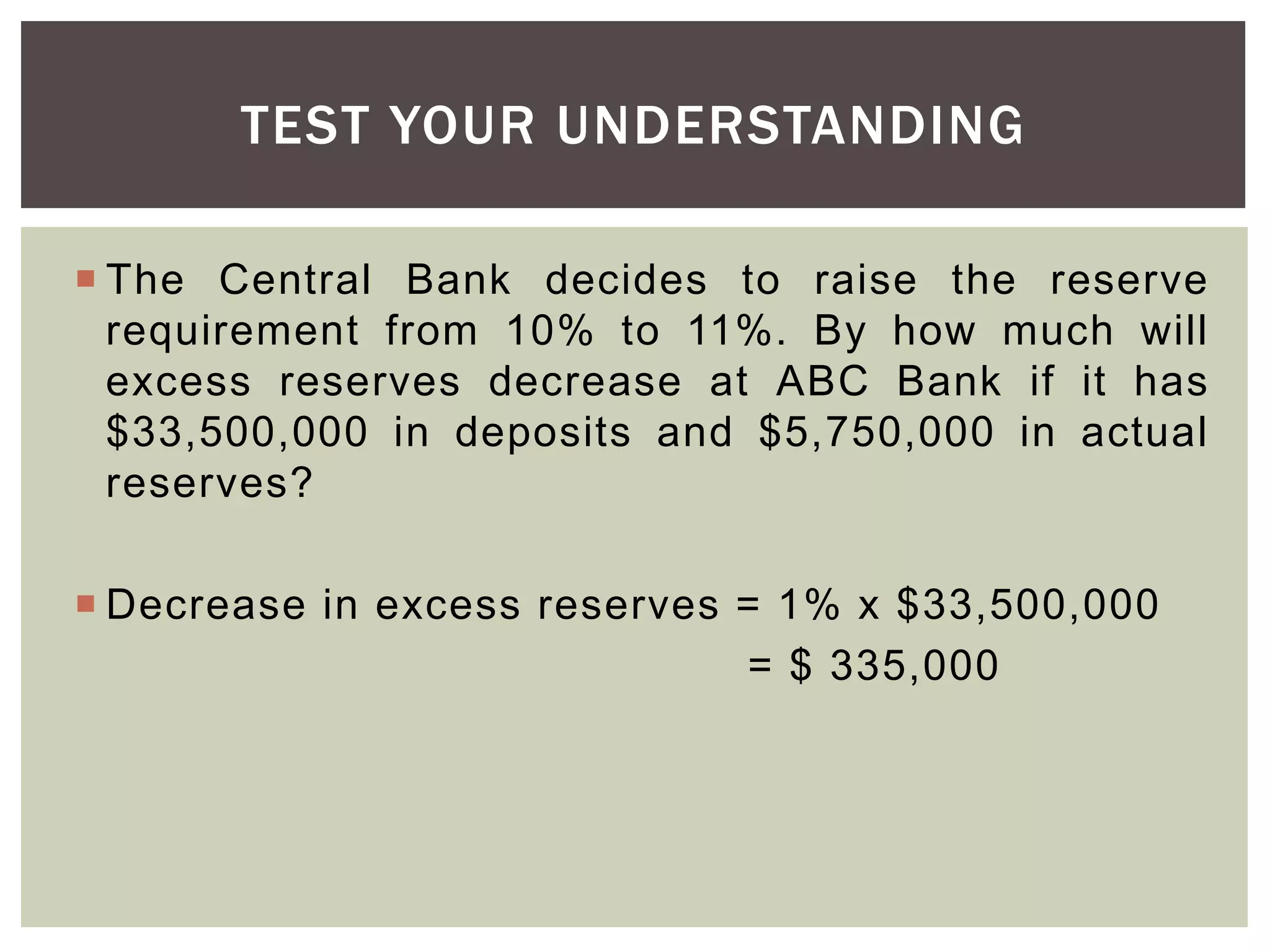
 The Central Bank decides to raise the reserve
requirement from 10% to 11%. By how much will
excess reserves decrease at ABC Bank if it has
$33,500,000 in deposits and $5,750,000 in actual
reserves?
 Decrease in excess reserves = 1% x $33,500,000
= $ 335,000
TEST YOUR UNDERSTANDING
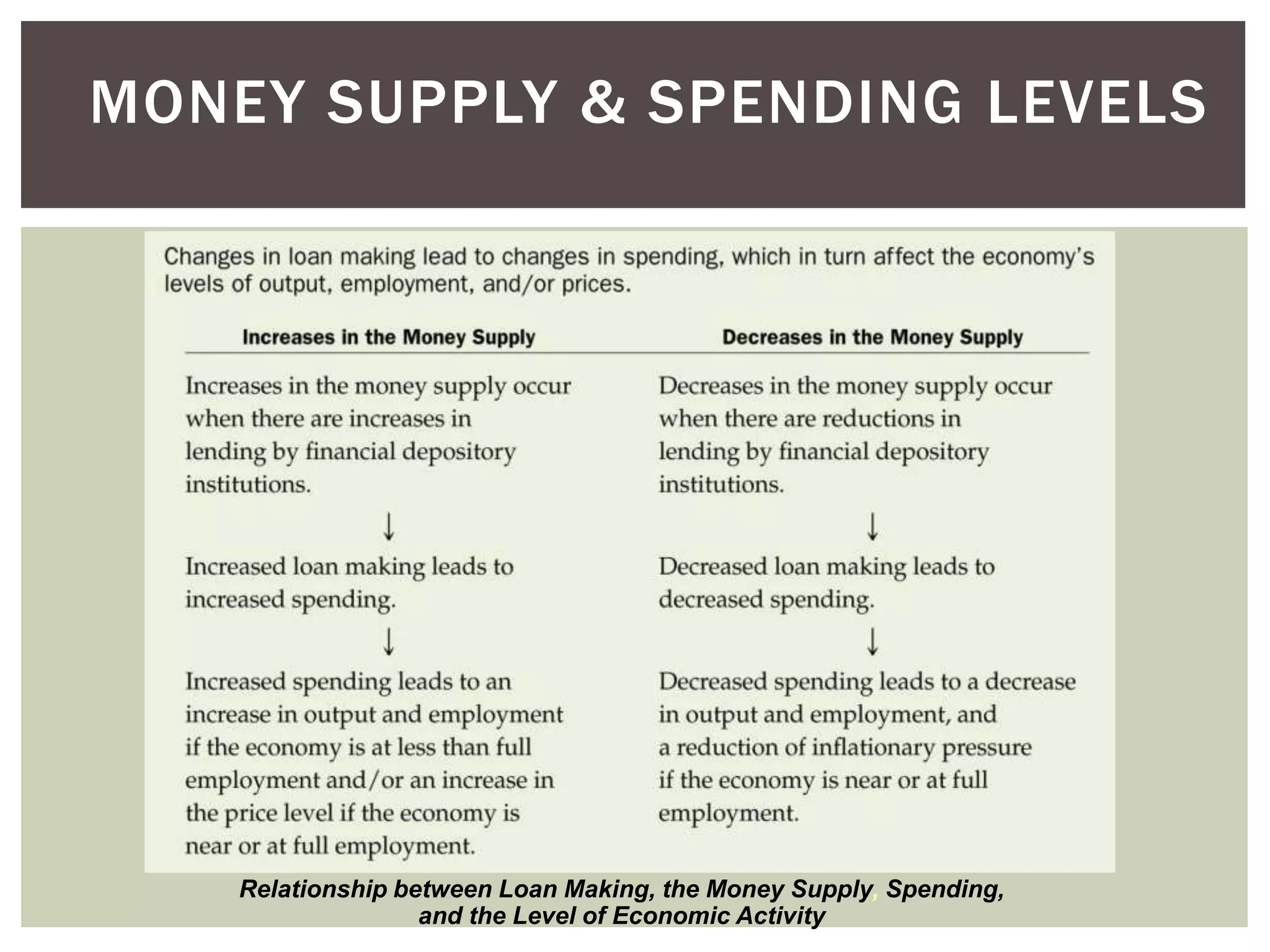
MONEY SUPPLY & SPENDING LEVELS
Relationship between Loan Making, the Money Supply, Spending,
and the Level of Economic Activity
INTEREST RATES
What is interest Rate?
Price paid to borrow money - cost of borrowing
Percentage of the amount borrowed.
Can be used to control the money supply.
INTEREST RATES &
SPENDING LEVELS
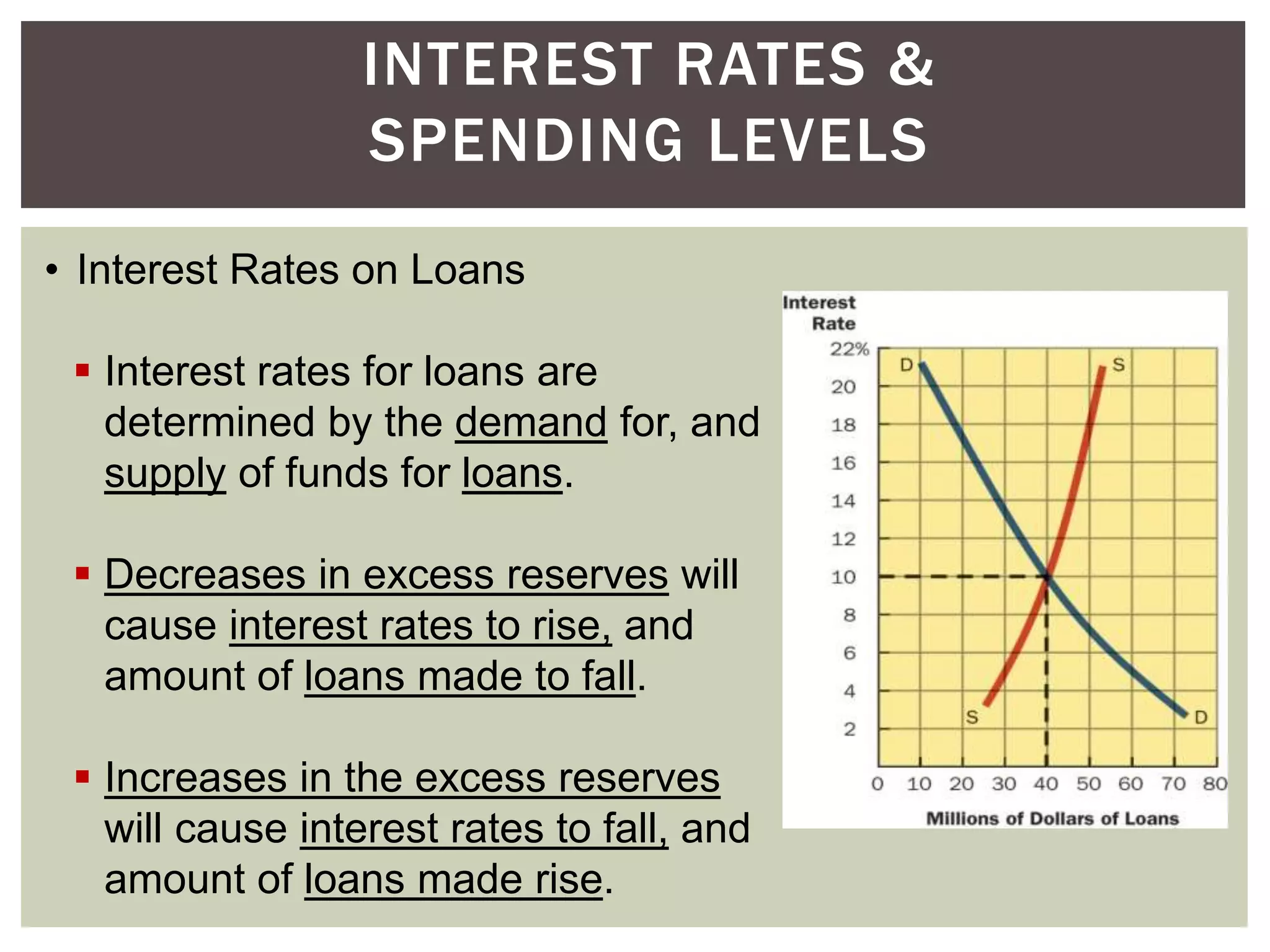
• Interest Rates on Loans
 Interest rates for loans are
determined by the demand for, and
supply of funds for loans.
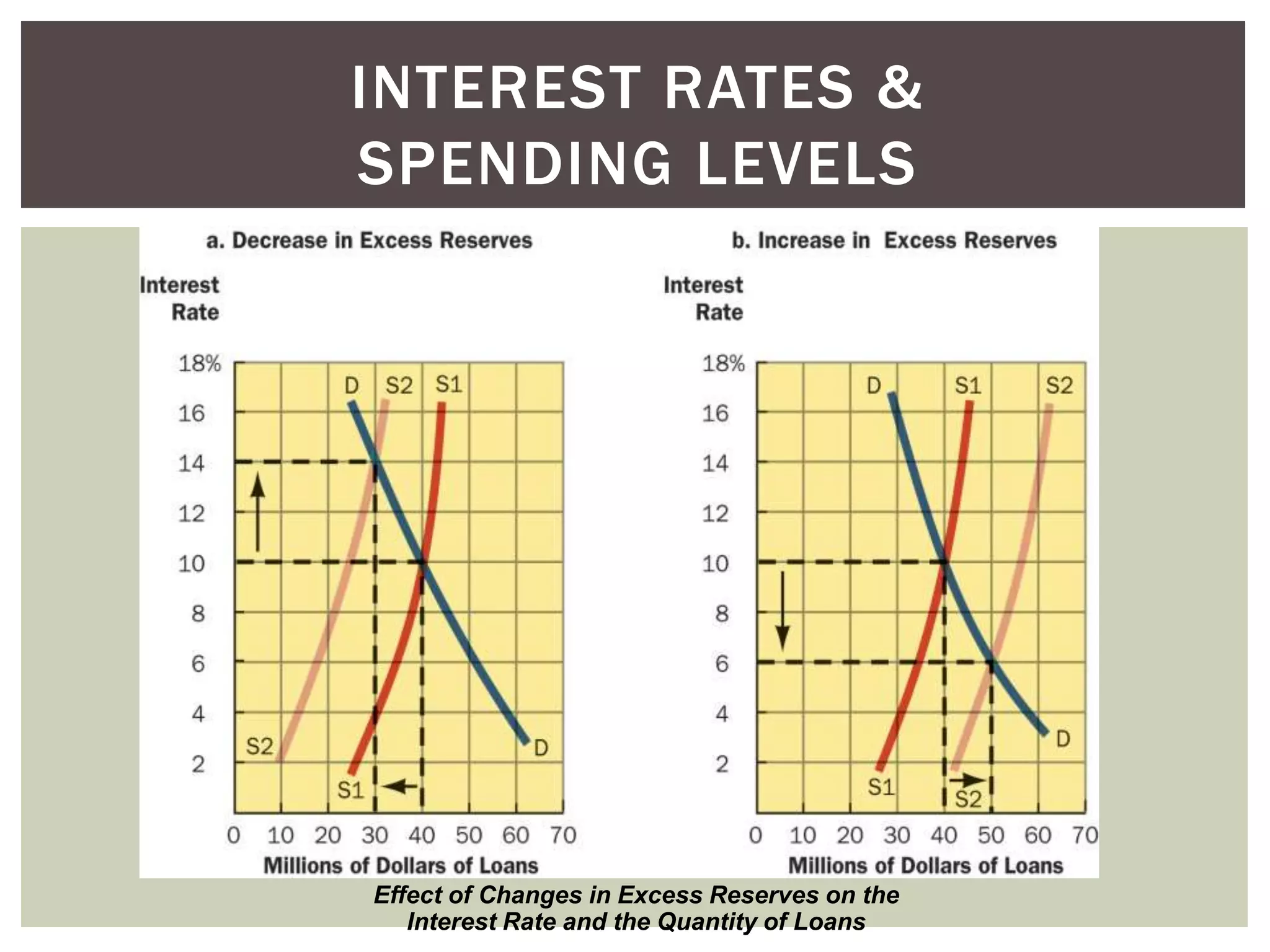
 Decreases in excess reserves will
cause interest rates to rise, and
amount of loans made to fall.
 Increases in the excess reserves
will cause interest rates to fall, and
amount of loans made rise.
Effect of Changes in Excess Reserves on the
Interest Rate and the Quantity of Loans
INTEREST RATES &
SPENDING LEVELS
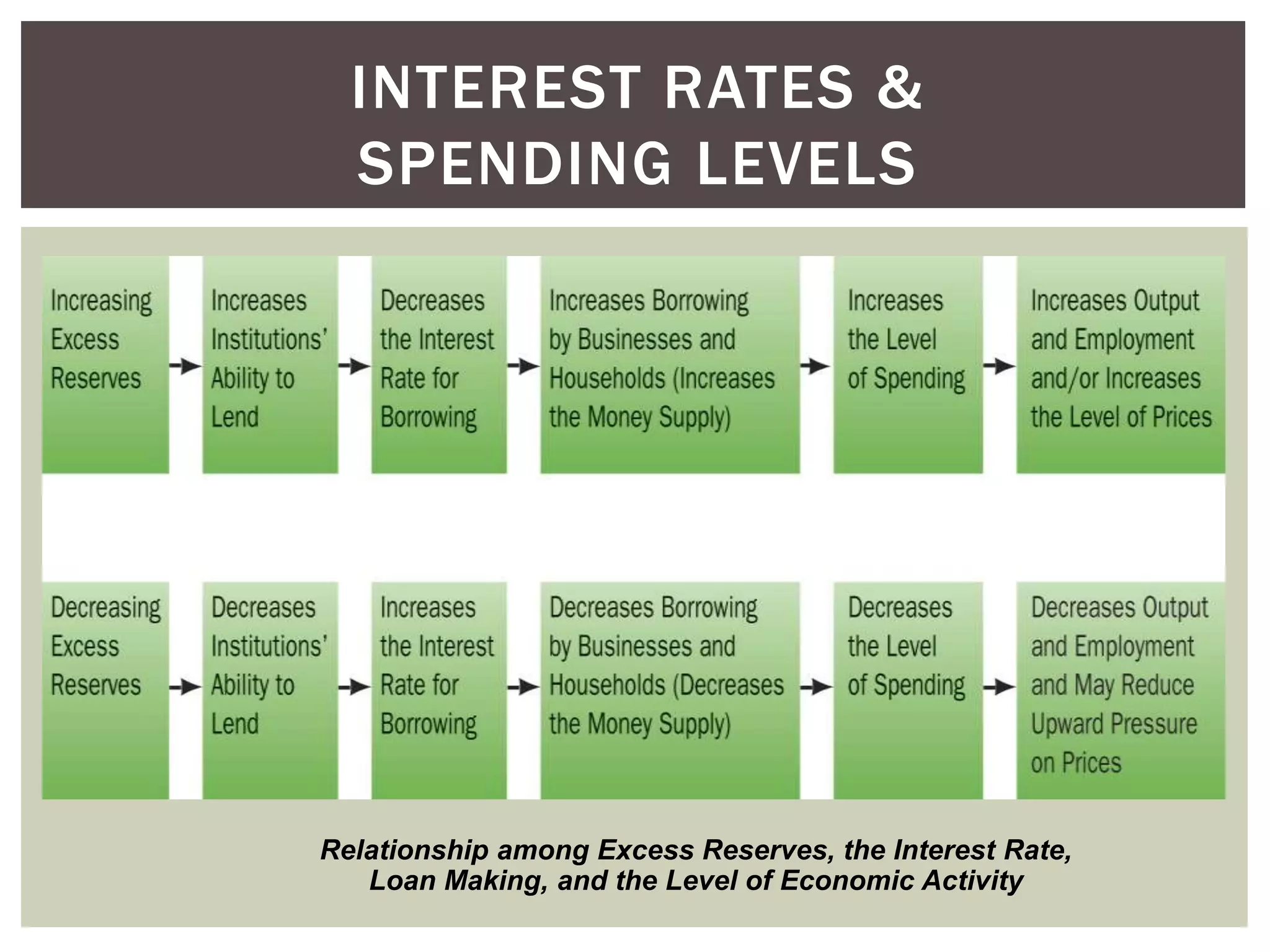
Relationship among Excess Reserves, the Interest Rate,
Loan Making, and the Level of Economic Activity
INTEREST RATES &
SPENDING LEVELS
TEST YOUR UNDERSTANDING
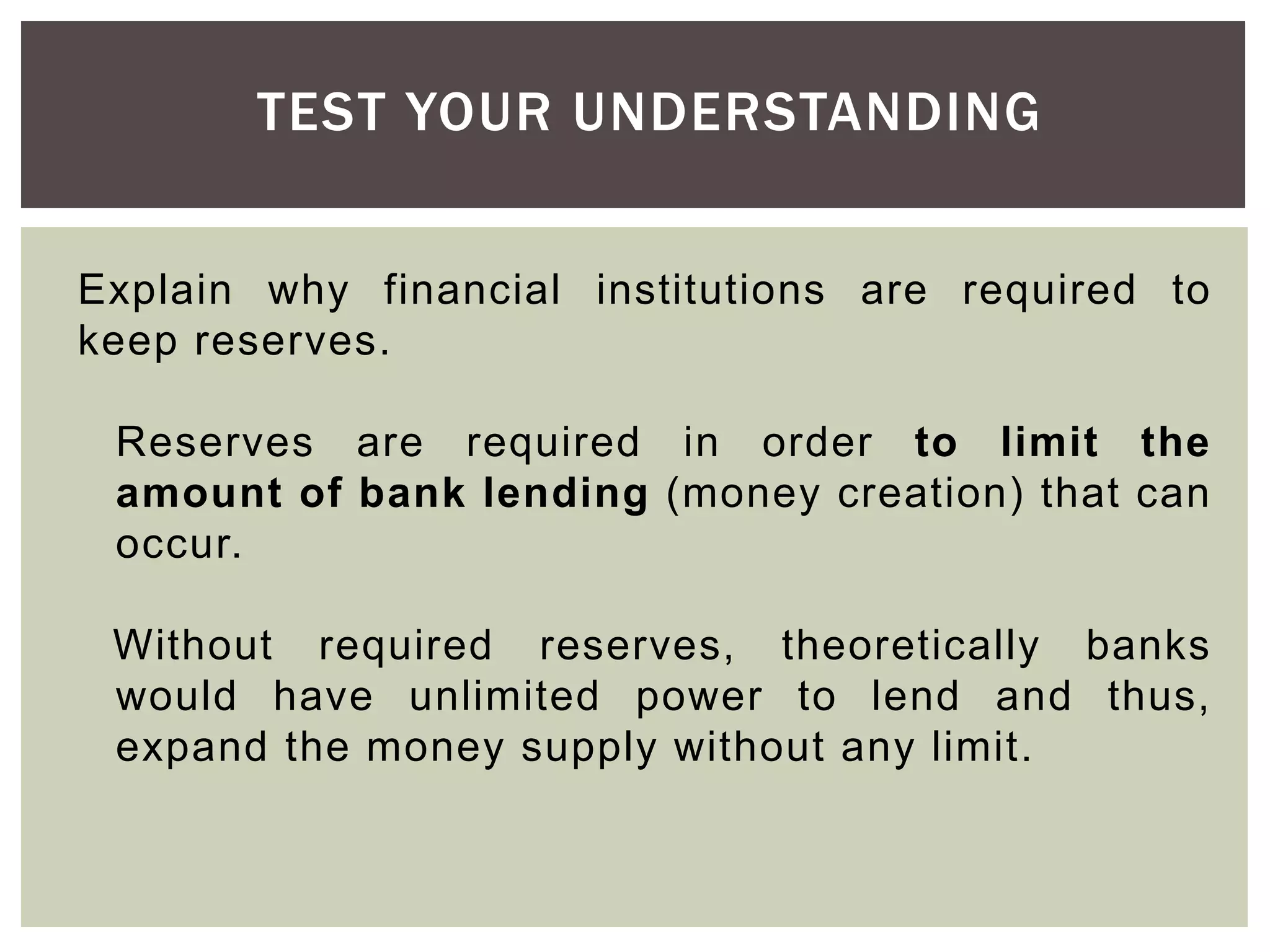
Explain why financial institutions are required to
keep reserves.
Reserves are required in order to limit the
amount of bank lending (money creation) that can
occur.
Without required reserves, theoretically banks
would have unlimited power to lend and thus,
expand the money supply without any limit.
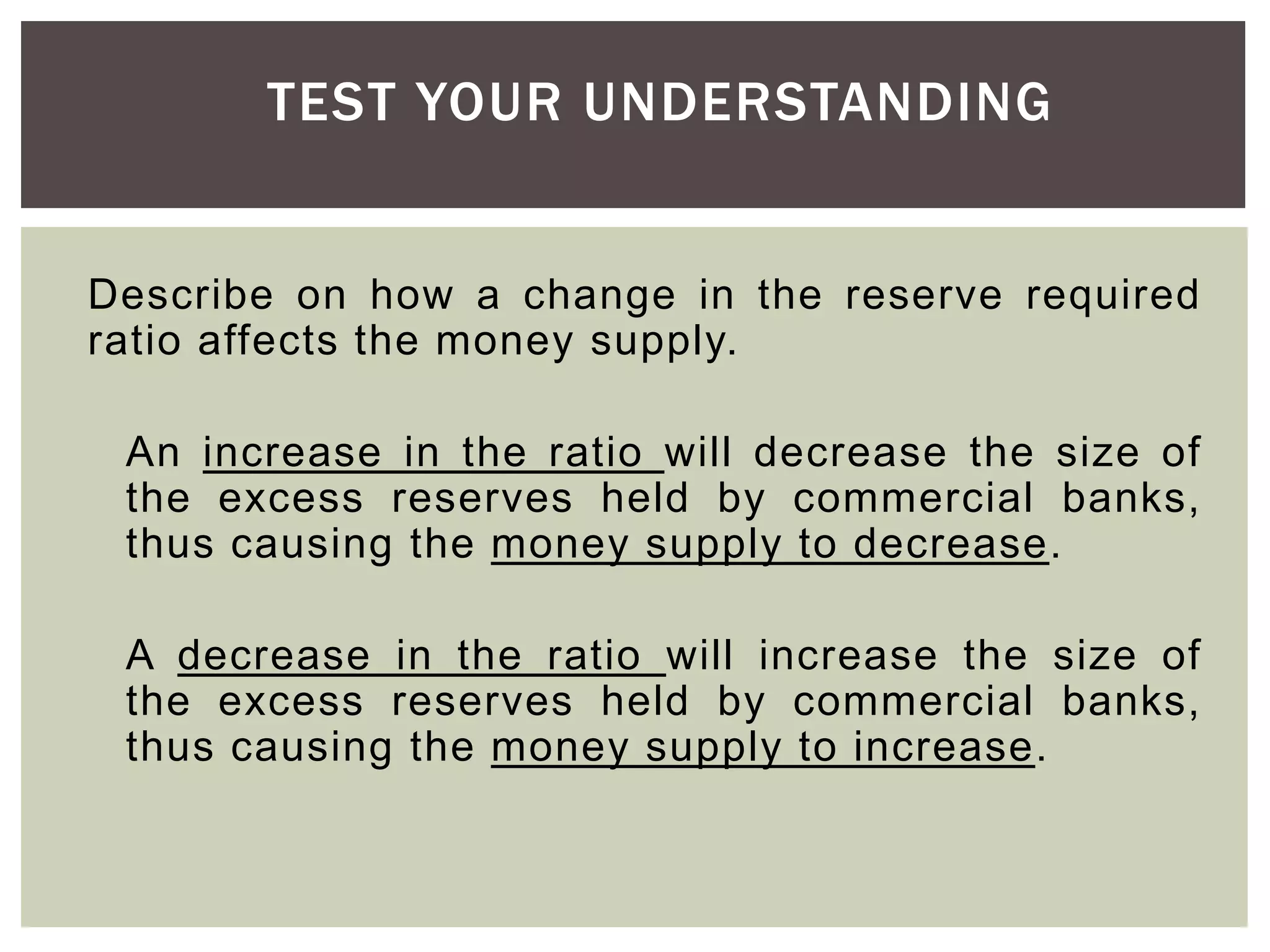
Describe on how a change in the reserve required
ratio affects the money supply.
An increase in the ratio will decrease the size of
the excess reserves held by commercial banks,
thus causing the money supply to decrease.
A decrease in the ratio will increase the size of
the excess reserves held by commercial banks,
thus causing the money supply to increase.
TEST YOUR UNDERSTANDING

Topic 11 - Monetary Theory

  • 1.
    PSCI 1500: Introduction toEconomics Monetary Theory
  • 2.
    MONEY SUPPLY &ECONOMIC ACTIVITY REVIEW Summary of Key Lessons from previous topics: 1. Total, or aggregate spending drives the economy’s levels of production, employment, and income. 2. Total spending is found by adding together the spending of all four major macroeconomic sectors. 3. Increases in total spending lead to increases in production, employment, and income unless the economy is at full employment.
  • 3.
    MONEY SUPPLY &ECONOMIC ACTIVITY REVIEW Summary of Key Lessons from previous topics 4. At (or near) full employment, increases in spending lead to overall price increases (demand-pull inflation) 5. Decreases in total spending result in a decline in production, employment, and income, and may dampen inflation. 6. Money is created when financial depository institutions make loans, destroyed as it is repaid.
  • 4.
    Equation of Exchange(MV = PQ) • Also known as the “Quantity Theory of Money” • Illustrates how changes in the supply of money (M) influence the level of prices (P) and/or the total output of goods and services (Q). • Velocity of money (V) is the number of times each dollar is spent for new goods and services in a year, or how often the money supply turns over each year. • The theory proposed that money supply has a direct, proportional relationship with price level. • Thus, increase in the currency in circulation would lead to a proportional increase in price of goods. MONEY SUPPLY & ECONOMIC ACTIVITY
  • 5.
    Changing Money Supply(M) based on MV = PQ Increase in money supply (M) • If the overall economy is not at full employment and production, it will lead to total output (Q) to increases more than the increase in price (P). • Whereas if the economy is at full employment, it will lead to the price (P) increases to be more than total output (Q) increases. Decrease in money supply (M) • Typically results in a decrease in total output (Q), but price (P) usually does not decrease. MONEY SUPPLY & ECONOMIC ACTIVITY
  • 6.
    MONEY CREATION  Componentsof bank reserves: 1. Actual Reserves (AR) - Financial institutions’ reserve account plus its vault cash. 2. Reserve Requirement (%) - Specific percentage of deposits that a financial institution must keep as actual reserves. 3. Required Reserves (RR) - Amount of actual reserves that a financial institution must keep to back its deposits.
  • 7.
    MONEY CREATION  Componentsof bank reserves (cont’d): 4. Excess Reserves (ER) • Reserves of a financial depository institution over the amount it is required to maintain in actual reserves. • Actual reserves minus required reserves. • ER = AR - RR
  • 8.
    MONEY CREATION  Processof Money Creation (cont’d.)  Excess Reserves & Loan Making  Financial depository institutions can make new loans up to the value of their excess reserves.
  • 9.
    MONEY CREATION  MultipleExpansion of Money Money Multiplier Effect - initial change in excess reserves in the financial depository institutions system causes a larger change in the money supply. Money Multiplier = 1/RR (RR – reserve requirement) For example, if 10%, money multiplier is 10
  • 10.
  • 11.
    EXCESS RESERVE (ER) EXCESS RESERVE - the foundation for loan making  Loan can be created up to the value of excess reserve  The supply of money can be controlled through controlling the amount of excess reserve.  Let say, Actual Reserve = $ 10,000 Required Reserve = $ 6,000 Excess Reserve = AR - RR = $ 4,000  If total loan demanded is greater than ER, how will the monetary policy react?...................
  • 12.
     The CentralBank puts $50,000,000 in new excess reserves into the system when the reserve requirement is 8%. What is the money multiplier and the maximum amount by which the money supply can increase because of these new reserves?  Money multiplier = 1/0.08 = 12.5  Money supply increase = $625,000,000 TEST YOUR UNDERSTANDING
  • 13.
     The CentralBank decides to raise the reserve requirement from 10% to 11%. By how much will excess reserves decrease at ABC Bank if it has $33,500,000 in deposits and $5,750,000 in actual reserves?  Decrease in excess reserves = 1% x $33,500,000 = $ 335,000 TEST YOUR UNDERSTANDING
  • 14.
    MONEY SUPPLY &SPENDING LEVELS Relationship between Loan Making, the Money Supply, Spending, and the Level of Economic Activity
  • 15.
    INTEREST RATES What isinterest Rate? Price paid to borrow money - cost of borrowing Percentage of the amount borrowed. Can be used to control the money supply.
  • 16.
    INTEREST RATES & SPENDINGLEVELS • Interest Rates on Loans  Interest rates for loans are determined by the demand for, and supply of funds for loans.  Decreases in excess reserves will cause interest rates to rise, and amount of loans made to fall.  Increases in the excess reserves will cause interest rates to fall, and amount of loans made rise.
  • 17.
    Effect of Changesin Excess Reserves on the Interest Rate and the Quantity of Loans INTEREST RATES & SPENDING LEVELS
  • 18.
    Relationship among ExcessReserves, the Interest Rate, Loan Making, and the Level of Economic Activity INTEREST RATES & SPENDING LEVELS
  • 19.
    TEST YOUR UNDERSTANDING Explainwhy financial institutions are required to keep reserves. Reserves are required in order to limit the amount of bank lending (money creation) that can occur. Without required reserves, theoretically banks would have unlimited power to lend and thus, expand the money supply without any limit.
  • 20.
    Describe on howa change in the reserve required ratio affects the money supply. An increase in the ratio will decrease the size of the excess reserves held by commercial banks, thus causing the money supply to decrease. A decrease in the ratio will increase the size of the excess reserves held by commercial banks, thus causing the money supply to increase. TEST YOUR UNDERSTANDING