Aromatic
and Allylic
NMR
Spin –Spin
Coupling
K.Loganathan
Physical Chemistry
M.Sc-Chemistry
Long range coupling
Allylic coupling
 Homoallylic systems
 Aromatic coupling
Hetero-aromatic coupling
Rigid systems
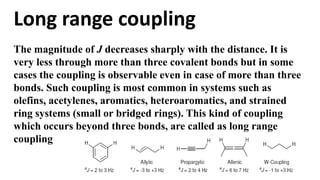
Long range coupling
The magnitude of J decreases sharply with the distance. It is
very less through more than three covalent bonds but in some
cases the coupling is observable even in case of more than three
bonds. Such coupling is most common in systems such as
olefins, acetylenes, aromatics, heteroaromatics, and strained
ring systems (small or bridged rings). This kind of coupling
which occurs beyond three bonds, are called as long range
coupling
Allylic coupling
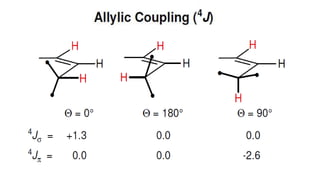
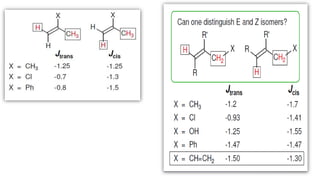
In addition to the geminal and vicinal coupling, alkenes also show small
coupling between
protons substituted on α carbons to the double bond and those on the
opposite end of the double bond. This four bond coupling is called
allylic coupling. Allylic coupling constant are very less
about 0-3 Hz. The π-electrons of the double bond apparently help in
coupling the concerned
nuclei and the magnitude of this depends upon the extent of overlap of
the carbon-hydrogen σ-bond with the π-bond. This type of coupling
also occurs in acetylenes.
Homoallylic Systems
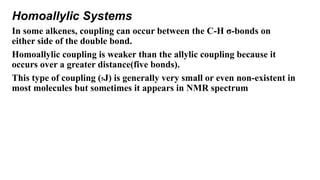
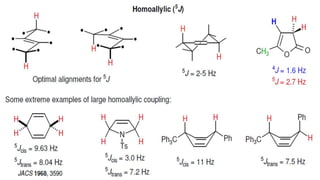
In some alkenes, coupling can occur between the C-H σ-bonds on
either side of the double bond.
Homoallylic coupling is weaker than the allylic coupling because it
occurs over a greater distance(five bonds).
This type of coupling (5J) is generally very small or even non-existent in
most molecules but sometimes it appears in NMR spectrum
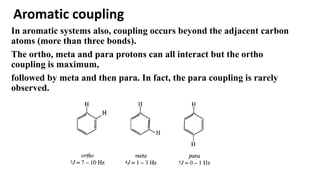
Aromatic coupling
In aromatic systems also, coupling occurs beyond the adjacent carbon
atoms (more than three bonds).
The ortho, meta and para protons can all interact but the ortho
coupling is maximum,
followed by meta and then para. In fact, the para coupling is rarely
observed.
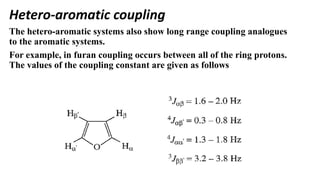
Hetero-aromatic coupling
The hetero-aromatic systems also show long range coupling analogues
to the aromatic systems.
For example, in furan coupling occurs between all of the ring protons.
The values of the coupling constant are given as follows
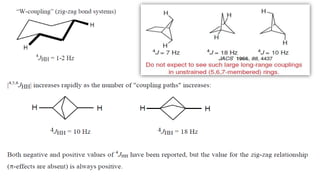
Rigid systems
The long range coupling occurs in compounds without π-systems also
but it is less common.
This unusual long range coupling in saturated systems occurs through
an arrangement of atoms in the
form of ‘W’ in which hydrogens occupy the end positions. The
magnitude of coupling constant is
usually small except in highly strained ring systems. Apparently these
rigid strained arrangements
somehow have a favorable geometry for the overlaps involved. Most of
the W type couplings
give rise to the peak broadening rather than apparent splitting.
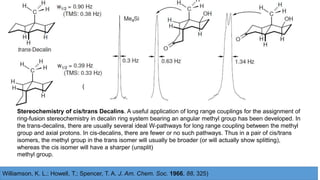
(
Williamson, K. L.; Howell, T.; Spencer, T. A. J. Am. Chem. Soc. 1966, 88, 325)
Stereochemistry of cis/trans Decalins. A useful application of long range couplings for the assignment of
ring-fusion stereochemistry in decalin ring system bearing an angular methyl group has been developed. In
the trans-decalins, there are usually several ideal W-pathways for long range coupling between the methyl
group and axial protons. In cis-decalins, there are fewer or no such pathways. Thus in a pair of cis/trans
isomers, the methyl group in the trans isomer will usually be broader (or will actually show splitting),
whereas the cis isomer will have a sharper (unsplit)
methyl group.
Longer-range coupling may also be observed
in molecules having
olefins,acetylenes,aromatics, hetero-
aromatics, and strained ring systems (small
or bridged rings).
Long-range spin-spin coupling nJ, n ≥4
Take Home Message
http://chem.ch.huji.ac.il/nmr/whatisnmr/whatisnmr.
https://acdlabs.typepad.com/elucidation/2008/04/identifyingmet.
Understanding Nmr Spectroscopy by James Keeler
NMR Spectroscopy by Harald Gunther
Resources

Aromatic allylic-nmr-spin-spin-coupling

  • 1.
  • 2.
    Long range coupling Allyliccoupling  Homoallylic systems  Aromatic coupling Hetero-aromatic coupling Rigid systems
  • 3.
    Long range coupling Themagnitude of J decreases sharply with the distance. It is very less through more than three covalent bonds but in some cases the coupling is observable even in case of more than three bonds. Such coupling is most common in systems such as olefins, acetylenes, aromatics, heteroaromatics, and strained ring systems (small or bridged rings). This kind of coupling which occurs beyond three bonds, are called as long range coupling
  • 4.
    Allylic coupling In additionto the geminal and vicinal coupling, alkenes also show small coupling between protons substituted on α carbons to the double bond and those on the opposite end of the double bond. This four bond coupling is called allylic coupling. Allylic coupling constant are very less about 0-3 Hz. The π-electrons of the double bond apparently help in coupling the concerned nuclei and the magnitude of this depends upon the extent of overlap of the carbon-hydrogen σ-bond with the π-bond. This type of coupling also occurs in acetylenes.
  • 7.
    Homoallylic Systems In somealkenes, coupling can occur between the C-H σ-bonds on either side of the double bond. Homoallylic coupling is weaker than the allylic coupling because it occurs over a greater distance(five bonds). This type of coupling (5J) is generally very small or even non-existent in most molecules but sometimes it appears in NMR spectrum
  • 9.
    Aromatic coupling In aromaticsystems also, coupling occurs beyond the adjacent carbon atoms (more than three bonds). The ortho, meta and para protons can all interact but the ortho coupling is maximum, followed by meta and then para. In fact, the para coupling is rarely observed.
  • 10.
    Hetero-aromatic coupling The hetero-aromaticsystems also show long range coupling analogues to the aromatic systems. For example, in furan coupling occurs between all of the ring protons. The values of the coupling constant are given as follows
  • 11.
    Rigid systems The longrange coupling occurs in compounds without π-systems also but it is less common. This unusual long range coupling in saturated systems occurs through an arrangement of atoms in the form of ‘W’ in which hydrogens occupy the end positions. The magnitude of coupling constant is usually small except in highly strained ring systems. Apparently these rigid strained arrangements somehow have a favorable geometry for the overlaps involved. Most of the W type couplings give rise to the peak broadening rather than apparent splitting.
  • 13.
    ( Williamson, K. L.;Howell, T.; Spencer, T. A. J. Am. Chem. Soc. 1966, 88, 325) Stereochemistry of cis/trans Decalins. A useful application of long range couplings for the assignment of ring-fusion stereochemistry in decalin ring system bearing an angular methyl group has been developed. In the trans-decalins, there are usually several ideal W-pathways for long range coupling between the methyl group and axial protons. In cis-decalins, there are fewer or no such pathways. Thus in a pair of cis/trans isomers, the methyl group in the trans isomer will usually be broader (or will actually show splitting), whereas the cis isomer will have a sharper (unsplit) methyl group.
  • 14.
    Longer-range coupling mayalso be observed in molecules having olefins,acetylenes,aromatics, hetero- aromatics, and strained ring systems (small or bridged rings). Long-range spin-spin coupling nJ, n ≥4 Take Home Message
  • 15.