




Mass Spectroscopy
By
Dr. P. R. Padole
Associate Professor
Department of Chemistry
Shri Shivaji Science College, Amravati.
SpectroscopySpectroscopy
Contents
 Introduction
 Defination
 Basic principle / Theory
 Brief outline of instrumentation.
 Ion formation and types
 Fragmentation processes
 Fragmentation patterns
 Fragmentation characteristics in relation to
parent structure and functional groups
2
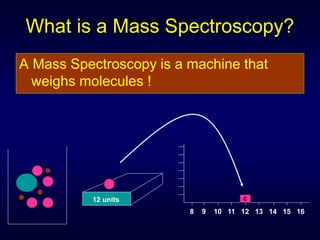
What is a Mass Spectroscopy?
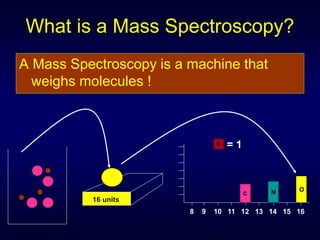
A Mass Spectroscopy is a machine that
weighs molecules !
0 units
What is a Mass Spectroscopy?
A Mass Spectroscopy is a machine that
weighs molecules !
12 units
8 9 10 11 12 13 14 15 16
C
What is a Mass Spectroscopy?
A Mass Spectroscopy is a machine that
weighs molecules !
16 units
8 9 10 11 12 13 14 15 16
C N O
H = 1
Basic Chemistry
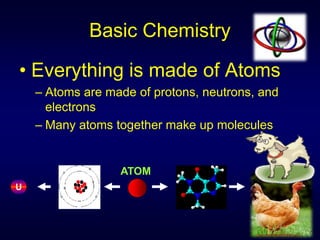
• Everything is made of Atoms
– Atoms are made of protons, neutrons, and
electrons
– Many atoms together make up molecules
U
ATOM
Oxygen
Nitrogen
8
9
10
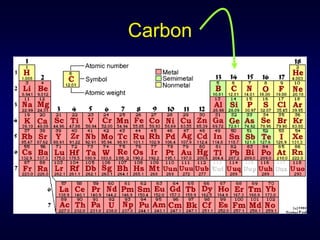
Carbon
Do you know?
Mass Spectroscopy
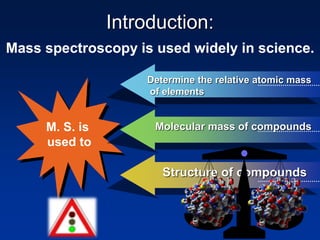
Introduction:
M. S. is
used to
Determine the relative atomic mass
of elements
Molecular mass of compounds
Structure of compounds
Mass spectroscopy is used widely in science.
Mass Spectroscopy?
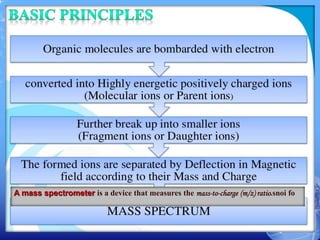
 Mass spectroscopy is an
instrumental technique in which
sample is converted rapidly into
positive ions by electron
bombardment and charged particles
are separated according to their
masses (m/z or m/e values).
14
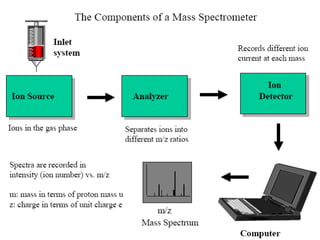
A mass spectrometer is a device that
measures the mass-to-charge (m/z) ratio snoi fo.
pramodpadole@gmail.com
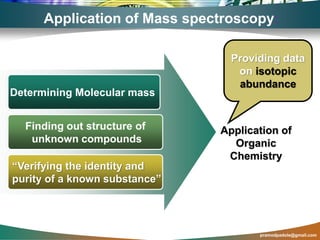
Application of Mass spectroscopy:
Determining Molecular mass
Finding out structure of
unknown compounds
“Verifying the identity and
purity of a known substance”
Application of
Organic
Chemistry
Providing data
on isotopic
abundance
Question
Q.1) Write / Explain in brief principle of mass spectroscopy.
(S-10, W-13, S-14 & S-19, 2-4 Mark)
Q.2) Explain the principle of mass spectroscopy.
(W-12, 2 Mark)
Q.3) Describe in short the principle of mass spectroscopy.
(W-15, 4 Mark)
Q.4) Describe the principle of mass spectroscopy.
Q.5) Which of the following spectroscopy would determine molecular
weight of a compound? (S-18, ½ Mark)
(a) UV-Visible (b) NMR (c) IR (d) Mass spectroscopy
17
Theory or Principle:
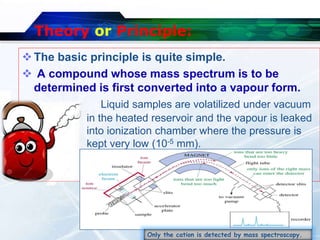
The basic principle is quite simple.
 A compound whose mass spectrum is to be
determined is first converted into a vapour form.
Liquid samples are volatilized under vacuum
in the heated reservoir and the vapour is leaked
into ionization chamber where the pressure is
kept very low (10-5 mm).
18Only the cation is detected by mass spectroscopy.
19
A mass spectrometer is a device that measures the mass-to-charge (m/z) ratio snoi fo.
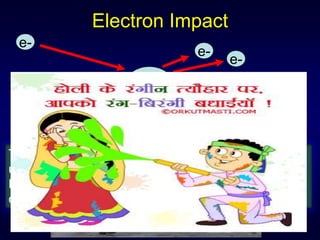
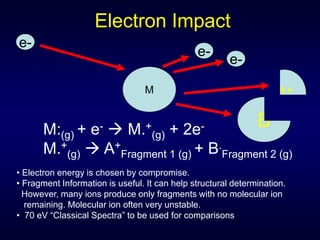
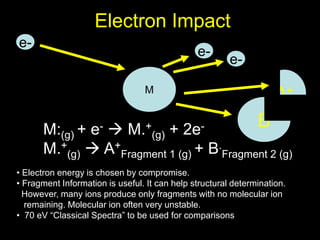
Electron Impact
M
e-
e-
e-
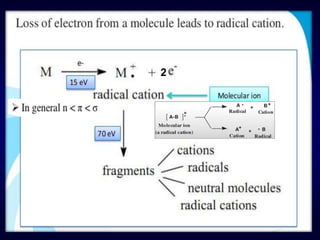
M:(g) + e-  M.+
(g) + 2e-
This reaction creates the molecular ion so is very
useful.
However, the excess energy from the electron can
cause the molecular ion to fall apart: Fragments
21
2
Electron Impact
A+M
e-
e-
e-
M:(g) + e-  M.+
(g) + 2e-
M.+
(g)  A+
Fragment 1 (g) + B.
Fragment 2 (g)
• Electron energy is chosen by compromise.
• Fragment Information is useful. It can help structural determination.
However, many ions produce only fragments with no molecular ion
remaining. Molecular ion often very unstable.
• 70 eV “Classical Spectra” to be used for comparisons
BB
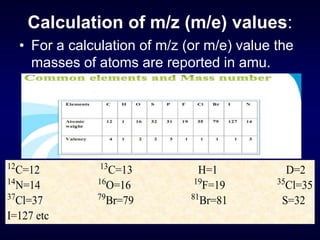
Calculation of m/z (m/e) values:
• For a calculation of m/z (or m/e) value the
masses of atoms are reported in amu.
23
12
C=12 13
C=13 H=1 D=2
14
N=14 16
O=16 19
F=19 35
Cl=35
37
Cl=37 79
Br=79 81
Br=81 S=32
I=127 etc
24
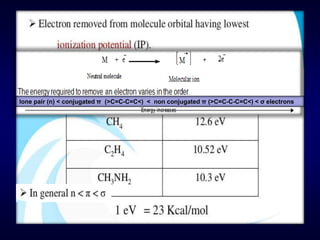
lone pair (n) < conjugated π (>C=C-C=C<) < non conjugated π (>C=C-C-C=C<) < σ electrons
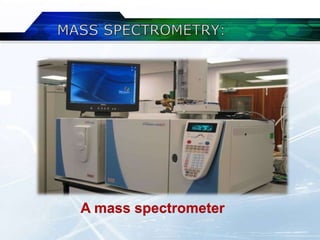
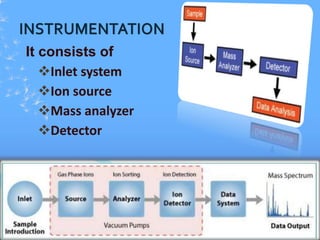
A mass spectrometer
It consists of
Inlet system
Ion source
Mass analyzer
Detector
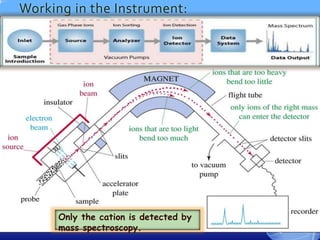
Working in the Instrument:
27
Only the cation is detected by
mass spectroscopy.
SpectroscopySpectroscopy
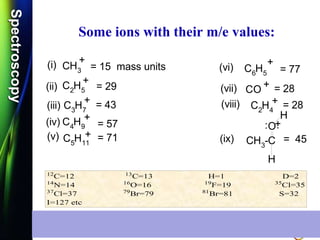
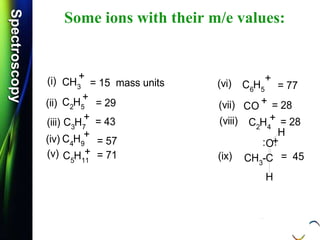
Some ions with their m/e values:
28
(i) CH3
+
= 15 mass units
(ii) C2
H5
+
= 29
(iii) C3
H7
+ = 43
(iv) C4
H9
+
= 57
(v) C5
H11
+ = 71
(vi) C6
H5
+
= 77
(vii) CO + = 28
(viii) C2
H4
+ = 28
(ix) CH3
-C
H
O
H
: .+
= 45
29
Electron Impact
A+M
e-
e-
e-
M:(g) + e-  M.+
(g) + 2e-
M.+
(g)  A+
Fragment 1 (g) + B.
Fragment 2 (g)
• Electron energy is chosen by compromise.
• Fragment Information is useful. It can help structural determination.
However, many ions produce only fragments with no molecular ion
remaining. Molecular ion often very unstable.
• 70 eV “Classical Spectra” to be used for comparisons
BB
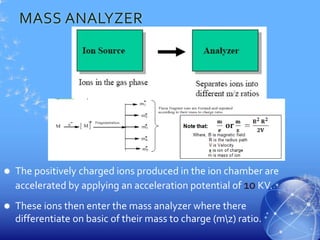
MASS ANALYZER
 The positively charged ions produced in the ion chamber are
accelerated by applying an acceleration potential of 10 KV.
 These ions then enter the mass analyzer where there
differentiate on basic of their mass to charge (mz) ratio.
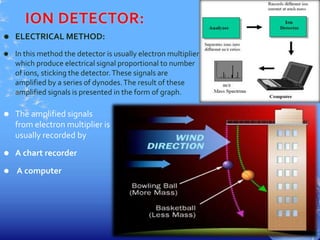
ION DETECTOR:
 ELECTRICAL METHOD:
 In this method the detector is usually electron multiplier
which produce electrical signal proportional to number
of ions, sticking the detector.These signals are
amplified by a series of dynodes.The result of these
amplified signals is presented in the form of graph.
 The amplified signals
from electron multiplier is
usually recorded by
 A chart recorder
 A computer
SpectroscopySpectroscopy
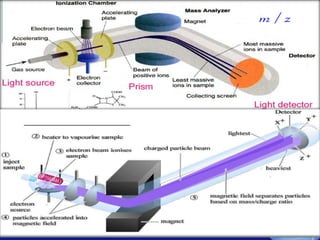
Deflection of cations:
33
34
Question
SpectroscopySpectroscopy
Q.1) Explain the terms: Mass spectrum.
(W-09, 2 Mark)
Q.2) A plot of mass to charge (m/z) ratio values along abscissa
and their relative abundance along the ordinate is called mass
spectrum.
(S-15, ½ Mark)
36 Mass
SpectroscopySpectroscopy
MASS SPECTRUM:
A plot of mass to charge (m/z) ratio values
along abscissa (X-axis) and their relative
abundance along the ordinate (Y-axis)
is called mass spectrum.
The m/z (or m/e) value of the parent ion (molecular ion) is equal to the
molecular (molar) mass of the compound.
m/z (or m/e)
Relativeabundance
10 20 30 40 50
Base peak (100 % intensity)
Molecular ion peak
M+
Daughter ion peaks
0 %
100%
(M+1)
(M+2)
Isotopic abundance
2
SpectroscopySpectroscopy
Q.1) Define term: Molecular ion peak.
(S-10, W-11, W-13, S-14, W-14, S-15 & W-16, 2 Mark)
Q.2) Define term: Parent ion. (S-11 & W-14, 2 Mark)
Q.3) Explain the terms: Molecular ion. (S-16, S-17 & W-17, 2 Mark)
Q.4) The last peak in the mass spectrum is called as molecular
ion peak. (W-16, ½ Mark)
Q.5) Explain the terms: Molecular ion peak with an example.
(W-19, 2 Mark)
Mass
Molecular ion or Parent ion:
SpectroscopySpectroscopy
Molecular ion or parent ion:
 Defination:
The peak at highest m/e (or m/z) value is
called as molecular ion or parent ion or
radical cation peak.
M: + e-
[ M ] + 2 e-
Neutral
Molecule
Molecular Ion
or Parent ion
10 -70 eV +.
SpectroscopySpectroscopy
Q.1) Explain the term: Peak area. (W-09 & S-18, 2 Mark)
Q.2) Define the term: Base peak.
(S-10, W-11, W-13, S-14, W-14, S-15 & W-16, 2 Mark)
Q.3) Explain the term Base peak with suitable example.
(S-13, W-17 & W-19, 2 Mark)
Q.4) A peak in mass spectrum whose intensity is assumed to be
100% is known as Base peak. (S-13, ½ Mark)
Q.5) In mass spectrum the peak given by most abundant ion and
whose intensity is assumed to be 100% is known as
Base peak. (W-15, ½ Mark)
Q.6) The peak corresponding to the most abundant ion in the mass spectrum
of a compound is called Base peak. (W-17, ½ Mark)
Q.7) What is base peak? (W-18, 1 Mark)
m/z (or m/e)
Relativeabundance
10 20 30 40 50
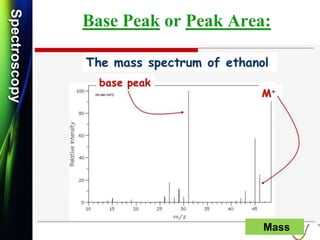
Base peak (largest peak or 100 % intensity)
Molecular ion peak
M+
Daughter ion peaks
0 %
100%
(M+1)
(M+2)
SpectroscopySpectroscopy
Base Peak or Peak Area:
Mass
SpectroscopySpectroscopy
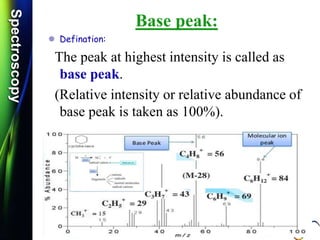
Base peak:
 Defination:
The peak at highest intensity is called as
base peak.
(Relative intensity or relative abundance of
base peak is taken as 100%).
SpectroscopySpectroscopy
Q.1) Define the term: Daughter ion.
(S-11, 2 Mark)
SpectroscopySpectroscopy
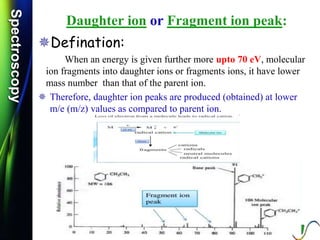
Daughter ion or Fragment ion peak:
Defination:
When an energy is given further more upto 70 eV, molecular
ion fragments into daughter ions or fragments ions, it have lower
mass number than that of the parent ion.
 Therefore, daughter ion peaks are produced (obtained) at lower
m/e (m/z) values as compared to parent ion.
LOGO
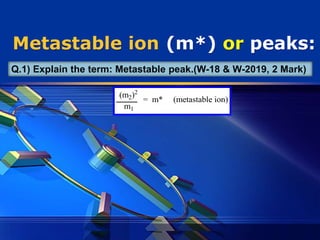
Metastable ion (m*) or peaks:
(m2)2
m1
= m* (metastable ion)
Q.1) Explain the term: Metastable peak.(W-18 & W-2019, 2 Mark)
Metastable ion (m*) or peaks:
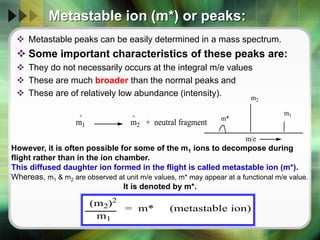
 Metastable peaks can be easily determined in a mass spectrum.
 Some important characteristics of these peaks are:
 They do not necessarily occurs at the integral m/e values
 These are much broader than the normal peaks and
 These are of relatively low abundance (intensity).
m1 m2 + neutral fragment
+ + m*
m2
m1
m/e
However, it is often possible for some of the m1 ions to decompose during
flight rather than in the ion chamber.
This diffused daughter ion formed in the flight is called metastable ion (m*).
Whereas, m1 & m2 are observed at unit m/e values, m* may appear at a functional m/e value.
It is denoted by m*.
(m2)2
m1
= m* (metastable ion)
SpectroscopySpectroscopy
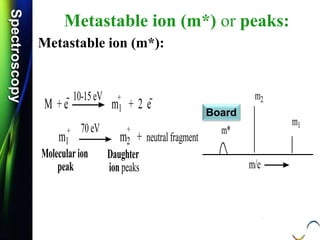
Metastable ion (m*) or peaks:
Metastable ion (m*):
Molecularion
peak
Daughter
ion peaks
m1 m2 + neutral fragment
+ + m*
m2
m1
m/e
M + e m1 + 2 e
+10-15eV
70eV
Board
SpectroscopySpectroscopy Metastable ion (m*) or peaks:
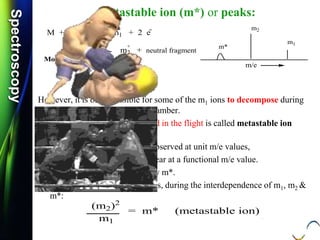
However, it is often possible for some of the m1 ions to decompose during
flight rather than in the ion chamber.
This diffused daughter ion formed in the flight is called metastable ion
(m*).
Whereas, m1 & m2 are observed at unit m/e values,
m* may appear at a functional m/e value.
It is denoted by m*.
A mathematical relationship exists, during the interdependence of m1, m2 &
m*:
(m2)2
m1
= m* (metastable ion)
Molecular ion
peak
Daughter
ion peaks
m1 m2 + neutral fragment
+ + m*
m2
m1
m/e
M + e m1 + 2 e
+10-15 eV
70 eV
SpectroscopySpectroscopy
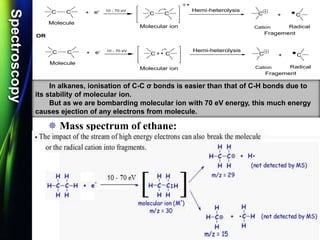
 Mass spectrum of ethane:
In alkanes, ionisation of C-C σ bonds is easier than that of C-H bonds due to
its stability of molecular ion.
But as we are bombarding molecular ion with 70 eV energy, this much energy
causes ejection of any electrons from molecule.
C C C C+
C C e-
Molecule
Molecular ion
Fragement
Cation Radical
Hemi-heterolysis+ 10 - 70 eV
C C C C+
C C e-
Molecule
Molecular ion
Fragement
Cation Radical
Hemi-heterolysis+ 10 - 70 eV
OR
SpectroscopySpectroscopy
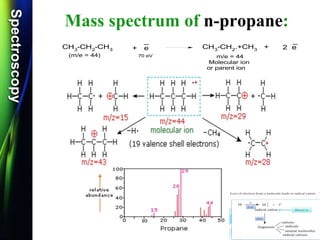
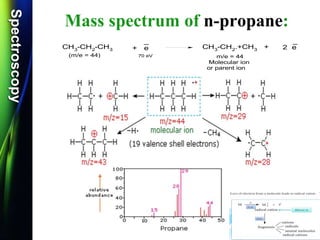
Mass spectrum of n-propane:
CH3
-CH2
-CH3 + e CH3
-CH2
.+CH3
+ 2 e
__
(m/e = 44) 70 eV m/e = 44
Molecular ion
or parent ion
SpectroscopySpectroscopy
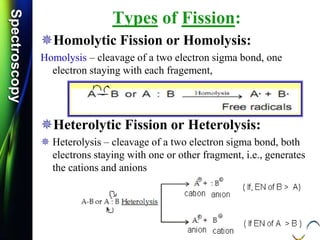
Types of Fission:
Homolytic Fission or Homolysis:
Homolysis – cleavage of a two electron sigma bond, one
electron staying with each fragement,
Heterolytic Fission or Heterolysis:
 Heterolysis – cleavage of a two electron sigma bond, both
electrons staying with one or other fragment, i.e., generates
the cations and anions
SpectroscopySpectroscopy
Types of Fission:
Hemi-Heterolytic Fission:
Definition: It is a cleavage of an ionized sigma bond; to
form cation and free radical.
 There is only one electron in the bonding sigma orbital,
hence the use of a single headed arrow.
 Note that: All molecular ions [cation-radicals] are written
inside square brackets.
 Hemi-Heterolysis: This special type of breaking of
ionized sigma covalent bond and
is possible in saturated hydrocarbons.
C C C C+
C C e-
Molecule
Molecular ion
Fragement
Cation Radical
Hemi-heterolysis+ 10 - 70 eV
C C C C+
C C e-
Molecule
Molecular ion
Fragement
Cation Radical
Hemi-heterolysis+ 10 - 70 eV
OR
A B
Hemi-Heterolysis
A B
A B
Hemi-Heterolysis
A B. + .
+
SpectroscopySpectroscopy
Some ions with their m/e values:
(i) CH3
+
= 15 mass units
(ii) C2
H5
+
= 29
(iii) C3
H7
+ = 43
(iv) C4
H9
+
= 57
(v) C5
H11
+ = 71
(vi) C6
H5
+
= 77
(vii) CO + = 28
(viii) C2
H4
+ = 28
(ix) CH3
-C
H
O
H
: .+
= 45
12
C=12 13
C=13 H=1 D=2
14
N=14 16
O=16 19
F=19 35
Cl=35
37
Cl=37 79
Br=79 81
Br=81 S=32
I=127 etc
SpectroscopySpectroscopy
Mass spectrum of n-propane:
CH3
-CH2
-CH3 + e CH3
-CH2
.+CH3
+ 2 e
__
(m/e = 44) 70 eV m/e = 44
Molecular ion
or parent ion
SpectroscopySpectroscopy
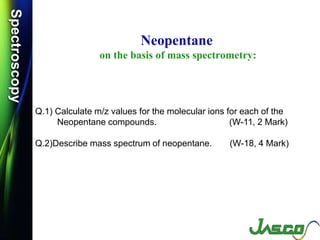
Neopentane
on the basis of mass spectrometry:
Q.1) Calculate m/z values for the molecular ions for each of the
Neopentane compounds. (W-11, 2 Mark)
Q.2)Describe mass spectrum of neopentane. (W-18, 4 Mark)
SpectroscopySpectroscopy
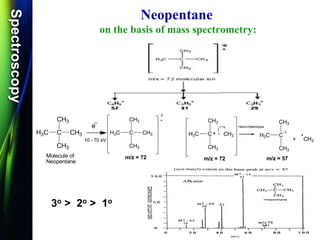
Neopentane
on the basis of mass spectrometry:
3o > 2o > 1o
H3C C CH3
CH3
CH3
H3C C
CH3
CH3
+ CH3
m/z = 72
H3C C CH3
CH3
CH3
e
_
Molecule of
Neopentane
10 - 70 eV
m/z = 57
H3C C CH3
CH3
CH3
m/z = 72
+
Hemi-Heterolysis
SpectroscopySpectroscopy
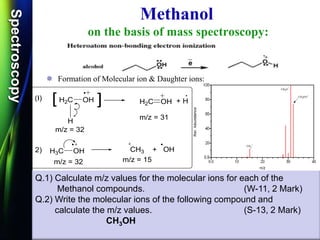
Methanol
on the basis of mass spectroscopy:
 Formation of Molecular ion & Daughter ions:
CH3
OH
H2C OH
H
+ HH2C OH
H3C OH CH3 + OH
m/z = 31
m/z = 32
m/z = 15m/z = 32
2)
(I) [ [
Q.1) Calculate m/z values for the molecular ions for each of the
Methanol compounds. (W-11, 2 Mark)
Q.2) Write the molecular ions of the following compound and
calculate the m/z values. (S-13, 2 Mark)
CH3OH
SpectroscopySpectroscopy
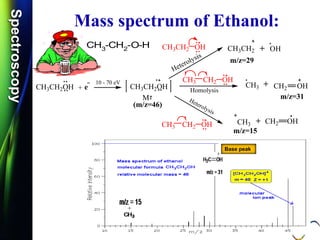
Mass spectrum of Ethanol:
 Q.1) Discuss /Explain the mass spectrum of ethanol.
(W-09 & W-14, 2-4 Mark)
 Q.2) Calculate m/z values for the molecular ions for each of
the Ethanol compounds. (S-13 & S-14, 2 Mark)
 Q.3) Calculate m/z values for the molecular ions for each of
the Methanol compounds. (W-15, 2 Mark)
CH3-CH2-OH
 Q.4) Calculate m/z values for the following molecular ion:
(W-16, S-17 & S-19, 2 Mark)
 Q.5) Give the structure of a compound C2H6O, whose mass spectrum
shows m/z values of 15, 29, 31 and 46.
(S-18, 4 Mark)
[CH3CH2OH]
SpectroscopySpectroscopy
Mass spectrum of Ethanol:
CH3
-CH2
-O-H
Base peak
CH3CH2OH e CH3CH2OH
M
(m/z=46)
CH2 OHCH3
m/z=31
Homolysis
CH3
m/z=15
Heterolysis
CH3CH2 OH
m/z=29
Heterolysis
CH3CH2 OH
CH3 CH2 OH
+
10 - 70 eV
CH3 CH2 OH CH2 OH
.
SpectroscopySpectroscopy
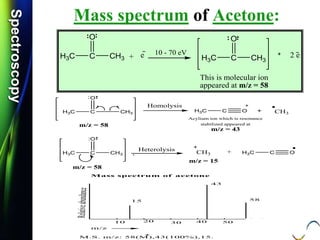
Mass spectrum of Acetone:
 Q.1) Discuss /Explain the mass spectrum of acetone.
 Q.2) Calculate m/e values for the molecular ions for each of
the Acetone compounds. (S-11, S-12 & S-14, 2 Mark)
 Q.3) Write the molecular ions of the following compound and
calculate the m/e values. (S-12, S-14 & W-14, 2 Mark)
CH3COCH3
 Q.4) Calculate m/z values for the molecular ions of the
Acetone compound. (W-11, 2 Mark)
 Q.5) Calculate m/z values for the following molecular ion:
[CH3COCH3]+. (S-17 & W-17, 2 mark)
 Q.6) Discuss the fragmentation of Acetone. (S-18, 4 Mark)
CH3C O
+.
..
SpectroscopySpectroscopy
Mass spectrum of Acetone:
H3C C
O
CH3 e H3C C
O
CH3
2 e
This is molecular ion
appeared at m/z = 58
+
10 - 70 eV
H3C C
O
CH3
Homolysis
H3C C O CH3
Acylium ion which is resonance
stabilized appeared at
m/z = 43
H3C C
O
CH3
Heterolysis CH3
m/z = 15
:
:
H3C C O+
m/z = 58
m/z = 58
SpectroscopySpectroscopy
Mass spectrum of Benzaldehyde:
 Q.1) Calculate m/z values for each of the following:
(S-16, 2 Mark)
 Q.2) Calculate m/z values for each of the following:
(S-16 & W-17, 2 Mark)
O +
C-H
.
m/e = 106
[C6H5-C-H]
O
+
.
m/z = 106
SpectroscopySpectroscopy
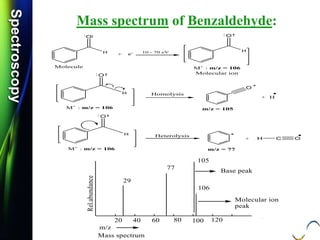
Mass spectrum of Benzaldehyde:
+H
O
H
O
M+
: m/z = 106
Homolysis
+ H
O
m/z = 105
Heterolysis
m/z = 77
:
e-
Molecule
:
H
O
M+
: m/z = 106
:
H
O
M+
: m/z = 106
:
H C O+
10 - 70 eV
Molecular ion
Problems
SpectroscopySpectroscopy
Some Important example on
Mass Spectroscopy:
Q.1) Write the molecular ions of the following
compounds and calculate the m/e values: (S-
12, S-14 & W-14, 2 Mark)
CH3-NH2
Ans: Fragments of m/e = 31, 30 & 28
+.CH3NH2 + e
- 10 - 70 eV
[ CH3NH2 ]
m/e = 31OR
+.
CH3 NH2 + e
- 10 - 70 eV
[ CH3 NH2 ]
m/e = 31
..
Q.2) Calculate the m/z (m/e) values for the
following ion in mass spectroscopy:
(S-15 &S-19, 2 Mark)
• Ans: m/e = 31
Q.3) Calculate the m/z (m/e) values for each of the
particles. (S-11, S-13 & S-14, 2 -4 Mark)
+.
[ CH3NH2 ]
(i) CH2=NH2 & (ii) CH3C O
+ .+ .
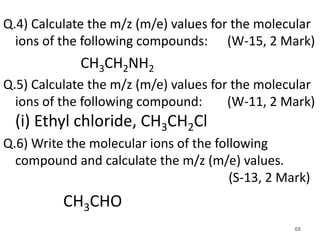
Q.4) Calculate the m/z (m/e) values for the molecular
ions of the following compounds: (W-15, 2 Mark)
CH3CH2NH2
Q.5) Calculate the m/z (m/e) values for the molecular
ions of the following compound: (W-11, 2 Mark)
(i) Ethyl chloride, CH3CH2Cl
Q.6) Write the molecular ions of the following
compound and calculate the m/z (m/e) values.
(S-13, 2 Mark)
CH3CHO
68
Q.7) Calculate the m/z (m/e) values for the
following ion in mass spectroscopy:
[(CH3)2CH]+ (S-15 & S-19, 2 Mark)
Q.8) Calculate the m/z (m/e) values for the
following ion in mass spectroscopy:
(S-16, 2 Mark)
69
+
CH3
CH3
CH-NH2
[ [
Q.9) Calculate the m/z (m/e) values for the
following molecular ion in mass spectroscopy:
(W-16 & S-19, 2 Mark)
70
[C6H5-CH3]
Q.10) Calculate the m/z (m/e) values for the
following ions: (W-18, 4 Mark)
71
[C6H5](i)
(ii) [CH3COOH]
Last Problem:
72
.
CH3CH2OH
[CH3CH2OH]
2e
2e
O
C
H3C CH3
O
H3C CH3
2e
e.g.-1)
e.g.-2)
e.g.-3)
m/e=78
m/e=46
m/e=58
+ e-
+ e-
+ e- 10 - 70 eV
10 - 70 eV
10 - 70 eV
SpectroscopySpectroscopy
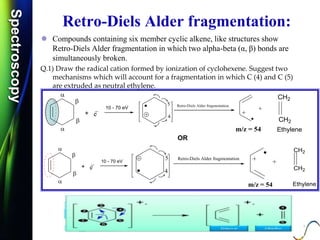
Retro-Diels Alder fragmentation:
 Compounds containing six member cyclic alkene, like structures show
Retro-Diels Alder fragmentation in which two alpha-beta (α, β) bonds are
simultaneously broken.
Q.1) Draw the radical cation formed by ionization of cyclohexene. Suggest two
mechanisms which will account for a fragmentation in which C (4) and C (5)
are extruded as neutral ethylene.
e
Retro-Diels Alder fragmentation
m/z = 54
4
5
CH2
CH2
Ethylene



+
10 - 70 eV
CH2
CH2
Ethylene
Retro-Diels Alder fragmentation
4
5
e




+
10 - 70 eV
m/z = 54
OR
SpectroscopySpectroscopy
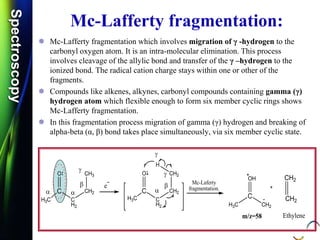
Mc-Lafferty fragmentation:
 Mc-Lafferty fragmentation which involves migration of γ -hydrogen to the
carbonyl oxygen atom. It is an intra-molecular elimination. This process
involves cleavage of the allylic bond and transfer of the γ –hydrogen to the
ionized bond. The radical cation charge stays within one or other of the
fragments.
 Compounds like alkenes, alkynes, carbonyl compounds containing gamma (γ)
hydrogen atom which flexible enough to form six member cyclic rings shows
Mc-Lafferty fragmentation.
 In this fragmentation process migration of gamma (γ) hydrogen and breaking of
alpha-beta (α, β) bond takes place simultaneously, via six member cyclic state.
O
C
C
H2
H3C
CH2
CH3
e
O
C
C
H2
H3C
CH2
CH2
H
Mc-Laferty
fragmentation.
OH
C
CH2
H3C CH2
m/z=58
CH2
 
 



Ethylene
75
THE END!

Mass spectroscopy by dr. pramod r. padole

  • 1.
    Mass Spectroscopy By Dr. P.R. Padole Associate Professor Department of Chemistry Shri Shivaji Science College, Amravati.
  • 2.
    SpectroscopySpectroscopy Contents  Introduction  Defination Basic principle / Theory  Brief outline of instrumentation.  Ion formation and types  Fragmentation processes  Fragmentation patterns  Fragmentation characteristics in relation to parent structure and functional groups 2
  • 3.
    What is aMass Spectroscopy? A Mass Spectroscopy is a machine that weighs molecules ! 0 units
  • 4.
    What is aMass Spectroscopy? A Mass Spectroscopy is a machine that weighs molecules ! 12 units 8 9 10 11 12 13 14 15 16 C
  • 5.
    What is aMass Spectroscopy? A Mass Spectroscopy is a machine that weighs molecules ! 16 units 8 9 10 11 12 13 14 15 16 C N O H = 1
  • 6.
    Basic Chemistry • Everythingis made of Atoms – Atoms are made of protons, neutrons, and electrons – Many atoms together make up molecules U ATOM
  • 7.
  • 8.
  • 9.
  • 10.
  • 11.
  • 12.
    Do you know? MassSpectroscopy
  • 13.
    Introduction: M. S. is usedto Determine the relative atomic mass of elements Molecular mass of compounds Structure of compounds Mass spectroscopy is used widely in science.
  • 14.
    Mass Spectroscopy?  Massspectroscopy is an instrumental technique in which sample is converted rapidly into positive ions by electron bombardment and charged particles are separated according to their masses (m/z or m/e values). 14 A mass spectrometer is a device that measures the mass-to-charge (m/z) ratio snoi fo.
  • 15.
    pramodpadole@gmail.com Application of Massspectroscopy: Determining Molecular mass Finding out structure of unknown compounds “Verifying the identity and purity of a known substance” Application of Organic Chemistry Providing data on isotopic abundance
  • 16.
  • 17.
    Q.1) Write /Explain in brief principle of mass spectroscopy. (S-10, W-13, S-14 & S-19, 2-4 Mark) Q.2) Explain the principle of mass spectroscopy. (W-12, 2 Mark) Q.3) Describe in short the principle of mass spectroscopy. (W-15, 4 Mark) Q.4) Describe the principle of mass spectroscopy. Q.5) Which of the following spectroscopy would determine molecular weight of a compound? (S-18, ½ Mark) (a) UV-Visible (b) NMR (c) IR (d) Mass spectroscopy 17
  • 18.
    Theory or Principle: Thebasic principle is quite simple.  A compound whose mass spectrum is to be determined is first converted into a vapour form. Liquid samples are volatilized under vacuum in the heated reservoir and the vapour is leaked into ionization chamber where the pressure is kept very low (10-5 mm). 18Only the cation is detected by mass spectroscopy.
  • 19.
    19 A mass spectrometeris a device that measures the mass-to-charge (m/z) ratio snoi fo.
  • 20.
    Electron Impact M e- e- e- M:(g) +e-  M.+ (g) + 2e- This reaction creates the molecular ion so is very useful. However, the excess energy from the electron can cause the molecular ion to fall apart: Fragments
  • 21.
  • 22.
    Electron Impact A+M e- e- e- M:(g) +e-  M.+ (g) + 2e- M.+ (g)  A+ Fragment 1 (g) + B. Fragment 2 (g) • Electron energy is chosen by compromise. • Fragment Information is useful. It can help structural determination. However, many ions produce only fragments with no molecular ion remaining. Molecular ion often very unstable. • 70 eV “Classical Spectra” to be used for comparisons BB
  • 23.
    Calculation of m/z(m/e) values: • For a calculation of m/z (or m/e) value the masses of atoms are reported in amu. 23 12 C=12 13 C=13 H=1 D=2 14 N=14 16 O=16 19 F=19 35 Cl=35 37 Cl=37 79 Br=79 81 Br=81 S=32 I=127 etc
  • 24.
    24 lone pair (n)< conjugated π (>C=C-C=C<) < non conjugated π (>C=C-C-C=C<) < σ electrons
  • 25.
  • 26.
    It consists of Inletsystem Ion source Mass analyzer Detector
  • 27.
    Working in theInstrument: 27 Only the cation is detected by mass spectroscopy.
  • 28.
    SpectroscopySpectroscopy Some ions withtheir m/e values: 28 (i) CH3 + = 15 mass units (ii) C2 H5 + = 29 (iii) C3 H7 + = 43 (iv) C4 H9 + = 57 (v) C5 H11 + = 71 (vi) C6 H5 + = 77 (vii) CO + = 28 (viii) C2 H4 + = 28 (ix) CH3 -C H O H : .+ = 45
  • 29.
  • 30.
    Electron Impact A+M e- e- e- M:(g) +e-  M.+ (g) + 2e- M.+ (g)  A+ Fragment 1 (g) + B. Fragment 2 (g) • Electron energy is chosen by compromise. • Fragment Information is useful. It can help structural determination. However, many ions produce only fragments with no molecular ion remaining. Molecular ion often very unstable. • 70 eV “Classical Spectra” to be used for comparisons BB
  • 31.
    MASS ANALYZER  Thepositively charged ions produced in the ion chamber are accelerated by applying an acceleration potential of 10 KV.  These ions then enter the mass analyzer where there differentiate on basic of their mass to charge (mz) ratio.
  • 32.
    ION DETECTOR:  ELECTRICALMETHOD:  In this method the detector is usually electron multiplier which produce electrical signal proportional to number of ions, sticking the detector.These signals are amplified by a series of dynodes.The result of these amplified signals is presented in the form of graph.  The amplified signals from electron multiplier is usually recorded by  A chart recorder  A computer
  • 33.
  • 34.
  • 35.
  • 36.
    SpectroscopySpectroscopy Q.1) Explain theterms: Mass spectrum. (W-09, 2 Mark) Q.2) A plot of mass to charge (m/z) ratio values along abscissa and their relative abundance along the ordinate is called mass spectrum. (S-15, ½ Mark) 36 Mass
  • 37.
    SpectroscopySpectroscopy MASS SPECTRUM: A plotof mass to charge (m/z) ratio values along abscissa (X-axis) and their relative abundance along the ordinate (Y-axis) is called mass spectrum. The m/z (or m/e) value of the parent ion (molecular ion) is equal to the molecular (molar) mass of the compound. m/z (or m/e) Relativeabundance 10 20 30 40 50 Base peak (100 % intensity) Molecular ion peak M+ Daughter ion peaks 0 % 100% (M+1) (M+2) Isotopic abundance 2
  • 38.
    SpectroscopySpectroscopy Q.1) Define term:Molecular ion peak. (S-10, W-11, W-13, S-14, W-14, S-15 & W-16, 2 Mark) Q.2) Define term: Parent ion. (S-11 & W-14, 2 Mark) Q.3) Explain the terms: Molecular ion. (S-16, S-17 & W-17, 2 Mark) Q.4) The last peak in the mass spectrum is called as molecular ion peak. (W-16, ½ Mark) Q.5) Explain the terms: Molecular ion peak with an example. (W-19, 2 Mark) Mass
  • 39.
    Molecular ion orParent ion:
  • 40.
    SpectroscopySpectroscopy Molecular ion orparent ion:  Defination: The peak at highest m/e (or m/z) value is called as molecular ion or parent ion or radical cation peak. M: + e- [ M ] + 2 e- Neutral Molecule Molecular Ion or Parent ion 10 -70 eV +.
  • 41.
    SpectroscopySpectroscopy Q.1) Explain theterm: Peak area. (W-09 & S-18, 2 Mark) Q.2) Define the term: Base peak. (S-10, W-11, W-13, S-14, W-14, S-15 & W-16, 2 Mark) Q.3) Explain the term Base peak with suitable example. (S-13, W-17 & W-19, 2 Mark) Q.4) A peak in mass spectrum whose intensity is assumed to be 100% is known as Base peak. (S-13, ½ Mark) Q.5) In mass spectrum the peak given by most abundant ion and whose intensity is assumed to be 100% is known as Base peak. (W-15, ½ Mark) Q.6) The peak corresponding to the most abundant ion in the mass spectrum of a compound is called Base peak. (W-17, ½ Mark) Q.7) What is base peak? (W-18, 1 Mark) m/z (or m/e) Relativeabundance 10 20 30 40 50 Base peak (largest peak or 100 % intensity) Molecular ion peak M+ Daughter ion peaks 0 % 100% (M+1) (M+2)
  • 42.
  • 43.
    SpectroscopySpectroscopy Base peak:  Defination: Thepeak at highest intensity is called as base peak. (Relative intensity or relative abundance of base peak is taken as 100%).
  • 44.
    SpectroscopySpectroscopy Q.1) Define theterm: Daughter ion. (S-11, 2 Mark)
  • 45.
    SpectroscopySpectroscopy Daughter ion orFragment ion peak: Defination: When an energy is given further more upto 70 eV, molecular ion fragments into daughter ions or fragments ions, it have lower mass number than that of the parent ion.  Therefore, daughter ion peaks are produced (obtained) at lower m/e (m/z) values as compared to parent ion.
  • 46.
    LOGO Metastable ion (m*)or peaks: (m2)2 m1 = m* (metastable ion) Q.1) Explain the term: Metastable peak.(W-18 & W-2019, 2 Mark)
  • 47.
    Metastable ion (m*)or peaks:  Metastable peaks can be easily determined in a mass spectrum.  Some important characteristics of these peaks are:  They do not necessarily occurs at the integral m/e values  These are much broader than the normal peaks and  These are of relatively low abundance (intensity). m1 m2 + neutral fragment + + m* m2 m1 m/e However, it is often possible for some of the m1 ions to decompose during flight rather than in the ion chamber. This diffused daughter ion formed in the flight is called metastable ion (m*). Whereas, m1 & m2 are observed at unit m/e values, m* may appear at a functional m/e value. It is denoted by m*. (m2)2 m1 = m* (metastable ion)
  • 48.
    SpectroscopySpectroscopy Metastable ion (m*)or peaks: Metastable ion (m*): Molecularion peak Daughter ion peaks m1 m2 + neutral fragment + + m* m2 m1 m/e M + e m1 + 2 e +10-15eV 70eV Board
  • 49.
    SpectroscopySpectroscopy Metastable ion(m*) or peaks: However, it is often possible for some of the m1 ions to decompose during flight rather than in the ion chamber. This diffused daughter ion formed in the flight is called metastable ion (m*). Whereas, m1 & m2 are observed at unit m/e values, m* may appear at a functional m/e value. It is denoted by m*. A mathematical relationship exists, during the interdependence of m1, m2 & m*: (m2)2 m1 = m* (metastable ion) Molecular ion peak Daughter ion peaks m1 m2 + neutral fragment + + m* m2 m1 m/e M + e m1 + 2 e +10-15 eV 70 eV
  • 50.
    SpectroscopySpectroscopy  Mass spectrumof ethane: In alkanes, ionisation of C-C σ bonds is easier than that of C-H bonds due to its stability of molecular ion. But as we are bombarding molecular ion with 70 eV energy, this much energy causes ejection of any electrons from molecule. C C C C+ C C e- Molecule Molecular ion Fragement Cation Radical Hemi-heterolysis+ 10 - 70 eV C C C C+ C C e- Molecule Molecular ion Fragement Cation Radical Hemi-heterolysis+ 10 - 70 eV OR
  • 51.
    SpectroscopySpectroscopy Mass spectrum ofn-propane: CH3 -CH2 -CH3 + e CH3 -CH2 .+CH3 + 2 e __ (m/e = 44) 70 eV m/e = 44 Molecular ion or parent ion
  • 52.
    SpectroscopySpectroscopy Types of Fission: HomolyticFission or Homolysis: Homolysis – cleavage of a two electron sigma bond, one electron staying with each fragement, Heterolytic Fission or Heterolysis:  Heterolysis – cleavage of a two electron sigma bond, both electrons staying with one or other fragment, i.e., generates the cations and anions
  • 53.
    SpectroscopySpectroscopy Types of Fission: Hemi-HeterolyticFission: Definition: It is a cleavage of an ionized sigma bond; to form cation and free radical.  There is only one electron in the bonding sigma orbital, hence the use of a single headed arrow.  Note that: All molecular ions [cation-radicals] are written inside square brackets.  Hemi-Heterolysis: This special type of breaking of ionized sigma covalent bond and is possible in saturated hydrocarbons. C C C C+ C C e- Molecule Molecular ion Fragement Cation Radical Hemi-heterolysis+ 10 - 70 eV C C C C+ C C e- Molecule Molecular ion Fragement Cation Radical Hemi-heterolysis+ 10 - 70 eV OR A B Hemi-Heterolysis A B A B Hemi-Heterolysis A B. + . +
  • 54.
    SpectroscopySpectroscopy Some ions withtheir m/e values: (i) CH3 + = 15 mass units (ii) C2 H5 + = 29 (iii) C3 H7 + = 43 (iv) C4 H9 + = 57 (v) C5 H11 + = 71 (vi) C6 H5 + = 77 (vii) CO + = 28 (viii) C2 H4 + = 28 (ix) CH3 -C H O H : .+ = 45 12 C=12 13 C=13 H=1 D=2 14 N=14 16 O=16 19 F=19 35 Cl=35 37 Cl=37 79 Br=79 81 Br=81 S=32 I=127 etc
  • 55.
    SpectroscopySpectroscopy Mass spectrum ofn-propane: CH3 -CH2 -CH3 + e CH3 -CH2 .+CH3 + 2 e __ (m/e = 44) 70 eV m/e = 44 Molecular ion or parent ion
  • 56.
    SpectroscopySpectroscopy Neopentane on the basisof mass spectrometry: Q.1) Calculate m/z values for the molecular ions for each of the Neopentane compounds. (W-11, 2 Mark) Q.2)Describe mass spectrum of neopentane. (W-18, 4 Mark)
  • 57.
    SpectroscopySpectroscopy Neopentane on the basisof mass spectrometry: 3o > 2o > 1o H3C C CH3 CH3 CH3 H3C C CH3 CH3 + CH3 m/z = 72 H3C C CH3 CH3 CH3 e _ Molecule of Neopentane 10 - 70 eV m/z = 57 H3C C CH3 CH3 CH3 m/z = 72 + Hemi-Heterolysis
  • 58.
    SpectroscopySpectroscopy Methanol on the basisof mass spectroscopy:  Formation of Molecular ion & Daughter ions: CH3 OH H2C OH H + HH2C OH H3C OH CH3 + OH m/z = 31 m/z = 32 m/z = 15m/z = 32 2) (I) [ [ Q.1) Calculate m/z values for the molecular ions for each of the Methanol compounds. (W-11, 2 Mark) Q.2) Write the molecular ions of the following compound and calculate the m/z values. (S-13, 2 Mark) CH3OH
  • 59.
    SpectroscopySpectroscopy Mass spectrum ofEthanol:  Q.1) Discuss /Explain the mass spectrum of ethanol. (W-09 & W-14, 2-4 Mark)  Q.2) Calculate m/z values for the molecular ions for each of the Ethanol compounds. (S-13 & S-14, 2 Mark)  Q.3) Calculate m/z values for the molecular ions for each of the Methanol compounds. (W-15, 2 Mark) CH3-CH2-OH  Q.4) Calculate m/z values for the following molecular ion: (W-16, S-17 & S-19, 2 Mark)  Q.5) Give the structure of a compound C2H6O, whose mass spectrum shows m/z values of 15, 29, 31 and 46. (S-18, 4 Mark) [CH3CH2OH]
  • 60.
    SpectroscopySpectroscopy Mass spectrum ofEthanol: CH3 -CH2 -O-H Base peak CH3CH2OH e CH3CH2OH M (m/z=46) CH2 OHCH3 m/z=31 Homolysis CH3 m/z=15 Heterolysis CH3CH2 OH m/z=29 Heterolysis CH3CH2 OH CH3 CH2 OH + 10 - 70 eV CH3 CH2 OH CH2 OH .
  • 61.
    SpectroscopySpectroscopy Mass spectrum ofAcetone:  Q.1) Discuss /Explain the mass spectrum of acetone.  Q.2) Calculate m/e values for the molecular ions for each of the Acetone compounds. (S-11, S-12 & S-14, 2 Mark)  Q.3) Write the molecular ions of the following compound and calculate the m/e values. (S-12, S-14 & W-14, 2 Mark) CH3COCH3  Q.4) Calculate m/z values for the molecular ions of the Acetone compound. (W-11, 2 Mark)  Q.5) Calculate m/z values for the following molecular ion: [CH3COCH3]+. (S-17 & W-17, 2 mark)  Q.6) Discuss the fragmentation of Acetone. (S-18, 4 Mark) CH3C O +. ..
  • 62.
    SpectroscopySpectroscopy Mass spectrum ofAcetone: H3C C O CH3 e H3C C O CH3 2 e This is molecular ion appeared at m/z = 58 + 10 - 70 eV H3C C O CH3 Homolysis H3C C O CH3 Acylium ion which is resonance stabilized appeared at m/z = 43 H3C C O CH3 Heterolysis CH3 m/z = 15 : : H3C C O+ m/z = 58 m/z = 58
  • 63.
    SpectroscopySpectroscopy Mass spectrum ofBenzaldehyde:  Q.1) Calculate m/z values for each of the following: (S-16, 2 Mark)  Q.2) Calculate m/z values for each of the following: (S-16 & W-17, 2 Mark) O + C-H . m/e = 106 [C6H5-C-H] O + . m/z = 106
  • 64.
    SpectroscopySpectroscopy Mass spectrum ofBenzaldehyde: +H O H O M+ : m/z = 106 Homolysis + H O m/z = 105 Heterolysis m/z = 77 : e- Molecule : H O M+ : m/z = 106 : H O M+ : m/z = 106 : H C O+ 10 - 70 eV Molecular ion
  • 65.
  • 66.
    SpectroscopySpectroscopy Some Important exampleon Mass Spectroscopy: Q.1) Write the molecular ions of the following compounds and calculate the m/e values: (S- 12, S-14 & W-14, 2 Mark) CH3-NH2 Ans: Fragments of m/e = 31, 30 & 28 +.CH3NH2 + e - 10 - 70 eV [ CH3NH2 ] m/e = 31OR +. CH3 NH2 + e - 10 - 70 eV [ CH3 NH2 ] m/e = 31 ..
  • 67.
    Q.2) Calculate them/z (m/e) values for the following ion in mass spectroscopy: (S-15 &S-19, 2 Mark) • Ans: m/e = 31 Q.3) Calculate the m/z (m/e) values for each of the particles. (S-11, S-13 & S-14, 2 -4 Mark) +. [ CH3NH2 ] (i) CH2=NH2 & (ii) CH3C O + .+ .
  • 68.
    Q.4) Calculate them/z (m/e) values for the molecular ions of the following compounds: (W-15, 2 Mark) CH3CH2NH2 Q.5) Calculate the m/z (m/e) values for the molecular ions of the following compound: (W-11, 2 Mark) (i) Ethyl chloride, CH3CH2Cl Q.6) Write the molecular ions of the following compound and calculate the m/z (m/e) values. (S-13, 2 Mark) CH3CHO 68
  • 69.
    Q.7) Calculate them/z (m/e) values for the following ion in mass spectroscopy: [(CH3)2CH]+ (S-15 & S-19, 2 Mark) Q.8) Calculate the m/z (m/e) values for the following ion in mass spectroscopy: (S-16, 2 Mark) 69 + CH3 CH3 CH-NH2 [ [
  • 70.
    Q.9) Calculate them/z (m/e) values for the following molecular ion in mass spectroscopy: (W-16 & S-19, 2 Mark) 70 [C6H5-CH3]
  • 71.
    Q.10) Calculate them/z (m/e) values for the following ions: (W-18, 4 Mark) 71 [C6H5](i) (ii) [CH3COOH]
  • 72.
    Last Problem: 72 . CH3CH2OH [CH3CH2OH] 2e 2e O C H3C CH3 O H3CCH3 2e e.g.-1) e.g.-2) e.g.-3) m/e=78 m/e=46 m/e=58 + e- + e- + e- 10 - 70 eV 10 - 70 eV 10 - 70 eV
  • 73.
    SpectroscopySpectroscopy Retro-Diels Alder fragmentation: Compounds containing six member cyclic alkene, like structures show Retro-Diels Alder fragmentation in which two alpha-beta (α, β) bonds are simultaneously broken. Q.1) Draw the radical cation formed by ionization of cyclohexene. Suggest two mechanisms which will account for a fragmentation in which C (4) and C (5) are extruded as neutral ethylene. e Retro-Diels Alder fragmentation m/z = 54 4 5 CH2 CH2 Ethylene    + 10 - 70 eV CH2 CH2 Ethylene Retro-Diels Alder fragmentation 4 5 e     + 10 - 70 eV m/z = 54 OR
  • 74.
    SpectroscopySpectroscopy Mc-Lafferty fragmentation:  Mc-Laffertyfragmentation which involves migration of γ -hydrogen to the carbonyl oxygen atom. It is an intra-molecular elimination. This process involves cleavage of the allylic bond and transfer of the γ –hydrogen to the ionized bond. The radical cation charge stays within one or other of the fragments.  Compounds like alkenes, alkynes, carbonyl compounds containing gamma (γ) hydrogen atom which flexible enough to form six member cyclic rings shows Mc-Lafferty fragmentation.  In this fragmentation process migration of gamma (γ) hydrogen and breaking of alpha-beta (α, β) bond takes place simultaneously, via six member cyclic state. O C C H2 H3C CH2 CH3 e O C C H2 H3C CH2 CH2 H Mc-Laferty fragmentation. OH C CH2 H3C CH2 m/z=58 CH2        Ethylene
  • 75.
  • 76.