K.Loganathan
Bio-Inorganic Chemistry
Ist-M.Sc-Chemistry
Contents
Introduction
Reactions
Sources & Extraction
Health Benefits
Chlorophyll -pale green; Phyllon-a leaf
 Chlorophyll is the dominant pigment on Earth and
serves as the light‐trapping and energy
transferring chromophore in photosynthetic
organisms.
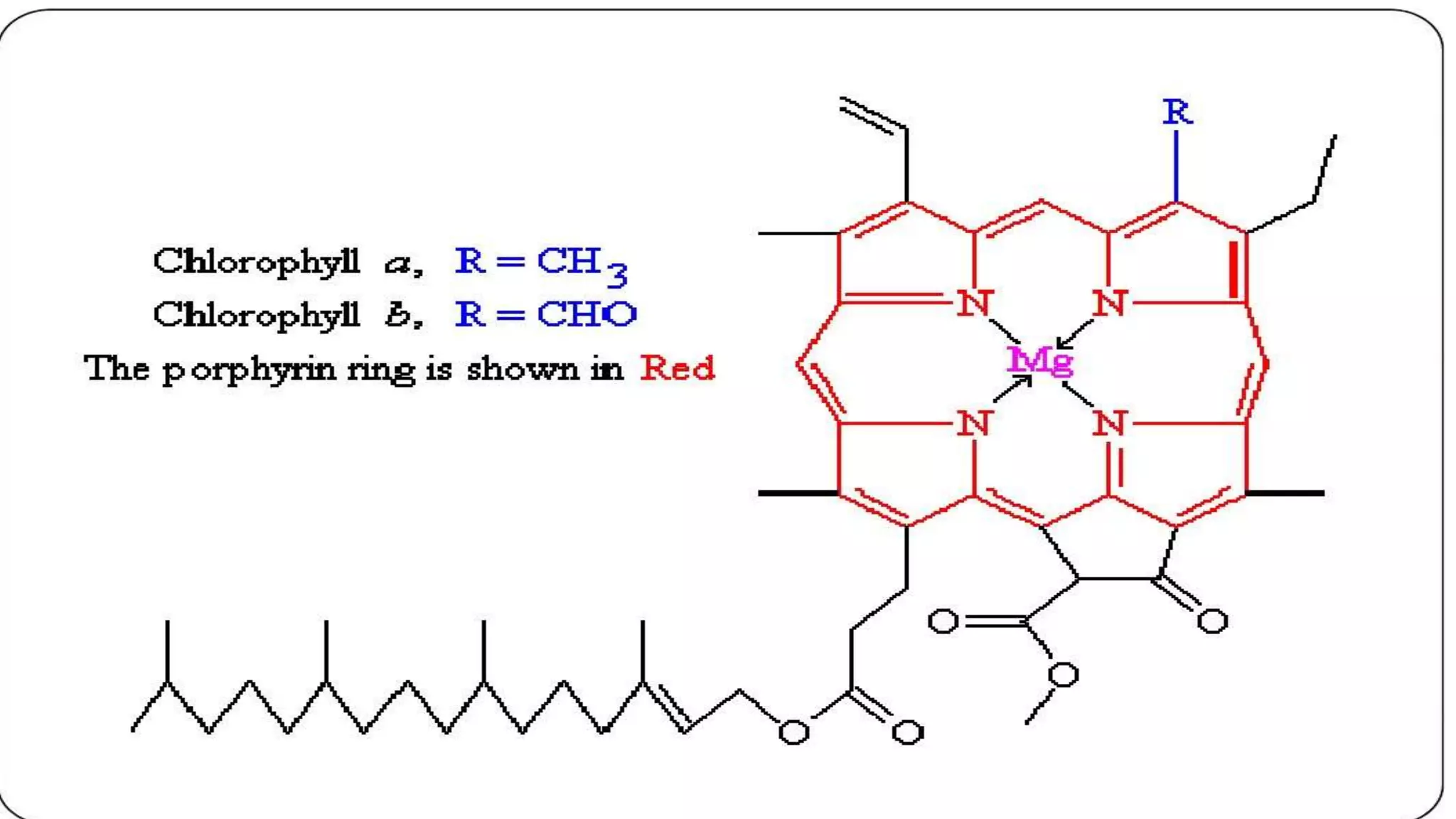
 In chlorophyll the central ion is magnesium, and
the large organic molecule is a porphyrin. The
porphyrin contains four nitrogen atoms that form
bonds to magnesium in a square planar
arrangement. There are several forms of
chlorophyll
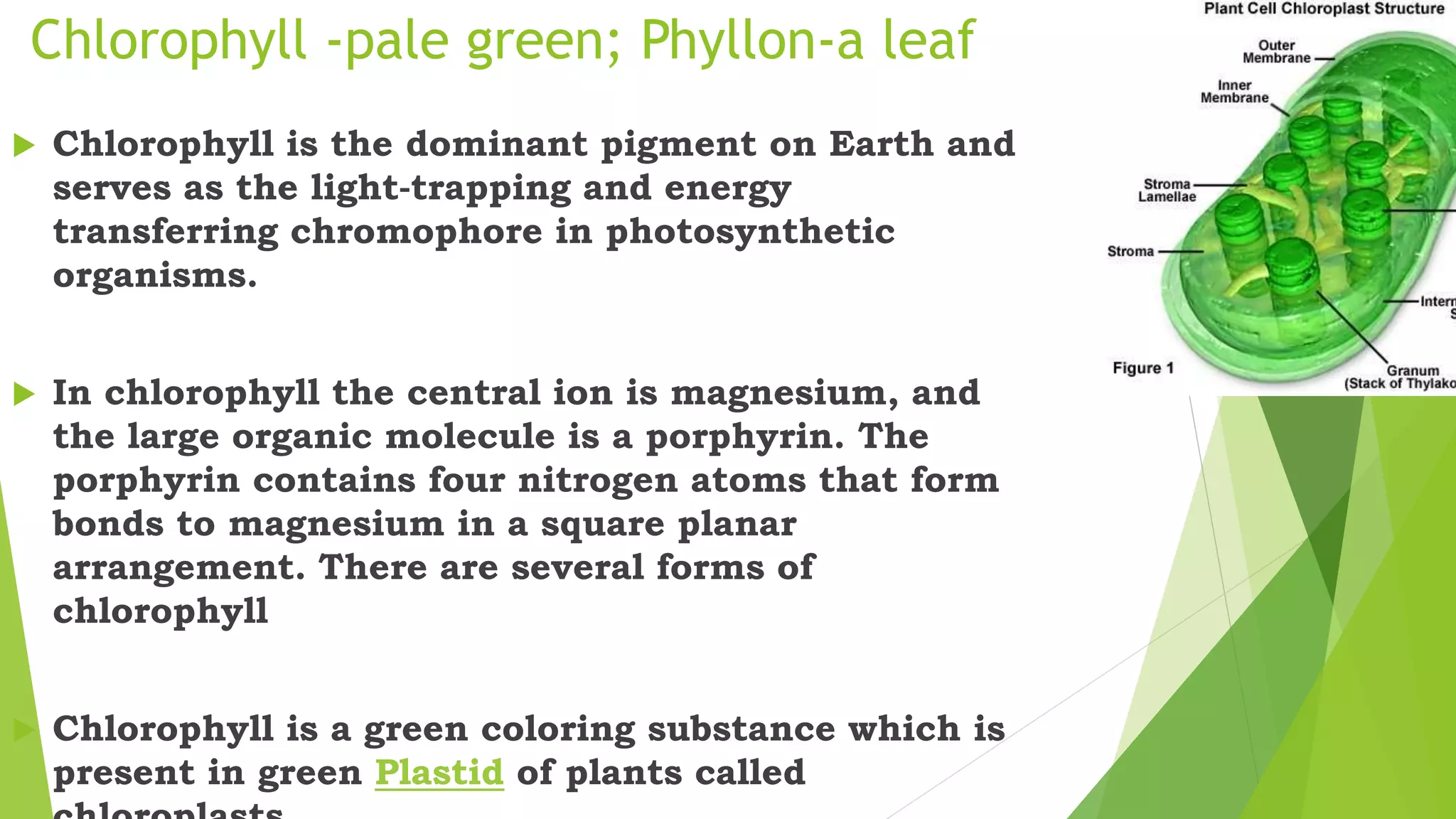
 Chlorophyll is a green coloring substance which is
present in green Plastid of plants called
There are many types of chlorophyll that is chlorophyll a,b,c,d,e
and bacteriochlorophyll. Chlorophyll "a" is the most abundant and
most important photosynthetic pigment. It is found in all green
plants except bacteria. It exists in several forms depending on its
arrangement in the membrane. Chlorophyll "b" is found in all
higher plants and green algae. Chlorophyll "c", "d" and "e" are
found in various groups of algae. Bacteriochlorophyll is found in
bacteria. So, shortcut is that chlorophyll is a green coloring
substance which is present in green plants.
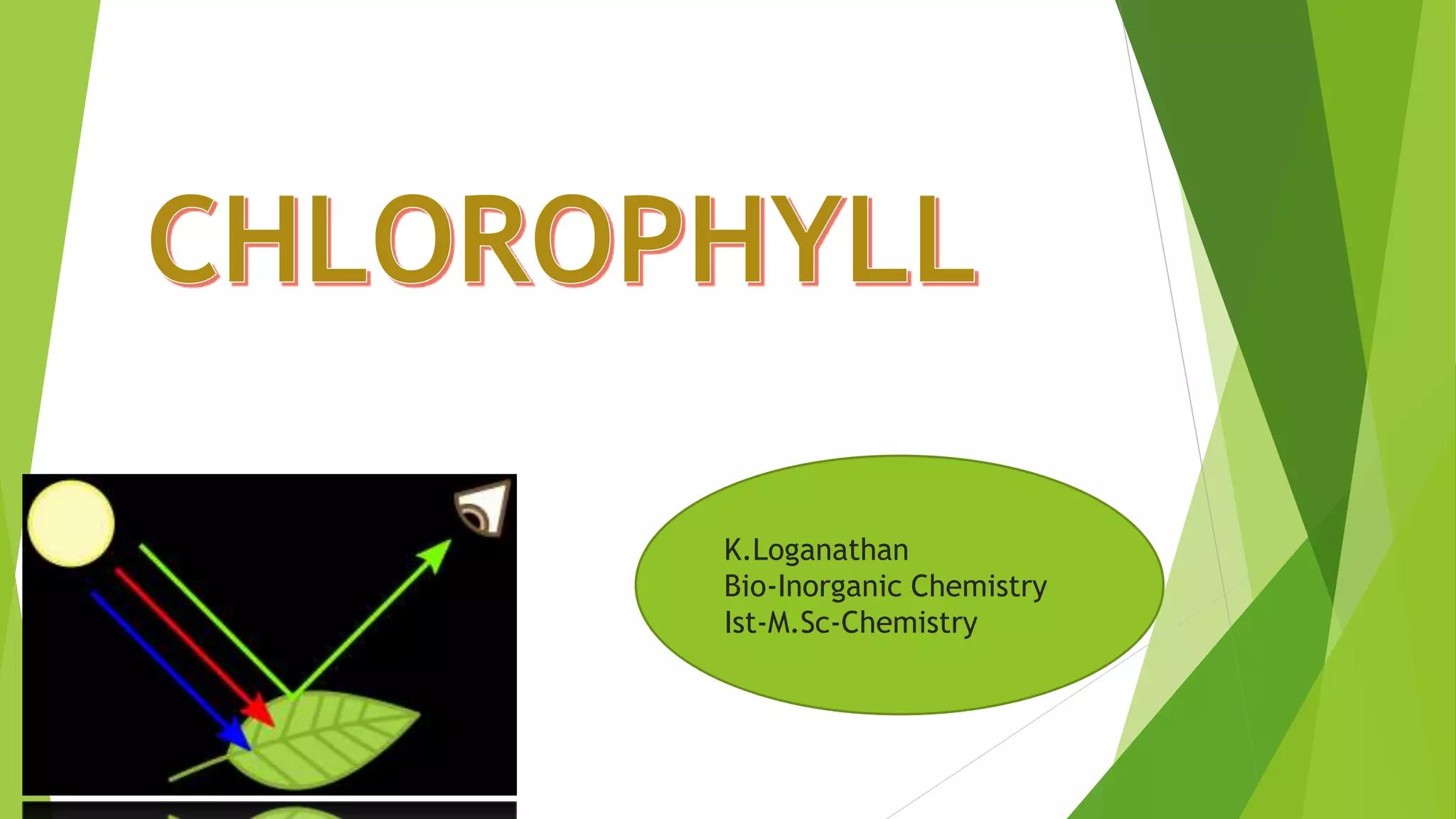
 Chlorophyll captures a portion of the visible spectrum of sunlight and
convert it into chemical energy for the formation of carbohydrates
 Chlorophyll's most important use, however, is in nature,
in photosynthesis. It is capable of channelling the energy of sunlight into
chemical energy through the process of photosynthesis. In this process the
energy absorbed by chlorophyll transforms carbon dioxide and water into
carbohydrates and oxygen
In the photosynthetic reaction electrons are transferred from water to carbon
dioxide i.e. carbon dioxide is reduced by water. Chlorophyll assists this transfer
as when chlorophyll absorbs light energy, an electron in chlorophyll is excited
from a lower energy state to a higher energy state. In this higher energy state,
this electron is more readily transferred to another molecule. This starts a chain
of electron-transfer steps, which ends with an electron being transferred to
carbon dioxide. Meanwhile, the chlorophyll which gave up an electron can
accept an electron from another molecule. This is the end of a process which
starts with the removal of an electron from water. Thus, chlorophyll is at the
centre of the photosynthetic oxidation-reduction reaction between carbon
dioxide and water.
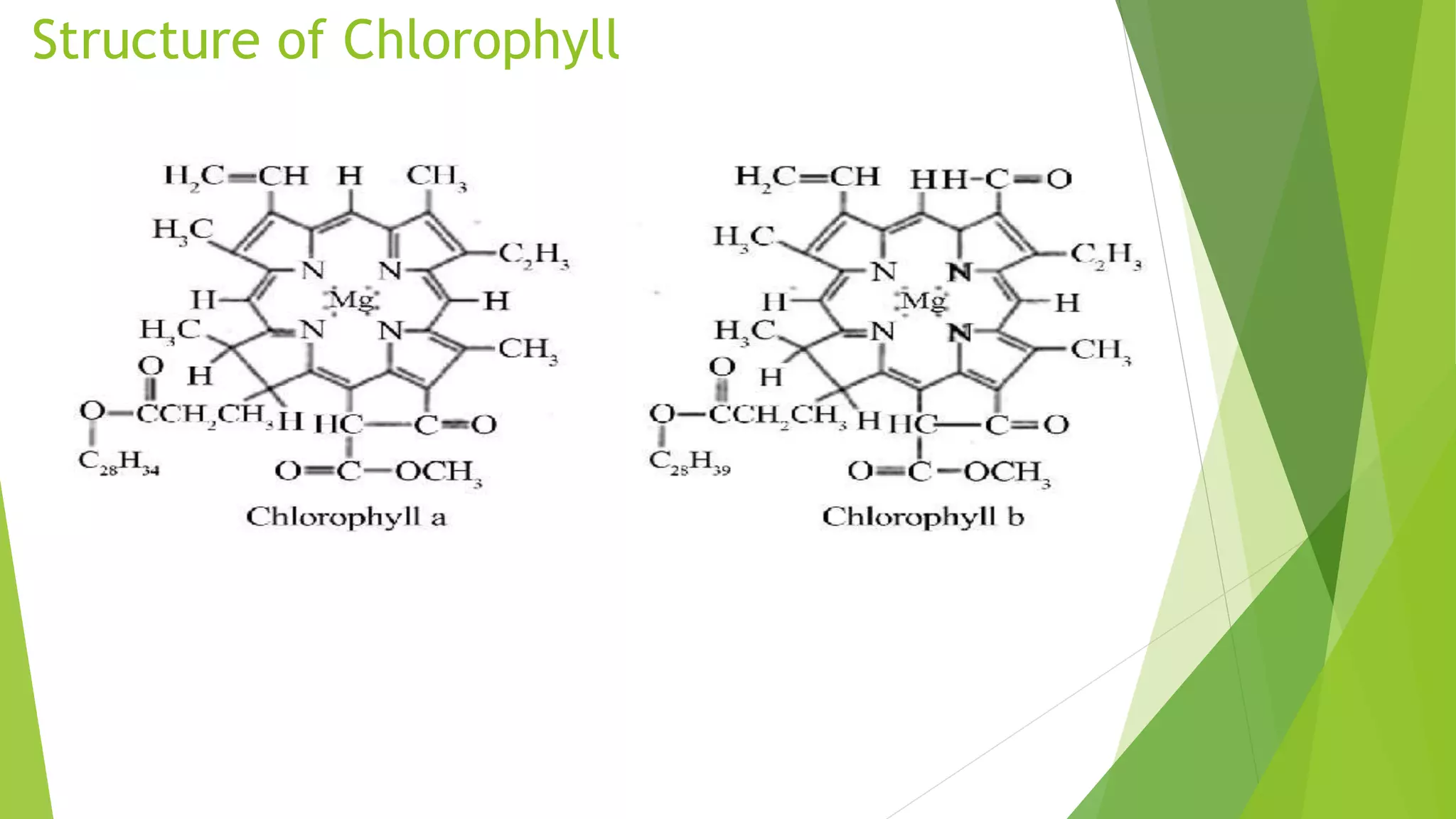
Structure of Chlorophyll
Chlorophyll is found in the chloroplasts of green
plants, and is what makes green plants, green. The basic
structure of a chlorophyll molecule is a porphyrin ring, co-
ordinated to a central atom. This is very similar in
structure to the heme group found in hemoglobin, except
that in heme the central atom is iron, whereas in
chlorophyll it is magnesium.
The chlorophyll molecule is the active part that
absorbs the sunlight, but just as with hemoglobin, in
order to do its job (synthesising carbohydrates) it needs to
be attached to the backbone of a very complicated protein.
This protein may look haphazard in design, but it has
exactly the correct structure to orient the chlorophyll
molecules in the optimal position to enable them to react
with nearby CO2 and H2O molecules in a very efficient
manner. Several chlorophyll molecules are lurking inside
this bacterial photoreceptor protein
The most important pigment in plant is Chlorophyll chla and
chlorophyll (chlb)
Chlorophyll is comosed of two arts; the first is a porphyrin with
magnesium at its center, the second is a hydrophobic
phytol tail
 The ring has many delocalized electrons that are shared
betweenseveral of the C, N, and H atoms; these delocalized electrons
are veryimportant for the function of chlorophyll.
 The tail is a 20 carbon chain that is highly hydrophicand stabilizes
themolecule in the hydrophobic core of the thylakoidmembrane.
 Structurally CH3 group is present in (chla) where (chlb) has a
CHOgroup.
 Chlorophyll a and b absorb different wavelengths better than
others.
Absorption spectrum of chlorophyll
Absorbance spectra of chlorophyll molecules
Photo induced Charge
separation
Light Absorption
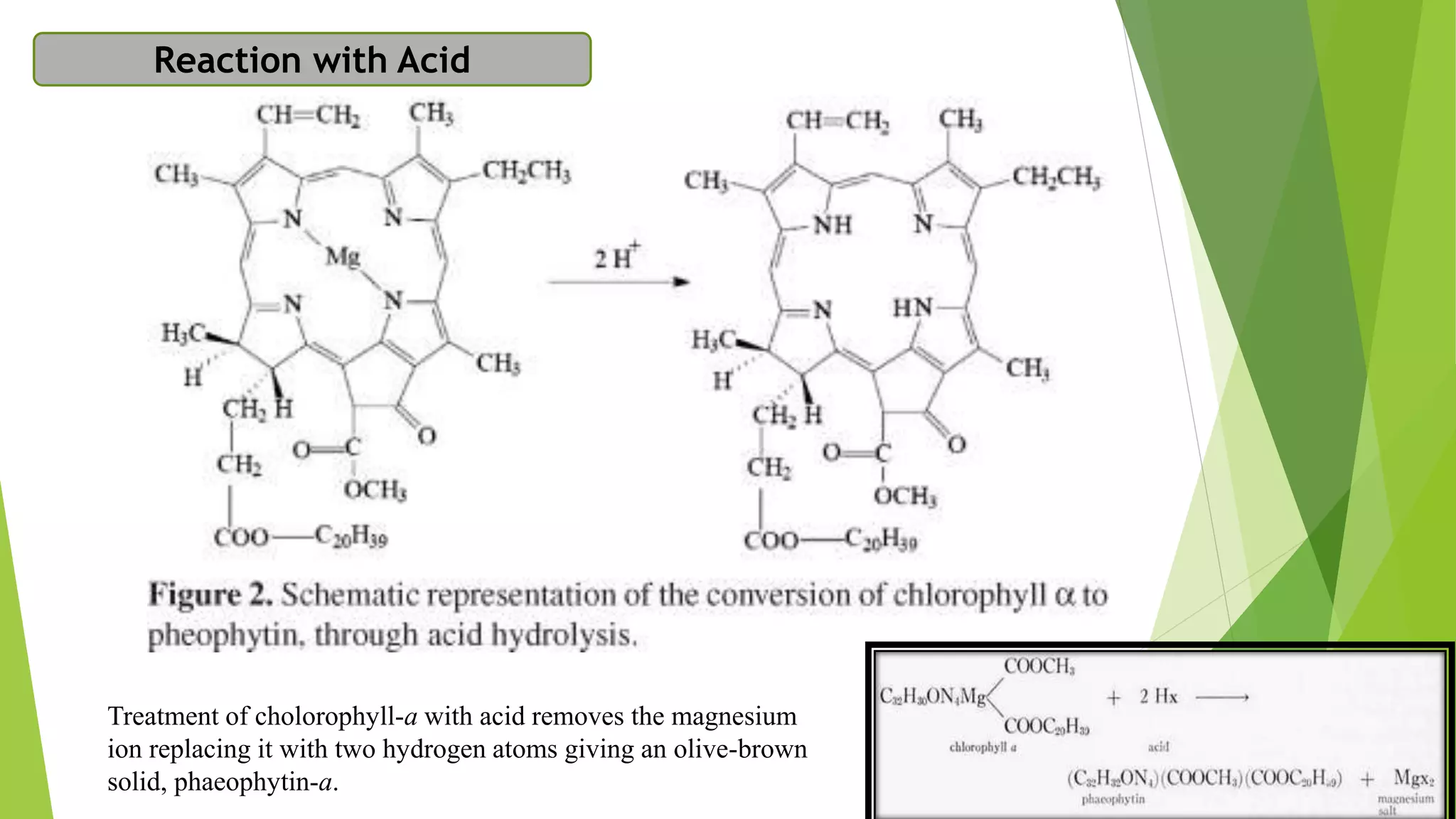
Reaction with Acid
Treatment of cholorophyll-a with acid removes the magnesium
ion replacing it with two hydrogen atoms giving an olive-brown
solid, phaeophytin-a.
Chlorophyll can also be reacted with a base which yields a
series of phyllins, magnesium porphyrin compounds
Reaction with Base
Sources of Chlorophyll
Extraction of chlorophyll
In plants chlorophyll is associated with specific proteins, for example, chlorophyll-a binding proteins
are referred to as CP I, CP 47 and CP 43. With improving biochemical techniques for use on the
membrane systems there has been an ever increasing success in the isolation and characterization of
these proteins.
Initially, detergents are used to break down the membrane into fragments, and these fragments are
further broken down by the use of different detergents. These detergents work by replacing the
membrane lipids which surround integral membrane proteins. The resulting particles are separated by
polyacrylamide gel electrophoresis (a standard biochemical method) in the presence of sufficient
detergent to keep them 'solubilised'. The activity and polypeptide composition can then be assayed as
the particle is purified. The detergents work by substituting lipids at different spots in the membrane,
this is also affected by the concentration of the detergent. One such detergent that is very commonly
used is SDS-PAGE (sodium dodecyl sulfate-polyacrylamide). This is generally used as it has several
advantages over other detergents: the separation can be carried out fairly rapidly and it also gives a
good overall picture of the distribution of chlorophyll.
Extraction of Chlorophyll
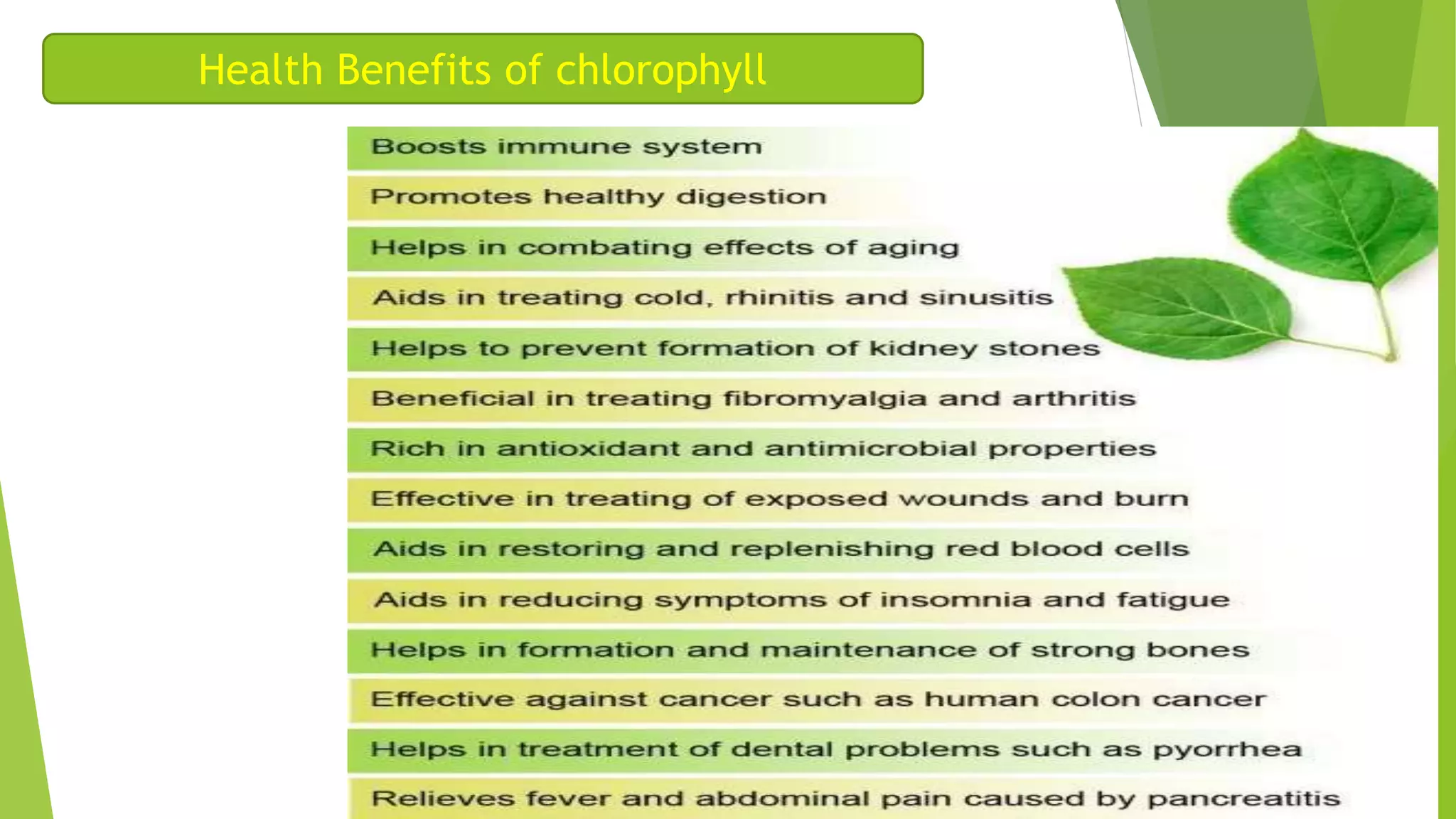
Health Benefits of chlorophyll
The numerous health benefits of chlorophyll
 Cleanses and oxygenates and builds the blood
 A powerful detoxification effect on the body
 Rich in enzymes that promote quick rejuvenation of our cells
 High in Amino acids
 Extracts toxins form the liver and improves liver function
 Regulator of calcium
 Helps break addiction
 Alkalizes the body
 Anti-inflammatory
 Wound-healing properties
 Fight infection
 Anti-oxidant – neutralize free radicals
 Promotes healthy intestinal flora
 Helps reverse protein-deficient anemia
 Protection from cancer
 Helps skin disorders
Thank you

Chlorophyll

  • 1.
  • 2.
  • 3.
    Chlorophyll -pale green;Phyllon-a leaf  Chlorophyll is the dominant pigment on Earth and serves as the light‐trapping and energy transferring chromophore in photosynthetic organisms.  In chlorophyll the central ion is magnesium, and the large organic molecule is a porphyrin. The porphyrin contains four nitrogen atoms that form bonds to magnesium in a square planar arrangement. There are several forms of chlorophyll  Chlorophyll is a green coloring substance which is present in green Plastid of plants called
  • 4.
    There are manytypes of chlorophyll that is chlorophyll a,b,c,d,e and bacteriochlorophyll. Chlorophyll "a" is the most abundant and most important photosynthetic pigment. It is found in all green plants except bacteria. It exists in several forms depending on its arrangement in the membrane. Chlorophyll "b" is found in all higher plants and green algae. Chlorophyll "c", "d" and "e" are found in various groups of algae. Bacteriochlorophyll is found in bacteria. So, shortcut is that chlorophyll is a green coloring substance which is present in green plants.
  • 5.
     Chlorophyll capturesa portion of the visible spectrum of sunlight and convert it into chemical energy for the formation of carbohydrates  Chlorophyll's most important use, however, is in nature, in photosynthesis. It is capable of channelling the energy of sunlight into chemical energy through the process of photosynthesis. In this process the energy absorbed by chlorophyll transforms carbon dioxide and water into carbohydrates and oxygen In the photosynthetic reaction electrons are transferred from water to carbon dioxide i.e. carbon dioxide is reduced by water. Chlorophyll assists this transfer as when chlorophyll absorbs light energy, an electron in chlorophyll is excited from a lower energy state to a higher energy state. In this higher energy state, this electron is more readily transferred to another molecule. This starts a chain of electron-transfer steps, which ends with an electron being transferred to carbon dioxide. Meanwhile, the chlorophyll which gave up an electron can accept an electron from another molecule. This is the end of a process which starts with the removal of an electron from water. Thus, chlorophyll is at the centre of the photosynthetic oxidation-reduction reaction between carbon dioxide and water.
  • 6.
  • 7.
    Chlorophyll is foundin the chloroplasts of green plants, and is what makes green plants, green. The basic structure of a chlorophyll molecule is a porphyrin ring, co- ordinated to a central atom. This is very similar in structure to the heme group found in hemoglobin, except that in heme the central atom is iron, whereas in chlorophyll it is magnesium. The chlorophyll molecule is the active part that absorbs the sunlight, but just as with hemoglobin, in order to do its job (synthesising carbohydrates) it needs to be attached to the backbone of a very complicated protein. This protein may look haphazard in design, but it has exactly the correct structure to orient the chlorophyll molecules in the optimal position to enable them to react with nearby CO2 and H2O molecules in a very efficient manner. Several chlorophyll molecules are lurking inside this bacterial photoreceptor protein
  • 9.
    The most importantpigment in plant is Chlorophyll chla and chlorophyll (chlb) Chlorophyll is comosed of two arts; the first is a porphyrin with magnesium at its center, the second is a hydrophobic phytol tail  The ring has many delocalized electrons that are shared betweenseveral of the C, N, and H atoms; these delocalized electrons are veryimportant for the function of chlorophyll.  The tail is a 20 carbon chain that is highly hydrophicand stabilizes themolecule in the hydrophobic core of the thylakoidmembrane.  Structurally CH3 group is present in (chla) where (chlb) has a CHOgroup.  Chlorophyll a and b absorb different wavelengths better than others.
  • 11.
    Absorption spectrum ofchlorophyll Absorbance spectra of chlorophyll molecules
  • 12.
  • 13.
    Reaction with Acid Treatmentof cholorophyll-a with acid removes the magnesium ion replacing it with two hydrogen atoms giving an olive-brown solid, phaeophytin-a.
  • 14.
    Chlorophyll can alsobe reacted with a base which yields a series of phyllins, magnesium porphyrin compounds Reaction with Base
  • 15.
  • 16.
    Extraction of chlorophyll Inplants chlorophyll is associated with specific proteins, for example, chlorophyll-a binding proteins are referred to as CP I, CP 47 and CP 43. With improving biochemical techniques for use on the membrane systems there has been an ever increasing success in the isolation and characterization of these proteins. Initially, detergents are used to break down the membrane into fragments, and these fragments are further broken down by the use of different detergents. These detergents work by replacing the membrane lipids which surround integral membrane proteins. The resulting particles are separated by polyacrylamide gel electrophoresis (a standard biochemical method) in the presence of sufficient detergent to keep them 'solubilised'. The activity and polypeptide composition can then be assayed as the particle is purified. The detergents work by substituting lipids at different spots in the membrane, this is also affected by the concentration of the detergent. One such detergent that is very commonly used is SDS-PAGE (sodium dodecyl sulfate-polyacrylamide). This is generally used as it has several advantages over other detergents: the separation can be carried out fairly rapidly and it also gives a good overall picture of the distribution of chlorophyll. Extraction of Chlorophyll
  • 17.
    Health Benefits ofchlorophyll
  • 19.
    The numerous healthbenefits of chlorophyll  Cleanses and oxygenates and builds the blood  A powerful detoxification effect on the body  Rich in enzymes that promote quick rejuvenation of our cells  High in Amino acids  Extracts toxins form the liver and improves liver function  Regulator of calcium  Helps break addiction  Alkalizes the body  Anti-inflammatory  Wound-healing properties  Fight infection  Anti-oxidant – neutralize free radicals  Promotes healthy intestinal flora  Helps reverse protein-deficient anemia  Protection from cancer  Helps skin disorders
  • 20.