Bioprocess engineering
Bioreactor control system
18 October 2019 Bioprocess Engineering 1
Presented by
S.Nandhini
G.Mohana priya
G.Nantha kumar
Content :
Control system
• Manual control
• Automatic control
Two-position controller
Proportional control
Integral control
Derivative control
Combination of method of control
Controller.
18 October 2019 Bioprocess Engineering 2
Control systems
• The process parameters may be controlled using
control loops .
• It consists of four basic components :
 A measuring element
A controller
A final control element
The process to be controlled .
18 October 2019 Bioprocess Engineering 3
Control system
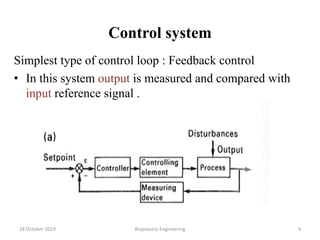
Simplest type of control loop : Feedback control
• In this system output is measured and compared with
input reference signal .
18 October 2019 Bioprocess Engineering 4
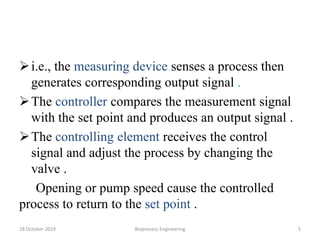
i.e., the measuring device senses a process then
generates corresponding output signal .
The controller compares the measurement signal
with the set point and produces an output signal .
The controlling element receives the control
signal and adjust the process by changing the
valve .
Opening or pump speed cause the controlled
process to return to the set point .
18 October 2019 Bioprocess Engineering 5
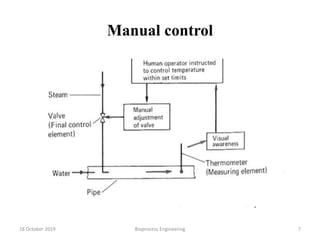
Manual system
• A simple example of control : Manual control .
• To regulate the temperature of water flowing through
a pipe .
• Manual control may be very costly in terms of labor .
• So use Automatic control as much as possible .
18 October 2019 Bioprocess Engineering 6
Manual control
18 October 2019 Bioprocess Engineering 7
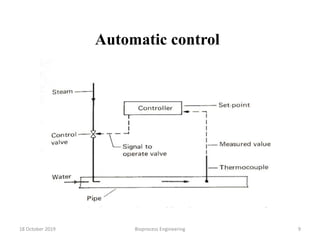
Automatic control
• When an automatic control loop is used, certain
modification is necessary .
• The measuring element must generate an output
signal which can be monitored by an instrument.
• In temperature control, thermometer is replaced by a
thermocouple which is connected to a controller
which in turn will produce a signal to operate the
steam valve.
18 October 2019 Bioprocess Engineering 8
Automatic control
18 October 2019 Bioprocess Engineering 9
Automatic control systems can be classified into
four main types :
 Two-positions controllers ( ON/OFF).
 Proportional controllers .
 Integral controllers .
 Derivative controllers .
18 October 2019 Bioprocess Engineering 10
Two-position controllers(ON/OFF)
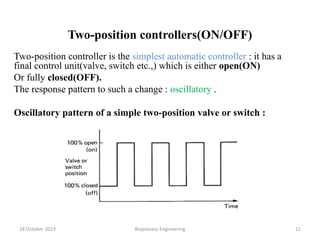
Two-position controller is the simplest automatic controller : it has a
final control unit(valve, switch etc.,) which is either open(ON)
Or fully closed(OFF).
The response pattern to such a change : oscillatory .
Oscillatory pattern of a simple two-position valve or switch :
18 October 2019 Bioprocess Engineering 11
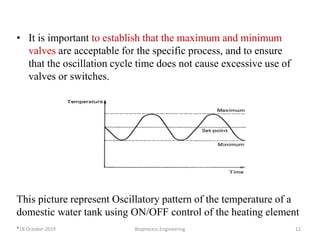
• It is important to establish that the maximum and minimum
valves are acceptable for the specific process, and to ensure
that the oscillation cycle time does not cause excessive use of
valves or switches.
This picture represent Oscillatory pattern of the temperature of a
domestic water tank using ON/OFF control of the heating element
.18 October 2019 Bioprocess Engineering 12
• ON/OFF control is not satisfactory for controlling any
process parameter so there is a sudden changes from the
equilibrium.
In these cases alternative forms of automatic control must be used
such as
1. Proportional control
2. Integral control
3. Derivative control
Many of the chemical industries are pneumatic. Pneumatic
controllers are still widely used because they are robust .
In other cases, when the control is electronic, the response to an
error will be represented as a change in output current or voltage.
18 October 2019 Bioprocess Engineering 13
Proportional control
• The change in output of the controller is proportional
to the input signal produced by the environmental
change (error) which has been detected by a sensor .
Mathematically it can be expressed by the following
equation: M=M0+KcΣ
where, M = output signal
Mo = controller output signal when there is
error .
Kc = controller gain or sensitivity
Σ= the error signal .
18 October 2019
Bioprocess Engineering
14
• The term Kc is the multiplying factor which relates a change
in input to the change in output .
Where, Kc may contain conversion units
This quantity PB is the error required to move the final control
element over the whole of its range and is expressed as a
percentage (%) of total range of measured variable .
18 October 2019 Bioprocess Engineering 15
Integral control
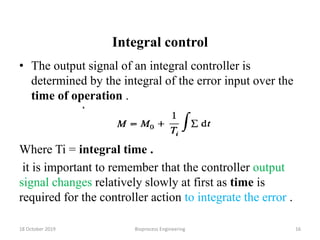
• The output signal of an integral controller is
determined by the integral of the error input over the
time of operation .
Where Ti = integral time .
it is important to remember that the controller output
signal changes relatively slowly at first as time is
required for the controller action to integrate the error .
18 October 2019 Bioprocess Engineering 16
Derivative control
• The controller senses the rate of change of the error
signal and contributes a component of the output
signal that is proportional to a derivative of the error
signal
where Td is a time rate constant .
It is important to remember that if the error is constant
there is no corrective action with derivative control.
18 October 2019 Bioprocess Engineering 17
Response of a derivative controller to
sinusoidal error inputs:
This picture represent that the output is always in a
direction to oppose changes in error, both away from
and towards the set point, which in this example results
in a 90° phase shift .
18 October 2019 Bioprocess Engineering 18
Combination of methods of control
Three combinations of control systems are used :
• Proportional plus integral
• Proportional plus derivative
• Proportional plus integral plus derivative .
18 October 2019 Bioprocess Engineering 19
Proportional plus integral
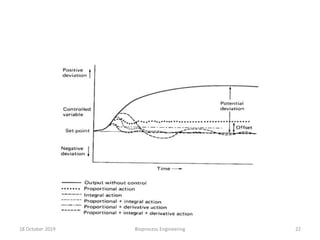
• The output response to an error gives rise to a slightly
higher initial deviation in the output signal compared
with that which would be obtained with proportional
control on its own .
Proportional plus derivative
• The output response to an error will lead to reduces
deviation, faster stabilization and a reduced offset
compared with proportional control alone.
18 October 2019 Bioprocess Engineering 20
Proportional plus integral plus derivative
This combination normally provides the best control
possibilities . The maximum and settling point similar to
those for a proportional derivative controller while the
integral action ensures that there is no offset .
Controllers
The first primary automatic controllers were electronic
control units :
• Adjusted manually
• Knowledge of control engineering is necessary to make
correct adjustments .
18 October 2019 Bioprocess Engineering 21
18 October 2019 Bioprocess Engineering 22
Reference :
• Principle of fermentation technology – P.F.Stanbury , A.Whitaker and S.J.Hall .
18 October 2019 Bioprocess Engineering 23
THANK YOU…..
18 October 2019 Bioprocess Engineering 24

Bioreactor control system

  • 1.
    Bioprocess engineering Bioreactor controlsystem 18 October 2019 Bioprocess Engineering 1 Presented by S.Nandhini G.Mohana priya G.Nantha kumar
  • 2.
    Content : Control system •Manual control • Automatic control Two-position controller Proportional control Integral control Derivative control Combination of method of control Controller. 18 October 2019 Bioprocess Engineering 2
  • 3.
    Control systems • Theprocess parameters may be controlled using control loops . • It consists of four basic components :  A measuring element A controller A final control element The process to be controlled . 18 October 2019 Bioprocess Engineering 3
  • 4.
    Control system Simplest typeof control loop : Feedback control • In this system output is measured and compared with input reference signal . 18 October 2019 Bioprocess Engineering 4
  • 5.
    i.e., the measuringdevice senses a process then generates corresponding output signal . The controller compares the measurement signal with the set point and produces an output signal . The controlling element receives the control signal and adjust the process by changing the valve . Opening or pump speed cause the controlled process to return to the set point . 18 October 2019 Bioprocess Engineering 5
  • 6.
    Manual system • Asimple example of control : Manual control . • To regulate the temperature of water flowing through a pipe . • Manual control may be very costly in terms of labor . • So use Automatic control as much as possible . 18 October 2019 Bioprocess Engineering 6
  • 7.
    Manual control 18 October2019 Bioprocess Engineering 7
  • 8.
    Automatic control • Whenan automatic control loop is used, certain modification is necessary . • The measuring element must generate an output signal which can be monitored by an instrument. • In temperature control, thermometer is replaced by a thermocouple which is connected to a controller which in turn will produce a signal to operate the steam valve. 18 October 2019 Bioprocess Engineering 8
  • 9.
    Automatic control 18 October2019 Bioprocess Engineering 9
  • 10.
    Automatic control systemscan be classified into four main types :  Two-positions controllers ( ON/OFF).  Proportional controllers .  Integral controllers .  Derivative controllers . 18 October 2019 Bioprocess Engineering 10
  • 11.
    Two-position controllers(ON/OFF) Two-position controlleris the simplest automatic controller : it has a final control unit(valve, switch etc.,) which is either open(ON) Or fully closed(OFF). The response pattern to such a change : oscillatory . Oscillatory pattern of a simple two-position valve or switch : 18 October 2019 Bioprocess Engineering 11
  • 12.
    • It isimportant to establish that the maximum and minimum valves are acceptable for the specific process, and to ensure that the oscillation cycle time does not cause excessive use of valves or switches. This picture represent Oscillatory pattern of the temperature of a domestic water tank using ON/OFF control of the heating element .18 October 2019 Bioprocess Engineering 12
  • 13.
    • ON/OFF controlis not satisfactory for controlling any process parameter so there is a sudden changes from the equilibrium. In these cases alternative forms of automatic control must be used such as 1. Proportional control 2. Integral control 3. Derivative control Many of the chemical industries are pneumatic. Pneumatic controllers are still widely used because they are robust . In other cases, when the control is electronic, the response to an error will be represented as a change in output current or voltage. 18 October 2019 Bioprocess Engineering 13
  • 14.
    Proportional control • Thechange in output of the controller is proportional to the input signal produced by the environmental change (error) which has been detected by a sensor . Mathematically it can be expressed by the following equation: M=M0+KcΣ where, M = output signal Mo = controller output signal when there is error . Kc = controller gain or sensitivity Σ= the error signal . 18 October 2019 Bioprocess Engineering 14
  • 15.
    • The termKc is the multiplying factor which relates a change in input to the change in output . Where, Kc may contain conversion units This quantity PB is the error required to move the final control element over the whole of its range and is expressed as a percentage (%) of total range of measured variable . 18 October 2019 Bioprocess Engineering 15
  • 16.
    Integral control • Theoutput signal of an integral controller is determined by the integral of the error input over the time of operation . Where Ti = integral time . it is important to remember that the controller output signal changes relatively slowly at first as time is required for the controller action to integrate the error . 18 October 2019 Bioprocess Engineering 16
  • 17.
    Derivative control • Thecontroller senses the rate of change of the error signal and contributes a component of the output signal that is proportional to a derivative of the error signal where Td is a time rate constant . It is important to remember that if the error is constant there is no corrective action with derivative control. 18 October 2019 Bioprocess Engineering 17
  • 18.
    Response of aderivative controller to sinusoidal error inputs: This picture represent that the output is always in a direction to oppose changes in error, both away from and towards the set point, which in this example results in a 90° phase shift . 18 October 2019 Bioprocess Engineering 18
  • 19.
    Combination of methodsof control Three combinations of control systems are used : • Proportional plus integral • Proportional plus derivative • Proportional plus integral plus derivative . 18 October 2019 Bioprocess Engineering 19
  • 20.
    Proportional plus integral •The output response to an error gives rise to a slightly higher initial deviation in the output signal compared with that which would be obtained with proportional control on its own . Proportional plus derivative • The output response to an error will lead to reduces deviation, faster stabilization and a reduced offset compared with proportional control alone. 18 October 2019 Bioprocess Engineering 20
  • 21.
    Proportional plus integralplus derivative This combination normally provides the best control possibilities . The maximum and settling point similar to those for a proportional derivative controller while the integral action ensures that there is no offset . Controllers The first primary automatic controllers were electronic control units : • Adjusted manually • Knowledge of control engineering is necessary to make correct adjustments . 18 October 2019 Bioprocess Engineering 21
  • 22.
    18 October 2019Bioprocess Engineering 22
  • 23.
    Reference : • Principleof fermentation technology – P.F.Stanbury , A.Whitaker and S.J.Hall . 18 October 2019 Bioprocess Engineering 23
  • 24.
    THANK YOU….. 18 October2019 Bioprocess Engineering 24