GAURAV KUMAR PANDIT
M.Sc. Plant Biology & Biotechnology
16LPMS 09
School of Life Science
University of Hyderabad
gauravbiologist@uohyd.ac.in
Supervisor
PROF. C.H.VENKETRAMANA
METAGENOMICS
3rd March 2017
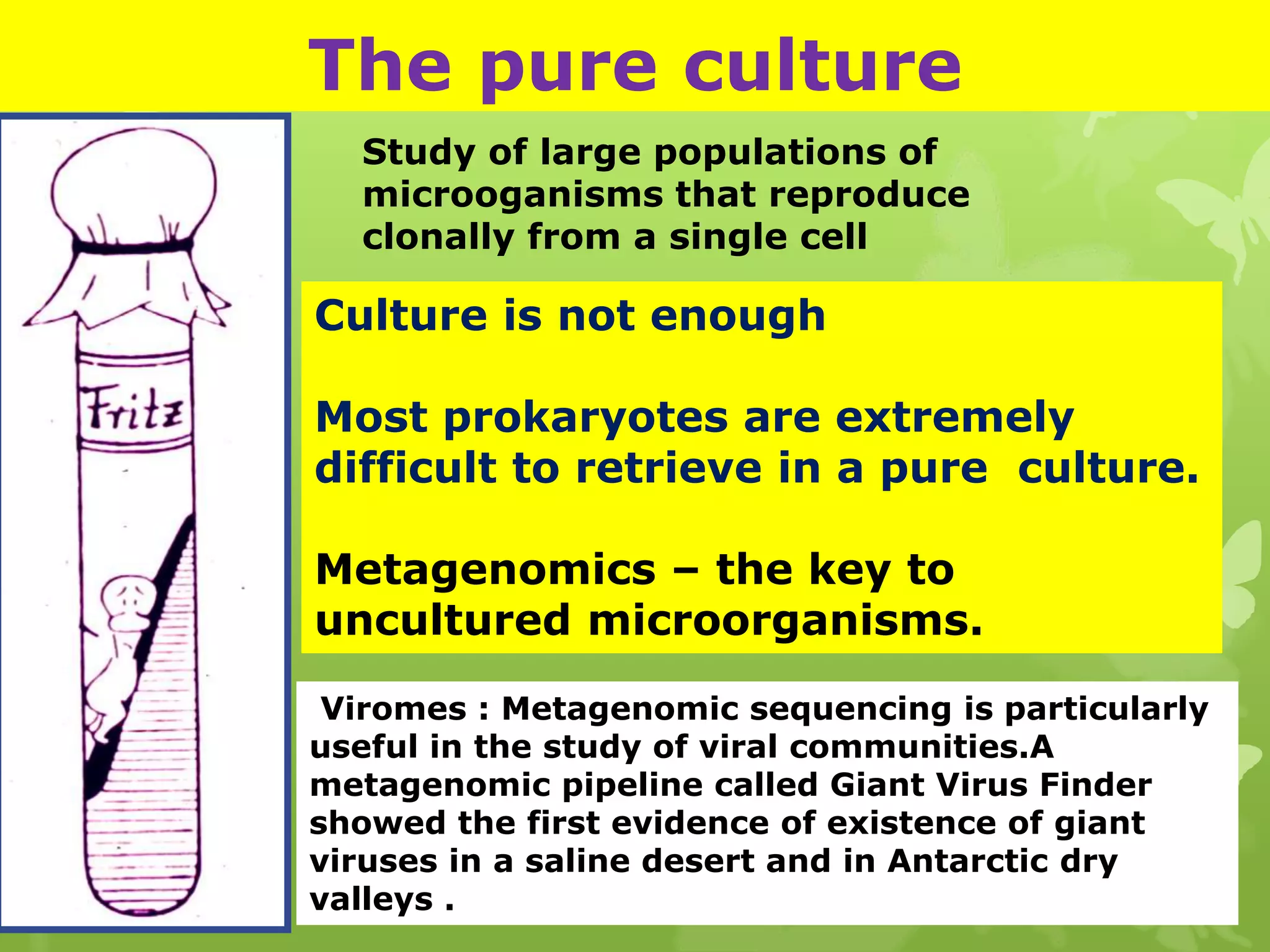
The pure culture
Culture is not enough
Most prokaryotes are extremely
difficult to retrieve in a pure culture.
Metagenomics – the key to
uncultured microorganisms.
Study of large populations of
microoganisms that reproduce
clonally from a single cell
Viromes : Metagenomic sequencing is particularly
useful in the study of viral communities.A
metagenomic pipeline called Giant Virus Finder
showed the first evidence of existence of giant
viruses in a saline desert and in Antarctic dry
valleys .
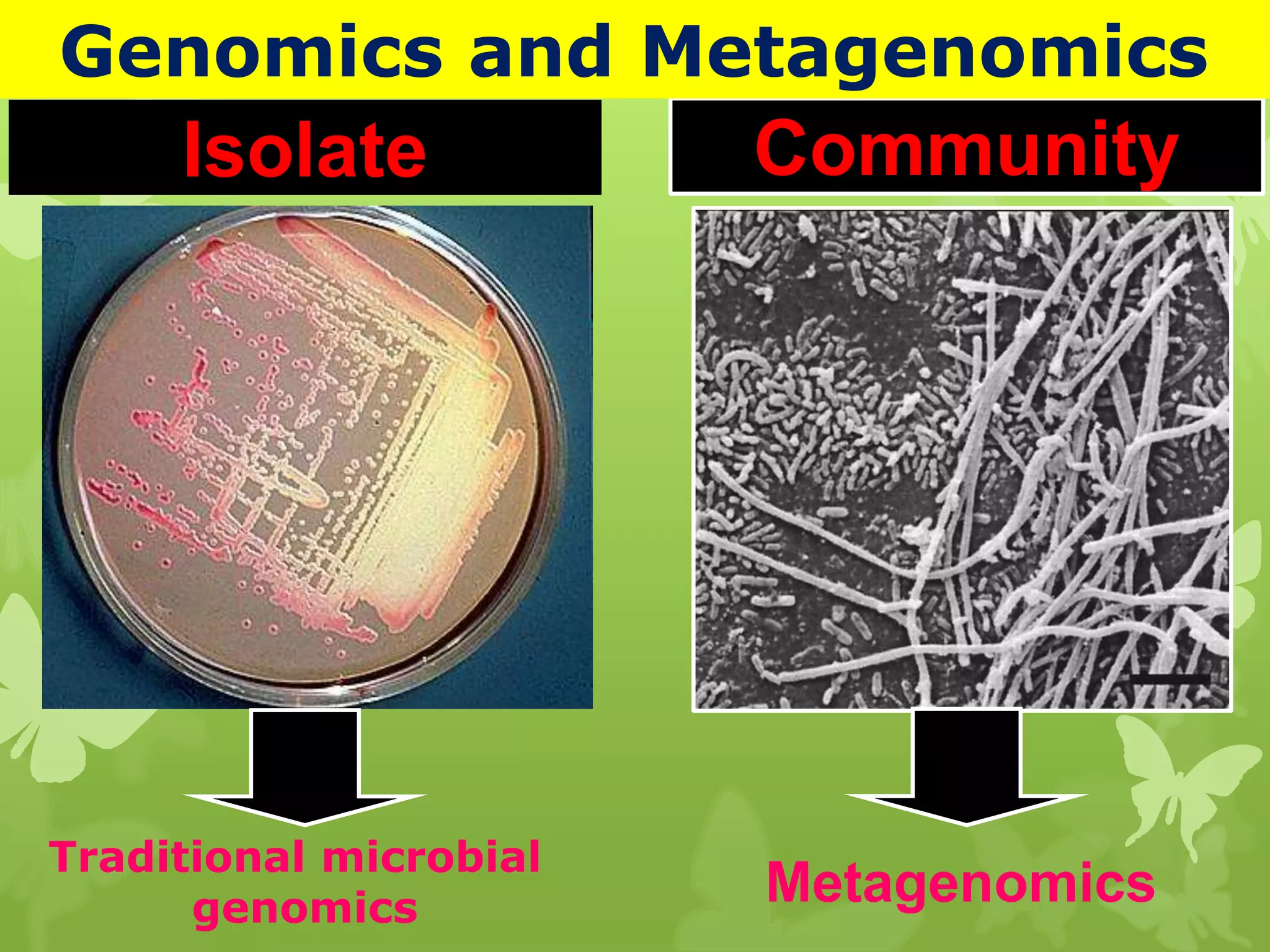
Isolate
Metagenomics
Community
Genomics and Metagenomics
Traditional microbial
genomics
Metagenomics
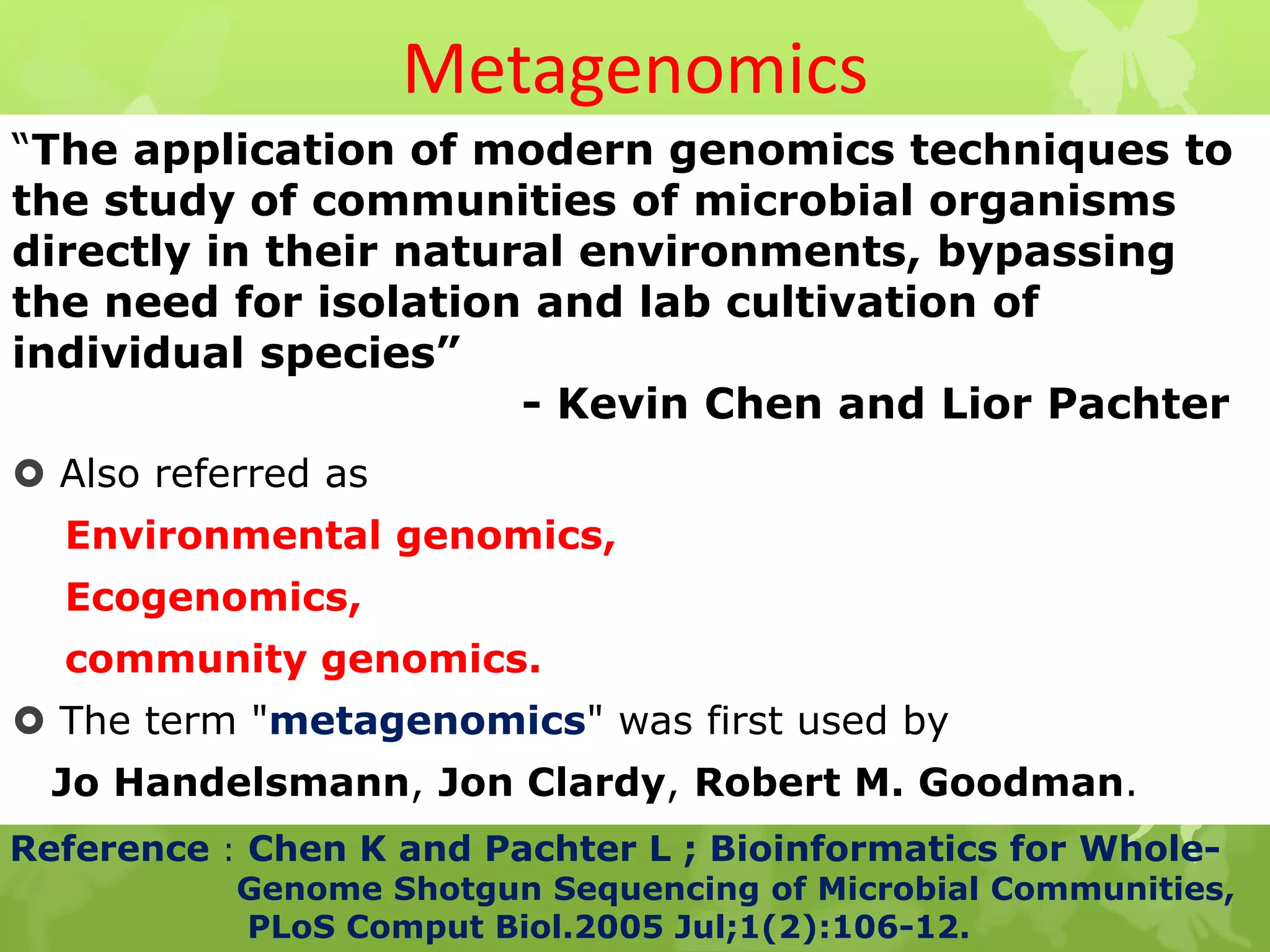
“The application of modern genomics techniques to
the study of communities of microbial organisms
directly in their natural environments, bypassing
the need for isolation and lab cultivation of
individual species”
- Kevin Chen and Lior Pachter
 Also referred as
Environmental genomics,
Ecogenomics,
community genomics.
 The term "metagenomics" was first used by
Jo Handelsmann, Jon Clardy, Robert M. Goodman.
Reference : Chen K and Pachter L ; Bioinformatics for Whole-
Genome Shotgun Sequencing of Microbial Communities,
PLoS Comput Biol.2005 Jul;1(2):106-12.
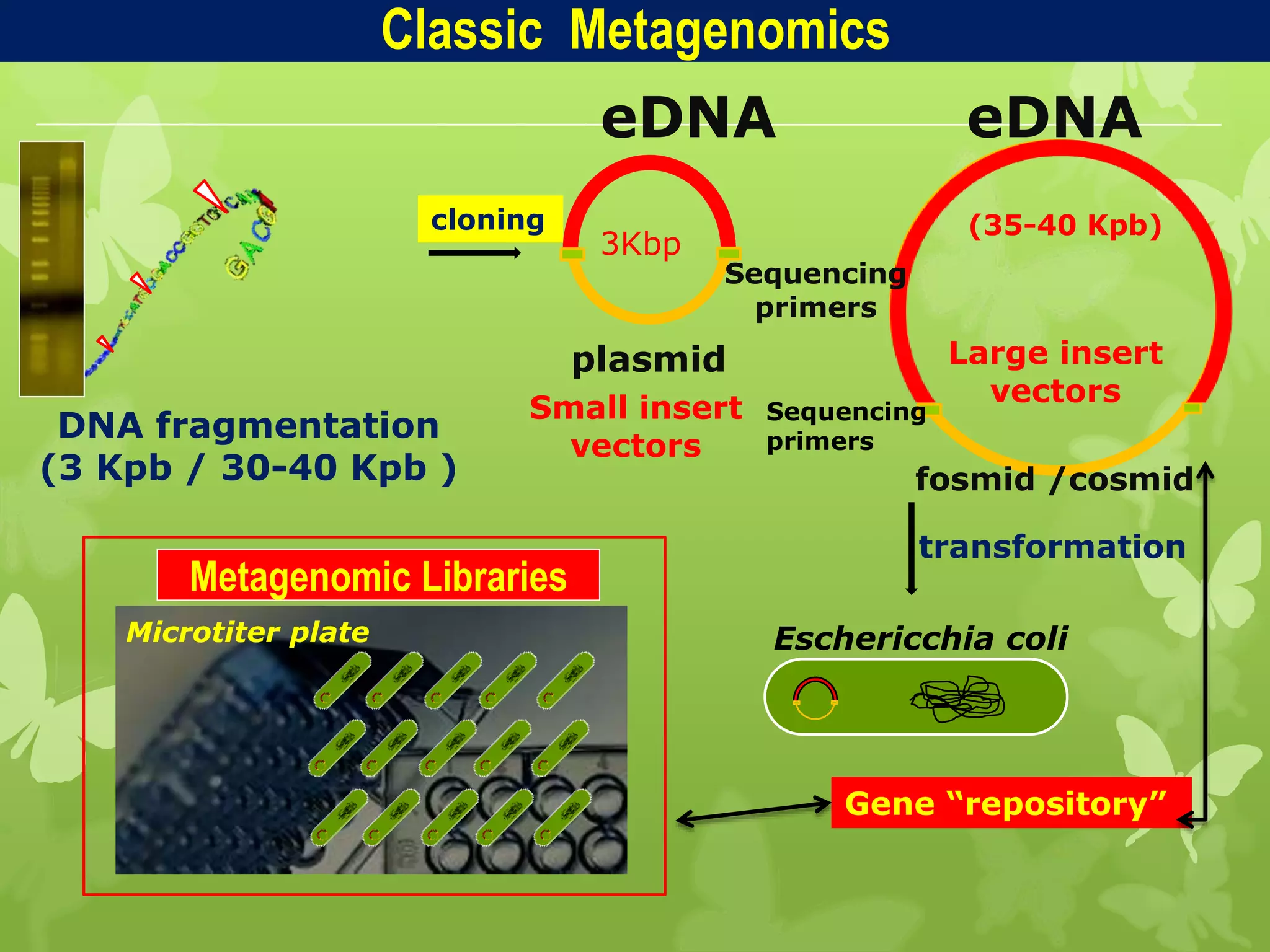
DNA fragmentation
(3 Kpb / 30-40 Kpb ) fosmid /cosmid
(35-40 Kpb)
eDNA
plasmid
cloning
Eschericchia coli
transformation
Microtiter plate
Metagenomic Libraries
Gene “repository”
Classic Metagenomics
Sequencing
primers
Sequencing
primers
Small insert
vectors
Large insert
vectors
eDNA
3Kbp
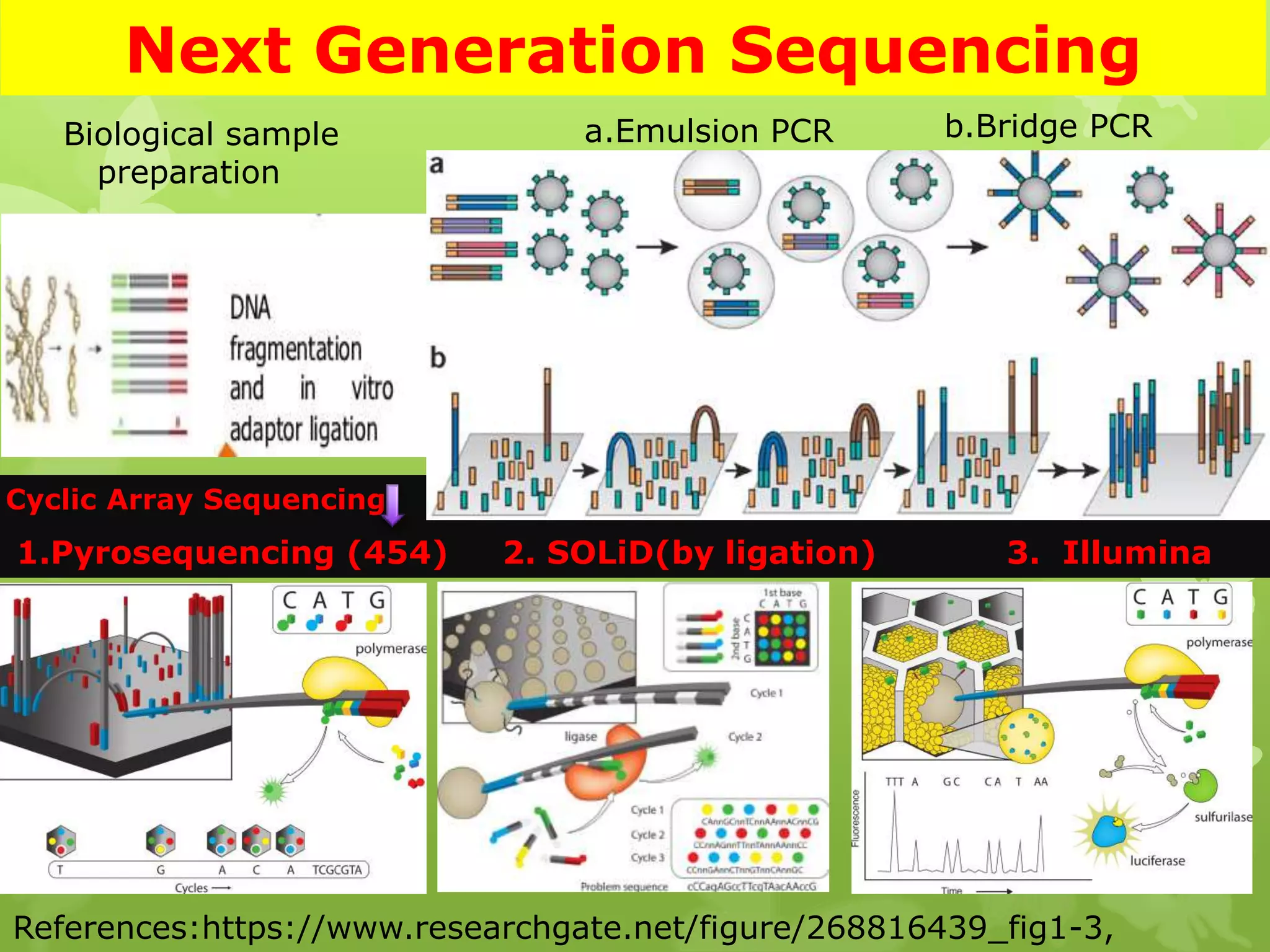
Next Generation Sequencing
Biological sample
preparation
a.Emulsion PCR b.Bridge PCR
Cyclic Array Sequencing
1.Pyrosequencing (454) 2. SOLiD(by ligation) 3. Illumina
References:https://www.researchgate.net/figure/268816439_fig1-3,
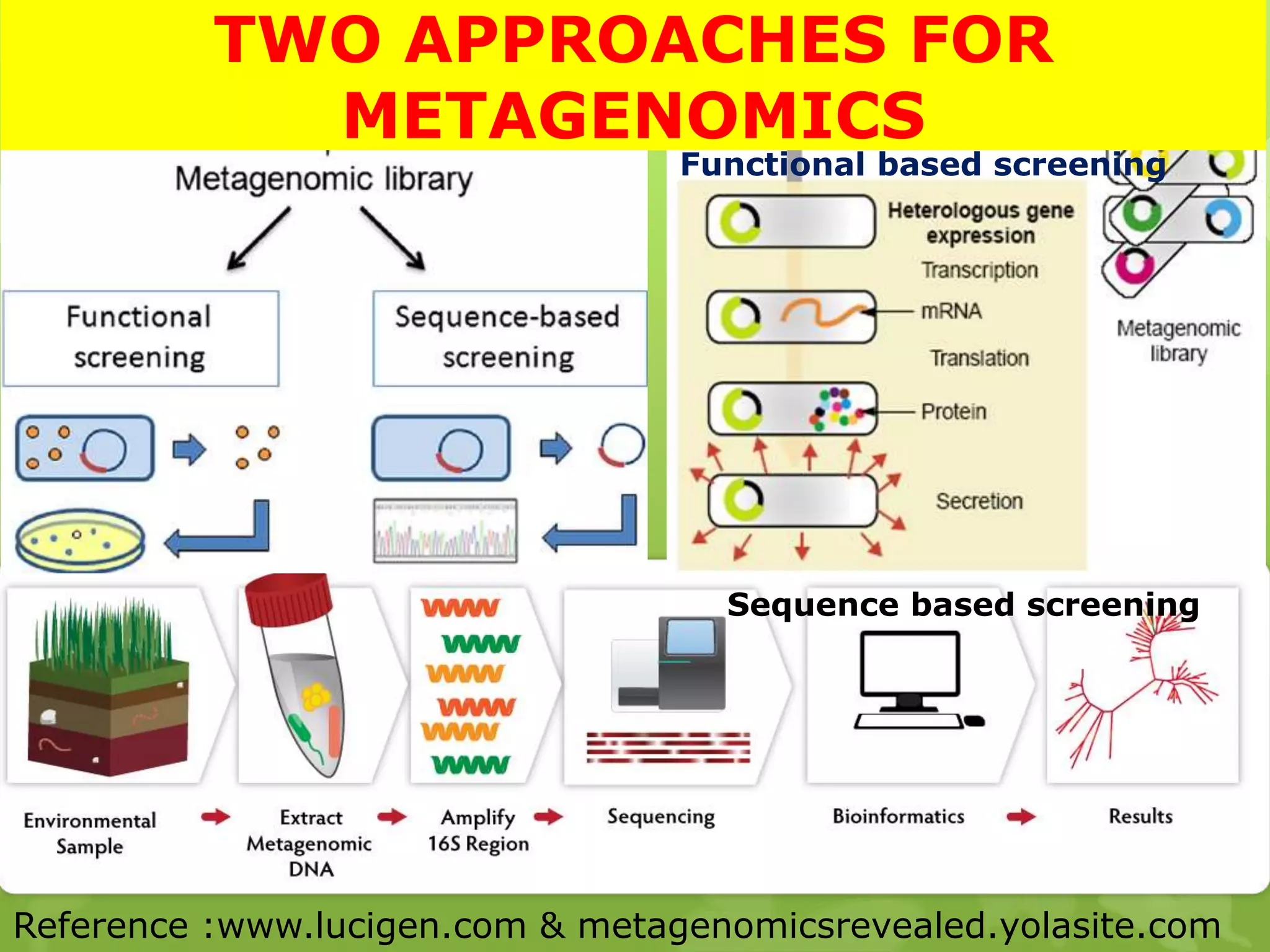
TWO APPROACHES FOR
METAGENOMICS
Functional based screening
Sequence based screening
Reference :www.lucigen.com & metagenomicsrevealed.yolasite.com
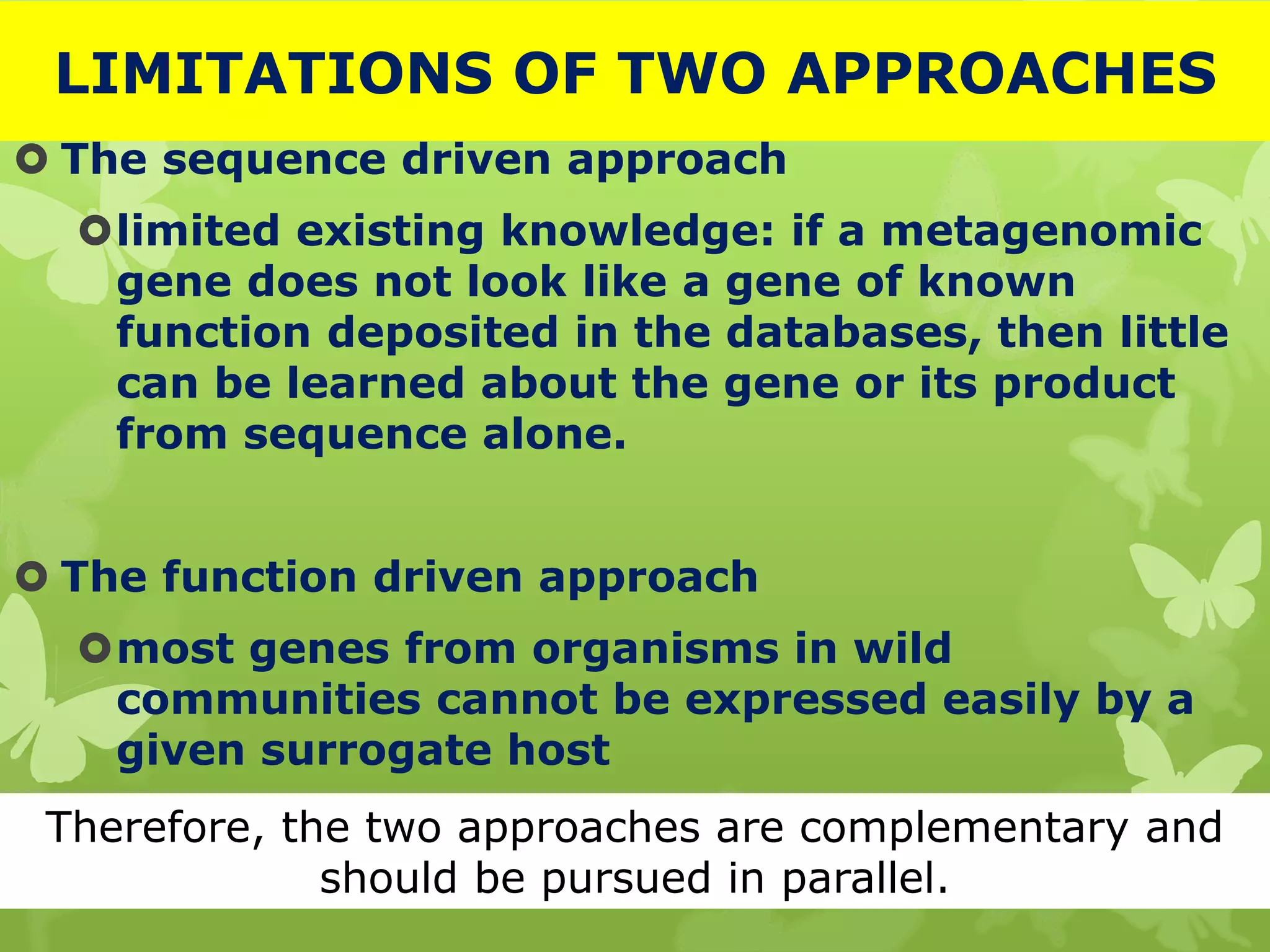
LIMITATIONS OF TWO APPROACHES
 The sequence driven approach
limited existing knowledge: if a metagenomic
gene does not look like a gene of known
function deposited in the databases, then little
can be learned about the gene or its product
from sequence alone.
 The function driven approach
most genes from organisms in wild
communities cannot be expressed easily by a
given surrogate host
Therefore, the two approaches are complementary and
should be pursued in parallel.
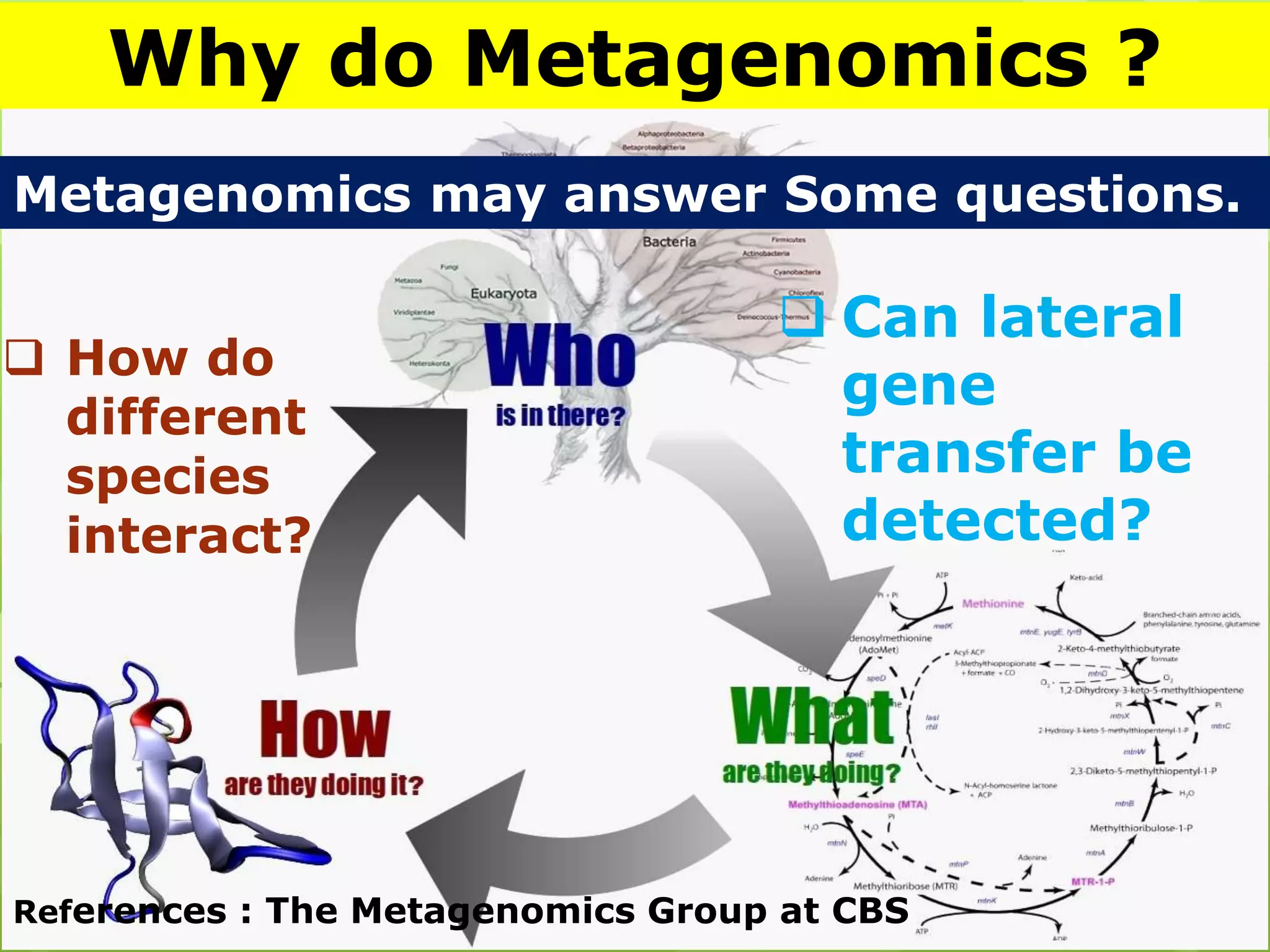
Why do Metagenomics ?
Metagenomics may answer Some questions.
 How do
different
species
interact?
 Can lateral
gene
transfer be
detected?
References : The Metagenomics Group at CBS
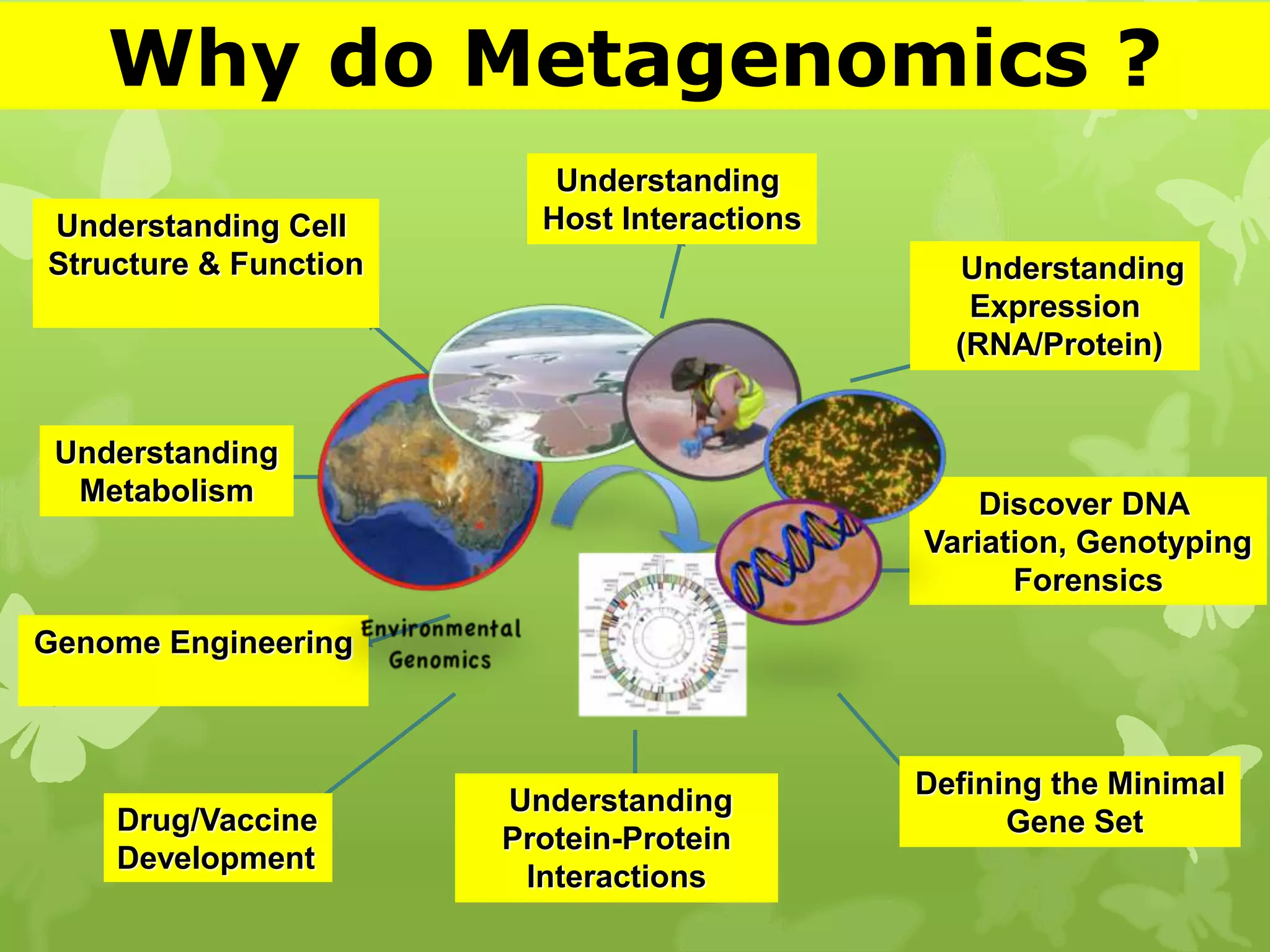
Understanding
Metabolism
Defining the Minimal
Gene Set
Genome Engineering
Understanding Cell
Structure & Function
Understanding
Host Interactions
Understanding
Protein-Protein
Interactions
Understanding
Expression
(RNA/Protein)
Discover DNA
Variation, Genotyping
Forensics
Drug/Vaccine
Development
Why do Metagenomics ?
LIMITATIONS
 Too much data?
 Most genes are not identifiable
 Contamination, chimeric clone sequences
 Requires proteomics or expression studies to
demonstrate phenotypic characteristics
 Need a standard method for annotating genomes
 Requires high throughput instrumentation – not
readily available to most institutions
 Errors in assembly due to inter-species
similarities.
 To identify new enzymes & antibiotics
 To assess the effects of age, diet, and pathologic
states on the distal gut micro biome of humans living
in different environments.
 Study antibiotic resistance in uncultured microbes
 Improved bioinformatics will quicken analysis for
library profiling .
 Discoveries such as phylogenic tags (rRNA genes,
etc) will give momentum to the growing field.
 Learning novel pathways will lead to knowledge
about the current nonculturable bacteria to then
culture these systems.
FUTURE OF METAGENOMICS
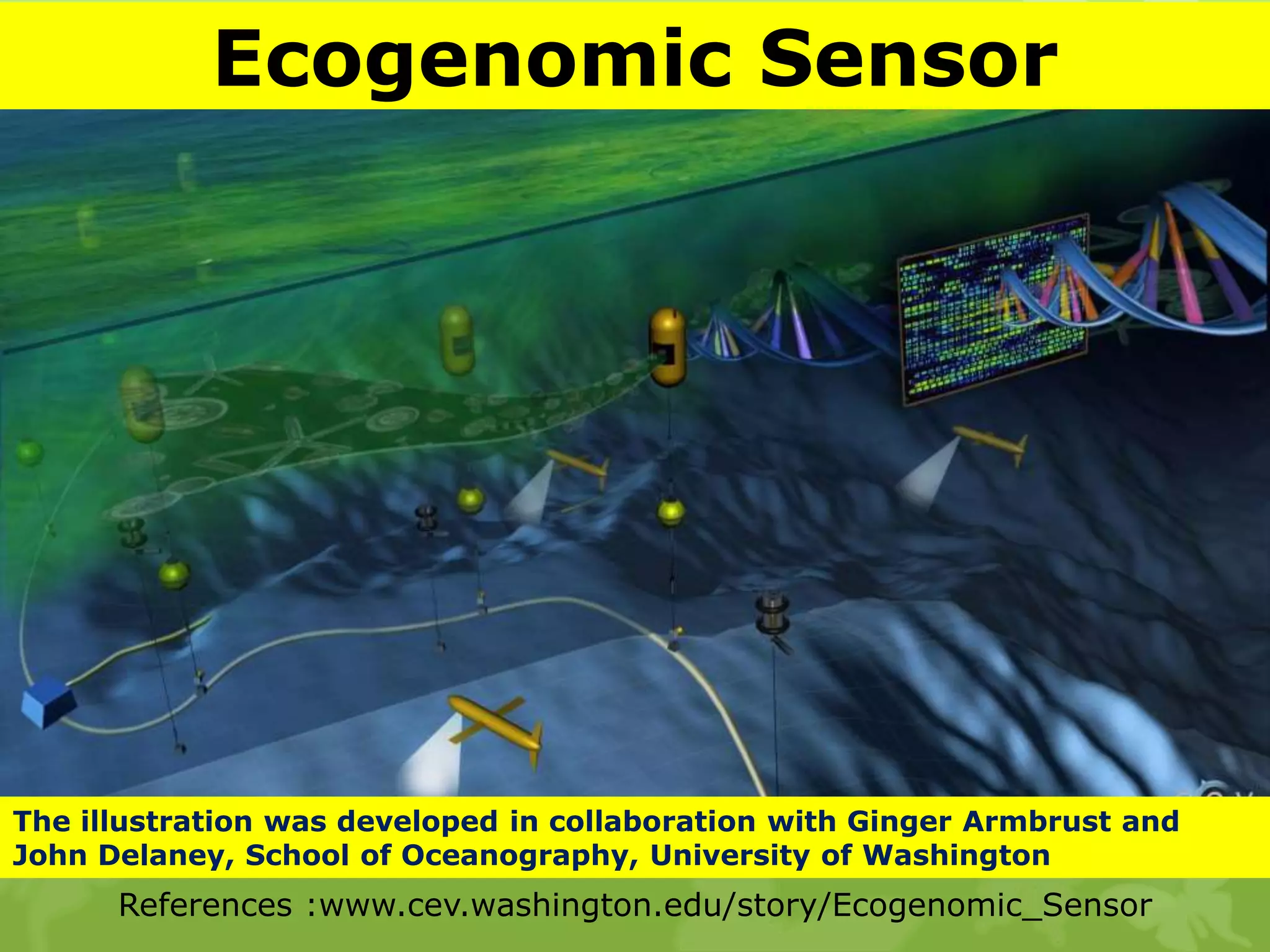
References :www.cev.washington.edu/story/Ecogenomic_Sensor
The illustration was developed in collaboration with Ginger Armbrust and
John Delaney, School of Oceanography, University of Washington
Ecogenomic Sensor
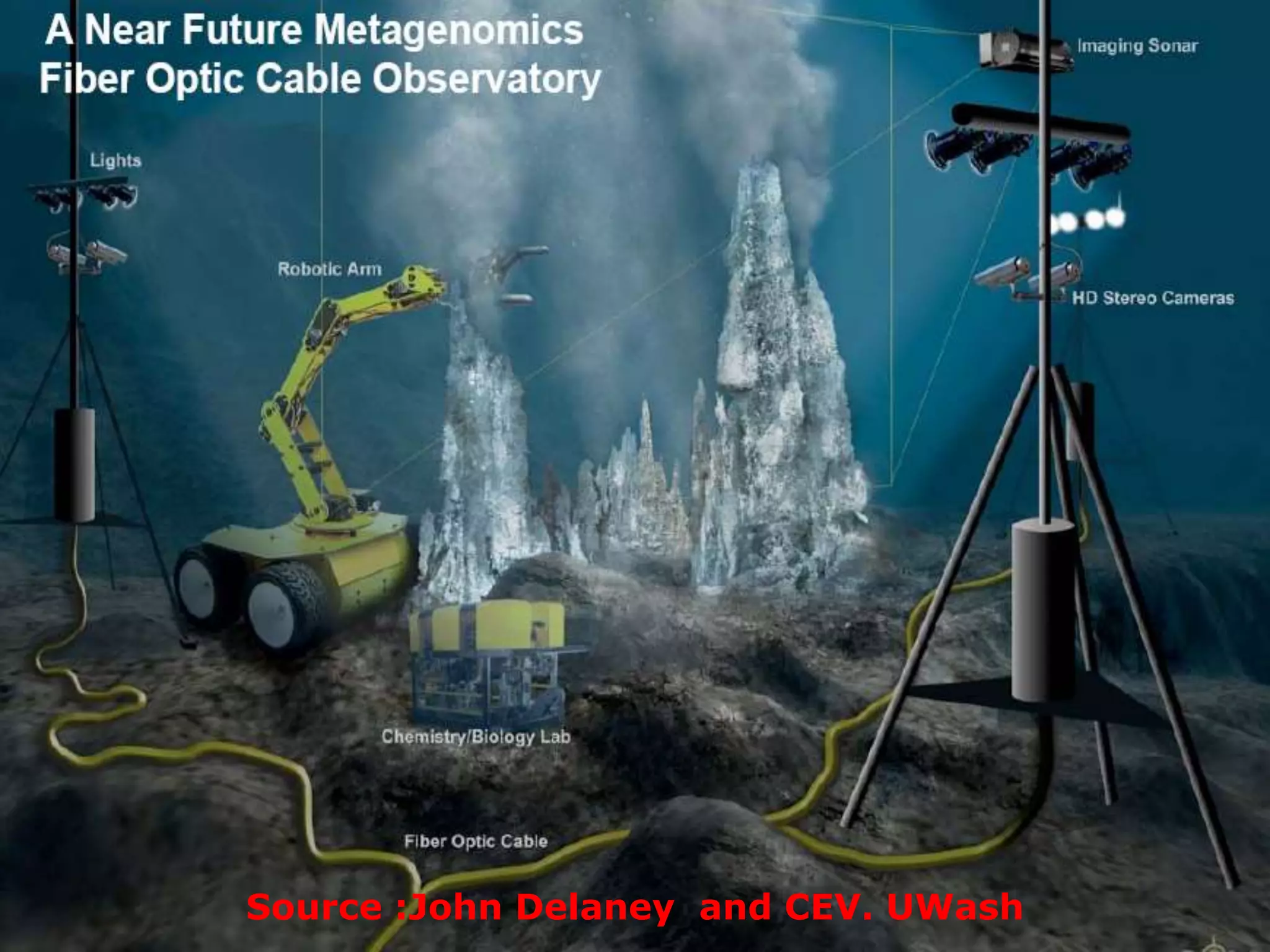
Source :John Delaney and CEV. UWash
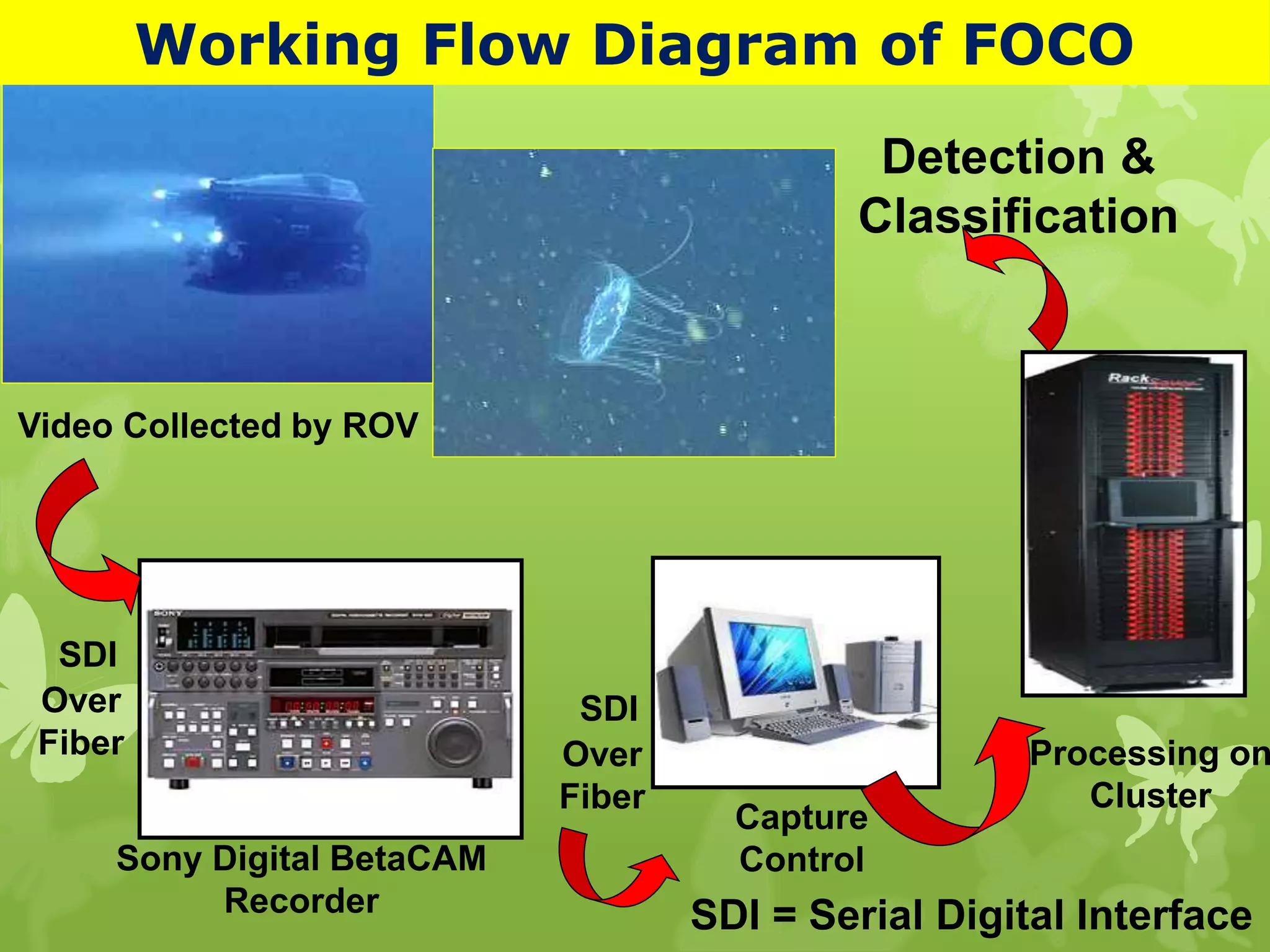
Video Collected by ROV
Sony Digital BetaCAM
Recorder
SDI
Over
Fiber
SDI
Over
Fiber
Capture
Control
Processing on
Cluster
Detection &
Classification
Working Flow Diagram of FOCO
SDI = Serial Digital Interface
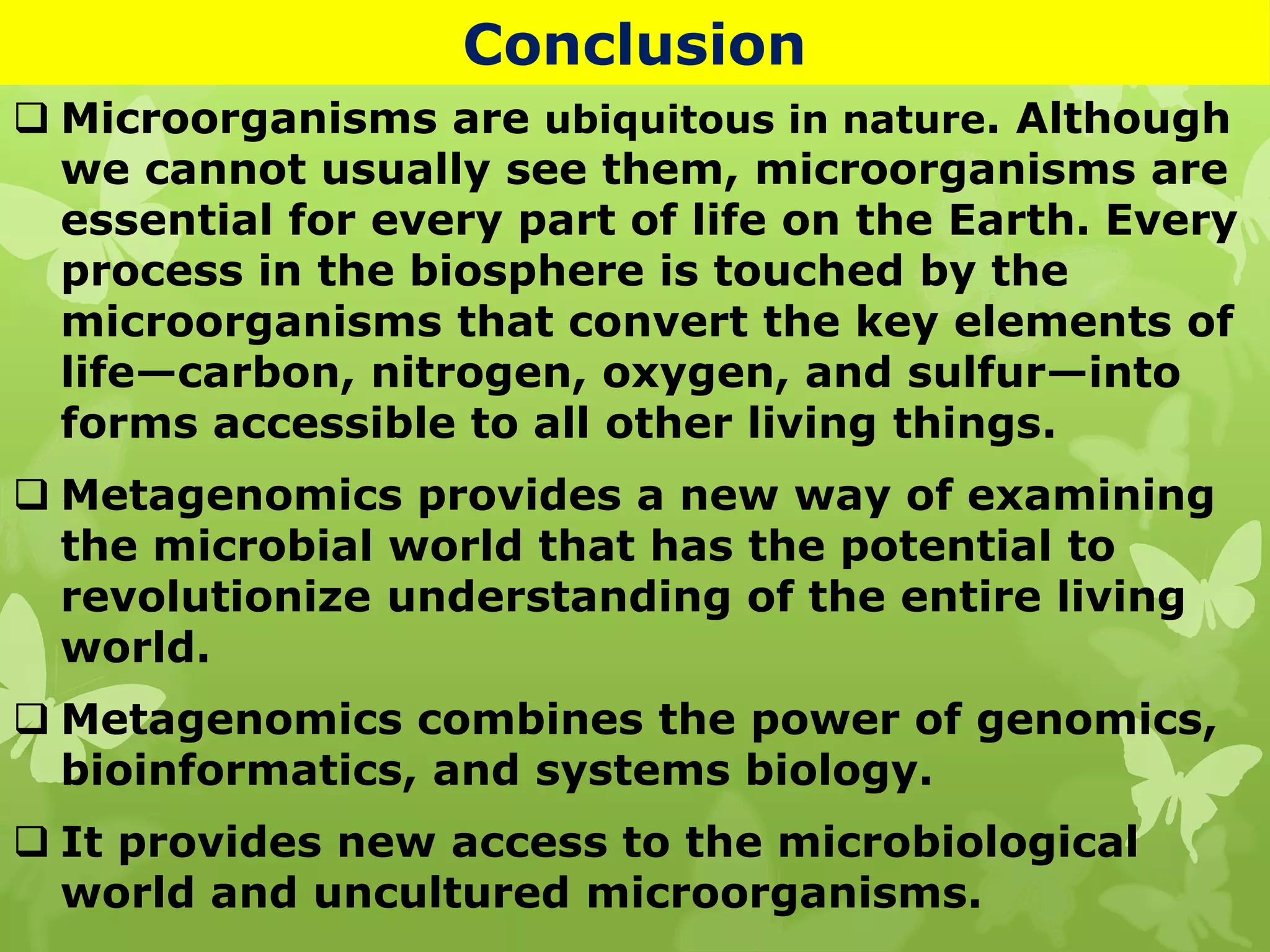
Conclusion
 Microorganisms are ubiquitous in nature. Although
we cannot usually see them, microorganisms are
essential for every part of life on the Earth. Every
process in the biosphere is touched by the
microorganisms that convert the key elements of
life—carbon, nitrogen, oxygen, and sulfur—into
forms accessible to all other living things.
 Metagenomics provides a new way of examining
the microbial world that has the potential to
revolutionize understanding of the entire living
world.
 Metagenomics combines the power of genomics,
bioinformatics, and systems biology.
 It provides new access to the microbiological
world and uncultured microorganisms.
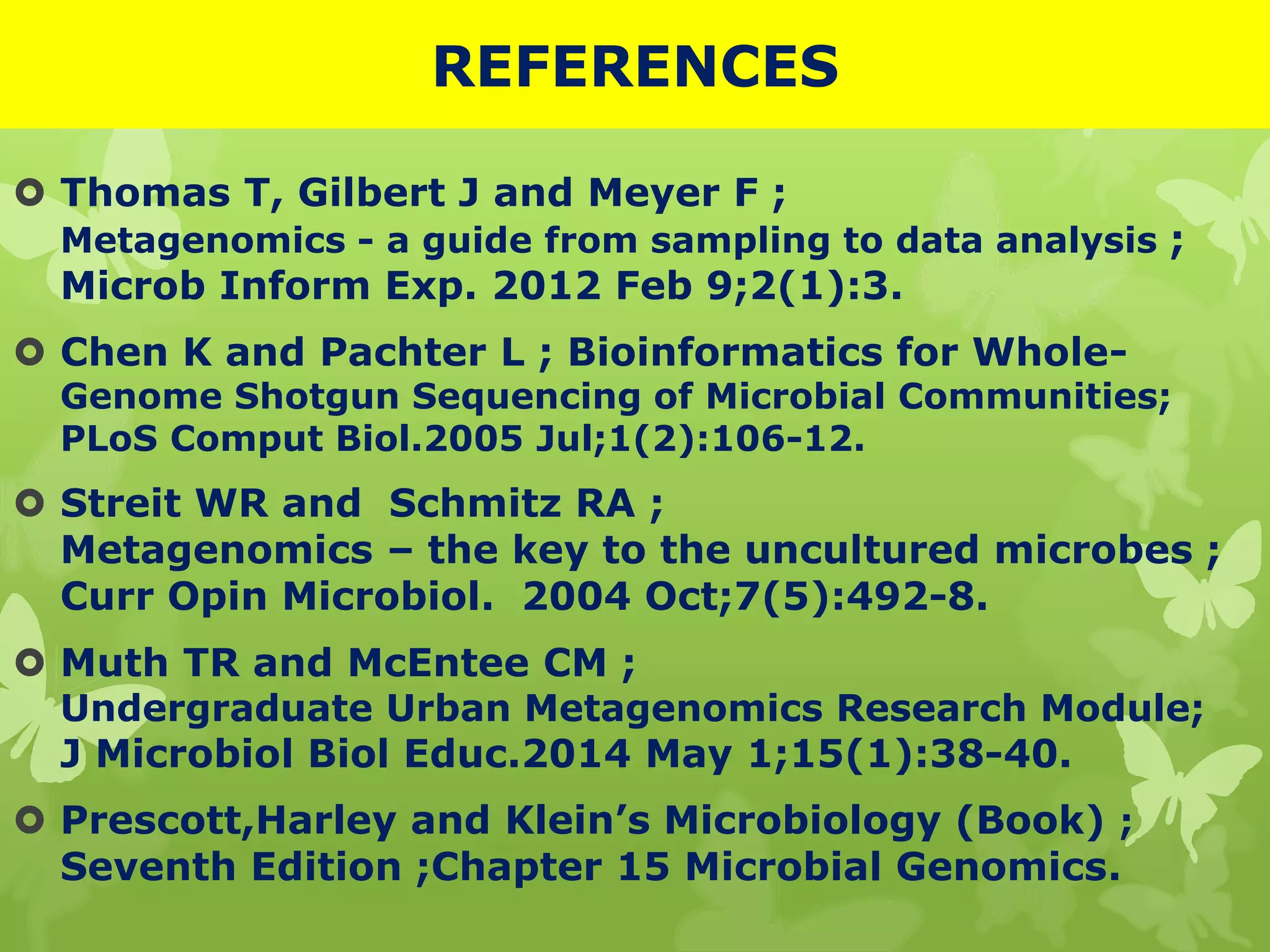
REFERENCES
 Thomas T, Gilbert J and Meyer F ;
Metagenomics - a guide from sampling to data analysis ;
Microb Inform Exp. 2012 Feb 9;2(1):3.
 Chen K and Pachter L ; Bioinformatics for Whole-
Genome Shotgun Sequencing of Microbial Communities;
PLoS Comput Biol.2005 Jul;1(2):106-12.
 Streit WR and Schmitz RA ;
Metagenomics – the key to the uncultured microbes ;
Curr Opin Microbiol. 2004 Oct;7(5):492-8.
 Muth TR and McEntee CM ;
Undergraduate Urban Metagenomics Research Module;
J Microbiol Biol Educ.2014 May 1;15(1):38-40.
 Prescott,Harley and Klein’s Microbiology (Book) ;
Seventh Edition ;Chapter 15 Microbial Genomics.
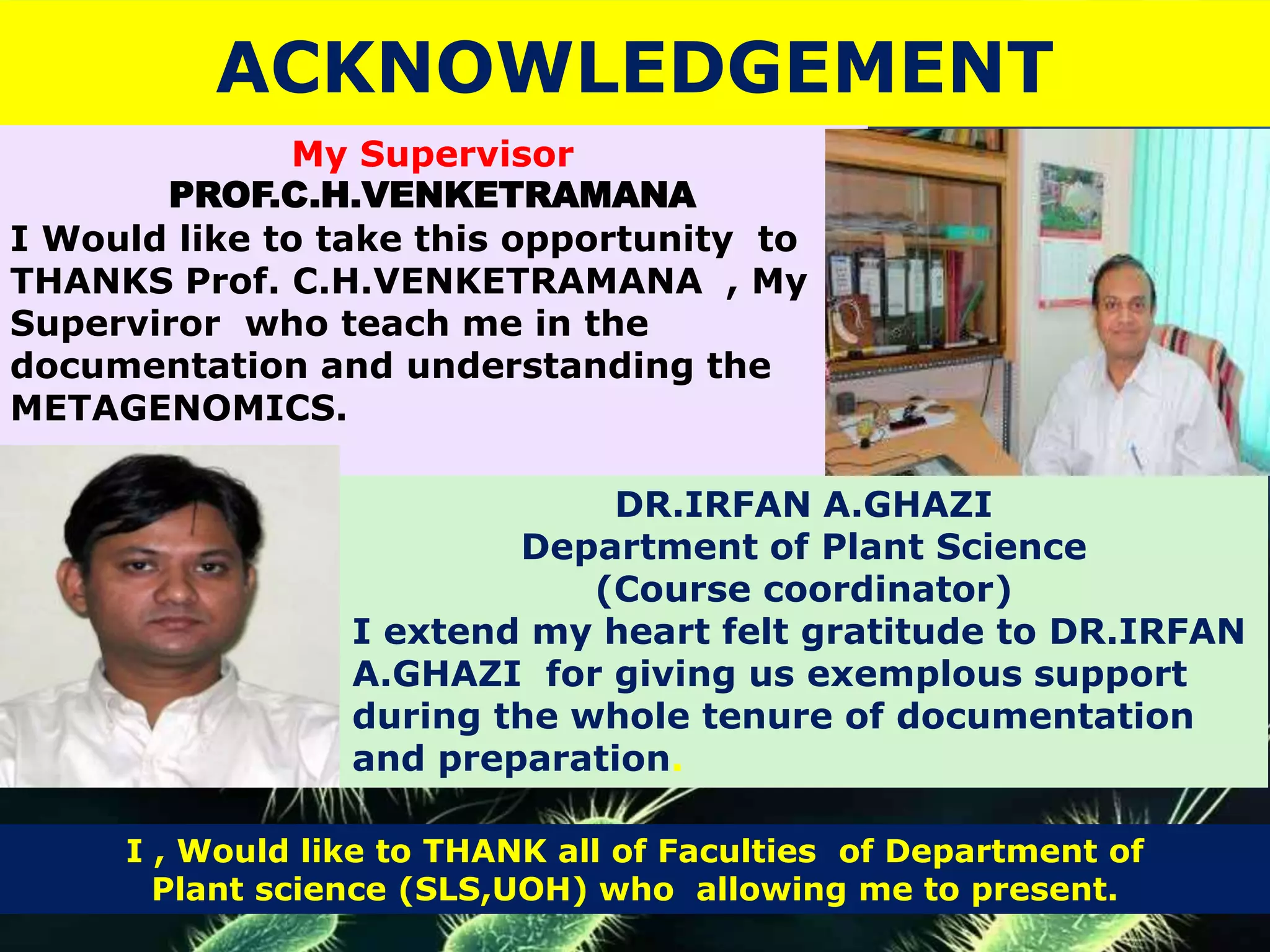
ACKNOWLEDGEMENT
My Supervisor
PROF.C.H.VENKETRAMANA
I Would like to take this opportunity to
THANKS Prof. C.H.VENKETRAMANA , My
Superviror who teach me in the
documentation and understanding the
METAGENOMICS.
DR.IRFAN A.GHAZI
Department of Plant Science
(Course coordinator)
I extend my heart felt gratitude to DR.IRFAN
A.GHAZI for giving us exemplous support
during the whole tenure of documentation
and preparation.
I , Would like to THANK all of Faculties of Department of
Plant science (SLS,UOH) who allowing me to present.
M
Wow ! She’s
Gorgeous
Hi; guys ! I’m Bacilli and
This is my wife Spirilla….
……..Hello ! I’m Micrococcus
And this is Gallionella.
Listen up my
fellow bacteria ,
we will attack
together when
we are enough
in number.
So, how many
are you ?
Start counting.
Metagenomics

  • 1.
    GAURAV KUMAR PANDIT M.Sc.Plant Biology & Biotechnology 16LPMS 09 School of Life Science University of Hyderabad gauravbiologist@uohyd.ac.in Supervisor PROF. C.H.VENKETRAMANA METAGENOMICS 3rd March 2017
  • 2.
    The pure culture Cultureis not enough Most prokaryotes are extremely difficult to retrieve in a pure culture. Metagenomics – the key to uncultured microorganisms. Study of large populations of microoganisms that reproduce clonally from a single cell Viromes : Metagenomic sequencing is particularly useful in the study of viral communities.A metagenomic pipeline called Giant Virus Finder showed the first evidence of existence of giant viruses in a saline desert and in Antarctic dry valleys .
  • 3.
  • 4.
    Metagenomics “The application ofmodern genomics techniques to the study of communities of microbial organisms directly in their natural environments, bypassing the need for isolation and lab cultivation of individual species” - Kevin Chen and Lior Pachter  Also referred as Environmental genomics, Ecogenomics, community genomics.  The term "metagenomics" was first used by Jo Handelsmann, Jon Clardy, Robert M. Goodman. Reference : Chen K and Pachter L ; Bioinformatics for Whole- Genome Shotgun Sequencing of Microbial Communities, PLoS Comput Biol.2005 Jul;1(2):106-12.
  • 5.
    DNA fragmentation (3 Kpb/ 30-40 Kpb ) fosmid /cosmid (35-40 Kpb) eDNA plasmid cloning Eschericchia coli transformation Microtiter plate Metagenomic Libraries Gene “repository” Classic Metagenomics Sequencing primers Sequencing primers Small insert vectors Large insert vectors eDNA 3Kbp
  • 6.
    Next Generation Sequencing Biologicalsample preparation a.Emulsion PCR b.Bridge PCR Cyclic Array Sequencing 1.Pyrosequencing (454) 2. SOLiD(by ligation) 3. Illumina References:https://www.researchgate.net/figure/268816439_fig1-3,
  • 7.
    TWO APPROACHES FOR METAGENOMICS Functionalbased screening Sequence based screening Reference :www.lucigen.com & metagenomicsrevealed.yolasite.com
  • 8.
    LIMITATIONS OF TWOAPPROACHES  The sequence driven approach limited existing knowledge: if a metagenomic gene does not look like a gene of known function deposited in the databases, then little can be learned about the gene or its product from sequence alone.  The function driven approach most genes from organisms in wild communities cannot be expressed easily by a given surrogate host Therefore, the two approaches are complementary and should be pursued in parallel.
  • 9.
    Why do Metagenomics? Metagenomics may answer Some questions.  How do different species interact?  Can lateral gene transfer be detected? References : The Metagenomics Group at CBS
  • 10.
    Understanding Metabolism Defining the Minimal GeneSet Genome Engineering Understanding Cell Structure & Function Understanding Host Interactions Understanding Protein-Protein Interactions Understanding Expression (RNA/Protein) Discover DNA Variation, Genotyping Forensics Drug/Vaccine Development Why do Metagenomics ?
  • 11.
    LIMITATIONS  Too muchdata?  Most genes are not identifiable  Contamination, chimeric clone sequences  Requires proteomics or expression studies to demonstrate phenotypic characteristics  Need a standard method for annotating genomes  Requires high throughput instrumentation – not readily available to most institutions  Errors in assembly due to inter-species similarities.
  • 12.
     To identifynew enzymes & antibiotics  To assess the effects of age, diet, and pathologic states on the distal gut micro biome of humans living in different environments.  Study antibiotic resistance in uncultured microbes  Improved bioinformatics will quicken analysis for library profiling .  Discoveries such as phylogenic tags (rRNA genes, etc) will give momentum to the growing field.  Learning novel pathways will lead to knowledge about the current nonculturable bacteria to then culture these systems. FUTURE OF METAGENOMICS
  • 13.
    References :www.cev.washington.edu/story/Ecogenomic_Sensor The illustrationwas developed in collaboration with Ginger Armbrust and John Delaney, School of Oceanography, University of Washington Ecogenomic Sensor
  • 14.
    Source :John Delaneyand CEV. UWash
  • 15.
    Video Collected byROV Sony Digital BetaCAM Recorder SDI Over Fiber SDI Over Fiber Capture Control Processing on Cluster Detection & Classification Working Flow Diagram of FOCO SDI = Serial Digital Interface
  • 16.
    Conclusion  Microorganisms areubiquitous in nature. Although we cannot usually see them, microorganisms are essential for every part of life on the Earth. Every process in the biosphere is touched by the microorganisms that convert the key elements of life—carbon, nitrogen, oxygen, and sulfur—into forms accessible to all other living things.  Metagenomics provides a new way of examining the microbial world that has the potential to revolutionize understanding of the entire living world.  Metagenomics combines the power of genomics, bioinformatics, and systems biology.  It provides new access to the microbiological world and uncultured microorganisms.
  • 17.
    REFERENCES  Thomas T,Gilbert J and Meyer F ; Metagenomics - a guide from sampling to data analysis ; Microb Inform Exp. 2012 Feb 9;2(1):3.  Chen K and Pachter L ; Bioinformatics for Whole- Genome Shotgun Sequencing of Microbial Communities; PLoS Comput Biol.2005 Jul;1(2):106-12.  Streit WR and Schmitz RA ; Metagenomics – the key to the uncultured microbes ; Curr Opin Microbiol. 2004 Oct;7(5):492-8.  Muth TR and McEntee CM ; Undergraduate Urban Metagenomics Research Module; J Microbiol Biol Educ.2014 May 1;15(1):38-40.  Prescott,Harley and Klein’s Microbiology (Book) ; Seventh Edition ;Chapter 15 Microbial Genomics.
  • 18.
    ACKNOWLEDGEMENT My Supervisor PROF.C.H.VENKETRAMANA I Wouldlike to take this opportunity to THANKS Prof. C.H.VENKETRAMANA , My Superviror who teach me in the documentation and understanding the METAGENOMICS. DR.IRFAN A.GHAZI Department of Plant Science (Course coordinator) I extend my heart felt gratitude to DR.IRFAN A.GHAZI for giving us exemplous support during the whole tenure of documentation and preparation. I , Would like to THANK all of Faculties of Department of Plant science (SLS,UOH) who allowing me to present.
  • 19.
    M Wow ! She’s Gorgeous Hi;guys ! I’m Bacilli and This is my wife Spirilla…. ……..Hello ! I’m Micrococcus And this is Gallionella. Listen up my fellow bacteria , we will attack together when we are enough in number. So, how many are you ? Start counting.