1
Objectives
 Identify sources of radiation
 Describe the basis of radiation
 Identify types of radiation
 Describe radiation dose and its impact on humans

 Identify the common types of radiation detection

devices

2
Introduction
 Most responder are uncomfortable in dealing with a

radiation response
 They lack in-depth understanding of radiation and its

hazards.
 With terrorism on the rise responders need to be

comfortable with the detection and monitoring
radiation.
 Nuclear detonation is very unlikely.
3
Introduction
 Radiological dispersion device (RDD) is, using a conventional

explosive to distribute radioactive materials.
 There is any number of potential sources of radiation
that could be used.
 Radiation detectors for responders are divided into two major
groups.
 One measures exposure to radiation.
 One measures the current amount of radiation in the
area.
 To be effective measure radiation you will need at least two
detectors. There is not one detector that measures all 5 types
of radiation.

4
Sources of Radiation
 We are subject to radiation every day
 Our bodies have radioactive substances
 We eat foods containing radiation every day
 We breathe in radiation with out harm everyday

 Our exposure to common radiation sources far exceeds

those that would be found at a nuclear power plant
 Television, Medical test, Elevation
 We are subjected to radiation that causes us no harm under normal
circumstances

5
How Can Radiation Hurt Us
 Basic atom (nucleus)
 Electrons, neutrons, and protons
 Protons and neutrons reside in nucleus
 Electrons are negatively charged and orbit the
nucleus
 Protons have a positive charge and determine the
element or type of atom

 Neutrons are same size as protons but neutral
6
How Can Radiation Hurt Us
 Each element, with a given number of protons, can

assume several forms, or isotopes.




Which are determined by the number of neutrons in the
nucleus?
The chemical properties of each isotope of an element are the
same.

 If there are too few or too many neutrons the nucleus

becomes unstable.
7
Radioisotopes
 Isotopes, whose nuclei are unstable, are radioactive

and emit radiation to regain stability.
 This emission of radiation, is known as radioactive

decay


Usually takes form of Gamma radiation. May also be Alpha,
Beta, or Neutron?

 Unstable materials may become stable after one or two

decays.


Others may take many decay cycles.
8
Radioisotopes
 Radioisotope decays by

the emission of an alpha
or beta particle.


The number of protons in
the nucleus changes.

 The radioisotope
becomes a different
element

 Examples
 Uranium is the base for

the development of
Radon




Common radioactive gas
found in homes
Radon decays into lead.

 Cobalt-60




Beta and Gamma energy
emitted
Decays to form Nickel-60
9
Half-Life
 Amount of time for half of a radioactive source to

decay
 Activity of a source of radioactive material is a measure

of the number of decays per second that occur within
it.
 Physical size of radioactive source is not an indicator

of radioactive strength or activity.
10
Radiation Dose
 As confusing as understanding the makeup of a radioactive

material, so is the calculation of the radiation dose.

 Three measurements can be used to describe radiation

dose.
$499



Absorbed dose



Equivalent dose



$595
Effective dose

11
Absorbed Dose
 Measurement of energy transferred to a material by

radiation
 Measured in units called



Gray (Gy)
Radiation absorbed dose (rad)

 I gray = 100 ra

12
Absorbed Dose
 Impact on humans, we need to understand the

absorbed energy on the body and potential biological
damage of radiation on humans. And convert the
absorbed dose to equivalent dose.
 Basic unit of equivalent dose is roentgen.



This value provides for the amount of ionization in air caused
by X-ray or Gamma radiation.



One roentgen equals 1 REM
13
Absorbed Dose
 Radiation monitors measure three scales.
 REM (R)
 MilliRem (mR)
 MicroRem (µR)
 The dose of radiation is expressed by a time factor,

typically an hour.

14
Radiation Protection
 Radiation dose should be kept
 “as low as reasonably achievable”


ALARA

 Three factors that influence radiation dose.
 Time
 Distance

 Shielding

15
Radiation Protection
 Minimize dose,
 Stay near the radiation source for as little time as
possible.
 Stand as far away from the source and place as much
shielding between people and the source as possible.
 Time is important as in many cases a human can

sustain a short exposure to radiation without being
harmed.
 Example



Limit your exposure to 1 (mR/hr). Your source is 60 (mR/hr)
You could be at the source for 1 minute
16
Radiation Protection
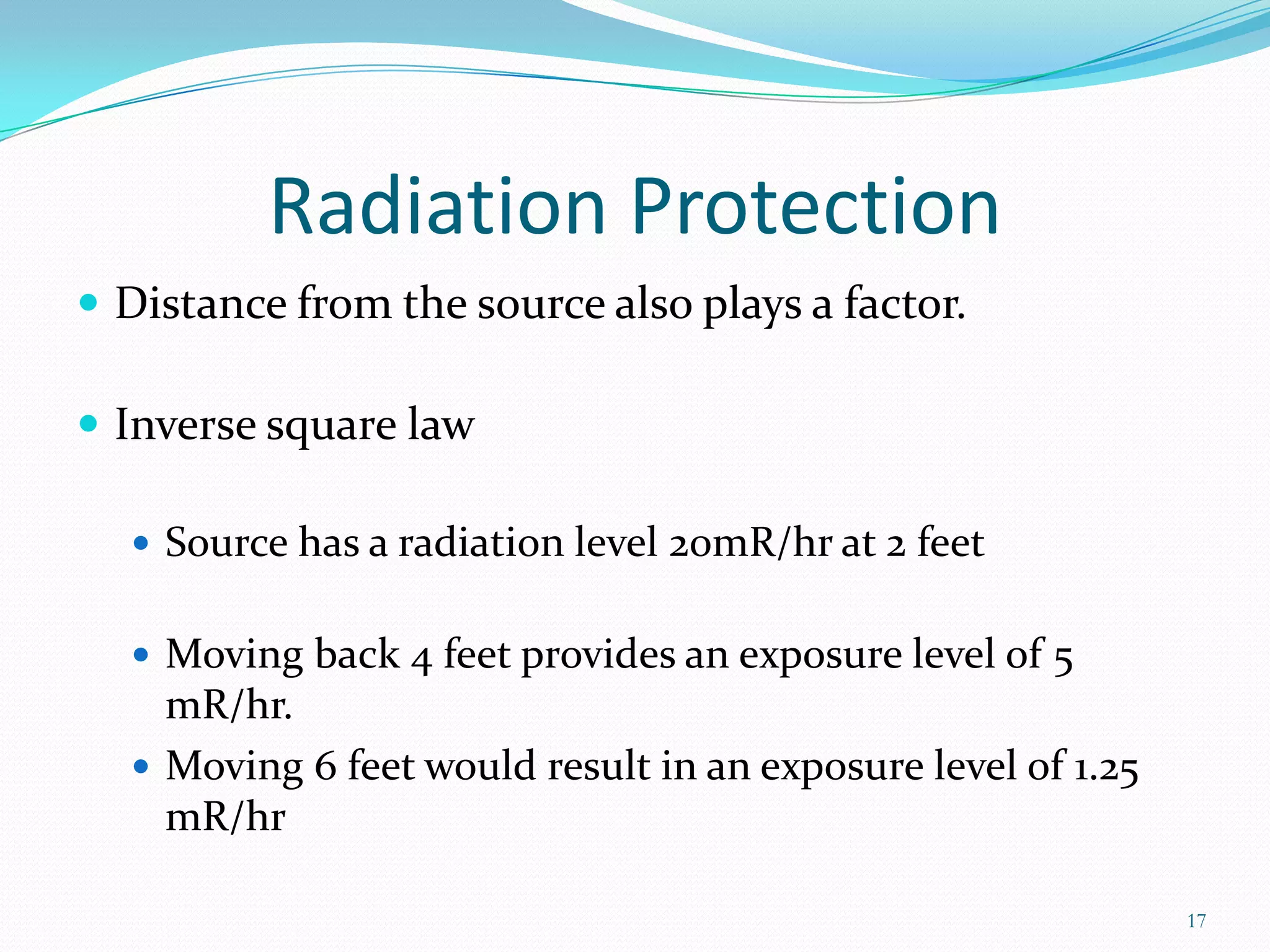
 Distance from the source also plays a factor.
 Inverse square law
 Source has a radiation level 20mR/hr at 2 feet
 Moving back 4 feet provides an exposure level of 5

mR/hr.
 Moving 6 feet would result in an exposure level of 1.25
mR/hr
17
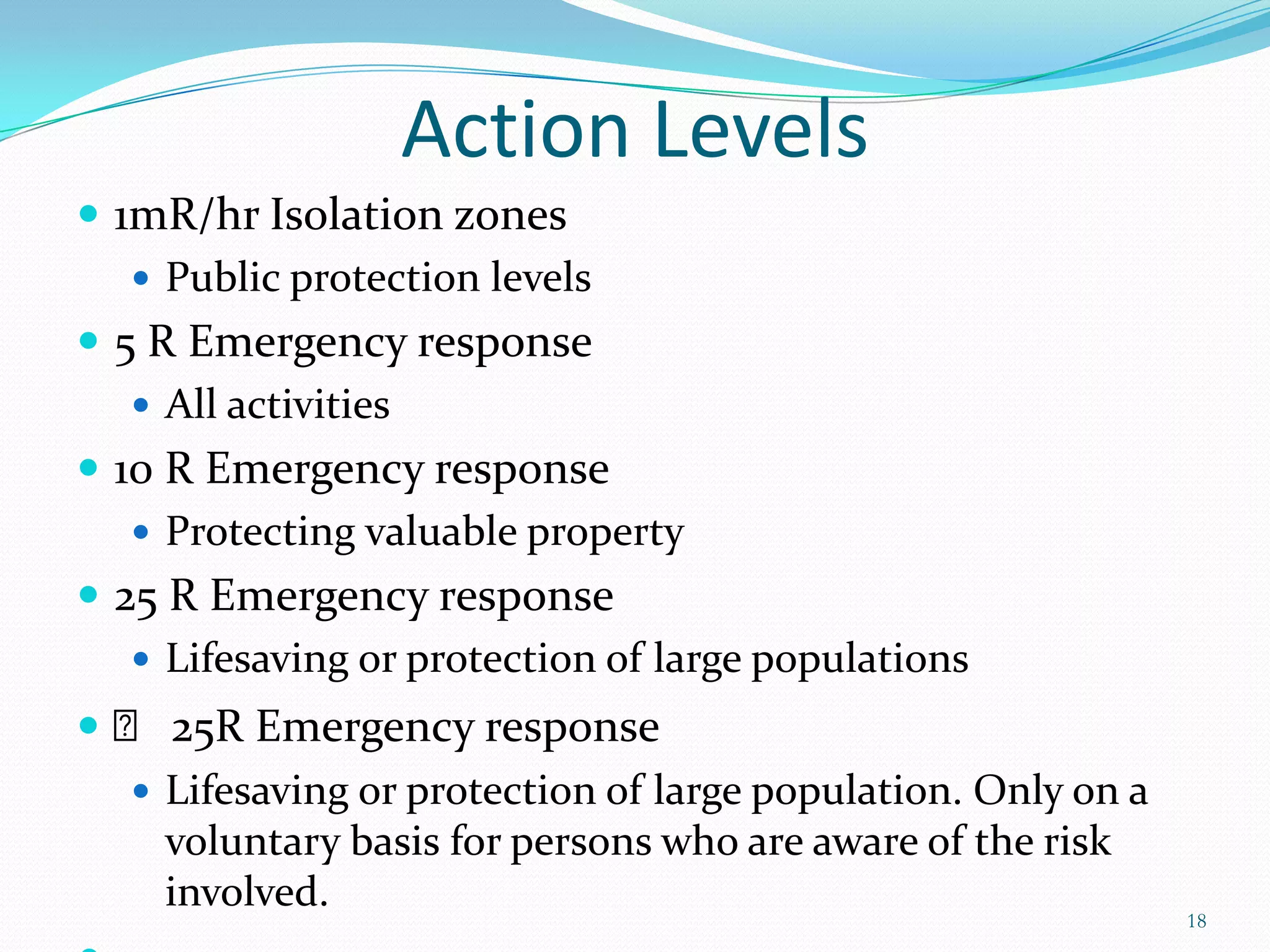
Action Levels
 1mR/hr Isolation zones
 Public protection levels
 5 R Emergency response
 All activities
 10 R Emergency response
 Protecting valuable property
 25 R Emergency response
 Lifesaving or protection of large populations
 ˃ 25R Emergency response
 Lifesaving or protection of large population. Only on a
voluntary basis for persons who are aware of the risk
involved.

18
Radiation Monitors
 Current radiation monitors provide two methods

of measuring radiation.
 REM and counts per minute
 REM being the most important to responders.

19
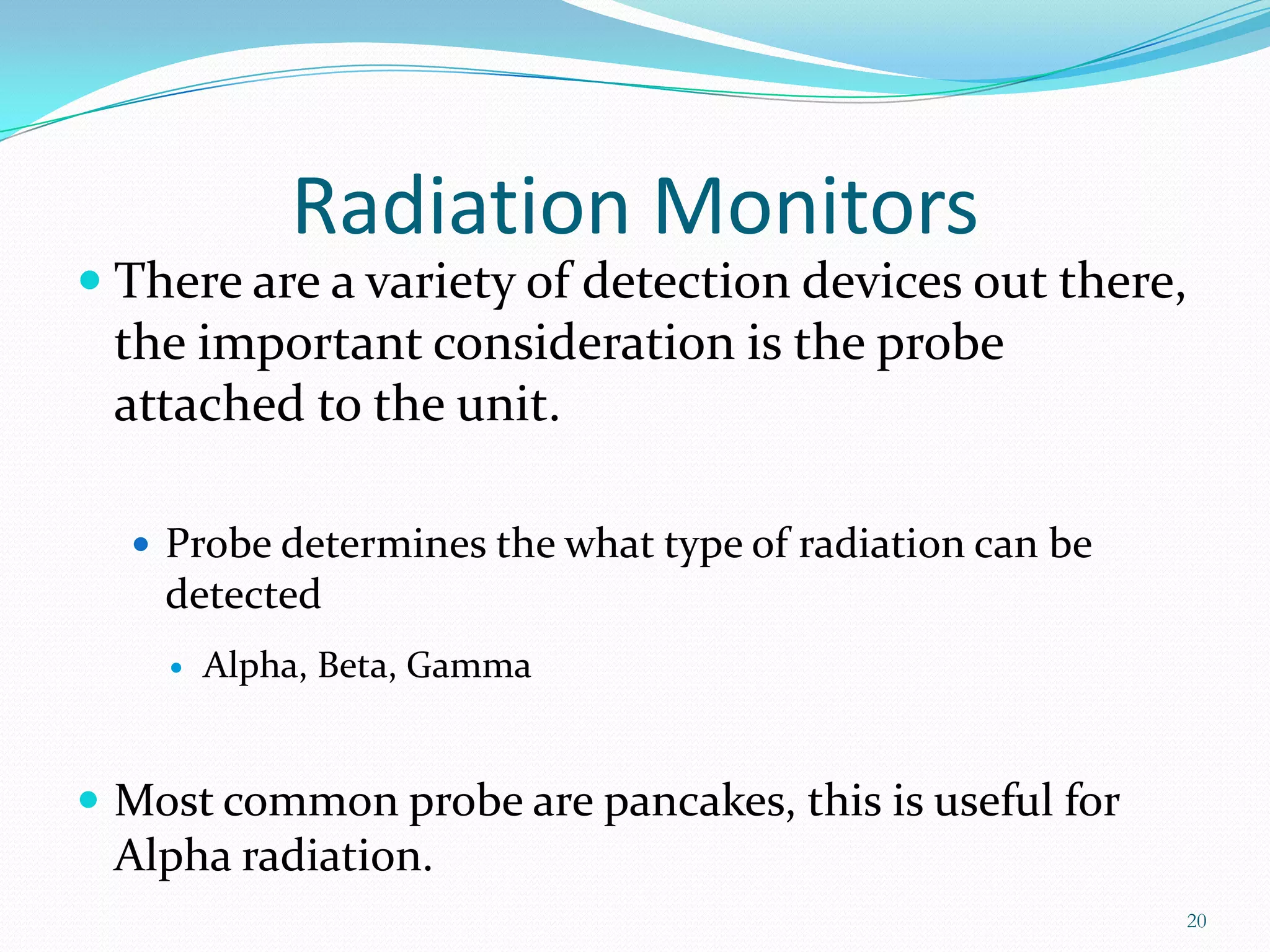
Radiation Monitors
 There are a variety of detection devices out there,

the important consideration is the probe
attached to the unit.
 Probe determines the what type of radiation can be

detected


Alpha, Beta, Gamma

 Most common probe are pancakes, this is useful for

Alpha radiation.
20
Radiation Monitors
 When the amount of

radiation becomes higher
we need to switch to the
internal probe.
 These are designed for
the higher level of
radiation
 When the monitor is

turned on it will pick up
background radiation.

 This is naturally occurring

radiation and it should
read in micro/rem.
 It is important that you go
do some field testing in
your area to determine
normal background.
 Then responders know
when they are being
exposed to radiation at
higher levels than
background.
21
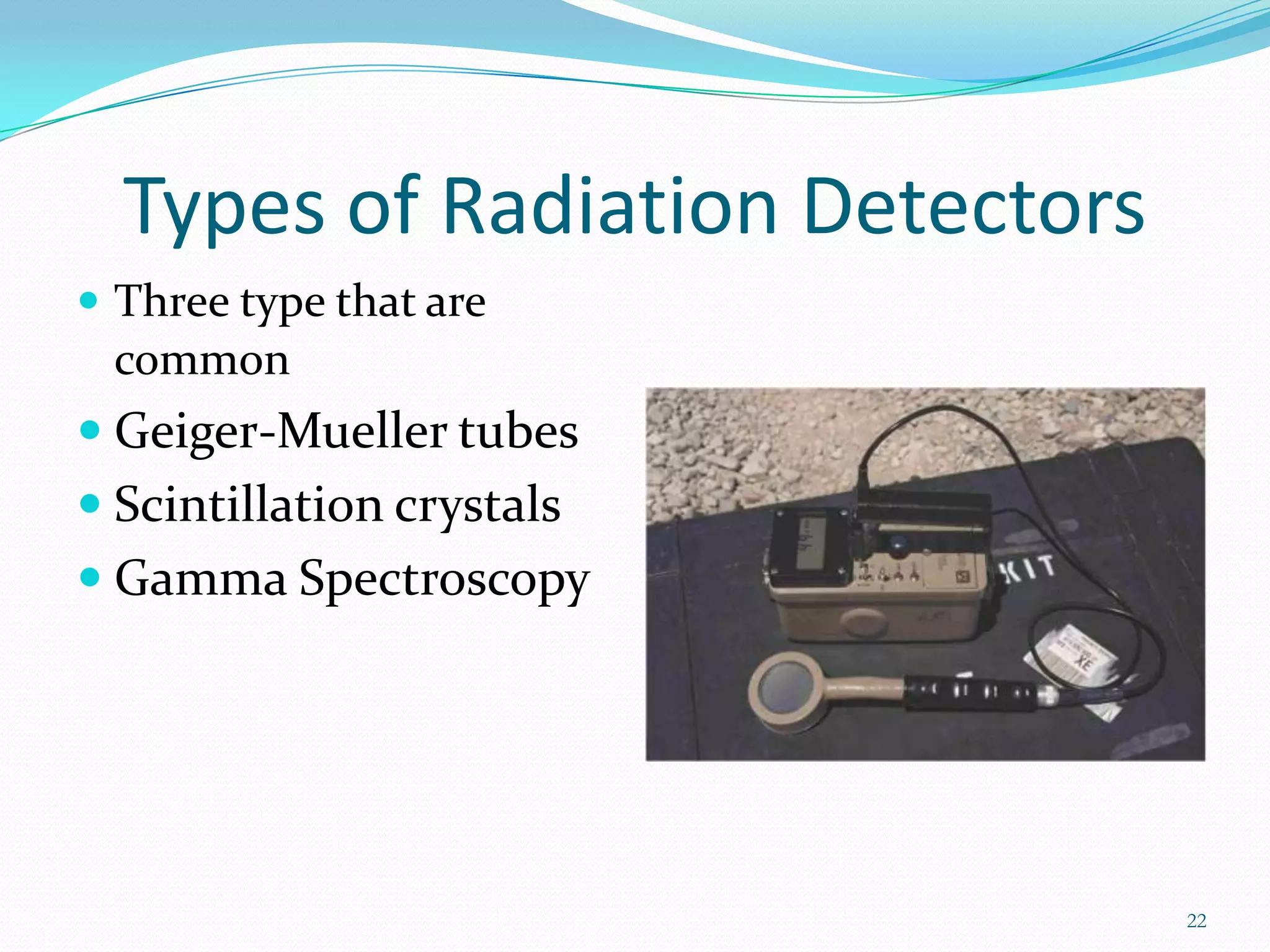
Types of Radiation Detectors
 Three type that are

common

 Geiger-Mueller tubes
 Scintillation crystals
 Gamma Spectroscopy

22
Types of Radiation Detectors
 GM tubes can detect Alpha, Beta, Gamma
 Uses electric current, a reaction takes place when

radiation interacts with the walls of the tube.
 Electrons are freed from the atom and flows to the
anode which is in the center of the tube.
 This induces an electrical “pulse” which is used to
determine when and how much radiation entered
the GM tube.
 These detectors are generally coupled with a
proportional counter, which counts the electrical
impulses.


You have a choice to count in radiation dose or counts per
minute

23
Types of Radiation Detectors
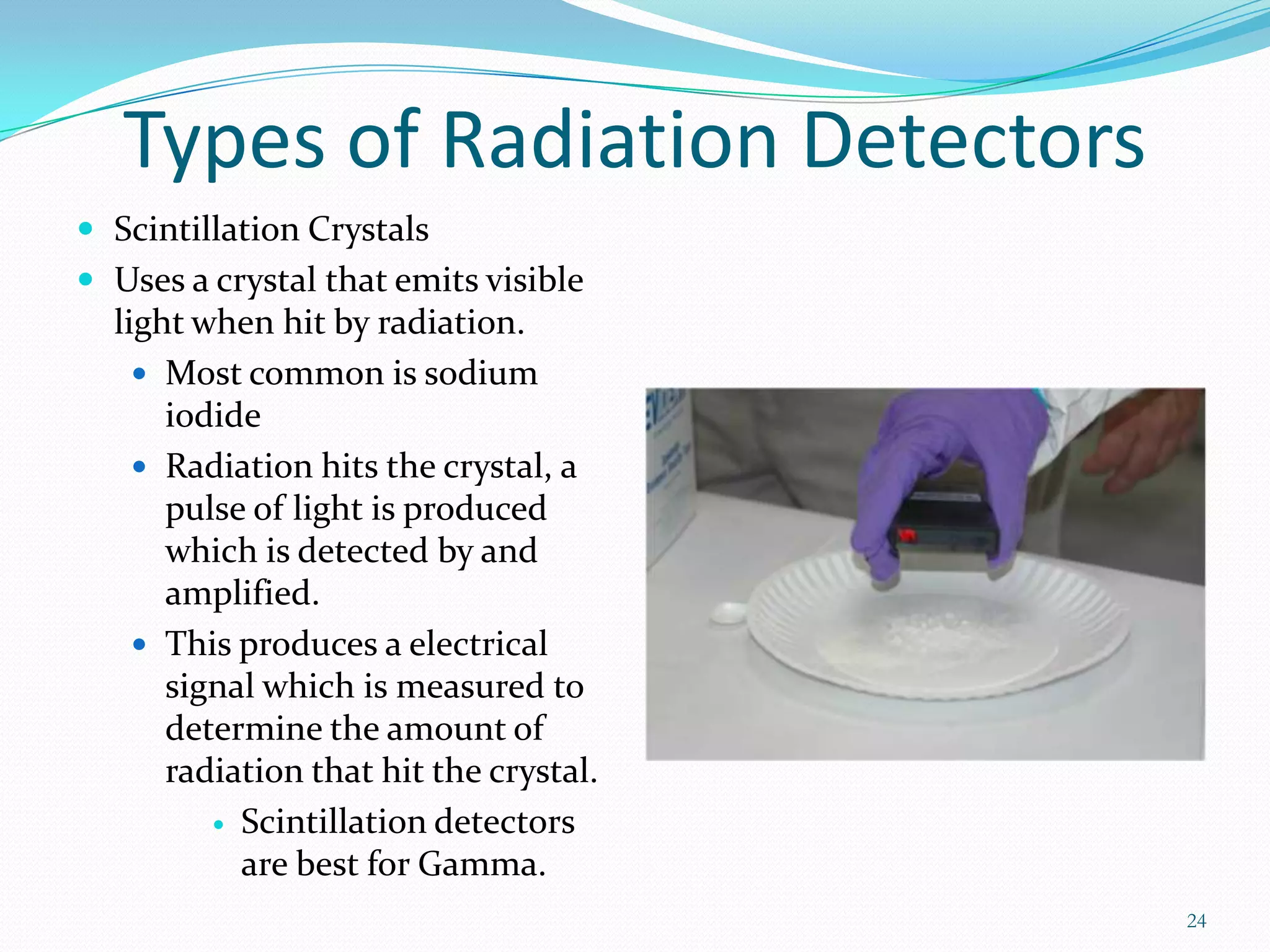
 Scintillation Crystals
 Uses a crystal that emits visible

light when hit by radiation.
 Most common is sodium
iodide
 Radiation hits the crystal, a
pulse of light is produced
which is detected by and
amplified.
 This produces a electrical
signal which is measured to
determine the amount of
radiation that hit the crystal.
 Scintillation detectors
are best for Gamma.
24
Types of Radiation Detectors
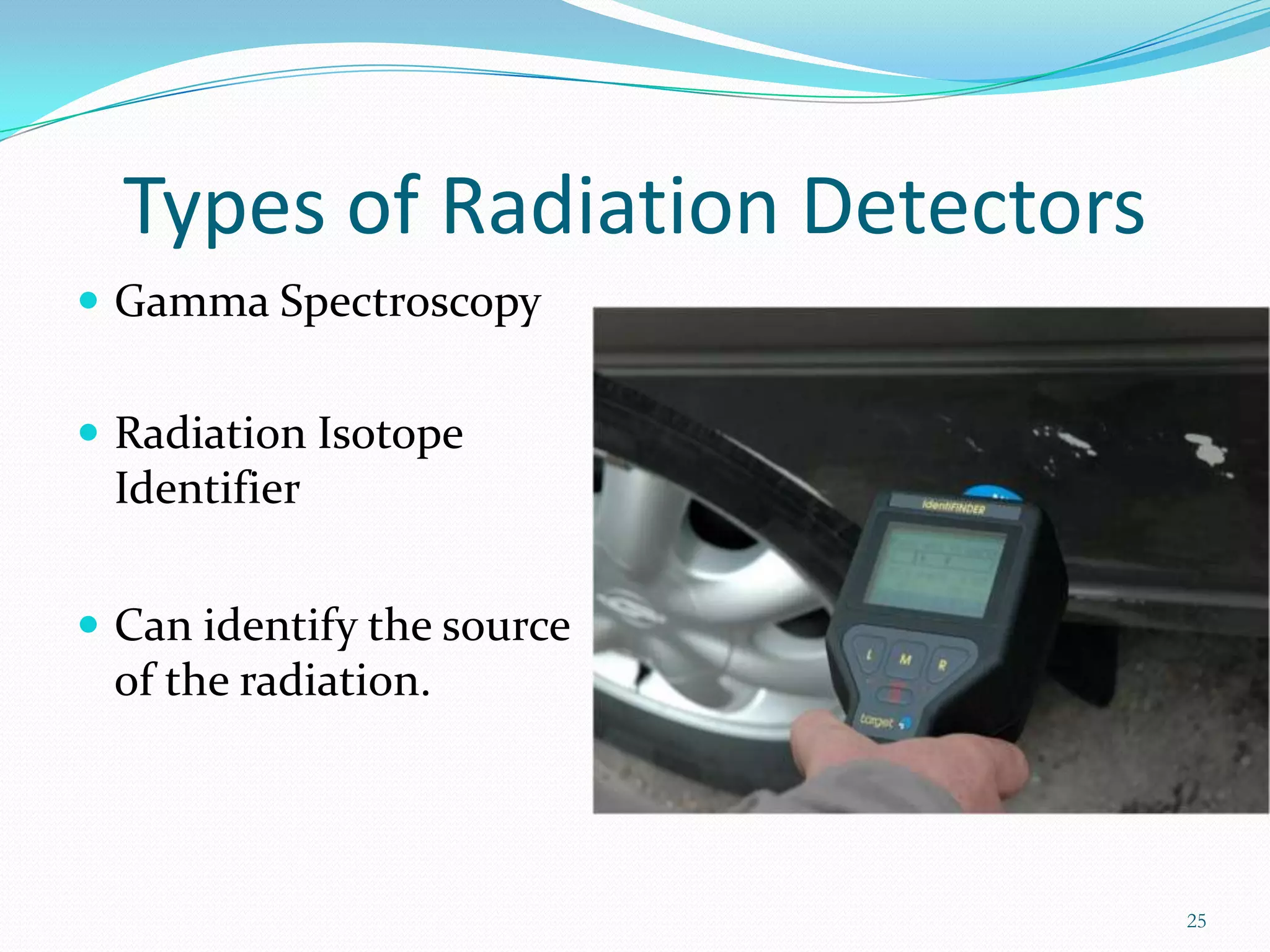
 Gamma Spectroscopy

 Radiation Isotope

Identifier
 Can identify the source

of the radiation.

25
Types of Radiation Detectors
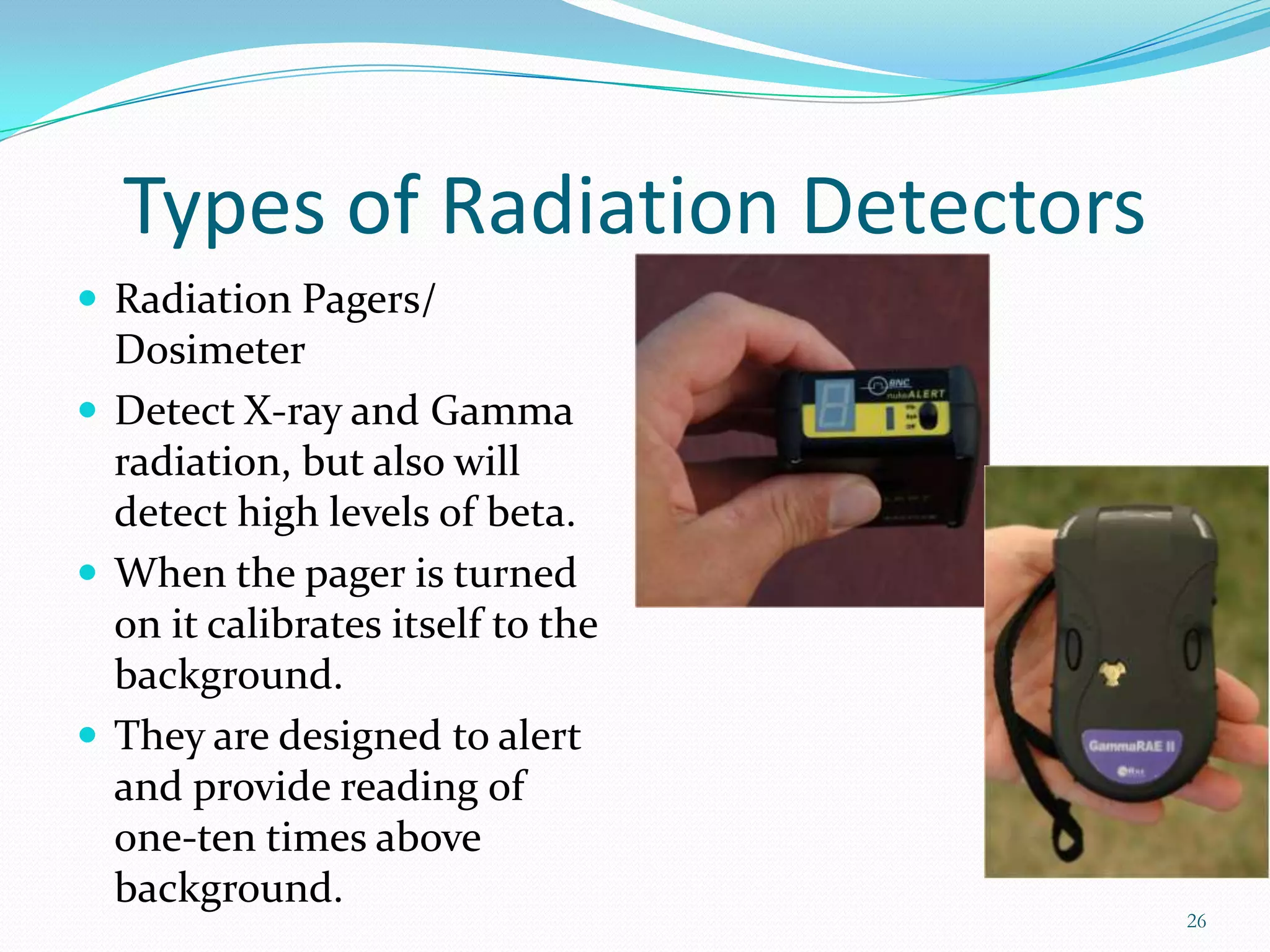
 Radiation Pagers/

Dosimeter
 Detect X-ray and Gamma
radiation, but also will
detect high levels of beta.
 When the pager is turned
on it calibrates itself to the
background.
 They are designed to alert
and provide reading of
one-ten times above
background.

26
Summary
 Responders need to become familiar with radiation

detection.
 Possibility exists for future events.
 Many radioactive substances exist and when we deal
with unidentified materials we need to check for
radiation.
 Knowing how to monitor for it is as important as
knowing the action levels.

27

Module 7 radiation detection, american fork fire rescue

  • 1.
  • 2.
    Objectives  Identify sourcesof radiation  Describe the basis of radiation  Identify types of radiation  Describe radiation dose and its impact on humans  Identify the common types of radiation detection devices 2
  • 3.
    Introduction  Most responderare uncomfortable in dealing with a radiation response  They lack in-depth understanding of radiation and its hazards.  With terrorism on the rise responders need to be comfortable with the detection and monitoring radiation.  Nuclear detonation is very unlikely. 3
  • 4.
    Introduction  Radiological dispersiondevice (RDD) is, using a conventional explosive to distribute radioactive materials.  There is any number of potential sources of radiation that could be used.  Radiation detectors for responders are divided into two major groups.  One measures exposure to radiation.  One measures the current amount of radiation in the area.  To be effective measure radiation you will need at least two detectors. There is not one detector that measures all 5 types of radiation. 4
  • 5.
    Sources of Radiation We are subject to radiation every day  Our bodies have radioactive substances  We eat foods containing radiation every day  We breathe in radiation with out harm everyday  Our exposure to common radiation sources far exceeds those that would be found at a nuclear power plant  Television, Medical test, Elevation  We are subjected to radiation that causes us no harm under normal circumstances 5
  • 6.
    How Can RadiationHurt Us  Basic atom (nucleus)  Electrons, neutrons, and protons  Protons and neutrons reside in nucleus  Electrons are negatively charged and orbit the nucleus  Protons have a positive charge and determine the element or type of atom  Neutrons are same size as protons but neutral 6
  • 7.
    How Can RadiationHurt Us  Each element, with a given number of protons, can assume several forms, or isotopes.   Which are determined by the number of neutrons in the nucleus? The chemical properties of each isotope of an element are the same.  If there are too few or too many neutrons the nucleus becomes unstable. 7
  • 8.
    Radioisotopes  Isotopes, whosenuclei are unstable, are radioactive and emit radiation to regain stability.  This emission of radiation, is known as radioactive decay  Usually takes form of Gamma radiation. May also be Alpha, Beta, or Neutron?  Unstable materials may become stable after one or two decays.  Others may take many decay cycles. 8
  • 9.
    Radioisotopes  Radioisotope decaysby the emission of an alpha or beta particle.  The number of protons in the nucleus changes.  The radioisotope becomes a different element  Examples  Uranium is the base for the development of Radon   Common radioactive gas found in homes Radon decays into lead.  Cobalt-60   Beta and Gamma energy emitted Decays to form Nickel-60 9
  • 10.
    Half-Life  Amount oftime for half of a radioactive source to decay  Activity of a source of radioactive material is a measure of the number of decays per second that occur within it.  Physical size of radioactive source is not an indicator of radioactive strength or activity. 10
  • 11.
    Radiation Dose  Asconfusing as understanding the makeup of a radioactive material, so is the calculation of the radiation dose.  Three measurements can be used to describe radiation dose. $499  Absorbed dose  Equivalent dose  $595 Effective dose 11
  • 12.
    Absorbed Dose  Measurementof energy transferred to a material by radiation  Measured in units called   Gray (Gy) Radiation absorbed dose (rad)  I gray = 100 ra 12
  • 13.
    Absorbed Dose  Impacton humans, we need to understand the absorbed energy on the body and potential biological damage of radiation on humans. And convert the absorbed dose to equivalent dose.  Basic unit of equivalent dose is roentgen.  This value provides for the amount of ionization in air caused by X-ray or Gamma radiation.  One roentgen equals 1 REM 13
  • 14.
    Absorbed Dose  Radiationmonitors measure three scales.  REM (R)  MilliRem (mR)  MicroRem (µR)  The dose of radiation is expressed by a time factor, typically an hour. 14
  • 15.
    Radiation Protection  Radiationdose should be kept  “as low as reasonably achievable”  ALARA  Three factors that influence radiation dose.  Time  Distance  Shielding 15
  • 16.
    Radiation Protection  Minimizedose,  Stay near the radiation source for as little time as possible.  Stand as far away from the source and place as much shielding between people and the source as possible.  Time is important as in many cases a human can sustain a short exposure to radiation without being harmed.  Example   Limit your exposure to 1 (mR/hr). Your source is 60 (mR/hr) You could be at the source for 1 minute 16
  • 17.
    Radiation Protection  Distancefrom the source also plays a factor.  Inverse square law  Source has a radiation level 20mR/hr at 2 feet  Moving back 4 feet provides an exposure level of 5 mR/hr.  Moving 6 feet would result in an exposure level of 1.25 mR/hr 17
  • 18.
    Action Levels  1mR/hrIsolation zones  Public protection levels  5 R Emergency response  All activities  10 R Emergency response  Protecting valuable property  25 R Emergency response  Lifesaving or protection of large populations  ˃ 25R Emergency response  Lifesaving or protection of large population. Only on a voluntary basis for persons who are aware of the risk involved. 18
  • 19.
    Radiation Monitors  Currentradiation monitors provide two methods of measuring radiation.  REM and counts per minute  REM being the most important to responders. 19
  • 20.
    Radiation Monitors  Thereare a variety of detection devices out there, the important consideration is the probe attached to the unit.  Probe determines the what type of radiation can be detected  Alpha, Beta, Gamma  Most common probe are pancakes, this is useful for Alpha radiation. 20
  • 21.
    Radiation Monitors  Whenthe amount of radiation becomes higher we need to switch to the internal probe.  These are designed for the higher level of radiation  When the monitor is turned on it will pick up background radiation.  This is naturally occurring radiation and it should read in micro/rem.  It is important that you go do some field testing in your area to determine normal background.  Then responders know when they are being exposed to radiation at higher levels than background. 21
  • 22.
    Types of RadiationDetectors  Three type that are common  Geiger-Mueller tubes  Scintillation crystals  Gamma Spectroscopy 22
  • 23.
    Types of RadiationDetectors  GM tubes can detect Alpha, Beta, Gamma  Uses electric current, a reaction takes place when radiation interacts with the walls of the tube.  Electrons are freed from the atom and flows to the anode which is in the center of the tube.  This induces an electrical “pulse” which is used to determine when and how much radiation entered the GM tube.  These detectors are generally coupled with a proportional counter, which counts the electrical impulses.  You have a choice to count in radiation dose or counts per minute 23
  • 24.
    Types of RadiationDetectors  Scintillation Crystals  Uses a crystal that emits visible light when hit by radiation.  Most common is sodium iodide  Radiation hits the crystal, a pulse of light is produced which is detected by and amplified.  This produces a electrical signal which is measured to determine the amount of radiation that hit the crystal.  Scintillation detectors are best for Gamma. 24
  • 25.
    Types of RadiationDetectors  Gamma Spectroscopy  Radiation Isotope Identifier  Can identify the source of the radiation. 25
  • 26.
    Types of RadiationDetectors  Radiation Pagers/ Dosimeter  Detect X-ray and Gamma radiation, but also will detect high levels of beta.  When the pager is turned on it calibrates itself to the background.  They are designed to alert and provide reading of one-ten times above background. 26
  • 27.
    Summary  Responders needto become familiar with radiation detection.  Possibility exists for future events.  Many radioactive substances exist and when we deal with unidentified materials we need to check for radiation.  Knowing how to monitor for it is as important as knowing the action levels. 27