Radiation
Detection
Detection
• Now that we know the
  characteristics of atomic
  structure and radioactivity, we
  now need to discuss methods of
  detecting radioactivity
• Since radiations are
  submicroscopic and cannot be
  seen, they must be detected
  indirectly
Detection
• This is accomplished through
  the fact that radiations ionize
  matter
• Since we cannot detect the
  radiations directly we detect the
  ions that it produces
• Consequently, most radiation
  detectors work on the process
  of ionization
Detection
• There are two types of
  detectors
  –   Passive
  –   Active
• Passive detectors do not require
  a constant source of energy, i.e.
  “plugged in”, batteries, etc.
• Active detectors require a
  constant energy source
Detection
• Passive detectors – The first
  passive detector we need to
  discuss is the first ever
  radiation detector…
  Photographic Film
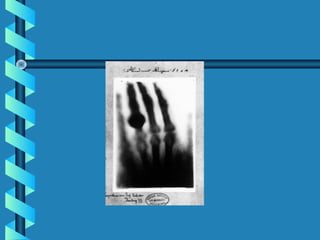
• In 1895 Wilhelm Roentgen used
  photographic film to record the
  first X-Rays
Detection
• In 1896 Henri Becquerel used
  photographic film to discover
  natural radioactivity
• Photographic film is a mixture of
  silver nitrate, when silver nitrate
  is ionized, they change color
• Photographic film is still the
  most commonly used detector
Detection
• Both x-rays used the medical
  field and PMD (personnel
  monitoring device) i.e. Film
  Badge
• The quantity of radiation
  determines the darkness of the
  film exposure
• The type of radiation can be
  determined by the use of filters
  placed in front of the film
Detection
• The advantages of photographic
  film are…
  – Cost effective
    • Cheap
    • Length of use
  – Requires no user interaction
• Disadvantages of film
  – Not immediate results
  – Not reusable
Detection
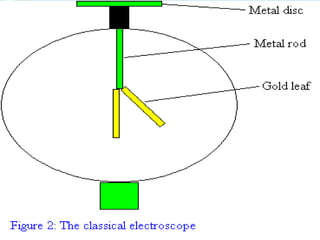
• Another passive detector not
  used anymore was called an
  electroscope
• Electroscopes used the
  charging and uncharging of ions
  to show the presence of
  radiation
Detection
• The rate at which the
  electroscope discharges, tells
  how strong the radiation source
  is
• Advantages of electroscopes
  – Reusable
• Disadvantage
  – Not qualitative (what kind of
    radiation)
  – Not accurately quantitative (how
    much)
Detection
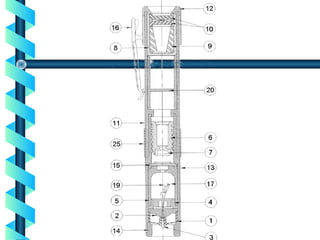
• Dosimeters are yet another type
  of passive detectors
• Dosimeters work like a
  miniature electroscope, inside
  there is a small ion chamber
• This chamber contains a Mylar
  fiber that works like the gold
  leaf of the electroscope
Detection
• The dosimeter is charged by
  placing the contact point on a
  corresponding charging contact
  on a dosimeter charger
• They are used for personnel
  monitoring
• They are used where the
  potential for higher doses of
  radiation are possible i.e.
  Nuclear Power Plants
Detection
• Advantages of dosimeters
 – Reusable
 – Accurately Quantitative (How
   Much)
 – Immediate results
• Disadvantages of dosimeters
 – Expensive (initial cost)
Detection
• The next passive detector we
  need to look at are TLD’s
  – (Thermo Luminescent Dosimetery)
• Early on in the study of radiation
  it was learned that radiation has
  very unique affects on
  crystalline structures
• Radiation energy causes
  electrons to move in these
  structures
Detection
• When electrons are moved to
  higher energy levels, they store
  energy
• In many cases this causes a
  color change in crystal i.e.
  brown glass
• Gemologists learn of this effect
  and used it to enhance the color
  of gem stones
Detection
• Consequently approximately 6
  thousand metric tons of
  gemstones are irradiated each
  year
• Approximately 85% of all the
  dark blue topaz sold in the US
  has been irradiated
• Other effects to gemstones
  include turning yellow into
  green diamonds
Detection
• Some crystals when heated and
  the electrons move back to their
  original positions, will give off
  visible light
• The amount of light given off is
  proportional to the amount of
  radiation received i.e. lithium
  fluoride
Detection
• Consequently, crystals can be
  used as personnel monitoring
  devices
• The advantages of TLD’s
  – Readers are inexpensive
  – They are reusable
• Disadvantages of TLD’s
  – More quantitative than qualitative
Detection
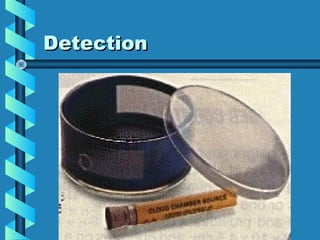
• Cloud Chambers are another
  passive detector
• The work on the process of a
  gas changing to a liquid
• They are similar to that of a jet
  airplane giving off a vapor trail
  at high altitude
• In a cloud chamber the cold
  area is at the bottom
Detection
• The atmosphere is made up of
  ethyl alcohol which is slightly
  heavier than air
• As the ethyl alcohol sinks
  towards the bottom, it gets cold
  and wants to condense
• It condenses on the trails of
  ions created by the radiation,
  therefore you see the effects of
  ionization
Detection
Detection
• Advantages of cloud chambers
  – You can physically see the effects
    of the radiation
• Disadvantages
  – Clouds don’t stay long


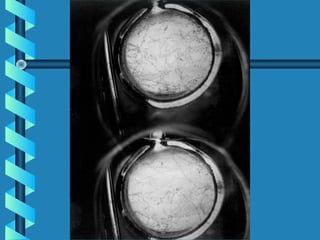
• Bubble Chambers work on the
  process of liquid changing to
  gas… opposite of a cloud
  chambers
Detection
• They use a chamber of liquid
  hydrogen, as the radiation
  passes through the liquid, it
  causes the atoms to move and
  the friction changes the liquid to
  a gas
• We do not do bubble chambers
  because hydrogen is explosive
  and tough to keep in a liquid
  state
Detection
• Advantages
  – Once the bubbles are created, they
    are frozen in position, therefore
    you can study bubble tracks…
• Disadvantages we discussed
  already…
• The final passive detector is the
  “missing link” between passive
  and active detectors
Detection
• A spark chamber contains many
  metal plates with a gap between
  them
• The plates all have alternating
  charges (+ - + - +)
• Inside the chamber and around
  the plates is an easily ionized
  gas
Detection
• As the radiation passes through
  the chamber, it creates ions
  that bridged the gap and creates
  trails of sparks
Detection
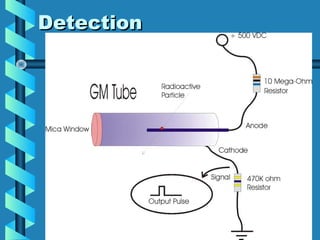
GM Tube
• Detects Alpha, Beta, and
  Gamma
• Low efficiency
• But won’t tell you what kind of
  radiation
Detection
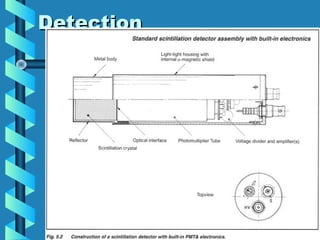
Scintillation
• Only Gamma
• And will differentiate between
  low and high energy gamma

Radiation detectors

  • 1.
  • 2.
    Detection • Now thatwe know the characteristics of atomic structure and radioactivity, we now need to discuss methods of detecting radioactivity • Since radiations are submicroscopic and cannot be seen, they must be detected indirectly
  • 3.
    Detection • This isaccomplished through the fact that radiations ionize matter • Since we cannot detect the radiations directly we detect the ions that it produces • Consequently, most radiation detectors work on the process of ionization
  • 4.
    Detection • There aretwo types of detectors – Passive – Active • Passive detectors do not require a constant source of energy, i.e. “plugged in”, batteries, etc. • Active detectors require a constant energy source
  • 5.
    Detection • Passive detectors– The first passive detector we need to discuss is the first ever radiation detector… Photographic Film • In 1895 Wilhelm Roentgen used photographic film to record the first X-Rays
  • 6.
    Detection • In 1896Henri Becquerel used photographic film to discover natural radioactivity • Photographic film is a mixture of silver nitrate, when silver nitrate is ionized, they change color • Photographic film is still the most commonly used detector
  • 7.
    Detection • Both x-raysused the medical field and PMD (personnel monitoring device) i.e. Film Badge • The quantity of radiation determines the darkness of the film exposure • The type of radiation can be determined by the use of filters placed in front of the film
  • 9.
    Detection • The advantagesof photographic film are… – Cost effective • Cheap • Length of use – Requires no user interaction • Disadvantages of film – Not immediate results – Not reusable
  • 10.
    Detection • Another passivedetector not used anymore was called an electroscope • Electroscopes used the charging and uncharging of ions to show the presence of radiation
  • 12.
    Detection • The rateat which the electroscope discharges, tells how strong the radiation source is • Advantages of electroscopes – Reusable • Disadvantage – Not qualitative (what kind of radiation) – Not accurately quantitative (how much)
  • 13.
    Detection • Dosimeters areyet another type of passive detectors • Dosimeters work like a miniature electroscope, inside there is a small ion chamber • This chamber contains a Mylar fiber that works like the gold leaf of the electroscope
  • 14.
    Detection • The dosimeteris charged by placing the contact point on a corresponding charging contact on a dosimeter charger • They are used for personnel monitoring • They are used where the potential for higher doses of radiation are possible i.e. Nuclear Power Plants
  • 15.
    Detection • Advantages ofdosimeters – Reusable – Accurately Quantitative (How Much) – Immediate results • Disadvantages of dosimeters – Expensive (initial cost)
  • 17.
    Detection • The nextpassive detector we need to look at are TLD’s – (Thermo Luminescent Dosimetery) • Early on in the study of radiation it was learned that radiation has very unique affects on crystalline structures • Radiation energy causes electrons to move in these structures
  • 18.
    Detection • When electronsare moved to higher energy levels, they store energy • In many cases this causes a color change in crystal i.e. brown glass • Gemologists learn of this effect and used it to enhance the color of gem stones
  • 19.
    Detection • Consequently approximately6 thousand metric tons of gemstones are irradiated each year • Approximately 85% of all the dark blue topaz sold in the US has been irradiated • Other effects to gemstones include turning yellow into green diamonds
  • 20.
    Detection • Some crystalswhen heated and the electrons move back to their original positions, will give off visible light • The amount of light given off is proportional to the amount of radiation received i.e. lithium fluoride
  • 21.
    Detection • Consequently, crystalscan be used as personnel monitoring devices • The advantages of TLD’s – Readers are inexpensive – They are reusable • Disadvantages of TLD’s – More quantitative than qualitative
  • 22.
    Detection • Cloud Chambersare another passive detector • The work on the process of a gas changing to a liquid • They are similar to that of a jet airplane giving off a vapor trail at high altitude • In a cloud chamber the cold area is at the bottom
  • 23.
    Detection • The atmosphereis made up of ethyl alcohol which is slightly heavier than air • As the ethyl alcohol sinks towards the bottom, it gets cold and wants to condense • It condenses on the trails of ions created by the radiation, therefore you see the effects of ionization
  • 24.
  • 25.
    Detection • Advantages ofcloud chambers – You can physically see the effects of the radiation • Disadvantages – Clouds don’t stay long • Bubble Chambers work on the process of liquid changing to gas… opposite of a cloud chambers
  • 26.
    Detection • They usea chamber of liquid hydrogen, as the radiation passes through the liquid, it causes the atoms to move and the friction changes the liquid to a gas • We do not do bubble chambers because hydrogen is explosive and tough to keep in a liquid state
  • 28.
    Detection • Advantages – Once the bubbles are created, they are frozen in position, therefore you can study bubble tracks… • Disadvantages we discussed already… • The final passive detector is the “missing link” between passive and active detectors
  • 29.
    Detection • A sparkchamber contains many metal plates with a gap between them • The plates all have alternating charges (+ - + - +) • Inside the chamber and around the plates is an easily ionized gas
  • 30.
    Detection • As theradiation passes through the chamber, it creates ions that bridged the gap and creates trails of sparks
  • 31.
  • 32.
    GM Tube • DetectsAlpha, Beta, and Gamma • Low efficiency • But won’t tell you what kind of radiation
  • 33.
  • 34.
    Scintillation • Only Gamma •And will differentiate between low and high energy gamma

Editor's Notes

  • #6 Roentgen was working with cathode ray tube and discovered that they were giving off some unknown ray which exposed film, because it was unknown…. He called it “x-ray”
  • #7 Becquerel was working with a substance called pitchblende “uranium ore” and laid it on film and it was exposed
  • #8 The electroscope detects static charge, so when an electroscope is charged and a radiation source is brought near, the ions caused by the radiation….would uncharge the electroscope
  • #10 The electroscope detects static charge, so when an electroscope is charged and a radiation source is brought near, the ions caused by the radiation….would uncharge the electroscope
  • #11 The electroscope detects static charge, so when an electroscope is charged and a radiation source is brought near, the ions caused by the radiation….would uncharge the electroscope
  • #13 The electroscope detects static charge, so when an electroscope is charged and a radiation source is brought near, the ions caused by the radiation….would uncharge the electroscope
  • #14 The electroscope detects static charge, so when an electroscope is charged and a radiation source is brought near, the ions caused by the radiation….would uncharge the electroscope