Aerial Apparatus
Driver/Operator Handbook
2nd Edition
Chapter 3 — Types and
Construction of Aerial
Apparatus
Learning Objective 1
Describe aerial ladder apparatus.
3–2
Aerial Apparatus Driver/Operator
DISCUSSION QUESTION
What are some other names for an
aerial ladder apparatus?
3–3
Aerial Apparatus Driver/Operator
• Power-operated ladder
• Turntable — Provides continuous
rotation
• Fully extended length
– Ranges from 50 to 135 feet (15 m to 41 m)
– Measured from ground to highest ladder
rung
Aerial Ladder Apparatus
3–4
Aerial Apparatus Driver/Operator
• Rescue
• Ventilation
• Elevated master stream application
• Gaining access to upper level of an
emergency scene
• Exposure protection
• Aboveground fire fighting
Uses of Aerial Ladder
Apparatus
3–5
Aerial Apparatus Driver/Operator
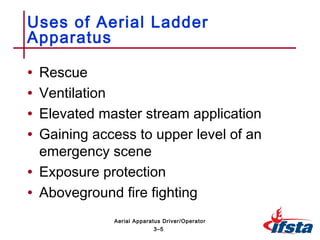
Two-Axle, Single Chassis
3–6
Aerial Apparatus Driver/Operator
Photo by Ted Boothroyd
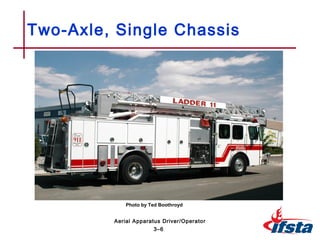
Three-Axle, Single Chassis
3–7
Aerial Apparatus Driver/Operator
Courtesy of Ron Jeffers
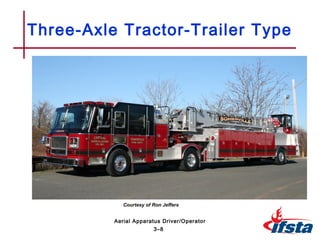
Three-Axle Tractor-Trailer Type
3–8
Aerial Apparatus Driver/Operator
Courtesy of Ron Jeffers
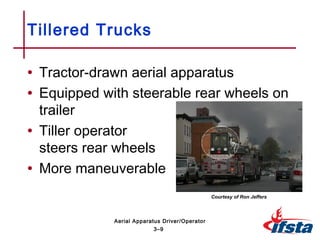
• Tractor-drawn aerial apparatus
• Equipped with steerable rear wheels on
trailer
• Tiller operator
steers rear wheels
• More maneuverable
Tillered Trucks
3–9
Aerial Apparatus Driver/Operator
Courtesy of Ron Jeffers
Discuss elevating platform apparatus.
Learning Objective 2
3–10
Aerial Apparatus Driver/Operator
• Platform leveling system
• Minimum floor area of 14 square feet
(1.3 m2
)
• Rail completely enclosing floor area
with no opening under railing greater
than 24 inches (610 mm)
• Two gates below top railing
Elevating Platform
Requirements
(Continued)
3–11
Aerial Apparatus Driver/Operator
• Kickplate at floor level (4 inches [100
mms] high)
• Drain openings
• Two operator control stations
• Backup hydraulic system
• Heat protective shield
Elevating Platform
Requirements
(Continued)
3–12
Aerial Apparatus Driver/Operator
• Protective water fog curtain nozzle
flowing at least 75 gpm (284 L/min)
• Load capacity of 750 pounds (340 kg)
when device is fully extended
• Load capacity of 500 pounds (227 kg)
when water delivery system is charged
Elevating Platform
Requirements
(Continued)
3–13
Aerial Apparatus Driver/Operator
• Water delivery system capable of
discharging at least 1,000 gpm (3 785
L/min) when aerial is in any position
• Platforms 110 feet (34 m) or shorter
should be raised to maximum elevation
and extension and rotated 90 degrees
in 150 seconds or less
Elevating Platform
Requirements
3–14
Aerial Apparatus Driver/Operator
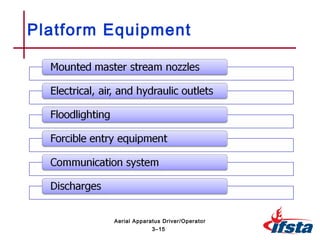
Platform Equipment
3–15
Aerial Apparatus Driver/Operator
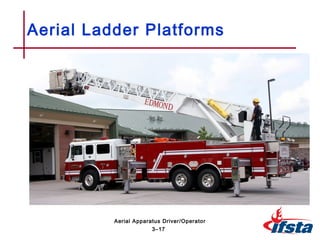
• Similar to aerial ladder apparatus
except that a working platform is
attached to end of aerial ladder
• Combine safe work area with safe,
climbable aerial ladder
• Commonly range in size from 85 to 100
feet (26 m to 34 m)
Aerial Ladder Platforms
(Continued)
3–16
Aerial Apparatus Driver/Operator
Aerial Ladder Platforms
3–17
Aerial Apparatus Driver/Operator
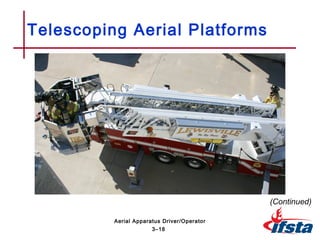
Telescoping Aerial Platforms
(Continued)
3–18
Aerial Apparatus Driver/Operator
DISCUSSION QUESTION
What is the main difference between
an aerial ladder platform and a
telescoping aerial platform?
3–19
Aerial Apparatus Driver/Operator
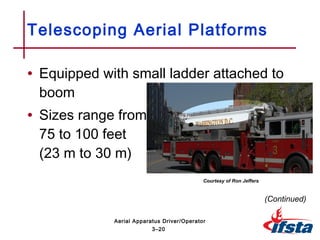
• Equipped with small ladder attached to
boom
• Sizes range from
75 to 100 feet
(23 m to 30 m)
Telescoping Aerial Platforms
(Continued)
3–20
Aerial Apparatus Driver/Operator
Courtesy of Ron Jeffers
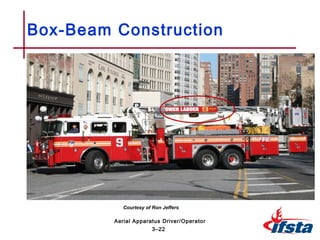
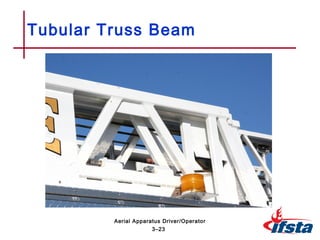
• Two or more sections and are made of
box-beam construction or tubular truss-
beam construction
Telescoping Aerial Platforms
3–21
Aerial Apparatus Driver/Operator
Box-Beam Construction
3–22
Aerial Apparatus Driver/Operator
Courtesy of Ron Jeffers
Tubular Truss Beam
3–23
Aerial Apparatus Driver/Operator
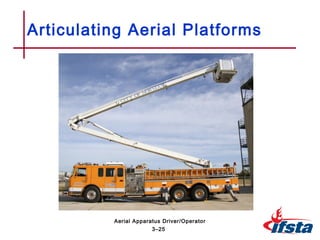
• Boom sections connected by hinge; fold
and unfold like an elbow
• Benefit — Platform can go “up and
over”
• Range in height 55 to 85 feet (17 m to
26 m)
• Combination devices
Articulating Aerial Platforms
3–24
Aerial Apparatus Driver/Operator
Articulating Aerial Platforms
3–25
Aerial Apparatus Driver/Operator
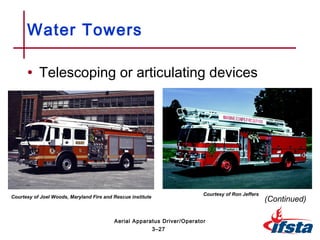
Describe water towers.
Learning Objective 3
3–26
Aerial Apparatus Driver/Operator
• Telescoping or articulating devices
Water Towers
(Continued)
3–27
Aerial Apparatus Driver/Operator
Courtesy of Ron Jeffers
Courtesy of Joel Woods, Maryland Fire and Rescue institute
• Movement of water and control of fire
stream remotely controlled by
driver/operator from ground level
• Fire streams deployed at a range of
elevations from horizontal to 90
degrees from ground
Water Towers
(Continued)
3–28
Aerial Apparatus Driver/Operator
• Sizes range from 50 to 130 feet (15 m
to 40 m)
• Capable of maximum flows ranging
from 1,000 to 5,000 gpm (4 000 L/min
to 20 000 L/min)
• May be equipped with ladders
Water Towers
3–29
Aerial Apparatus Driver/Operator
Describe the features and functions of a
quint.
Learning Objective 4
3–30
Aerial Apparatus Driver/Operator
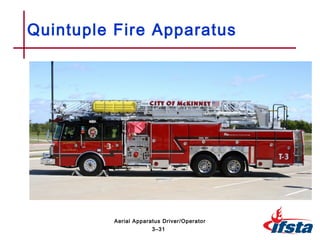
Quintuple Fire Apparatus
3–31
Aerial Apparatus Driver/Operator
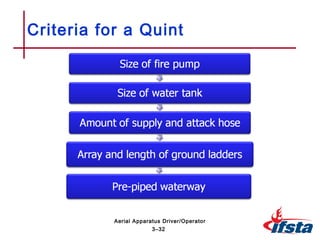
Criteria for a Quint
3–32
Aerial Apparatus Driver/Operator
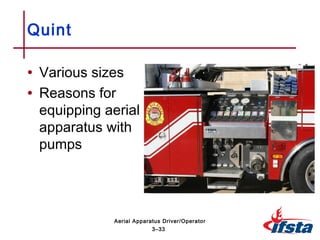
• Various sizes
• Reasons for
equipping aerial
apparatus with
pumps
Quint
3–33
Aerial Apparatus Driver/Operator
Identify the primary features of aerial
devices.
Learning Objective 5
3–34
Aerial Apparatus Driver/Operator
• Must be constructed to perform safely
and properly under a wide variety of fire
and rescue emergencies
Ladder
3–35
Aerial Apparatus Driver/Operator
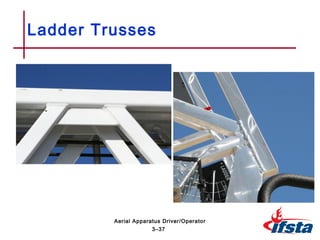
• Used to create beams of ladder
• Bars or rods that form rigid framework
• Constructed by several methods and
several materials
• Triangles add strength
• Permit tension and compression
Ladder Trusses
(Continued)
3–36
Aerial Apparatus Driver/Operator
Ladder Trusses
3–37
Aerial Apparatus Driver/Operator
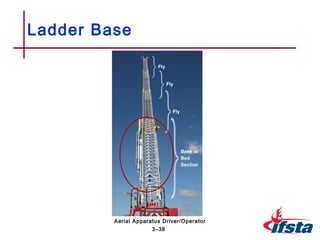
Ladder Base
3–38
Aerial Apparatus Driver/Operator
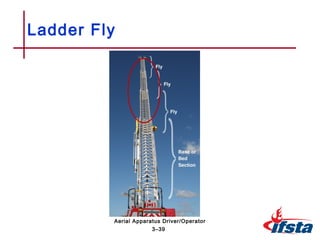
Ladder Fly
3–39
Aerial Apparatus Driver/Operator
• Heat-treated aluminum alloy
• Steel
• Fastened by rivets, welded, or heliarced
Ladder Construction
3–40
Aerial Apparatus Driver/Operator
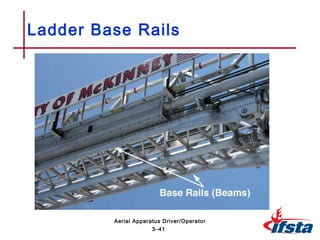
Ladder Base Rails
3–41
Aerial Apparatus Driver/Operator
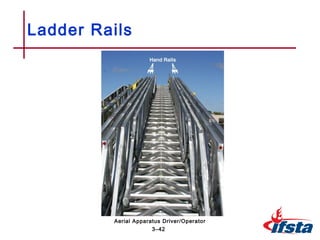
Ladder Rails
3–42
Aerial Apparatus Driver/Operator
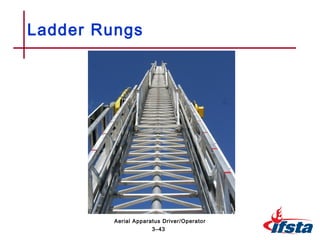
Ladder Rungs
3–43
Aerial Apparatus Driver/Operator
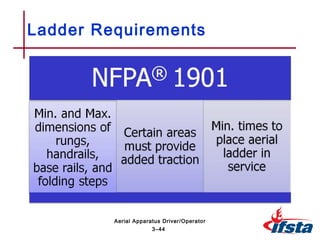
Ladder Requirements
3–44
Aerial Apparatus Driver/Operator
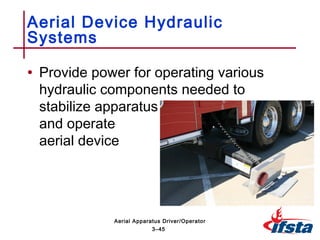
• Provide power for operating various
hydraulic components needed to
stabilize apparatus
and operate
aerial device
Aerial Device Hydraulic
Systems
3–45
Aerial Apparatus Driver/Operator
• Medium by which system transmits
force
Hydraulic Fluid
3–46
Aerial Apparatus Driver/Operator
• Creates force on hydraulic fluid
• Powered by a power-take-off (PTO)
• May be rotary vane or rotary gear
positive-displacement
Hydraulic Pump
3–47
Aerial Apparatus Driver/Operator
• Supplies hydraulic fluid
• Displaced fluid flows back into reservoir
• Supplies adequate amount of fluid
• Supplemented by filters and exchange-
type oil coolers
Hydraulic Reservoir
3–48
Aerial Apparatus Driver/Operator
• Supply hydraulic fluid
• Steel tubing and aircraft-type, steel-
braided hose
Tubing and Hoses
3–49
Aerial Apparatus Driver/Operator
• Control flow of hydraulic fluid
• Start, stop, regulate, and direct flow of
fluid
• Controlled manually, electrically,
hydraulically, mechanically, or by
combination
Valves
(Continued)
3–50
Aerial Apparatus Driver/Operator
• Check
• Relief
• Counterbalance
• Selector
• Actuator
Valves
(Continued)
3–51
Aerial Apparatus Driver/Operator
• Monitor
• Stack
• Proportional directional control
Valves
3–52
Aerial Apparatus Driver/Operator
• Used as actuators
• Convert energy in system into linear
mechanical force or motion
Hydraulic Cylinders
3–53
Aerial Apparatus Driver/Operator
DISCUSSION QUESTION
What types of cylinders are typically
used on aerial devices?
3–54
Aerial Apparatus Driver/Operator
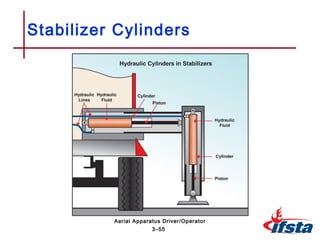
Stabilizer Cylinders
3–55
Aerial Apparatus Driver/Operator
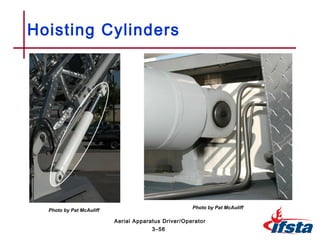
Hoisting Cylinders
3–56
Aerial Apparatus Driver/Operator
Photo by Pat McAuliff
DISCUSSION QUESTION
What is a trunnion?
3–57
Aerial Apparatus Driver/Operator
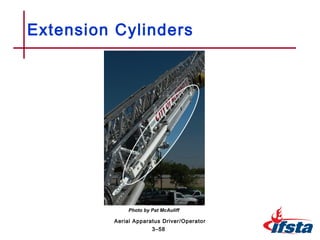
Extension Cylinders
3–58
Aerial Apparatus Driver/Operator
Photo by Pat McAuliff
Describe the cable systems, chains,
slides, and rollers used by aerial
apparatus.
Learning Objective 6
3–59
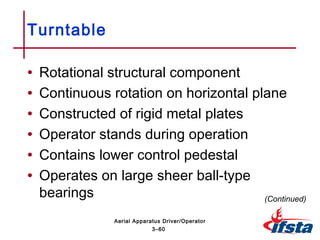
Aerial Apparatus Driver/Operator
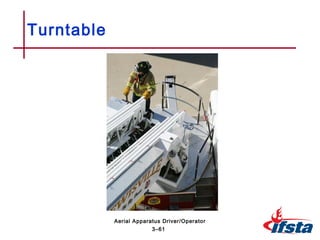
• Rotational structural component
• Continuous rotation on horizontal plane
• Constructed of rigid metal plates
• Operator stands during operation
• Contains lower control pedestal
• Operates on large sheer ball-type
bearings
Turntable
(Continued)
3–60
Aerial Apparatus Driver/Operator
Turntable
3–61
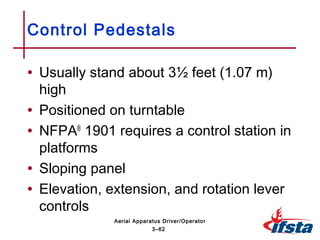
Aerial Apparatus Driver/Operator
• Usually stand about 3½ feet (1.07 m)
high
• Positioned on turntable
• NFPA®
1901 requires a control station in
platforms
• Sloping panel
• Elevation, extension, and rotation lever
controls
Control Pedestals
3–62
Aerial Apparatus Driver/Operator
DISCUSSION QUESTION
How are the control levers
positioned on the pedestal?
3–63
Aerial Apparatus Driver/Operator
• Engine speed switch
• Light switch
• Hydraulic oil pressure gauge
• Hydraulic oil temperature gauge
• Extension indicators
• Stop and lock controls
• Rung alignment indicator
Other Controls and Instruments
(Continued)
3–64
Aerial Apparatus Driver/Operator
• Inclinometer
• Engine starter switch
• Communications equipment
• Elevated master stream controls
• Hydraulic lock valve
• Switch for emergency operation pump
Other Controls and Instruments
3–65
Aerial Apparatus Driver/Operator
Discuss water delivery systems.
Learning Objective 7
3–66
Aerial Apparatus Driver/Operator
DISCUSSION QUESTION
What is the purpose of water
delivery systems?
3–67
Aerial Apparatus Driver/Operator
• Bed ladder systems
• Telescoping waterway systems
• Detachable ladder pipe systems
Pre-Piped Aerial
Ladder Waterway
3–68
Aerial Apparatus Driver/Operator
• Nontelescoping section of pipe
• Usually 3 or 3½ inches (76 or 90 mm)
diameter
• Attached underside of bed section
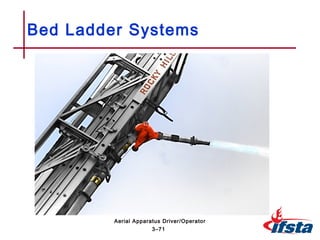
• Master stream nozzle attached to end
of pipe
• Solid stream nozzles
Bed Ladder Systems
(Continued)
3–69
Aerial Apparatus Driver/Operator
• Manually operated nozzles operated
from tip of retracted aerial device or
from the ground or turntable through the
use of rope
• Gear-operated mechanism for raising
and lowering fire stream
Bed Ladder Systems
(Continued)
3–70
Aerial Apparatus Driver/Operator
Bed Ladder Systems
3–71
Aerial Apparatus Driver/Operator
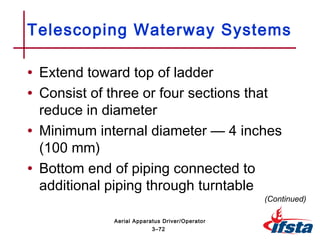
• Extend toward top of ladder
• Consist of three or four sections that
reduce in diameter
• Minimum internal diameter — 4 inches
(100 mm)
• Bottom end of piping connected to
additional piping through turntable
Telescoping Waterway Systems
(Continued)
3–72
Aerial Apparatus Driver/Operator
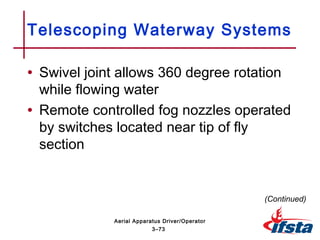
• Swivel joint allows 360 degree rotation
while flowing water
• Remote controlled fog nozzles operated
by switches located near tip of fly
section
Telescoping Waterway Systems
(Continued)
3–73
Aerial Apparatus Driver/Operator
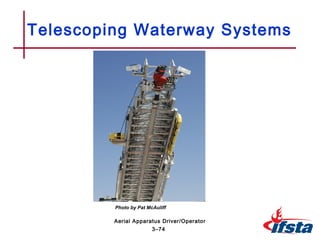
Telescoping Waterway Systems
3–74
Aerial Apparatus Driver/Operator
Photo by Pat McAuliff
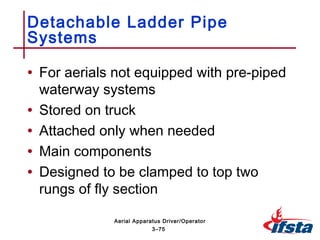
• For aerials not equipped with pre-piped
waterway systems
• Stored on truck
• Attached only when needed
• Main components
• Designed to be clamped to top two
rungs of fly section
Detachable Ladder Pipe
Systems
3–75
Aerial Apparatus Driver/Operator
• Equipped with solid stream or fog
nozzle
• Controlled at tip of ladder by firefighter
• Limited to flows of less than 750 gpm (3
000 L/min)
• Supplied by single 3- or 3½-inch (77
mm or 90 mm) hoseline
Detachable Ladder Pipe
Systems
3–76
Aerial Apparatus Driver/Operator
• Subject to excessive side twist due to
backward thrust of solid or fog master
stream
• Should not be operated from aerial
positioned at 90 degree angle or
vertical position
Detachable Ladder Pipe
Systems
3–77
Aerial Apparatus Driver/Operator
DISCUSSION QUESTION
At what degree should the ladder be
placed to ensure the safest service
and optimal stream penetration of a
detachable ladder pipe?
3–78
Aerial Apparatus Driver/Operator
• Similar to pre-piped ladder systems;
difference - nozzle is located in platform
• Larger than aerial ladders due to
greater load capacities of platforms
• Safer than aerial ladders
• Two nozzles
• Discharge
Elevating Platform
Waterway Systems
3–79
Aerial Apparatus Driver/Operator
• Designed specifically for deployment of
elevated master streams
• Control of motion and nozzle from
control panel
• Water most often comes from
apparatus pump
• Equipped with number of options
Water Tower Systems
3–80
Aerial Apparatus Driver/Operator
Identify communication systems.
Learning Objective 8
3–81
Aerial Apparatus Driver/Operator
• Used for firefighters at tip to
communicate with driver/operator at
turntable control station
• Consist of “hands-free”
transmitter/receiver at tip of ladder in
elevating platform and second
transmitter/receiver at turntable
Communication Systems
(Continued)
3–82
Aerial Apparatus Driver/Operator
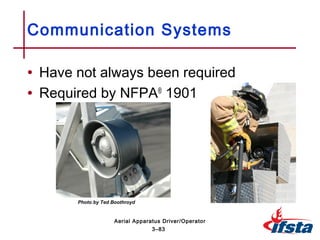
• Have not always been required
• Required by NFPA®
1901
Communication Systems
3–83
Aerial Apparatus Driver/Operator
Photo by Ted Boothroyd
Describe breathing air systems.
Learning Objective 9
3–84
Aerial Apparatus Driver/Operator
• Allow one or more firefighters operating
at tip to breath clean air without need to
don SCBA
• Components
• Not required by NFPA®
1901, does
contain requirements
Breathing Air Systems
3–85
Aerial Apparatus Driver/Operator
Compare various apparatus-mounted
special systems.
Learning Objective 10
3–86
Aerial Apparatus Driver/Operator
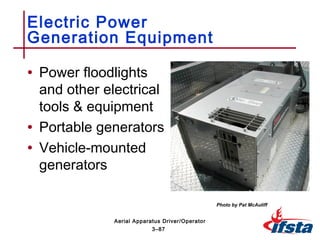
• Power floodlights
and other electrical
tools & equipment
• Portable generators
• Vehicle-mounted
generators
Electric Power
Generation Equipment
3–87
Aerial Apparatus Driver/Operator
Photo by Pat McAuliff
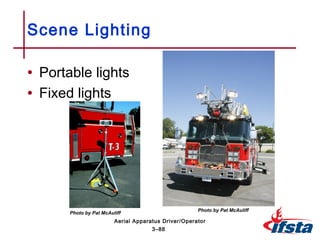
• Portable lights
• Fixed lights
Scene Lighting
3–88
Aerial Apparatus Driver/Operator
Photo by Pat McAuliff
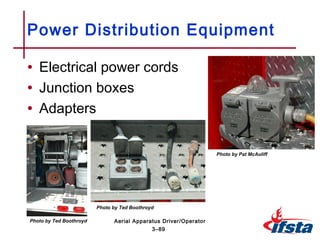
• Electrical power cords
• Junction boxes
• Adapters
Power Distribution Equipment
3–89
Aerial Apparatus Driver/Operator
Photo by Pat McAuliff
Photo by Ted Boothroyd
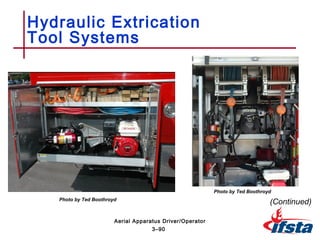
Hydraulic Extrication
Tool Systems
(Continued)
3–90
Aerial Apparatus Driver/Operator
Photo by Ted Boothroyd
DISCUSSION QUESTION
What are the most common types of
hydraulic powered tools?
3–91
Aerial Apparatus Driver/Operator
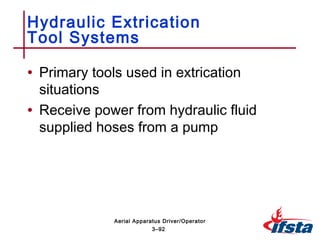
• Primary tools used in extrication
situations
• Receive power from hydraulic fluid
supplied hoses from a pump
Hydraulic Extrication
Tool Systems
3–92
Aerial Apparatus Driver/Operator
Describe the portable equipment
carried on aerial apparatus.
Learning Objective 11
3–93
Aerial Apparatus Driver/Operator
• Used when aerial ladder can’t reach,
additional ladders are needed, or only
ground ladders are needed
• Include — Attic, roof, and extension
ladders
• Extension ladder 40 feet (12 m) or
longer
Ground Ladders
3–94
Aerial Apparatus Driver/Operator
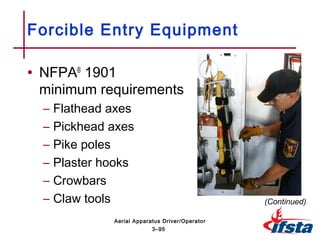
• NFPA®
1901
minimum requirements
– Flathead axes
– Pickhead axes
– Pike poles
– Plaster hooks
– Crowbars
– Claw tools
Forcible Entry Equipment
(Continued)
3–95
Aerial Apparatus Driver/Operator
• NFPA®
1901 minimum requirements
– Sledgehammers
– Hacksaws and keyhole saws
– Wrenches
– Hammers
– Snipes and pliers
– Screwdrivers
Forcible Entry Equipment
(Continued)
3–96
Aerial Apparatus Driver/Operator
• May also be carried
– Rotary, reciprocating,
and chain saws
– Hydraulic door openers
– Cutting torches
Forcible Entry Equipment
3–97
Aerial Apparatus Driver/Operator
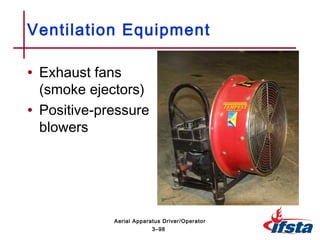
• Exhaust fans
(smoke ejectors)
• Positive-pressure
blowers
Ventilation Equipment
3–98
Aerial Apparatus Driver/Operator
• Salvage and overhaul
• Loss control
• Additional equipment
Salvage, Overhaul, and
Loss Control Equipment
3–99
Aerial Apparatus Driver/Operator
• Portable hand lights
• Portable fire extinguishers
• Water extinguishers
• Multiple SCBA units
• Spare SCBA cylinders
• Medical kit
• Spanner wrenches
Additional Equipment
(Continued)
3–100
Aerial Apparatus Driver/Operator
• Bolt cutters
• Ladder belts
• Light-use life safety rope
• General-use life safety rope
• Utility rope
• Wheel chocks
Additional Equipment
3–101
Aerial Apparatus Driver/Operator
Summary
• It is important that aerial apparatus
driver/operators understand the various
varieties of apparatus they may be
required to operate.
• The aerial apparatus driver/operator
should be familiar with the entire
apparatus and its operation.
(Continued)
3–102
Aerial Apparatus Driver/Operator
• The driver/operator should know his/her
equipment, its proper operation, and
regular equipment maintenance based
on manufacturer’s recommendations.
Summary
3–103
Aerial Apparatus Driver/Operator
Review Questions
1. What are the main uses of
aerial ladders?
2. How do aerial ladder platforms
operate?
3. What is a water tower?
(Continued)
3–104
Aerial Apparatus Driver/Operator
Review Questions
4. To what three main portions of
an aerial ladder do firefighters and
driver/operators commonly refer?
5. What is the purpose of an
auxiliary hydraulic pump?
6. What controls and instruments may
be located on the control pedestal?
(Continued)
3–105
Aerial Apparatus Driver/Operator
7. What is the purpose of a fixed
breathing air system?
8. What advantages and disadvantages
are presented by inverters?
9. What ventilation equipment may be
required on an aerial apparatus?
Review Questions
3–106
Aerial Apparatus Driver/Operator

Chapter 03

  • 1.
    Aerial Apparatus Driver/Operator Handbook 2ndEdition Chapter 3 — Types and Construction of Aerial Apparatus
  • 2.
    Learning Objective 1 Describeaerial ladder apparatus. 3–2 Aerial Apparatus Driver/Operator
  • 3.
    DISCUSSION QUESTION What aresome other names for an aerial ladder apparatus? 3–3 Aerial Apparatus Driver/Operator
  • 4.
    • Power-operated ladder •Turntable — Provides continuous rotation • Fully extended length – Ranges from 50 to 135 feet (15 m to 41 m) – Measured from ground to highest ladder rung Aerial Ladder Apparatus 3–4 Aerial Apparatus Driver/Operator
  • 5.
    • Rescue • Ventilation •Elevated master stream application • Gaining access to upper level of an emergency scene • Exposure protection • Aboveground fire fighting Uses of Aerial Ladder Apparatus 3–5 Aerial Apparatus Driver/Operator
  • 6.
    Two-Axle, Single Chassis 3–6 AerialApparatus Driver/Operator Photo by Ted Boothroyd
  • 7.
    Three-Axle, Single Chassis 3–7 AerialApparatus Driver/Operator Courtesy of Ron Jeffers
  • 8.
    Three-Axle Tractor-Trailer Type 3–8 AerialApparatus Driver/Operator Courtesy of Ron Jeffers
  • 9.
    • Tractor-drawn aerialapparatus • Equipped with steerable rear wheels on trailer • Tiller operator steers rear wheels • More maneuverable Tillered Trucks 3–9 Aerial Apparatus Driver/Operator Courtesy of Ron Jeffers
  • 10.
    Discuss elevating platformapparatus. Learning Objective 2 3–10 Aerial Apparatus Driver/Operator
  • 11.
    • Platform levelingsystem • Minimum floor area of 14 square feet (1.3 m2 ) • Rail completely enclosing floor area with no opening under railing greater than 24 inches (610 mm) • Two gates below top railing Elevating Platform Requirements (Continued) 3–11 Aerial Apparatus Driver/Operator
  • 12.
    • Kickplate atfloor level (4 inches [100 mms] high) • Drain openings • Two operator control stations • Backup hydraulic system • Heat protective shield Elevating Platform Requirements (Continued) 3–12 Aerial Apparatus Driver/Operator
  • 13.
    • Protective waterfog curtain nozzle flowing at least 75 gpm (284 L/min) • Load capacity of 750 pounds (340 kg) when device is fully extended • Load capacity of 500 pounds (227 kg) when water delivery system is charged Elevating Platform Requirements (Continued) 3–13 Aerial Apparatus Driver/Operator
  • 14.
    • Water deliverysystem capable of discharging at least 1,000 gpm (3 785 L/min) when aerial is in any position • Platforms 110 feet (34 m) or shorter should be raised to maximum elevation and extension and rotated 90 degrees in 150 seconds or less Elevating Platform Requirements 3–14 Aerial Apparatus Driver/Operator
  • 15.
  • 16.
    • Similar toaerial ladder apparatus except that a working platform is attached to end of aerial ladder • Combine safe work area with safe, climbable aerial ladder • Commonly range in size from 85 to 100 feet (26 m to 34 m) Aerial Ladder Platforms (Continued) 3–16 Aerial Apparatus Driver/Operator
  • 17.
    Aerial Ladder Platforms 3–17 AerialApparatus Driver/Operator
  • 18.
  • 19.
    DISCUSSION QUESTION What isthe main difference between an aerial ladder platform and a telescoping aerial platform? 3–19 Aerial Apparatus Driver/Operator
  • 20.
    • Equipped withsmall ladder attached to boom • Sizes range from 75 to 100 feet (23 m to 30 m) Telescoping Aerial Platforms (Continued) 3–20 Aerial Apparatus Driver/Operator Courtesy of Ron Jeffers
  • 21.
    • Two ormore sections and are made of box-beam construction or tubular truss- beam construction Telescoping Aerial Platforms 3–21 Aerial Apparatus Driver/Operator
  • 22.
    Box-Beam Construction 3–22 Aerial ApparatusDriver/Operator Courtesy of Ron Jeffers
  • 23.
    Tubular Truss Beam 3–23 AerialApparatus Driver/Operator
  • 24.
    • Boom sectionsconnected by hinge; fold and unfold like an elbow • Benefit — Platform can go “up and over” • Range in height 55 to 85 feet (17 m to 26 m) • Combination devices Articulating Aerial Platforms 3–24 Aerial Apparatus Driver/Operator
  • 25.
  • 26.
    Describe water towers. LearningObjective 3 3–26 Aerial Apparatus Driver/Operator
  • 27.
    • Telescoping orarticulating devices Water Towers (Continued) 3–27 Aerial Apparatus Driver/Operator Courtesy of Ron Jeffers Courtesy of Joel Woods, Maryland Fire and Rescue institute
  • 28.
    • Movement ofwater and control of fire stream remotely controlled by driver/operator from ground level • Fire streams deployed at a range of elevations from horizontal to 90 degrees from ground Water Towers (Continued) 3–28 Aerial Apparatus Driver/Operator
  • 29.
    • Sizes rangefrom 50 to 130 feet (15 m to 40 m) • Capable of maximum flows ranging from 1,000 to 5,000 gpm (4 000 L/min to 20 000 L/min) • May be equipped with ladders Water Towers 3–29 Aerial Apparatus Driver/Operator
  • 30.
    Describe the featuresand functions of a quint. Learning Objective 4 3–30 Aerial Apparatus Driver/Operator
  • 31.
    Quintuple Fire Apparatus 3–31 AerialApparatus Driver/Operator
  • 32.
    Criteria for aQuint 3–32 Aerial Apparatus Driver/Operator
  • 33.
    • Various sizes •Reasons for equipping aerial apparatus with pumps Quint 3–33 Aerial Apparatus Driver/Operator
  • 34.
    Identify the primaryfeatures of aerial devices. Learning Objective 5 3–34 Aerial Apparatus Driver/Operator
  • 35.
    • Must beconstructed to perform safely and properly under a wide variety of fire and rescue emergencies Ladder 3–35 Aerial Apparatus Driver/Operator
  • 36.
    • Used tocreate beams of ladder • Bars or rods that form rigid framework • Constructed by several methods and several materials • Triangles add strength • Permit tension and compression Ladder Trusses (Continued) 3–36 Aerial Apparatus Driver/Operator
  • 37.
  • 38.
  • 39.
  • 40.
    • Heat-treated aluminumalloy • Steel • Fastened by rivets, welded, or heliarced Ladder Construction 3–40 Aerial Apparatus Driver/Operator
  • 41.
    Ladder Base Rails 3–41 AerialApparatus Driver/Operator
  • 42.
  • 43.
  • 44.
  • 45.
    • Provide powerfor operating various hydraulic components needed to stabilize apparatus and operate aerial device Aerial Device Hydraulic Systems 3–45 Aerial Apparatus Driver/Operator
  • 46.
    • Medium bywhich system transmits force Hydraulic Fluid 3–46 Aerial Apparatus Driver/Operator
  • 47.
    • Creates forceon hydraulic fluid • Powered by a power-take-off (PTO) • May be rotary vane or rotary gear positive-displacement Hydraulic Pump 3–47 Aerial Apparatus Driver/Operator
  • 48.
    • Supplies hydraulicfluid • Displaced fluid flows back into reservoir • Supplies adequate amount of fluid • Supplemented by filters and exchange- type oil coolers Hydraulic Reservoir 3–48 Aerial Apparatus Driver/Operator
  • 49.
    • Supply hydraulicfluid • Steel tubing and aircraft-type, steel- braided hose Tubing and Hoses 3–49 Aerial Apparatus Driver/Operator
  • 50.
    • Control flowof hydraulic fluid • Start, stop, regulate, and direct flow of fluid • Controlled manually, electrically, hydraulically, mechanically, or by combination Valves (Continued) 3–50 Aerial Apparatus Driver/Operator
  • 51.
    • Check • Relief •Counterbalance • Selector • Actuator Valves (Continued) 3–51 Aerial Apparatus Driver/Operator
  • 52.
    • Monitor • Stack •Proportional directional control Valves 3–52 Aerial Apparatus Driver/Operator
  • 53.
    • Used asactuators • Convert energy in system into linear mechanical force or motion Hydraulic Cylinders 3–53 Aerial Apparatus Driver/Operator
  • 54.
    DISCUSSION QUESTION What typesof cylinders are typically used on aerial devices? 3–54 Aerial Apparatus Driver/Operator
  • 55.
  • 56.
    Hoisting Cylinders 3–56 Aerial ApparatusDriver/Operator Photo by Pat McAuliff Photo by Pat McAuliff
  • 57.
    DISCUSSION QUESTION What isa trunnion? 3–57 Aerial Apparatus Driver/Operator
  • 58.
    Extension Cylinders 3–58 Aerial ApparatusDriver/Operator Photo by Pat McAuliff
  • 59.
    Describe the cablesystems, chains, slides, and rollers used by aerial apparatus. Learning Objective 6 3–59 Aerial Apparatus Driver/Operator
  • 60.
    • Rotational structuralcomponent • Continuous rotation on horizontal plane • Constructed of rigid metal plates • Operator stands during operation • Contains lower control pedestal • Operates on large sheer ball-type bearings Turntable (Continued) 3–60 Aerial Apparatus Driver/Operator
  • 61.
  • 62.
    • Usually standabout 3½ feet (1.07 m) high • Positioned on turntable • NFPA® 1901 requires a control station in platforms • Sloping panel • Elevation, extension, and rotation lever controls Control Pedestals 3–62 Aerial Apparatus Driver/Operator
  • 63.
    DISCUSSION QUESTION How arethe control levers positioned on the pedestal? 3–63 Aerial Apparatus Driver/Operator
  • 64.
    • Engine speedswitch • Light switch • Hydraulic oil pressure gauge • Hydraulic oil temperature gauge • Extension indicators • Stop and lock controls • Rung alignment indicator Other Controls and Instruments (Continued) 3–64 Aerial Apparatus Driver/Operator
  • 65.
    • Inclinometer • Enginestarter switch • Communications equipment • Elevated master stream controls • Hydraulic lock valve • Switch for emergency operation pump Other Controls and Instruments 3–65 Aerial Apparatus Driver/Operator
  • 66.
    Discuss water deliverysystems. Learning Objective 7 3–66 Aerial Apparatus Driver/Operator
  • 67.
    DISCUSSION QUESTION What isthe purpose of water delivery systems? 3–67 Aerial Apparatus Driver/Operator
  • 68.
    • Bed laddersystems • Telescoping waterway systems • Detachable ladder pipe systems Pre-Piped Aerial Ladder Waterway 3–68 Aerial Apparatus Driver/Operator
  • 69.
    • Nontelescoping sectionof pipe • Usually 3 or 3½ inches (76 or 90 mm) diameter • Attached underside of bed section • Master stream nozzle attached to end of pipe • Solid stream nozzles Bed Ladder Systems (Continued) 3–69 Aerial Apparatus Driver/Operator
  • 70.
    • Manually operatednozzles operated from tip of retracted aerial device or from the ground or turntable through the use of rope • Gear-operated mechanism for raising and lowering fire stream Bed Ladder Systems (Continued) 3–70 Aerial Apparatus Driver/Operator
  • 71.
    Bed Ladder Systems 3–71 AerialApparatus Driver/Operator
  • 72.
    • Extend towardtop of ladder • Consist of three or four sections that reduce in diameter • Minimum internal diameter — 4 inches (100 mm) • Bottom end of piping connected to additional piping through turntable Telescoping Waterway Systems (Continued) 3–72 Aerial Apparatus Driver/Operator
  • 73.
    • Swivel jointallows 360 degree rotation while flowing water • Remote controlled fog nozzles operated by switches located near tip of fly section Telescoping Waterway Systems (Continued) 3–73 Aerial Apparatus Driver/Operator
  • 74.
    Telescoping Waterway Systems 3–74 AerialApparatus Driver/Operator Photo by Pat McAuliff
  • 75.
    • For aerialsnot equipped with pre-piped waterway systems • Stored on truck • Attached only when needed • Main components • Designed to be clamped to top two rungs of fly section Detachable Ladder Pipe Systems 3–75 Aerial Apparatus Driver/Operator
  • 76.
    • Equipped withsolid stream or fog nozzle • Controlled at tip of ladder by firefighter • Limited to flows of less than 750 gpm (3 000 L/min) • Supplied by single 3- or 3½-inch (77 mm or 90 mm) hoseline Detachable Ladder Pipe Systems 3–76 Aerial Apparatus Driver/Operator
  • 77.
    • Subject toexcessive side twist due to backward thrust of solid or fog master stream • Should not be operated from aerial positioned at 90 degree angle or vertical position Detachable Ladder Pipe Systems 3–77 Aerial Apparatus Driver/Operator
  • 78.
    DISCUSSION QUESTION At whatdegree should the ladder be placed to ensure the safest service and optimal stream penetration of a detachable ladder pipe? 3–78 Aerial Apparatus Driver/Operator
  • 79.
    • Similar topre-piped ladder systems; difference - nozzle is located in platform • Larger than aerial ladders due to greater load capacities of platforms • Safer than aerial ladders • Two nozzles • Discharge Elevating Platform Waterway Systems 3–79 Aerial Apparatus Driver/Operator
  • 80.
    • Designed specificallyfor deployment of elevated master streams • Control of motion and nozzle from control panel • Water most often comes from apparatus pump • Equipped with number of options Water Tower Systems 3–80 Aerial Apparatus Driver/Operator
  • 81.
    Identify communication systems. LearningObjective 8 3–81 Aerial Apparatus Driver/Operator
  • 82.
    • Used forfirefighters at tip to communicate with driver/operator at turntable control station • Consist of “hands-free” transmitter/receiver at tip of ladder in elevating platform and second transmitter/receiver at turntable Communication Systems (Continued) 3–82 Aerial Apparatus Driver/Operator
  • 83.
    • Have notalways been required • Required by NFPA® 1901 Communication Systems 3–83 Aerial Apparatus Driver/Operator Photo by Ted Boothroyd
  • 84.
    Describe breathing airsystems. Learning Objective 9 3–84 Aerial Apparatus Driver/Operator
  • 85.
    • Allow oneor more firefighters operating at tip to breath clean air without need to don SCBA • Components • Not required by NFPA® 1901, does contain requirements Breathing Air Systems 3–85 Aerial Apparatus Driver/Operator
  • 86.
    Compare various apparatus-mounted specialsystems. Learning Objective 10 3–86 Aerial Apparatus Driver/Operator
  • 87.
    • Power floodlights andother electrical tools & equipment • Portable generators • Vehicle-mounted generators Electric Power Generation Equipment 3–87 Aerial Apparatus Driver/Operator Photo by Pat McAuliff
  • 88.
    • Portable lights •Fixed lights Scene Lighting 3–88 Aerial Apparatus Driver/Operator Photo by Pat McAuliff Photo by Pat McAuliff
  • 89.
    • Electrical powercords • Junction boxes • Adapters Power Distribution Equipment 3–89 Aerial Apparatus Driver/Operator Photo by Pat McAuliff Photo by Ted Boothroyd Photo by Ted Boothroyd
  • 90.
    Hydraulic Extrication Tool Systems (Continued) 3–90 AerialApparatus Driver/Operator Photo by Ted Boothroyd Photo by Ted Boothroyd
  • 91.
    DISCUSSION QUESTION What arethe most common types of hydraulic powered tools? 3–91 Aerial Apparatus Driver/Operator
  • 92.
    • Primary toolsused in extrication situations • Receive power from hydraulic fluid supplied hoses from a pump Hydraulic Extrication Tool Systems 3–92 Aerial Apparatus Driver/Operator
  • 93.
    Describe the portableequipment carried on aerial apparatus. Learning Objective 11 3–93 Aerial Apparatus Driver/Operator
  • 94.
    • Used whenaerial ladder can’t reach, additional ladders are needed, or only ground ladders are needed • Include — Attic, roof, and extension ladders • Extension ladder 40 feet (12 m) or longer Ground Ladders 3–94 Aerial Apparatus Driver/Operator
  • 95.
    • NFPA® 1901 minimum requirements –Flathead axes – Pickhead axes – Pike poles – Plaster hooks – Crowbars – Claw tools Forcible Entry Equipment (Continued) 3–95 Aerial Apparatus Driver/Operator
  • 96.
    • NFPA® 1901 minimumrequirements – Sledgehammers – Hacksaws and keyhole saws – Wrenches – Hammers – Snipes and pliers – Screwdrivers Forcible Entry Equipment (Continued) 3–96 Aerial Apparatus Driver/Operator
  • 97.
    • May alsobe carried – Rotary, reciprocating, and chain saws – Hydraulic door openers – Cutting torches Forcible Entry Equipment 3–97 Aerial Apparatus Driver/Operator
  • 98.
    • Exhaust fans (smokeejectors) • Positive-pressure blowers Ventilation Equipment 3–98 Aerial Apparatus Driver/Operator
  • 99.
    • Salvage andoverhaul • Loss control • Additional equipment Salvage, Overhaul, and Loss Control Equipment 3–99 Aerial Apparatus Driver/Operator
  • 100.
    • Portable handlights • Portable fire extinguishers • Water extinguishers • Multiple SCBA units • Spare SCBA cylinders • Medical kit • Spanner wrenches Additional Equipment (Continued) 3–100 Aerial Apparatus Driver/Operator
  • 101.
    • Bolt cutters •Ladder belts • Light-use life safety rope • General-use life safety rope • Utility rope • Wheel chocks Additional Equipment 3–101 Aerial Apparatus Driver/Operator
  • 102.
    Summary • It isimportant that aerial apparatus driver/operators understand the various varieties of apparatus they may be required to operate. • The aerial apparatus driver/operator should be familiar with the entire apparatus and its operation. (Continued) 3–102 Aerial Apparatus Driver/Operator
  • 103.
    • The driver/operatorshould know his/her equipment, its proper operation, and regular equipment maintenance based on manufacturer’s recommendations. Summary 3–103 Aerial Apparatus Driver/Operator
  • 104.
    Review Questions 1. Whatare the main uses of aerial ladders? 2. How do aerial ladder platforms operate? 3. What is a water tower? (Continued) 3–104 Aerial Apparatus Driver/Operator
  • 105.
    Review Questions 4. Towhat three main portions of an aerial ladder do firefighters and driver/operators commonly refer? 5. What is the purpose of an auxiliary hydraulic pump? 6. What controls and instruments may be located on the control pedestal? (Continued) 3–105 Aerial Apparatus Driver/Operator
  • 106.
    7. What isthe purpose of a fixed breathing air system? 8. What advantages and disadvantages are presented by inverters? 9. What ventilation equipment may be required on an aerial apparatus? Review Questions 3–106 Aerial Apparatus Driver/Operator