Aerial Apparatus
Driver/Operator Handbook
2nd Edition
Chapter 4 — Introduction to
Apparatus Inspection,
Maintenance, and Testing
Learning Objective 1
Describe a systematic maintenance
program.
4–2
Aerial Apparatus Driver/Operator
DISCUSSION QUESTION
What is the difference between
maintenance and repair?
4–3
Aerial Apparatus Driver/Operator
• Necessary for every fire department,
fire brigade, and wildland fire agency
• Should identify
– Which functions are performed
– Who performs functions
• Dictate responsibilities of
driver/operator
Maintenance Program
4–4
Aerial Apparatus Driver/Operator
• Varies from department to department
• Career — Performed at beginning of
each work period
• Volunteer — Should establish
procedures
Schedule for Maintenance
4–5
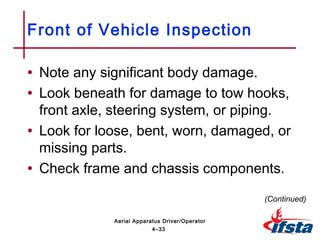
Aerial Apparatus Driver/Operator
• Serves as warranty claims, accident
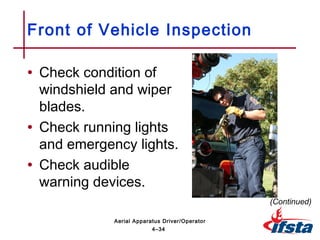
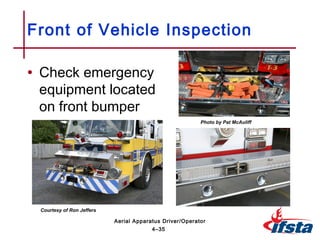
investigation, and decision to purchase
new apparatus
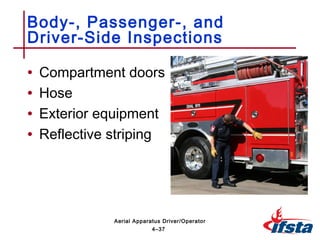
• Procedures and transmission
determined by individual department
Maintenance and Inspection
Documentation
4–6
Aerial Apparatus Driver/Operator
Identify proper fire apparatus cleaning
procedures.
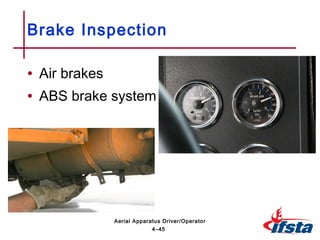
Learning Objective 2
4–7
Aerial Apparatus Driver/Operator
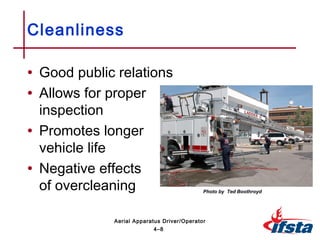
• Good public relations
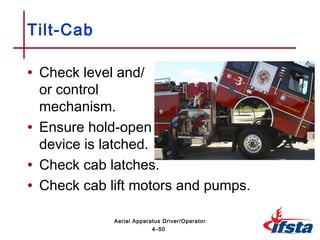
• Allows for proper
inspection
• Promotes longer
vehicle life
• Negative effects
of overcleaning
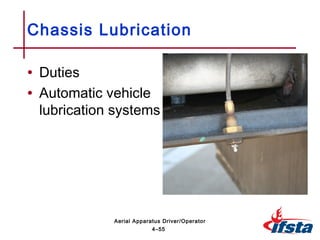
Cleanliness
4–8
Aerial Apparatus Driver/Operator
Photo by Ted Boothroyd
• Newer apparatus require more gentle
cleaning than older apparatus
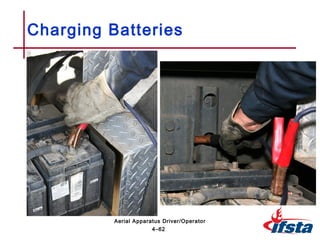
• Once new vehicle finish is cured, nozzle
or pressure washer maybe used for
speed cleaning
Washing
4–9
Aerial Apparatus Driver/Operator
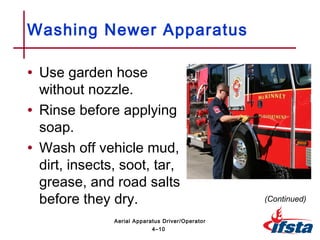
• Use garden hose
without nozzle.
• Rinse before applying
soap.
• Wash off vehicle mud,
dirt, insects, soot, tar,
grease, and road salts
before they dry.
Washing Newer Apparatus
(Continued)
4–10
Aerial Apparatus Driver/Operator
• Wash with automotive detergent.
• Do not wash with extremely hot water.
• Begin washing from top, work
downward.
• Dry with clean chamois or rubber
squeegee.
Washing Newer Apparatus
4–11
Aerial Apparatus Driver/Operator
Discuss glass care and interior cleaning
of fire apparatus.
Learning Objective 3
4–12
Aerial Apparatus Driver/Operator
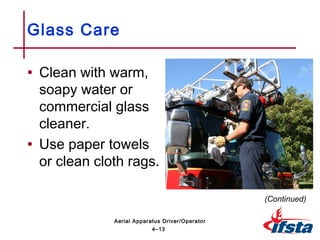
• Clean with warm,
soapy water or
commercial glass
cleaner.
• Use paper towels
or clean cloth rags.
Glass Care
(Continued)
4–13
Aerial Apparatus Driver/Operator
• Do not use dry towels and/or rags.
• Do not use putty knives, steel wool, or
other abrasive tools.
Glass Care
4–14
Aerial Apparatus Driver/Operator
DISCUSSION QUESTION
Why is it important to keep seat
upholstery, dashboard and engine
compartment coverings, and floor
finishes clean?
4–15
Aerial Apparatus Driver/Operator
• Sweep or vacuum.
• Use warm soapy water or commercial
cleaning products.
• Ventilate.
• Pay attention when using liquids around
electrical system.
Interior Cleaning
(Continued)
4–16
Aerial Apparatus Driver/Operator
• Do not use cleaning solvents such as
acetone, lacquer thinner, enamel
reducer, nail polish remover, laundry
soap, bleach, naphtha, or carbon
tetrachloride to clean interior surfaces.
Interior Cleaning
4–17
Aerial Apparatus Driver/Operator
• May no longer be necessary
• May damage clear-coat protective-seal
finishes
Waxing
4–18
Aerial Apparatus Driver/Operator
• Do not apply until paint is six months
old.
• Apply after washing and drying.
• Apply according to product instructions.
• Polish out with soft cloth or electric
buffer.
Waxing (If Required)
4–19
Aerial Apparatus Driver/Operator
Clean the interior and wash and wax
the exterior of a fire department
apparatus.
Objective 4 is measured in Skill Sheet 4-1.
Learning Objective 4
4–20
Aerial Apparatus Driver/Operator
Describe apparatus inspection
procedures.
Learning Objective 5
4–21
Aerial Apparatus Driver/Operator
• Daily walk-around inspection
– Commercial vehicle pre-trip, road-
worthiness inspection
– Inspection of operational readiness of
emergency equipment
• Driver/operator should review previous
record inspections.
Apparatus
Inspection Procedures
4–22
Aerial Apparatus Driver/Operator
DISCUSSION QUESTION
How are the sides of apparatus
identified in your jurisdiction?
4–23
Aerial Apparatus Driver/Operator
• Check left (driver’s) side first.
• Repeat procedure on right
(passenger’s) side.
• Make sure various aspects of cab doors
are in order.
• Inspect door window glass.
• Ensure windows roll up and down
correctly.
Cab Left- and
Right-Side Inspections
(Continued)
4–24
Aerial Apparatus Driver/Operator
• Check all steps, platforms, tool mounts,
lights, and handrails.
• Check saddle fuel tanks beneath door
opening.
• Check fuel filler caps.
• Check the wheel.
• Check each lug nut by hand.
Cab Left- and
Right-Side Inspections
(Continued)
4–25
Aerial Apparatus Driver/Operator
• Look for cracks or damage around the
lip of the wheel rim.
• Ensure front splash guards are in place
and secure.
• Look for unusual accumulations of
brake dust, rust tracks, powder, or
metal fillings on wheel.
Cab Left- and
Right-Side Inspections
(Continued)
4–26
Aerial Apparatus Driver/Operator
• Look for signs of rust or powder around
lug nuts.
• Inspect wheel/tire assembly for other
leaks.
• Visually inspect suspension
components.
Cab Left- and
Right-Side Inspections
(Continued)
4–27
Aerial Apparatus Driver/Operator
• Look for defects or wear involving the
springs, spring hangers, shackles, U-
bolts, and shock absorbers.
• Ensure that springs do not have
cracked or broken leaves.
Cab Left- and
Right-Side Inspections
4–28
Aerial Apparatus Driver/Operator
• Ensure tire types match.
• Make certain that all tires are same size
and have same the weight ratings.
• Check speed ratings.
• Check proper tread depth.
• Check valve stem.
• Ensure valve stem caps are in place.
Tire Types and Condition
4–29
Aerial Apparatus Driver/Operator
• Check inflation to manufacture's
recommended tire pressure.
– Maximum tire pressure imprinted on
exterior is NOT recommended operating
tire pressure.
– Check GVWR placard or tire
manufacturer's recommendation for correct
operating pressure.
Tire Inflation
4–30
Aerial Apparatus Driver/Operator
• Construction type
• Tire maximum load in pounds
• Tire maximum psi pressure
• Traction index
• Temperature index
• Tread wear index
Tire Sidewall Information
(Continued)
4–31
Aerial Apparatus Driver/Operator
• Ply rating
• Size code
• Maximum safe speed rating
• The word “regroovable”
• Serial number
• DOT number
Tire Sidewall Information
4–32
Aerial Apparatus Driver/Operator
• Note any significant body damage.
• Look beneath for damage to tow hooks,
front axle, steering system, or piping.
• Look for loose, bent, worn, damaged, or
missing parts.
• Check frame and chassis components.
Front of Vehicle Inspection
(Continued)
4–33
Aerial Apparatus Driver/Operator
• Check condition of
windshield and wiper
blades.
• Check running lights
and emergency lights.
• Check audible
warning devices.
Front of Vehicle Inspection
(Continued)
4–34
Aerial Apparatus Driver/Operator
• Check emergency
equipment located
on front bumper
Front of Vehicle Inspection
4–35
Aerial Apparatus Driver/Operator
Photo by Pat McAuliff
Courtesy of Ron Jeffers
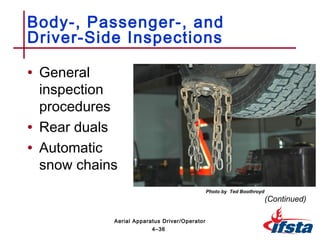
• General
inspection
procedures
• Rear duals
• Automatic
snow chains
Body-, Passenger-, and
Driver-Side Inspections
(Continued)
4–36
Aerial Apparatus Driver/Operator
Photo by Ted Boothroyd
• Compartment doors
• Hose
• Exterior equipment
• Reflective striping
Body-, Passenger-, and
Driver-Side Inspections
4–37
Aerial Apparatus Driver/Operator
• Running and warning lights
• Equipment in rear compartments
• Cabinet doors
• Equipment stored on outside rear area
• Hose beds
• Equipment stored in hose bed
• Inspecting a quint
Rear of Vehicle Inspection
4–38
Aerial Apparatus Driver/Operator
• Seats and mirrors
• Start engine
• Seat belts securely mounted and
operate without binding
• Buckles open and close freely
• Tilt/telescopic steering wheel
In-Cab Inspection
(Continued)
4–39
Aerial Apparatus Driver/Operator
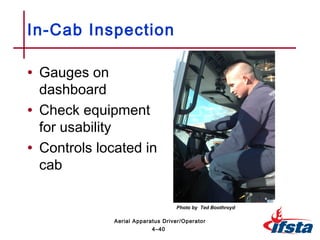
• Gauges on
dashboard
• Check equipment
for usability
• Controls located in
cab
In-Cab Inspection
4–40
Aerial Apparatus Driver/Operator
Photo by Ted Boothroyd
• Must be in proper working order and
securely stowed
Rescue and
Fire Fighting Equipment
4–41
Aerial Apparatus Driver/Operator
• Prevent an overload of vehicle’s
electrical generation system.
• Incorporate a load sequencer and load
monitor.
Electrical Load
Management System
4–42
Aerial Apparatus Driver/Operator
• Check adjustment of clutch pedal for
insufficient or excessive free play.
Manual Shift Transmission
4–43
Aerial Apparatus Driver/Operator
DISCUSSION QUESTION
What is free play?
4–44
Aerial Apparatus Driver/Operator
• Air brakes
• ABS brake system
Brake Inspection
4–45
Aerial Apparatus Driver/Operator
• Test air compressor governor cutout
pressure.
• Test air compressor governor cut-in
pressure.
• Test air leakage.
• Test low-pressure warning signal.
Braking Tests
(Continued)
4–46
Aerial Apparatus Driver/Operator
• Test spring brakes for automatic
actuation.
• Check rate of air pressure buildup.
• Test service brakes.
• Test parking brake.
• Test slack adjusters.
Braking Tests
4–47
Aerial Apparatus Driver/Operator
DISCUSSION QUESTION
What should be done if any of the
tests indicate the brakes do not
perform in accordance with state or
provincial requirements?
4–48
Aerial Apparatus Driver/Operator
• May be performed before engine is
started
• Most checks should not be done while
engine is running
Engine Compartment
Inspection
4–49
Aerial Apparatus Driver/Operator
• Check level and/
or control
mechanism.
• Ensure hold-open
device is latched.
• Check cab latches.
• Check cab lift motors and pumps.
Tilt-Cab
4–50
Aerial Apparatus Driver/Operator
• Engine (crankcase) oil level
• Engine air filter
• Emergency shutdown
• Exhaust system
• Radiator coolant (antifreeze) level
• Cooling fan
Minimum Inspection
of Engine Compartment
(Continued)
4–51
Aerial Apparatus Driver/Operator
• Windshield washer fluid level
• Battery condition
• Automatic transmission fluid level
• Manual transmission oil level
• Power steering fluid level
• Brake fluid
Minimum Inspection
of Engine Compartment
(Continued)
4–52
Aerial Apparatus Driver/Operator
• Air system
• Belts
• Leaks
• Hoses and supply lines
• Electrical wiring
• Steering linkage
Minimum Inspection
of Engine Compartment
4–53
Aerial Apparatus Driver/Operator
• May be required of driver/operator
• Helps prevent costly repairs
• Reduces out-of-service time
• Effectiveness
• Oil number
Chassis Lubrication
(Continued)
4–54
Aerial Apparatus Driver/Operator
• Duties
• Automatic vehicle
lubrication systems
Chassis Lubrication
4–55
Aerial Apparatus Driver/Operator
Perform a test of the air brake system.
Objective 6 is measured in Skill Sheet 4-2.
Learning Objective 6
4–56
Aerial Apparatus Driver/Operator
Perform a walk-around routine
maintenance inspection.
Objective 7 is measured in Skill Sheet 4-3.
Learning Objective 7
4–57
Aerial Apparatus Driver/Operator
Perform an in-cab operational
inspection.
Objective 8 is measured in Skill Sheet 4-4.
Learning Objective 8
4–58
Aerial Apparatus Driver/Operator
Perform an engine compartment
inspection.
Objective 9 is measured in Skill Sheet 4-5.
Learning Objective 9
4–59
Aerial Apparatus Driver/Operator
Discuss charging batteries.
Learning Objective 10
4–60
Aerial Apparatus Driver/Operator
• May be required after long periods of
inactivity or improper drain of electrical
system
• Generally performed with battery
charger
• Procedure
• Jump starting considerations
Charging Batteries
(Continued)
4–61
Aerial Apparatus Driver/Operator
Charging Batteries
4–62
Aerial Apparatus Driver/Operator
DISCUSSION QUESTION
When might jump-starting be
necessary?
4–63
Aerial Apparatus Driver/Operator
Charge an apparatus battery.
Objective 11 is measured in Skill Sheet 4-6.
Learning Objective 11
4–64
Aerial Apparatus Driver/Operator
Describe aerial device inspections.
Learning Objective 12
4–65
Aerial Apparatus Driver/Operator
• Level of hydraulic fluid
• Stabilizers
• Turntable assembly
• Lower control pedestals
• Platform control console
• Communications system
Visual Inspection
(Continued)
4–66
Aerial Apparatus Driver/Operator
• Breathing air supply system
• Extension/retraction system
• Elevation/lifting cylinders
• Various sections of aerial device
• Elevating platform assembly
Visual Inspection
(Continued)
4–67
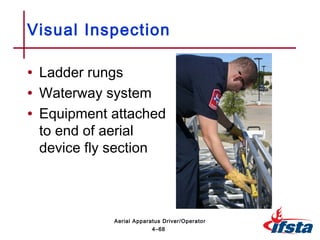
Aerial Apparatus Driver/Operator
• Ladder rungs
• Waterway system
• Equipment attached
to end of aerial
device fly section
Visual Inspection
4–68
Aerial Apparatus Driver/Operator
• Park apparatus in suitable location for
operating aerial device.
• Transfer power from drive train to aerial
device hydraulic system.
• Check operation of stabilizers.
Operational Inspection
(Continued)
4–69
Aerial Apparatus Driver/Operator
DISCUSSION QUESTION
What is indicated if the truck begins
to lean toward one side or the other
after the stabilizers have been
deployed for a while?
4–70
Aerial Apparatus Driver/Operator
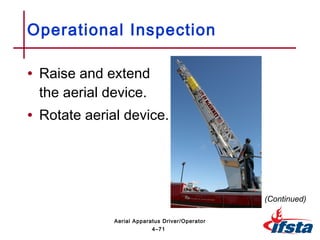
• Raise and extend
the aerial device.
• Rotate aerial device.
Operational Inspection
(Continued)
4–71
Aerial Apparatus Driver/Operator
• Check manual locking devices.
• Test operation of auxiliary equipment.
• Stow aerial device and stabilizers.
Operational Inspection
4–72
Aerial Apparatus Driver/Operator
Inspect a fire apparatus aerial device.
Objective 13 is measured in Skill Sheet 4-7.
Learning Objective 13
4–73
Aerial Apparatus Driver/Operator
Identify various apparatus testing
methods.
Learning Objective 14
4–74
Aerial Apparatus Driver/Operator
• Performed immediately after
construction and yearly afterward
• Required by insurance industry
• Conform to NFPA®
1911
• Preservice tests
• Service tests
Testing
4–75
Aerial Apparatus Driver/Operator
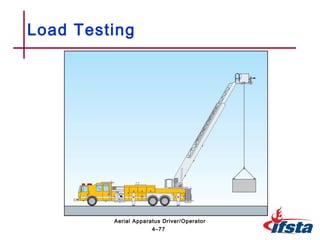
• Determines aerial device is capable to
handle weight it is rated to carry
• May not be a totally accurate
• Good indication that a static load can
be supported at the tip
• If only static load tests are conducted,
not accurately tested
Load Testing
(Continued)
4–76
Aerial Apparatus Driver/Operator
Load Testing
4–77
Aerial Apparatus Driver/Operator
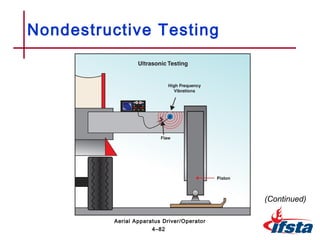
• Used to inspect structural components
without physically altering, placing
under load or stress, or otherwise
damaging or causing wear
• Involves equipment and expertise not
found in most fire departments
• Performed by independent testing
agencies
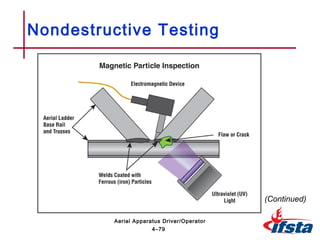
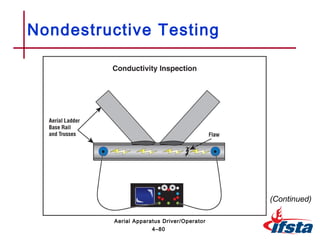
Nondestructive Testing
(Continued)
4–78
Aerial Apparatus Driver/Operator
Nondestructive Testing
(Continued)
4–79
Aerial Apparatus Driver/Operator
Nondestructive Testing
(Continued)
4–80
Aerial Apparatus Driver/Operator
• Liquid penetrant
• Radiographic
• Hardness
• Acoustic emission inspections
Nondestructive Testing
(Continued)
4–81
Aerial Apparatus Driver/Operator
Nondestructive Testing
(Continued)
4–82
Aerial Apparatus Driver/Operator
• Operational Testing — Performed to
determine that the hydraulic system and
structural mechanisms are performing
in proper manner and in accordance
with manufacturer’s specifications
Nondestructive Testing
4–83
Aerial Apparatus Driver/Operator
• Manufacturer testing
• Certification testing
• Acceptance testing
Preservice Tests
4–84
Aerial Apparatus Driver/Operator
DISCUSSION QUESTION
What should be done if an apparatus
does not pass an acceptance test?
4–85
Aerial Apparatus Driver/Operator
Test the operation of an elevating
platform aerial apparatus.
Objective 15 is measured in Skill Sheet 4-8.
Learning Objective 15
4–86
Aerial Apparatus Driver/Operator
Test the operation of a water tower
apparatus.
Objective 16 is measured in Skill Sheet 4-9.
Learning Objective 16
4–87
Aerial Apparatus Driver/Operator
Summary
• Modern aerial apparatus are large,
complicated, and expensive pieces of
fire equipment and must be kept in a
state of good repair and operational
readiness.
(Continued)
4–88
Aerial Apparatus Driver/Operator
• It is the driver/operator’s responsibility
to ensure that aerial apparatus are
clean, well maintained, in good repair,
and thoroughly inspected.
• Driver/operators should be aggressive
with regard to the inspection of the
aerial apparatus and should report any
problems found during an inspection.
Summary
4–89
Aerial Apparatus Driver/Operator
Review Questions
1. What is the difference between
maintenance and repair?
2. Why should new apparatus be
washed with cold water?
3. What type of inspections are
conducted when the driver/operator
performs the daily walk-around
inspection? (Continued)
4–90
Aerial Apparatus Driver/Operator
Review Questions
4. What danger arises from
testing audible warning devices inside
a building?
5. What are some guidelines that
should be used when performing a
compartment door inspection?
(Continued)
4–91
Aerial Apparatus Driver/Operator
6. What is the purpose of an electrical
load management system?
7. What tests should be performed as
part of a complete in-cab air-brake
test?
Review Questions
4–92
Aerial Apparatus Driver/Operator
8. How should unsealed batteries
be checked?
9. What is the correct procedure
for charging a battery?
10. What two purposes are served by
an operational inspection of an aerial
device?
Review Questions
4–93
Aerial Apparatus Driver/Operator

Chapter 04

  • 1.
    Aerial Apparatus Driver/Operator Handbook 2ndEdition Chapter 4 — Introduction to Apparatus Inspection, Maintenance, and Testing
  • 2.
    Learning Objective 1 Describea systematic maintenance program. 4–2 Aerial Apparatus Driver/Operator
  • 3.
    DISCUSSION QUESTION What isthe difference between maintenance and repair? 4–3 Aerial Apparatus Driver/Operator
  • 4.
    • Necessary forevery fire department, fire brigade, and wildland fire agency • Should identify – Which functions are performed – Who performs functions • Dictate responsibilities of driver/operator Maintenance Program 4–4 Aerial Apparatus Driver/Operator
  • 5.
    • Varies fromdepartment to department • Career — Performed at beginning of each work period • Volunteer — Should establish procedures Schedule for Maintenance 4–5 Aerial Apparatus Driver/Operator
  • 6.
    • Serves aswarranty claims, accident investigation, and decision to purchase new apparatus • Procedures and transmission determined by individual department Maintenance and Inspection Documentation 4–6 Aerial Apparatus Driver/Operator
  • 7.
    Identify proper fireapparatus cleaning procedures. Learning Objective 2 4–7 Aerial Apparatus Driver/Operator
  • 8.
    • Good publicrelations • Allows for proper inspection • Promotes longer vehicle life • Negative effects of overcleaning Cleanliness 4–8 Aerial Apparatus Driver/Operator Photo by Ted Boothroyd
  • 9.
    • Newer apparatusrequire more gentle cleaning than older apparatus • Once new vehicle finish is cured, nozzle or pressure washer maybe used for speed cleaning Washing 4–9 Aerial Apparatus Driver/Operator
  • 10.
    • Use gardenhose without nozzle. • Rinse before applying soap. • Wash off vehicle mud, dirt, insects, soot, tar, grease, and road salts before they dry. Washing Newer Apparatus (Continued) 4–10 Aerial Apparatus Driver/Operator
  • 11.
    • Wash withautomotive detergent. • Do not wash with extremely hot water. • Begin washing from top, work downward. • Dry with clean chamois or rubber squeegee. Washing Newer Apparatus 4–11 Aerial Apparatus Driver/Operator
  • 12.
    Discuss glass careand interior cleaning of fire apparatus. Learning Objective 3 4–12 Aerial Apparatus Driver/Operator
  • 13.
    • Clean withwarm, soapy water or commercial glass cleaner. • Use paper towels or clean cloth rags. Glass Care (Continued) 4–13 Aerial Apparatus Driver/Operator
  • 14.
    • Do notuse dry towels and/or rags. • Do not use putty knives, steel wool, or other abrasive tools. Glass Care 4–14 Aerial Apparatus Driver/Operator
  • 15.
    DISCUSSION QUESTION Why isit important to keep seat upholstery, dashboard and engine compartment coverings, and floor finishes clean? 4–15 Aerial Apparatus Driver/Operator
  • 16.
    • Sweep orvacuum. • Use warm soapy water or commercial cleaning products. • Ventilate. • Pay attention when using liquids around electrical system. Interior Cleaning (Continued) 4–16 Aerial Apparatus Driver/Operator
  • 17.
    • Do notuse cleaning solvents such as acetone, lacquer thinner, enamel reducer, nail polish remover, laundry soap, bleach, naphtha, or carbon tetrachloride to clean interior surfaces. Interior Cleaning 4–17 Aerial Apparatus Driver/Operator
  • 18.
    • May nolonger be necessary • May damage clear-coat protective-seal finishes Waxing 4–18 Aerial Apparatus Driver/Operator
  • 19.
    • Do notapply until paint is six months old. • Apply after washing and drying. • Apply according to product instructions. • Polish out with soft cloth or electric buffer. Waxing (If Required) 4–19 Aerial Apparatus Driver/Operator
  • 20.
    Clean the interiorand wash and wax the exterior of a fire department apparatus. Objective 4 is measured in Skill Sheet 4-1. Learning Objective 4 4–20 Aerial Apparatus Driver/Operator
  • 21.
    Describe apparatus inspection procedures. LearningObjective 5 4–21 Aerial Apparatus Driver/Operator
  • 22.
    • Daily walk-aroundinspection – Commercial vehicle pre-trip, road- worthiness inspection – Inspection of operational readiness of emergency equipment • Driver/operator should review previous record inspections. Apparatus Inspection Procedures 4–22 Aerial Apparatus Driver/Operator
  • 23.
    DISCUSSION QUESTION How arethe sides of apparatus identified in your jurisdiction? 4–23 Aerial Apparatus Driver/Operator
  • 24.
    • Check left(driver’s) side first. • Repeat procedure on right (passenger’s) side. • Make sure various aspects of cab doors are in order. • Inspect door window glass. • Ensure windows roll up and down correctly. Cab Left- and Right-Side Inspections (Continued) 4–24 Aerial Apparatus Driver/Operator
  • 25.
    • Check allsteps, platforms, tool mounts, lights, and handrails. • Check saddle fuel tanks beneath door opening. • Check fuel filler caps. • Check the wheel. • Check each lug nut by hand. Cab Left- and Right-Side Inspections (Continued) 4–25 Aerial Apparatus Driver/Operator
  • 26.
    • Look forcracks or damage around the lip of the wheel rim. • Ensure front splash guards are in place and secure. • Look for unusual accumulations of brake dust, rust tracks, powder, or metal fillings on wheel. Cab Left- and Right-Side Inspections (Continued) 4–26 Aerial Apparatus Driver/Operator
  • 27.
    • Look forsigns of rust or powder around lug nuts. • Inspect wheel/tire assembly for other leaks. • Visually inspect suspension components. Cab Left- and Right-Side Inspections (Continued) 4–27 Aerial Apparatus Driver/Operator
  • 28.
    • Look fordefects or wear involving the springs, spring hangers, shackles, U- bolts, and shock absorbers. • Ensure that springs do not have cracked or broken leaves. Cab Left- and Right-Side Inspections 4–28 Aerial Apparatus Driver/Operator
  • 29.
    • Ensure tiretypes match. • Make certain that all tires are same size and have same the weight ratings. • Check speed ratings. • Check proper tread depth. • Check valve stem. • Ensure valve stem caps are in place. Tire Types and Condition 4–29 Aerial Apparatus Driver/Operator
  • 30.
    • Check inflationto manufacture's recommended tire pressure. – Maximum tire pressure imprinted on exterior is NOT recommended operating tire pressure. – Check GVWR placard or tire manufacturer's recommendation for correct operating pressure. Tire Inflation 4–30 Aerial Apparatus Driver/Operator
  • 31.
    • Construction type •Tire maximum load in pounds • Tire maximum psi pressure • Traction index • Temperature index • Tread wear index Tire Sidewall Information (Continued) 4–31 Aerial Apparatus Driver/Operator
  • 32.
    • Ply rating •Size code • Maximum safe speed rating • The word “regroovable” • Serial number • DOT number Tire Sidewall Information 4–32 Aerial Apparatus Driver/Operator
  • 33.
    • Note anysignificant body damage. • Look beneath for damage to tow hooks, front axle, steering system, or piping. • Look for loose, bent, worn, damaged, or missing parts. • Check frame and chassis components. Front of Vehicle Inspection (Continued) 4–33 Aerial Apparatus Driver/Operator
  • 34.
    • Check conditionof windshield and wiper blades. • Check running lights and emergency lights. • Check audible warning devices. Front of Vehicle Inspection (Continued) 4–34 Aerial Apparatus Driver/Operator
  • 35.
    • Check emergency equipmentlocated on front bumper Front of Vehicle Inspection 4–35 Aerial Apparatus Driver/Operator Photo by Pat McAuliff Courtesy of Ron Jeffers
  • 36.
    • General inspection procedures • Rearduals • Automatic snow chains Body-, Passenger-, and Driver-Side Inspections (Continued) 4–36 Aerial Apparatus Driver/Operator Photo by Ted Boothroyd
  • 37.
    • Compartment doors •Hose • Exterior equipment • Reflective striping Body-, Passenger-, and Driver-Side Inspections 4–37 Aerial Apparatus Driver/Operator
  • 38.
    • Running andwarning lights • Equipment in rear compartments • Cabinet doors • Equipment stored on outside rear area • Hose beds • Equipment stored in hose bed • Inspecting a quint Rear of Vehicle Inspection 4–38 Aerial Apparatus Driver/Operator
  • 39.
    • Seats andmirrors • Start engine • Seat belts securely mounted and operate without binding • Buckles open and close freely • Tilt/telescopic steering wheel In-Cab Inspection (Continued) 4–39 Aerial Apparatus Driver/Operator
  • 40.
    • Gauges on dashboard •Check equipment for usability • Controls located in cab In-Cab Inspection 4–40 Aerial Apparatus Driver/Operator Photo by Ted Boothroyd
  • 41.
    • Must bein proper working order and securely stowed Rescue and Fire Fighting Equipment 4–41 Aerial Apparatus Driver/Operator
  • 42.
    • Prevent anoverload of vehicle’s electrical generation system. • Incorporate a load sequencer and load monitor. Electrical Load Management System 4–42 Aerial Apparatus Driver/Operator
  • 43.
    • Check adjustmentof clutch pedal for insufficient or excessive free play. Manual Shift Transmission 4–43 Aerial Apparatus Driver/Operator
  • 44.
    DISCUSSION QUESTION What isfree play? 4–44 Aerial Apparatus Driver/Operator
  • 45.
    • Air brakes •ABS brake system Brake Inspection 4–45 Aerial Apparatus Driver/Operator
  • 46.
    • Test aircompressor governor cutout pressure. • Test air compressor governor cut-in pressure. • Test air leakage. • Test low-pressure warning signal. Braking Tests (Continued) 4–46 Aerial Apparatus Driver/Operator
  • 47.
    • Test springbrakes for automatic actuation. • Check rate of air pressure buildup. • Test service brakes. • Test parking brake. • Test slack adjusters. Braking Tests 4–47 Aerial Apparatus Driver/Operator
  • 48.
    DISCUSSION QUESTION What shouldbe done if any of the tests indicate the brakes do not perform in accordance with state or provincial requirements? 4–48 Aerial Apparatus Driver/Operator
  • 49.
    • May beperformed before engine is started • Most checks should not be done while engine is running Engine Compartment Inspection 4–49 Aerial Apparatus Driver/Operator
  • 50.
    • Check leveland/ or control mechanism. • Ensure hold-open device is latched. • Check cab latches. • Check cab lift motors and pumps. Tilt-Cab 4–50 Aerial Apparatus Driver/Operator
  • 51.
    • Engine (crankcase)oil level • Engine air filter • Emergency shutdown • Exhaust system • Radiator coolant (antifreeze) level • Cooling fan Minimum Inspection of Engine Compartment (Continued) 4–51 Aerial Apparatus Driver/Operator
  • 52.
    • Windshield washerfluid level • Battery condition • Automatic transmission fluid level • Manual transmission oil level • Power steering fluid level • Brake fluid Minimum Inspection of Engine Compartment (Continued) 4–52 Aerial Apparatus Driver/Operator
  • 53.
    • Air system •Belts • Leaks • Hoses and supply lines • Electrical wiring • Steering linkage Minimum Inspection of Engine Compartment 4–53 Aerial Apparatus Driver/Operator
  • 54.
    • May berequired of driver/operator • Helps prevent costly repairs • Reduces out-of-service time • Effectiveness • Oil number Chassis Lubrication (Continued) 4–54 Aerial Apparatus Driver/Operator
  • 55.
    • Duties • Automaticvehicle lubrication systems Chassis Lubrication 4–55 Aerial Apparatus Driver/Operator
  • 56.
    Perform a testof the air brake system. Objective 6 is measured in Skill Sheet 4-2. Learning Objective 6 4–56 Aerial Apparatus Driver/Operator
  • 57.
    Perform a walk-aroundroutine maintenance inspection. Objective 7 is measured in Skill Sheet 4-3. Learning Objective 7 4–57 Aerial Apparatus Driver/Operator
  • 58.
    Perform an in-caboperational inspection. Objective 8 is measured in Skill Sheet 4-4. Learning Objective 8 4–58 Aerial Apparatus Driver/Operator
  • 59.
    Perform an enginecompartment inspection. Objective 9 is measured in Skill Sheet 4-5. Learning Objective 9 4–59 Aerial Apparatus Driver/Operator
  • 60.
    Discuss charging batteries. LearningObjective 10 4–60 Aerial Apparatus Driver/Operator
  • 61.
    • May berequired after long periods of inactivity or improper drain of electrical system • Generally performed with battery charger • Procedure • Jump starting considerations Charging Batteries (Continued) 4–61 Aerial Apparatus Driver/Operator
  • 62.
  • 63.
    DISCUSSION QUESTION When mightjump-starting be necessary? 4–63 Aerial Apparatus Driver/Operator
  • 64.
    Charge an apparatusbattery. Objective 11 is measured in Skill Sheet 4-6. Learning Objective 11 4–64 Aerial Apparatus Driver/Operator
  • 65.
    Describe aerial deviceinspections. Learning Objective 12 4–65 Aerial Apparatus Driver/Operator
  • 66.
    • Level ofhydraulic fluid • Stabilizers • Turntable assembly • Lower control pedestals • Platform control console • Communications system Visual Inspection (Continued) 4–66 Aerial Apparatus Driver/Operator
  • 67.
    • Breathing airsupply system • Extension/retraction system • Elevation/lifting cylinders • Various sections of aerial device • Elevating platform assembly Visual Inspection (Continued) 4–67 Aerial Apparatus Driver/Operator
  • 68.
    • Ladder rungs •Waterway system • Equipment attached to end of aerial device fly section Visual Inspection 4–68 Aerial Apparatus Driver/Operator
  • 69.
    • Park apparatusin suitable location for operating aerial device. • Transfer power from drive train to aerial device hydraulic system. • Check operation of stabilizers. Operational Inspection (Continued) 4–69 Aerial Apparatus Driver/Operator
  • 70.
    DISCUSSION QUESTION What isindicated if the truck begins to lean toward one side or the other after the stabilizers have been deployed for a while? 4–70 Aerial Apparatus Driver/Operator
  • 71.
    • Raise andextend the aerial device. • Rotate aerial device. Operational Inspection (Continued) 4–71 Aerial Apparatus Driver/Operator
  • 72.
    • Check manuallocking devices. • Test operation of auxiliary equipment. • Stow aerial device and stabilizers. Operational Inspection 4–72 Aerial Apparatus Driver/Operator
  • 73.
    Inspect a fireapparatus aerial device. Objective 13 is measured in Skill Sheet 4-7. Learning Objective 13 4–73 Aerial Apparatus Driver/Operator
  • 74.
    Identify various apparatustesting methods. Learning Objective 14 4–74 Aerial Apparatus Driver/Operator
  • 75.
    • Performed immediatelyafter construction and yearly afterward • Required by insurance industry • Conform to NFPA® 1911 • Preservice tests • Service tests Testing 4–75 Aerial Apparatus Driver/Operator
  • 76.
    • Determines aerialdevice is capable to handle weight it is rated to carry • May not be a totally accurate • Good indication that a static load can be supported at the tip • If only static load tests are conducted, not accurately tested Load Testing (Continued) 4–76 Aerial Apparatus Driver/Operator
  • 77.
  • 78.
    • Used toinspect structural components without physically altering, placing under load or stress, or otherwise damaging or causing wear • Involves equipment and expertise not found in most fire departments • Performed by independent testing agencies Nondestructive Testing (Continued) 4–78 Aerial Apparatus Driver/Operator
  • 79.
  • 80.
  • 81.
    • Liquid penetrant •Radiographic • Hardness • Acoustic emission inspections Nondestructive Testing (Continued) 4–81 Aerial Apparatus Driver/Operator
  • 82.
  • 83.
    • Operational Testing— Performed to determine that the hydraulic system and structural mechanisms are performing in proper manner and in accordance with manufacturer’s specifications Nondestructive Testing 4–83 Aerial Apparatus Driver/Operator
  • 84.
    • Manufacturer testing •Certification testing • Acceptance testing Preservice Tests 4–84 Aerial Apparatus Driver/Operator
  • 85.
    DISCUSSION QUESTION What shouldbe done if an apparatus does not pass an acceptance test? 4–85 Aerial Apparatus Driver/Operator
  • 86.
    Test the operationof an elevating platform aerial apparatus. Objective 15 is measured in Skill Sheet 4-8. Learning Objective 15 4–86 Aerial Apparatus Driver/Operator
  • 87.
    Test the operationof a water tower apparatus. Objective 16 is measured in Skill Sheet 4-9. Learning Objective 16 4–87 Aerial Apparatus Driver/Operator
  • 88.
    Summary • Modern aerialapparatus are large, complicated, and expensive pieces of fire equipment and must be kept in a state of good repair and operational readiness. (Continued) 4–88 Aerial Apparatus Driver/Operator
  • 89.
    • It isthe driver/operator’s responsibility to ensure that aerial apparatus are clean, well maintained, in good repair, and thoroughly inspected. • Driver/operators should be aggressive with regard to the inspection of the aerial apparatus and should report any problems found during an inspection. Summary 4–89 Aerial Apparatus Driver/Operator
  • 90.
    Review Questions 1. Whatis the difference between maintenance and repair? 2. Why should new apparatus be washed with cold water? 3. What type of inspections are conducted when the driver/operator performs the daily walk-around inspection? (Continued) 4–90 Aerial Apparatus Driver/Operator
  • 91.
    Review Questions 4. Whatdanger arises from testing audible warning devices inside a building? 5. What are some guidelines that should be used when performing a compartment door inspection? (Continued) 4–91 Aerial Apparatus Driver/Operator
  • 92.
    6. What isthe purpose of an electrical load management system? 7. What tests should be performed as part of a complete in-cab air-brake test? Review Questions 4–92 Aerial Apparatus Driver/Operator
  • 93.
    8. How shouldunsealed batteries be checked? 9. What is the correct procedure for charging a battery? 10. What two purposes are served by an operational inspection of an aerial device? Review Questions 4–93 Aerial Apparatus Driver/Operator