L. C. P. B.  - Module  3 Fire Behavior
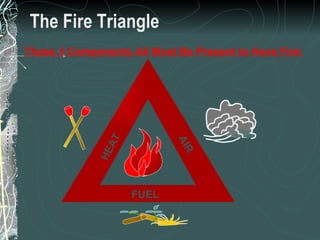
The Fire Triangle Fire Behaviour  Overhead  FUEL HEAT AIR These 3 Components All Must Be Present to Have Fire: 1 of 31 Low Complexity Prescribed Burn Worker
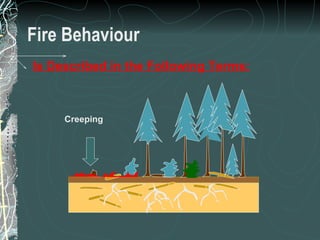
Fire Behaviour Is Described in the Following Terms: Creeping
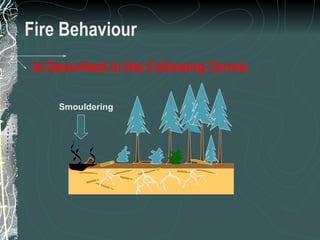
Fire Behaviour Smouldering Is Described in the Following Terms: 2 of 31 Low Complexity Prescribed Burn Worker
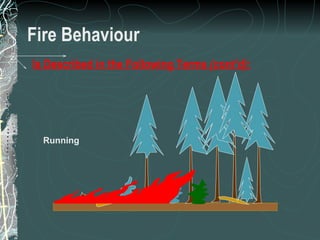
Fire Behaviour Running Is Described in the Following Terms  (cont’d) :
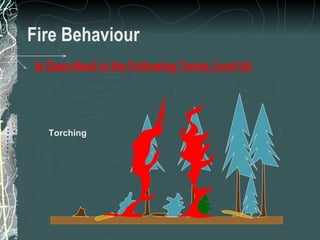
Fire Behaviour Torching Is Described in the Following Terms  (cont’d) :
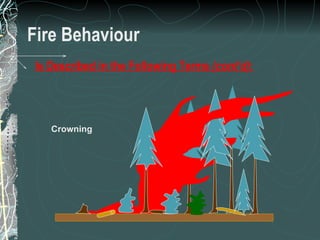
Fire Behaviour Is Described in the Following Terms  (cont’d) : Crowning
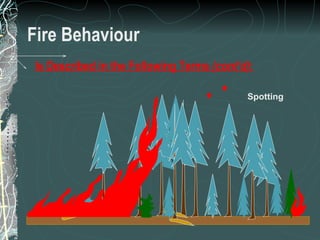
Fire Behaviour Is Described in the Following Terms  (cont’d) : Spotting
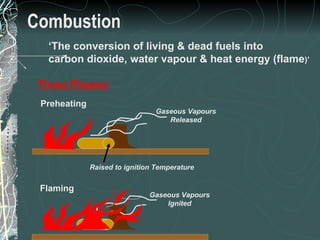
Combustion Gaseous Vapours Released Raised to ignition Temperature Preheating Flaming ‘ The conversion of living & dead fuels into carbon dioxide, water vapour & heat energy (flame )’ Three Phases: Gaseous Vapours Ignited
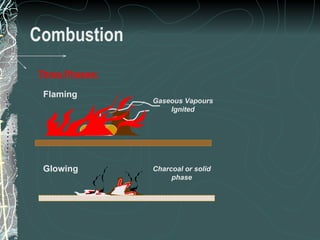
Combustion Flaming Glowing Three Phases: Gaseous Vapours Ignited Charcoal or solid phase
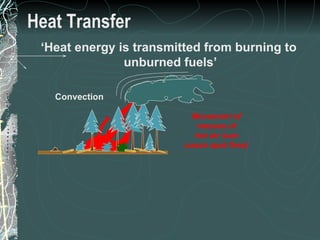
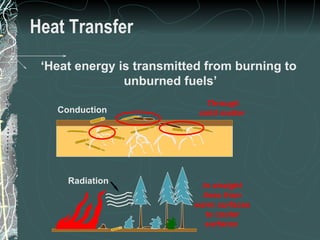
Heat Transfer ‘ Heat energy is transmitted from burning to  unburned fuels’ Convection Movement of masses of hot air (can cause spot fires)
Heat Transfer ‘ Heat energy is transmitted from burning to  unburned fuels’ Conduction Radiation Through solid matter  In straight lines from warm surfaces to cooler surfaces
Fuels Quantity   Amount of fuel available Type   Association of fuels that are distinctive (species, form, size, arrangement and continuity). Size   Fine, medium, coarse Arrangement  Horizontal and vertical distribution of all combustible materials within a particular fuel type ‘ These fuel characteristics can effect fire behaviour’…..
Fuels Distribution   Continuity of fuels over an area Fuel Moisture Content   The amount of fuel available for combustion. The lower the moisture content, the greater the amount of fuel available. ‘ These fuel characteristics can effect fire behaviour’…..
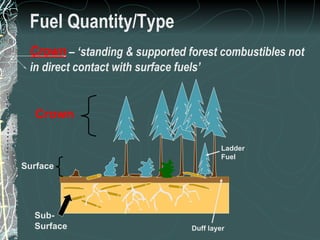
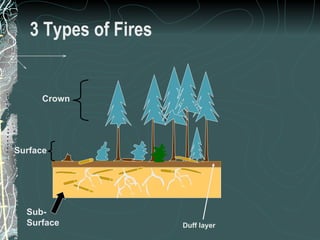
Fuel Quantity/Type Crown   – ‘standing & supported forest combustibles not in direct contact with surface fuels’ Crown Surface Sub- Surface Duff layer Ladder Fuel
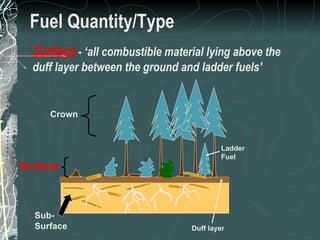
Fuel Quantity/Type Surface  - ‘all combustible material lying above the  duff layer between the ground and ladder fuels’ Crown Surface Sub- Surface Duff layer Subsurface  - ‘all combustible material below the litter (duff) layer of the forest floor (e.g., roots, punky wood and peat)’ Ladder Fuel 8 of 31 Low Complexity Prescribed Burn Worker
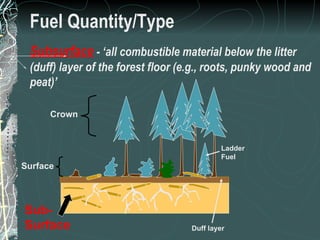
Fuel Quantity/Type Subsurface  - ‘all combustible material below the litter (duff) layer of the forest floor (e.g., roots, punky wood and peat)’ Crown Surface Sub- Surface Duff layer Ladder Fuel 8 of 31 Low Complexity Prescribed Burn Worker
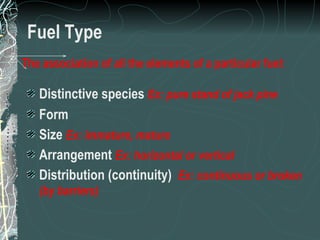
Fuel Type Distinctive species  Ex: pure stand of jack pine Form Size  Ex:   immature, mature Arrangement  Ex: horizontal or vertical Distribution (continuity)  Ex: continuous or broken (by barriers) The association of all the elements of a particular fuel:
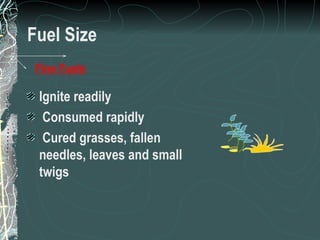
Fuel Size Ignite readily  Consumed rapidly  Cured grasses, fallen needles, leaves and small twigs Fine Fuels
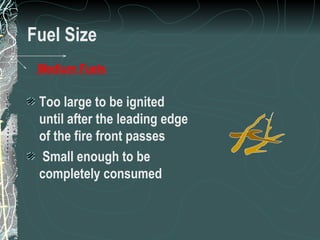
Fuel Size Too large to be ignited until after the leading edge of the fire front passes Small enough to be completely consumed Medium Fuels
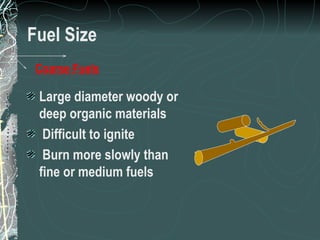
Fuel Size Large diameter woody or deep organic materials Difficult to ignite Burn more slowly than fine or medium fuels Coarse Fuels
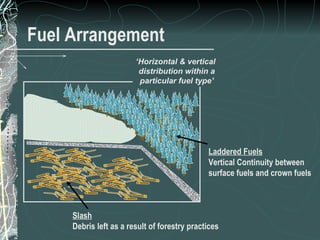
Fuel Arrangement Spread! ‘ Horizontal & vertical  distribution within a particular fuel type’ 11 of 31 Low Complexity Prescribed Burn Worker Laddered Fuels Vertical Continuity between surface fuels and crown fuels Slash Debris left as a result of forestry practices
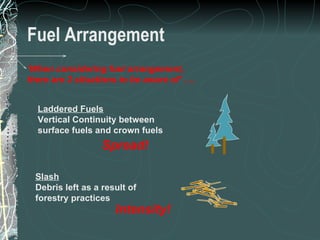
Fuel Arrangement ‘ When considering fuel arrangement,  there are 2 situations to be aware of’ …. Slash Debris left as a result of  forestry practices  Intensity! Laddered Fuels Vertical Continuity between surface fuels and crown fuels  Spread!
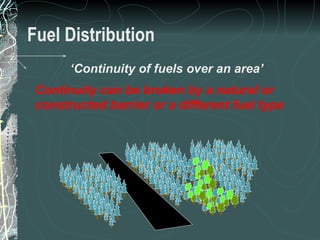
Fuel Distribution ‘ Continuity of fuels over an area’ Continuity can be broken by a natural or constructed barrier or a different fuel type  12 of 31 Low Complexity Prescribed Burn Worker
3 Types of Fires Crown Surface Sub- Surface Duff layer 13 of 31 Low Complexity Prescribed Burn Worker
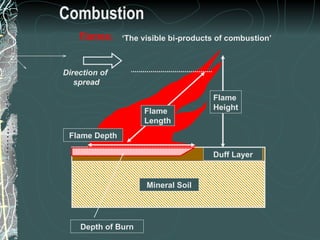
Combustion Flames: Flame Length Flame Height Flame Depth ‘ The visible bi-products of combustion’ Duff Layer Mineral Soil Depth of Burn Direction of  spread 14 of 31 Low Complexity Prescribed Burn Worker
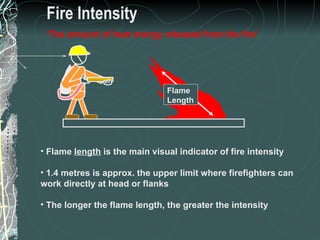
Fire Intensity Flame Length Flame  length  is the main visual indicator of fire intensity 1.4 metres is approx. the upper limit where firefighters can work directly at head or flanks The longer the flame length, the greater the intensity ‘ The amount of heat energy released from the fire’ 15 of 31 Low Complexity Prescribed Burn Worker
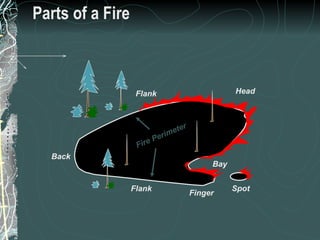
Parts of a Fire Spot  Bay  Head  Back  Flank  Flank  Finger  Fire Perimeter  16 of 31 Low Complexity Prescribed Burn Worker
Effects of Weather Relative Humidity Precipitation Temperature Wind (direction & speed) 17 of 31 Low Complexity Prescribed Burn Worker Factors to consider:
Effects of Weather  (cont’d) Defined as the amount of moisture in the air at the prevailing temperature The amount of moisture directly affects the moisture content of the forest fuels All other factors being equal, a RH of 40% or less usually means fires will burn quite rapidly When the RH is greater than 65%, it usually means fires will burn slowly, if at all 18 of 31 Low Complexity Prescribed Burn Worker Relative Humidity
Effects of Weather  (cont’d) Defined as the presence of rain, hail or dew Influences the moisture content of forest fuels and impacts the RH in a given area Accumulated rain is measured in millimetres (25 mm = 1 inch) 19 of 31 Low Complexity Prescribed Burn Worker Precipitation
Effects of Weather  (cont’d) Defined as the degree of hotness or coldness of a substance High temperature contributes to the drying of forest fuels When temperature is increased, less heat from the fire is required during pre-heating (pyrolisis) stage Temperature
Effects of Weather  (cont’d) Defined as the natural movement of air parallel to the earth’s surface Can influence fire behaviour by: –  moving moist air away from or over fuels –  blowing burning embers outside the fire perimeter –  carrying burning embers that have been lifted above the ground by convection (may start new fires some distance away) –  bending convection columns closer to unburned fuels which will pre-heat them –  bringing a continuous flow of oxygen to the fire Wind
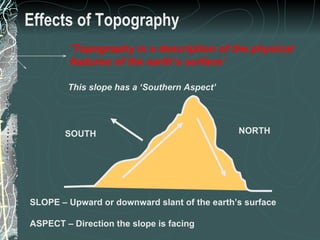
Effects of Topography SOUTH NORTH SLOPE – Upward or downward slant of the earth’s surface ASPECT – Direction the slope is facing This slope has a ‘Southern Aspect’ ‘ Topography is a description of the physical features of the earth’s surface’ 22 of 31 Low Complexity Prescribed Burn Worker
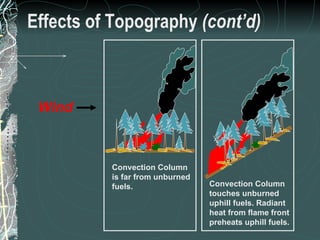
Effects of Topography  (cont’d) Convection Column is far from unburned fuels. Convection Column touches unburned uphill fuels. Radiant heat from flame front preheats uphill fuels. 23 of 31 Low Complexity Prescribed Burn Worker Wind
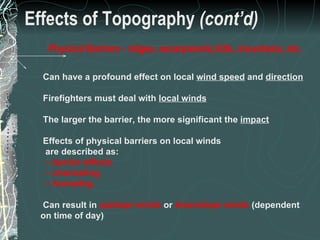
Effects of Topography  (cont’d) Physical Barriers - ridges, escarpments,hills, mountains, etc. Can have a profound effect on local  wind speed  and  direction Firefighters must deal with  local winds The larger the barrier, the more significant the  impact Effects of physical barriers on local winds  are described as: –  barrier effects –  channeling –  funneling Can result in  upslope   winds  or  downslope   winds  (dependent on time of day)
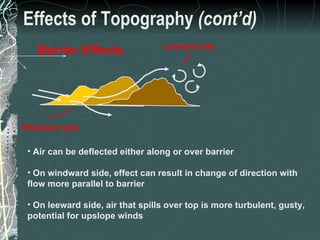
Effects of Topography  (cont’d) Barrier Effects Air can be deflected either along or over barrier On windward side, effect can result in change of direction with flow more parallel to barrier On leeward side, air that spills over top is more turbulent, gusty, potential for upslope winds Leeward side Windward side 25 of 31 Low Complexity Prescribed Burn Worker
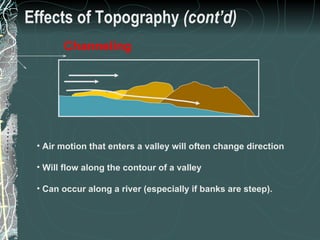
Effects of Topography  (cont’d) Channeling Air motion that enters a valley will often change direction Will flow along the contour of a valley Can occur along a river (especially if banks are steep). 26 of 31 Low Complexity Prescribed Burn Worker
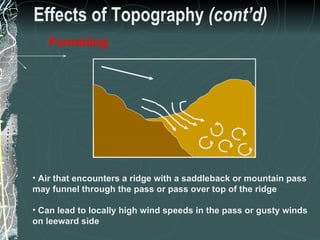
Effects of Topography  (cont’d) Funneling Air that encounters a ridge with a saddleback or mountain pass may funnel through the pass or pass over top of the ridge Can lead to locally high wind speeds in the pass or gusty winds on leeward side 27 of 31 Low Complexity Prescribed Burn Worker
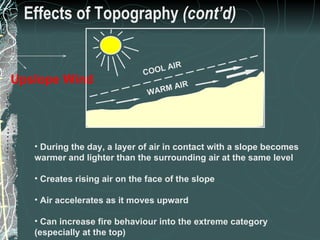
Effects of Topography  (cont’d) Upslope Wind COOL AIR WARM AIR During the day, a layer of air in contact with a slope becomes warmer and lighter than the surrounding air at the same level Creates rising air on the face of the slope Air accelerates as it moves upward Can increase fire behaviour into the extreme category (especially at the top) 28 of 31 Low Complexity Prescribed Burn Worker


Module 3 - Fire Behavior

  • 1.
    L. C. P.B. - Module 3 Fire Behavior
  • 2.
    The Fire TriangleFire Behaviour Overhead FUEL HEAT AIR These 3 Components All Must Be Present to Have Fire: 1 of 31 Low Complexity Prescribed Burn Worker
  • 3.
    Fire Behaviour IsDescribed in the Following Terms: Creeping
  • 4.
    Fire Behaviour SmoulderingIs Described in the Following Terms: 2 of 31 Low Complexity Prescribed Burn Worker
  • 5.
    Fire Behaviour RunningIs Described in the Following Terms (cont’d) :
  • 6.
    Fire Behaviour TorchingIs Described in the Following Terms (cont’d) :
  • 7.
    Fire Behaviour IsDescribed in the Following Terms (cont’d) : Crowning
  • 8.
    Fire Behaviour IsDescribed in the Following Terms (cont’d) : Spotting
  • 9.
    Combustion Gaseous VapoursReleased Raised to ignition Temperature Preheating Flaming ‘ The conversion of living & dead fuels into carbon dioxide, water vapour & heat energy (flame )’ Three Phases: Gaseous Vapours Ignited
  • 10.
    Combustion Flaming GlowingThree Phases: Gaseous Vapours Ignited Charcoal or solid phase
  • 11.
    Heat Transfer ‘Heat energy is transmitted from burning to unburned fuels’ Convection Movement of masses of hot air (can cause spot fires)
  • 12.
    Heat Transfer ‘Heat energy is transmitted from burning to unburned fuels’ Conduction Radiation Through solid matter In straight lines from warm surfaces to cooler surfaces
  • 13.
    Fuels Quantity Amount of fuel available Type Association of fuels that are distinctive (species, form, size, arrangement and continuity). Size Fine, medium, coarse Arrangement Horizontal and vertical distribution of all combustible materials within a particular fuel type ‘ These fuel characteristics can effect fire behaviour’…..
  • 14.
    Fuels Distribution Continuity of fuels over an area Fuel Moisture Content The amount of fuel available for combustion. The lower the moisture content, the greater the amount of fuel available. ‘ These fuel characteristics can effect fire behaviour’…..
  • 15.
    Fuel Quantity/Type Crown – ‘standing & supported forest combustibles not in direct contact with surface fuels’ Crown Surface Sub- Surface Duff layer Ladder Fuel
  • 16.
    Fuel Quantity/Type Surface - ‘all combustible material lying above the duff layer between the ground and ladder fuels’ Crown Surface Sub- Surface Duff layer Subsurface - ‘all combustible material below the litter (duff) layer of the forest floor (e.g., roots, punky wood and peat)’ Ladder Fuel 8 of 31 Low Complexity Prescribed Burn Worker
  • 17.
    Fuel Quantity/Type Subsurface - ‘all combustible material below the litter (duff) layer of the forest floor (e.g., roots, punky wood and peat)’ Crown Surface Sub- Surface Duff layer Ladder Fuel 8 of 31 Low Complexity Prescribed Burn Worker
  • 18.
    Fuel Type Distinctivespecies Ex: pure stand of jack pine Form Size Ex: immature, mature Arrangement Ex: horizontal or vertical Distribution (continuity) Ex: continuous or broken (by barriers) The association of all the elements of a particular fuel:
  • 19.
    Fuel Size Ignitereadily Consumed rapidly Cured grasses, fallen needles, leaves and small twigs Fine Fuels
  • 20.
    Fuel Size Toolarge to be ignited until after the leading edge of the fire front passes Small enough to be completely consumed Medium Fuels
  • 21.
    Fuel Size Largediameter woody or deep organic materials Difficult to ignite Burn more slowly than fine or medium fuels Coarse Fuels
  • 22.
    Fuel Arrangement Spread!‘ Horizontal & vertical distribution within a particular fuel type’ 11 of 31 Low Complexity Prescribed Burn Worker Laddered Fuels Vertical Continuity between surface fuels and crown fuels Slash Debris left as a result of forestry practices
  • 23.
    Fuel Arrangement ‘When considering fuel arrangement, there are 2 situations to be aware of’ …. Slash Debris left as a result of forestry practices Intensity! Laddered Fuels Vertical Continuity between surface fuels and crown fuels Spread!
  • 24.
    Fuel Distribution ‘Continuity of fuels over an area’ Continuity can be broken by a natural or constructed barrier or a different fuel type 12 of 31 Low Complexity Prescribed Burn Worker
  • 25.
    3 Types ofFires Crown Surface Sub- Surface Duff layer 13 of 31 Low Complexity Prescribed Burn Worker
  • 26.
    Combustion Flames: FlameLength Flame Height Flame Depth ‘ The visible bi-products of combustion’ Duff Layer Mineral Soil Depth of Burn Direction of spread 14 of 31 Low Complexity Prescribed Burn Worker
  • 27.
    Fire Intensity FlameLength Flame length is the main visual indicator of fire intensity 1.4 metres is approx. the upper limit where firefighters can work directly at head or flanks The longer the flame length, the greater the intensity ‘ The amount of heat energy released from the fire’ 15 of 31 Low Complexity Prescribed Burn Worker
  • 28.
    Parts of aFire Spot Bay Head Back Flank Flank Finger Fire Perimeter 16 of 31 Low Complexity Prescribed Burn Worker
  • 29.
    Effects of WeatherRelative Humidity Precipitation Temperature Wind (direction & speed) 17 of 31 Low Complexity Prescribed Burn Worker Factors to consider:
  • 30.
    Effects of Weather (cont’d) Defined as the amount of moisture in the air at the prevailing temperature The amount of moisture directly affects the moisture content of the forest fuels All other factors being equal, a RH of 40% or less usually means fires will burn quite rapidly When the RH is greater than 65%, it usually means fires will burn slowly, if at all 18 of 31 Low Complexity Prescribed Burn Worker Relative Humidity
  • 31.
    Effects of Weather (cont’d) Defined as the presence of rain, hail or dew Influences the moisture content of forest fuels and impacts the RH in a given area Accumulated rain is measured in millimetres (25 mm = 1 inch) 19 of 31 Low Complexity Prescribed Burn Worker Precipitation
  • 32.
    Effects of Weather (cont’d) Defined as the degree of hotness or coldness of a substance High temperature contributes to the drying of forest fuels When temperature is increased, less heat from the fire is required during pre-heating (pyrolisis) stage Temperature
  • 33.
    Effects of Weather (cont’d) Defined as the natural movement of air parallel to the earth’s surface Can influence fire behaviour by: – moving moist air away from or over fuels – blowing burning embers outside the fire perimeter – carrying burning embers that have been lifted above the ground by convection (may start new fires some distance away) – bending convection columns closer to unburned fuels which will pre-heat them – bringing a continuous flow of oxygen to the fire Wind
  • 34.
    Effects of TopographySOUTH NORTH SLOPE – Upward or downward slant of the earth’s surface ASPECT – Direction the slope is facing This slope has a ‘Southern Aspect’ ‘ Topography is a description of the physical features of the earth’s surface’ 22 of 31 Low Complexity Prescribed Burn Worker
  • 35.
    Effects of Topography (cont’d) Convection Column is far from unburned fuels. Convection Column touches unburned uphill fuels. Radiant heat from flame front preheats uphill fuels. 23 of 31 Low Complexity Prescribed Burn Worker Wind
  • 36.
    Effects of Topography (cont’d) Physical Barriers - ridges, escarpments,hills, mountains, etc. Can have a profound effect on local wind speed and direction Firefighters must deal with local winds The larger the barrier, the more significant the impact Effects of physical barriers on local winds are described as: – barrier effects – channeling – funneling Can result in upslope winds or downslope winds (dependent on time of day)
  • 37.
    Effects of Topography (cont’d) Barrier Effects Air can be deflected either along or over barrier On windward side, effect can result in change of direction with flow more parallel to barrier On leeward side, air that spills over top is more turbulent, gusty, potential for upslope winds Leeward side Windward side 25 of 31 Low Complexity Prescribed Burn Worker
  • 38.
    Effects of Topography (cont’d) Channeling Air motion that enters a valley will often change direction Will flow along the contour of a valley Can occur along a river (especially if banks are steep). 26 of 31 Low Complexity Prescribed Burn Worker
  • 39.
    Effects of Topography (cont’d) Funneling Air that encounters a ridge with a saddleback or mountain pass may funnel through the pass or pass over top of the ridge Can lead to locally high wind speeds in the pass or gusty winds on leeward side 27 of 31 Low Complexity Prescribed Burn Worker
  • 40.
    Effects of Topography (cont’d) Upslope Wind COOL AIR WARM AIR During the day, a layer of air in contact with a slope becomes warmer and lighter than the surrounding air at the same level Creates rising air on the face of the slope Air accelerates as it moves upward Can increase fire behaviour into the extreme category (especially at the top) 28 of 31 Low Complexity Prescribed Burn Worker
  • 41.
  • 42.