Wildfire Disaster
Management
Dr Fayaz A. Malla
Assistant Professor, Environmental Sciences
GDC Tral
Higher Education Department, Govt. of J&K
Email: nami.fayaz@gmail.com
INTRODUCTION
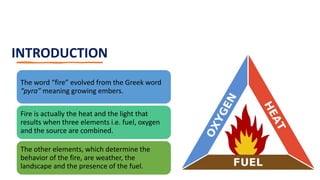
The word “fire” evolved from the Greek word
“pyra” meaning growing embers.
Fire is actually the heat and the light that
results when three elements i.e. fuel, oxygen
and the source are combined.
The other elements, which determine the
behavior of the fire, are weather, the
landscape and the presence of the fuel.
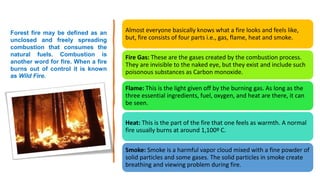
Forest fire may be defined as an
unclosed and freely spreading
combustion that consumes the
natural fuels. Combustion is
another word for fire. When a fire
burns out of control it is known
as Wild Fire.
Almost everyone basically knows what a fire looks and feels like,
but, fire consists of four parts i.e., gas, flame, heat and smoke.
Fire Gas: These are the gases created by the combustion process.
They are invisible to the naked eye, but they exist and include such
poisonous substances as Carbon monoxide.
Flame: This is the light given off by the burning gas. As long as the
three essential ingredients, fuel, oxygen, and heat are there, it can
be seen.
Heat: This is the part of the fire that one feels as warmth. A normal
fire usually burns at around 1,100º C.
Smoke: Smoke is a harmful vapor cloud mixed with a fine powder of
solid particles and some gases. The solid particles in smoke create
breathing and viewing problem during fire.
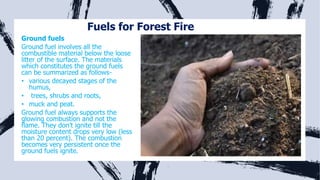
Ground fuels
Ground fuel involves all the
combustible material below the loose
litter of the surface. The materials
which constitutes the ground fuels
can be summarized as follows-
• various decayed stages of the
humus,
• trees, shrubs and roots,
• muck and peat.
Ground fuel always supports the
glowing combustion and not the
flame. They don't ignite till the
moisture content drops very low (less
than 20 percent). The combustion
becomes very persistent once the
ground fuels ignite.
Fuels for Forest Fire
Surface fuels
All the combustible material on the forest
floor is included in surface fuels. This type of
fuel is the most common type of fire fuels.
This may include-
• tree leaves and the fine litter,
• grasses, weeds, ferns and the other
herbaceous plants,
• ow brush, seedlings and saplings of trees,
• fine deadwood on the forest floor,
• large logs and stumps, and
• roots of trees.
These fuels ignite very readily and provide
the basic combustible material for the forest
fires.
Fuels for Forest Fire
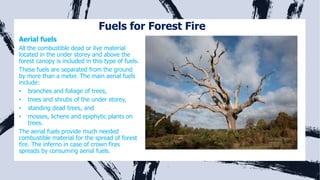
Aerial fuels
All the combustible dead or live material
located in the under storey and above the
forest canopy is included in this type of fuels.
These fuels are separated from the ground
by more than a meter. The main aerial fuels
include:
• branches and foliage of trees,
• trees and shrubs of the under storey,
• standing dead trees, and
• mosses, lichens and epiphytic plants on
trees.
The aerial fuels provide much needed
combustible material for the spread of forest
fire. The inferno in case of crown fires
spreads by consuming aerial fuels.
Fuels for Forest Fire
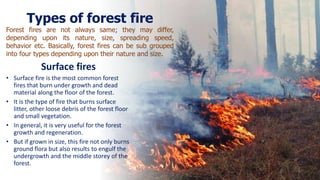
Surface fires
• Surface fire is the most common forest
fires that burn under growth and dead
material along the floor of the forest.
• It is the type of fire that burns surface
litter, other loose debris of the forest floor
and small vegetation.
• In general, it is very useful for the forest
growth and regeneration.
• But if grown in size, this fire not only burns
ground flora but also results to engulf the
undergrowth and the middle storey of the
forest.
Types of forest fire
Forest fires are not always same; they may differ,
depending upon its nature, size, spreading speed,
behavior etc. Basically, forest fires can be sub grouped
into four types depending upon their nature and size.
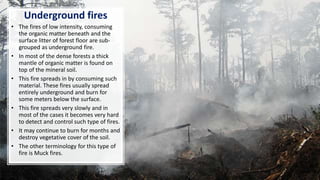
Underground fires
• The fires of low intensity, consuming
the organic matter beneath and the
surface litter of forest floor are sub-
grouped as underground fire.
• In most of the dense forests a thick
mantle of organic matter is found on
top of the mineral soil.
• This fire spreads in by consuming such
material. These fires usually spread
entirely underground and burn for
some meters below the surface.
• This fire spreads very slowly and in
most of the cases it becomes very hard
to detect and control such type of fires.
• It may continue to burn for months and
destroy vegetative cover of the soil.
• The other terminology for this type of
fire is Muck fires.
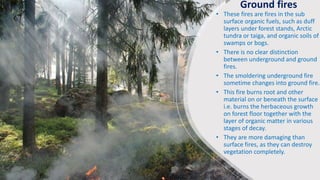
Ground fires
• These fires are fires in the sub
surface organic fuels, such as duff
layers under forest stands, Arctic
tundra or taiga, and organic soils of
swamps or bogs.
• There is no clear distinction
between underground and ground
fires.
• The smoldering underground fire
sometime changes into ground fire.
• This fire burns root and other
material on or beneath the surface
i.e. burns the herbaceous growth
on forest floor together with the
layer of organic matter in various
stages of decay.
• They are more damaging than
surface fires, as they can destroy
vegetation completely.
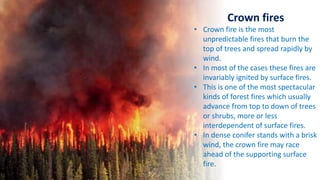
Crown fires
• Crown fire is the most
unpredictable fires that burn the
top of trees and spread rapidly by
wind.
• In most of the cases these fires are
invariably ignited by surface fires.
• This is one of the most spectacular
kinds of forest fires which usually
advance from top to down of trees
or shrubs, more or less
interdependent of surface fires.
• In dense conifer stands with a brisk
wind, the crown fire may race
ahead of the supporting surface
fire.
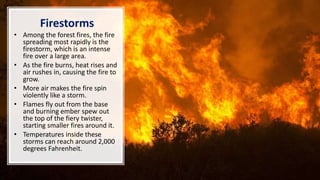
Firestorms
• Among the forest fires, the fire
spreading most rapidly is the
firestorm, which is an intense
fire over a large area.
• As the fire burns, heat rises and
air rushes in, causing the fire to
grow.
• More air makes the fire spin
violently like a storm.
• Flames fly out from the base
and burning ember spew out
the top of the fiery twister,
starting smaller fires around it.
• Temperatures inside these
storms can reach around 2,000
degrees Fahrenheit.
A fire is said to be
running when it is
spreading rapidly
It is creeping when it is
spreading slowly with
low flames
A fire is smoldering
when it burns without a
flame and is barely
spreading.
A fire is said to be
spotting when it is
producing sparks or
embers that are carried
by the wind or by the
combustion column
caused by the fire and
start new fires beyond
the main fire
A fire is torching when
it moves from one
crown to another fire
into the crowns of
individual trees, but not
necessary from one
crown to another.
It is crowning when it
spreads from tree to
tree usually in
conjunction with, but
sometimes completely
independent of the
surface fire.
A flare-up is a sudden
acceleration of fire
spread or intensity, of
relatively short duration
for a portion of the fire.
A blowup, on the other
hand is a dramatic
change in the behavior
of the whole fire, the
point of rapid transition
to a severe fire.
Specialized vocabulary
used by the wildfire
community for
describing different
types of fire behavior.
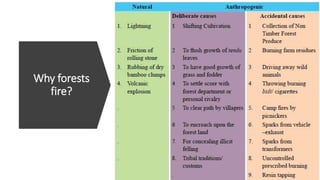
Why forests
fire?
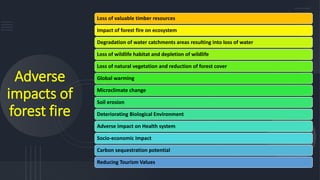
Adverse impacts of forest fire
The Forest Survey of India data on forest fire attribute around 50 percent of the forest areas as fire prone.
Adverse
impacts of
forest fire
Loss of valuable timber resources
Impact of forest fire on ecosystem
Degradation of water catchments areas resulting into loss of water
Loss of wildlife habitat and depletion of wildlife
Loss of natural vegetation and reduction of forest cover
Global warming
Microclimate change
Soil erosion
Deteriorating Biological Environment
Adverse impact on Health system
Socio-economic impact
Carbon sequestration potential
Reducing Tourism Values
An assessment of the threat to
human life, property, forest,
other wooded land and other
land assets and values, in
conjunction with the
management objectives for the
area.
Preparedness for the fire
suppression must reflect the
variable nature of fire dangers.
Developing appropriate modern
early warning capability of wild-
land fire danger.
Initiate prevention activities to
reduce the hazards and
potential losses.
Must ensure a measured fire
suppression response that
reflects the threat, the safety of
fire fighting personnel and the
public, and the impact on the
environment.
Must formalize a single
management structure for all
personnel.
Trained, well equipped,
assessed and accredited
personnel must be appointed.
Striving for consistent funding
that enables fire managers to
adequately meet the goals of
the guiding principles safely and
efficiently.
Fire Protection Plans- A Fire Protection Plan is must to carry out preparedness and response activities. A well-
developed Plan must include:
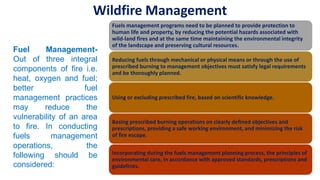
Wildfire Management
Fuels management programs need to be planned to provide protection to
human life and property, by reducing the potential hazards associated with
wild-land fires and at the same time maintaining the environmental integrity
of the landscape and preserving cultural resources.
Reducing fuels through mechanical or physical means or through the use of
prescribed burning to management objectives must satisfy legal requirements
and be thoroughly planned.
Using or excluding prescribed fire, based on scientific knowledge.
Basing prescribed burning operations on clearly defined objectives and
prescriptions, providing a safe working environment, and minimizing the risk
of fire escape.
Incorporating during the fuels management planning process, the principles of
environmental care, in accordance with approved standards, prescriptions and
guidelines.
Fuel Management-
Out of three integral
components of fire i.e.
heat, oxygen and fuel;
better fuel
management practices
may reduce the
vulnerability of an area
to fire. In conducting
fuels management
operations, the
following should be
considered:
Wildfire Management
Fire management activities should be
based upon good scientific studies
and follow sound management
principles.
These activities should be planned
and conducted in an environmentally
sensitive manner considering fire
regimes and fire management
activities appropriate to maintain the
vigor and diversity in populations of
species and communities of the area's
indigenous flora and fauna.
Appropriate measure to be taken to
safeguard water quality and quantity.
Also ensure to minimize the impact of
fire management activities on
streams, springs, soaks, swampy
ground and bodies of standing water,
and their physical and biological
quality.
Landscape values, geomorphologic
features, cultural and historical sites
being considered when planning
operations.
Soil being protected by measures
which prevent inappropriate
destruction of its physical and
chemical properties, or which
promote stabilization of bare or
disturbed earth following
disturbance.
Indigenous flora and fauna being
protected following wildfire
suppression by measures which
promote the re-establishment of the
ecological processes existing prior to
the wildfire.
Wildfire Management
Environmental Protection- Forest fire cause immense loss to environment, to minimize it the following
principles need to be observed:
The objectives of the global fire early warning
systems are to:
• Develop a global early warning system for vegetation fire.
• Develop an information network to quickly disseminate early
warning of fire danger globally to local communities;
• Develop a historical record of global fire danger information
for early warning product enhancement, validation and
strategic planning purposes;
• Design and implement a technology transfer programme to
provide the following training for global, regional, national and
local community applications;
• Early warning system operation,
• Methods for local to global calibration of the system,
• Use of the system for prevention, preparedness, detection
and where appropriate, fire response decision- making.
Another area of importance in
international collaboration is capacity
building in fire management. There is
quite good scope to enhance the
capacity of individual country through
training of its officials and other staff
(mainly forest department personnel)
and exposure visits in countries having
good infrastructures and experience in
handling forest fires.
Strengthening early warning
Capacity-building
Thank
You

wildfires-220101122849 (1).pdf

  • 1.
    Wildfire Disaster Management Dr FayazA. Malla Assistant Professor, Environmental Sciences GDC Tral Higher Education Department, Govt. of J&K Email: nami.fayaz@gmail.com
  • 2.
    INTRODUCTION The word “fire”evolved from the Greek word “pyra” meaning growing embers. Fire is actually the heat and the light that results when three elements i.e. fuel, oxygen and the source are combined. The other elements, which determine the behavior of the fire, are weather, the landscape and the presence of the fuel.
  • 3.
    Forest fire maybe defined as an unclosed and freely spreading combustion that consumes the natural fuels. Combustion is another word for fire. When a fire burns out of control it is known as Wild Fire. Almost everyone basically knows what a fire looks and feels like, but, fire consists of four parts i.e., gas, flame, heat and smoke. Fire Gas: These are the gases created by the combustion process. They are invisible to the naked eye, but they exist and include such poisonous substances as Carbon monoxide. Flame: This is the light given off by the burning gas. As long as the three essential ingredients, fuel, oxygen, and heat are there, it can be seen. Heat: This is the part of the fire that one feels as warmth. A normal fire usually burns at around 1,100º C. Smoke: Smoke is a harmful vapor cloud mixed with a fine powder of solid particles and some gases. The solid particles in smoke create breathing and viewing problem during fire.
  • 4.
    Ground fuels Ground fuelinvolves all the combustible material below the loose litter of the surface. The materials which constitutes the ground fuels can be summarized as follows- • various decayed stages of the humus, • trees, shrubs and roots, • muck and peat. Ground fuel always supports the glowing combustion and not the flame. They don't ignite till the moisture content drops very low (less than 20 percent). The combustion becomes very persistent once the ground fuels ignite. Fuels for Forest Fire
  • 5.
    Surface fuels All thecombustible material on the forest floor is included in surface fuels. This type of fuel is the most common type of fire fuels. This may include- • tree leaves and the fine litter, • grasses, weeds, ferns and the other herbaceous plants, • ow brush, seedlings and saplings of trees, • fine deadwood on the forest floor, • large logs and stumps, and • roots of trees. These fuels ignite very readily and provide the basic combustible material for the forest fires. Fuels for Forest Fire
  • 6.
    Aerial fuels All thecombustible dead or live material located in the under storey and above the forest canopy is included in this type of fuels. These fuels are separated from the ground by more than a meter. The main aerial fuels include: • branches and foliage of trees, • trees and shrubs of the under storey, • standing dead trees, and • mosses, lichens and epiphytic plants on trees. The aerial fuels provide much needed combustible material for the spread of forest fire. The inferno in case of crown fires spreads by consuming aerial fuels. Fuels for Forest Fire
  • 7.
    Surface fires • Surfacefire is the most common forest fires that burn under growth and dead material along the floor of the forest. • It is the type of fire that burns surface litter, other loose debris of the forest floor and small vegetation. • In general, it is very useful for the forest growth and regeneration. • But if grown in size, this fire not only burns ground flora but also results to engulf the undergrowth and the middle storey of the forest. Types of forest fire Forest fires are not always same; they may differ, depending upon its nature, size, spreading speed, behavior etc. Basically, forest fires can be sub grouped into four types depending upon their nature and size.
  • 8.
    Underground fires • Thefires of low intensity, consuming the organic matter beneath and the surface litter of forest floor are sub- grouped as underground fire. • In most of the dense forests a thick mantle of organic matter is found on top of the mineral soil. • This fire spreads in by consuming such material. These fires usually spread entirely underground and burn for some meters below the surface. • This fire spreads very slowly and in most of the cases it becomes very hard to detect and control such type of fires. • It may continue to burn for months and destroy vegetative cover of the soil. • The other terminology for this type of fire is Muck fires.
  • 9.
    Ground fires • Thesefires are fires in the sub surface organic fuels, such as duff layers under forest stands, Arctic tundra or taiga, and organic soils of swamps or bogs. • There is no clear distinction between underground and ground fires. • The smoldering underground fire sometime changes into ground fire. • This fire burns root and other material on or beneath the surface i.e. burns the herbaceous growth on forest floor together with the layer of organic matter in various stages of decay. • They are more damaging than surface fires, as they can destroy vegetation completely.
  • 10.
    Crown fires • Crownfire is the most unpredictable fires that burn the top of trees and spread rapidly by wind. • In most of the cases these fires are invariably ignited by surface fires. • This is one of the most spectacular kinds of forest fires which usually advance from top to down of trees or shrubs, more or less interdependent of surface fires. • In dense conifer stands with a brisk wind, the crown fire may race ahead of the supporting surface fire.
  • 11.
    Firestorms • Among theforest fires, the fire spreading most rapidly is the firestorm, which is an intense fire over a large area. • As the fire burns, heat rises and air rushes in, causing the fire to grow. • More air makes the fire spin violently like a storm. • Flames fly out from the base and burning ember spew out the top of the fiery twister, starting smaller fires around it. • Temperatures inside these storms can reach around 2,000 degrees Fahrenheit.
  • 12.
    A fire issaid to be running when it is spreading rapidly It is creeping when it is spreading slowly with low flames A fire is smoldering when it burns without a flame and is barely spreading. A fire is said to be spotting when it is producing sparks or embers that are carried by the wind or by the combustion column caused by the fire and start new fires beyond the main fire A fire is torching when it moves from one crown to another fire into the crowns of individual trees, but not necessary from one crown to another. It is crowning when it spreads from tree to tree usually in conjunction with, but sometimes completely independent of the surface fire. A flare-up is a sudden acceleration of fire spread or intensity, of relatively short duration for a portion of the fire. A blowup, on the other hand is a dramatic change in the behavior of the whole fire, the point of rapid transition to a severe fire. Specialized vocabulary used by the wildfire community for describing different types of fire behavior.
  • 13.
  • 14.
    Adverse impacts offorest fire The Forest Survey of India data on forest fire attribute around 50 percent of the forest areas as fire prone.
  • 15.
    Adverse impacts of forest fire Lossof valuable timber resources Impact of forest fire on ecosystem Degradation of water catchments areas resulting into loss of water Loss of wildlife habitat and depletion of wildlife Loss of natural vegetation and reduction of forest cover Global warming Microclimate change Soil erosion Deteriorating Biological Environment Adverse impact on Health system Socio-economic impact Carbon sequestration potential Reducing Tourism Values
  • 16.
    An assessment ofthe threat to human life, property, forest, other wooded land and other land assets and values, in conjunction with the management objectives for the area. Preparedness for the fire suppression must reflect the variable nature of fire dangers. Developing appropriate modern early warning capability of wild- land fire danger. Initiate prevention activities to reduce the hazards and potential losses. Must ensure a measured fire suppression response that reflects the threat, the safety of fire fighting personnel and the public, and the impact on the environment. Must formalize a single management structure for all personnel. Trained, well equipped, assessed and accredited personnel must be appointed. Striving for consistent funding that enables fire managers to adequately meet the goals of the guiding principles safely and efficiently. Fire Protection Plans- A Fire Protection Plan is must to carry out preparedness and response activities. A well- developed Plan must include: Wildfire Management
  • 17.
    Fuels management programsneed to be planned to provide protection to human life and property, by reducing the potential hazards associated with wild-land fires and at the same time maintaining the environmental integrity of the landscape and preserving cultural resources. Reducing fuels through mechanical or physical means or through the use of prescribed burning to management objectives must satisfy legal requirements and be thoroughly planned. Using or excluding prescribed fire, based on scientific knowledge. Basing prescribed burning operations on clearly defined objectives and prescriptions, providing a safe working environment, and minimizing the risk of fire escape. Incorporating during the fuels management planning process, the principles of environmental care, in accordance with approved standards, prescriptions and guidelines. Fuel Management- Out of three integral components of fire i.e. heat, oxygen and fuel; better fuel management practices may reduce the vulnerability of an area to fire. In conducting fuels management operations, the following should be considered: Wildfire Management
  • 18.
    Fire management activitiesshould be based upon good scientific studies and follow sound management principles. These activities should be planned and conducted in an environmentally sensitive manner considering fire regimes and fire management activities appropriate to maintain the vigor and diversity in populations of species and communities of the area's indigenous flora and fauna. Appropriate measure to be taken to safeguard water quality and quantity. Also ensure to minimize the impact of fire management activities on streams, springs, soaks, swampy ground and bodies of standing water, and their physical and biological quality. Landscape values, geomorphologic features, cultural and historical sites being considered when planning operations. Soil being protected by measures which prevent inappropriate destruction of its physical and chemical properties, or which promote stabilization of bare or disturbed earth following disturbance. Indigenous flora and fauna being protected following wildfire suppression by measures which promote the re-establishment of the ecological processes existing prior to the wildfire. Wildfire Management Environmental Protection- Forest fire cause immense loss to environment, to minimize it the following principles need to be observed:
  • 19.
    The objectives ofthe global fire early warning systems are to: • Develop a global early warning system for vegetation fire. • Develop an information network to quickly disseminate early warning of fire danger globally to local communities; • Develop a historical record of global fire danger information for early warning product enhancement, validation and strategic planning purposes; • Design and implement a technology transfer programme to provide the following training for global, regional, national and local community applications; • Early warning system operation, • Methods for local to global calibration of the system, • Use of the system for prevention, preparedness, detection and where appropriate, fire response decision- making. Another area of importance in international collaboration is capacity building in fire management. There is quite good scope to enhance the capacity of individual country through training of its officials and other staff (mainly forest department personnel) and exposure visits in countries having good infrastructures and experience in handling forest fires. Strengthening early warning Capacity-building
  • 20.