Chapter 3
Presented by:
Ahmed Rashdee Indal
Al-Rashid Biting
Mohammad Alih S. Hashim
(BSCRIM 3A)
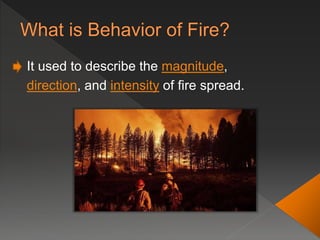
It used to describe the magnitude,
direction, and intensity of fire spread.
 Conduction - it describes the transfer of heat
within a solid material from hotter to cooler parts.
 Convection - it describe a mass movement in a
fluid i.e., a liquid or a gas where fluid at one
temperature and density moves under the influence
of gravity through surrounding fluid at a different
temperature and density.
 Radiation - it describe the transfer of heat through
a gas or vacuum in a similar way to light.
1. Incipient - the product in this phase may be so minuscule as to be
detected only by an ionization detector.
2. Emergent Smoldering - in this phase, the product of combustion become
increasingly more pronounced. There is no meaningful change in the
oxygen content of the air.
3. Free-Burning - during this phase of the fire, the rate and intensity of open
burning increases geometrically. Flashover is the best example for this
phase.
› Flashover - is defined as a stage in the development of contained fire
in which all exposed surfaces reach ignition temperature, more or less
simultaneously, and fire spreads rapidly.
4. Oxygen - regulated smoldering - if the room or area of the fire's origin is
adequately airtight, thereby limiting the amount of oxygen-rich air being
drawn into that area, then the open burning that occurs in free-burning
phase will deplete the available oxygen.
› Back draft - sudden and rapid (violent) burning of heated gasses in a
confined area that occurs in the form of explosion
1. Fuel – It is the name given to the suite of
variable used o describe the
vegetation the fire is spreading through.
2. Slope – Assuming all other condition are equal,
the rate of spread of a fire increases as
slope increases.
3. Aspect – in general, south-facing slope receive
more direct sunlight throughout the day
in comparison to north-facing slopes.
4. Weather – components of weather which
influence fire spread are wind speed,
wind direction, and moisture present in
the fuel.
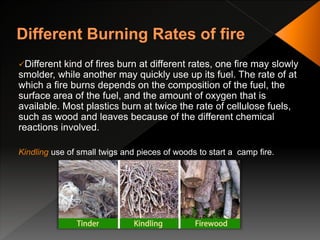
Different kind of fires burn at different rates, one fire may slowly
smolder, while another may quickly use up its fuel. The rate of at
which a fire burns depends on the composition of the fuel, the
surface area of the fuel, and the amount of oxygen that is
available. Most plastics burn at twice the rate of cellulose fuels,
such as wood and leaves because of the different chemical
reactions involved.
Kindling use of small twigs and pieces of woods to start a camp fire.
1. The total surface of material available for combustion,
more substantial materials, such as most timbers will only
burn at the outer surface.
2. The quantity of heat energy locked in the chemical
composition which can be release by burning; which can
vary considerably for different material
3. The length of flames produced; flames radiate heat and
the size of the flames affects the intensity
4. The Adequacy of the supply of oxygen to the fire, the total
surface area of the material available for combustion, and
he length of flames produced.
1. Structural Fire Spread
Fire spread involves the extension of fire from one point to
another. The transfer of heat and wind facrors plays a large role in
this extension.
2. Direction and rate of Spread
heat from the fire in the open rises as a column of hot gas called
plume. In doing so, it pre-heats any fuel or combustible materials
located above the point of origin and when heated sufficiently, this
ignites greatly increasing the volume and upper progression of
Flame. The resulting air flow draws cool air into the base of the fire
from all direction. This in-flow air into the plume is called Entrainment.
3. Chimney effect
since there is natural tendency for flame and heated gases to rise,
any structural element that enhances this upward movement serve as
a natural chimney effect. Such enhancement is called the chimney
effect
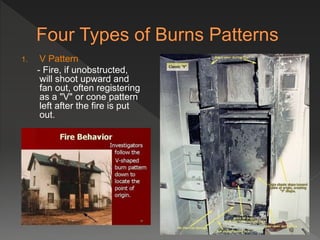
1. V Pattern
- Fire, if unobstructed,
will shoot upward and
fan out, often registering
as a "V" or cone pattern
left after the fire is put
out.
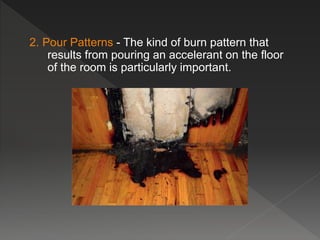
2. Pour Patterns - The kind of burn pattern that
results from pouring an accelerant on the floor
of the room is particularly important.
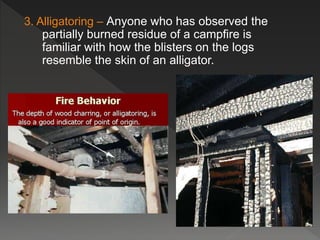
3. Alligatoring – Anyone who has observed the
partially burned residue of a campfire is
familiar with how the blisters on the logs
resemble the skin of an alligator.
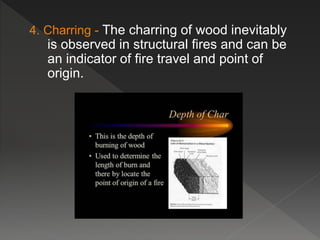
4. Charring - The charring of wood inevitably
is observed in structural fires and can be
an indicator of fire travel and point of
origin.
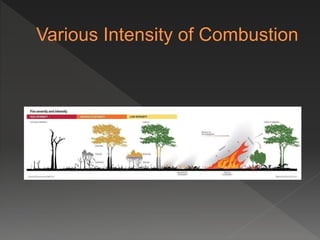
The upward movement of flame can be affected and altered by many
factors. Among the most common are the following:
1. A draft or crosswind from an open window, door or skylight.
2. An available secondary fuel source in close proximity to the
original point of ignition.
3. A highly combustible fuel at the point of origin, e,g., A large pool of
liquid accelerant, when ignited, causes the apex of "V" to be at least
as wide as the pool.
4. Environmental consideration, such as class and type of
construction, and other conditions that might impede or block the
upward progression of the products of combustion.
 The density and color of the smoke and flame
associated with a particular fire can show the type of
material or fuel that is burning.
 The color of the flames can also indicate the
approximate temperature of the flame.
 Fire suppression efforts will also affect the color of the
smoke. The application of water can produce large
volume of condensing vapor that appears white or
gray when mixed with black smoke from the fire.
 White smoke – indicates light fuels burning
or from pre combustion/Dehydration of
fuels
 Tan and Brown smoke – woody materials
burning and poor air quality
 Grey smoke – indicates that a fire is
slowing down or running out of combustible
material to burn.
 Black smoke – heavy and or oily/resinous
fuels and man-made material burning
The way that a fire develops is affected by many
factors. As fire continue to grow, Environmental
factors become increasingly important in influencing
its extent.
 Amount of oxygen
 Fuel supply and composition
 Fire suppression
 The energy released by combustion causes
rise in temperature of the product of
combustion. The temperature attained
depends on the rate of release of the energy
and the quantity of combustion products.
 Most combustible processes release
energy, or heat, for the production of
power, for use in industrial processes,
and for domestic heating and lighting
1
en
and
of
2
3
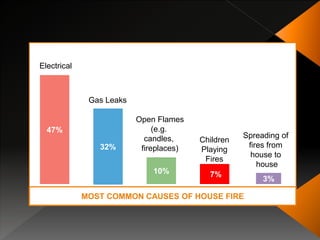
MOST COMMON CAUSES OF HOUSE FIRE
47%
32%
10%
3%
7%
Electrical
Gas Leaks
Open Flames
(e.g.
candles,
fireplaces)
Children
Playing
Fires
Spreading of
fires from
house to
house
END OF THE
PRESENTATION

Behavior of Fire.pptx

  • 1.
    Chapter 3 Presented by: AhmedRashdee Indal Al-Rashid Biting Mohammad Alih S. Hashim (BSCRIM 3A)
  • 4.
    It used todescribe the magnitude, direction, and intensity of fire spread.
  • 5.
     Conduction -it describes the transfer of heat within a solid material from hotter to cooler parts.  Convection - it describe a mass movement in a fluid i.e., a liquid or a gas where fluid at one temperature and density moves under the influence of gravity through surrounding fluid at a different temperature and density.  Radiation - it describe the transfer of heat through a gas or vacuum in a similar way to light.
  • 6.
    1. Incipient -the product in this phase may be so minuscule as to be detected only by an ionization detector. 2. Emergent Smoldering - in this phase, the product of combustion become increasingly more pronounced. There is no meaningful change in the oxygen content of the air. 3. Free-Burning - during this phase of the fire, the rate and intensity of open burning increases geometrically. Flashover is the best example for this phase. › Flashover - is defined as a stage in the development of contained fire in which all exposed surfaces reach ignition temperature, more or less simultaneously, and fire spreads rapidly. 4. Oxygen - regulated smoldering - if the room or area of the fire's origin is adequately airtight, thereby limiting the amount of oxygen-rich air being drawn into that area, then the open burning that occurs in free-burning phase will deplete the available oxygen. › Back draft - sudden and rapid (violent) burning of heated gasses in a confined area that occurs in the form of explosion
  • 7.
    1. Fuel –It is the name given to the suite of variable used o describe the vegetation the fire is spreading through. 2. Slope – Assuming all other condition are equal, the rate of spread of a fire increases as slope increases. 3. Aspect – in general, south-facing slope receive more direct sunlight throughout the day in comparison to north-facing slopes. 4. Weather – components of weather which influence fire spread are wind speed, wind direction, and moisture present in the fuel.
  • 8.
    Different kind offires burn at different rates, one fire may slowly smolder, while another may quickly use up its fuel. The rate of at which a fire burns depends on the composition of the fuel, the surface area of the fuel, and the amount of oxygen that is available. Most plastics burn at twice the rate of cellulose fuels, such as wood and leaves because of the different chemical reactions involved. Kindling use of small twigs and pieces of woods to start a camp fire.
  • 10.
    1. The totalsurface of material available for combustion, more substantial materials, such as most timbers will only burn at the outer surface. 2. The quantity of heat energy locked in the chemical composition which can be release by burning; which can vary considerably for different material 3. The length of flames produced; flames radiate heat and the size of the flames affects the intensity 4. The Adequacy of the supply of oxygen to the fire, the total surface area of the material available for combustion, and he length of flames produced.
  • 11.
    1. Structural FireSpread Fire spread involves the extension of fire from one point to another. The transfer of heat and wind facrors plays a large role in this extension. 2. Direction and rate of Spread heat from the fire in the open rises as a column of hot gas called plume. In doing so, it pre-heats any fuel or combustible materials located above the point of origin and when heated sufficiently, this ignites greatly increasing the volume and upper progression of Flame. The resulting air flow draws cool air into the base of the fire from all direction. This in-flow air into the plume is called Entrainment. 3. Chimney effect since there is natural tendency for flame and heated gases to rise, any structural element that enhances this upward movement serve as a natural chimney effect. Such enhancement is called the chimney effect
  • 13.
    1. V Pattern -Fire, if unobstructed, will shoot upward and fan out, often registering as a "V" or cone pattern left after the fire is put out.
  • 14.
    2. Pour Patterns- The kind of burn pattern that results from pouring an accelerant on the floor of the room is particularly important.
  • 15.
    3. Alligatoring –Anyone who has observed the partially burned residue of a campfire is familiar with how the blisters on the logs resemble the skin of an alligator.
  • 16.
    4. Charring -The charring of wood inevitably is observed in structural fires and can be an indicator of fire travel and point of origin.
  • 17.
    The upward movementof flame can be affected and altered by many factors. Among the most common are the following: 1. A draft or crosswind from an open window, door or skylight. 2. An available secondary fuel source in close proximity to the original point of ignition. 3. A highly combustible fuel at the point of origin, e,g., A large pool of liquid accelerant, when ignited, causes the apex of "V" to be at least as wide as the pool. 4. Environmental consideration, such as class and type of construction, and other conditions that might impede or block the upward progression of the products of combustion.
  • 19.
     The densityand color of the smoke and flame associated with a particular fire can show the type of material or fuel that is burning.  The color of the flames can also indicate the approximate temperature of the flame.  Fire suppression efforts will also affect the color of the smoke. The application of water can produce large volume of condensing vapor that appears white or gray when mixed with black smoke from the fire.
  • 20.
     White smoke– indicates light fuels burning or from pre combustion/Dehydration of fuels  Tan and Brown smoke – woody materials burning and poor air quality  Grey smoke – indicates that a fire is slowing down or running out of combustible material to burn.  Black smoke – heavy and or oily/resinous fuels and man-made material burning
  • 21.
    The way thata fire develops is affected by many factors. As fire continue to grow, Environmental factors become increasingly important in influencing its extent.  Amount of oxygen  Fuel supply and composition  Fire suppression
  • 22.
     The energyreleased by combustion causes rise in temperature of the product of combustion. The temperature attained depends on the rate of release of the energy and the quantity of combustion products.  Most combustible processes release energy, or heat, for the production of power, for use in industrial processes, and for domestic heating and lighting
  • 24.
  • 25.
    MOST COMMON CAUSESOF HOUSE FIRE 47% 32% 10% 3% 7% Electrical Gas Leaks Open Flames (e.g. candles, fireplaces) Children Playing Fires Spreading of fires from house to house
  • 26.