Heating of the Earth
• Energy Transfers
  – Co nd uc tio n: transfer of
    heat from one object to
    another through touch.
     • A spatula warms up after
       sitting in a hot pan.
     • Metals are the best
       conductors of heat,
       whereas air is the worst
       conductor of heat.
Heating of the Earth
• Energy Transfers
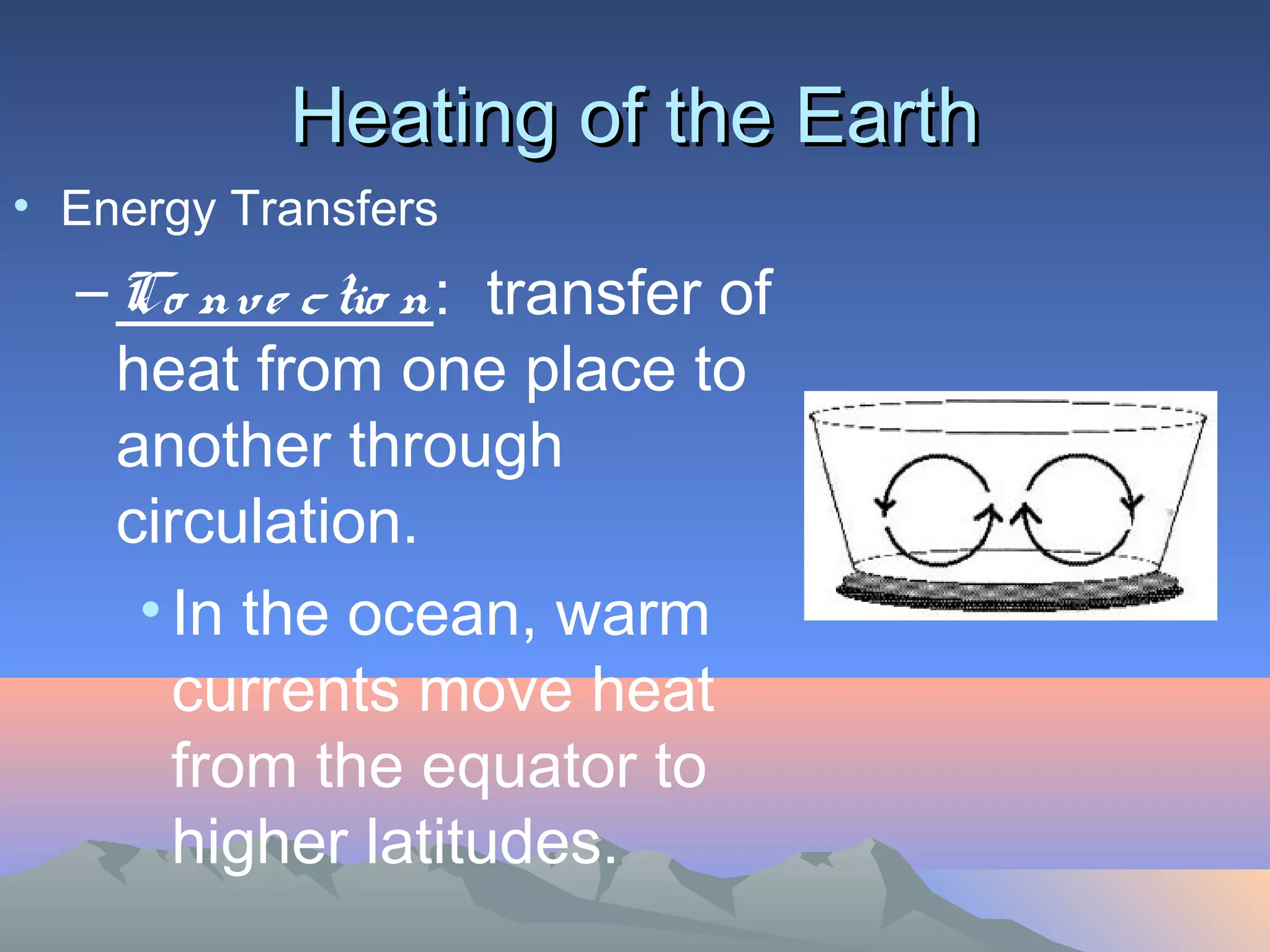
  – Co nve c tio n: transfer of
    heat from one place to
    another through
    circulation.
     • In the ocean, warm
       currents move heat
       from the equator to
       higher latitudes.
Heating of the Earth
• Energy Transfers
  – Ra d ia tio n: radiant
    energy that is emitted by
    an object.
Heating of the Earth
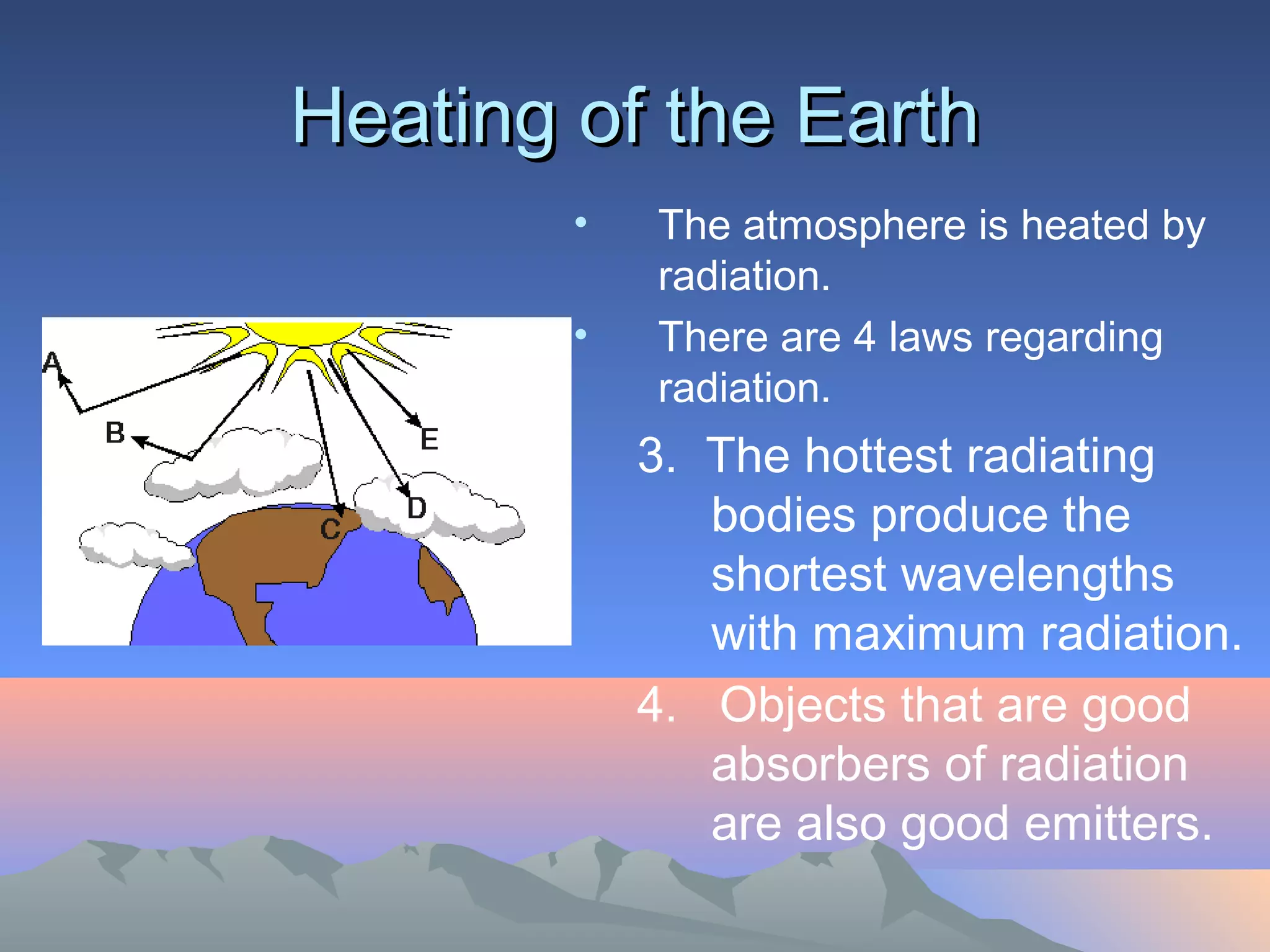
        •   The atmosphere is heated
            by radiation.
        •   There are 4 laws regarding
            radiation.
            1. All objects, at any
               temperature, emit
               radiant energy.
            2. Hotter objects radiate
               more total energy per
               unit area than colder
               objects do.
Heating of the Earth
        •   The atmosphere is heated by
            radiation.
        •   There are 4 laws regarding
            radiation.
            3. The hottest radiating
               bodies produce the
               shortest wavelengths
               with maximum radiation.
            4. Objects that are good
               absorbers of radiation
               are also good emitters.
Heating of the Earth
•   Solar Radiation
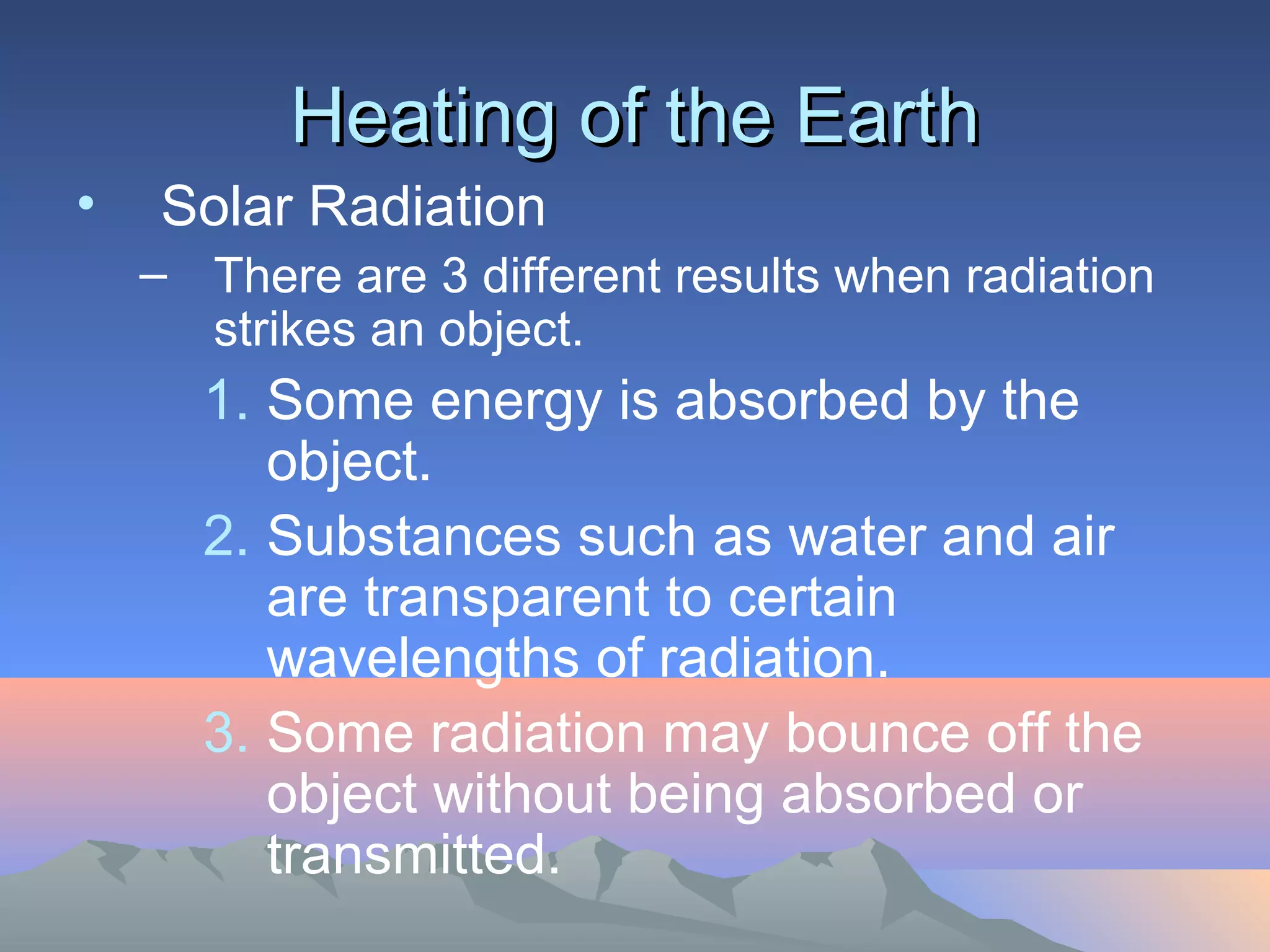
    – There are 3 different results when radiation
      strikes an object.
      1. Some energy is absorbed by the
         object.
      2. Substances such as water and air
         are transparent to certain
         wavelengths of radiation.
      3. Some radiation may bounce off the
         object without being absorbed or
         transmitted.
Heating of the Earth
•    Solar Radiation
    – Reflecting: light bounces off an object
      in 1 direction.
    – Scattering: light bounces off an object
      in several directions; the total amount
      of energy is divided up into the various
      rays.
    – Absorption: an object takes in the heat
      and energy received by radiation.
Solar Radiation
Temperature Differences
• Land and Water
  Differences
  – Land heats and cools more
    quickly than water.
  – The temperature range is
    greater for land than water.
     • The land heats up to a higher
       temperature than water can
       and will cool lower than water
       can.
     • In the Northern Hemisphere,
       there is 39% land; whereas
       the Southern Hemisphere has
       19% land.
         – What does this indicate?
Temperature Differences
• Geographic
  Differences
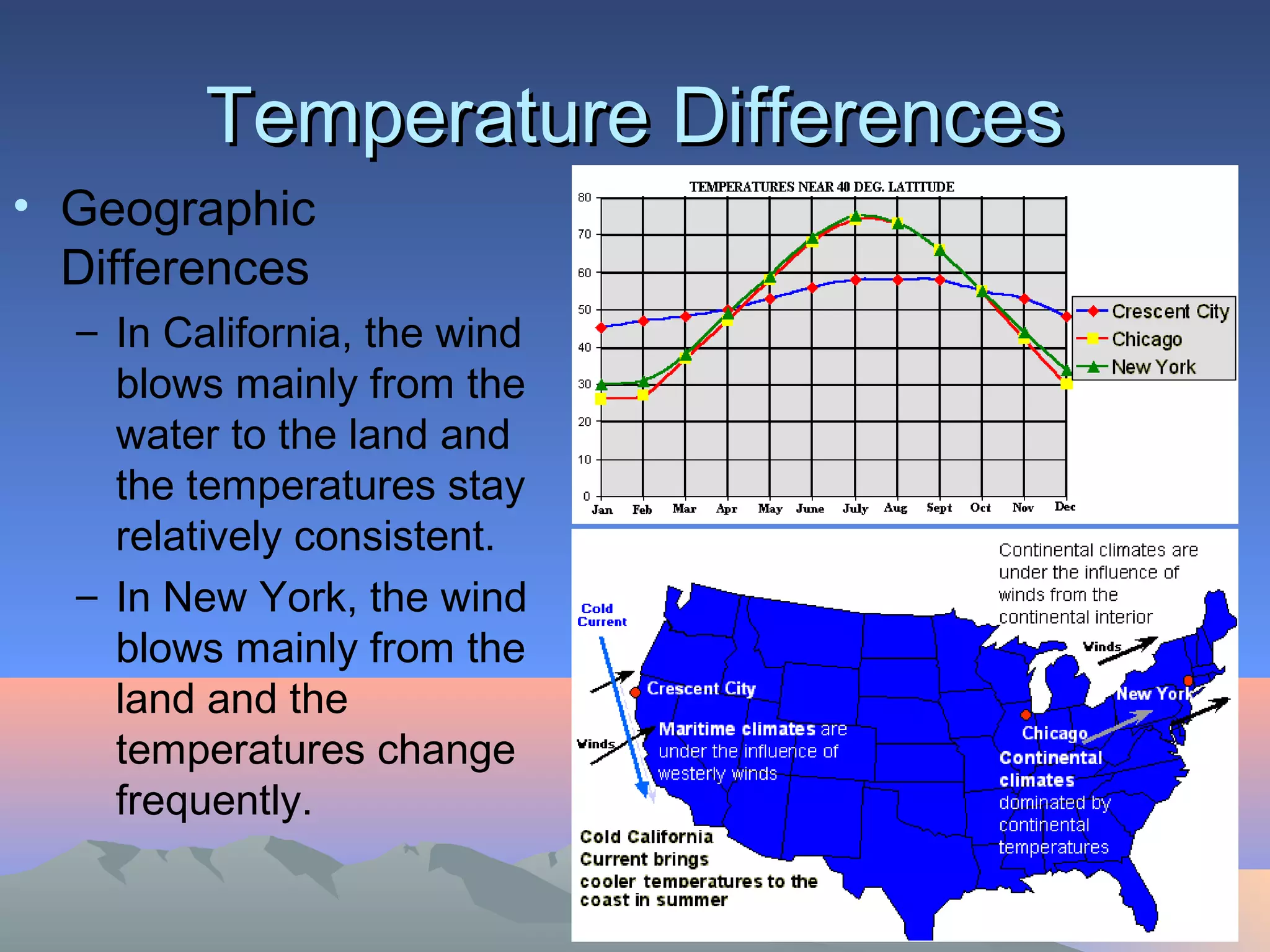
  – In California, the wind
    blows mainly from the
    water to the land and
    the temperatures stay
    relatively consistent.
  – In New York, the wind
    blows mainly from the
    land and the
    temperatures change
    frequently.
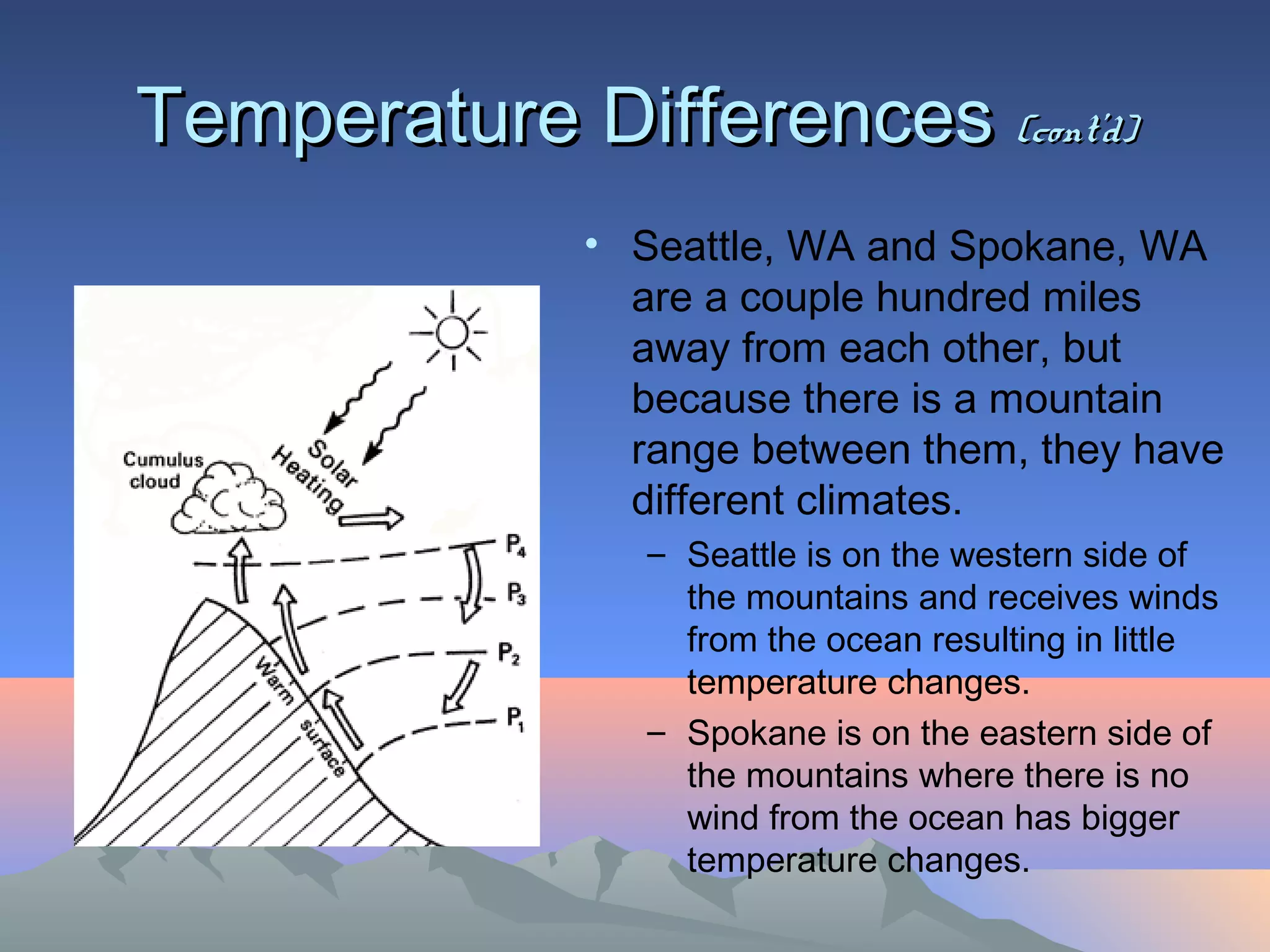
Temperature Differences (cont’d)
              • Seattle, WA and Spokane, WA
                are a couple hundred miles
                away from each other, but
                because there is a mountain
                range between them, they have
                different climates.
                 – Seattle is on the western side of
                   the mountains and receives winds
                   from the ocean resulting in little
                   temperature changes.
                 – Spokane is on the eastern side of
                   the mountains where there is no
                   wind from the ocean has bigger
                   temperature changes.
Temperature Differences
• Altitude Differences
  – Two cities in Ecuador, Quito
    and Guayaquil, are close to
    each other, but have
    different average
    temperatures.
     • Quito is high in the mountains
       and has a lower average
       temperature.
     • Guavaquil is close to the sea
       level and has a higher
       average temperature.
Temperature Differences
          • Cloud Cover and Albedo
            – A d o is the amount of
                lbe
              radiation that is reflected
              back to space.
               • Clouds have a high albedo,
                 leading to less solar
                 radiation reaching Earth,
                 causing lower
                 temperatures during the
                 day.
               • At night, clouds trap heat in
                 the atmosphere and keep
                 the temperature higher.
World Distribution of Temperature
• I o the rm s are lines that show
   s
  differences in temperature
  (similar to contour lines on a
  topographic map) on an
  isothermal map.
   – The temperatures on these maps
     are taken at the same elevation in
     order to eliminate any differences
     in altitude.
   – The higher latitudes have cooler
     average temperatures and have
     greater temperature changes.
   – Latitudes close to the Equator
     have higher average temperatures
     and very little temperature
     changes.

Heating of the earth - 2

  • 1.
    Heating of theEarth • Energy Transfers – Co nd uc tio n: transfer of heat from one object to another through touch. • A spatula warms up after sitting in a hot pan. • Metals are the best conductors of heat, whereas air is the worst conductor of heat.
  • 2.
    Heating of theEarth • Energy Transfers – Co nve c tio n: transfer of heat from one place to another through circulation. • In the ocean, warm currents move heat from the equator to higher latitudes.
  • 3.
    Heating of theEarth • Energy Transfers – Ra d ia tio n: radiant energy that is emitted by an object.
  • 4.
    Heating of theEarth • The atmosphere is heated by radiation. • There are 4 laws regarding radiation. 1. All objects, at any temperature, emit radiant energy. 2. Hotter objects radiate more total energy per unit area than colder objects do.
  • 5.
    Heating of theEarth • The atmosphere is heated by radiation. • There are 4 laws regarding radiation. 3. The hottest radiating bodies produce the shortest wavelengths with maximum radiation. 4. Objects that are good absorbers of radiation are also good emitters.
  • 6.
    Heating of theEarth • Solar Radiation – There are 3 different results when radiation strikes an object. 1. Some energy is absorbed by the object. 2. Substances such as water and air are transparent to certain wavelengths of radiation. 3. Some radiation may bounce off the object without being absorbed or transmitted.
  • 7.
    Heating of theEarth • Solar Radiation – Reflecting: light bounces off an object in 1 direction. – Scattering: light bounces off an object in several directions; the total amount of energy is divided up into the various rays. – Absorption: an object takes in the heat and energy received by radiation.
  • 8.
  • 9.
    Temperature Differences • Landand Water Differences – Land heats and cools more quickly than water. – The temperature range is greater for land than water. • The land heats up to a higher temperature than water can and will cool lower than water can. • In the Northern Hemisphere, there is 39% land; whereas the Southern Hemisphere has 19% land. – What does this indicate?
  • 10.
    Temperature Differences • Geographic Differences – In California, the wind blows mainly from the water to the land and the temperatures stay relatively consistent. – In New York, the wind blows mainly from the land and the temperatures change frequently.
  • 11.
    Temperature Differences (cont’d) • Seattle, WA and Spokane, WA are a couple hundred miles away from each other, but because there is a mountain range between them, they have different climates. – Seattle is on the western side of the mountains and receives winds from the ocean resulting in little temperature changes. – Spokane is on the eastern side of the mountains where there is no wind from the ocean has bigger temperature changes.
  • 12.
    Temperature Differences • AltitudeDifferences – Two cities in Ecuador, Quito and Guayaquil, are close to each other, but have different average temperatures. • Quito is high in the mountains and has a lower average temperature. • Guavaquil is close to the sea level and has a higher average temperature.
  • 13.
    Temperature Differences • Cloud Cover and Albedo – A d o is the amount of lbe radiation that is reflected back to space. • Clouds have a high albedo, leading to less solar radiation reaching Earth, causing lower temperatures during the day. • At night, clouds trap heat in the atmosphere and keep the temperature higher.
  • 14.
    World Distribution ofTemperature • I o the rm s are lines that show s differences in temperature (similar to contour lines on a topographic map) on an isothermal map. – The temperatures on these maps are taken at the same elevation in order to eliminate any differences in altitude. – The higher latitudes have cooler average temperatures and have greater temperature changes. – Latitudes close to the Equator have higher average temperatures and very little temperature changes.